---
title: "Meshing a packed-bed pore space with a volume-controlled Voronoi grid"
subtitle: "Seed the interstitial space of a peclet.dem sphere packing, tessellate + clip against the sphere walls, and relax the seeds so the cell volumes follow a target — uniform, or graded to refine at the walls (an inflation layer)."
author: "Peclet"
date: "2026-07-04"
categories: [voro, dem, meshing, porous-media, sdf]
jupyter: python3
---
[](https://colab.research.google.com/github/computational-chemical-engineering/peclet-examples/blob/main/examples/pore-mesh-voronoi/index.ipynb){target="_blank"}
Runs on a free Colab CPU runtime — the first cell installs `peclet` from PyPI.
::: {.callout-note}
**Experimental API.** The SDF-walled pore-mesh functions used here — `peclet.voro.sdf_voronoi_section`
(and `optimize_pore_mesh`) — are new and still evolving (see the open issues at the end). The packing
(`peclet.dem`) is stock.
:::
## What you'll learn
How to build a **body-fitted, graded Voronoi mesh of a pore space** — the Voronoi analogue of a graded
CFD mesh with an inflation layer. Drop seed points into the fluid between packed spheres, tessellate,
and **clip every cell against the sphere surfaces** (their signed-distance field) so the cells tile only
the fluid. The key idea: the cell volumes are set by *where the seeds go*, so a good **seeding
heuristic** — placing seeds at the target local size $s(\phi)=\mathrm{clip}(\phi, s_{lo}, s_{hi})$,
small near the walls and growing into the pores — gives a graded, wall-hugging mesh **directly**, no
volume relaxation required. You'll compare it against a uniform mesh, cut clean cross-sections with a
robust cell-section primitive, and see where a curved-wall SDF clip still leaves a hair of white.
## The setup
The packing is periodic; the fluid is everything outside the spheres. The solid is described by the
union signed-distance field $\phi(\mathbf{x}) = \min_i(\lVert \mathbf{x}-\mathbf{c}_i\rVert - r_i)$
($\phi<0$ inside a sphere, $>0$ in the fluid). We seed $N$ points where $\phi>0$, build their Voronoi
cells with `peclet.voro`, and clip each against the $\phi=0$ surfaces so the cells tile only the fluid.
A cell's volume is roughly the cube of the local seed spacing, so to grade the mesh we place the seeds
at a **target size** that depends on the distance to the nearest wall:
$$
s(\phi) = \mathrm{clip}(\phi,\, s_{lo},\, s_{hi}), \qquad V_{\mathrm{ref}} = s(\phi)^3
$$ {#eq-target}
— cells shrink to $s_{lo}$ at the walls and grow to $s_{hi}$ in the open pores. The heuristic below puts
one seed roughly every $s(\phi)$, in shells around each sphere, so the mesh *is* the target: no
optimisation needed. (If you later want the volumes made *exactly* equal or exactly on-target,
`optimize_pore_mesh` relaxes the seed positions — with the caveat in the open issues.)
```{python}
#| label: bootstrap
#| code-summary: "Environment bootstrap (installs peclet from PyPI on Colab/Binder)"
import importlib.util, os, subprocess, sys
_local = os.environ.get("PECLET_LOCAL_BUILD")
if _local:
    sys.path[:0] = _local.split(os.pathsep)                     # local dem/voro build(s)
elif importlib.util.find_spec("peclet") is None:
    subprocess.run([sys.executable, "-m", "pip", "install", "-q", "peclet"], check=True)

import numpy as np
import matplotlib.pyplot as plt
from matplotlib.collections import PolyCollection
from matplotlib.patches import Circle
from matplotlib.colors import LogNorm, TwoSlopeNorm
from peclet import voro
from peclet_examples import pore_mesh as pm

plt.rcParams.update({"figure.dpi": 130, "font.size": 10, "figure.facecolor": "white",
                     "savefig.bbox": "tight"})
```
## Step 1 — pack the spheres
`peclet.dem` grows a random close packing (porosity ≈ 0.37).
```{python}
#| label: pack
centres, radii, L = pm.pack_spheres(n=180)
print(f"{len(centres)} spheres, box L={L:.2f}, porosity ≈ {1 - (4/3*np.pi*(radii**3).sum())/L**3:.2f}")
```
## Step 2 — the seeding *is* the volume control
The cell volumes are set by **where you put the seeds**, so the whole game is a good seeding heuristic.
`seed_graded` realises a target size field $s(\phi)=\mathrm{clip}(\phi, s_{lo}, s_{hi})$ directly: it lays
concentric shells around every sphere at growing distance $d$, with the radial step *and* the in-surface
spacing both equal to the local size $s(d)$. A seed at wall-distance $\phi$ then gets a cell of size
$\approx s(\phi)$ — small ($s_{lo}$) hugging the curved walls, growing to $s_{hi}$ in the open pores.
That gives a body-fitted, graded, inflation-layer mesh **from the seeding alone — no relaxation**.
We compare two seedings: a **uniform** one ($s_{lo}=s_{hi}$, which meshes the walls at the bulk
resolution and so can't hug them) and a **distance-graded** one.
```{python}
#| label: run
z0 = L / 2
s_uniform = pm.seed_graded(centres, radii, L, s_lo=0.19, s_hi=0.19, seed=1)   # one size everywhere
s_graded  = pm.seed_graded(centres, radii, L, s_lo=0.10, s_hi=0.36, seed=1)   # small at walls → large in pores
stages = [s_uniform, s_graded]
titles = ["uniform  (s = 0.19)", "distance-graded  (s = 0.10 → 0.36)"]
sec = [pm.section_cells(s, centres, radii, L, z0) for s in stages]   # each -> (polygons, volume, seed)
print("cells:", {t.split()[0]: len(v) for t, (_, v, _) in zip(titles, sec)})
```
## Step 3 — cross-section: uniform vs graded
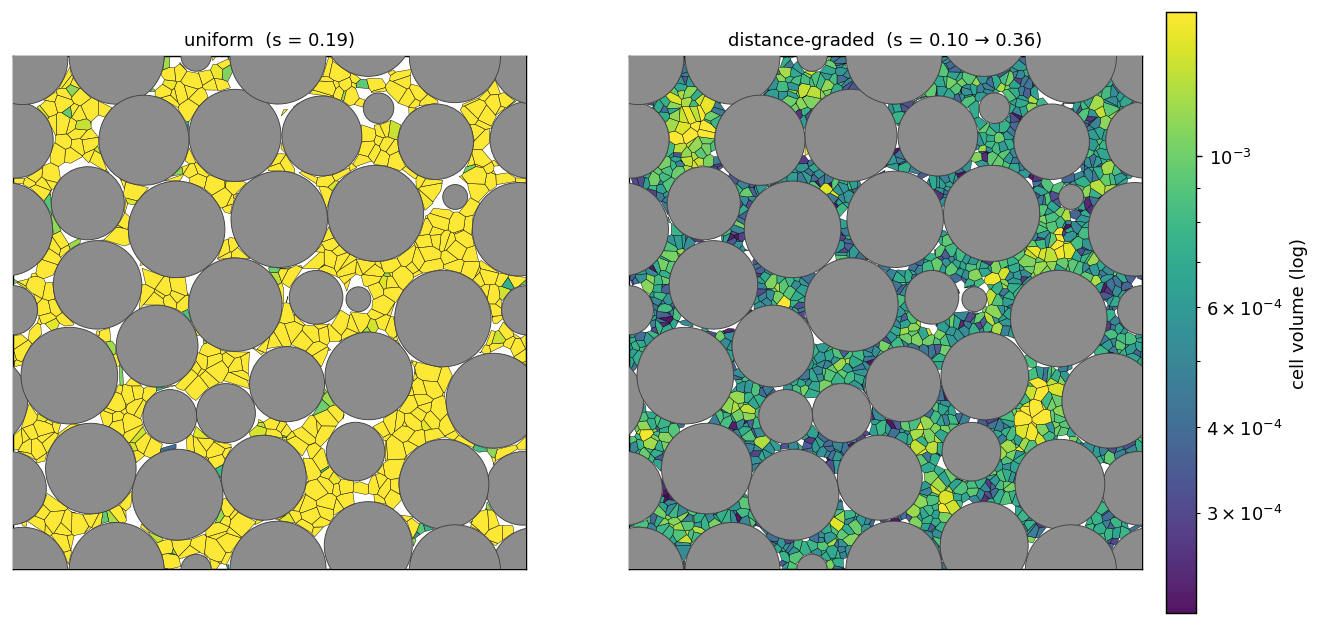
We cut the 3-D cells with the plane $z=L/2$ and colour them by cell volume (grey discs = spheres cut by
the plane). `sdf_voronoi_section` cuts each cell directly from its dual structure — a robust convex
section that tiles the plane exactly — so no VTK and no fragile face slicing.
```{python}
#| label: fig-volume
#| fig-cap: "Cross-section of the two seedings, cells coloured by volume (log, shared scale). The graded mesh (right) hugs every wall with small cells and grows into the pores; the uniform mesh (left) carries one size everywhere and leaves a rim where its bulk-sized cells can't follow the curved walls."
#| fig-width: 11
sl = [pm.tile_periodic(polys, vol, L) for polys, vol, _ in sec]   # +periodic images at the box faces
gv = np.asarray(sec[1][1])                                        # scale colours to the graded range
norm = LogNorm(*np.percentile(gv[gv > 0], [2, 98]))              # so its wall→pore gradient is visible

def draw(ax, polys, vals, nrm, cmap, title, win=None, lw=0.25):
    ax.add_collection(PolyCollection(polys, array=np.asarray(vals), cmap=cmap, norm=nrm,
                                     edgecolors="k", linewidths=lw, alpha=0.92))
    for c, r in zip(centres, radii):
        if abs(z0 - c[2]) < r:
            for sx in (0, -L, L):
                for sy in (0, -L, L):
                    ax.add_patch(Circle((c[0]+sx, c[1]+sy), np.sqrt(r*r-(z0-c[2])**2),
                                        facecolor="0.55", edgecolor="0.25", lw=0.5, zorder=3))
    ax.set(xlim=win[:2] if win else (0, L), ylim=win[2:] if win else (0, L), aspect="equal")
    ax.set_title(title, fontsize=10); ax.set_xticks([]); ax.set_yticks([])

fig, axes = plt.subplots(1, 2, figsize=(12, 6))
for ax, (polys, vals), t in zip(axes, sl, titles):
    draw(ax, polys, vals, norm, "viridis", t)
fig.colorbar(axes[0].collections[0], ax=axes, fraction=0.046, pad=0.02, label="cell volume (log)")
plt.show()
```
Both meshes fill the pore space, but only the **graded** one resolves the walls the way you'd want: a
ring of small (dark) cells hugging every sphere, growing smoothly to large (yellow) cells in the open
pores. The **uniform** mesh carries the bulk cell size right up to the walls, so its cells are too big
to hug the curved surface — that's the residual white rim around the spheres. The grading is not a
post-process; it is exactly what the distance-shell seeding places.
## Step 4 — what happens at a wall
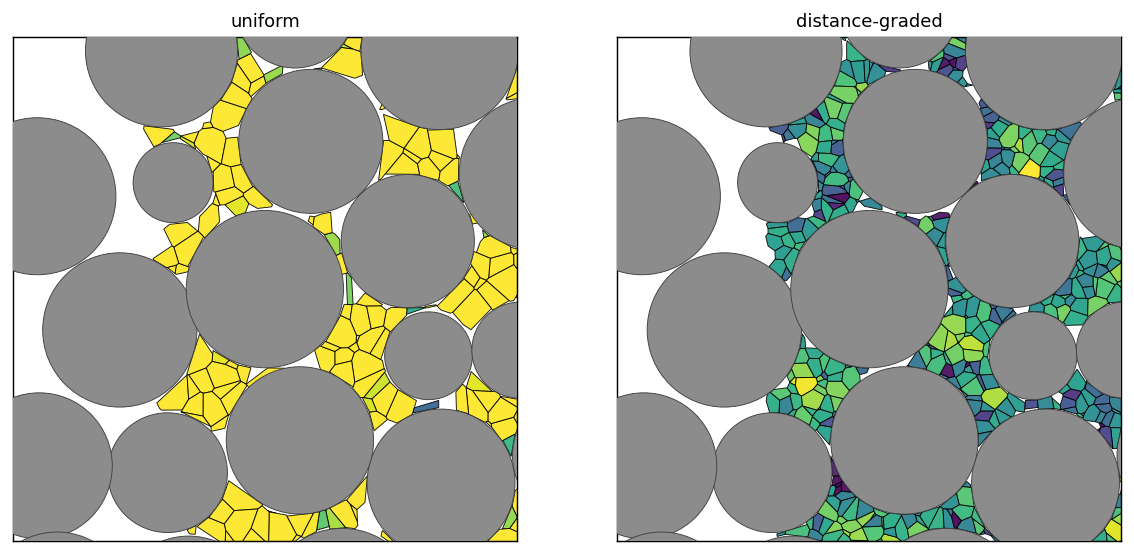
Zooming onto one sphere makes it explicit.
```{python}
#| label: fig-wall
#| fig-cap: "Zoom at a sphere. Left: a uniform mesh — bulk-sized cells recede from the curved wall (rim). Right: the graded mesh packs small cells against the wall and grows outward — a body-fitted inflation layer."
#| fig-width: 11
cross = [(i, r*r-(z0-c[2])**2) for i, (c, r) in enumerate(zip(centres, radii)) if abs(z0-c[2]) < r]
i0 = max(cross, key=lambda t: t[1])[0]; cx, cy, w = centres[i0, 0], centres[i0, 1], 1.6
win = (cx-w, cx+w, cy-w, cy+w)
fig, ax = plt.subplots(1, 2, figsize=(11, 5.5))
for a, k, t in [(ax[0], 0, "uniform"), (ax[1], 1, "distance-graded")]:
    draw(a, *sl[k], norm, "viridis", t, win=win, lw=0.5)
plt.show()
```
## Results — the seeding hits the target size directly
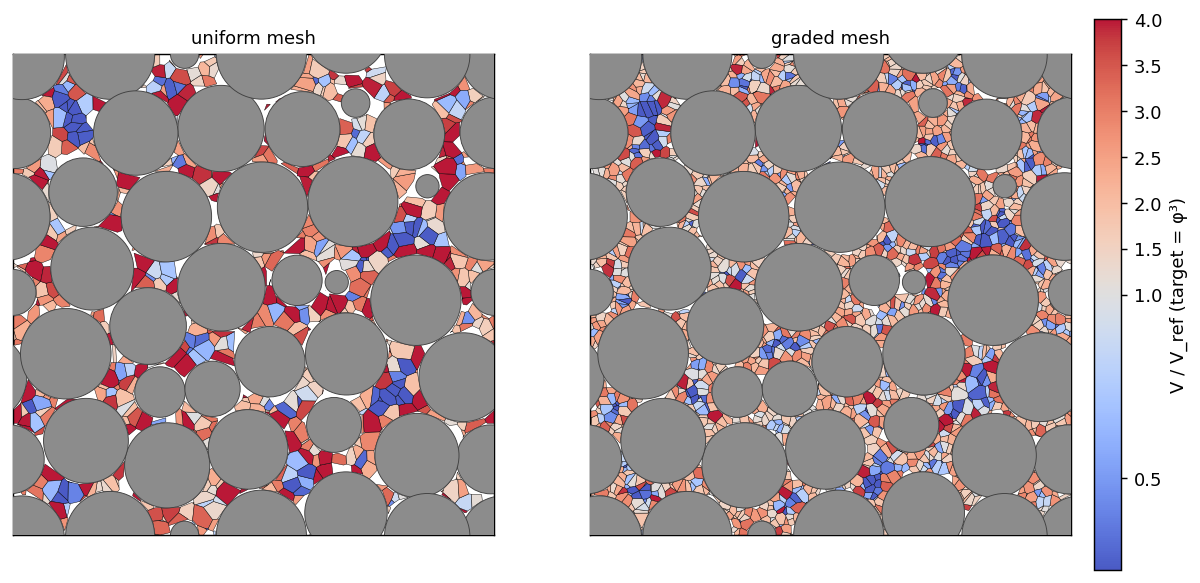
Because the shells are placed *at* the target size $s(\phi)$, the graded mesh's cell volumes already
match $V_{\mathrm{ref}}=s(\phi)^3$ — no relaxation needed. Colouring by $V/V_{\mathrm{ref}}$
(renormalised so 1 = on target) shows this: the graded mesh is broadly on target (pale), while the same
metric against a graded target exposes how far a uniform mesh is from it.
```{python}
#| label: fig-rel
#| fig-cap: "V/V_ref against the graded target φ³ (blue = smaller than target, white = on target, red = larger). The graded seeding (right) is broadly on target everywhere; the uniform mesh (left) is far off — too coarse at the walls, too fine in the pores."
#| fig-width: 11
fig, ax = plt.subplots(1, 2, figsize=(11, 5.5))
rn = TwoSlopeNorm(vmin=1/4, vcenter=1.0, vmax=4.0)
for a, s, (polys, vol, seed), t in [(ax[0], s_uniform, sec[0], "uniform mesh"),
                                    (ax[1], s_graded, sec[1], "graded mesh")]:
    vref = pm.vref_graded(pm.union_sdf(np.ascontiguousarray(s), centres, radii, L))[seed]
    relv = vol / (vref * vol.sum() / vref.sum())      # renormalise so Σ V_ref = Σ V (on-target = 1)
    draw(a, *pm.tile_periodic(polys, relv, L), rn, "coolwarm", t)
fig.colorbar(ax[1].collections[0], ax=ax, fraction=0.025, pad=0.02, label="V / V_ref (target = φ³)")
plt.show()
```
## Adapt this yourself
- **Change the grading.** `seed_graded(..., s_lo, s_hi)` sets the wall and bulk sizes; edit the size
field in `pm.seed_graded` from `clip(φ, s_lo, s_hi)` to e.g. `clip(φ², …)` for a thicker layer, or to a
*solution* field (fine where a gradient is large) for solution-adaptive meshing.
- **Denser or coarser.** Lower `s_lo` for a finer wall layer — cost grows like $1/s_{lo}^2$, so keep
$s_{lo}\gtrsim0.08$ on a packed bed. `sdf_voronoi_section` cuts the section in O(N), so even a fine
mesh renders quickly.
- **Equalise further.** If you want the volumes *exactly* equal rather than graded, feed the seeding to
`voro.optimize_pore_mesh(positions, vref, …, method="steepest"|"graphamg", free_energy=…)` — but see
the open issue below.
## Open issues (logged in ISSUES.md)
1. **The relaxation collapses cells.** `optimize_pore_mesh` moves seeds toward a target volume, but a
position-only step can't move seeds *between* pores, so from a mismatched start it collapses cells in
the throats instead of redistributing. Seeding *at* the target size (this example) sidesteps it; a
hard log-barrier keeps cells open once the start is feasible.
2. **Curved-wall clip.** The SDF clip approximates each sphere by flat (tangent) facets, so the very
tightest throats keep a hair of white the mesh can't reach; it shrinks with a finer wall layer. An
exact tessellator-side curved-wall clip would close it.
*(The cross-section is cut cell-by-cell with `sdf_voronoi_section`, which tiles exactly — the residual
white is real geometry, item 2, not a slicing artefact.)*
## Reproduce this
```bash
pip install -e .          # + a recent peclet (peclet-voro with optimize_pore_mesh)
quarto render examples/pore-mesh-voronoi/index.qmd --execute
# local suite build instead of PyPI (dem + voro build dirs, os.pathsep-joined):
PECLET_LOCAL_BUILD=/path/to/suite/dem/build:/path/to/suite/voro/build_py \
  quarto render examples/pore-mesh-voronoi/index.qmd --execute
```