Voronoi update throughput: repair vs rebuild, workstation → H100
How fast peclet.voro brings a Voronoi tessellation of moving points up to date each step — 8.7× a cold build on an 8-thread host, 4.0–4.6× on H100s at 400 000 seeds per GPU with 80 % weak-scaling efficiency, cell volumes exact to 1e-11 — and the two places where it is not yet fast.
What this measures
Every moving-cell method in peclet.voro — Lloyd relaxation of a pore mesh, the body-fitted flow solver on seeds that follow the flow, power-diagram contact detection, the moving-cell multiphase track — pays the same bill each time step: the Voronoi cells of the moved seeds have to be brought up to date. Rebuilding the whole tessellation from scratch is the safe way and the slow one. The engine’s alternative is a repair:
- a certificate kernel over all cells decides which cells can have changed topology (a plane that used to cut the cell no longer does, or a neighbour that used not to cut it now does);
- the cells whose topology is intact are only re-evaluated (vertices recomputed on the resident plane set — a few flops per plane);
- the flagged cells are re-clipped from scratch, and an adaptive gate hands the whole step to a full rebuild when more than a set fraction of the cells is flagged.
The figure of merit is the per-step wall time of that path relative to the production cold build, as a function of how far the seeds move per step (in units of the mean seed spacing). Two questions decide whether the method tracks are viable at all:
- Is the repair exact? Its cell volumes must equal a cold build’s to round-off; a repair that quietly drifts is worse than a slow rebuild.
- Does it scale? Across MPI ranks (one GPU each) the repair has to keep its advantage while the distributed cold build pays a ghost-layer gather every step.
Both were measured on the workstation first (RTX 5080 + 8 OpenMP threads, 2026-09-03) and then on one gpu_h100 node of Snellius (4 × H100, 2026-09-05). The raw logs sit in results/ and the two figures are produced by plot_throughput.py.
The instrument
voro/tests/kokkos/bench_report --repair N nSteps builds N uniform random seeds in the periodic unit box (MovingTessellation, FP64), moves every seed by a random displacement of fixed length \(\delta\) per step, and for each \(\delta\) in the sweep times nSteps repair steps against nSteps cold builds of the same positions, reporting the flagged fraction, the gate decisions, and the maximum relative cell-volume deviation between the two paths. voro/tests/kokkos_mpi/bench_repair_mpi N nSteps [--sdf] is the distributed version on the core ORB decomposition (DistributedMovingTessellation): the repair of the owned cells is checked against a distributed cold build every step, and with --sdf the same run passes through a solid (a sphere ∪ torus core scene, SdfScene) with an additional check against a single-rank cold SDF build.
Workstation baseline (RTX 5080, 8-thread host)
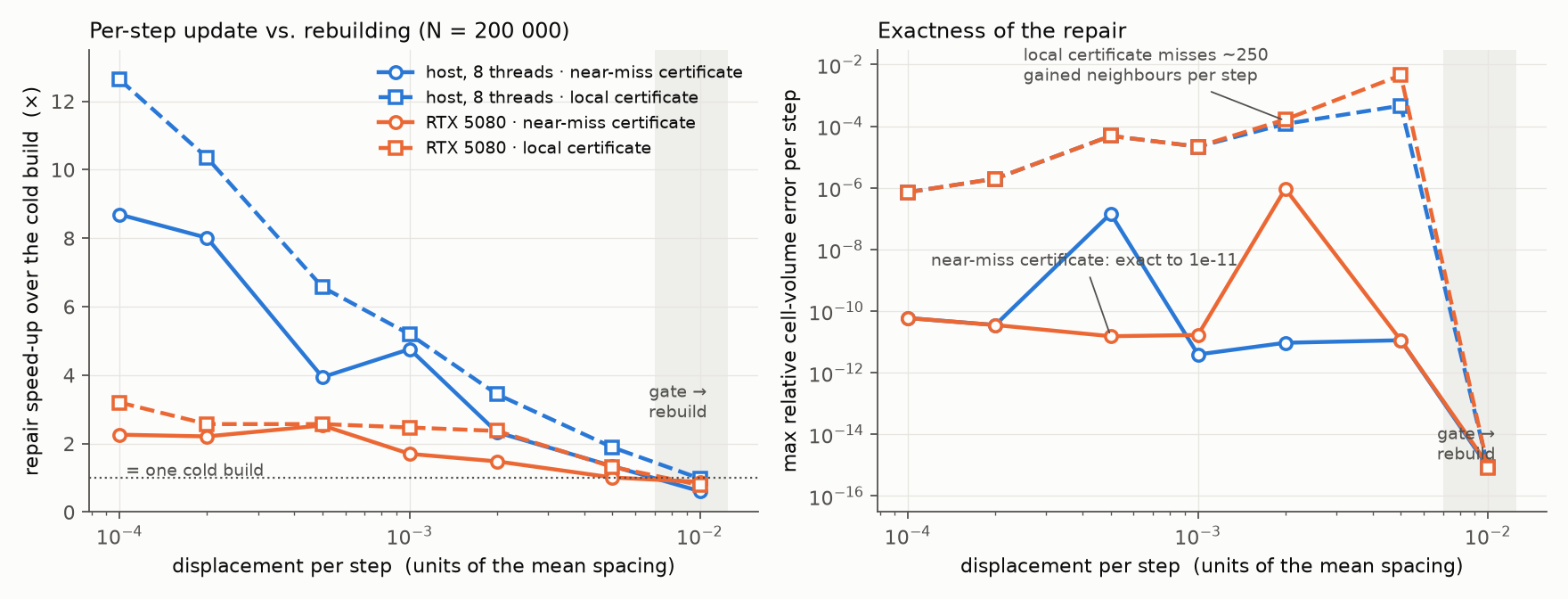
4953948); dashed: the original local certificate.results/workstation/repair_*_nearmiss.csv). The host cold build is 0.42–0.45 Mcells/s, the RTX 5080’s 1.0–1.2 Mcells/s FP64. The suite’s study page records a 9.7× host speed-up for this row from a quieter run of the same binary; the 8.7× here is the logged sweep.
| disp | host repair Mcells/s | host speed-up | RTX 5080 repair Mcells/s | RTX 5080 speed-up | flagged % | max rel. ΔV |
|---|---|---|---|---|---|---|
| 1e-4 | 3.69 | 8.7 | 2.41 | 2.3 | 1.4 | 6e-11 |
| 2e-4 | 3.35 | 8.0 | 2.48 | 2.2 | 2.7 | 4e-11 |
| 5e-4 | 1.69 | 3.9 | 2.64 | 2.5 | 6.5 | 1.5e-7 / 2e-11 |
| 1e-3 | 1.65 | 4.8 | 1.84 | 1.7 | 12.5 | 4e-12 |
| 2e-3 | 1.01 | 2.3 | 1.56 | 1.5 | 23.2 | 9e-12 / 9e-7 |
| 5e-3 | 0.57 | 1.3 | 0.98 | 1.0 | 47.5 | 1e-11 |
| ≥ 1e-2 (gate → rebuild) | 0.25 | 0.6 | 0.84 | 0.8–0.9 | 72–100 | 1e-15 |
Three things the baseline says:
- The repair path is the right idea, and the host proves it: at \(10^{-4}\) spacing per step the 8-thread host updates 3.7 Mcells/s, 8.7× its own cold build, re-clipping 1.4 % of the cells.
- The GPU update path is latency-bound, not throughput-bound. The RTX 5080’s repair is slower than the host’s although its cold build is 2.5× faster: at small displacements the step’s work is a full-N certificate kernel plus a gather of ~3k cells — microseconds of compute — and what is left is the launch and synchronisation structure of
MovingTessellation::step(per-step grid rebuild, compact with a host round-trip counter, a verify loop with more round trips). Fusing the compact into the certify kernel and keeping the counters on device is the open tuning item; the ceiling is the certificate kernel alone. - The gate’s rebuild costs 0.8–0.9× a cold build, so “never much slower than rebuilding” holds on both backends.
The repair was not exact — and the benchmark is what showed it
The first sweep (dashed curves, results/workstation/repair_*_local_cert.csv) ran 12.6× on the host and 3.2× on the GPU — and its volume error grew with the displacement to \(5\times10^{-4}\) per step, with ~250 neighbour relations missed per step on both backends. The local certificate saw lost faces and flipped partners but not gained neighbours whose plane had been just outside the cell before the move. Over 400 steps this accumulated to the \(1.6\times10^{-3}\) drift the dynamic tests had been carrying, independent of the certificate tolerance.
The fix is the near-miss certificate: every (re)build records the candidate planes that missed the cell by less than half a skin, and the certificate re-tests exactly those each step. The repair becomes exact to \(10^{-11}\) per step (\(5.5\times10^{-11}\) over 400 steps at the default tolerance, \(1.2\times10^{-15}\) at a tight one), at ~70 % of the previous speed — the price is the extended-reach emission in every gather. The residual “misses” are zero-area slivers below the tolerance. The solid curves in the figure are this version, and everything below is measured with it.
Snellius H100: weak scaling of the distributed repair
One gpu_h100 node, one MPI rank per GPU (Kokkos CUDA, OpenMPI 5.0.3, CUDA 12.6), 400 000 seeds per GPU so N = 400k / 800k / 1.6M at 1 / 2 / 4 GPUs; job 26366044, voro/tools/snellius_voro_mpi.sh.
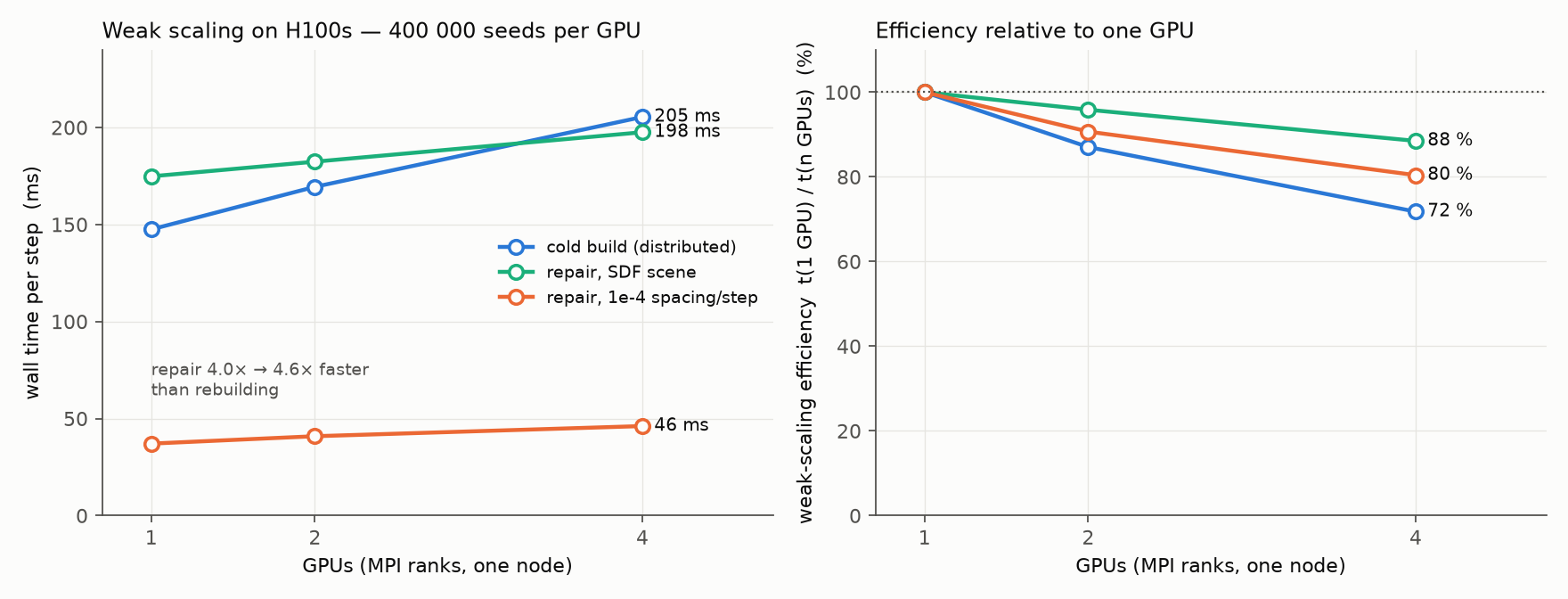
REPAIR(MPI) exactness: PASS at every rank count.
| disp | np=1 cold | np=1 repair | speed-up | np=2 cold | np=2 repair | speed-up | np=4 cold | np=4 repair | speed-up | max rel. ΔV |
|---|---|---|---|---|---|---|---|---|---|---|
| 1e-4 | 149.8 | 37.1 | 4.04 | 174.0 | 40.9 | 4.25 | 212.9 | 46.1 | 4.62 | 2.0e-10 |
| 2e-4 | 147.4 | 36.8 | 4.01 | 169.8 | 40.4 | 4.20 | 205.4 | 46.0 | 4.47 | 1.7e-9 |
| 5e-4 | 147.5 | 44.2 | 3.34 | 169.2 | 48.5 | 3.49 | 203.5 | 53.8 | 3.78 | 9.6e-6 |
| 1e-3 | 147.5 | 64.7 | 2.28 | 169.4 | 68.9 | 2.46 | 204.9 | 74.6 | 2.75 | 2.4e-7 |
| 2e-3 | 147.5 | 93.0 | 1.59 | 170.0 | 96.8 | 1.76 | 206.0 | 103.4 | 1.99 | 2.8e-4 |
| 5e-3 | 146.8 | 171.2 | 0.86 | 169.2 | 178.1 | 0.95 | 205.4 | 188.7 | 1.09 | 1.2e-6 |
| 1e-2 (gate → rebuild) | 147.4 | 188.8 | 0.78 | 168.4 | 201.3 | 0.84 | 205.4 | 219.6 | 0.94 | 1.3e-15 |
| 1 GPU (400k) | 2 GPUs (800k) | 4 GPUs (1.6M) | |
|---|---|---|---|
| cold build, aggregate Mcells/s | 2.71 | 4.72 | 7.79 |
| repair at 1e-4, aggregate Mcells/s | 10.8 | 19.6 | 34.7 |
| weak-scaling efficiency, cold build | 100 % | 87 % | 72 % |
| weak-scaling efficiency, repair at 1e-4 | 100 % | 91 % | 80 % |
| weak-scaling efficiency, gate rebuild (1e-2) | 100 % | 94 % | 86 % |
The same sweep through the SDF scene (--sdf): the distributed SDF repair reproduces the single-rank cold SDF build to \(10^{-10}\) in every cell with zero emptiness mismatches at every row and rank count — but its cost is another matter (below).
REPAIR(MPI,SDF) exactness: PASS, emptyMismatch = 0.
| disp | np=1 cold | np=1 repair | ratio | np=2 cold | np=2 repair | ratio | np=4 cold | np=4 repair | ratio |
|---|---|---|---|---|---|---|---|---|---|
| 1e-4 | 155.8 | 174.8 | 0.89 | 178.8 | 182.4 | 0.98 | 209.5 | 197.5 | 1.06 |
| 2e-4 … 2e-3 | ~154 | ~176 | 0.87–0.88 | ~176 | ~181 | 0.97 | ~206 | ~195 | 1.05–1.06 |
| 5e-3 | 154.3 | 187.1 | 0.82 | 175.6 | 194.3 | 0.90 | 206.1 | 210.7 | 0.98 |
| 1e-2 | 154.2 | 197.8 | 0.78 | 175.7 | 208.7 | 0.84 | 205.5 | 226.6 | 0.91 |
What the numbers say
- The repair scales weakly at 80 % to 4 GPUs, and its advantage over rebuilding grows with the rank count (4.0× → 4.6×): the distributed cold build pays the ghost-layer gather every step while the repair only touches the flagged cells. The cold build itself scales at 72 % — the ORB block’s halo-to-volume ratio at 400k seeds per rank. Per GPU, the H100 cold build is 2.7 Mcells/s FP64 (2.4× the RTX 5080, whose FP64 rate is a fraction of its FP32) and its repair 10.8 Mcells/s (4.4× the RTX 5080, 2.9× the 8-thread host).
- The gate rebuild stays at 0.78–0.94× a cold build distributed, as on the workstation.
- Not yet fast: the SDF-walled repair costs a cold build (0.87–1.06×) while the certificate flags no cell. The per-step cost is therefore outside the re-clip; the candidate is the boundary watch, which evaluates the wall for every cell every step, plus the SDF clip inside the full re-evaluation. A kernel-level split of the step (certify / re-evaluate / re-clip timers) will say which. Until then a walled moving-cell case gains nothing from repairing over rebuilding — the tuning item with the largest payoff for the body-fitted and multiphase tracks, since every one of their cases has walls.
- One exactness caveat, open: at \(2\times10^{-3}\) spacing per step the wall-free repair deviates by \(2.8\times10^{-4}\) (1 GPU) and \(1.5\times10^{-4}\) (4 GPUs) in one cell’s relative volume, against \(\le 10^{-5}\) in every other row; it shows at np = 1, so it is not a distribution artefact. The workstation’s near-miss table has \(9\times10^{-12}\) / \(9\times10^{-7}\) for the same row, and the suite’s dynamic test has a known nondeterministic case at this displacement: a thread- or atomic-order dependence of the moving repair in the \(10^{-3}\)–\(5\times10^{-3}\) band. The bench’s PASS gate is looser than the \(10^{-11}\) the certificate achieves elsewhere; the residual miss is real and needs a deterministic worklist order or a tighter certificate there.
The distributed flow solver’s gates ran in the same job (test_flow_mpi, 4 ranks, a \(24^3\)-seed jittered lattice, 20 Taylor–Green steps): collocated RK3 agrees with the single-rank reference to \(1.0\times10^{-15}\) in velocity, implicit diffusion to \(4.2\times10^{-11}\), the covolume solver to \(2.6\times10^{-14}\), the device-packed ghost exchange equals the host path in every entry, and the isolated distributed pressure solve has true residual equal to its recursive residual — the H100 row of the method plan’s C5 rung.
Reproduce this
Workstation (voro built with -DPECLET_VORO_KOKKOS=ON against the suite’s host-openmp and nvidia-cuda prefixes):
cd suite/voro
OMP_NUM_THREADS=8 OMP_PROC_BIND=false ./build_host/tests/kokkos/bench_report --repair 200000 8
./build_cuda/tests/kokkos/bench_report --repair 200000 8
./build_cuda/tests/kokkos/bench_report --cold            # cold build vs N
Snellius (billed per allocated GPU; the script asks for the 4 H100s of one node and uses 1, 2, 4 of them in turn; ~8 minutes):
cd $SUITE/voro && sbatch tools/snellius_voro_mpi.sh # -> voro-mpi-<jobid>.outThen python plot_throughput.py in this directory regenerates both figures from results/. The suite’s own record of these numbers, with the cold-build-vs-N table and the tuning history, is suite/docs/studies/voro_update_throughput.md; the method plan that this rung (A4) belongs to is suite/docs/VORONOI_METHODS_PLAN.md.