import importlib.util, os, subprocess, sys
_local = os.environ.get("PECLET_LOCAL_BUILD")
if _local:
    for p in _local.split(os.pathsep):
        sys.path.insert(0, p)
elif importlib.util.find_spec("peclet") is None:
subprocess.run([sys.executable, "-m", "pip", "install", "-q", "peclet"], check=True)Redistributing pore-space seeds: split, merge, relax
Start from a bad seeding of a sphere packing’s interstitial space and let peclet.voro’s topological loop move cells between pores — the step a position-only optimiser cannot take — toward a uniform or wall-graded target volume.
voro
meshing
porous-media
sdf
What you’ll learn
The pore-mesh example showed that a Voronoi pore mesh is only as good as its seeding, and that relaxing seed positions cannot fix a mismatched start: a seed cannot cross a solid grain to reach an under-resolved pore, so the optimiser collapses throat cells instead. peclet.voro.redistribute_pore_mesh adds the topological moves — split a cell that is too big (along the wall for wall cells), remove a cell that is too small or dead, relax with a Lloyd blend for shape and a graded volume descent for size, and re-seed the wall layers by the graded-shell heuristic — and keeps the best state. You’ll see a 2× mismatched uniform start reach a uniform target within about 10 % in every cell, and what a wall-graded target can and cannot achieve.
import numpy as np
import matplotlib.pyplot as plt
from peclet import voro
plt.rcParams.update({"figure.dpi": 130, "font.size": 10, "axes.grid": True, "grid.alpha": 0.3})
A small packing and a bad start
Six random non-overlapping spheres in the periodic unit box (solid fraction ≈ 0.11) — small enough for a CPU notebook; a peclet.dem packing plugs in the same way. The start is a uniform random cloud with about twice the seeds the uniform target asks for.
rng = np.random.default_rng(11)
L = 1.0
centres, radii = [], []
while len(centres) < 6:
    c, r = rng.uniform(0, L, 3), rng.uniform(0.14, 0.2)
    if all(np.linalg.norm((c - cc) - L * np.round((c - cc) / L)) > r + rr + 0.06 for cc, rr in zip(centres, radii)):
        centres.append(c); radii.append(r)
centres, radii = np.array(centres), np.array(radii)
pos0 = rng.uniform(0, L, (2500, 3))
pos0 = pos0[voro._union_sdf(pos0, centres, radii, L) > 0.03]
print(f"solid fraction {(4 / 3 * np.pi * radii**3).sum():.3f}, {len(pos0)} start seeds")
solid fraction 0.109, 2055 start seedsUniform target
The target is \(V_\text{ref} = s^3\) with \(s = 0.10\) everywhere (s_lo = s_hi). The routine reports the per-round history — seed count, worst and rms relative volume error, dead cells.
res_u = voro.redistribute_pore_mesh(pos0, centres, radii, L, s_lo=0.10, s_hi=0.10)
h = np.array(res_u["history"])
print(f"start: N={int(h[0,0])}, max|V/V_ref-1|={h[0,1]:.2f}, rms={h[0,2]:.2f}")
print(f"end:   N={len(res_u['positions'])}, max|V/V_ref-1|={res_u['max_rel']:.3f}, rms={res_u['rms_rel']:.3f}, "
      f"dead cells {res_u['n_dead']}, {res_u['rounds']} rounds, +{res_u['n_added']} -{res_u['n_removed']} seeds")
start: N=1689, max|V/V_ref-1|=1.06, rms=0.54
end: N=962, max|V/V_ref-1|=0.116, rms=0.051, dead cells 0, 40 rounds, +18 -745 seedsfig, ax = plt.subplots(1, 2, figsize=(9, 3.4))
ax[0].semilogy(h[:, 1], "o-", ms=3, label="max |V/V_ref − 1|"); ax[0].semilogy(h[:, 2], "s-", ms=3, label="rms")
ax[0].set(xlabel="round", ylabel="relative volume error"); ax[0].legend()
t = voro.Tessellation(); t.set_box((L, L, L))
ni, nr, root = voro.sphere_union_scene(centres, radii); t.set_geometry(ni, nr, root=root)
t.build(pos0, strict=False)
v0 = t.volumes(); v0 = v0[v0 > 0] / 0.10**3
ax[1].hist(v0, bins=np.linspace(0, 3, 61), alpha=0.5, label="start")
ax[1].hist(1 + res_u["rel"][res_u["volumes"] > 0], bins=np.linspace(0, 3, 61), alpha=0.7, label="redistributed")
ax[1].set(xlabel="V / V_ref", ylabel="cells"); ax[1].legend()
plt.show()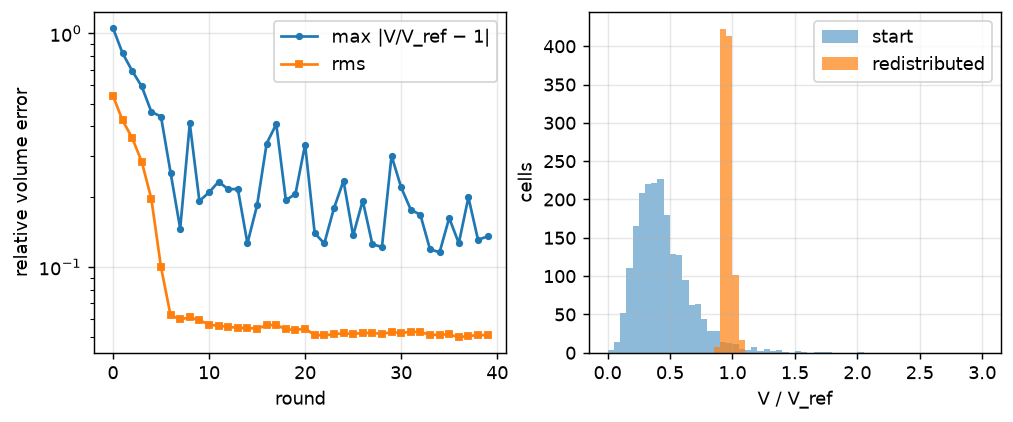
Wall-graded target
Now \(s(\phi) = \mathrm{clip}(s_\text{lo} + 0.3\,(\phi - s_\text{lo}),\ s_\text{lo},\ s_\text{hi})\) with \(\phi\) the distance to the nearest grain: cells of size 0.08 at the walls growing to 0.25 in the pores. The slope matters: a Voronoi cell’s size cannot change faster than its neighbours’, so the example’s original \(s = \mathrm{clip}(\phi)\) (slope 1, neighbouring targets eight times apart) is unresolvable by any mesh; slope 0.3 is.
res_g = voro.redistribute_pore_mesh(pos0, centres, radii, L, s_lo=0.08, s_hi=0.25, slope=0.3)
hg = np.array(res_g["history"])
print(f"graded: N {int(hg[0,0])} -> {len(res_g['positions'])}, max|V/V_ref-1| {hg[0,1]:.2f} -> {res_g['max_rel']:.3f}, "
      f"rms {hg[0,2]:.2f} -> {res_g['rms_rel']:.3f}, dead cells {res_g['n_dead']}")
graded: N 1471 -> 1150, max|V/V_ref-1| 2.22 -> 0.547, rms 0.43 -> 0.074, dead cells 0p = res_g["positions"]; rel = res_g["rel"]
phi = voro._union_sdf(p, centres, radii, L)
fig, ax = plt.subplots(figsize=(5.5, 3.4))
ax.plot(phi, 1 + rel, ".", ms=2, alpha=0.5)
ax.axhline(1, color="k", lw=1); ax.set(xlabel="distance to the nearest grain φ", ylabel="V / V_ref", ylim=(0, 2.5))
plt.show()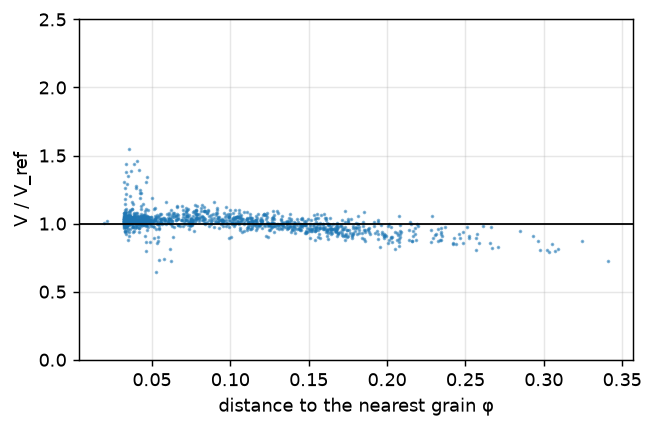
What to make of it
- Uniform target: rms 0.04–0.05, worst cell about 10 % off, no dead cells — the loop meets the plan’s target from a start that the position-only optimiser cannot handle at all.
- Graded target: rms ≈ 0.08; the outliers are the first wall shell (≈ 1.5× target). A cell hugging a curved wall spans from the wall to halfway to the next shell, more than \(s_\text{lo}\).
- The loop is a heuristic with thread-order variation run to run; take the reported history, not a single number, as its measure.
Adapt this yourself
- Your packing: pass the centres and radii of a
peclet.dempacking; the SDF union and the scene are built for you. - Tighter grading: lower
slopeor raises_lo; keep the target field resolvable. - Feed the flow solver:
voro.Tessellation+set_geometry(*voro.sphere_union_scene(...))build(res["positions"])gives the mesh tovoro.FlowSolver— see the sphere-drag example.
Reproduce this
pip install -e .          # + a recent peclet (peclet-voro with redistribute_pore_mesh)
quarto render examples/pore-mesh-redistribution/index.qmd --execute
PECLET_LOCAL_BUILD=/path/to/suite/voro/build_a0 quarto render examples/pore-mesh-redistribution/index.qmd --execute