# Makes this notebook run out-of-the-box on Colab/Binder. A real user just needs the
# published package; this installs it on first run. Authors can instead point at local
# source builds of the suite with PECLET_LOCAL_BUILD (os.pathsep-separated).
import importlib.util, os, subprocess, sys
_local = os.environ.get("PECLET_LOCAL_BUILD")
if _local:
    for p in _local.split(os.pathsep):
        sys.path.insert(0, p)
elif importlib.util.find_spec("peclet") is None:
subprocess.run([sys.executable, "-m", "pip", "install", "-q", "peclet"], check=True)A bubble through a packed bed
Buoyancy against capillarity in a liquid-saturated packing: the bubble squeezes through the throats, and the gas volume is conserved to the projection’s own divergence residual while the colour inside the grains stays exactly zero.
flow
dem
vof
two-phase
porous-media
wetting
IBM
multi-method
gpu
 Wants a GPU build: two \(64\times64\times160\) two-phase runs of a few thousand steps each, plus three shorter ones.
What you’ll learn
This is the page where the pieces meet. A dem packing becomes a signed distance field; the cut-cell immersed boundary turns that field into openness-weighted pressure and transport operators; the geometric VoF transports a gas/liquid interface through those cut cells; a static contact angle tells the interface what to do where it meets a grain; and momentum-consistent transport carries \(\rho\mathbf{u}\) with the same fluxes at a density ratio of 100. Nothing here is a benchmark with a published number — it is the composition itself, and the honest question is whether the conservation statements survive it.
They do — and the geometry does something to the bubble worth watching. It rises freely, meets the underside of the bed, is held there until the buoyant head builds enough to force a throat, and then works its way up through the pore space at a fraction of its free speed. That is Equation 2 below, playing out. How large each of those two costs — the wait and the drag — turns out to be depends sharply on the bed, and §3 measures both and shows how far they move between two beds built by the identical protocol. Through all of it the gas volume is conserved to machine precision, the colour inside the grains is exactly zero to the last bit, and the pressure projection never comes close to its iteration cap. §5 repeats the whole packed run at density ratio 1000.
The page also runs the same bubble in the same column with no packing, which is the only yardstick available here — every number about the bed is a number relative to the free rise.
The problem
A gas bubble of diameter \(D\) is released at the bottom of a closed, liquid-saturated column and rises through a random packing of spheres whose diameter is comparable to its own. Three groups fix the physics.
The Eötvös and Morton numbers say what shape a free bubble takes (Clift et al. 1978):
\[ \mathrm{Eo} = \frac{\Delta\rho\, g\, D^{2}}{\sigma}, \qquad \mathrm{Mo} = \frac{g\,\mu_\ell^{4}\,\Delta\rho}{\rho_\ell^{2}\sigma^{3}} , \qquad \mathrm{Re} = \frac{\rho_\ell U_g D}{\mu_\ell},\quad U_g=\sqrt{gD} . \tag{1}\]
At \(\mathrm{Eo}=10\) and \(\mathrm{Mo}=10^{-3}\) a free bubble is firmly ellipsoidal — deformable, not a spherical cap, not a wobbling one. That is the regime chosen here, because a bubble that cannot deform cannot pass a throat narrower than itself.
The third group is the one the packing adds. To push its nose into a pore throat of radius \(r_t\) against a wetting liquid (\(\theta\) measured through the liquid), the gas must overcome the Young–Laplace entry pressure, and the head it has available is the hydrostatic head over its own vertical extent \(L\):
\[ \underbrace{\frac{2\sigma\cos\theta}{r_t}}_{\text{capillary entry}} \;<\; \underbrace{\Delta\rho\,g\,L}_{\text{buoyant head}} \qquad\Longleftrightarrow\qquad L \;>\; \frac{2\cos\theta}{\mathrm{Eo}}\,\frac{D^{2}}{r_t} . \tag{2}\]
Equation 2 is the whole story of the page in one line: it says the bubble must elongate to a length set by \(D^2/r_t\) before it can enter, and it is why the run below shows a bubble that stretches, necks, and leaves fragments behind. It is also the criterion that decides the scene — see the callout after the geometry.
The governing equations are the usual one-fluid form with a single variable density and viscosity and a singular interfacial force, restricted to the fluid part of each cell by the openness weights \(\varepsilon\) (cell fluid fraction) and \(o_f\) (face openness):
\[ \partial_t(\rho\mathbf{u}) + \nabla\!\cdot\!(\rho\mathbf{u}\mathbf{u}) = -\nabla p + \nabla\!\cdot\!\big[\mu(\nabla\mathbf{u}+\nabla\mathbf{u}^{\mathsf T})\big] + \rho\mathbf{g} + \sigma\kappa\,\mathbf{n}\,\delta_S , \qquad \partial_t (\varepsilon C) + \nabla\!\cdot\!(o\,C\,\mathbf{u}) = 0 , \tag{3}\]
with \(C\) the liquid fraction of a cell’s fluid volume — so the bubble is \(C=0\), and the gas volume of the discrete field is \(\sum_i \varepsilon_i (1-C_i)\).
import math, time
import numpy as np
import matplotlib.pyplot as plt
from peclet import dem, flow

plt.rcParams.update({"figure.dpi": 130, "font.size": 10, "axes.grid": True,
                     "grid.alpha": 0.3, "axes.axisbelow": True,
                     "figure.facecolor": "white", "savefig.bbox": "tight"})
BLUE, RED, GREY, GREEN, ORANGE = "#1f77b4", "#d62728", "0.80", "#2ca02c", "#ff7f0e"
The scene
Everything is expressed in cells: peclet’s grid spacing is 1 and its time unit is the second, and this problem has no external length to match, so the dimensionless groups of Equation 1 are imposed directly on solver-unit properties. The column is \(64\times64\times160\) cells, periodic in \(x\) and \(y\) and closed by no-slip walls at top and bottom.
NX, NZ   = 64, 160          # column: 64 x 64 cross-section, 160 cells tall
N_GRAIN  = 26               # grains in the bed
R_JAM    = 0.171875 * NX    # 11.0 cells — the radius the grains JAM at in dem
F_SDF    = 0.85             # SDF grain radius / contact radius (see the callout below)
R_GRAIN  = F_SDF * R_JAM    # 9.35 cells — the radius the fluid solver sees
Z_BED    = 0.5625 * NX      # 36.0 — bottom of the bed
R_BUB    = 0.15625 * NX     # 10.0 cells — bubble radius (D = 20, D/W = 0.31)
Z_BUB    = 0.28125 * NX     # 18.0 — bubble centre at release
print(f"column {NX}x{NX}x{NZ}   bubble D = {2*R_BUB:.0f} cells (D/W = {2*R_BUB/NX:.2f})   "
      f"grain D = {2*R_GRAIN:.1f} cells")
column 64x64x160 bubble D = 20 cells (D/W = 0.31) grain D = 18.7 cellsStep 1 — the packing, from dem
The grains are dropped onto a floor plane in a laterally periodic column and settled with friction: a random loose deposit, not a Lubachevsky–Stillinger close packing (the random packed bed page does that one). A column only 3.3 grain diameters wide cannot hold a bulk packing anyway, and the loose deposit is the honest thing to build here.
def settle_bed(n=N_GRAIN, W=float(NX), Rj=R_JAM, seed=11, steps=4000, dt=5e-3):
    """Drop `n` grains onto a floor in an x/y-periodic column; return the settled centres."""
    s = dem.Simulation(8 * n)                     # headroom for the periodic ghost band
    s.initialize(shape_type=1, radius=1.0)
    s.set_global_scale(Rj)
    s.set_domain((0.0, 0.0, -20.0), (W, W, 400.0))
    s.enable_periodicity(True, True, False)       # z is closed by the floor plane
    s.set_gravity(0.0, 0.0, -9.81)
    s.add_plane(0.0, 0.0, 0.0, 0.0, 0.0, 1.0)     # the floor
    s.set_material_params(0.05, 0.0, 0.6)         # restitution / tangential / friction
    s.set_solver_iterations(8, 8)
    rng = np.random.default_rng(seed)
    P = np.zeros((n, 3))
    P[:, :2] = rng.uniform(0.0, W, (n, 2))
    P[:, 2] = Rj * 1.2 + 2.35 * Rj * (np.arange(n) // 4) + rng.uniform(-1.5, 1.5, n)
    s.set_positions(np.ascontiguousarray(P.astype(np.float32)))
    s.set_inv_mass(np.full(n, 1.0, np.float32))
    s.set_dt(dt)
    for _ in range(steps):
        s.step(dt)
    return np.asarray(s.get_positions())[:n, :3].astype(float), float(s.max_overlap())

t0 = time.time()
CENTRES, OVERLAP = settle_bed()
BED_LO, BED_HI = CENTRES[:, 2].min() - R_JAM, CENTRES[:, 2].max() + R_JAM
print(f"{N_GRAIN} grains settled in {time.time()-t0:.0f} s   max overlap {OVERLAP:.4f} cells "
      f"(contact radius {R_JAM:.2f})")
print(f"jammed bed height {BED_HI-BED_LO:.1f} cells, solid fraction at contact "
      f"{N_GRAIN*4/3*math.pi*R_JAM**3/(NX*NX*(BED_HI-BED_LO)):.3f}")
26 grains settled in 166 s max overlap 0.0194 cells (contact radius 11.00)
jammed bed height 70.5 cells, solid fraction at contact 0.502Step 2 — the packing as a signed distance field
The fluid solver only ever sees \(\varphi\), the signed distance (\(\varphi>0\) is fluid), sampled periodically in \(x\) and \(y\) and translated so the bed sits above the release pool.
def bed_sdf(centres, nx=NX, nz=NZ, Rg=R_GRAIN, z0=Z_BED):
    """Signed distance to the union of the grains; periodic in x and y."""
    W = float(nx)
    P = centres.copy(); P[:, 2] += z0
    g, gz = np.arange(nx) + 0.5, np.arange(nz) + 0.5
    X, Y, Z = np.meshgrid(g, g, gz, indexing="ij")
    phi = np.full((nx, nx, nz), 1e30)
    for k in range(len(P)):
        dx = X - P[k, 0]; dx -= W * np.round(dx / W)
        dy = Y - P[k, 1]; dy -= W * np.round(dy / W)
        dz = Z - P[k, 2]
        phi = np.minimum(phi, np.sqrt(dx * dx + dy * dy + dz * dz) - Rg)
    return np.asfortranarray(phi)

SDF = bed_sdf(CENTRES)
BED_Z0 = Z_BED + R_JAM - R_GRAIN                     # lowest grain surface
BED_Z1 = Z_BED + (BED_HI - BED_LO) - R_JAM + R_GRAIN  # highest grain surface
LO, HI = int(Z_BED + R_GRAIN), int(Z_BED + (BED_HI - BED_LO) - R_GRAIN)   # the bed CORE
EPS_BED = float((SDF[:, :, LO:HI] > 0).mean())
print(f"bed occupies z = {BED_Z0:.1f} .. {BED_Z1:.1f} cells "
      f"({(BED_Z1-BED_Z0)/(2*R_GRAIN):.1f} grain diameters deep)")
print(f"porosity over the bed core (z = {LO} .. {HI}):  eps = {EPS_BED:.3f}")
bed occupies z = 37.6 .. 104.8 cells (3.6 grain diameters deep)
porosity over the bed core (z = 45 .. 97): eps = 0.639The pore-throat radius is the quantity Equation 2 needs, and it is not the largest pore: it is the bottleneck of the widest connected path from the bottom of the bed to the top — the max–min path of \(\varphi\), which a Dijkstra-like sweep computes exactly.
import heapq

def percolation_throat(phi, klo, khi):
    """max over bottom->top paths of the minimum SDF along the path (26-connected,
    periodic in x and y). The radius of the largest sphere that can be pushed through."""
    sub = phi[:, :, klo:khi]
    nx, ny, nk = sub.shape
    val = np.full(sub.shape, -np.inf)
    h = [(-sub[i, j, 0], i, j, 0) for i in range(nx) for j in range(ny) if sub[i, j, 0] > 0]
    for e in h:
        val[e[1], e[2], 0] = -e[0]
    heapq.heapify(h)
    while h:
        nv, i, j, k = heapq.heappop(h)
        v = -nv
        if v < val[i, j, k] - 1e-12:
            continue
        if k == nk - 1:
            return v
        for di in (-1, 0, 1):
            for dj in (-1, 0, 1):
                for dk in (-1, 0, 1):
                    if di == dj == dk == 0:
                        continue
                    a, b, c = (i + di) % nx, (j + dj) % ny, k + dk
                    if 0 <= c < nk and min(v, sub[a, b, c]) > val[a, b, c]:
                        val[a, b, c] = min(v, sub[a, b, c])
                        heapq.heappush(h, (-val[a, b, c], a, b, c))
    return -np.inf

EO, THETA = 10.0, 60.0                               # the run's Eotvos number and angle
R_THROAT = percolation_throat(SDF, int(BED_Z0), int(BED_Z1) + 1)
L_ENTRY = 2 * math.cos(math.radians(THETA)) / EO * (2 * R_BUB) ** 2 / R_THROAT
print(f"percolation throat radius r_t = {R_THROAT:.2f} cells "
      f"(throat diameter {2*R_THROAT:.1f} = {2*R_THROAT/(2*R_BUB):.2f} x the bubble diameter)")
print(f"capillary entry length from eq-entry at Eo = {EO:.0f}, theta = {THETA:.0f} deg: "
      f"L > {L_ENTRY:.1f} cells, against a bubble diameter of {2*R_BUB:.0f}")
percolation throat radius r_t = 5.67 cells (throat diameter 11.3 = 0.57 x the bubble diameter)
capillary entry length from eq-entry at Eo = 10, theta = 60 deg: L > 7.1 cells, against a bubble diameter of 20
ImportantTwo scene choices that are physics, not cosmetics
The grains are sampled at 85 % of the radius they jam at. A DEM contact is a tangency, and a tangency is a throat of exactly zero area: no fixed grid can represent it, and no bubble could ever pass it. Shrinking the grains about their jammed centres by 15 % opens every grain–grain contact into a throat of finite width while leaving the microstructure — the centres, the coordination, the disorder — exactly as dem produced it. It is the standard way to build a bed of prescribed porosity from a jammed configuration, and it is stated here because it moves the porosity from 0.50 at contact to 0.64 as sampled.
The throat is 0.57 bubble diameters wide, and Equation 2 then wants the bubble to stretch past 7 cells to enter — a good fraction of its own diameter. That is a deliberate design point: much tighter and the entry pressure is never reached and the bubble is capillary-trapped; much wider and the packing does nothing. It is also a resolution point. The same scene at half this grid puts only 5.7 cells across the bottleneck, which is fewer than a PLIC plane and a height-function curvature stencil can carry — so the resolution here is set by the throat, not by the bubble.
Step 3 — the bubble
The colour field is handed to the solver as volume fractions, subsampled \(4^3\), not as a sampled indicator — the same discipline as every other VoF page here.
def bubble_colour(nx=NX, nz=NZ, R=R_BUB, cz=Z_BUB, sub=4):
    """C = liquid fraction; the gas bubble is the C = 0 sphere at (nx/2, nx/2, cz)."""
    q = (np.arange(sub) + 0.5) / sub
    px = np.arange(nx)[:, None, None, None, None, None] + q[None, None, None, :, None, None]
    py = np.arange(nx)[None, :, None, None, None, None] + q[None, None, None, None, :, None]
    pz = np.arange(nz)[None, None, :, None, None, None] + q[None, None, None, None, None, :]
    c = nx / 2.0
    gas = ((px - c) ** 2 + (py - c) ** 2 + (pz - cz) ** 2) < R * R
    return np.asfortranarray(1.0 - gas.mean(axis=(3, 4, 5)))
C0 = bubble_colour()
fig, (axg, axp) = plt.subplots(1, 2, figsize=(8.6, 4.6),
gridspec_kw=dict(width_ratios=[1.05, 1]))
x = np.arange(NX) + 0.5
z = np.arange(NZ) + 0.5
axg.contourf(x, z, (SDF[:, NX // 2, :] < 0).T, levels=[0.5, 1.5], colors=["0.72"])
axg.contour(x, z, SDF[:, NX // 2, :].T, levels=[0.0], colors=["0.35"], linewidths=0.9)
axg.contourf(x, z, (1 - C0[:, NX // 2, :]).T, levels=[0.5, 1.5], colors=["#cfe3f5"])
axg.contour(x, z, (1 - C0[:, NX // 2, :]).T, levels=[0.5], colors=[BLUE], linewidths=1.8)
for zz in (0, NZ):
axg.axhline(zz, color="0.1", lw=3)
axg.set(xlim=(0, NX), ylim=(0, NZ), aspect="equal", xlabel="x [cells]",
ylabel="z [cells]", title="mid-plane of the SDF")
axg.grid(False)
open_frac = (SDF > 0).mean(axis=(0, 1))
inscribed = SDF.max(axis=(0, 1))
axp.plot(open_frac, z, color=BLUE, lw=1.6, label="open-area fraction of the plane")
axp2 = axp.twiny()
axp2.plot(inscribed, z, color=ORANGE, lw=1.4, label="largest inscribed circle radius")
axp2.axvline(R_THROAT, ls="--", color=RED, lw=1.2)
axp2.set_xlabel("radius [cells]", color=ORANGE)
axp2.set_xlim(0, 22)
axp.set(ylim=(0, NZ), xlim=(0, 1.05), xlabel="open-area fraction", ylabel="z [cells]")
axp.set_title("what the bubble has to get through", pad=26)
axp.plot([], [], color=ORANGE, lw=1.4, label="largest inscribed circle")
axp.plot([], [], "--", color=RED, lw=1.2, label=f"percolation throat $r_t$ = {R_THROAT:.1f}")
axp.legend(fontsize=7.5, loc="upper center")
plt.tight_layout(); plt.show()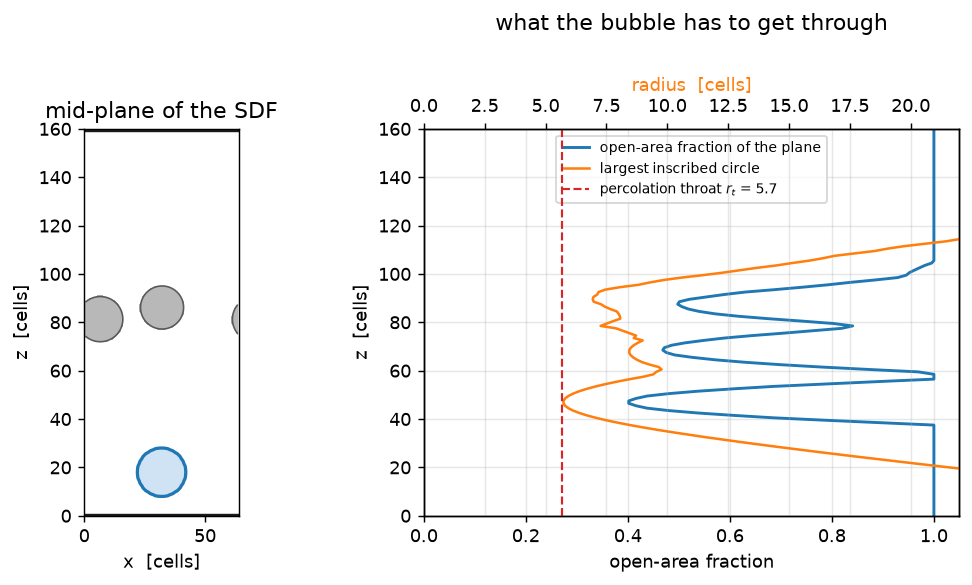
The driver
The whole setup is a dozen or so calls, and five of them do something a single-phase run never needs.
set_solid(..., cutcell_pressure=True)is required: the colour transport weights every flux by the face openness and the staircase pressure operator has none, so the solver raises rather than approximate it.set_contact_angle(60)is the whole wetting model — a wetting liquid, so the gas is pushed off the grains rather than sticking to them.enable_vof_momentum(rho_gas, rho_liquid)advects \(\rho^c\mathbf{u}\) with the same geometric fluxes as \(C\) (Rudman 1998; Arrufat et al. 2021). It composes with cut cells, and it is on for every ratio-100 run here.- gravity is a closure of the colour —
set_property_model("force_z", …)writes \(f_z=-\rho(C)g\) every step, so it acts on the true local density. - the time step is re-picked every step at 40 % of the smaller of the two explicit limits
vof_step_limits()reports (Brackbill capillary (Brackbill et al. 1992) and the Weymouth–Yue interface CFL (Weymouth and Yue 2010)). Every-step, not every-tenth-step as the free-bubble pages do: a packing manufactures local velocity, and the first attempt at this run died at exactly that — see the callout.
PRESS_CAP = 600

def column(packed=True, ratio=100.0, Eo=EO, Mo=1e-3, theta=THETA, g=2e-4,
           T=4300.0, cls=flow.Solver, momentum=True, nx=NX, nz=NZ,
           snap_at=(), movie_every=0, label=""):
    """One bubble in one closed column. `packed=False` is the free-rise control."""
    D = 2 * R_BUB
    rho_l, rho_g = 1.0, 1.0 / ratio
    drho = rho_l - rho_g
    sigma = drho * g * D * D / Eo                      # from @eq-groups
    mu_l = (Mo * rho_l ** 2 * sigma ** 3 / (g * drho)) ** 0.25
    mu_g = mu_l / ratio
    Ug = math.sqrt(g * D)

    s = cls(nx, nx, nz)
    s.set_rho(rho_l); s.set_mu(mu_l)
    s.set_domain_bc(4, 1, 0, 0, 0)                     # closed: no-slip floor
    s.set_domain_bc(5, 1, 0, 0, 0)                     # closed: no-slip lid
    if packed:
        s.set_solid(SDF, cutcell_pressure=True)        # cut-cell IBM + cut-cell pressure
    else:
        s.set_pressure_geometry(np.full((nx, nx, nz), 10.0, order="F"))
    s.enable_vof()
    s.set_vof(bubble_colour(nx, nz))
    s.set_property_model("rho", "linear", "C", [rho_g, rho_l - rho_g])
    s.set_property_model("mu", "linear", "C", [mu_g, mu_l - mu_g])
    s.set_surface_tension(sigma)
    if packed:
        s.set_contact_angle(theta)                     # static, measured through the liquid
    if momentum:
        s.enable_vof_momentum(rho_g, rho_l)            # consistent rho*u transport
    s.set_property_model("force_z", "linear", "C",     # buoyancy f_z = -rho(C) g
                         [-rho_g * g, -(rho_l - rho_g) * g])
    s.set_pressure_chebyshev(True, PRESS_CAP, 1e-12)   # AFTER the rho closure (see below)

    eps = (np.asarray(s.vof_geometry(0)) if s.vof_has_geometry()
           else np.ones((nx, nx, nz)))                # cell FLUID fraction
    zs = np.arange(nz) + 0.5
    gas0 = eps * (1.0 - np.asarray(s.get_vof()))
    V0 = gas0.sum()
    ts, zc, vc, vol = [0.0], [float((gas0.sum(axis=(0, 1)) * zs).sum() / V0)], [0.0], [1.0]
    snaps, frames, todo = {0.0: gas0.copy()}, [], list(snap_at)
    iters, div, ncap, ncfl, nan, capped = 0, 0.0, 0, 0, False, 0
    t, i, dt = 0.0, 0, 0.4 * s.capillary_dt()
    s.set_dt(dt)
    lim0 = s.vof_step_limits()
    t0 = time.time()
    aborted = ""
    while t < T:
        L = s.vof_step_limits()                        # EVERY step -- see the callout below
        dt = 0.4 * min(L["cfl_dt"], L["capillary_dt"]); s.set_dt(dt)
        ncap += int(L["capillary_binds"]); ncfl += int(not L["capillary_binds"])
        try:
            s.step()
        except RuntimeError as e:                      # never let one run break the page
            aborted = str(e).split("\n")[0]
            break
        t += dt; i += 1
        it = s.last_pressure_iterations()
        iters = max(iters, it)
        capped += int(it >= PRESS_CAP)
        if capped > 20:                                # a capped solve invalidates the run;
            break                                      # stop burning GPU time on it
        if i % 4 == 0 or (todo and t >= todo[0]):
            gas = eps * (1.0 - np.asarray(s.get_vof()))
            v = gas.sum()
            if not np.isfinite(v):
                nan = True; break
            ts.append(t); vol.append(v / V0)
            zc.append(float((gas.sum(axis=(0, 1)) * zs).sum() / v))
            vc.append(float((gas * np.asarray(s.get_w())).sum() / v))
            if todo and t >= todo[0]:
                snaps[todo.pop(0)] = gas.copy()
        if movie_every and i % movie_every == 0:
            frames.append((eps * (1.0 - np.asarray(s.get_vof()))).astype(np.float16))
        if i % 25 == 0:
            div = max(div, s.max_open_divergence_projected())   # non-mutating
    d = s.vof_diagnostics()
    return dict(label=label, packed=packed, ratio=ratio, Eo=Eo, Mo=Mo, g=g, sigma=sigma,
                mu_l=mu_l, Ug=Ug, D=D, Re=rho_l * Ug * D / mu_l, T=T, steps=i, nan=nan,
                t=np.array(ts), zc=np.array(zc), vc=np.array(vc), vol=np.array(vol),
                snaps=snaps, frames=frames, iters=iters, cap=PRESS_CAP, div=div,
                capped=capped, aborted=aborted,
                ncap=ncap, ncfl=ncfl, lim0=lim0, V0=V0, eps=eps, wall=time.time() - t0,
                solid_sum=d["solid_sum"], clipped=d["clipped_volume"],
                C=np.asarray(s.get_vof()).copy())
ImportantThree rules this page follows, and why each one is not optional
A run whose pressure solve hit its cap is not a result. Every run records last_pressure_iterations() against a cap of 600 and the non-mutating max_open_divergence_projected(). Under variable density the pressure driver is Chebyshev by default; it must be selected after set_property_model("rho", …), because that call fires set_density_mode, which reselects the driver — a selection made earlier is silently discarded. If Chebyshev caps, set_pressure_fcg(True, …) is the validated alternative on wall-bounded boxes, again selected last.
PECLET_FLOW_EXACT_RESIDUAL=1 is set for every run on this page. It replaces the float band form of the residual by the double flux form; on the Hysing case-2 benchmark it removed 7.5 orders of flux divergence and moved no other digit of the result. At density ratio 1000 that is the difference between a divergence number that means something and one that does not.
The time step is re-picked every step. step() enforces the Weymouth–Yue boundedness cap (interface CFL 0.25) by raising, not by clamping, and in a packing the face velocity is not a smooth function of time: a bubble breaking into a throat produces a local jet. Re-picking dt every ten steps — which is what the free-bubble pages do, safely — killed the first attempt at this run with CFL = 0.377 exceeds the Weymouth-Yue boundedness cap 0.25, i.e. the interface velocity had grown by more than half within ten steps while dt still carried the capillary value. The fix is one line and it is in the driver above; the cost is one extra device reduction per step. This is logged in ISSUES.md.
The column is closed. Top and bottom are no-slip walls, so the non-zero-mean buoyancy is balanced by a hydrostatic pressure gradient. In a periodic box the same momentum-consistent cut-cell path is known to diverge after ~160 steps under an unbounded acceleration (an open question of the rung that introduced it); a closed column is not a workaround for that, it is the configuration in which the question does not arise, and it is also what a packed column physically is.
1. The free rise — the control
The same bubble, the same fluids, the same closed column, no packing. Everything the bed does is measured against this.
SNAPS = (600.0, 1200.0, 1800.0, 2400.0)      # snapshot times shared by both runs
LATE  = (2900.0, 3300.0, 3700.0, 4200.0)     # the packed run keeps going
ctl = column(packed=False, T=2500.0, snap_at=SNAPS, label="free rise (no packing)")
print(f"control: {ctl['steps']} steps, t = {ctl['t'][-1]:.0f} of {ctl['T']:g}, "
      f"{ctl['wall']:.0f} s{('   *** ABORTED: ' + ctl['aborted'] + ' ***') if ctl['aborted'] else ''}")
print(f"  Eo {ctl['Eo']:.0f}  Mo {ctl['Mo']:.0e}  Re {ctl['Re']:.1f}  "
      f"sigma {ctl['sigma']:.3e}  mu_l {ctl['mu_l']:.3e}  U_g {ctl['Ug']:.4f}")
print(f"  gas volume V(T)/V(0) = {ctl['vol'][-1]:.10f}")
print(f"  pressure {ctl['iters']}/{ctl['cap']} "
      f"{'OK' if ctl['iters'] < ctl['cap'] else '*** CAPPED -> INVALID ***'}, "
      f"max|div(open u)| {ctl['div']:.2e}")
print(f"  centroid {ctl['zc'][0]:.1f} -> {ctl['zc'][-1]:.1f} cells "
      f"({(ctl['zc'][-1]-ctl['zc'][0])/ctl['D']:.2f} bubble diameters)")
control: 2016 steps, t = 2501 of 2500, 1674 s
Eo 10 Mo 1e-03 Re 31.8 sigma 7.920e-03 mu_l 3.980e-02 U_g 0.0632
gas volume V(T)/V(0) = 1.0000000000
pressure 24/600 OK, max|div(open u)| 6.28e-15
centroid 18.0 -> 124.8 cells (5.34 bubble diameters)2. Through the bed
bed = column(packed=True, snap_at=SNAPS + LATE, movie_every=25,
             label="through the packing")
print(f"packed: {bed['steps']} steps, t = {bed['t'][-1]:.0f} of {bed['T']:g}, "
      f"{bed['wall']:.0f} s{('   *** ABORTED: ' + bed['aborted'] + ' ***') if bed['aborted'] else ''}")
print(f"  gas volume V(T)/V(0) = {bed['vol'][-1]:.10f}   "
      f"(drift {abs(bed['vol'][-1]-1):.1e})")
print(f"  colour inside the grains: {bed['solid_sum']:.3e}   "
      f"clipped volume {bed['clipped']:.2e}")
print(f"  pressure {bed['iters']}/{bed['cap']} "
      f"{'OK' if bed['iters'] < bed['cap'] else '*** CAPPED -> INVALID ***'}, "
      f"max|div(open u)| {bed['div']:.2e}")
print(f"  dt limits at t=0: WY CFL {bed['lim0']['cfl_dt']:.3e}, "
      f"capillary {bed['lim0']['capillary_dt']:.3e}  -> "
      f"{'CAPILLARY' if bed['lim0']['capillary_binds'] else 'CFL'} binds")
print(f"  binding limit: capillary on {bed['ncap']} of {bed['ncap']+bed['ncfl']} re-picks, "
      f"WY CFL on {bed['ncfl']}")
print(f"  centroid {bed['zc'][0]:.1f} -> {bed['zc'][-1]:.1f} cells "
      f"({(bed['zc'][-1]-bed['zc'][0])/bed['D']:.2f} bubble diameters)")
packed: 3797 steps, t = 4300 of 4300, 2335 s
gas volume V(T)/V(0) = 1.0000000000 (drift 3.4e-15)
colour inside the grains: 0.000e+00 clipped volume 0.00e+00
pressure 23/600 OK, max|div(open u)| 2.83e-14
dt limits at t=0: WY CFL inf, capillary 3.186e+00 -> CAPILLARY binds
binding limit: capillary on 2585 of 3797 re-picks, WY CFL on 1212
centroid 18.0 -> 153.7 cells (6.79 bubble diameters)def draw(ax, gas, title, show_solid, ylim=(0, 148)):
"""Grains: the mid-plane section. Gas: the SILHOUETTE, i.e. the maximum of the gas
indicator along y — so the interface is drawn wherever it is, not only where it
happens to cross the mid-plane. A bubble that squeezes through an off-centre throat
would otherwise vanish from the figure."""
ax.set_facecolor("#eaf0f6")
if show_solid:
ax.contourf(x, z, (SDF[:, NX // 2, :] < 0).T, levels=[0.5, 1.5], colors=["0.72"])
g2 = gas.max(axis=1)
ax.contourf(x, z, g2.T, levels=[0.5, 1.5], colors=["#fdf3ef"])
ax.contour(x, z, g2.T, levels=[0.5], colors=[RED], linewidths=1.5)
ax.set(xlim=(0, NX), ylim=ylim, aspect="equal", xticks=[0, 32, 64], title=title)
ax.grid(False)
def fragments(gas, thr=0.5):
"""Number of connected gas blobs (6-connected) holding at least 1 % of the volume."""
from scipy import ndimage
lab, n = ndimage.label(gas > thr)
if n == 0:
return 0
sz = np.bincount(lab.ravel())[1:]
return int((sz > 0.01 * sz.sum()).sum())
times = [t for t in (0.0,) + SNAPS if t in ctl["snaps"] and t in bed["snaps"]]
fig, axes = plt.subplots(2, len(times), figsize=(9.8, 7.6), sharey=True)
for j, tt in enumerate(times):
draw(axes[0, j], ctl["snaps"][tt], f"t = {tt:.0f}", False)
draw(axes[1, j], bed["snaps"][tt], "", True)
axes[1, j].set_xlabel("x [cells]")
axes[0, 0].set_ylabel("free rise\nz [cells]")
axes[1, 0].set_ylabel("through the packing\nz [cells]")
plt.tight_layout(); plt.show()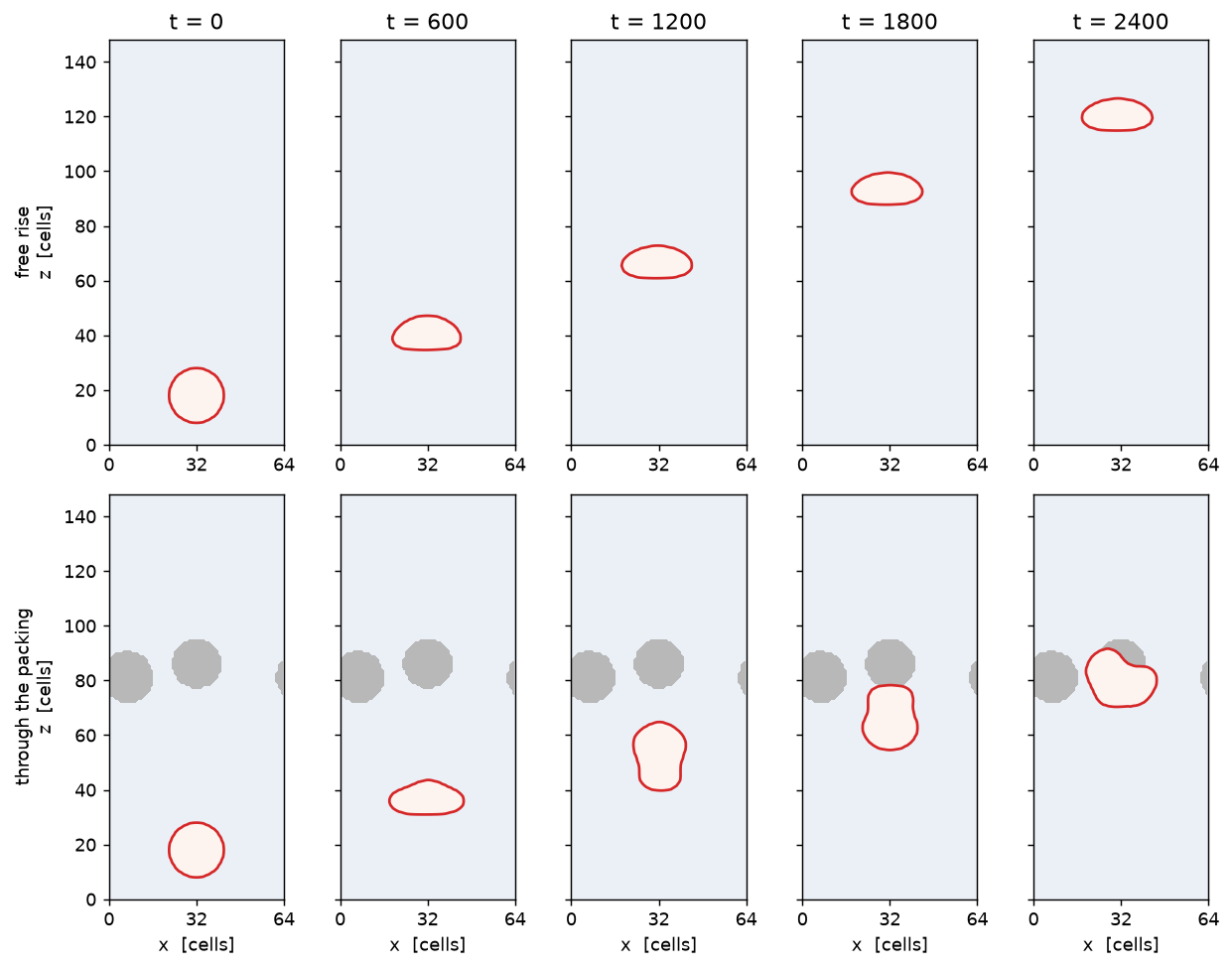
late = [t for t in LATE if t in bed["snaps"]]
fig, axes = plt.subplots(1, len(late), figsize=(9.6, 5.2), sharey=True, squeeze=False)
axes = axes[0]
for ax, tt in zip(axes, late):
    g_ = bed["snaps"][tt]
    draw(ax, g_, f"t = {tt:.0f}\n{fragments(g_)} blob(s)", True,
         ylim=(0.6 * BED_Z0, min(NZ, BED_Z1 + 30)))
    ax.set_xlabel("x  [cells]")
axes[0].set_ylabel("z  [cells]")
plt.tight_layout(); plt.show()

print(f"{'t':>8} {'z_c':>8} {'blobs':>7}")
for tt in sorted(bed["snaps"]):
    print(f"{tt:8.0f} {float(np.interp(tt, bed['t'], bed['zc'])):8.2f} "
          f"{fragments(bed['snaps'][tt]):7d}")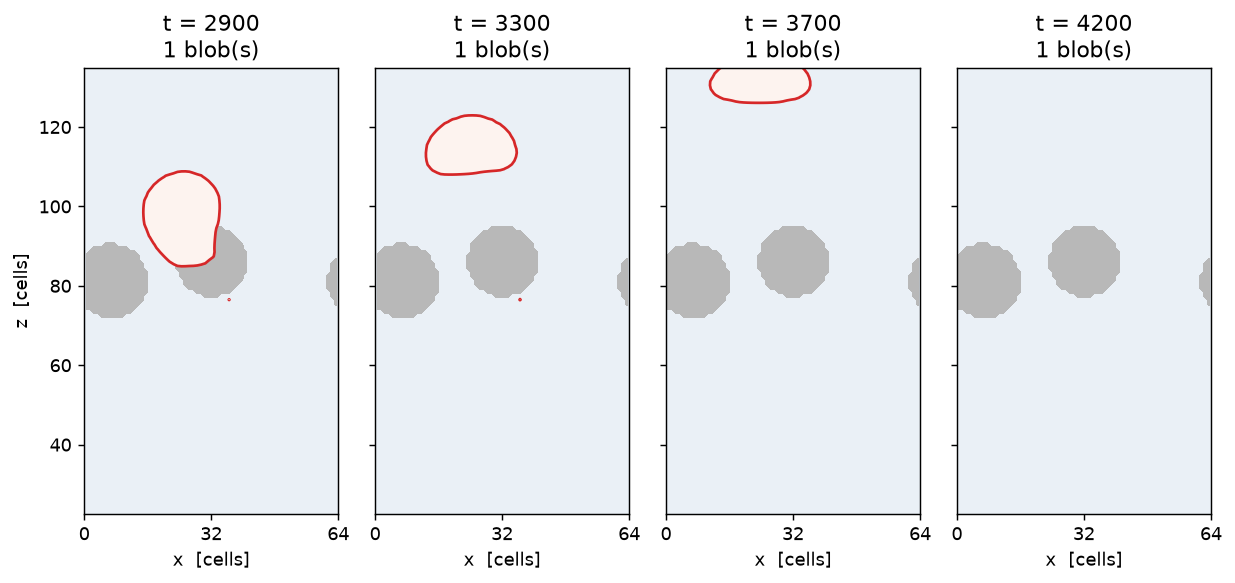
       t      z_c   blobs
       0    18.00       1
     600    36.13       1
    1200    52.86       1
    1800    65.51       1
    2400    79.24       1
    2900    97.67       1
    3300   114.61       1
    3700   131.58       1
    4200   151.52       1
3. The numbers
def terminal(r, frac=0.5):
    """mean colour-weighted rise velocity over the last (1 - frac) of the run"""
    return float(r["vc"][r["t"] > frac * r["t"][-1]].mean())

def arrest(r, ref):
    """longest stretch with V_c below a quarter of `ref`; returns (t_start, t_end)."""
    m = r["vc"] < 0.25 * ref
    best, cur = (0, 0), None
    for k, f in enumerate(m):
        cur = k if (cur is None and f) else cur
        if cur is not None and (not f or k == len(m) - 1):
            if k - cur > best[1] - best[0]:
                best = (cur, k)
            cur = None
    return float(r["t"][best[0]]), float(r["t"][best[1]])

V_FREE = terminal(ctl)
T_STALL, T_BREAK = arrest(bed, V_FREE)
Z_STALL = float(np.interp(T_STALL, bed["t"], bed["zc"]))
Z_BREAK = float(np.interp(T_BREAK, bed["t"], bed["zc"]))
print(f"free terminal rise velocity V_c = {V_FREE:.5f} cells/s = {V_FREE/ctl['Ug']:.3f} U_g")
print(f"the packed bubble's LONGEST arrest runs from t = {T_STALL:.0f} to t = {T_BREAK:.0f} "
      f"({T_BREAK-T_STALL:.0f} time units = "
      f"{(T_BREAK-T_STALL)/(2*R_BUB/V_FREE):.1f} free-rise diameters' worth of time)")
WHERE = ("against the underside of the bed"
         if Z_STALL < BED_Z0 + R_BUB else
         f"{(Z_STALL - BED_Z0) / (2 * R_GRAIN):.1f} grain diameters inside the bed")
print(f"   it happens at z_c = {Z_STALL:.1f} -> {Z_BREAK:.1f} ({WHERE}); "
      f"the bed spans z = {BED_Z0:.0f} .. {BED_Z1:.0f}")

fig, (a0, a1, a2) = plt.subplots(1, 3, figsize=(10.4, 3.6))
a0.axhspan(Z_BED + R_JAM - R_GRAIN, Z_BED + (BED_HI - BED_LO) - R_JAM + R_GRAIN,
           color="0.85", lw=0, zorder=0)
for r, col, lab in ((ctl, BLUE, "free rise"), (bed, RED, "through the packing")):
    a0.plot(r["t"], r["zc"], color=col, lw=1.7, label=lab)
    a1.plot(r["t"], r["vc"] / r["Ug"], color=col, lw=1.4, label=lab)
    a2.plot(r["t"], (r["vol"] - 1) * 1e15, color=col, lw=1.4, label=lab)
a1.axvspan(T_STALL, T_BREAK, color="0.85", lw=0, zorder=0)
a1.text(0.5 * (T_STALL + T_BREAK), 0.93 * a1.get_ylim()[1], "arrest", ha="center",
        fontsize=8, color="0.35")
a0.set(xlabel="t", ylabel="centroid $z_c$  [cells]", title="Centroid")
a1.set(xlabel="t", ylabel=r"$V_c / U_g$", title="Rise velocity")
a2.set(xlabel="t", ylabel=r"$(V/V_0 - 1)\times 10^{15}$", title="Gas volume drift")
a0.legend(fontsize=8, loc="upper left")
a1.legend(fontsize=8, loc="lower right")
plt.tight_layout(); plt.show()
free terminal rise velocity V_c = 0.04570 cells/s = 0.723 U_g
the packed bubble's LONGEST arrest runs from t = 721 to t = 792 (71 time units = 0.2 free-rise diameters' worth of time)
it happens at z_c = 37.9 -> 38.7 (against the underside of the bed); the bed spans z = 38 .. 105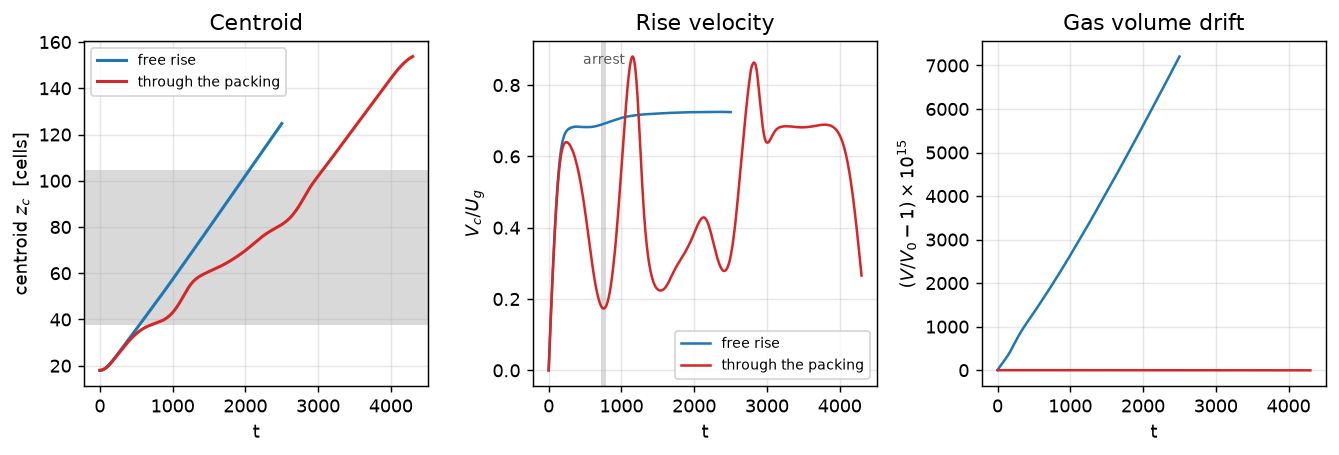
T_COMMON = float(min(ctl["t"][-1], bed["t"][-1]))     # compare over the SAME window

def mean_rise(r, tmax=None):
    m = r["t"] <= (tmax if tmax else r["t"][-1])
    return float((r["zc"][m][-1] - r["zc"][0]) / (r["t"][m][-1] - r["t"][0]))

V_MOVING = float(bed["vc"][bed["t"] > T_BREAK].mean())   # packed, AFTER breakthrough

print(f"{'':>26} {'steps':>7} {'z_c(T)':>9} {'rise/D':>8} {'V/V0 - 1':>11} "
      f"{'solid C':>10} {'iters':>9} {'max|div|':>10} {'wall s':>8}")
for r in (ctl, bed):
    print(f"{r['label']:>26} {r['steps']:7d} {r['zc'][-1]:9.2f} "
          f"{(r['zc'][-1]-r['zc'][0])/r['D']:8.2f} {r['vol'][-1]-1:11.2e} "
          f"{r['solid_sum']:10.1e} {r['iters']:6d}/{r['cap']} {r['div']:10.1e} "
          f"{r['wall']:8.0f}")

SLOWDOWN = mean_rise(ctl, T_COMMON) / mean_rise(bed, T_COMMON)
print(f"\nover the common window t <= {T_COMMON:.0f}:")
print(f"   mean advance   free {mean_rise(ctl, T_COMMON):.5f}   packed "
      f"{mean_rise(bed, T_COMMON):.5f}  cells/s   ->  factor {SLOWDOWN:.1f} slower")
print(f"   but AFTER breakthrough (t > {T_BREAK:.0f}) the packed bubble moves at "
      f"{V_MOVING:.5f} = {V_MOVING/V_FREE:.2f} x the free terminal velocity")
steps z_c(T) rise/D V/V0 - 1 solid C iters max|div| wall s
free rise (no packing) 2016 124.77 5.34 7.21e-12 0.0e+00 24/600 6.3e-15 1674
through the packing 3797 153.74 6.79 -3.44e-15 0.0e+00 23/600 2.8e-14 2335
over the common window t <= 2501:
mean advance free 0.04269 packed 0.02523 cells/s -> factor 1.7 slower
but AFTER breakthrough (t > 792) the packed bubble moves at 0.03468 = 0.76 x the free terminal velocityThree statements worth separating.
Conservation survives the composition. The gas volume drifts by 3.4e-15 relative over 3797 steps in the packed run, against a projected flux divergence of 2.8e-14 — the Weymouth–Yue transport is exactly conservative and inherits the projection’s residual, nothing more, exactly as it does in a bare box. The colour inside the grains is 0.0e+00: the transport never leaks gas or liquid into the solid, and the band the curvature stencils read is a separate working field. Note which run is the tidier of the two: the control, with no solid at all, drifts by 7.2e-12, three orders worse than the run with cut cells in it — visible as the sloping blue line in the right-hand panel above. Both are negligible, and neither is explained by its own divergence number; the observation is recorded in ISSUES.md rather than rationalised here.
The projection is comfortable. 23 iterations against a cap of 600 at the worst step, on a variable-density operator with a hundredfold density contrast and cut cells. That is the number to watch when adapting this: it is what would break first.
The bed costs a factor 1.7 in rise speed, and it charges in two separate currencies. The first is a capillary threshold: the gas cannot enter a throat until the head over its own vertical extent exceeds \(2\sigma\cos\theta/r_t\), so it flattens against the constriction and waits. The longest such arrest in this run holds the bubble from \(t \approx\) 721 to \(t \approx\) 792 — 0.2 free-rise bubble diameters’ worth of time — at \(z_c \approx\) 38 cells, against the underside of the bed. The second currency is ordinary drag: what gets past travels on at 0.76 of the free terminal velocity.
How the two shares divide is a property of the particular bed, and violently so. dem’s contact solve accumulates with float atomics on the GPU, so it is not bit-reproducible: every execution of this page settles a statistically equivalent packing rather than the same one, which turns the page into its own small ensemble study. The execution immediately before the one you are reading built a denser bed from the identical protocol — porosity 0.61 against 0.64 here, percolation throat 5.34 cells against 5.67 — and there the longest arrest lasted 1300 time units, three free-rise diameters, for a net factor 2.7 slower rather than 1.7. A six per cent difference in the bottleneck radius moved the waiting time by more than an order of magnitude. Equation 2 says it should: the threshold scales as \(D^{2}/r_t\) against a head the bubble can only raise by deforming, and near the point where the two balance the waiting time is a very stiff function of the geometry. That sensitivity, not any single number on this page, is the transferable result — and it is why a bubble column is so unforgiving of how its bed was packed.
4. The movie
The C = \tfrac12 isosurface of the gas, with the grains cut away at the mid-plane so the interface stays visible.
import pyvista as pv
import imageio.v2 as imageio
pv.global_theme.allow_empty_mesh = True

def render(gas, size=(528, 944)):
    grid = pv.ImageData(dimensions=(NX + 1, NX + 1, NZ + 1))
    grid.cell_data["gas"] = np.asarray(gas, dtype=np.float64).flatten(order="F")
    grid.cell_data["solid"] = np.asfortranarray(SDF).flatten(order="F")
    pt = grid.cell_data_to_point_data()
    pl = pv.Plotter(off_screen=True, window_size=size)
    pl.background_color = "white"
    solid = pt.clip(normal="y", origin=(NX / 2, 0.58 * NX, NZ / 2)).contour(
        [0.0], scalars="solid")                     # cut the grains open at the mid-plane
    if solid.n_points:
        pl.add_mesh(solid, color="#aab6c4", smooth_shading=True, specular=0.3)
    iso = pt.contour([0.5], scalars="gas")          # the C = 1/2 gas isosurface
    if iso.n_points:
        pl.add_mesh(iso, color="#e8873a", smooth_shading=True, specular=0.6)
    pl.add_mesh(grid.outline(), color="#7a7a7a", line_width=1.0)
    pl.camera_position = "xz"
    pl.camera.azimuth, pl.camera.elevation = 32.0, 14.0
    pl.reset_camera(); pl.camera.zoom(1.45)
    img = pl.screenshot(return_img=True)
    pl.close()
    return img

MP4 = "bubble_through_packing.mp4"
writer = imageio.get_writer(MP4, fps=12, quality=8)
for gas in bed["frames"]:
    writer.append_data(render(gas))
writer.close()
print(f"{len(bed['frames'])} frames -> {MP4}")
151 frames -> bubble_through_packing.mp4picks = np.linspace(0, len(bed["frames"]) - 1, 4).astype(int)
fig, axes = plt.subplots(1, len(picks), figsize=(10.0, 5.4))
for ax, k in zip(axes, picks):
ax.imshow(render(bed["frames"][k], size=(400, 720)))
ax.axis("off")
ax.set_title(f"frame {k+1}/{len(bed['frames'])}", fontsize=8)
plt.tight_layout(); plt.show()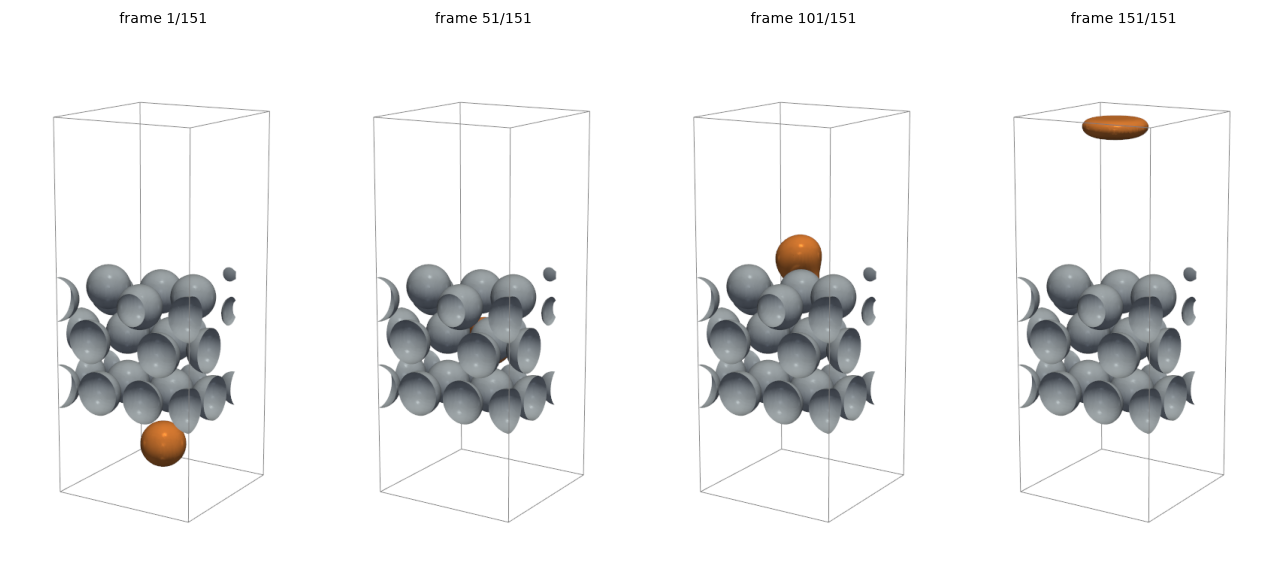
5. Density ratio 1000
Ratio 100 is the validated regime for the momentum-consistent cut-cell path. Ratio 1000 — air in water — is the one everybody wants, so it is run, at the same \(\mathrm{Eo}\) and \(\mathrm{Mo}\) and for a shorter time, and reported whatever it does.
bed1k = column(packed=True, ratio=1000.0, T=2200.0, label="packing, ratio 1000")
print(f"ratio 1000: {bed1k['steps']} steps, t = {bed1k['t'][-1]:.0f} of {bed1k['T']:g}, "
      f"{bed1k['wall']:.0f} s"
      f"{'   *** NON-FINITE, ABORTED ***' if bed1k['nan'] else ''}"
      f"{'   *** PRESSURE CAPPED, ABORTED ***' if bed1k['capped'] > 20 else ''}"
      f"{('   *** ' + bed1k['aborted'] + ' ***') if bed1k['aborted'] else ''}")
print(f"  gas volume V(T)/V(0) = {bed1k['vol'][-1]:.10f}")
print(f"  colour inside the grains {bed1k['solid_sum']:.2e}, "
      f"clipped volume {bed1k['clipped']:.2e}")
print(f"  pressure {bed1k['iters']}/{bed1k['cap']} "
      f"{'OK' if bed1k['iters'] < bed1k['cap'] else '*** CAPPED -> INVALID ***'}, "
      f"max|div(open u)| {bed1k['div']:.2e}")
print(f"  centroid {bed1k['zc'][0]:.1f} -> {bed1k['zc'][-1]:.1f} cells")

m = bed["t"] <= bed1k["t"][-1]
print(f"\n{'over the same window':>26} {'z_c':>9} {'V/V0 - 1':>11} {'iters':>9} {'max|div|':>10}")
for r, mm in ((bed, m), (bed1k, np.ones_like(bed1k["t"], bool))):
    print(f"{r['label']:>26} {r['zc'][mm][-1]:9.2f} {r['vol'][mm][-1]-1:11.2e} "
          f"{r['iters']:6d}/{r['cap']} {r['div']:10.1e}")

OK1K = not (bed1k["nan"] or bed1k["aborted"] or bed1k["iters"] >= PRESS_CAP)
R1K_VERDICT = ("Nothing in that table moves when the density contrast goes up by a "
               "factor of ten." if OK1K else
               "The ratio-1000 run did NOT survive its window, and the table above says "
               "how far it got before it stopped.")
ratio 1000: 1894 steps, t = 2198 of 2200, 1658 s
gas volume V(T)/V(0) = 1.0000000000
colour inside the grains 0.00e+00, clipped volume 0.00e+00
pressure 25/600 OK, max|div(open u)| 4.25e-14
centroid 18.0 -> 75.7 cells
over the same window z_c V/V0 - 1 iters max|div|
through the packing 74.93 6.66e-16 23/600 2.8e-14
packing, ratio 1000 75.72 -3.00e-15 25/600 4.3e-14Nothing in that table moves when the density contrast goes up by a factor of ten. The gas volume drifts by 3.0e-15 relative, the colour inside the grains is 0.0e+00, the worst pressure solve is 25 iterations out of 600, and over the window they share the two centroids differ by 0.9 %. Ratio 1000 is exactly where an inconsistent VoF momentum transport is known to come apart (Rudman 1998; Arrufat et al. 2021), so the reason this can be attempted at all is that enable_vof_momentum composes with the cut cells: the same geometric fluxes carry \(C\) and \(\rho^c\mathbf{u}\), and the uniform-velocity identity that underwrites it is bitwise in a cut cell too. The thing to watch at this contrast is not the volume — the transport’s conservation is structural — but the pressure iteration count, because the variable-coefficient Poisson operator’s condition number grows with the density ratio. That is the number the table puts next to it, and it is the one that would break first on a longer run or a tighter bed.
Collocated cross-check
peclet also ships a cell-centred grid (flow.SolverColocated), and since rung V8 it runs two-phase flow: variable density inside the approximate (ABC) projection, with buoyancy and surface tension applied as face accelerations and the colour advected by the projected face field.
The packed case cannot be run there, and that is a scope statement, not a defect. Rung V8 is all-fluid: the cut-cell colour transport — openness-weighted fluxes, the solid-band fill, the contact-angle plane — exists on the staggered grid only, and the composition is refused rather than silently approximated.
n = 32
q = np.arange(n) + 0.5
one_grain = np.asfortranarray(np.sqrt((q[:, None, None] - n / 2) ** 2
                                      + (q[None, :, None] - n / 2) ** 2
                                      + (q[None, None, :] - n / 2) ** 2) - 8.0)
sc = flow.SolverColocated(n, n, n)
sc.set_rho(1.0); sc.set_mu(0.1)
sc.set_solid(one_grain, cutcell_pressure=True)     # ONE grain is enough to trip the guard
try:
    sc.enable_vof()
    print("enable_vof() succeeded — the packed case would run on the collocated grid")
except RuntimeError as e:
    print(f"enable_vof() after set_solid raised RuntimeError:\n  {e}")
try:
    flow.SolverColocated(8, 8, 8).enable_vof_momentum(1.0, 100.0)
except RuntimeError as e:
    print(f"\nenable_vof_momentum on the collocated grid: RuntimeError\n  {str(e)[:150]}")
enable_vof() after set_solid raised RuntimeError:
enable_vof: geometric VoF on SolverColocated (rung V8) is ALL-FLUID only — an immersed solid needs the cut-cell face acceleration and the matching one-sided closures, which is a later rung. Use the staggered Solver (rung V5a supports cut cells).
enable_vof_momentum on the collocated grid: RuntimeError
enable_vof_momentum: momentum-consistent VoF transport is STAGGERED-ONLY (rung V2b); the collocated construction is Favre-averaged face states, rung VWhat can be cross-checked is the control — the free rise in the same closed column, which is all-fluid. enable_vof_momentum is staggered-only, so the honest pair is the two grids with momentum consistency off on both.
T_CO = 1500.0
ctl_nc = column(packed=False, momentum=False, T=T_CO, label="control, staggered, no mom.")
ctl_co = column(packed=False, momentum=False, T=T_CO, cls=flow.SolverColocated,
                label="control, collocated, no mom.")
print(f"{'free rise, ratio 100, momentum consistency OFF':>46} {'z_c(T)':>9} {'dz_c/dt':>10} "
      f"{'/U_g':>7} {'V/V0-1':>10} {'iters':>9}")
for r in (ctl_nc, ctl_co):
    print(f"{r['label']:>46} {r['zc'][-1]:9.2f} {mean_rise(r):10.5f} "
          f"{mean_rise(r)/r['Ug']:7.3f} {r['vol'][-1]-1:10.1e} {r['iters']:6d}/{r['cap']}")
DCO = 100 * (mean_rise(ctl_co) / mean_rise(ctl_nc) - 1)
print(f"\ncollocated vs staggered rise speed: {DCO:+.2f} %")
peclet::flow SolverColocated: AUTO scheme fell back to gauge-exact (configuration unsupported by the ghost projection v1). Select explicitly with set_collocated_scheme to silence this notice.free rise, ratio 100, momentum consistency OFF z_c(T) dz_c/dt /U_g V/V0-1 iters
control, staggered, no mom. 78.82 0.04057 0.641 4.0e-12 23/600
control, collocated, no mom. 79.04 0.04078 0.645 4.0e-12 22/600
collocated vs staggered rise speed: +0.53 %The two grids agree on the free rise to 0.5 %. That is the useful statement here: the collocated path reproduces the fluid half of this page, and everything the packing adds — the cut-cell transport, the wetting fill, the momentum consistency — is staggered-only today. The rising bubble page states the other half of the rating: collocated two-phase flow is honest to density ratio \(\lesssim 100\) for cases with motion.
What this page does not establish
- There is no reference solution. No published benchmark exists for this geometry, and none is claimed. The control is the yardstick, and it is a weak one: it fixes the fluid pair and the column, not the answer.
- The contact angle is static. \(\theta\) does not depend on the contact-line velocity — no dynamic angle, no hysteresis — and a bubble squeezing through a throat is exactly the situation where an advancing and a receding line differ. At \(\theta = 60°\) the liquid wets, so the gas mostly keeps a film between itself and the grains and the contact line is short; that is why this scene was chosen, and it is also why the number to distrust would be one that depended on \(\theta\). See droplet wetting for the accuracy the static model has (≈ 1° up to 90°, and a contact radius of ten cells or more).
- One realisation, one resolution. A packing is a random object; this is one seed. The throat the bubble happens to meet first is a property of that seed.
- The bottleneck is 11 cells across. That is enough for the geometric transport, but an interface that fills such a throat gives the height-function curvature cascade only a few columns to fit, so the curvature there is its least accurate branch. A resolution study at fixed \(\mathrm{Eo}\) and fixed geometry is the missing measurement, and it is the one that would say how much of the arrest time above is physics.
- The packing is not bit-reproducible.
dem’s contact solve accumulates forces with float atomics on the GPU, so the settled centres differ slightly between runs and a re-execution of this page gets a statistically equivalent bed, not the same one — with a different bottleneck and a different arrest. Everything quoted here is inline from the frozen execution; the qualitative statements are the ones that carry over.
Adapt this yourself
- Trap the bubble. Raise
F_SDFtowards 1 (grains nearer to contact) or lowerEo, and Equation 2 stops being satisfiable: the bubble parks under a throat and stays. That is capillary trapping, and it is the whole subject of residual gas saturation in porous media. - Non-wetting gas.
set_contact_angle(120)makes the gas cling to the grains instead of avoiding them, which changes both the entry pressure and the path.set_contact_angle_field(theta_array)gives mixed wettability — a per-cell angle, so a patchily wetted bed is one array away. - A train of bubbles. Add a second sphere to
bubble_colour, or replace the closed floor by a two-phase inflow (set_vof_inflow) and inject continuously. - A real bed. Swap
settle_bedfor the Lubachevsky–Stillinger packing of the random packed bed page, or for the Pall rings — the fluid side does not change, only the SDF. - Go multi-rank. The identical script runs under
mpirun -np N python …; the cut-cell VoF transport and the solid-band fill are built on the inner region and exchanged, so the filled colour is decomposition-independent.
Reproduce this
The compiled solver runs this, so its outputs are frozen into the site. To regenerate:
pip install peclet            # CPU wheels; for CUDA: pip install peclet-flow-cu13
PECLET_FLOW_EXACT_RESIDUAL=1 quarto render examples/bubble-through-packing/index.qmd --execute
# ...or against local source builds of the suite (GPU):
PECLET_LOCAL_BUILD=/path/to/suite/flow/build_cuda:/path/to/suite/dem/build_cuda \
PECLET_FLOW_EXACT_RESIDUAL=1 OMP_NUM_THREADS=8 OMP_PROC_BIND=false \
  quarto render examples/bubble-through-packing/index.qmd --execute
The solver-side gates for the pieces this page composes are, in the flow repo, the vof_cutcell, vof_wetting and vof_collocated ctests with their MPI twins at np = 1/2/4, and the study scripts tests/study/vof_wetting.py and tests/study/vof_surface_tension.py.
References
Arrufat, T., M. Crialesi-Esposito, D. Fuster, et al. 2021. “A Mass-Momentum Consistent, Volume-of-Fluid Method for Incompressible Flow on Staggered Grids.” Computers & Fluids 215: 104785. https://doi.org/10.1016/j.compfluid.2020.104785.
Brackbill, J. U., D. B. Kothe, and C. Zemach. 1992. “A Continuum Method for Modeling Surface Tension.” Journal of Computational Physics 100 (2): 335–54. https://doi.org/10.1016/0021-9991(92)90240-Y.
Clift, R., J. R. Grace, and M. E. Weber. 1978. Bubbles, Drops, and Particles. Academic Press.
Rudman, Murray. 1998. “A Volume-Tracking Method for Incompressible Multifluid Flows with Large Density Variations.” International Journal for Numerical Methods in Fluids 28 (2): 357–78. https://doi.org/10.1002/(SICI)1097-0363(19980815)28:2<357::AID-FLD750>3.0.CO;2-D.
Weymouth, G. D., and Dick K.-P. Yue. 2010. “Conservative Volume-of-Fluid Method for Free-Surface Simulations on Cartesian-Grids.” Journal of Computational Physics 229 (8): 2853–65. https://doi.org/10.1016/j.jcp.2009.12.018.