peclet.flow vs FoxBerry — strong scaling
Head-to-head on FoxBerry’s own 64M-cell benchmark cases, 24 → 1536 cores on Snellius
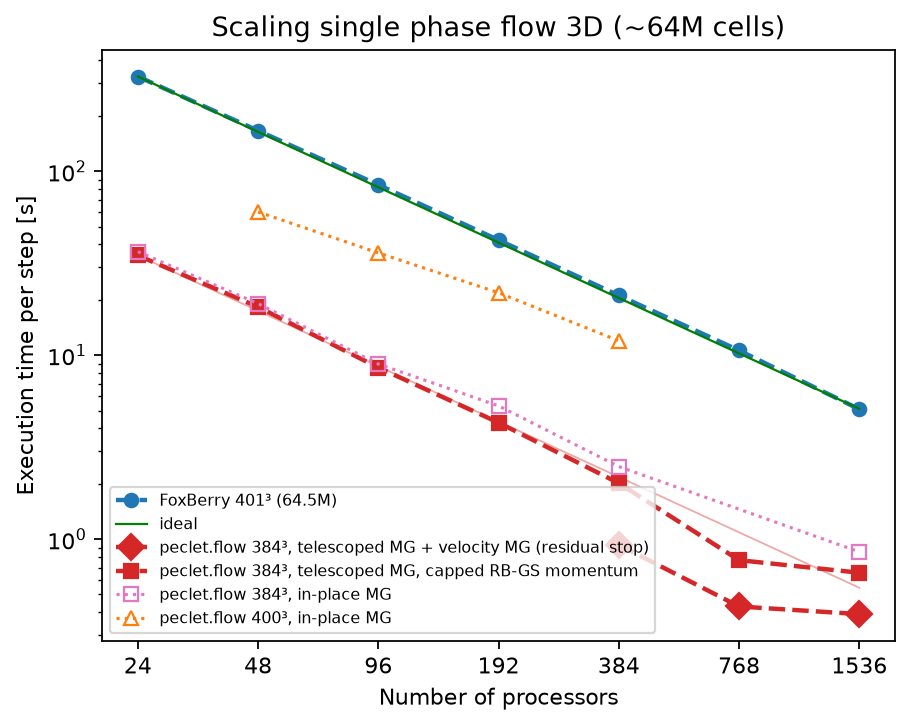
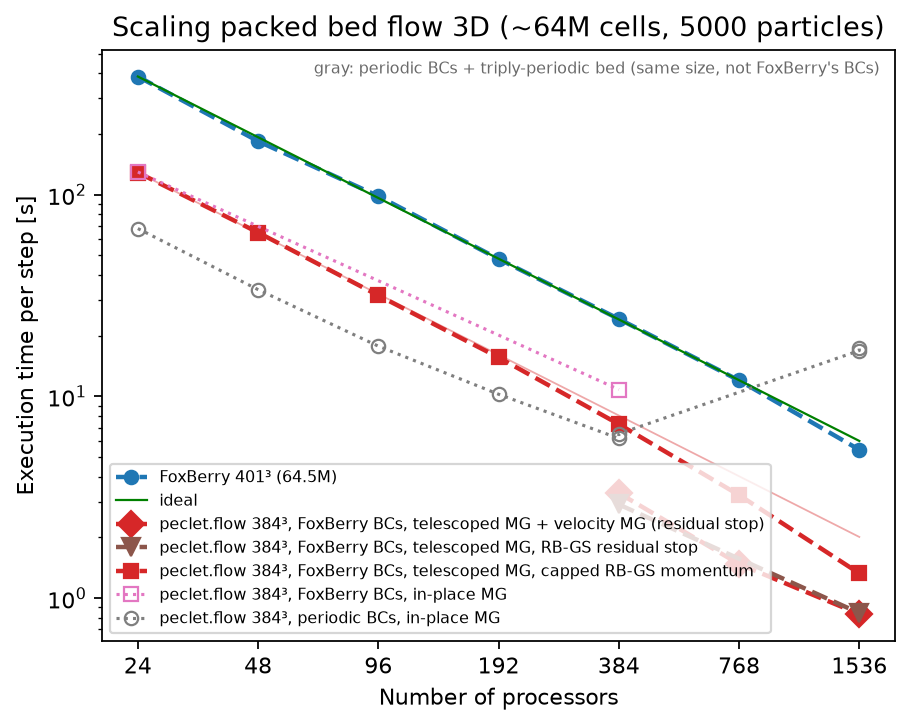
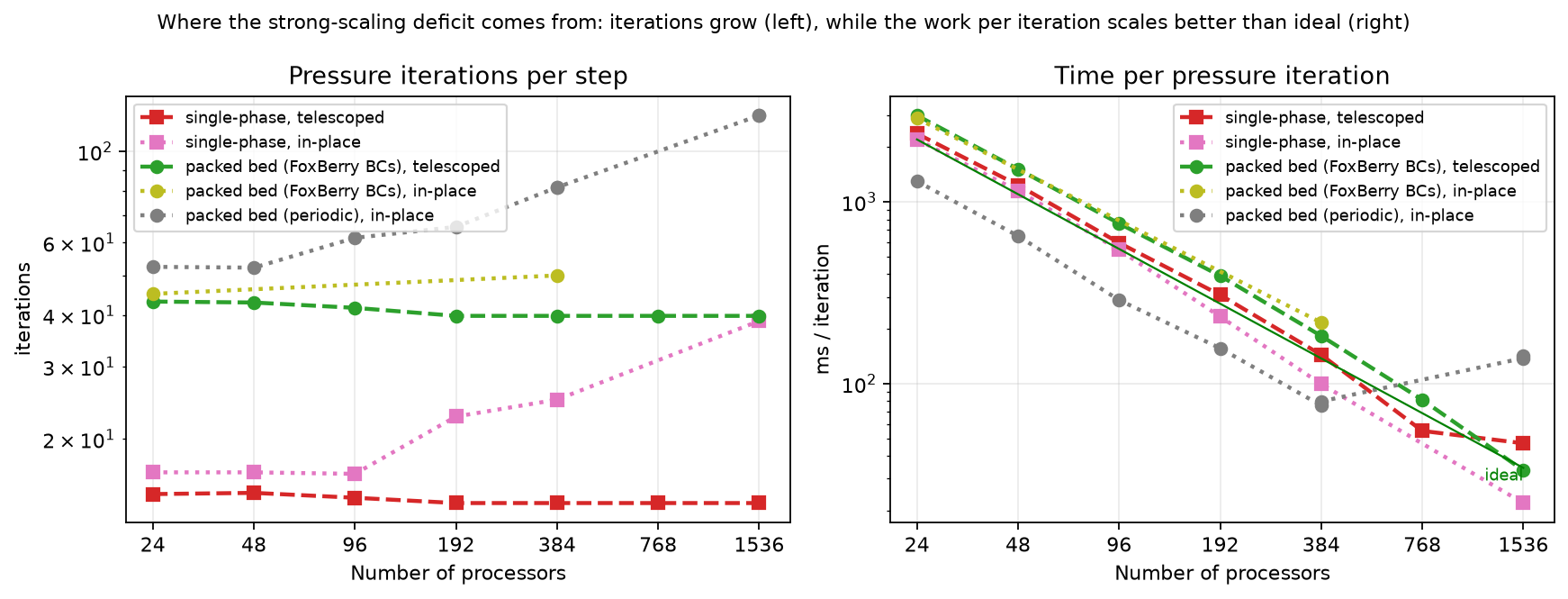
Second campaign, complete ladder. Since the first (2026-09-01) the pressure multigrid gained coarse-level telescoping on the ORB tree — the coarse-grid limit that capped the first ladder is gone — the packed bed runs with FoxBerry’s own boundary conditions (inlet/outlet, four walls, wall-confined bed), and the intermittent multi-node hang that blocked the top rungs was root-caused to a consensus-protocol race in the halo topology builder and fixed. Pressure iteration counts are flat from 24 to 1536 cores on both cases. Third pass, same day: the momentum solve — which had become the dominant cost — was found to be stopping on the wrong criterion and burning its sweep cap; with a residual-based stop and a velocity multigrid that now runs under MPI the packed-bed step is another 2.2× faster (0.834 s at 1536 cores, 6.5× FoxBerry) and the single-phase one 1.7–2.2× (0.391 s, 13×). Those points are the diamonds on the graphs.
Reproduces the two 3-D strong-scaling cases of FoxBerry’s scaling/Scaling.cpp with peclet.flow, so the results drop straight onto FoxBerry’s own graphs: log–log, execution time per step against processor count, ~64M cells, the ladder 24 → 1536. Both codes are pure MPI, one rank per core, on Snellius genoa nodes (192 cores each).
What is being compared
| FoxBerry | peclet.flow | |
|---|---|---|
| Pressure solve | AMG (Trilinos/MueLu), tol 1e-14 | geometric multigrid (8 levels, telescoped) + MG-PCG, rtol 1e-8 |
| Grid | 401³ = 64.5M | 384³ = 56.6M |
| Momentum | implicit, Chebyshev-preconditioned | implicit, Red–Black Gauss–Seidel |
| Operator precision | double | double on the packed bed (-DPECLET_FLOW_MREAL_DOUBLE), float single-phase |
The grid differs because peclet’s geometric multigrid coarsens an axis only while it stays even, so an odd dimension never coarsens at all — 401³ would cripple the pressure solve for reasons unrelated to parallelism. Among even neighbours the factorization decides everything: 384 = 2⁷·3 gives seven halvings and divides the whole rank ladder cleanly, where 400 = 2⁴·25 gives four. A 400³ series is kept as a cell-count-matched control; the gap between the two curves is the price of grid factorization.
The packed bed needs the double-precision operator build: float operator storage breaks the row-sum identity A·1 = 0 at ~1e-7 per row, which three decades of cut-cell aperture contrast amplify until MG-PCG floors and rebounds. The float build caps at 384³ on this bed while the fp64 build converges in ~40 iterations — and is 2× faster in wall clock. Single-phase is unaffected.
Case 1 — single-phase flow
Unit box, inlet u=1, outlet, four no-slip walls, ρ=μ=1, 100 steps.
| cores | FoxBerry [s] | peclet [s] | speedup | pressure iters | efficiency vs 24 |
|---|---|---|---|---|---|
| 24 | 327 | 34.8 | 9.4× | 14.7 | 100 % |
| 48 | 166 | 18.3 | 9.1× | 14.8 | 95 % |
| 96 | 84.3 | 8.56 | 9.9× | 14.4 | 102 % |
| 192 | 42.2 | 4.29 | 9.8× | 14.0 | 101 % |
| 384 | 21.1 | 2.01 | 10.5× | 14.0 | 108 % |
| 768 | 10.6 | 0.768 | 13.8× | 14.0 | 142 % |
| 1536 | 5.08 | 0.656 | 7.7× | 14.0 | 83 % |
With the momentum fix (velocity MG, residual stop 1e-5 — the diamonds): 0.930 / 0.430 / 0.391 s at 384 / 768 / 1536 cores, 22.7× / 24.6× / 13.0× FoxBerry, pressure iterations 13.8 unchanged.
peclet is 8–14× faster than FoxBerry across the whole ladder. The pressure iteration count is flat at 14 from 24 to 1536 cores. The super-linear efficiency through 768 is the shrinking per-rank block fitting cache (the 24–96 rungs share one node’s memory bandwidth, which flatters the baseline and so understates these efficiencies further); at 1536 the single-phase step is down to 37 k cells per rank and the 200-odd momentum sweeps per step, each with a halo exchange, become latency-bound — 768 → 1536 buys only 1.17×, and FoxBerry’s curve, still on ideal halving there, closes to 7.7×.
The dashed pink series is the same solver with telescoping off: identical to 96 cores, then the iteration count climbs (16.6 → 24.9 at 384, 38.7 at 1536) as the hierarchy is cut short. At 384 cores telescoping is worth 24.9 → 14.0 iterations and 2.48 → 2.01 s/step.
Case 2 — packed bed, 5000 spheres
Same box and boundary conditions as case 1 — inlet, outlet, four no-slip walls — with 5000 static spheres at solid holdup 0.45, cut-cell IBM, D/Δ ≈ 21 cells. The bed is grown by peclet.dem inside six SDF walls inset from the box faces, so sphere centres lie in [0.01, 0.99] exactly as in FoxBerry’s Scaling.cpp; no sphere cuts the inlet or outlet plane.
| cores | FoxBerry [s] | peclet [s] | speedup | pressure iters | efficiency vs 24 |
|---|---|---|---|---|---|
| 24 | 385 | 129 | 3.0× | 43.1 | 100 % |
| 48 | 184 | 64.9 | 2.8× | 42.9 | 99 % |
| 96 | 98.3 | 31.6 | 3.1× | 41.7 | 102 % |
| 192 | 48 | 15.6 | 3.1× | 39.8 | 103 % |
| 384 | 24.2 | 7.28 | 3.3× | 39.8 | 110 % |
| 768 | 12 | 3.24 | 3.7× | 39.8 | 124 % |
| 1536 | 5.44 | 1.33 | 4.1× | 39.8 | 151 % |
With the momentum fix (residual stop 1e-5 — the diamonds / triangles): velocity MG 3.32 / 1.48 / 0.834 s at 384 / 768 / 1536 cores, RB-GS with the residual stop 2.91 / – / 0.844 s — 8.3× / 8.1× / 6.5× FoxBerry, pressure iterations 39.8 unchanged, <u> and max|div| identical to the capped runs to seven digits, and 99.5 % strong-scaling efficiency from 384 to 1536 on the MG series.
3.0–4.1× faster than FoxBerry with flat iteration counts (43 → 40) and ≥ 99 % efficiency across the whole ladder, super-linear at the top (124 % at 768, 151 % at 1536 — unlike the single-phase case, this step is dominated by the momentum sweeps, which are compute-bound and keep gaining from cache as the block shrinks). Every run converged to rtol 1e-8 on every step (max 45 iterations against a cap of 200); runs with any capped step are rejected, not plotted. The 100-step rungs at 192 / 384 / 768 / 1536 agree on <u> and max|div| to seven digits, which is the acceptance test for a clean halo topology (below).
The A/B against the in-place hierarchy at 384 cores: 49.9 iterations (max 69) and 10.8 s/step without telescoping, 39.8 (max 45) and 7.28 s with — a third off the step. At 24 cores the two are identical (129.5 vs 128.7 s): the hierarchy already reaches full depth there and telescoping correctly costs nothing.
The gray series is the first campaign’s stand-in (periodic box, triply-periodic bed, in-place multigrid); it is kept because it shows the cliff the old hierarchy fell off at 1536 cores.
What changed: telescoping on the ORB tree
A multigrid level here used to coarsen an axis only if every rank’s block was even on it, because coarse levels had to be the fine decomposition coarsened in place (which keeps restriction and prolongation purely local). When no axis qualified the hierarchy simply stopped: at 1536 ranks with 24×48×32 blocks it stopped at 24×48×24 globally, several levels short of the 3³ the grid allows, and the preconditioner weakened accordingly — the first campaign measured the whole strong-scaling loss to be that iteration growth, with time per iteration scaling super-linearly.
The fix is the standard one (PETSc PCTELESCOPE, MueLu RepartitionFactory, hypre’s redundant coarse solve, DUNE’s accumulation), done geometrically on the decomposition peclet already has. The ORB partition is a bisection tree; truncating that tree merges sibling blocks into a valid coarser partition on fewer ranks. When a level’s blocks can no longer coarsen (an odd extent on a coarsenable axis) or drop below 4 cells on a side, the level’s residual is gathered at its own resolution onto the root rank of each merged group, restricted there, and the V-cycle recurses on a sub-communicator of the roots; the correction is prolonged and scattered back. The other ranks wait at that level — on a 24³ grid there is no work for them to lose. The measured ladders:
| ranks | levels (global grid @ ranks holding it) |
|---|---|
| 24 | 384³@24 → … → 12³@24 → 6³@1 → 3³@1 |
| 384 | 384³@384 → … → 24³@384 → 12³@8 → 6³@8 → 3³@1 |
| 768 | 384³@768 → … → 24³@768 → 12³@8 → 6³@8 → 3³@1 |
| 1536 | 384³@1536 → … → 24³@1536 → 12³@64 → 6³@64 → 3³@1 |
Every ladder now bottoms at 3³ on one rank, the same as a single-rank solve, which is why the iteration counts are rank-independent. The transfer needs no halo exchange (restriction and prolongation are inner-only), the gather is a few kB per rank, and the only new communication is a Gatherv/Scatterv per telescoped level per V-cycle. It is opt-in for now (PECLET_FLOW_TELESCOPE=1, Solver.set_pressure_telescope(True)); flow.predict_hierarchy prints the ladder any grid/rank count would get, without launching anything.
The momentum solve: stopping on the wrong criterion
With the pressure iterations flat, the packed-bed step was 63 % momentum solve at 384 cores: the implicit-diffusion Red–Black Gauss–Seidel hit its cap of 200 sweeps per component on every step (ν·Δt/Δx² ≈ 4×10⁴ here). The a-priori study at 96³ showed what that cap was buying: nothing. The stop rule was “update ≤ 10⁻³ × the first sweep’s update”, and on a warm-started, near-steady step the first update is already at noise level — the update-stopped solve and one run 25× longer agree to 1e-14, both being the same stalled iteration. The rule demanded a thousandfold reduction of noise, and the cap was its only exit.
The fix is a residual-based stop: end a component’s solve once max|b − A u| ≤ rtol · max(max|b|, max|A u|) over the solved unknowns (the forcing enters through the inflow ghost, not through b, hence the scale; the held inflow face is imposed, not solved, hence excluded). At 96³ the RB-GS drops from 468 to 24 sweeps per step at rtol 10⁻³ and 51 at 10⁻⁵, with errors matching the tolerance. On the same occasion the velocity multigrid was wired under MPI — on the solver’s own decomposition, with a new operator for the case of an immersed solid with domain BCs (level 0 the sharp cut-cell stencil with the implicit-upwind advection the domain-BC path always used, coarse levels a staircase Helmholtz with the domain-face folds) — and it converges to the same fixed point as RB-GS to 2e-11.
At scale the two are close: at 384 cores RB-GS with the residual stop is slightly cheaper (2.91 vs 3.32 s), at 1536 the V-cycle’s fewer halo exchanges win (0.834 vs 0.844 s); both cut the step by 2.2× against the capped run and leave the pressure iteration count and the solution (seven digits) unchanged. A tolerance of 10⁻³ is too loose — it leaves the momentum residual at 8e-4 and the pressure solve pays for it (14 → 30 iterations on the single-phase case); 10⁻⁵ costs one extra V-cycle and restores it. The velocity hierarchy needs no depth on a pore-confined bed (2, 3 and 5 levels give identical cycle counts: the coarse grid only serves the clean fluid interior), so it needs no telescoping where the pressure hierarchy did.
What remains at the top of the single-phase ladder is latency: 37 k cells per rank at 1536 cores, 768 → 1536 buys 1.1× (the pressure solve’s 14 V-cycles with their per-level exchanges), which is why FoxBerry’s curve, still on ideal halving there, closes from 25× to 13×. Two caveats belong with every 1536-core number here: node placement — the same configuration measured 0.391 s on one allocation and 0.256 s on another (a defaults-only verification run), and 0.834 vs 0.786 s on the bed, so the top rung carries a ±30 % allocation spread that the lower rungs do not — and the communication-light Chebyshev pressure driver brings nothing on this hardware: against a same-allocation PCG control it is 0.251 vs 0.256 s single-phase (14 iterations either way) and 4.18 vs 0.79 s on the bed (238 iterations against 40; the cut-cell operator’s spectrum is not the interval it assumes). The shipped defaults are slightly more conservative than the diamonds: the momentum tolerance follows the pressure solver’s (1e-8 here) rather than a fixed 1e-5, because the projection is what consumes u* and resolves what the momentum residual leaves to its own tolerance — no free constant, and the single-GPU regression suite is then identical to its baseline step for step. A run with no tuning flags at all (telescoping on, coupled tolerance, the velocity-MG auto rule) measures 3.31 s packed at 384, 0.898 s packed and 0.368 s single-phase at 1536 — 7.3× / 6.1× / 13.8× FoxBerry, <u> and max|div| to seven digits as above.
The rung that would not run
Runs at 768 and 1536 ranks hung intermittently in the first warm-up step, with every rank blocked in MPI_Waitall inside a ghost-layer exchange, on both the telescoped and the in-place hierarchy. A stack census of a hung 1536-rank job (parallel gdb over all 192 ranks of a node) placed 178 ranks in the telescope Scatterv and the 8 group roots in the halo exchange of the 64-rank sub-hierarchy — the first exchange on a freshly built topology. A halo timeout diagnostic that prints every unmatched request (partner, byte count, level) then named it: on that level every rank had all 26 receive partners but only 0–26 of its 26 send partners.
The cause was in the consensus protocol (NBX) that builds each level’s topology: consecutive rounds on one communicator shared a tag, so a rank that had already seen round k’s barrier complete could post round k+1’s messages while a neighbour still draining round k took them as round-k messages. The receive side of a topology is computed locally, the send side is learned from the round — so the victim never learned it had to send. Larger communicators, larger barrier skew, more likely: hence ≥ 4 nodes, and intermittent. The engine now rotates the tag per round through a per-communicator counter, the topology builder cross-checks promised against requested cells and throws on a mismatch, and a regression test drives hundreds of back-to-back rounds (it fails on a laptop with the rotation removed). The rungs above were all re-measured on the fixed engine.
Reading the numbers fairly
- The 24/48/96 rungs sit on one
--exclusivenode, so they have up to 8× the memory bandwidth per rank of the 192-rank run. That flatters the baseline and therefore understates the efficiencies quoted above; the apples-to-apples segment is 192 → 1536 (1, 2, 4, 8 full nodes). - 384³ is 12 % fewer cells than FoxBerry’s 64.5M, and Δx is 4 % larger.
- Runs whose pressure solve hit its iteration cap on any step are rejected, not plotted: a capped step’s time is set by the cap rather than by convergence.
- The bed is
peclet.dem-grown at FoxBerry’s N, holdup and radius; their PRNG is not reproducible outside FoxBerry, so the beds are statistically equivalent rather than identical. - FoxBerry’s momentum solve is Chebyshev-preconditioned; peclet’s is a plain RB-GS that caps on the packed bed (previous section). The packed-bed comparison therefore flatters FoxBerry.
Reproducing
Everything — driver, bed generator, Snellius job scripts, result JSONs and the runbook — is in benchmarks/foxberry-scaling/. The telescoping design and its measurements are in the suite’s docs/MG_TELESCOPING_PLAN.md; the prioritized register of everything the two campaigns surfaced is docs/SCALING_ISSUES.md.