A 1D diffusion model. On the left boundary a surface reaction is modelled. To handle general surface reactions, we make the concentration at the boundary a variable to be solved.
The governing equation inside the domain is
On the boundary at we have, using the outward normal (which points in the direction there):
where can be a non-linear multicomponent surface reaction. At the domain is closed: .
Solution Methodology
The method we use here is to extend the variables to be solved in the system with the concentration on the boundary: , and then solve the non-linear equation for the surface reaction simultaneously with the other transport equations.
Imports
import numpy as np
from matplotlib import pyplot as plt
from IPython.display import clear_output, display
from pymrm import construct_grad, construct_div, update_array_indices, construct_coefficient_matrix, NumJac, newtonParameters
L = 0.005
D = 1e-5
num_c = 3
num_x = 100
k = 1.0
dt = 1e-3
num_timesteps = 100
output_interval = 10
Grid and Kinetics
def kinetics(c, k):
    rate = np.empty_like(c)
    r = k * c[..., 0] * c[..., 1]
    rate[..., 0] = -r
    rate[..., 1] = -r
    rate[..., 2] = r
    return rate


x_f = np.linspace(0, L, num_x + 1)
x_c = 0.5 * (x_f[1:] + x_f[:-1])
Boundary Conditions and Operators
bc_neumann = {'a': 1, 'b': 0, 'd': 0}
bc_dirichlet = {'a': 0, 'b': 1, 'd': 1}

c_all = np.zeros((num_x + 1, num_c))
c_b = c_all[0:1, :]
c = c_all[1:, :]

div_mat = construct_div(c.shape, x_f, axis=0, nu=0)
div_mat = update_array_indices(div_mat, (c.shape, None), (c_all.shape, None), offset=((1, 0), None))

grad_mat, grad_bc_l, grad_bc_r = construct_grad(
    c.shape, x_f, axis=0, bc=(bc_dirichlet, bc_neumann), shapes_d=((1, num_c), None)
)
grad_mat = update_array_indices(grad_mat, (None, c.shape), (None, c_all.shape), offset=(None, (1, 0)))

accum_mat = construct_coefficient_matrix(np.asarray(1.0 / dt), c.shape)
accum_mat = update_array_indices(accum_mat, c.shape, c_all.shape, offset=(1, 0))

jac_cc = accum_mat - D * div_mat @ grad_mat
jac_cb = -D * div_mat @ grad_bc_l
jac_cb = update_array_indices(jac_cb, (None, c_b.shape), (None, c_all.shape))
jac_bc = D * grad_mat[0:num_c, :]
jac_bc = update_array_indices(jac_bc, (c_b.shape, None), (c_all.shape, None))

jac_const = jac_cc + jac_cb + jac_bc
Residual Function
numjac_b = NumJac(c_b.shape)


def construct_g(c_all, c_old):
    c_b = c_all[0:1, :]
    c_vec = c_all.ravel()
    g_all = np.empty_like(c_all)
    g_vec = g_all.ravel()
    g_b_vec = g_all[0:1, ...].ravel()

    g_vec[...] = jac_const @ c_vec - accum_mat @ c_old.ravel()
    react, jac_react = numjac_b(lambda c_b: kinetics(c_b, k), c_b)
    g_b_vec[...] += D * (grad_bc_l[0:num_c, :] @ c_b.ravel()) + react.ravel()
    jac_bb = D * grad_bc_l[0:num_c, :] + jac_react
    jac_bb = update_array_indices(jac_bb, c_b.shape, c_all.shape)
    jac = jac_const + jac_bb
    return g_vec, jac
Initial Conditions and Plot Setup
c_all[1:, 0] = 2.0
c_all[1:, 1] = 0.5

labels = [r'$A$', r'$B$', r'$C$']
fig, ax = plt.subplots()
lines = [ax.plot(x_c, c[:, j], label=labels[j])[0] for j in range(num_c)]
ax.set_xlabel('position')
ax.set_ylabel('concentration')
plt.legend()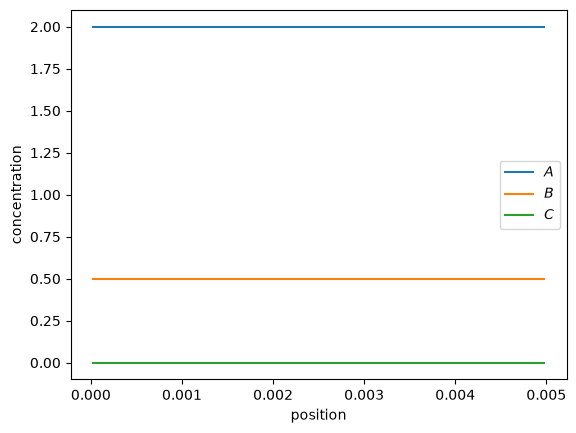
Time-Stepping Loop
for i in range(num_timesteps):
    c_old = c_all.copy()
    c_vec = c_all.ravel()
    g_all, jac = construct_g(c_all, c_old)
    result = newton(lambda c_all: construct_g(c_all, c_old), c_all)
    c_all[...] = result.x
    if (i + 1) % output_interval == 0:
        clear_output(wait=True)
        for j in range(num_c):
            lines[j].set_ydata(c[:, j])
        display(fig)
clear_output(wait=True)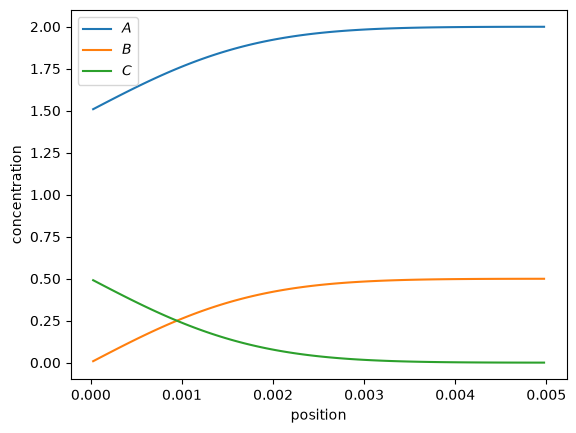
Checking the result
construct_g returns the residual and its Jacobian for the full extended state, including the boundary unknown . At the final converged state we can use pymrm.checks.residual_check to verify, in a scale-free (backward-error) sense, that the residual is close to zero. This is a stronger statement than Newton’s success=True, which only says that the last step was small. It does not test the Jacobian itself; pymrm.checks.check_jacobian does that.
from pymrm.checks import residual_check

check_result = residual_check(lambda u: construct_g(u, c_old), c_all)
print(check_result)
print(f"residual_check ok={check_result['ok']}, backward_error={check_result['backward_error']:.3e}")
{'ok': True, 'backward_error': 1.331178923542547e-16, 'max_abs_residual': 4.774847184307873e-12}
residual_check ok=True, backward_error=1.331e-16