# Bootstrap: the pymrm this page was checked with, and the gallery files it was
# published with. Works in a checkout, in CI and on a fresh Colab VM.
GALLERY_REF = "gallery-2026.11.10.3"  # replaced by the release tag at publication
PYMRM = ">=3.3.0,<4"  # equals meta.yaml pymrm_min_version, up to the next major
PAGE = "C2.10-o-xylene-phthalic-anhydride"  # equals the page directory

import os, sys, urllib.request
from pathlib import Path
_shared = next((p / "shared" for p in (Path.cwd(), *Path.cwd().parents)
                if (p / "shared" / "gallery_bootstrap.py").is_file()), None)
if _shared is None:
    _shared = (Path(os.environ.get("XDG_CACHE_HOME") or Path.home() / ".cache")
               / "pymrm-gallery" / GALLERY_REF)
    _shared.mkdir(parents=True, exist_ok=True)
    urllib.request.urlretrieve(
        "https://raw.githubusercontent.com/computational-chemical-engineering/"
        f"pymrm-gallery/{GALLERY_REF}/shared/gallery_bootstrap.py",
        _shared / "gallery_bootstrap.py")
sys.path.insert(0, str(_shared))
sys.modules.pop("gallery_bootstrap", None)
from gallery_bootstrap import setup
setup(PAGE, PYMRM, GALLERY_REF); # the semicolon stops the cell echoing the patho-Xylene to phthalic anhydride: the classic hot spot
sec:C
struct:S2
struct:S6
tier:T0
data:tier6
phase:gas-solid
Froment’s 1967 demonstration that effective kinetics plus a two-dimensional pseudo-homogeneous model reproduces fixed-bed hot spots: both models rebuilt, and the disagreement between their runaway limits measured continuously.
o-Xylene to phthalic anhydride: the classic hot spot
Catalog ID: C2.10 · Structures: S2 (plug flow), S6 (2-D radial) · Tier: T0 · covers D3.4 (the multitubular reactor half of the same paper; the scope argument is in the case files)
Raise the feed of a cooled multitubular o-xylene oxidation reactor by three degrees, from 357 to 360 °C, and in Froment’s computation the hot spot goes from 30 °C to runaway. Froment’s 1967 paper is where that demonstration was first made with effective kinetics inside a two-dimensional pseudo-homogeneous model, and it is the paper every reactor textbook cites for it. This page rebuilds both of its models from the printed constants and compares them with every numerical result the text states.
import time
from dataclasses import replace

import numpy as np
import pandas as pd
import matplotlib.pyplot as plt
from IPython.display import display
from scipy.integrate import solve_ivp
from gallery_utils import load_data, load_meta, cite_data, Claims
from model import (FromentCase, froment_source, u_overall, Tube2D, Tube1D,
                   Tube1DSteady, critical_inlet, exchanger_mean)

import warnings
# A march far past the runaway cap can overflow inside scipy's BDF difference
# table before the cap event stops it; whether the warning is emitted depends on
# the BLAS kernel, and the result does not (the march is classified as a runaway).
warnings.filterwarnings("ignore", message="invalid value encountered in subtract",
                        category=RuntimeWarning, module="scipy.integrate._ivp.bdf")
plt.rcParams.update({"figure.dpi": 110, "axes.grid": True, "grid.alpha": 0.3})
pd.set_option("display.width", 200)
claims = Claims(PAGE.split("-")[0])
Background
Phthalic anhydride is made by air oxidation of o-xylene over V₂O₅ at a few hundred degrees, with the xylene mole fraction held below 1 % to stay under the explosion limit. The paper describes the industrial arrangement: a multitubular reactor of 2500 tubes, 2.5 cm in diameter and 2.5 to 3 m long, packed with catalyst and cooled by a salt bath. The chemistry is a triangular network (the wanted partial oxidation, the consecutive combustion of the product, and the parallel combustion of the feed), and the two side reactions release far more heat than the wanted one, so the selectivity question and the temperature question are the same question.
In 1967 the standard design tool was the one-dimensional plug-flow model, which by construction “provides no information concerning excessive temperatures along the axis”. Froment’s paper is an investigation of the reliability of that model: it sets up a two-dimensional effective-transport model with radial mass and heat dispersion and a wall film, reviews where every transport parameter comes from, runs both models on the same o-xylene case with the same heat-transfer data, and reports where they disagree. The famous answers: the 2-D model puts the runaway limit at 360 °C where the 1-D model puts it at 365 °C; the axis temperature is far above the radial mean; and a 10 % change in either heat-transfer parameter converts a runaway case into a 35 °C hot spot.
Scope. The catalogue lists the kinetics (C2.10) and the multitubular reactor (D3.4) as separate cases naming this same paper. They are one page, for the same reason A2.1 absorbed A2.2: the paper prints no kinetic data (the rate constants are asserted as “fairly representative” of the V₂O₅ chemistry), so the only printed numbers the kinetics can be checked against are the reactor solves, which are exactly D3.4’s content. A kinetics page and a reactor page would validate against the same five stated numbers. The full argument, including what a future separate D3.4 would need (Calderbank’s kinetics with data, or the radial heat-transfer cases A3.11/A3.12), is recorded in queue_cases/C2.10.yaml and queue_cases/D3.4.yaml.
The published model
The reaction scheme (p. 23), with \(A\) = o-xylene, \(B\) = phthalic anhydride, \(C\) = the total-combustion products CO + CO₂, all three steps pseudo-first-order in the hydrocarbon because oxygen is in large excess:
\[ A \xrightarrow{(+\,\text{air}),\,k_1} B \xrightarrow{(+\,\text{air}),\,k_2} C, \qquad A \xrightarrow{(+\,\text{air}),\,k_3} C \]
\[ r_A = (k_1 + k_3)\,N_{A0}\,N_0\,(1-y), \qquad r_B = N_{A0}\,N_0\,[\,k_1(1-y) - k_2 x\,], \qquad r_C = N_{A0}\,N_0\,[\,k_2 x + k_3(1-y)\,] \]
with \(x\) the conversion to phthalic anhydride, \(w\) the conversion to CO + CO₂, \(y = x + w\) the total conversion, and (p. 23, all three read off the page image):
\[ \ln k_1 = -\frac{27{,}000}{1.98\,(t+T_0)} + 19.837,\qquad \ln k_2 = -\frac{31{,}400}{1.98\,(t+T_0)} + 20.86,\qquad \ln k_3 = -\frac{28{,}600}{1.98\,(t+T_0)} + 18.97 \]
where \(t = T - T_0\) and \(t + T_0\) is the absolute temperature. The rates are per kg of catalyst per hour; the paper leaves the units of \(k\) implicit and they are fixed here by the paper’s own groups (see the parameters cell).
The two-dimensional model (Eq. 1, p. 24), in the paper’s dimensionless coordinates \(z = z'/d_p\), \(r = r'/d_p\), \(R = R'/d_p\), with axial dispersion dropped (“at the high flow rates used in practice, the contribution of this mechanism may be neglected”):
\[ \frac{\partial x}{\partial z} = a_1\!\left(\frac{\partial^2 x}{\partial r^2} + \frac{1}{r}\frac{\partial x}{\partial r}\right) + b_1 r_B,\qquad \frac{\partial w}{\partial z} = a_1\!\left(\frac{\partial^2 w}{\partial r^2} + \frac{1}{r}\frac{\partial w}{\partial r}\right) + b_1 r_C, \]
\[ \frac{\partial t}{\partial z} = a_2\!\left(\frac{\partial^2 t}{\partial r^2} + \frac{1}{r}\frac{\partial t}{\partial r}\right) + b_2 r_B + b_3 r_C \]
\[ a_1 = \frac{1}{\mathrm{Pe}_{mR}},\quad a_2 = \frac{\lambda_R}{G c_p d_p} = \frac{1}{\mathrm{Pe}_{hR}},\quad b_1 = \frac{\rho_b d_p M_m}{G N_{A0}},\quad b_2 = \frac{\rho_b d_p(-\Delta H_1)}{G c_p},\quad b_3 = \frac{\rho_b d_p(-\Delta H_3)}{G c_p} \]
Boundary conditions (p. 24): \(x = w = t = 0\) at \(z=0\); symmetry at \(r=0\); no mass flux at the wall; and at the wall the film condition \(\left(\partial t/\partial r\right)_R = -\dfrac{\alpha_w d_p}{\lambda_R}\,t = -\alpha\,t\), the tube-wall and coolant-side resistances neglected. Radial mean values are \(\zeta_m = 2\int_0^1 \zeta\,(r/R)\,\mathrm{d}(r/R)\).
The one-dimensional model (p. 25) is the radially lumped reduction,
\[ \frac{\mathrm{d}x}{\mathrm{d}z} = b_1 r_B,\qquad \frac{\mathrm{d}w}{\mathrm{d}z} = b_1 r_C,\qquad \frac{\mathrm{d}t}{\mathrm{d}z} = -\frac{4U}{G c_p d_t}\,t + b_2 r_B + b_3 r_C \]
and the point of the comparison is that \(U\) is not free: it is built from the same \(\lambda_R\) and \(\alpha_w\) used in the 2-D model, by matching the zero-order moment of the exact packed-bed heat-exchanger solution (pp. 25–26), which collapses to
\[ \frac{1}{U} = \frac{1}{\alpha_w} + \frac{R'}{4\lambda_R} \]
The paper prints the closed-form exchanger solution on the way, a Bessel series over the roots of \(\lambda J_1(\lambda) = \alpha R\, J_0(\lambda)\), and that series is used below as an analytic check on the radial operator.
Two printed values are European-style thousands separators
Page 24 prints “\(G = 4.684\) kg./sq. meter hr.” and “\(\Delta H_3 = -1.090\) kcal./gram mole”. Both periods are thousands separators (Froment wrote from Ghent), and the paper itself proves it three ways, printed in the parameters cell below: p. 19 prints \(G = 4684\) outright for the same reactor; the printed \(\mathrm{Pe}_{hR} = 5.25\) equals \(G c_p d_p/\lambda_R\) only with \(G = 4684\) (with 4.684 it would be 0.00524); and \(-1090\) kcal/gmol is the heat of complete combustion of o-xylene, while \(-1.090\) kcal/gmol would make total combustion 282 times less exothermic than partial oxidation, contradicting the paper’s own argument that hot spots destroy selectivity. The same 1960s typesetting trap, in mid-dot decimal form, is documented on the sibling page D2.2 for Van Welsenaere & Froment (1970). The break table below shows what taking either literally would do. A third slip: p. 24 says \(N_{A0} = 0.00924\) “corresponds to 44 gram moles/cu. meter”; the unit is grams per normal cubic meter. Figure 11’s own axis is labelled g/Nm³, and the arithmetic (also below) closes for g/Nm³ and not for mol/m³.
Parameters and assumptions
Every constant is printed in the paper; the CSV records where. Three points need stating rather than assuming:
- \(M_m\) and \(c_p\) are printed on p. 19, in the companion single-reaction example on the same reactor, not restated on p. 24. \(c_p = 0.25\) is additionally pinned by p. 24’s own \(\mathrm{Pe}_{hR} = 5.25\), which contains it. \(M_m = 29.48\) has no closing identity on p. 24; recomputing the feed mean molecular weight from the composition (o-xylene in air) gives 29.68 (+0.7 %), and \(M_m\) enters only the conversion scale \(b_1\), not the temperature equation.
- The absolute-temperature offset is not printed. The baseline here uses \(T[\mathrm{K}] = t\,[°\mathrm{C}] + 273.15\); 1967 practice was often \(+273\). The 0.15 K difference is 0.024 % in absolute temperature at 357 °C, which the activation energy amplifies to about 0.5 % in \(k_1\), and the runaway limit sits on an exponential knife edge, so the sensitivity rows below show both conventions.
- Bed length is taken as 3 m (“2.5 to 3 meters long”; at 357 °C “a length of 3 meters is sufficient to reach the maximum in phthalic anhydride concentration”, which this rebuild does not reproduce; see the Results).
Units are the paper’s own (kg, m, hr, kcal, °C), with the two heats of reaction per kmol so that the rate constants come out in kmol per kg of catalyst per hour. model.FromentCase holds the printed constants and derives the groups of Eq. 1 from them, so a changed constant changes every group that contains it.
par = load_data("froment-1967-parameters.csv", page=PAGE)
P = dict(zip(par.symbol, par.value))
CASE = FromentCase.from_table(P)        # kelvin = 273.15, the baseline convention
Z_END = CASE.z_end                       # bed length L/d_p = 1000

print("dimensionless groups:")
print(f"  a1 = 1/Pe_mR   = {CASE.a1:.6f}")
print(f"  a2 = 1/Pe_hR   = {CASE.a2:.6f}   (Pe_hR = {1 / CASE.a2:.4f}, paper prints 5.25)")
print(f"  alpha          = {CASE.alpha:.4f}     (alpha*R = Biot = {CASE.alpha * CASE.R:.4f})")
print(f"  R = R'/d_p     = {CASE.R:.4f}")
print(f"  b1 = {CASE.b1:.5f}   b2 = {CASE.b2:.3f} degC   b3 = {CASE.b3:.3f} degC")


def identity_devs(case):
    """Relative gaps of printed derived values from the printed primaries."""
    return {
        "pehr_identity_rel": abs(case.G * case.c_p * case.d_p / case.lam_R - 5.25) / 5.25,
        "u_ref_identity_rel": abs(u_overall(case.lam_R, case.alpha_w, case.R_tube) - 82.7) / 82.7,
        "u_lam075_identity_rel": abs(u_overall(0.75, case.alpha_w, case.R_tube) - 86) / 86,
        "u_aw150_identity_rel": abs(u_overall(case.lam_R, 150.0, case.R_tube) - 88) / 88,
    }


def na0_from_conc(conc_g_per_m3, molar_mass=106.17):
    """Mole fraction of o-xylene for a concentration per normal m3 (0 degC, 1 atm)."""
    n_total = 101325.0 / (8.314 * 273.15)                 # mol/m3 at NTP
    return (conc_g_per_m3 / molar_mass) / n_total


def m_feed(case, m_air=28.97):
    """Mean molar mass of o-xylene (106.17) in air at the inlet mole fraction."""
    return case.NA0 * 106.17 + (1 - case.NA0) * m_air


def reynolds(case):
    """Re = G d_p / mu with the Sutherland viscosity of air at about 630 K."""
    mu_air = 1.458e-6 * 630.0 ** 1.5 / (630.0 + 110.4) * 3600.0   # kg/(m hr)
    return case.G * case.d_p / mu_air


DEV = identity_devs(CASE)
U_REF = u_overall(CASE.lam_R, CASE.alpha_w, CASE.R_tube)
NA0_CALC = na0_from_conc(44.0)
NA0_DEV = abs(NA0_CALC - CASE.NA0) / CASE.NA0
M_FEED = m_feed(CASE)
RE = reynolds(CASE)
ADIABATIC_AB = CASE.NA0 / CASE.M_m * 1000.0 * CASE.dH1 / 1000.0 / CASE.c_p
DH3_LITERAL_RATIO = CASE.dH1 / 1090.0     # -dH1 against "-1.090 kcal/gmol" read literally

print()
print("identity checks against printed derived values (nothing here is free):")
print(f"  Pe_hR = G*cp*dp/lam_R = {CASE.G * CASE.c_p * CASE.d_p / CASE.lam_R:.4f} vs printed 5.25 "
      f"-> {100 * DEV['pehr_identity_rel']:.2f} %  (pins G = 4684 AND cp = 0.25)")
print(f"  U(0.67, 134) = {U_REF:.3f} vs printed 82.7  -> {100 * DEV['u_ref_identity_rel']:.2f} %")
print(f"  U(0.75, 134) = {u_overall(0.75, CASE.alpha_w, CASE.R_tube):.3f} vs printed 86    "
      f"-> {100 * DEV['u_lam075_identity_rel']:.2f} %")
print(f"  U(0.67, 150) = {u_overall(CASE.lam_R, 150.0, CASE.R_tube):.3f} vs printed 88    "
      f"-> {100 * DEV['u_aw150_identity_rel']:.2f} %")
print(f"  44 g/Nm3 -> N_A0 = {NA0_CALC:.5f} vs printed 0.00924 -> {100 * NA0_DEV:.2f} % "
      "(closes for g/Nm3; for 44 mol/m3 it would be off by 100x)")
print(f"  Re = G*dp/mu(630 K) = {RE:.0f} vs printed 121 "
      "(order-of-magnitude witness for G = 4684; with 4.684 it would be 0.13)")
print(f"  feed molar mass from the composition = {M_FEED:.2f} vs printed M_m = {CASE.M_m} "
      f"({100 * (M_FEED / CASE.M_m - 1):+.1f} %)")
print(f"  adiabatic rise of A->B alone = {ADIABATIC_AB:.0f} degC (the knife edge under the "
      "whole page)")
print(f"  -dH1 / 1.090 kcal/gmol = {DH3_LITERAL_RATIO:.0f}: total combustion read literally "
      "would be that many times LESS exothermic than partial oxidation")
print(f"  0.15 K of the Kelvin offset at 357 degC: {100 * 0.15 / (357 + 273.15):.3f} % of T, "
      f"{100 * (np.exp(CASE.E[0] / CASE.R_gas * 0.15 / 630.0 ** 2) - 1):.2f} % in k1")
dimensionless groups:
a1 = 1/Pe_mR = 0.100000
a2 = 1/Pe_hR = 0.190720 (Pe_hR = 5.2433, paper prints 5.25)
alpha = 0.6000 (alpha*R = Biot = 2.5000)
R = R'/d_p = 4.1667
b1 = 2.65646 b2 = 1022.459 degC b3 = 3630.231 degC
identity checks against printed derived values (nothing here is free):
Pe_hR = G*cp*dp/lam_R = 5.2433 vs printed 5.25 -> 0.13 % (pins G = 4684 AND cp = 0.25)
U(0.67, 134) = 82.462 vs printed 82.7 -> 0.29 %
U(0.75, 134) = 85.989 vs printed 86 -> 0.01 %
U(0.67, 150) = 88.255 vs printed 88 -> 0.29 %
44 g/Nm3 -> N_A0 = 0.00929 vs printed 0.00924 -> 0.52 % (closes for g/Nm3; for 44 mol/m3 it would be off by 100x)
Re = G*dp/mu(630 K) = 125 vs printed 121 (order-of-magnitude witness for G = 4684; with 4.684 it would be 0.13)
feed molar mass from the composition = 29.68 vs printed M_m = 29.48 (+0.7 %)
adiabatic rise of A->B alone = 385 degC (the knife edge under the whole page)
-dH1 / 1.090 kcal/gmol = 282: total combustion read literally would be that many times LESS exothermic than partial oxidation
0.15 K of the Kelvin offset at 357 degC: 0.024 % of T, 0.52 % in k1The data
There is no experimental dataset in this paper, and none is claimed here. The kinetics are presented by Froment as “fairly representative of the gas phase air oxidation of o-xylene into phthalic anhydride on V₂O₅ catalysts”: asserted, not fitted to data in this document, and Calderbank (the second name on the catalogue row) is not on disk. Everything this page compares against is the paper’s own computed results, stated in its running text: this is reproduction of a published reference solution (tier 6), the same standing as D2.2 and B1.1, not validation against measurement. Nothing is fitted: every model input is a printed constant, so the reproduction can genuinely fail, and the break table shows what failure would look like.
Two committed datasets: froment-1967-parameters.csv (the printed constants, with the page each was read from) and froment-1967-stated-results.csv (every numerical statement in the text about this case, with the paper’s own qualifiers preserved).
Cross-page reconciliation. The published D2.2 page carries Van Welsenaere & Froment (1970), the same reactor and the same first reaction, three years later. Its parameter CSV was transcribed independently of this page, so the shared constants are reconciled below rather than retyped. D2.2’s recorded findings about its rows, checked against this page: (1) its c_p = 0.323 kcal/(m³·°C) is printed volumetric, which is exactly \(\rho_g c_p = 1.293
\times 0.25\), so it confirms rather than contradicts this page’s mass-basis 0.25; (2) its numbers had to be read from page renders because the 1970 OCR drops mid-dot decimals, the same typesetting-trap family as the thousands separators above; (3) its \(U = 82.7\) is inherited from this 1967 paper, so agreement on that row is a shared source, not two witnesses; the printed \(\lambda_R\), \(\alpha_w\) route above is the independent check on it.
res = load_data("froment-1967-stated-results.csv", page=PAGE)
print(cite_data(load_meta("froment-1967-stated-results.csv", page=PAGE)))
with pd.option_context("display.max_colwidth", 30):
    display(res[["quantity", "value", "unit", "model", "qualifier", "printed_where"]])

d22 = load_data("van-welsenaere-froment-1970-parameters.csv",
                page="D2.2-van-welsenaere-froment-runaway")
D22 = dict(zip(d22.symbol, d22.value))


def reconcile(case, D):
    """Every constant shared with the independently transcribed D2.2 page."""
    rows = [
        ("M_m [kg/kmol]", case.M_m, D["M"]),
        ("rho_b [kg/m3]", case.rho_b, D["rho_b"]),
        ("-dH1 [kcal/kmol]", case.dH1, D["minus_dH"]),
        ("tube radius R' [m]", case.R_tube, D["R"]),
        ("N_0 = p_B0 [-, atm at 1 atm]", case.N0, D["p_B0"]),
        ("E1/R_gas [K]  (27000/1.98)", case.E[0] / case.R_gas, D["a"]),
        ("lnA1 [-]", case.lnA[0], D["b"]),
        ("U printed [kcal/(m2 hr degC)]", 82.7, D["U"]),
        ("G*cp [kcal/(m2 hr degC)] vs u*cp_vol", case.G * case.c_p, D["u"] * D["c_p"]),
    ]
    tab = pd.DataFrame(rows, columns=["constant", "this page (Froment 1967)",
                                      "D2.2 page (VW&F 1970)"])
    tab["rel diff"] = (tab.iloc[:, 1] - tab.iloc[:, 2]).abs() / tab.iloc[:, 2].abs()
    return tab


REC = reconcile(CASE, D22)
D22_SHARED_MAX = float(REC["rel diff"][:8].max())
D22_GCP = float(REC["rel diff"].iloc[-1])
display(REC.assign(**{"rel diff": REC["rel diff"].map(lambda v: f"{v:.2e}")}))
print(f"First eight rows identical to <0.1 % (largest {D22_SHARED_MAX:.1e}): two independent "
      "transcriptions of the shared constants agree. The last row differs by "
      f"{100 * D22_GCP:.1f} % because the 1970 paper quotes u = {D22['u']:.0f} m/hr against "
      f"1967's G = {CASE.G:.0f} kg/(m2 hr) (equivalent gas density {CASE.G / D22['u']:.3f} vs "
      f"{D22['c_p'] / CASE.c_p:.3f} kg/m3), a genuine, small difference between the two "
      "papers, not a transcription error.")
Froment, G. F. (1967) — Industrial & Engineering Chemistry 59(2) 18-27 — doi:10.1021/ie50686a006 — table| quantity | value | unit | model | qualifier | printed_where | |
|---|---|---|---|---|---|---|
| 0 | tm_hotspot_357 | 30.00 | degC | 2D | about | p. 25 |
| 1 | runaway_limit_2d | 360.00 | degC | 2D | runs away at | p. 25 |
| 2 | rise_1d_362 | 40.00 | degC | 1D | only | p. 26 |
| 3 | rise_1d_363 | 48.00 | degC | 1D | NaN | p. 26 |
| 4 | runaway_limit_1d | 365.00 | degC | 1D | now found to be | p. 26 |
| 5 | runaway_gap | 5.00 | degC | 1D vs 2D | within | p. 26 |
| 6 | U_ref | 82.70 | kcal/(m2 hr degC) | 1D | NaN | p. 26 |
| 7 | U_lam075 | 86.00 | kcal/(m2 hr degC) | 1D | amounts to | p. 27 |
| 8 | U_aw150 | 88.00 | kcal/(m2 hr degC) | 1D | NaN | p. 27 |
| 9 | tm_360_lam075 | 35.00 | degC | 2D | about | p. 27 |
| 10 | tm_360_aw150 | 35.00 | degC | 2D | about | p. 27 |
| 11 | Pe_hR | 5.25 | - | 2D | NaN | p. 24 |
| 12 | Re | 121.00 | - | 2D | NaN | p. 24 |
| 13 | conc_variant_1 | 38.00 | g/Nm3 | 2D | NaN | p. 25 |
| 14 | conc_variant_2 | 32.00 | g/Nm3 | 2D | NaN | p. 25 |
| 15 | hotspot_locus_hi | 43.00 | degC | 2D | NaN | p. 25 |
| 16 | hotspot_locus_lo | 30.00 | degC | 2D | NaN | p. 25 |
| 17 | pemr_8_vs_10 | 0.00 | - | 2D | completely negligible | p. 26 |
| 18 | pa_max_length_357 | 3.00 | m | 2D | sufficient to reach | p. 25 |
| constant | this page (Froment 1967) | D2.2 page (VW&F 1970) | rel diff | |
|---|---|---|---|---|
| 0 | M_m [kg/kmol] | 29.480000 | 29.4800 | 0.00e+00 |
| 1 | rho_b [kg/m3] | 1300.000000 | 1300.0000 | 0.00e+00 |
| 2 | -dH1 [kcal/kmol] | 307000.000000 | 307000.0000 | 0.00e+00 |
| 3 | tube radius R' [m] | 0.012500 | 0.0125 | 0.00e+00 |
| 4 | N_0 = p_B0 [-, atm at 1 atm] | 0.208000 | 0.2080 | 0.00e+00 |
| 5 | E1/R_gas [K] (27000/1.98) | 13636.363636 | 13636.0000 | 2.67e-05 |
| 6 | lnA1 [-] | 19.837000 | 19.8370 | 0.00e+00 |
| 7 | U printed [kcal/(m2 hr degC)] | 82.700000 | 82.7000 | 0.00e+00 |
| 8 | G*cp [kcal/(m2 hr degC)] vs u*cp_vol | 1171.000000 | 1162.8000 | 7.05e-03 |
First eight rows identical to <0.1 % (largest 2.7e-05): two independent transcriptions of the shared constants agree. The last row differs by 0.7 % because the 1970 paper quotes u = 3600 m/hr against 1967's G = 4684 kg/(m2 hr) (equivalent gas density 1.301 vs 1.292 kg/m3), a genuine, small difference between the two papers, not a transcription error.PyMRM implementation
The 2-D model is parabolic in \(z\) (axial dispersion is dropped by the paper), so \(z\) is an integration variable and the discretisation lives entirely on the radial axis: construct_grad/construct_div with nu=1 (cylindrical), the same radial-operator vocabulary as A2.3 and A3.15, marched in \(z\) with a stiff integrator, which is the modern version of the implicit Crank–Nicolson march the paper itself used (“the program was tried out in 1961”). Boundary conditions use the outward normal (\(a\,\partial c/\partial n + b\,c = d\)):
- \(r = 0\) (normal \(-r\)): symmetry, \(\partial t/\partial n = 0\), so
{a: 1, b: 0, d: 0}; - \(r = R\) (normal \(+r\)), temperature: the paper’s wall film \(\partial t/\partial r = -\alpha t\) becomes \(\partial t/\partial n + \alpha t
= 0\), so
{a: 1, b: alpha, d: 0}; - \(r = R\), mass: no flux through the wall,
{a: 1, b: 0, d: 0}.
The model code is in model.py next to this notebook, and none of it is specific to o-xylene. Tube2D takes a pointwise source function, a radial dispersion coefficient and a wall coefficient per field, assembles the constant dispersion operator once (state (n_r, 3): radius first, fields last), and marches with scipy’s BDF method, handing it the exact sparse Jacobian: the constant operator plus NumJac of the source. Tube1D is the radially lumped reduction, where the radial operator is replaced by the wall sink \(-4U/(Gc_p d_t)\,t\). The chemistry is froment_source, the only place the triangular scheme appears. The cell below builds both models of this page from those pieces.
The numerics. The 2-D march hands the integrator the exact Jacobian from the operators; a second route lets solve_ivp build it by finite differences, and the two are compared below (they agree to the integrator tolerance). The runaway limits are bisected to 1e-4 °C. pymrm also has pseudo_transient and continuation, but neither fits this page: both solve a steady residual, while here \(z\) is a marching coordinate and the only steady problem (the 1-D boundary-value route below) has one solution, which Newton reaches from a cold start. The runaway limit is not a fold of a steady branch that continuation could follow; it is a threshold on the outcome of an initial-value problem (the mean temperature passing a cap), so it is located by bisection.
N_R = 80          # radial cells of the baseline 2-D model
CAP_2D = 150.0    # runaway: the radial-mean temperature rise passes this (degC)
CAP_1D = 300.0


def tube2d(T0C, case=CASE, n_r=N_R, a=None, alpha=None, nu=1, **src):
    """Froment's 2-D model at inlet (= coolant) temperature T0C.

    ``a = (a1, a2)`` and ``alpha`` replace the case's groups (break rows only);
    ``src`` goes to ``froment_source``.
    """
    a1, a2 = (case.a1, case.a2) if a is None else a
    alpha = case.alpha if alpha is None else alpha
    return Tube2D(froment_source(case, T0C, **src),
                  dispersion=(a1, a1, a2),       # x, w: 1/Pe_mR; t: 1/Pe_hR
                  wall=(0.0, 0.0, alpha),        # x, w: no flux; t: dt/dr = -alpha t
                  R=case.R, n_r=n_r, nu=nu)      # nu=1: cylindrical radial operator


def runs_away_2d(T0C, cap=CAP_2D, **kw):
    """True when the radial-mean temperature rise passes ``cap`` inside the bed."""
    m = tube2d(T0C, **kw).march(Z_END, cap=cap)
    return m.ran_away or m.hot_spot()[1] > cap


def limit_2d(lo=356.0, hi=364.0, tol=1e-4, cap=CAP_2D, **kw):
    """2-D runaway limit by bisection; every probe is a fresh march from the inlet."""
    return critical_inlet(lambda T0: runs_away_2d(T0, cap=cap, **kw), lo, hi, tol)[0]


def tube1d(T0C, case=CASE, U=82.7, **src):
    """The paper's 1-D reduction (p. 25), with the printed U = 82.7 by default."""
    return Tube1D(froment_source(case, T0C, **src), wall=(0.0, 0.0, case.wall_sink(U)))


def march_1d(T0C, cap=CAP_1D, **kw):
    case = kw.get("case", CASE)
    return tube1d(T0C, **kw).march(case.z_end, cap=cap, max_step=case.z_end / 200)


def hot_spot_1d(T0C, n_z=4000, **kw):
    """(z' in m, temperature rise) at the 1-D maximum; (nan, inf) after a runaway."""
    t1 = march_1d(T0C, **kw)
    z, t = t1.hot_spot(n_z=n_z)
    return z * CASE.d_p, t


def limit_1d(lo=360.0, hi=368.0, tol=1e-4, **kw):
    return critical_inlet(lambda T0: bool(np.isinf(hot_spot_1d(T0, **kw)[1])),
                          lo, hi, tol)[0]


def bvp_1d(T0C, n_z=4000, U=82.7):
    """The steady upwind route to the 1-D model, cold-started (all fields zero)."""
    b = Tube1DSteady(froment_source(CASE, T0C), wall=(0.0, 0.0, CASE.wall_sink(U)),
                     z_end=Z_END, n_z=n_z)
    # scale: typical size per field (x, w order one; t in degC) for the step test
    return b.solve(np.zeros(b.shape), scale=np.array([1.0, 1.0, 100.0]), tol=1e-10)
Results
The two-dimensional model: Figure 9’s family, and the 3 °C cliff
The radial-mean temperature rise \(t_m(z)\) for the inlet (= coolant) temperatures of the paper’s Figure 9. At 357 °C the hot spot is a controlled 30 °C; at 360 °C the profile climbs far above it, the paper’s “the temperature rise goes out of control”. The axis temperature runs far above the mean, which is the whole argument against the 1-D model.
T0_FAMILY = [350.0, 355.0, 357.0, 358.5, 360.0]


def family_2d(case=CASE, **src):
    runs = {T0: tube2d(T0, case=case, **src).march(Z_END, cap=CAP_2D) for T0 in T0_FAMILY}
    return runs, {T0: runs[T0].hot_spot() for T0 in T0_FAMILY}


runs2d, HS2D = family_2d()

fig, (axL, axR) = plt.subplots(1, 2, figsize=(11.5, 4.2))
for T0 in T0_FAMILY:
    z, means, axis_vals = runs2d[T0].profiles()
    axL.plot(z * CASE.d_p, means[:, 2], lw=1.7, label=f"{T0:g} °C")
    axR.plot(z * CASE.d_p, axis_vals[:, 2], lw=1.7, label=f"{T0:g} °C")
for ax, ttl in [(axL, "radial mean  $t_m$  (the paper's Figure 9)"),
                (axR, "axis  $t(r{=}0)$")]:
    ax.set(xlabel="bed length $z'$ (m)", ylabel="temperature rise $t$ (°C)",
           title=ttl, xlim=(0, 1.5), ylim=(0, 70))
    ax.legend(fontsize=8, title="inlet = coolant")
plt.tight_layout(); plt.show()

print("2-D hot spots (radial mean):")
for T0 in T0_FAMILY:
    z_hs, tm_hs = HS2D[T0]
    if np.isinf(tm_hs):
        print(f"  T0 = {T0:6.1f} degC : runaway (mean t passed {CAP_2D:.0f} degC inside the bed)")
    else:
        print(f"  T0 = {T0:6.1f} degC : tm_max = {tm_hs:6.2f} degC at z' = {z_hs * CASE.d_p:.2f} m")
TM357 = HS2D[357.0][1]
print(f"\npaper, p. 25: at 357 degC 'the hot spot, where tm equals about 30 degC' -> computed "
      f"{TM357:.2f} degC ({100 * abs(TM357 - 30) / 30:.1f} % from the stated ~30)")
_, _, ax360 = runs2d[360.0].profiles()
print(f"at 360 degC the mean rise reaches {HS2D[360.0][1]:.0f} degC with axis peak "
      f"{ax360[:, 2].max():.0f} degC: far past the knee, though in this rebuild 360.0 degC is "
      "still just below the runaway limit located in the next cells")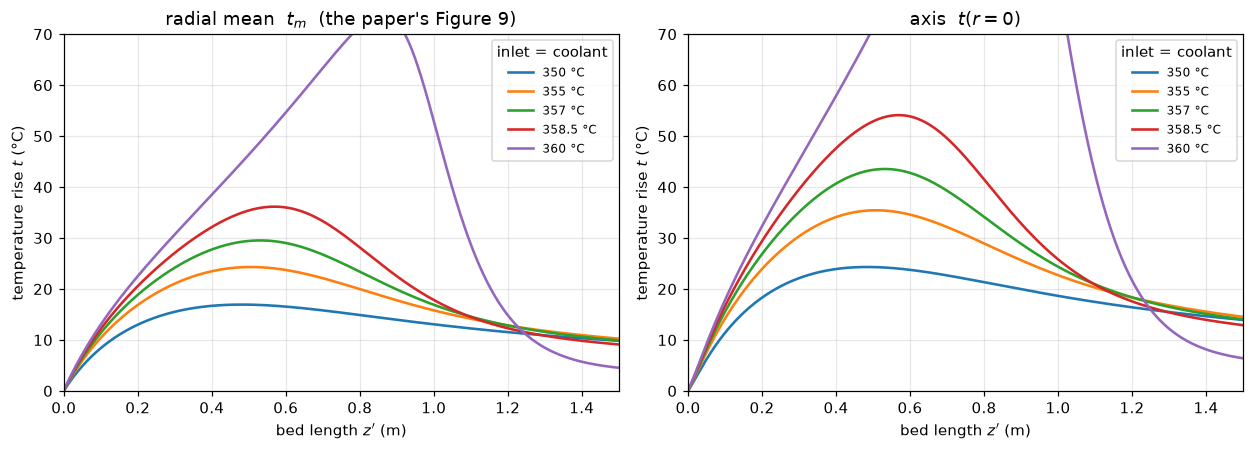
2-D hot spots (radial mean):
  T0 =  350.0 degC : tm_max =  16.94 degC at z' = 0.48 m
  T0 =  355.0 degC : tm_max =  24.31 degC at z' = 0.51 m
  T0 =  357.0 degC : tm_max =  29.53 degC at z' = 0.53 m
  T0 =  358.5 degC : tm_max =  36.16 degC at z' = 0.57 m
  T0 =  360.0 degC : tm_max =  73.84 degC at z' = 0.86 m

paper, p. 25: at 357 degC 'the hot spot, where tm equals about 30 degC' -> computed 29.53 degC (1.6 % from the stated ~30)
at 360 degC the mean rise reaches 74 degC with axis peak 121 degC: far past the knee, though in this rebuild 360.0 degC is still just below the runaway limit located in the next cells
Radial structure, the product maximum, and selectivity
The paper’s Figure 8 shows severe radial gradients even in the controlled case; its Figure 10 shows the selectivity cost of running hotter. Both are reproduced qualitatively (the figures are not digitised; every quantitative comparison on this page is against a stated number). The consecutive scheme makes the phthalic anhydride conversion pass through a maximum. The paper says 3 m is enough to reach it at 357 °C; in this rebuild it is not: the bed is marched on to 10 m below to find where the maximum is.
m357 = runs2d[357.0]
z_marks = [0.2, 0.4, 0.6, 0.9, 1.5]
fig, (axA, axB) = plt.subplots(1, 2, figsize=(11.5, 4.0))
for zm in z_marks:
    axA.plot(m357.r_c / CASE.R, m357.state(zm / CASE.d_p)[:, 2], lw=1.6, label=f"z' = {zm:g} m")
axA.set(xlabel="$r/R$", ylabel="temperature rise $t$ (°C)",
        title="radial temperature profiles, inlet 357 °C (cf. paper Fig. 8)")
axA.legend(fontsize=8)
for T0 in [355.0, 357.0, 360.0]:
    _, means, _ = runs2d[T0].profiles()
    ys = means[:, 0] + means[:, 1]
    sel = np.divide(means[:, 0], ys, out=np.ones_like(ys), where=ys > 1e-6)
    axB.plot(ys, sel, lw=1.7, label=f"{T0:g} °C")
axB.set(xlabel="total conversion $y$", ylabel="selectivity $x/y$",
        title="selectivity vs conversion (cf. paper Fig. 10)", xlim=(0, 1), ylim=(0.5, 1.0))
axB.legend(fontsize=8, title="inlet = coolant")
plt.tight_layout(); plt.show()


def pa_profile(T0C, length_m=3.0, **kw):
    """(z' in m, radial-mean x, w) of the 2-D model on a bed of ``length_m``."""
    m = tube2d(T0C, **kw).march(length_m / CASE.d_p, cap=CAP_2D)
    z, means, _ = m.profiles(n_z=1500 if length_m == 3.0 else 9001)
    return z * CASE.d_p, means[:, 0], means[:, 1]


def pa_maximum(T0C, **kw):
    """Position (m) and value of the phthalic anhydride maximum on a 10 m bed."""
    z, xm, _ = pa_profile(T0C, length_m=10.0, **kw)
    i = int(np.argmax(xm))
    return z[i], xm[i], float(np.interp(3.0, z, xm))


zz, xm, wm = pa_profile(357.0)
x05, x10, x20, x25, x30 = np.interp([0.5, 1.0, 2.0, 2.5, 3.0], zz, xm)
SLOPE_EXIT = 2 * (x30 - x25)
SEL_EXIT, Y_EXIT = xm[-1] / (xm[-1] + wm[-1]), xm[-1] + wm[-1]
Z_PA_357, X_PA_357, X3_357 = pa_maximum(357.0)
Z_PA_360, X_PA_360, X3_360 = pa_maximum(360.0)
PA_SHORT = 1 - X3_357 / X_PA_357
print(f"phthalic anhydride conversion at 357 degC: x = {x20:.3f} at 2.0 m, {x25:.3f} at 2.5 m, "
      f"{x30:.3f} at 3.0 m; the local slope has fallen from {2 * (x10 - x05):.2f}/m in the "
      f"first meter to {SLOPE_EXIT:.2f}/m at the exit")
print(f"marched on to 10 m: the maximum is at z' = {Z_PA_357:.1f} m, x = {X_PA_357:.3f}; "
      f"the 3 m exit is {100 * PA_SHORT:.0f} % below it")
print(f"at 360 degC the maximum is at z' = {Z_PA_360:.2f} m (x = {X_PA_360:.3f}; "
      f"{X3_360:.3f} at 3 m): almost, but still past the 3 m exit")
print("paper, p. 25: 'a length of 3 meters is sufficient to reach the maximum in phthalic "
      "anhydride concentration' at 357 degC (row pa_max_length_357 of the stated results, "
      "with its p. 24 neighbour) - not reproduced: in this rebuild it almost holds at 360 "
      "degC, not at 357")
print(f"outlet selectivity x/y at 357 degC = {SEL_EXIT:.3f}, total conversion y = {Y_EXIT:.3f} "
      "(Figure 10's 357 curve reads ~0.83-0.85 at this conversion; qualitative only)")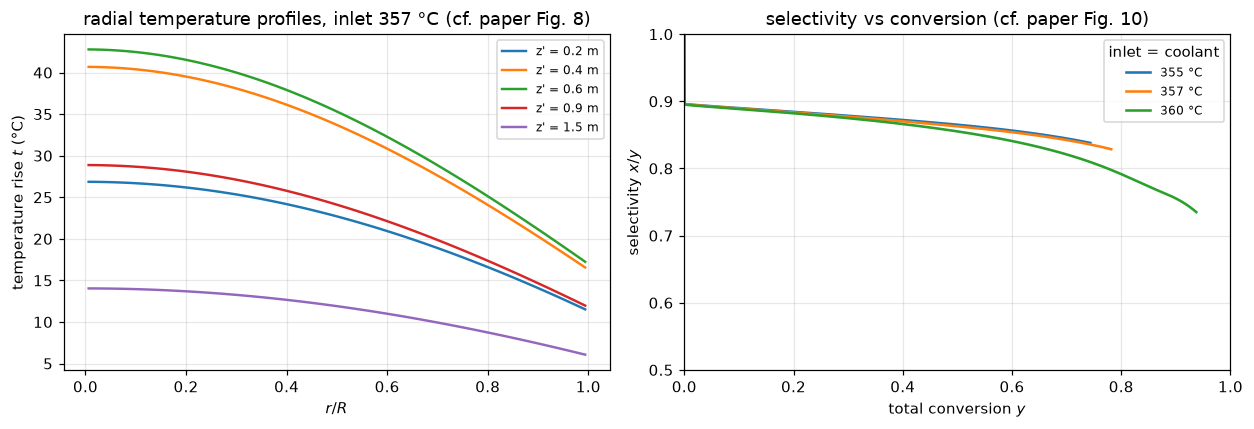
phthalic anhydride conversion at 357 degC: x = 0.573 at 2.0 m, 0.616 at 2.5 m, 0.648 at 3.0 m; the local slope has fallen from 0.37/m in the first meter to 0.06/m at the exit
marched on to 10 m: the maximum is at z' = 6.6 m, x = 0.722; the 3 m exit is 10 % below it
at 360 degC the maximum is at z' = 3.19 m (x = 0.689; 0.689 at 3 m): almost, but still past the 3 m exit
paper, p. 25: 'a length of 3 meters is sufficient to reach the maximum in phthalic anhydride concentration' at 357 degC (row pa_max_length_357 of the stated results, with its p. 24 neighbour) - not reproduced: in this rebuild it almost holds at 360 degC, not at 357
outlet selectivity x/y at 357 degC = 0.829, total conversion y = 0.782 (Figure 10's 357 curve reads ~0.83-0.85 at this conversion; qualitative only)
The one-dimensional model with the derived U, and the two runaway limits
The 1-D model must use \(U\) built from the same \(\lambda_R\) and \(\alpha_w\); the paper prints 82.7 and it is recomputed above. Its Figure 12 family is reproduced below, then both runaway limits are located continuously by bisection on solves that each start from the inlet, where the paper probed whole degrees. The runaway criterion is a 150 °C cap on the mean temperature rise (300 °C in the 1-D model); the validation section shows the located limit does not depend on that choice.
T0_FAMILY_1D = [350.0, 355.0, 357.0, 358.5, 362.0, 363.0, 365.0]


def family_1d(**kw):
    out = {}
    for T0 in T0_FAMILY_1D:
        t1 = march_1d(T0, **kw)
        z = np.linspace(0.0, t1.sol.t[-1], 2500)
        out[T0] = (z, t1.sol.sol(z)[2], t1.ran_away)
    return out


FAM1D = family_1d()
HS1D = {T0: (np.inf if ran else t.max()) for T0, (z, t, ran) in FAM1D.items()}
fig, ax = plt.subplots(figsize=(6.8, 4.2))
for T0, (z, t, ran) in FAM1D.items():
    ax.plot(z * CASE.d_p, t, lw=1.6, label=f"{T0:g} °C" + (" (runaway)" if ran else ""))
ax.set(xlim=(0, 1.5), ylim=(0, 70), xlabel="bed length $z'$ (m)",
       ylabel="temperature rise $t$ (°C)", title="1-D model, U = 82.7 (the paper's Figure 12)")
ax.legend(fontsize=8, title="inlet = coolant"); plt.tight_layout(); plt.show()

RISE362, RISE363 = HS1D[362.0], HS1D[363.0]
print(f"1-D hot spot at 362 degC: {RISE362:.1f} degC   (paper: 'a rise of only 40 deg')")
print(f"1-D hot spot at 363 degC: {RISE363:.1f} degC   (paper: 'a rise of 48 deg')")
print(f"  deviations: {100 * abs(RISE362 - 40) / 40:.1f} % and {100 * abs(RISE363 - 48) / 48:.1f} % "
      "on quantities that double every ~2 degC at this point")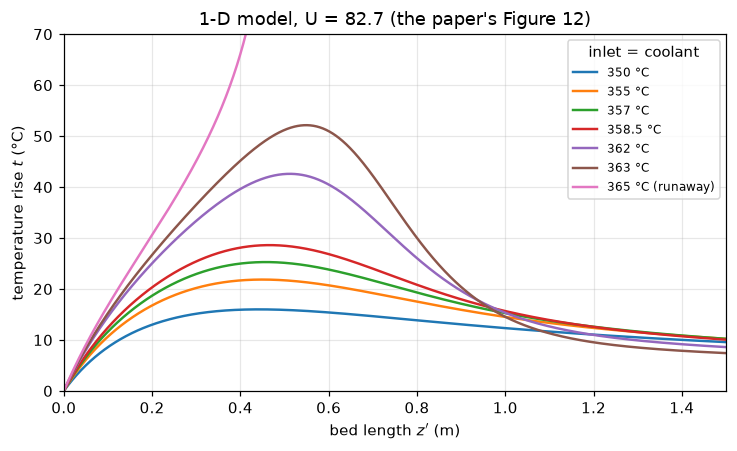
1-D hot spot at 362 degC: 42.6 degC   (paper: 'a rise of only 40 deg')
1-D hot spot at 363 degC: 52.1 degC   (paper: 'a rise of 48 deg')
  deviations: 6.5 % and 8.6 % on quantities that double every ~2 degC at this point
# The two runaway limits, bisected to 1e-4 degC from brackets of 8 degC.
T0C_2D = limit_2d()
T0C_1D = limit_1d()
GAP = T0C_1D - T0C_2D
print(f"2-D runaway limit: T0 = {T0C_2D:.4f} degC (paper: 'predicts a runaway ... for an "
"inlet temperature of 360 degC')")
print(f"1-D runaway limit: T0 = {T0C_1D:.4f} degC ("
"paper: 'now found to be 365 degC'; Figure 12 probes 363 then 365)")
print(f"gap between the models: {GAP:.2f} degC ("
"paper: 'within five degrees ... has to be considered excellent')")
# the paper's statements as labels, each decided directly at the stated temperatures
RA_2D_360 = runs_away_2d(360.0)
IN_BRACKET_1D = (not np.isinf(hot_spot_1d(363.0)[1])) and bool(np.isinf(hot_spot_1d(365.0)[1]))
MARGIN_2D = T0C_2D - 360.0
MARGIN_1D = min(T0C_1D - 363.0, 365.0 - T0C_1D)
print(f"\nDoes the 2-D model run away at 360 degC? {RA_2D_360}: its limit is "
f"{MARGIN_2D:+.4f} degC from 360. Does the 1-D model hold at 363 and run away at 365? "
f"{IN_BRACKET_1D} (limit {MARGIN_1D:.2f} degC inside the bracket).")
# how the inputs are read moves the 2-D limit across 360 degC
T0C_2D_PEHR = limit_2d(a=(CASE.a1, 1 / 5.25)) # the printed Pe_hR = 5.25
T0C_2D_NA0P19 = limit_2d(case=replace(CASE, NA0=0.00927)) # p. 19's N_A0
print("So the 1-D limit sits inside the paper's integer bracket (363, 365], and the 2-D limit "
f"is at the paper's 360 degC within 0.01 degC. Which side of 360 it falls on is set by how "
"the inputs are read, not by the numerics (the grid and the integrator move it by less "
f"than 0.001 degC): with the printed Pe_hR = 5.25 instead of the recomputed "
f"{1 / CASE.a2:.4f} the limit is {T0C_2D_PEHR:.3f} degC, with p. 19's N_A0 = 0.00927 it "
f"is {T0C_2D_NA0P19:.3f} degC. The 1-D model uses the printed U = 82.7, the 2-D model "
"the recomputed Pe_hR; that asymmetry alone decides the 2-D label. The continuous gap "
"is smaller than the quoted five degrees.")2-D runaway limit: T0 = 360.0060 degC (paper: 'predicts a runaway ... for an inlet temperature of 360 degC')
1-D runaway limit: T0 = 363.9333 degC (paper: 'now found to be 365 degC'; Figure 12 probes 363 then 365)
gap between the models: 3.93 degC (paper: 'within five degrees ... has to be considered excellent')
Does the 2-D model run away at 360 degC? False: its limit is +0.0060 degC from 360. Does the 1-D model hold at 363 and run away at 365? True (limit 0.93 degC inside the bracket).
So the 1-D limit sits inside the paper's integer bracket (363, 365], and the 2-D limit is at the paper's 360 degC within 0.01 degC. Which side of 360 it falls on is set by how the inputs are read, not by the numerics (the grid and the integrator move it by less than 0.001 degC): with the printed Pe_hR = 5.25 instead of the recomputed 5.2433 the limit is 359.964 degC, with p. 19's N_A0 = 0.00927 it is 359.871 degC. The 1-D model uses the printed U = 82.7, the 2-D model the recomputed Pe_hR; that asymmetry alone decides the 2-D label. The continuous gap is smaller than the quoted five degrees.The runaway limit against the inlet concentration (Figure 11)
\(N_{A0}\) scales with the inlet concentration and cancels out of the mass equations (\(b_1 r_B\) carries no \(N_{A0}\)), so a lower inlet concentration is exactly a factor below 1 on the temperature sources. The paper’s Figure 11 is drawn for 44, 38 and 32 g/Nm³; it is not digitised, so only its direction and shape are compared.
N_R_SWEEP = 48     # the sweeps below use a coarser radial grid; see Validation


def limits_by_conc(concs=(44.0, 38.0, 32.0), **kw):
    return {c: limit_2d(lo=356.0, hi=378.0, tol=1e-3, n_r=N_R_SWEEP,
                        heat_scale=c / 44.0, **kw) for c in concs}


CRIT_BY_CONC = limits_by_conc()
D_44_38 = CRIT_BY_CONC[38.0] - CRIT_BY_CONC[44.0]
D_38_32 = CRIT_BY_CONC[32.0] - CRIT_BY_CONC[38.0]
print("runaway limit vs inlet concentration (n_r = 48, bisected to 1e-3 degC):")
for c, T0c in CRIT_BY_CONC.items():
    print(f"  {c:4.0f} g/Nm3 : T0_crit = {T0c:.2f} degC")
print(f"the limit rises by {D_44_38:.1f} degC from 44 to 38 and a further {D_38_32:.1f} degC "
      "to 32 g/Nm3: the direction and steepening the paper's Figure 11 draws. The figure "
      "itself is not digitised; no quantitative claim is made about its curve positions.")
runaway limit vs inlet concentration (n_r = 48, bisected to 1e-3 degC):
44 g/Nm3 : T0_crit = 360.00 degC
38 g/Nm3 : T0_crit = 366.30 degC
32 g/Nm3 : T0_crit = 374.19 degC
the limit rises by 6.3 degC from 44 to 38 and a further 7.9 degC to 32 g/Nm3: the direction and steepening the paper's Figure 11 draws. The figure itself is not digitised; no quantitative claim is made about its curve positions.Validation
Four layers, ordered by what each can and cannot catch. What no numerical check below can catch: a mis-transcription of the kinetic constants that both routes share. \(k_1\)’s constants have an independent witness (the D2.2 reconciliation above: \(27000/1.98 = 13636\) and \(\ln A = 19.837\), transcribed separately from the 1970 paper); \(k_2\) and \(k_3\) have none (no other document on disk prints them), so their guard is the reproduction agreement itself, which is exactly why nothing here was allowed to be fitted.
1. The radial operator against the paper’s own closed form
With the reaction off, the 2-D model is the packed-bed heat exchanger whose exact Bessel-series solution the paper prints (p. 25). Marching the pymrm operator from a uniform inlet and comparing the mean-temperature decay against the series tests the cylindrical nu=1 divergence, the Robin wall condition, the symmetry axis and the area-weighted averaging at once, and none of the kinetics. It can fail: the Cartesian operator (nu=0) and a flipped wall-film sign both move it far outside tolerance (break table). The moment-matching identity behind \(U\) is also verified; that one is the paper’s own algebra, labelled an identity, and only checks the transcription of the \(K\) formula.
A printed defect in that algebra, recorded not repaired: the paper’s printed \(1/K\) series (p. 25) carries \(R^2\) where the zero-order moment of its own \(t_m'\) series requires \(R^4\), a factor \(R^2 = 17.36\) at these dimensions. The code below uses the correct \(R^4\); with the printed \(R^2\) the moment identity misses by exactly that factor, which is how the defect was found.
def hx_error(n_r=80, nu=1, wall_sign=1.0, z_probe=50.0, rtol=1e-11, atol=1e-13, case=CASE):
    """|pymrm - series| / series for the reactionless exchanger at z_probe."""
    m = Tube2D(lambda u: np.zeros_like(u), dispersion=(case.a2,),
               wall=(wall_sign * case.alpha,), R=case.R, n_r=n_r, nu=nu)
    sol = solve_ivp(m.rhs, (0.0, z_probe), np.ones(n_r), method="BDF", jac=m.jac_disp,
                    rtol=rtol, atol=atol, dense_output=True)
    tm_num = float(m.weights @ sol.sol(z_probe))
    tm_ref = exchanger_mean(z_probe, case.a2, case.alpha, case.R)[0]
    return abs(tm_num - tm_ref) / tm_ref


def hx_orders(**kw):
    errs = [hx_error(n_r=n, **kw) for n in (20, 40, 80)]
    return errs, (np.log2(errs[0] / errs[1]), np.log2(errs[1] / errs[2]))


HX_ERRS, HX_ORDERS = hx_orders()
HX_OK = HX_ERRS[2]
HX_NOISE = abs(HX_OK - hx_error(rtol=1e-12, atol=1e-14))
print("exchanger check at z = 50 (z' = 0.15 m), n_r = 80:")
print(f"  pymrm vs printed series : {HX_OK:.2e} relative")
print(f"  grid convergence n_r 20/40/80: {HX_ERRS[0]:.2e} / {HX_ERRS[1]:.2e} / {HX_ERRS[2]:.2e}"
      f"  (observed order {HX_ORDERS[0]:.2f}, {HX_ORDERS[1]:.2f})")
print(f"  finest error over its integrator noise: above 1e3 (here {HX_OK / HX_NOISE:.1e})")


def k_moments(case=CASE, printed=False):
    """K from the closed form and from the zero moment of the t_m' series (p. 25).

    ``printed=True`` uses the paper's printed R^2 in place of the R^4 the moment
    requires.
    """
    a2, alpha, R = case.a2, case.alpha, case.R
    aR = alpha * R
    roots = exchanger_mean(0.0, a2, alpha, R)[1]
    k_closed = (2 * a2 / R) * (4 * alpha / (aR + 4.0))
    pre = 4 * alpha ** 2 * R ** 2 / a2 if printed else 4 * aR ** 2 * R ** 2 / a2
    k_series = 1.0 / (pre * np.sum(1.0 / (roots ** 4 * (roots ** 2 + aR ** 2))))
    return k_closed, k_series


K_CLOSED, K_SERIES = k_moments()
K_ID = abs(K_CLOSED - K_SERIES) / K_CLOSED
K_PRINTED_FACTOR = k_moments(printed=True)[1] / K_CLOSED
print(f"\nK closed form {K_CLOSED:.6f} vs zero-moment series {K_SERIES:.6f}: identity, the "
      f"paper's own algebra, below 1e-8 (here {K_ID:.1e})")
print(f"with the printed R^2 the series misses by a factor {K_PRINTED_FACTOR:.2f} "
      f"(R^2 = {CASE.R ** 2:.2f})")
exchanger check at z = 50 (z' = 0.15 m), n_r = 80:
pymrm vs printed series : 4.92e-05 relative
grid convergence n_r 20/40/80: 7.73e-04 / 1.96e-04 / 4.92e-05 (observed order 1.98, 1.99)
finest error over its integrator noise: above 1e3 (here 2.9e+06)
K closed form 0.033801 vs zero-moment series 0.033801: identity, the paper's own algebra, below 1e-8 (here 6.4e-11)
with the printed R^2 the series misses by a factor 17.36 (R^2 = 17.36)2. Every stated number in the paper, in one table
The complete set of numerical statements the text makes about this case, against what the rebuilt models give. The three hot-spot rows carry the paper’s own “about”; the runaway rows are integer-degree statements, so their honest reading is a bracket (the stated limit runs away, the last probed temperature below it does not).
CASE_LAM075 = replace(CASE, lam_R=0.75)      # changes a2 and alpha together
CASE_AW150 = replace(CASE, alpha_w=150.0)    # changes alpha only
HS_LAM075 = tube2d(360.0, case=CASE_LAM075).march(Z_END, cap=CAP_2D).hot_spot()[1]
HS_AW150 = tube2d(360.0, case=CASE_AW150).march(Z_END, cap=CAP_2D).hot_spot()[1]

rows = [
    ("Pe_hR from G, cp, dp, lam_R", 5.25, CASE.G * CASE.c_p * CASE.d_p / CASE.lam_R, "exact printed"),
    ("U(lam=0.67, aw=134)", 82.7, U_REF, "exact printed"),
    ("U(lam=0.75, aw=134)", 86.0, u_overall(0.75, CASE.alpha_w, CASE.R_tube), "exact printed"),
    ("U(lam=0.67, aw=150)", 88.0, u_overall(CASE.lam_R, 150.0, CASE.R_tube), "exact printed"),
    ("2-D hot spot t_m at 357 degC", 30.0, TM357, "'about'"),
    ("2-D t_m at 360 degC, lam_e=0.75", 35.0, HS_LAM075, "'about'"),
    ("2-D t_m at 360 degC, alpha_w=150", 35.0, HS_AW150, "'about'"),
    ("1-D rise at 362 degC", 40.0, RISE362, "stated"),
    ("1-D rise at 363 degC", 48.0, RISE363, "stated"),
    ("2-D runaway limit", 360.0, T0C_2D, "runs away at (bracket 357-360)"),
    ("1-D runaway limit", 365.0, T0C_1D, "runs away at (bracket 363-365)"),
]
tab = pd.DataFrame(rows, columns=["quantity", "paper", "this page", "qualifier"])
tab["dev %"] = 100 * (tab["this page"] - tab["paper"]).abs() / tab["paper"].abs()
display(tab.assign(**{k: tab[k].map(lambda v: f"{v:.2f}") for k in ("paper", "this page", "dev %")}))

STATED = tab.iloc[4:9]     # the five model-output statements with real content
STATED_MEAN, STATED_WORST = STATED["dev %"].mean(), STATED["dev %"].max()
print(f"five stated model results: mean |dev| = {STATED_MEAN:.1f} %, worst = "
      f"{STATED_WORST:.1f} % (the 363 degC rise, a quantity that doubles every ~2 degC of "
      "inlet temperature at that point)")
print(f"runaway limits: 2-D {T0C_2D:.4f}, {T0C_2D - 360.0:+.4f} degC from the paper's 360, "
      f"a distance set by the input reading (printed Pe_hR: {T0C_2D_PEHR:.4f}); "
      f"1-D {T0C_1D:.4f} in (363, 365]: {363.0 < T0C_1D <= 365.0}")
print("\nREPRODUCTION, not validation: every 'paper' value here is Froment's own 1967 "
      "Crank-Nicolson/numerical-integration result. Nothing was fitted (all model inputs "
      "are printed constants), so the agreement is a genuine test of the transcription and "
"the solver, but says nothing about the kinetics against reality.")| quantity | paper | this page | qualifier | dev % | |
|---|---|---|---|---|---|
| 0 | Pe_hR from G, cp, dp, lam_R | 5.25 | 5.24 | exact printed | 0.13 |
| 1 | U(lam=0.67, aw=134) | 82.70 | 82.46 | exact printed | 0.29 |
| 2 | U(lam=0.75, aw=134) | 86.00 | 85.99 | exact printed | 0.01 |
| 3 | U(lam=0.67, aw=150) | 88.00 | 88.25 | exact printed | 0.29 |
| 4 | 2-D hot spot t_m at 357 degC | 30.00 | 29.53 | 'about' | 1.57 |
| 5 | 2-D t_m at 360 degC, lam_e=0.75 | 35.00 | 35.47 | 'about' | 1.35 |
| 6 | 2-D t_m at 360 degC, alpha_w=150 | 35.00 | 34.29 | 'about' | 2.02 |
| 7 | 1-D rise at 362 degC | 40.00 | 42.59 | stated | 6.49 |
| 8 | 1-D rise at 363 degC | 48.00 | 52.14 | stated | 8.63 |
| 9 | 2-D runaway limit | 360.00 | 360.01 | runs away at (bracket 357-360) | 0.00 |
| 10 | 1-D runaway limit | 365.00 | 363.93 | runs away at (bracket 363-365) | 0.29 |
five stated model results: mean |dev| = 4.0 %, worst = 8.6 % (the 363 degC rise, a quantity that doubles every ~2 degC of inlet temperature at that point)
runaway limits: 2-D 360.0060, +0.0060 degC from the paper's 360, a distance set by the input reading (printed Pe_hR: 359.9642); 1-D 363.9333 in (363, 365]: True

REPRODUCTION, not validation: every 'paper' value here is Froment's own 1967 Crank-Nicolson/numerical-integration result. Nothing was fitted (all model inputs are printed constants), so the agreement is a genuine test of the transcription and the solver, but says nothing about the kinetics against reality.
3. A second, independent route to the headline numbers
The headline quantities are recomputed by routes that share no assembly code with the pymrm models:
- 2-D: an independently written conservative finite-difference operator (hand-built face-flux balances, one-sided Robin ghost at the wall) marched with a different stiff integrator (
RadauvsBDF); - 1-D: the pymrm steady boundary-value route (
construct_convflux_upwindandnewton, the D2.2 machinery) against the adaptive march used above.
The routes share the printed constants and nothing else: the Newton solve of the 1-D route starts from zero in every field, not from the march, and raises if it does not converge. Agreement therefore tests discretisation, integration and assembly: everything except the transcription, which is guarded separately above. A third comparison checks the Jacobian: the 2-D march with the integrator’s own finite-difference Jacobian.
def indep_2d(T0C, n_r=80, case=CASE, cap=CAP_2D):
    """Independent route: hand-built FD + Radau. No pymrm calls anywhere."""
    a1i, a2i, al, Rdim = case.a1, case.a2, case.alpha, case.R
    lnA, E, Rg, kelvin = np.array(case.lnA), np.array(case.E), case.R_gas, case.kelvin
    b1, b2, b3, NA0, N0 = case.b1, case.b2, case.b3, case.NA0, case.N0
    r_f = np.linspace(0.0, Rdim, n_r + 1)
    r_c = 0.5 * (r_f[:-1] + r_f[1:])
    h = r_f[1] - r_f[0]

    def lap(D, robin):
        A = np.zeros((n_r, n_r))
        for i in range(n_r):
            if i > 0:
                A[i, i - 1] += D * r_f[i] / (h * h * r_c[i])
                A[i, i] -= D * r_f[i] / (h * h * r_c[i])
            if i < n_r - 1:
                A[i, i + 1] += D * r_f[i + 1] / (h * h * r_c[i])
                A[i, i] -= D * r_f[i + 1] / (h * h * r_c[i])
            elif robin:   # wall flux -D dt/dr = D*al*t_wall, ghost-free one-sided
                A[i, i] -= D * r_f[i + 1] * al / ((1 + al * h / 2) * h * r_c[i])
        return A

    Lm, Lt = lap(a1i, False), lap(a2i, True)
    wgt = (r_f[1:] ** 2 - r_f[:-1] ** 2) / Rdim ** 2

    def rhs(z, u):
        x, w, t = u[:n_r], u[n_r:2 * n_r], u[2 * n_r:]
        T = t + T0C + kelvin
        k1 = np.exp(lnA[0] - E[0] / (Rg * T))
        k2 = np.exp(lnA[1] - E[1] / (Rg * T))
        k3 = np.exp(lnA[2] - E[2] / (Rg * T))
        y = x + w
        rB = NA0 * N0 * (k1 * (1 - y) - k2 * x)
        rC = NA0 * N0 * (k2 * x + k3 * (1 - y))
        return np.concatenate([Lm @ x + b1 * rB, Lm @ w + b1 * rC,
                               Lt @ t + b2 * rB + b3 * rC])

    def hit_cap(z, u):
        return wgt @ u[2 * n_r:] - cap
    hit_cap.terminal, hit_cap.direction = True, 1
    sol = solve_ivp(rhs, (0.0, case.z_end), np.zeros(3 * n_r), method="Radau",
                    rtol=1e-8, atol=1e-10, dense_output=True, events=hit_cap)
    if sol.t_events[0].size:
        return np.inf
    zz = np.linspace(0.0, sol.t[-1], 4000)
    return float((sol.sol(zz)[2 * n_r:, :].T @ wgt).max())


def indep_limit(lo=359.95, hi=360.05, tol=1e-4, n_r=80):
    """Bisect the independent route; critical_inlet checks both bracket ends first."""
    return critical_inlet(lambda T0: bool(np.isinf(indep_2d(T0, n_r=n_r))), lo, hi, tol)[0]


TM357_INDEP = indep_2d(357.0, n_r=40)
ROUTE2_TM = abs(TM357_INDEP - TM357) / TM357
print("2-D hot spot at 357 degC, two independent routes:")
print(f"  pymrm operators + BDF, n_r = 80      : {TM357:.4f} degC")
print(f"  hand-built FD + Radau, n_r = 40      : {TM357_INDEP:.4f} degC   (rel diff {ROUTE2_TM:.2e})")
print("  (deliberately different grids, so the reported difference is the deterministic "
      "discretisation gap, not integrator noise)")
T0C_2D_INDEP = indep_limit()
ROUTE2_CRIT = abs(T0C_2D_INDEP - T0C_2D)
print(f"2-D runaway limit, independent route on n_r = 80: {T0C_2D_INDEP:.4f} degC (pymrm "
      f"route {T0C_2D:.4f}), both bisected to 1e-4 degC; they agree to better than 1e-3 degC "
      f"(here {ROUTE2_CRIT:.1e})")

print("\n1-D hot spots, adaptive march vs pymrm steady BVP (n_z = 4000, cold-started Newton):")
ROUTE2_1D = {}
for T0 in (357.0, 362.0, 363.0):
    b = bvp_1d(T0)
    bvp = b.hot_spot()[1]
    marched = HS1D[T0] if T0 in HS1D else hot_spot_1d(T0)[1]
    ROUTE2_1D[T0] = abs(bvp - marched) / marched
    print(f"  T0 = {T0:5.1f}: march {marched:7.3f}  pymrm BVP {bvp:7.3f}  rel diff "
          f"{ROUTE2_1D[T0]:.2e}  ({b.result.nit} Newton iterations)")


def bvp_order(T0=363.0, n=(2000, 4000, 8000), reference=None):
    ref = HS1D[T0] if reference is None else reference
    errs = [abs(bvp_1d(T0, n_z=k).hot_spot()[1] - ref) / ref for k in n]
    return errs, np.log2(errs[0] / errs[1]), np.log2(errs[1] / errs[2])


BVP_ERRS, *BVP_ORD = bvp_order()
print(f"  363 degC on n_z = 2000/4000/8000: {BVP_ERRS[0]:.2e} / {BVP_ERRS[1]:.2e} / "
      f"{BVP_ERRS[2]:.2e}, observed order {BVP_ORD[0]:.2f}, {BVP_ORD[1]:.2f}: the first-order "
      "upwind bias, shrinking with n_z")


def march_fd_jacobian(T0C, rtol=1e-8):
    """The 2-D march with no Jacobian given to the integrator (finite differences)."""
    m = tube2d(T0C)
    m.sol = solve_ivp(m.rhs, (0.0, Z_END), np.zeros(m.shape).ravel(), method="BDF",
                      rtol=rtol, atol=rtol * 1e-2, dense_output=True)
    m.ran_away = False
    return m.hot_spot()[1]


_t = time.perf_counter(); TM357_FDJ = march_fd_jacobian(357.0); _t_fd = time.perf_counter() - _t
_t = time.perf_counter(); tube2d(357.0).march(Z_END, cap=CAP_2D); _t_ex = time.perf_counter() - _t
FDJ_GAP = abs(TM357_FDJ - TM357)
print(f"\n2-D march at 357 degC with the integrator's finite-difference Jacobian "
      f"against the exact one: gap below 1e-5 degC (here {FDJ_GAP:.1e}); "
      f"runtime (here {_t_fd:.2f} s against {_t_ex:.2f} s)")
2-D hot spot at 357 degC, two independent routes:
pymrm operators + BDF, n_r = 80 : 29.5277 degC
hand-built FD + Radau, n_r = 40 : 29.5419 degC (rel diff 4.83e-04)
(deliberately different grids, so the reported difference is the deterministic discretisation gap, not integrator noise)
2-D runaway limit, independent route on n_r = 80: 360.0057 degC (pymrm route 360.0060), both bisected to 1e-4 degC; they agree to better than 1e-3 degC (here 2.4e-04)
1-D hot spots, adaptive march vs pymrm steady BVP (n_z = 4000, cold-started Newton):
T0 = 357.0: march 25.281 pymrm BVP 25.251 rel diff 1.17e-03 (5 Newton iterations)
T0 = 362.0: march 42.595 pymrm BVP 42.478 rel diff 2.75e-03 (7 Newton iterations)
T0 = 363.0: march 52.142 pymrm BVP 51.915 rel diff 4.35e-03 (7 Newton iterations)
363 degC on n_z = 2000/4000/8000: 8.64e-03 / 4.35e-03 / 2.18e-03, observed order 0.99, 0.99: the first-order upwind bias, shrinking with n_z
2-D march at 357 degC with the integrator's finite-difference Jacobian against the exact one: gap below 1e-5 degC (here 2.8e-09); runtime (here 0.21 s against 0.13 s)4. Refinement and threshold insensitivity
Grid and tolerance refinement for the headline hot spot, then the runaway limit’s insensitivity to the arbitrary 150 °C cap, and the limit on a finer radial grid: is “360 °C is still controlled” a property of the model or of the grid?
def grid_study(n_list=(20, 40, 80, 160), weights=None):
    """Hot spot at 357 degC on several radial grids; ``weights(m)`` replaces the mean's."""
    out = {}
    for nn in n_list:
        m = tube2d(357.0, n_r=nn)
        if weights is not None:
            m.weights = weights(m)
        out[nn] = m.march(Z_END, cap=CAP_2D).hot_spot()[1]
    order = np.log2(abs(out[20] - out[80]) / abs(out[40] - out[160]))
    return out, order, abs(out[80] - out[160])


TM_BY_N, GRID_ORDER, E80 = grid_study()
print("grid refinement, 2-D hot spot at 357 degC (BDF rtol 1e-8):")
for nn, v in TM_BY_N.items():
    print(f"  n_r = {nn:4d}: tm_max = {v:.4f} degC")
print(f"  apparent order {GRID_ORDER:.1f}; n_r = 80 sits {E80:.4f} degC from n_r = 160")


def rtol_study(rtols=(1e-6, 1e-8, 1e-10)):
    return {rt: tube2d(357.0).march(Z_END, cap=CAP_2D, rtol=rt).hot_spot()[1] for rt in rtols}


TM_BY_RTOL = rtol_study()
RTOL_SPREAD = max(TM_BY_RTOL.values()) - min(TM_BY_RTOL.values())
print("\nintegrator tolerance, same quantity, n_r = 80:")
for rt, v in TM_BY_RTOL.items():
    print(f"  rtol = {rt:.0e}: tm_max = {v:.4f} degC")
print(f"  spread below 1e-3 degC (here {RTOL_SPREAD:.1e})")


def cap_study(caps=(100.0, 150.0, 250.0)):
    return {cap: limit_2d(tol=1e-3, cap=cap, n_r=N_R_SWEEP) for cap in caps}


CRIT_BY_CAP = cap_study()
CAP_RANGE = max(CRIT_BY_CAP.values()) - min(CRIT_BY_CAP.values())
print("\nrunaway-cap insensitivity (2-D limit, n_r = 48, bisected to 1e-3 degC):")
for cap, v in CRIT_BY_CAP.items():
    print(f"  cap = {cap:5.0f} degC: T0_crit = {v:.4f} degC")
print(f"  range across a 2.5x range of the cap below 2e-3 degC (here {CAP_RANGE:.1e}): near "
      "criticality the peak passes any finite cap almost at once.")


def knee_peak(T0C):
    """Peak radial-mean rise of the 2-D model, marched with a 2000 degC cap."""
    m = tube2d(T0C).march(Z_END, cap=2000.0)
    return 2000.0 if m.ran_away else m.hot_spot()[1]


KNEE = (knee_peak(T0C_2D - 5e-4), knee_peak(T0C_2D + 5e-4))
print(f"\nthe knee, n_r = 80: peak mean rise {KNEE[0]:.0f} degC at 5e-4 degC below the limit and "
      f"{KNEE[1]:.0f} degC at 5e-4 degC above it; any cap between the two gives the same limit "
      f"to 1e-3 degC, and the {CAP_2D:.0f} degC cap sits between them.")

RA_360_N160 = runs_away_2d(360.0, n_r=160)
T0C_2D_N160 = limit_2d(lo=360.0, hi=360.1, tol=1e-4, n_r=160)
print(f"\nn_r = 160: runs away at 360 degC? {RA_360_N160}; limit {T0C_2D_N160:.4f} degC, "
      f"within 1e-3 degC of n_r = 80 (n_r = 48 gives {CRIT_BY_CAP[150.0]:.4f}). The limit "
      "rises with the grid by less than 0.001 degC per doubling, so the grid does not decide "
      "the label; the input reading does (above).")
grid refinement, 2-D hot spot at 357 degC (BDF rtol 1e-8):
n_r = 20: tm_max = 29.5713 degC
n_r = 40: tm_max = 29.5365 degC
n_r = 80: tm_max = 29.5277 degC
n_r = 160: tm_max = 29.5255 degC
apparent order 2.0; n_r = 80 sits 0.0022 degC from n_r = 160
integrator tolerance, same quantity, n_r = 80:
rtol = 1e-06: tm_max = 29.5277 degC
rtol = 1e-08: tm_max = 29.5277 degC
rtol = 1e-10: tm_max = 29.5277 degC
spread below 1e-3 degC (here 2.1e-05)
runaway-cap insensitivity (2-D limit, n_r = 48, bisected to 1e-3 degC):
cap = 100 degC: T0_crit = 360.0044 degC
cap = 150 degC: T0_crit = 360.0044 degC
cap = 250 degC: T0_crit = 360.0044 degC
range across a 2.5x range of the cap below 2e-3 degC (here 0.0e+00): near criticality the peak passes any finite cap almost at once.
the knee, n_r = 80: peak mean rise 85 degC at 5e-4 degC below the limit and 869 degC at 5e-4 degC above it; any cap between the two gives the same limit to 1e-3 degC, and the 150 degC cap sits between them.
n_r = 160: runs away at 360 degC? False; limit 360.0066 degC, within 1e-3 degC of n_r = 80 (n_r = 48 gives 360.0044). The limit rises with the grid by less than 0.001 degC per doubling, so the grid does not decide the label; the input reading does (above).Four results, stated to the precision the computations support.
- The 2-D limit is 360.006 °C, at the paper’s 360 within 0.01 °C. Which side of 360 it falls on is set by how the inputs are read (the printed \(\mathrm{Pe}_{hR} = 5.25\) puts it below 360), not by the numerics.
- Bisected to 1e-4 °C, the margin above 360 °C is 0.006 °C.
- At \(\mathrm{Pe}_{mR} = 8\), on the same radial grid and bisected to 1e-4 °C, the runaway limit shifts by 0.043 °C (What pymrm adds): resolved, and still small, about a seventh of the shift from a 1 % change in the heat-transfer parameters.
- At 357 °C the phthalic anhydride maximum is at 6.6 m and the 3 m exit is 10 % below it, so the paper’s “a length of 3 meters is sufficient to reach the maximum” is not reproduced at 357 °C. It almost holds at 360 °C, where the maximum is at 3.2 m, still past the 3 m exit.
Claims: what each number is, and how it is checked
Every number the page stands behind is registered once, in the cell below (docs/claims-design.md in the gallery repository):
- a value is a result whose size is set by physics, the data or the discretisation. CI holds it to a relative tolerance of the committed baseline, 5 % unless the cell says otherwise. The runaway limits carry 1e-5 (0.004 °C): they are bisected to 1e-4 °C and identical under three BLAS kernels, so the tolerance is set by the bisection, not by a sensitivity (a 0.15 K Kelvin offset shifts every limit by exactly 0.15 °C, because the model depends on the inlet temperature only through \(T_0 + 273.15\));
- a bound is a quantity whose size is not physics: an identity, a solver-tolerance gap, a convergence order. It is checked against its stated limits on every run and states its basis;
- an exact result is a label, with its distance to the threshold that decided it.
# --- transcription identities and derived constants ---------------------------
for k, v in DEV.items():
    claims.value(k, v)
claims.value("na0_from_44gnm3_rel", NA0_DEV)
claims.value("re_from_G", RE)
claims.value("m_feed_from_composition", M_FEED, rtol=1e-3)
claims.value("m_feed_rel_pct", 100 * (M_FEED / CASE.M_m - 1))
claims.value("adiabatic_rise_AB_C", ADIABATIC_AB)
claims.value("dh3_literal_ratio", DH3_LITERAL_RATIO)
claims.value("kelvin_offset_rel_T_pct", 100 * 0.15 / (357 + 273.15))
claims.value("k1_shift_kelvin_pct", 100 * (np.exp(CASE.E[0] / CASE.R_gas * 0.15 / 630.0 ** 2) - 1))
claims.bound("d22_shared_max_rel", D22_SHARED_MAX, max=1e-3, basis="chosen",
             note="two transcriptions of the same printed constants; E1/R_gas carries the "
                  "rounding of 13636")
claims.value("d22_gcp_rel", D22_GCP)
# --- the radial operator against the printed series ------------------------------
claims.value("hx_series_rel_z50", HX_OK)
claims.bound("hx_order_20_40", HX_ORDERS[0], min=1.9, max=2.1, basis="theory")
claims.bound("hx_order_40_80", HX_ORDERS[1], min=1.9, max=2.1, basis="theory")
claims.bound("hx_finest_over_noise", HX_OK / HX_NOISE, min=1e3, basis="theory",
             note="noise: change of the error when the integrator tolerances drop tenfold")
claims.bound("k_moment_identity_rel", K_ID, max=1e-8, basis="identity",
             note="the paper's own algebra; the series is truncated at roots below 150")
claims.value("k_printed_series_factor", K_PRINTED_FACTOR, rtol=1e-3)
# --- the stated results --------------------------------------------------------------
claims.value("tm2d_hotspot_357_C", TM357)
claims.value("tm2d_357_vs_paper_rel", abs(TM357 - 30.0) / 30.0)
claims.value("z_hotspot_357_m", HS2D[357.0][0] * CASE.d_p)
for T0 in (350.0, 355.0, 358.5, 360.0):
    claims.value(f"tm2d_{T0:g}_C".replace(".", ""), HS2D[T0][1])
claims.value("rise1d_362_C", RISE362)
claims.value("rise1d_362_vs_paper_rel", abs(RISE362 - 40.0) / 40.0)
claims.value("rise1d_363_C", RISE363)
claims.value("rise1d_363_vs_paper_rel", abs(RISE363 - 48.0) / 48.0)
claims.value("tm2d_360_lam075_C", HS_LAM075)
claims.value("tm2d_360_lam075_vs_paper_rel", abs(HS_LAM075 - 35.0) / 35.0)
claims.value("tm2d_360_aw150_C", HS_AW150)
claims.value("tm2d_360_aw150_vs_paper_rel", abs(HS_AW150 - 35.0) / 35.0)
claims.value("stated_mean_dev_pct", STATED_MEAN)
claims.value("stated_worst_dev_pct", STATED_WORST)
# --- the runaway limits ----------------------------------------------------------------
claims.value("t0crit_2d_C", T0C_2D, rtol=1e-5)
claims.value("t0crit_1d_C", T0C_1D, rtol=1e-5)
claims.value("t0crit_2d_minus_360_C", MARGIN_2D)
claims.value("runaway_gap_C", GAP, rtol=1e-3)
claims.value("t0crit_2d_printed_pehr_C", T0C_2D_PEHR, rtol=1e-5)
claims.value("t0crit_2d_na0_p19_C", T0C_2D_NA0P19, rtol=1e-5)
claims.bound("knee_peak_below_C", KNEE[0], max=CAP_2D, basis="chosen",
             note="peak radial-mean rise 5e-4 degC below the limit, marched with no cap")
claims.bound("knee_peak_above_C", KNEE[1], min=CAP_2D, basis="chosen",
             note="peak radial-mean rise 5e-4 degC above the limit, or its last value at a 2000 degC cap")
claims.exact("runs_away_2d_at_360", RA_2D_360, margin=MARGIN_2D, min_margin=1e-3,
             note="margin: distance of the bisected limit above 360 degC. min_margin covers "
                  "the numerics only (grid, integrator); a different reading of the inputs "
                  "moves the limit across 360 (t0crit_2d_printed_pehr_C)")
claims.exact("runs_away_2d_at_360_n160", RA_360_N160, margin=T0C_2D_N160 - 360.0,
             min_margin=1e-3)
claims.exact("in_bracket_1d", IN_BRACKET_1D, margin=MARGIN_1D, min_margin=0.1,
             note="holds at 363 and runs away at 365; margin: distance of the limit to the "
                  "nearer end")
claims.value("t0crit_38_minus_44_C", D_44_38, rtol=1e-3)
claims.value("t0crit_32_minus_38_C", D_38_32, rtol=1e-3)
claims.value("limit_steepening_ratio", D_38_32 / D_44_38, rtol=0.02)
# --- the product maximum and selectivity -----------------------------------------------
claims.value("x357_exit_slope_per_m", SLOPE_EXIT)
claims.value("x357_at_3m", X3_357)
claims.value("x357_max", X_PA_357)
claims.value("z_pa_max_357_m", Z_PA_357)
claims.value("pa_shortfall_at_3m_357", PA_SHORT)
claims.value("z_pa_max_360_m", Z_PA_360)
claims.exact("pa_max_within_3m_357", bool(Z_PA_357 <= 3.0), margin=(Z_PA_357 - 3.0) / 3.0,
             min_margin=0.1)
claims.value("selectivity_exit_357", SEL_EXIT)
claims.value("conversion_exit_357", Y_EXIT)
# --- second routes ------------------------------------------------------------------------
claims.value("route2_tm357_rel", ROUTE2_TM)
claims.bound("route2_t0crit_2d_absdiff", ROUTE2_CRIT, max=1e-3, basis="chosen",
             note="two discretisations at n_r = 80, both bisected to 1e-4 degC")
claims.value("route2_rise1d_363_rel", ROUTE2_1D[363.0])
claims.bound("bvp_upwind_order", BVP_ORD[1], min=0.9, max=1.1, basis="theory",
             note="first-order upwind, n_z 4000 to 8000")
claims.bound("fd_jacobian_vs_exact_tm357", FDJ_GAP, max=1e-5, basis="tolerance",
             note="BDF rtol 1e-8 in both routes")
# --- refinement and the cap ----------------------------------------------------------------
claims.bound("tm357_grid_order", GRID_ORDER, min=1.8, max=2.2, basis="theory")
claims.value("tm357_n80_vs_n160_C", E80)
claims.bound("tm357_rtol_spread_C", RTOL_SPREAD, max=1e-3, basis="tolerance",
             note="BDF rtol 1e-6 to 1e-10")
claims.bound("t0crit_2d_n80_vs_n160_C", abs(T0C_2D_N160 - T0C_2D), max=1e-3, basis="chosen",
             note="grid effect on the 2-D limit; the label 'runs away at 360' depends on "
                  "inputs, not on this")
claims.bound("t0crit_cap_range_C", CAP_RANGE, max=2e-3, basis="chosen",
             note="twice the bisection tolerance of 1e-3 degC")
The defect-injection table
Each row breaks one thing on purpose, re-runs the computation behind one claim with the defect in place, and hands the result to claims.breaks, which records whether the claim’s own check (its tolerance or its bound) catches it. Several rows are the transcription traps this page actually faced: the two thousands separators taken literally, the unprinted Kelvin offset, the unit of “44”. Every claim must be failed by at least one row, and the last cell of the page raises otherwise.
BREAK = []


def brk(name, metric, value, note=""):
    """One injected defect: ``value`` is what claim ``metric`` becomes with it."""
    caught = claims.breaks(name, metric, value)
    BREAK.append(dict(defect=name, metric=metric, clean=claims[metric], broken=value,
                      caught=caught, note=note))


# --- transcription ----------------------------------------------------------------
CASE_G_LIT = replace(CASE, G=4.684)
CASE_DH3_LIT = replace(CASE, dH3=1090.0)
CASE_K273 = replace(CASE, kelvin=273.0)
CASE_RT_DIAM = replace(CASE, d_t=2 * CASE.d_t)          # R' taken as the diameter
brk("G read literally as 4.684", "pehr_identity_rel", identity_devs(CASE_G_LIT)["pehr_identity_rel"])
brk("G read literally as 4.684", "re_from_G", reynolds(CASE_G_LIT))
for k in ("u_ref_identity_rel", "u_lam075_identity_rel", "u_aw150_identity_rel"):
    brk("tube radius R' taken as the diameter", k, identity_devs(CASE_RT_DIAM)[k])
brk("44 read as mol/m3, not g/Nm3", "na0_from_44gnm3_rel",
    abs(na0_from_conc(44.0 * 106.17) - CASE.NA0) / CASE.NA0)
brk("air molar mass taken as N2's (28.01)", "m_feed_from_composition", m_feed(CASE, 28.01))
brk("air molar mass taken as N2's (28.01)", "m_feed_rel_pct",
    100 * (m_feed(CASE, 28.01) / CASE.M_m - 1))
_case_cvol = replace(CASE, c_p=0.323)
brk("D2.2's volumetric c_p 0.323 taken as mass basis", "adiabatic_rise_AB_C",
    _case_cvol.NA0 / _case_cvol.M_m * 1000.0 * _case_cvol.dH1 / 1000.0 / _case_cvol.c_p)
brk("-dH1 compared in kcal/kmol with dH3 in kcal/gmol", "dh3_literal_ratio",
    CASE.dH1 / 1.090)
brk("offset taken relative to 357 degC, not 630 K", "kelvin_offset_rel_T_pct", 100 * 0.15 / 357)
brk("k1 shift with E2 instead of E1", "k1_shift_kelvin_pct",
    100 * (np.exp(CASE.E[1] / CASE.R_gas * 0.15 / 630.0 ** 2) - 1))
_rec_bad = reconcile(replace(CASE, rho_b=1030.0), D22)
brk("rho_b transposed to 1030", "d22_shared_max_rel", float(_rec_bad["rel diff"][:8].max()))
brk("G*cp against D2.2's u without its c_p", "d22_gcp_rel",
    abs(CASE.G * CASE.c_p - D22["u"]) / D22["u"])

# --- the radial operator --------------------------------------------------------------------
_hx_nu0 = hx_orders(nu=0)
brk("nu = 0 (Cartesian radial operator)", "hx_series_rel_z50", _hx_nu0[0][2],
    "wrong geometry: a slab has more cross-section near the wall")
brk("wall film sign flipped (b = -alpha)", "hx_series_rel_z50", hx_error(wall_sign=-1.0),
    "the outward-normal trap: the film heats instead of cools")
brk("nu = 0 (Cartesian radial operator)", "hx_order_20_40", _hx_nu0[1][0])
brk("nu = 0 (Cartesian radial operator)", "hx_order_40_80", _hx_nu0[1][1])
brk("integrator tolerances 1e-6 / 1e-8", "hx_finest_over_noise",
    HX_OK / abs(hx_error(rtol=1e-6, atol=1e-8) - hx_error(rtol=1e-12, atol=1e-14)))
_kc, _ks = k_moments(printed=True)
brk("the printed R^2 in the 1/K series", "k_moment_identity_rel", abs(_kc - _ks) / _kc)
_case_rd = replace(CASE, d_t=2 * CASE.d_t)
brk("R taken from the diameter", "k_printed_series_factor",
    k_moments(_case_rd, printed=True)[1] / k_moments(_case_rd)[0])

# --- the stated results ---------------------------------------------------------------------
_runs_swap = {T0: tube2d(T0, k_order=(0, 2, 1)).march(Z_END, cap=CAP_2D) for T0 in (357.0,)}
_tm_swap = _runs_swap[357.0].hot_spot()[1]
brk("k2 <-> k3 swapped", "tm2d_hotspot_357_C", _tm_swap,
    "no independent witness prints k2, k3, so the reproduction is their only guard")
brk("k2 <-> k3 swapped", "tm2d_357_vs_paper_rel", abs(_tm_swap - 30.0) / 30.0)
brk("heat Pe taken = mass Pe (a2 = 1/10)", "tm2d_hotspot_357_C",
    tube2d(357.0, a=(CASE.a1, 0.1)).march(Z_END, cap=CAP_2D).hot_spot()[1],
    "the two Peclet numbers differ by 1.9x")
brk("dH3 read literally as -1.090 kcal/gmol", "tm2d_hotspot_357_C",
    tube2d(357.0, case=CASE_DH3_LIT).march(Z_END, cap=CAP_2D).hot_spot()[1], "combustion heat 1000x low")
_hs_g_lit = tube2d(357.0, case=CASE_G_LIT).march(Z_END, cap=CAP_2D).hot_spot()
brk("G read literally as 4.684", "tm2d_hotspot_357_C", _hs_g_lit[1],
    "every G-bearing group 1000x off: the 3 m bed behaves like 3 km of packing")
brk("G read literally as 4.684", "z_hotspot_357_m", _hs_g_lit[0] * CASE.d_p,
    "the hot spot moves to within a millimetre of the inlet")
_runs_k273, _hs_k273 = family_2d(CASE_K273)
_runs_kswap, _hs_kswap = family_2d(k_order=(0, 2, 1))
brk("Kelvin offset 273 instead of 273.15", "z_hotspot_357_m", _hs_k273[357.0][0] * CASE.d_p,
    "0.15 K moves the hot spot by less than its 5 % tolerance")
brk("k2 <-> k3 swapped", "z_hotspot_357_m", _hs_kswap[357.0][0] * CASE.d_p,
    "the swap changes the height of the hot spot more than its position")
for T0 in (350.0, 355.0, 358.5, 360.0):
    brk("Kelvin offset 273 instead of 273.15", f"tm2d_{T0:g}_C".replace(".", ""), _hs_k273[T0][1],
        "0.15 K moves the cooler hot spots by 1 to 3 %, inside the 5 % tolerance; "
        "the k2 <-> k3 row fails them")
    brk("k2 <-> k3 swapped", f"tm2d_{T0:g}_C".replace(".", ""), _hs_kswap[T0][1])
_fam_swap = family_1d(k_order=(0, 2, 1))
_hs1_swap = {T0: (np.inf if ran else t.max()) for T0, (z, t, ran) in _fam_swap.items()}
for T0, paper in ((362.0, 40.0), (363.0, 48.0)):
    brk("k2 <-> k3 swapped (1-D)", f"rise1d_{T0:g}_C", _hs1_swap[T0])
    brk("k2 <-> k3 swapped (1-D)", f"rise1d_{T0:g}_vs_paper_rel", abs(_hs1_swap[T0] - paper) / paper)
_hs_lam_a2 = tube2d(360.0, a=(CASE.a1, CASE_LAM075.a2)).march(Z_END, cap=CAP_2D).hot_spot()[1]
brk("lam_e = 0.75 put in a2 only (alpha kept)", "tm2d_360_lam075_C", _hs_lam_a2,
    "lambda_R enters the wall group too")
brk("lam_e = 0.75 put in a2 only (alpha kept)", "tm2d_360_lam075_vs_paper_rel",
    abs(_hs_lam_a2 - 35.0) / 35.0)
_hs_aw_swap = tube2d(360.0, case=CASE_AW150, k_order=(0, 2, 1)).march(Z_END, cap=CAP_2D).hot_spot()[1]
brk("k2 <-> k3 swapped", "tm2d_360_aw150_C", _hs_aw_swap)
brk("k2 <-> k3 swapped", "tm2d_360_aw150_vs_paper_rel", abs(_hs_aw_swap - 35.0) / 35.0)
_stated_swap = np.array([abs(_tm_swap - 30) / 30, abs(HS_LAM075 - 35) / 35, abs(HS_AW150 - 35) / 35,
                         abs(_hs1_swap[362.0] - 40) / 40, abs(_hs1_swap[363.0] - 48) / 48]) * 100
brk("k2 <-> k3 swapped (both models)", "stated_mean_dev_pct", _stated_swap.mean())
brk("k2 <-> k3 swapped (both models)", "stated_worst_dev_pct", _stated_swap.max())

# --- the runaway limits ------------------------------------------------------------------
T0C_2D_K273 = limit_2d(case=CASE_K273)
T0C_1D_K273 = limit_1d(case=CASE_K273)
brk("Kelvin offset 273 instead of 273.15", "t0crit_2d_C", T0C_2D_K273)
brk("Kelvin offset 273 instead of 273.15", "t0crit_1d_C", T0C_1D_K273)
brk("Kelvin offset 273 instead of 273.15", "t0crit_2d_minus_360_C", T0C_2D_K273 - 360.0)
brk("Kelvin offset 273 instead of 273.15", "t0crit_2d_printed_pehr_C",
    limit_2d(a=(CASE.a1, 1 / 5.25), case=CASE_K273))
brk("Kelvin offset 273 instead of 273.15", "t0crit_2d_na0_p19_C",
    limit_2d(case=replace(CASE_K273, NA0=0.00927)))
brk("n_r = 48 (bisected to 1e-3) against n_r = 160", "t0crit_2d_n80_vs_n160_C",
    abs(T0C_2D_N160 - CRIT_BY_CAP[150.0]))
brk("knee probed 0.05 degC above the limit", "knee_peak_below_C", knee_peak(T0C_2D + 0.05))
brk("knee probed 0.05 degC below the limit", "knee_peak_above_C", knee_peak(T0C_2D - 0.05))
brk("Kelvin offset 273 in the 1-D model only", "runaway_gap_C", T0C_1D_K273 - T0C_2D)
_case_aw99 = replace(CASE, alpha_w=0.99 * CASE.alpha_w)
brk("alpha_w 1 % low", "runs_away_2d_at_360", runs_away_2d(360.0, case=_case_aw99))
brk("alpha_w 1 % low", "runs_away_2d_at_360_n160", runs_away_2d(360.0, case=_case_aw99, n_r=160))
brk("1-D model with U = alpha_w (the bed's radial resistance dropped)", "in_bracket_1d",
    (not np.isinf(hot_spot_1d(363.0, U=CASE.alpha_w)[1]))
    and bool(np.isinf(hot_spot_1d(365.0, U=CASE.alpha_w)[1])))
_conc_b2 = {c: limit_2d(lo=356.0, hi=378.0, tol=1e-3, n_r=N_R_SWEEP,
                        b=(CASE.b1, CASE.b2 * c / 44.0, CASE.b3)) for c in (38.0, 32.0)}
brk("concentration scaling on b2 only (combustion heat unscaled)", "t0crit_38_minus_44_C",
    _conc_b2[38.0] - CRIT_BY_CONC[44.0])
brk("concentration scaling on b2 only (combustion heat unscaled)", "t0crit_32_minus_38_C",
    _conc_b2[32.0] - _conc_b2[38.0])
brk("concentration scaling on b2 only (combustion heat unscaled)", "limit_steepening_ratio",
    (_conc_b2[32.0] - _conc_b2[38.0]) / (_conc_b2[38.0] - CRIT_BY_CONC[44.0]))
_conc_b3 = {c: limit_2d(lo=356.0, hi=378.0, tol=1e-3, n_r=N_R_SWEEP,
                        b=(CASE.b1, CASE.b2, CASE.b3 * c / 44.0)) for c in (38.0, 32.0)}
brk("concentration scaling on b3 only (partial-oxidation heat unscaled)",
    "limit_steepening_ratio",
    (_conc_b3[32.0] - _conc_b3[38.0]) / (_conc_b3[38.0] - CRIT_BY_CONC[44.0]))

# --- the product maximum ------------------------------------------------------------------
_zs, _xs, _ws = pa_profile(357.0, k_order=(0, 2, 1))
_x25s, _x30s = np.interp([2.5, 3.0], _zs, _xs)
brk("k2 <-> k3 swapped", "x357_exit_slope_per_m", 2 * (_x30s - _x25s))
brk("k2 <-> k3 swapped", "selectivity_exit_357", _xs[-1] / (_xs[-1] + _ws[-1]),
    "the swap changes the product balance by less than the 5 % tolerance here")
brk("k2 <-> k3 swapped", "conversion_exit_357", _xs[-1] + _ws[-1],
    "the swap changes the product balance by less than the 5 % tolerance here")
_pa_swap = pa_maximum(357.0, k_order=(0, 2, 1))
_NOTE_PA = "the swap changes the product balance by less than the 5 % tolerance here"
brk("k2 <-> k3 swapped", "x357_at_3m", _pa_swap[2], _NOTE_PA)
brk("k2 <-> k3 swapped", "x357_max", _pa_swap[1], _NOTE_PA)
brk("k2 <-> k3 swapped", "z_pa_max_357_m", _pa_swap[0])
brk("k2 <-> k3 swapped", "pa_shortfall_at_3m_357", 1 - _pa_swap[2] / _pa_swap[1])
brk("k2 <-> k3 swapped", "pa_max_within_3m_357", bool(_pa_swap[0] <= 3.0),
    "the maximum stays beyond 3 m; the M_m row below moves it inside")
brk("Kelvin offset 273 instead of 273.15", "z_pa_max_360_m", pa_maximum(360.0, case=CASE_K273)[0])
_case_mx = replace(CASE, M_m=106.17)       # b1 with o-xylene's molar mass, not the feed's
_zb, _xb, _wb = pa_profile(357.0, case=_case_mx)
brk("M_m of o-xylene (106.17) in b1", "selectivity_exit_357", _xb[-1] / (_xb[-1] + _wb[-1]))
brk("M_m of o-xylene (106.17) in b1", "conversion_exit_357", _xb[-1] + _wb[-1])
_pa_mx = pa_maximum(357.0, case=_case_mx)
brk("M_m of o-xylene (106.17) in b1", "x357_at_3m", _pa_mx[2])
brk("M_m of o-xylene (106.17) in b1", "x357_max", _pa_mx[1],
    "a faster conversion reaches about the same maximum, only earlier")
brk("heat Pe taken = mass Pe (a2 = 1/10)", "x357_max",
    pa_maximum(357.0, a=(CASE.a1, 0.1))[1], "the bed runs away and burns the product")
brk("M_m of o-xylene (106.17) in b1", "pa_max_within_3m_357", bool(_pa_mx[0] <= 3.0))

# --- second routes -------------------------------------------------------------------------
brk("independent route on n_r = 20", "route2_tm357_rel",
    abs(indep_2d(357.0, n_r=20) - TM357) / TM357)
_t0c_pe8_48 = limit_2d(lo=350.0, hi=364.0, n_r=N_R_SWEEP, a=(1 / 8.0, CASE.a2))
brk("independent route on n_r = 40 against pymrm on 80", "route2_t0crit_2d_absdiff",
    abs(indep_limit(n_r=40) - T0C_2D), "a grid mismatch between the two routes")
brk("BVP on n_z = 1000", "route2_rise1d_363_rel",
    abs(bvp_1d(363.0, n_z=1000).hot_spot()[1] - RISE363) / RISE363)
brk("march reference with Kelvin offset 273 (the two routes disagree in the model)",
    "bvp_upwind_order", bvp_order(reference=hot_spot_1d(363.0, n_z=2500, case=CASE_K273)[1])[2])
brk("FD-Jacobian route at rtol 1e-4", "fd_jacobian_vs_exact_tm357",
    abs(march_fd_jacobian(357.0, rtol=1e-4) - TM357))

# --- refinement and the cap ------------------------------------------------------------------
_tm_left, _order_left, _e80_left = grid_study(
    weights=lambda m: 2 * m.r_f[:-1] * np.diff(m.r_f) / m.R ** 2)
brk("radial mean with left-face radii (first-order quadrature)", "tm357_grid_order", _order_left)
brk("radial mean with left-face radii (first-order quadrature)", "tm357_n80_vs_n160_C", _e80_left)
_rt_bad = rtol_study((1e-3, 1e-8))
brk("integrator rtol 1e-3 in the sweep", "tm357_rtol_spread_C",
    max(_rt_bad.values()) - min(_rt_bad.values()))
_cap_bad = cap_study((40.0, 150.0))
brk("cap 40 degC (below the controlled peaks)", "t0crit_cap_range_C",
    max(_cap_bad.values()) - min(_cap_bad.values()))
What pymrm adds
The reproduction itself is the point: the 1967 landmark rebuilt from the printed constants alone, both models, with the 1-D/2-D comparison that took the Ghent computing centre a custom Crank–Nicolson program now an operator swap (nu=1 radial dispersion in, lumped \(-4U/(Gc_p d_t)\) out), and the tube classes in model.py reusable for other pseudo-homogeneous fixed beds within their assumptions (plug flow, no axial dispersion, constant dispersion and wall coefficients, a coolant value constant along the tube). Beyond that, three things the paper could only assert or sample:
- Continuous runaway limits. The paper probes whole degrees (357/360, 363/365); bisection locates both limits to 1e-4 °C and shows the true 1-D/2-D gap is smaller than the quoted five degrees: the paper’s headline conclusion survives being computed properly.
- The \(\mathrm{Pe}_{mR} = 8\) claim, re-measured at the knife edge. The paper reports the influence of \(\mathrm{Pe}_{mR}\) = 8 vs 10 as “completely negligible”, from repeating a handful of profile calculations. The cell below confirms it at controlled conditions and then asks the harder question the 1967 sampling could not afford: does it stay negligible for the runaway limit itself, the most sensitive number in the problem? The limit moves by 0.043 °C, about a seventh of what a 1 % change in the heat-transfer parameters does, so the claim holds there too.
- The heat-transfer sensitivity as a curve. The paper’s Figures 13–14 are two points (10 % on \(\lambda_e\), 10 % on \(\alpha_w\), both rescuing the 360 °C case to about 35 °C, both reproduced in the table above). The sweep below draws the whole margin: how much heat-transfer error the design can absorb at each inlet temperature.
TM357_PE8 = tube2d(357.0, a=(1 / 8.0, CASE.a2)).march(Z_END, cap=CAP_2D).hot_spot()[1]
PE8_TM_SHIFT = abs(TM357_PE8 - TM357) / TM357
print(f"Pe_mR 10 -> 8 at 357 degC: tm_max {TM357:.2f} -> {TM357_PE8:.2f} degC "
      f"({100 * PE8_TM_SHIFT:.1f} %, 'completely negligible', as stated)")
T0C_PE8 = limit_2d(lo=350.0, hi=364.0, a=(1 / 8.0, CASE.a2))
PE8_SHIFT = T0C_2D - T0C_PE8
print(f"and the runaway limit itself, both on n_r = 80 and bisected to 1e-4 degC: {T0C_2D:.4f} "
      f"degC (Pe_mR = 10) vs {T0C_PE8:.4f} degC (Pe_mR = 8), a shift of {PE8_SHIFT:.3f} degC.")

# the heat-transfer margin, drawn as a curve instead of two points
SCALES = np.linspace(0.95, 1.25, 13)


def margin_curve(scale_lam=True, scale_aw=True):
    out = []
    for s in SCALES:
        c = replace(CASE, lam_R=CASE.lam_R * (s if scale_lam else 1.0),
                    alpha_w=CASE.alpha_w * (s if scale_aw else 1.0))
        out.append(limit_2d(lo=355.0, hi=375.0, tol=1e-2, n_r=N_R_SWEEP, case=c))
    return np.array(out)


CRIT_VS_SCALE = margin_curve()
SLOPE = np.polyfit(100 * (SCALES - 1), CRIT_VS_SCALE, 1)[0]
fig, ax = plt.subplots(figsize=(6.4, 4.0))
ax.plot(100 * (SCALES - 1), CRIT_VS_SCALE, "o-", lw=1.6, ms=4)
ax.axhline(360, color="tab:red", lw=0.9, ls="--", label="360 °C, the paper's runaway case")
ax.set(xlabel=r"heat-transfer parameters $\lambda_R,\ \alpha_w$ scaled by (%)",
       ylabel="2-D runaway limit $T_{0,crit}$ (°C)",
       title="how much heat-transfer error the design absorbs")
ax.legend(fontsize=8); plt.tight_layout(); plt.show()
print(f"sensitivity near nominal: {SLOPE:.2f} degC of runaway limit per percent of "
      "heat-transfer capacity, the quantitative form of the paper's closing warning that "
      "prediction 'requires a degree of precision in the measurement of the experimental "
      "parameters seldom achieved'. The Pe_mR shift above is "
      f"{PE8_SHIFT / SLOPE:.2f} % of heat-transfer capacity in these units.")

claims.value("pe8_tm357_rel_shift", PE8_TM_SHIFT)
claims.value("pe8_t0crit_shift_C", PE8_SHIFT, rtol=0.02)
claims.value("heat_transfer_slope_C_per_pct", SLOPE, rtol=0.02)
claims.value("ten_percent_limit_shift_C", 10 * SLOPE, rtol=0.02)
claims.value("pe8_shift_over_one_pct", PE8_SHIFT / SLOPE, rtol=0.02)
claims.bound("t0crit_1d_kelvin273_shift_C", T0C_1D_K273 - T0C_1D, min=0.1498, max=0.1502,
             basis="identity", structural=True,
             note="0.15 by construction: the model sees T0 only through T0 + offset, so "
                  "lowering the offset by 0.15 K raises every limit by 0.15 degC; the window "
                  "is the two bisection tolerances")
claims.value("rise363_kelvin273_shift_C", RISE363 - hot_spot_1d(363.0, n_z=2500, case=CASE_K273)[1])

brk("Pe_mR = 5 instead of 8", "pe8_tm357_rel_shift",
    abs(tube2d(357.0, a=(1 / 5.0, CASE.a2)).march(Z_END, cap=CAP_2D).hot_spot()[1] - TM357) / TM357)
brk("Pe_mR = 8 limit on n_r = 48, against the baseline on n_r = 80", "pe8_t0crit_shift_C",
    T0C_2D - _t0c_pe8_48)
_crit_lam_only = margin_curve(scale_aw=False)
_slope_lam = np.polyfit(100 * (SCALES - 1), _crit_lam_only, 1)[0]
brk("only lam_R scaled (alpha_w fixed)", "heat_transfer_slope_C_per_pct", _slope_lam)
brk("only lam_R scaled (alpha_w fixed)", "ten_percent_limit_shift_C", 10 * _slope_lam)
brk("only lam_R scaled (alpha_w fixed)", "pe8_shift_over_one_pct", PE8_SHIFT / _slope_lam)
_case_k2733 = replace(CASE, kelvin=273.3)
brk("offset 273.3 (the convention shift reversed)", "t0crit_1d_kelvin273_shift_C",
    limit_1d(case=_case_k2733) - T0C_1D)
brk("offset 273.3 (the convention shift reversed)", "rise363_kelvin273_shift_C",
    RISE363 - hot_spot_1d(363.0, n_z=2500, case=_case_k2733)[1])

# --- prose numbers, checked against the claims they quote ---------------------------------------
claims.says("29.68", "m_feed_from_composition")              # Parameters
claims.says("0.7", "m_feed_rel_pct")                         # Parameters: "+0.7 %"
claims.says("0.024", "kelvin_offset_rel_T_pct")              # Parameters: "0.024 %"
claims.says("0.5", "k1_shift_kelvin_pct")                    # Parameters: "about 0.5 %"
claims.says("282", "dh3_literal_ratio")                      # thousands separators
claims.says("17.36", "k_printed_series_factor")              # Validation 1
claims.says("360.006", "t0crit_2d_C")                        # Four results
claims.says("0.006", "t0crit_2d_minus_360_C")                # Four results
claims.says("0.043", "pe8_t0crit_shift_C")                   # Four results, What pymrm adds
claims.says("6.6", "z_pa_max_357_m")                         # Four results
claims.says("10%", "pa_shortfall_at_3m_357")                 # Four results
claims.says("3.2", "z_pa_max_360_m")                         # Four results
claims.says("0.3", "heat_transfer_slope_C_per_pct")          # Reuse
claims.says("1.9", "rise363_kelvin273_shift_C")              # Reuse
claims.says("3", "ten_percent_limit_shift_C")                # Reuse: "~3 degC"
claims.says("0.15", "t0crit_1d_kelvin273_shift_C")            # Reuse
claims.says("35", "tm2d_360_lam075_C")                       # What pymrm adds: "about 35"
claims.says("35", "tm2d_360_aw150_C")
print(f"{len(claims.metrics)} claims registered")
Pe_mR 10 -> 8 at 357 degC: tm_max 29.53 -> 29.56 degC (0.1 %, 'completely negligible', as stated)
and the runaway limit itself, both on n_r = 80 and bisected to 1e-4 degC: 360.0060 degC (Pe_mR = 10) vs 359.9634 degC (Pe_mR = 8), a shift of 0.043 degC.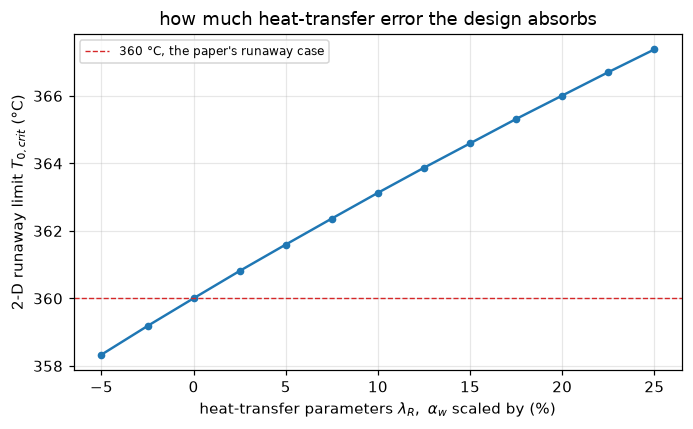
sensitivity near nominal: 0.30 degC of runaway limit per percent of heat-transfer capacity, the quantitative form of the paper's closing warning that prediction 'requires a degree of precision in the measurement of the experimental parameters seldom achieved'. The Pe_mR shift above is 0.14 % of heat-transfer capacity in these units.
77 claims registered
BT = pd.DataFrame(BREAK)
def _shown(metric, v):
# a bound's digits are this run's and differ between machines: shown as such
if claims.metrics[metric]["kind"] == "bound":
return f"(here {float(v):.1e})"
if isinstance(v, (bool, np.bool_)):
return str(bool(v))
return f"{v:.4g}"
_table = BT.assign(clean=[_shown(m, v) for m, v in zip(BT.metric, BT.clean)],
broken=[_shown(m, v) for m, v in zip(BT.metric, BT.broken)])
with pd.option_context("display.max_colwidth", 60, "display.width", 250,
"display.max_rows", 200):
display(_table[["defect", "metric", "clean", "broken", "caught", "note"]])
_caught = set(BT[BT.caught].metric)
_open = sorted(k for k in claims.metrics if k not in _caught)
print(f"{len(BT)} rows; {int(BT.caught.sum())} fail the claim they target, "
f"{len(BT) - int(BT.caught.sum())} do not (each says why in its note).")
print(f"{len(_caught)} of {len(claims.metrics)} claims are failed by at least one row.")
print("claims with no failing row:", ", ".join(_open) or "none")| defect | metric | clean | broken | caught | note | |
|---|---|---|---|---|---|---|
| 0 | G read literally as 4.684 | pehr_identity_rel | 0.001279 | 0.999 | True | |
| 1 | G read literally as 4.684 | re_from_G | 125.4 | 0.1254 | True | |
| 2 | tube radius R' taken as the diameter | u_ref_identity_rel | 0.002883 | 0.2799 | True | |
| 3 | tube radius R' taken as the diameter | u_lam075_identity_rel | 0.0001244 | 0.2639 | True | |
| 4 | tube radius R' taken as the diameter | u_aw150_identity_rel | 0.002894 | 0.2896 | True | |
| 5 | 44 read as mol/m3, not g/Nm3 | na0_from_44gnm3_rel | 0.005249 | 105.7 | True | |
| 6 | air molar mass taken as N2's (28.01) | m_feed_from_composition | 29.68 | 28.73 | True | |
| 7 | air molar mass taken as N2's (28.01) | m_feed_rel_pct | 0.6897 | -2.537 | True | |
| 8 | D2.2's volumetric c_p 0.323 taken as mass basis | adiabatic_rise_AB_C | 384.9 | 297.9 | True | |
| 9 | -dH1 compared in kcal/kmol with dH3 in kcal/gmol | dh3_literal_ratio | 281.7 | 2.817e+05 | True | |
| 10 | offset taken relative to 357 degC, not 630 K | kelvin_offset_rel_T_pct | 0.0238 | 0.04202 | True | |
| 11 | k1 shift with E2 instead of E1 | k1_shift_kelvin_pct | 0.5167 | 0.6011 | True | |
| 12 | rho_b transposed to 1030 | d22_shared_max_rel | (here 2.7e-05) | (here 2.1e-01) | True | |
| 13 | G*cp against D2.2's u without its c_p | d22_gcp_rel | 0.007052 | 0.6747 | True | |
| 14 | nu = 0 (Cartesian radial operator) | hx_series_rel_z50 | 4.916e-05 | 1.148 | True | wrong geometry: a slab has more cross-section near the wall |
| 15 | wall film sign flipped (b = -alpha) | hx_series_rel_z50 | 4.916e-05 | 778.6 | True | the outward-normal trap: the film heats instead of cools |
| 16 | nu = 0 (Cartesian radial operator) | hx_order_20_40 | (here 2.0e+00) | (here 8.3e-04) | True | |
| 17 | nu = 0 (Cartesian radial operator) | hx_order_40_80 | (here 2.0e+00) | (here 2.1e-04) | True | |
| 18 | integrator tolerances 1e-6 / 1e-8 | hx_finest_over_noise | (here 2.9e+06) | (here 4.4e+02) | True | |
| 19 | the printed R^2 in the 1/K series | k_moment_identity_rel | (here 6.4e-11) | (here 1.6e+01) | True | |
| 20 | R taken from the diameter | k_printed_series_factor | 17.36 | 69.44 | True | |
| 21 | k2 <-> k3 swapped | tm2d_hotspot_357_C | 29.53 | 24.06 | True | no independent witness prints k2, k3, so the reproductio... |
| 22 | k2 <-> k3 swapped | tm2d_357_vs_paper_rel | 0.01574 | 0.1979 | True | |
| 23 | heat Pe taken = mass Pe (a2 = 1/10) | tm2d_hotspot_357_C | 29.53 | inf | True | the two Peclet numbers differ by 1.9x |
| 24 | dH3 read literally as -1.090 kcal/gmol | tm2d_hotspot_357_C | 29.53 | 12.52 | True | combustion heat 1000x low |
| 25 | G read literally as 4.684 | tm2d_hotspot_357_C | 29.53 | 23.47 | True | every G-bearing group 1000x off: the 3 m bed behaves lik... |
| 26 | G read literally as 4.684 | z_hotspot_357_m | 0.5304 | 0.0007502 | True | the hot spot moves to within a millimetre of the inlet |
| 27 | Kelvin offset 273 instead of 273.15 | z_hotspot_357_m | 0.5304 | 0.5281 | False | 0.15 K moves the hot spot by less than its 5 % tolerance |
| 28 | k2 <-> k3 swapped | z_hotspot_357_m | 0.5304 | 0.5199 | False | the swap changes the height of the hot spot more than it... |
| 29 | Kelvin offset 273 instead of 273.15 | tm2d_350_C | 16.94 | 16.78 | False | 0.15 K moves the cooler hot spots by 1 to 3 %, inside th... |
| 30 | k2 <-> k3 swapped | tm2d_350_C | 16.94 | 14.66 | True | |
| 31 | Kelvin offset 273 instead of 273.15 | tm2d_355_C | 24.31 | 24 | False | 0.15 K moves the cooler hot spots by 1 to 3 %, inside th... |
| 32 | k2 <-> k3 swapped | tm2d_355_C | 24.31 | 20.43 | True | |
| 33 | Kelvin offset 273 instead of 273.15 | tm2d_3585_C | 36.16 | 35.28 | False | 0.15 K moves the cooler hot spots by 1 to 3 %, inside th... |
| 34 | k2 <-> k3 swapped | tm2d_3585_C | 36.16 | 27.91 | True | |
| 35 | Kelvin offset 273 instead of 273.15 | tm2d_360_C | 73.84 | 54.39 | True | 0.15 K moves the cooler hot spots by 1 to 3 %, inside th... |
| 36 | k2 <-> k3 swapped | tm2d_360_C | 73.84 | 33.95 | True | |
| 37 | k2 <-> k3 swapped (1-D) | rise1d_362_C | 42.59 | 33.25 | True | |
| 38 | k2 <-> k3 swapped (1-D) | rise1d_362_vs_paper_rel | 0.06487 | 0.1687 | True | |
| 39 | k2 <-> k3 swapped (1-D) | rise1d_363_C | 52.14 | 37.7 | True | |
| 40 | k2 <-> k3 swapped (1-D) | rise1d_363_vs_paper_rel | 0.0863 | 0.2146 | True | |
| 41 | lam_e = 0.75 put in a2 only (alpha kept) | tm2d_360_lam075_C | 35.47 | 27.98 | True | lambda_R enters the wall group too |
| 42 | lam_e = 0.75 put in a2 only (alpha kept) | tm2d_360_lam075_vs_paper_rel | 0.01346 | 0.2006 | True | |
| 43 | k2 <-> k3 swapped | tm2d_360_aw150_C | 34.29 | 26.94 | True | |
| 44 | k2 <-> k3 swapped | tm2d_360_aw150_vs_paper_rel | 0.02018 | 0.2303 | True | |
| 45 | k2 <-> k3 swapped (both models) | stated_mean_dev_pct | 4.011 | 12.3 | True | |
| 46 | k2 <-> k3 swapped (both models) | stated_worst_dev_pct | 8.63 | 21.46 | True | |
| 47 | Kelvin offset 273 instead of 273.15 | t0crit_2d_C | 360 | 360.2 | True | |
| 48 | Kelvin offset 273 instead of 273.15 | t0crit_1d_C | 363.9 | 364.1 | True | |
| 49 | Kelvin offset 273 instead of 273.15 | t0crit_2d_minus_360_C | 0.005951 | 0.1559 | True | |
| 50 | Kelvin offset 273 instead of 273.15 | t0crit_2d_printed_pehr_C | 360 | 360.1 | True | |
| 51 | Kelvin offset 273 instead of 273.15 | t0crit_2d_na0_p19_C | 359.9 | 360 | True | |
| 52 | n_r = 48 (bisected to 1e-3) against n_r = 160 | t0crit_2d_n80_vs_n160_C | (here 6.4e-04) | (here 2.2e-03) | True | |
| 53 | knee probed 0.05 degC above the limit | knee_peak_below_C | (here 8.5e+01) | (here 1.0e+03) | True | |
| 54 | knee probed 0.05 degC below the limit | knee_peak_above_C | (here 8.7e+02) | (here 6.2e+01) | True | |
| 55 | Kelvin offset 273 in the 1-D model only | runaway_gap_C | 3.927 | 4.077 | True | |
| 56 | alpha_w 1 % low | runs_away_2d_at_360 | False | True | True | |
| 57 | alpha_w 1 % low | runs_away_2d_at_360_n160 | False | True | True | |
| 58 | 1-D model with U = alpha_w (the bed's radial resistance ... | in_bracket_1d | True | False | True | |
| 59 | concentration scaling on b2 only (combustion heat unscaled) | t0crit_38_minus_44_C | 6.296 | 3.75 | True | |
| 60 | concentration scaling on b2 only (combustion heat unscaled) | t0crit_32_minus_38_C | 7.889 | 4.112 | True | |
| 61 | concentration scaling on b2 only (combustion heat unscaled) | limit_steepening_ratio | 1.253 | 1.096 | True | |
| 62 | concentration scaling on b3 only (partial-oxidation heat... | limit_steepening_ratio | 1.253 | 1.123 | True | |
| 63 | k2 <-> k3 swapped | x357_exit_slope_per_m | 0.06407 | 0.06743 | True | |
| 64 | k2 <-> k3 swapped | selectivity_exit_357 | 0.8287 | 0.8345 | False | the swap changes the product balance by less than the 5 ... |
| 65 | k2 <-> k3 swapped | conversion_exit_357 | 0.7816 | 0.7598 | False | the swap changes the product balance by less than the 5 ... |
| 66 | k2 <-> k3 swapped | x357_at_3m | 0.6477 | 0.6341 | False | the swap changes the product balance by less than the 5 ... |
| 67 | k2 <-> k3 swapped | x357_max | 0.7219 | 0.7006 | False | the swap changes the product balance by less than the 5 ... |
| 68 | k2 <-> k3 swapped | z_pa_max_357_m | 6.648 | 6.016 | True | |
| 69 | k2 <-> k3 swapped | pa_shortfall_at_3m_357 | 0.1027 | 0.09495 | True | |
| 70 | k2 <-> k3 swapped | pa_max_within_3m_357 | False | False | False | the maximum stays beyond 3 m; the M_m row below moves it... |
| 71 | Kelvin offset 273 instead of 273.15 | z_pa_max_360_m | 3.194 | 4.8 | True | |
| 72 | M_m of o-xylene (106.17) in b1 | selectivity_exit_357 | 0.8287 | 0.7037 | True | |
| 73 | M_m of o-xylene (106.17) in b1 | conversion_exit_357 | 0.7816 | 0.984 | True | |
| 74 | M_m of o-xylene (106.17) in b1 | x357_at_3m | 0.6477 | 0.6924 | True | |
| 75 | M_m of o-xylene (106.17) in b1 | x357_max | 0.7219 | 0.7228 | False | a faster conversion reaches about the same maximum, only... |
| 76 | heat Pe taken = mass Pe (a2 = 1/10) | x357_max | 0.7219 | 0.2467 | True | the bed runs away and burns the product |
| 77 | M_m of o-xylene (106.17) in b1 | pa_max_within_3m_357 | False | True | True | |
| 78 | independent route on n_r = 20 | route2_tm357_rel | 0.0004829 | 0.002236 | True | |
| 79 | independent route on n_r = 40 against pymrm on 80 | route2_t0crit_2d_absdiff | (here 2.4e-04) | (here 3.7e-03) | True | a grid mismatch between the two routes |
| 80 | BVP on n_z = 1000 | route2_rise1d_363_rel | 0.004352 | 0.01704 | True | |
| 81 | march reference with Kelvin offset 273 (the two routes d... | bvp_upwind_order | (here 9.9e-01) | (here -9.3e-02) | True | |
| 82 | FD-Jacobian route at rtol 1e-4 | fd_jacobian_vs_exact_tm357 | (here 2.8e-09) | (here 6.5e-03) | True | |
| 83 | radial mean with left-face radii (first-order quadrature) | tm357_grid_order | (here 2.0e+00) | (here 9.8e-01) | True | |
| 84 | radial mean with left-face radii (first-order quadrature) | tm357_n80_vs_n160_C | 0.00221 | 0.2107 | True | |
| 85 | integrator rtol 1e-3 in the sweep | tm357_rtol_spread_C | (here 2.1e-05) | (here 3.4e-03) | True | |
| 86 | cap 40 degC (below the controlled peaks) | t0crit_cap_range_C | (here 0.0e+00) | (here 9.8e-01) | True | |
| 87 | Pe_mR = 5 instead of 8 | pe8_tm357_rel_shift | 0.001253 | 0.003275 | True | |
| 88 | Pe_mR = 8 limit on n_r = 48, against the baseline on n_r... | pe8_t0crit_shift_C | 0.04255 | 0.04415 | True | |
| 89 | only lam_R scaled (alpha_w fixed) | heat_transfer_slope_C_per_pct | 0.3008 | 0.146 | True | |
| 90 | only lam_R scaled (alpha_w fixed) | ten_percent_limit_shift_C | 3.008 | 1.46 | True | |
| 91 | only lam_R scaled (alpha_w fixed) | pe8_shift_over_one_pct | 0.1414 | 0.2915 | True | |
| 92 | offset 273.3 (the convention shift reversed) | t0crit_1d_kelvin273_shift_C | (here 1.5e-01) | (here -1.5e-01) | True | |
| 93 | offset 273.3 (the convention shift reversed) | rise363_kelvin273_shift_C | 1.929 | -2.252 | True |
94 rows; 83 fail the claim they target, 11 do not (each says why in its note).
77 of 77 claims are failed by at least one row.
claims with no failing row: none
What the checks can and cannot do
- The exchanger claims test the radial operator against the paper’s exact series, so every assembly defect that matters (wrong
nu, a flipped wall sign) moves them. They test nothing in the kinetics. - The stated-result claims compare with Froment’s own computation. A shared transcription error in \(k_2\) or \(k_3\) would move them, which is why the \(k_2 \leftrightarrow k_3\) rows are there; an error both this page and the paper made cannot be seen.
- The second routes share only the printed constants. They can tell a wrong operator or integrator from a right one, not a wrong constant from a right one.
- The labels (does 360 °C run away, is the 1-D limit inside its bracket) carry their margins, so a label that sits inside the numerical noise of its threshold would raise rather than print.
Reuse
| Change | Where |
|---|---|
| Other kinetics in a fixed-bed tube | write a pointwise source(u) for state (n_r, n_f) and pass it to model.Tube2D / model.Tube1D; NumJac takes its Jacobian |
| More species or a second temperature | one more field: one more entry in dispersion and wall |
| A coolant temperature other than the inlet’s, constant along the tube | u_wall= (the wall condition becomes dt/dr = -alpha (t - t_wall)) |
| A steady 1-D formulation | model.Tube1DSteady (upwind finite volumes, pymrm.newton) |
| A runaway or ignition threshold | model.critical_inlet with a predicate that marches from the inlet; it checks both bracket ends |
What Tube2D assumes, and so what a new use must also satisfy: plug flow with the same unit convective coefficient for every field (the equations divided through by the convective term, as in Froment’s dimensionless form); no axial dispersion; dispersion and wall coefficients constant in \(r\) and \(z\); a coolant value constant along the tube (it is folded into a constant boundary vector when the operators are assembled); a uniform radial grid. A velocity profile, temperature-dependent properties or a coolant that heats up along the tube need changes to the class, not only a new source.
- The 1-D runaway machinery with criteria instead of brute force is the sibling page
D2.2: same reactor, same \(k_1\), closed-form critical-inlet criteria. - The S6 radial-operator pattern (cylindrical
construct_grad/construct_div, Robin wall) is shared withA2.3(dispersion closure) andA3.15(Graetz problem); the radial heat-transfer parameters themselves areA3.12(Yagi–Kunii, the very correlation Froment used for \(\lambda_R\)). - Froment kinetics with data is
C2.1(Xu & Froment SMR, validated against the runs it was fitted to); use it as the model when a kinetics page proper is wanted.
Limits to keep in mind. The kinetics are pseudo-first-order effective rate laws at 1 atm in large air excess on a 1960s V₂O₅ catalyst, asserted by the paper as representative and never fitted to data in this document; do not transplant them quantitatively. The runaway limit is exponentially sensitive: this page measures 0.3 °C of limit per percent of heat-transfer capacity (so the paper’s own 10 % parameter uncertainty is worth about 3 °C), and even the unprinted 273-vs-273.15 Kelvin convention, 0.5 % in \(k_1\), moves every limit by exactly 0.15 °C (the model sees only \(T_0\) plus the offset) and the 363 °C hot spot by 1.9 °C. Any reuse of the numbers (rather than the pattern) inherits that sensitivity. The paper’s own kinetics were superseded by Calderbank’s measurements (not on disk) and by Froment & Bischoff’s textbook treatment; a separate D3.4 page against those sources would be validation, this page is reproduction.
Reference. Froment, G. F. (1967). Industrial & Engineering Chemistry 59(2), 18–27. doi:10.1021/ie50686a006
# Claims: prints every registered number, writes agreement.json for CI, and
# raises when a claim fails its own check or has no break row.
claims.report();   # the semicolon keeps the notebook from echoing the payload
Claims for C2.10:
pehr_identity_rel = 0.0012793 value rtol 0.05
u_ref_identity_rel = 0.0028835 value rtol 0.05
u_lam075_identity_rel = 0.00012436 value rtol 0.05
u_aw150_identity_rel = 0.0028939 value rtol 0.05
na0_from_44gnm3_rel = 0.0052487 value rtol 0.05
re_from_G = 125.35 value rtol 0.05
m_feed_from_composition = 29.683 value rtol 0.001
m_feed_rel_pct = 0.68972 value rtol 0.05
adiabatic_rise_AB_C = 384.9 value rtol 0.05
dh3_literal_ratio = 281.65 value rtol 0.05
kelvin_offset_rel_T_pct = 0.023804 value rtol 0.05
k1_shift_kelvin_pct = 0.51669 value rtol 0.05
d22_shared_max_rel = (here 2.7e-05) bound bound <= 0.001 [chosen]
d22_gcp_rel = 0.0070519 value rtol 0.05
hx_series_rel_z50 = 4.9159e-05 value rtol 0.05
hx_order_20_40 = (here 2.0e+00) bound bound [1.9, 2.1] [theory]
hx_order_40_80 = (here 2.0e+00) bound bound [1.9, 2.1] [theory]
hx_finest_over_noise = (here 2.9e+06) bound bound >= 1000 [theory]
k_moment_identity_rel = (here 6.4e-11) bound bound <= 1e-08 [identity]
k_printed_series_factor = 17.361 value rtol 0.001
tm2d_hotspot_357_C = 29.528 value rtol 0.05
tm2d_357_vs_paper_rel = 0.015744 value rtol 0.05
z_hotspot_357_m = 0.53038 value rtol 0.05
tm2d_350_C = 16.941 value rtol 0.05
tm2d_355_C = 24.309 value rtol 0.05
tm2d_3585_C = 36.156 value rtol 0.05
tm2d_360_C = 73.839 value rtol 0.05
rise1d_362_C = 42.595 value rtol 0.05
rise1d_362_vs_paper_rel = 0.064868 value rtol 0.05
rise1d_363_C = 52.142 value rtol 0.05
rise1d_363_vs_paper_rel = 0.086295 value rtol 0.05
tm2d_360_lam075_C = 35.471 value rtol 0.05
tm2d_360_lam075_vs_paper_rel = 0.013459 value rtol 0.05
tm2d_360_aw150_C = 34.294 value rtol 0.05
tm2d_360_aw150_vs_paper_rel = 0.020175 value rtol 0.05
stated_mean_dev_pct = 4.0108 value rtol 0.05
stated_worst_dev_pct = 8.6295 value rtol 0.05
t0crit_2d_C = 360.01 value rtol 1e-05
t0crit_1d_C = 363.93 value rtol 1e-05
t0crit_2d_minus_360_C = 0.0059509 value rtol 0.05
runaway_gap_C = 3.9274 value rtol 0.001
t0crit_2d_printed_pehr_C = 359.96 value rtol 1e-05
t0crit_2d_na0_p19_C = 359.87 value rtol 1e-05
knee_peak_below_C = (here 8.5e+01) bound bound <= 150 [chosen]
knee_peak_above_C = (here 8.7e+02) bound bound >= 150 [chosen]
runs_away_2d_at_360 = False exact exact, margin 0.00595
runs_away_2d_at_360_n160 = False exact exact, margin 0.00659
in_bracket_1d = True exact exact, margin 0.933
t0crit_38_minus_44_C = 6.2963 value rtol 0.001
t0crit_32_minus_38_C = 7.8888 value rtol 0.001
limit_steepening_ratio = 1.2529 value rtol 0.02
x357_exit_slope_per_m = 0.064073 value rtol 0.05
x357_at_3m = 0.64772 value rtol 0.05
x357_max = 0.72187 value rtol 0.05
z_pa_max_357_m = 6.6478 value rtol 0.05
pa_shortfall_at_3m_357 = 0.10272 value rtol 0.05
z_pa_max_360_m = 3.1944 value rtol 0.05
pa_max_within_3m_357 = False exact exact, margin 1.22
selectivity_exit_357 = 0.82866 value rtol 0.05
conversion_exit_357 = 0.78165 value rtol 0.05
route2_tm357_rel = 0.00048289 value rtol 0.05
route2_t0crit_2d_absdiff = (here 2.4e-04) bound bound <= 0.001 [chosen]
route2_rise1d_363_rel = 0.0043523 value rtol 0.05
bvp_upwind_order = (here 9.9e-01) bound bound [0.9, 1.1] [theory]
fd_jacobian_vs_exact_tm357 = (here 2.8e-09) bound bound <= 1e-05 [tolerance]
tm357_grid_order = (here 2.0e+00) bound bound [1.8, 2.2] [theory]
tm357_n80_vs_n160_C = 0.0022098 value rtol 0.05
tm357_rtol_spread_C = (here 2.1e-05) bound bound <= 0.001 [tolerance]
t0crit_2d_n80_vs_n160_C = (here 6.4e-04) bound bound <= 0.001 [chosen]
t0crit_cap_range_C = (here 0.0e+00) bound bound <= 0.002 [chosen]
pe8_tm357_rel_shift = 0.0012534 value rtol 0.05
pe8_t0crit_shift_C = 0.042545 value rtol 0.02
heat_transfer_slope_C_per_pct = 0.30085 value rtol 0.02
ten_percent_limit_shift_C = 3.0085 value rtol 0.02
pe8_shift_over_one_pct = 0.14142 value rtol 0.02
t0crit_1d_kelvin273_shift_C = (here 1.5e-01) bound bound [0.1498, 0.1502] [identity]
rise363_kelvin273_shift_C = 1.9291 value rtol 0.05