# Bootstrap: the pymrm this page was checked with, and the gallery files it was
# published with. Works in a checkout, in CI and on a fresh Colab VM.
GALLERY_REF = "gallery-2026.11.10.3"  # replaced by the release tag at publication
PYMRM = ">=3.3.0,<4"  # equals meta.yaml pymrm_min_version, up to the next major
PAGE = "B1.7-mears-criteria"  # equals the page directory

import os, sys, urllib.request
from pathlib import Path
_shared = next((p / "shared" for p in (Path.cwd(), *Path.cwd().parents)
                if (p / "shared" / "gallery_bootstrap.py").is_file()), None)
if _shared is None:
    _shared = (Path(os.environ.get("XDG_CACHE_HOME") or Path.home() / ".cache")
               / "pymrm-gallery" / GALLERY_REF)
    _shared.mkdir(parents=True, exist_ok=True)
    urllib.request.urlretrieve(
        "https://raw.githubusercontent.com/computational-chemical-engineering/"
        f"pymrm-gallery/{GALLERY_REF}/shared/gallery_bootstrap.py",
        _shared / "gallery_bootstrap.py")
sys.path.insert(0, str(_shared))
sys.modules.pop("gallery_bootstrap", None)
from gallery_bootstrap import setup
setup(PAGE, PYMRM, GALLERY_REF); # the semicolon stops the cell echoing the pathThe Mears criteria: what each transport-limit test actually guarantees
sec:B
struct:S3
struct:S4
tier:T0
data:tier6
phase:gas-solid
Mears (1971) collects the diagnostic inequalities that decide whether a measured rate is chemistry or transport, each claiming a 5 % tolerance. This page solves the pellet, film and dispersion problems exactly and measures what each criterion’s boundary really admits: the one that is exact, the ones the rounding broke, the window where one loses all power, and the limit where the combined criterion fails structurally.
The Mears criteria: what each transport-limit test actually guarantees
Catalog ID: B1.7 · Structures: S3 (1D steady BVP) + S4 (axial dispersion) · Tier: T0
An experimenter measures a rate. Before that number can be called kinetics, gradients must be ruled out in three domains: intraparticle (inside the pellet), interphase (across the film around it) and interparticle (across the reactor). Mears (1971) collects, and in three cases derives, one-line inequalities in observables for each domain, almost all carrying the same promise: satisfy this, and the measured rate deviates from the true one by less than 5 %.
Those inequalities are still the standard screening tests. What none of them comes with is a measurement of what the promise is worth: the derivations are first-order perturbation expansions, several right-hand sides are rounded, and one is stated with an unquantified exclusion zone. B1.4 does this audit for the Weisz-Prater criterion alone; this page does it for the rest of the family. Every criterion the paper prints is solved against exactly, and the page reports, per criterion, the deviation its boundary actually admits:
- One criterion is exact. The interphase mass test (eq. 17) holds its 5 % to all digits for first-order kinetics, because the film balance makes the deviation equal to a third of the criterion’s own left side.
- The intraparticle family is uniformly liberal by the same rounding. The paper says “a numerical value of 0.75 … was rounded to 1”. That rounding is the gap between the stated 5 % and what the printed bounds admit.
- The nonisothermal criterion (eq. 9) has a measurable window of no power. Its bound diverges at the compensation point \(n = \gamma\beta\); the exact 5 % threshold stays finite, so near compensation the criterion certifies states with arbitrarily large deviations, and the page computes the window of \(\gamma\beta\) in which even the unrounded 0.75 cannot save it.
- The combined interphase-intraparticle criterion (eq. 21) fails structurally at low Biot number, and passing every pellet-scale criterion at once still admits more than twice the 5 %, because the tolerances stack.
- The axial-dispersion criterion (eq. 30), Mears’ own, holds its claim at every conversion and order tested.
The numbers behind each statement are printed by the code below and collected in What pymrm adds.
import numpy as np
import sympy as sp
import matplotlib.pyplot as plt
from IPython.display import Markdown, display
from scipy.optimize import brentq, minimize_scalar
from pymrm.checks import find_roots, observed_orders
from gallery_utils import Claims, load_claims
from model import (Power, WeiszHicks, InhibitedLH, shoot, cross, eta_iso1,  # this page's model.py
                   Pellet, film_mass_dev, film_heat_dev, AxialVessel, frac_unconverted,
                   axial_dev, axial_dev_covary, petersen_dev, joint_worst)

np.seterr(all="ignore")
plt.rcParams.update({"figure.dpi": 110, "axes.grid": True, "grid.alpha": 0.3})
claims = Claims(PAGE.split("-")[0])
BREAK = []
B14 = load_claims("B1.4-weisz-prater-criterion")   # numbers this page compares with


def brk(row, metric, broken):
    """One injected defect: ``broken`` is what claim ``metric`` becomes with it."""
    caught = claims.breaks(row, metric, broken)
    BREAK.append((row, metric, claims[metric], broken, caught))
    return caught
Background
The forward problem, given kinetics compute the transport-corrupted rate, is what B1.1 solves. The experimenter faces the inverse problem: the intrinsic kinetics are what the experiment is for, so a usable test must be stated in measured quantities only. The classic example is Weisz and Prater’s group \(\Phi = \mathcal{R}\,r_p^2/(C_s D_e)\) (observed rate per particle volume, particle radius, surface concentration, effective diffusivity) with the criterion \(\Phi < 1\).
Mears’ 1971 review assembles the whole toolbox in that spirit and extends it. Its route to each criterion is perturbation analysis: expand the rate in a Taylor series in the concentration and temperature perturbations, and bound the group of observables that keeps the first-order rate deviation below a stated tolerance, usually 5 %. That construction has two systematic consequences this page measures. First, a first-order expansion is only as good as the curvature it drops, so each boundary sits slightly off the true 5 % contour, sometimes on the safe side and sometimes not, and in the intraparticle family the deliberate rounding of 0.75 to 1 moves it further. Second, wherever two effects cancel at first order (the \(n = \gamma\beta\) compensation case), the criterion’s denominator vanishes and the test loses all power; the paper says the case “requires further consideration”, and this page measures how wide it is.
The paper contains no data, no figures and no tables: every claim in it is an inequality plus prose. The criteria are inequalities between computable quantities, so the validation is to solve the underlying pellet, film and reactor problems exactly and measure where each stated tolerance holds, where it fails, and by how much.
The published model
Provenance: what was read, and where each criterion comes from
Mears, D. E. (1971), “Tests for Transport Limitations in Experimental Catalytic Reactors”, Ind. Eng. Chem. Process Des. Develop. 10(4), 541-547, is the only document consulted. The scan is CCITT-G4 bilevel at 300 ppi native; every equation and every numeric threshold below was read off cropped 300 dpi renders (pdftoppm -r 300) of the journal page named, because the text layer loses exactly the load-bearing symbols: the effectiveness factor extracts as a bare comma, eq. (25)’s right side 5.3 comes back as a degree sign and a dash, and eq. (3)’s \(1/|n|\) loses its absolute-value bars. The PDF also opens with the tail of the preceding article (a catalytic-cracking study), so identity was established from page 2 onward, the running head, and the ACS download stamp article-pdf/10/4/541/.
This paper is a review, and the three criteria “derived by the author” are derived in two companion papers, not here. The interphase criteria (eqs. 14, 17) and the interparticle radial criterion (eq. 23) cite “Mears, 1971b” (J. Catal. 20, 127); the axial criterion (eqs. 29-32) cites “Mears, 1971a” (Chem. Eng. Sci., listed “in press”). Neither companion was consulted; this page audits the criteria exactly as the review states them, which is also how the literature cites them. The remaining criteria are attributed by the review to Weisz & Prater (1954), Weisz (1957), Hudgins (1968), Anderson (1963), Kubota & Yamanaka (1969), Weisz & Hicks (1962), Carberry (1961), Satterfield et al. (1969), van den Bleek et al. (1969) and Petersen (1965b, 1968); none of those was consulted either.
The criteria, as printed
All symbols as in the paper’s Nomenclature (journal page 547): \(\mathcal{R}\) is the observed rate per unit particle volume, \(r_p\) the particle radius, \(d_p\) its diameter, \(C_s\)/\(C_b\) the surface/bulk reactant concentration, \(D_e\) the effective diffusivity, \(\lambda\) the particle conductivity, \(h\)/\(k_c\) the film heat/mass transfer coefficients, \(n\) the power-law order, \(E\) the true activation energy.
Intraparticle, isothermal (journal pages 542-543):
\[\frac{\mathcal{R}r_p^2}{C_sD_e} < 1 \tag{1}\]
(Weisz-Prater; first order, sphere, \(\eta \ge 0.95\)), with Weisz (1957)’s linear-approximation values “conservatively 0.3 for second-order reactions and 6 for zero order”, 0.6 for first order;
\[\frac{\mathcal{R}r_p^2}{C_sD_e} < \frac{\mathcal{R}_s}{C_s\mathcal{R}'_{cs}} \tag{2}\]
(Hudgins 1968, \(\eta > 0.95\), “a numerical value of 0.75 … was rounded to 1”, extendable to negative orders “by taking the absolute value of the derivative”), which for power-law kinetics becomes
\[\frac{\mathcal{R}r_p^2}{C_sD_e} < \frac{1}{|n|} \tag{3}\]
(eqs. 2 and 3 “fail for zero-order kinetics … the value of 6 on the right obtained by Weisz is recommended”).
Intraparticle, thermal (page 542): Anderson’s quasi-isothermality test, “the observed rate \(\mathcal{R}\) must not differ from the rate that would prevail at constant temperature by more than an acceptable amount, say 5 %”, with “again a numerical value of 0.75 on the right … rounded to 1”, valid “whether diffusional limitations exist in the particle or not”:
\[\frac{|\Delta H|\mathcal{R}r_p^2}{\lambda T_s} < \frac{T_sR}{E} \tag{6}\]
Intraparticle, combined concentration and temperature (page 543): for power-law kinetics (except zero order), \(\eta = 1 \pm 0.05\) if
\[\frac{\mathcal{R}r_p^2}{C_sD_e} < \frac{1}{|n - \gamma\beta|}, \qquad \gamma = \frac{E}{RT_s}, \qquad \beta = \frac{(-\Delta H)D_eC_s}{\lambda T_s} \tag{9-11}\]
with the caveat that “the special case for which \(|n-\gamma\beta|\) is close to or equal to zero requires further consideration”: there “the heat effect compensates for the diffusion effect so that the rate stays nearly constant until the concentration within the catalyst has dropped to less than 80 % of the surface value”, and Petersen’s asymptotic method “gives a value of 13 for the right side of Equation 9 when \(n\) and \(\gamma\beta\) both equal 1.0”. The isothermal-particle corollary is
\[|\gamma\beta| < 0.05\,n \tag{13}\]
and the comparison case is Weisz and Hicks (1962) for exothermic first-order reactions, which “safely predicts positive deviations (\(\eta > 1.05\)) … but fails to predict negative deviations for endothermic reactions”:
\[\frac{\mathcal{R}r_p^2}{C_sD_e}\exp\!\left[\frac{\gamma\beta}{1+\beta}\right] < 1 \tag{12}\]
Interphase (pages 543-544): Mears’ film-heat criterion, “if the observed rate is to deviate by less than 5 %”,
\[|\chi| = \left|\frac{-\Delta H\,\mathcal{R}\,r_p}{h\,T_b}\right| < 0.15\,\frac{RT_b}{E} \tag{14}\]
valid “whether transport limitations exist in the particle or not”; the film heat resistance limits before the intraparticle one as long as
\[\mathrm{Bi}_p = h\,d_p/\lambda < 10 \tag{15}\]
Carberry (1961)’s first-order isothermal mass test \(\eta k/k_ca < 0.1\) (eq. 16), “generalized to other reaction orders by the perturbation approach, allowing a 5 % deviation as before”:
\[\omega = \frac{\mathcal{R}\,r_p}{C_b\,k_c} < \frac{0.15}{n} \tag{17}\]
(“the criterion also shows that zero-order reactions are not affected by interphase transport”), and Satterfield et al.’s trickle-flow analogue \(\mathcal{R}r_p/C^*k_{LS} < 0.15\) (eq. 18).
Combined interphase-intraparticle (page 544): replacing the Dirichlet surface conditions by film conditions (eqs. 19-20), “excluding \(|n - \gamma_b\beta_b|\) close to zero, the resulting criterion for \(\eta = 1 \pm 0.05\) becomes”
\[\frac{\mathcal{R}r_p^2}{C_bD_e} < \frac{1 + 0.33\,\gamma\chi}{|n-\gamma_b\beta_b|\,(1 + 0.33\,n\omega)} \tag{21}\]
with \(\gamma_b, \beta_b\) at bulk conditions, and its isothermality corollary \(|\gamma_b\beta_b + 0.3\,n\gamma_b\chi| < 0.05\,n\) (eq. 22).
Interparticle (page 545): the radial-heat criterion at the hot spot, \(|\Delta H|\mathcal{R}_bR_o^2/(k_eT_w) < 0.4\,RT_w/E\) (eq. 23, wall-resistance variant eq. 26, ordering rule eq. 25 with right side 5.3), the dilution criterion \(L/d_p > 250\,b/\delta\) (eq. 27), and the axial-dispersion family: Petersen’s asymptotic \(\alpha = \sqrt{k_bD_a}/v < 1\) (eq. 28), against Mears’ perturbation criterion holding “the deviation in the required reactor length to less than 5 %”,
\[\alpha < 0.22 \tag{29}\]
or, equivalently,
\[\frac{L}{d_p} > \frac{20\,n}{\mathrm{Pe}_a}\ln\frac{C_o}{C_f} \tag{30, 32}\]
with \(\mathrm{Pe}_a = v d_p/D_a\), “about four and a half times more conservative than the earlier one” because “asymptotic criteria actually indicate the transition region … rather than the point at which transport effects are just starting to become significant”.
What is audited, and what is stated only
The pellet-scale and axial criteria (eqs. 1-3, 6, 9, 12, 13, 14, 16, 17, 21 in its isothermal part, 28-32) are audited against exact solves below. Three groups are stated, not audited, each for a reason given here: eqs. 4-5 (volume-change modulus) would need a pellet flux model with net convection, and the paper’s own position is that “in dilute cases the volume-change effect becomes negligible”; the paper also prints \(\theta\) with opposite signs, \(\theta = (\nu-1)Y_s\) in eq. 4 (page 542) against \(\theta = (1-\nu)Y_s\) in the nomenclature (page 547), so a builder of that criterion must pick a sign the source does not settle. Eqs. 23-27 (interparticle) test a reactor-scale temperature field against \(k_e\) correlations and a stochastic bypassing model that live in other papers, so an audit has no self-contained reference to solve. Eq. 22’s thermal part couples film heat to the pellet interior, and its audit belongs with eq. 21’s thermal part; both are beyond the isothermal reduction audited here. Eq. 18 is eq. 17 with \(C^*k_{LS}\) in place of \(C_bk_c\) at \(n = 1\), so its audit is the \(n = 1\) column of eq. 17’s.
Parameters and assumptions
Everything is audited in the dimensionless variables the criteria themselves use, so no physical parameter values enter any audit except the two dimensional cross-checks of the film section.
Pellet (intraparticle). Sphere, steady state, constant \(D_e\) and \(\lambda\), single irreversible reaction, uniform activity: the paper’s own assumptions. With \(y = c/C_s\), \(u = r/r_p\), the two balances reduce by the Prater relation (tested on B1.6, not re-derived here) to
\[\nabla^2 y = \phi^2\,\mathcal{F}(y),\qquad \mathcal{F}(y) = y^n\exp\!\left[\frac{\gamma\beta(1-y)}{1+\beta(1-y)}\right], \qquad y'(0) = 0,\; y(1) = 1,\]
with \(\nu = 2\) in the Laplacian. All rate laws are normalised to \(\mathcal{F}(1) = 1\), so the observable is exactly the printed group in every case:
\[\Phi \equiv \frac{\mathcal{R}r_p^2}{C_sD_e} = \phi^2\eta = 3\,y'(1), \qquad \eta = \frac{3\,y'(1)}{\phi^2}.\]
The deviation eqs. 1-3, 9, 12 bound is \(|\eta - 1|\), the observed rate against the rate at surface conditions (“\(\eta = 1 \pm 0.05\)”). The deviation eq. 6 bounds is different and is measured differently: the observed rate against “the rate that would prevail at constant temperature”, i.e. \(\eta/\eta_{\rm iso}(\phi) - 1\) at the same \(\phi\).
Film (interphase). Resistances lumped at the surface (the paper’s stated assumption), sphere, so the external area per particle volume is \(a = 3/r_p\) (nomenclature page: \(a\) = “superficial (outside) surface area of catalyst particle per unit particle volume”). The steady film balances then tie the surface state to the criteria’s own left sides exactly:
\[1 - \frac{C_s}{C_b} = \frac{\mathcal{R}r_p}{3\,k_cC_b} = \frac{\omega}{3}, \qquad \frac{T_s - T_b}{T_b} = \frac{(-\Delta H)\mathcal{R}r_p}{3\,h\,T_b} = \frac{\chi}{3},\]
because \(\mathcal{R}\) in \(\omega\) and \(\chi\) is the observed rate. The deviation eqs. 14, 16, 17 bound is the observed rate against the rate at bulk conditions, which is therefore a closed-form function of the observables: the interphase audit is exact algebra, and the numerics only cross-check it.
Combined (eq. 21). The same pellet with the Dirichlet surface condition replaced by the film condition \(y'(1) = \mathrm{Bi}_m(1 - y(1))\), \(\mathrm{Bi}_m = k_cr_p/D_e\), everything now normalised on bulk: \(\Phi_b = \mathcal{R}r_p^2/(C_bD_e) = 3y'(1)\), \(\eta_b\) against bulk conditions, and \(\omega = \Phi_b/\mathrm{Bi}_m\), all observables again.
Axial (eqs. 28-32). Isothermal single reaction in a closed vessel with axial dispersion, Danckwerts boundary conditions (the canonical treatment is A2.1), power-law rate. The deviation eq. 30 bounds is in the required reactor length, and two readings of “required length” exist; both are computed. At the criterion’s own boundary \(L/d_p = (20n/\mathrm{Pe}_a)\ln(C_o/C_f)\) the vessel Peclet number is \(\mathrm{Pe}_L = vL/D_a = 20\,n\ln(C_o/C_f)\), a function of conversion alone. The main reading holds \(\mathrm{Pe}_L\) at that boundary value and measures the \(k\tau\) deficit of that vessel against plug flow, the perturbation-theory object, whose first-order term \(\ln(C_o/C_f)/\mathrm{Pe}_L\) is exactly 5 % at the boundary. The self-consistent reading (extra length at fixed \(k\), \(v\), \(D_a\), with \(\mathrm{Pe}_L\) growing with \(L\)) is printed beside it.
Parameter ranges. Orders \(n \in \{-1, \tfrac12, 1, 2, 3\}\) plus zero order and one inhibited Langmuir-Hinshelwood rate; \(\gamma = 10\)-\(40\) (the paper’s “typical values 10-40”); \(\gamma\beta\) from \(-2\) to \(+3\), inside the paper’s \(\beta\) range “\(-0.1\)-\(0.1\)” at \(\gamma = 30\); \(\mathrm{Bi}_m = 0.3\)-\(100\); conversions 0.2-0.99. Carried without test: steady state, sphere geometry (the criteria are all stated for \(r_p\) of a sphere), constant properties, and the Prater relation inside the pellet.
GAMMA = 30.0           # Arrhenius number of the eq. 9 audit (paper: "typical values 10-40")
RT_REF = 1e-12         # DOP853 tolerance of the reference states pymrm is compared with
WEISZ = {1.0: 0.6, 2.0: 0.3}   # Weisz (1957)'s linear-approximation bounds
K_LH = 5.0             # adsorption group of the inhibited rate (the rate law of B1.4)
The data
There is none, and there cannot be: provenance tier 6.
The source paper prints no measurement, no figure and no table anywhere in its seven pages (checked page by page on the renders; the only tabular matter is the Nomenclature). Its claims are inequalities plus derivation prose, so nothing on this page is validated against experiment. What follows is: exact closed forms, two numerical methods solving the same stated models, and the paper’s own printed numbers and internal identities used as transcription checks.
No dataset is shipped and no figure is digitised. No other page’s CSV is loaded. Three committed numbers of B1.4 are read with load_claims: the effectiveness factor at \(\Phi = 1\) of the inhibited Langmuir-Hinshelwood rate, which is compared with this page’s own value, and B1.4’s two fold onsets, which are printed beside this page’s values where they occur.
PyMRM implementation
Three solvers, with a division of labour between them.
shoot is the reference for every pellet threshold. Substituting \(s = \phi u\) removes \(\phi\) from the pellet equation, so integrating outward from a prescribed centre value \(y_c\) until \(y = 1\) (Dirichlet), or until \(s\,y'(s) = \mathrm{Bi}_m(1-y)\) (film surface), yields \(\phi\) as the stopping radius. Parametrising by \(y_c\) instead of \(\phi\) traverses a solution branch, folds included, in one deterministic pass. cross scans a fixed ladder of the branch parameter with pymrm.checks.find_roots and refines each state where a criterion binds by Brent’s method on the integration itself.
Pellet is the pymrm finite-volume solver, checked against shoot and the closed form on grid ladders:
- Boundary conditions use the OUTWARD normal. Centre: symmetry,
{a:1, b:0, d:0}. Surface, Dirichlet:{a:0, b:1, d:1}. Surface, film: the flux condition \(\mathrm{d}y/\mathrm{d}u = \mathrm{Bi}_m(1-y)\) has \(n = +u\) there, so \(\partial y/\partial n + \mathrm{Bi}_m\,y = \mathrm{Bi}_m\), i.e.{a:1, b:Bim, d:Bim}. The physical equation sits in a comment next to each. - Operators are assembled once in
__init__; the exact Jacobian of the pointwise rate is put on the diagonal withconstruct_coefficient_matrix. - Layout
(n_u, 1), spatial axis first, field last. newtonwithbounds=(0, 1),tol=1e-12andstagnation=True; every solve that does not report success raises.- The observable \(\Phi = 3\,y'(1)\) is the surface gradient from
compute_boundary_values, the gradient the operator transports.
AxialVessel is the closed dispersion vessel on the pymrm operators, assembled as in A2.1: van Leer TVD face fluxes and their exact Jacobian from ConvFluxTVD, solved by newton(damping="monotone", stagnation=True) from the upwind solution; Danckwerts inlet {a: D/v, b: 1, d: 1} (the outward normal points against the flow, so \(D/v\,\partial c/\partial n + c = c^\ast\)); zero-gradient outlet {a:1, b:0, d:0}. The outlet concentration is the face value from compute_boundary_values. A second solver of the same discrete equations, van Leer deferred correction (the upwind operator plus the lagged limiter correction, the source linearised at the previous sweep), is kept as a validation route.
# One solve of each model, and what they are built from.
p_demo = Pellet(400)
y_demo, sol_demo = p_demo.solve(1.0, Power(1.0))
print(f"first-order sphere, phi = 1, 400 cells: newton '{sol_demo.message}'")
print(f"  operators assembled once; Jacobian of the rate exact on the diagonal; layout {p_demo.shape}")
v_demo = AxialVessel(20 * np.log(1 / (1 - 0.632)), 400)
c_demo, sol_ax = v_demo.solve(1.05 * np.log(1 / (1 - 0.632)))
print(f"axial vessel, 400 cells, ConvFluxTVD (van Leer) + newton(damping='monotone'): '{sol_ax.message}'")
first-order sphere, phi = 1, 400 cells: newton 'Converged'
operators assembled once; Jacobian of the rate exact on the diagonal; layout (400, 1)
axial vessel, 400 cells, ConvFluxTVD (van Leer) + newton(damping='monotone'): 'Converged'Results
1. The transcription, checked against the paper’s own identities
Every threshold was read off a render, and a misread threshold silently changes every verdict downstream, so the criteria are first checked against each other. The paper pays for checks with real resolving power: printed numbers that are derivable from other printed numbers. A misreading of any of the constants involved (0.75, 0.15, 0.22, 20, 10) breaks at least one of them.
# (a) eq. 29 and eq. 30 are the same criterion in two notations:
# alpha^2 = k_b D_a/v^2 = ktau/Pe_L, and eq. 30 with tau = L/v reads
# 1 > 20 ktau/Pe_L = 20 alpha^2, i.e. alpha < 1/sqrt(20).
ALPHA_STAR = 1.0 / np.sqrt(20.0)
claims.bound("alpha_star_identity", ALPHA_STAR, min=0.2236, max=0.2237, basis="identity",
             structural=True, note="1/sqrt(20) from eq. 30's 20, against eq. 29's printed 0.22")
print(f"(a) eq. 30 in alpha form: alpha < 1/sqrt(20) = {ALPHA_STAR:.4f}, which rounds to the "
      f"0.22 printed as eq. 29;")
print(f"    eq. 28 (alpha < 1) is looser by sqrt(20) = {1 / ALPHA_STAR:.2f}, the paper's "
      "'four and a half times'.")
print("    Structural: algebra relating two printed constants; it tests their transcription only.")


# (c) the 0.75 the paper says was 'rounded to 1'. Small-Phi expansion of the
# sphere: eta = 1 - n Phi/15 + O(Phi^2), so the 5 % point sits at Phi = 0.75/n.
# Measured from the branch at its kinetic end (t large, y_c -> 1, Phi -> 0),
# extrapolated linearly in Phi from two states.
def perturbation_slopes(nu=2):
    """d(1 - eta)/dPhi at Phi -> 0 for n = 1/2, 1, 2, divided by n/15."""
    out = {}
    for n in (0.5, 1.0, 2.0):
        (e1, P1), (e2, P2) = [(o[1], o[2]) for o in (shoot(Power(n), t, nu=nu) for t in (6.2, 6.9))]
        d1, d2 = (1 - e1) / P1, (1 - e2) / P2
        out[n] = (d2 + (d1 - d2) * (0.0 - P2) / (P1 - P2)) * 15.0 / n
    return out


SLOPE = perturbation_slopes()
claims.bound("perturbation_slope_rel_err", max(abs(v - 1) for v in SLOPE.values()), max=1e-4,
             basis="chosen", note="linear extrapolation to Phi = 0 from Phi of about 1e-3; "
             "the next term of the expansion is O(Phi)")
brk("pellet traced as a slab (nu = 0)", "perturbation_slope_rel_err",
    max(abs(v - 1) for v in perturbation_slopes(nu=0).values()))
for n, v in SLOPE.items():
    print(f"(c) n = {n}: measured d(1 - eta)/dPhi at Phi -> 0 over n/15 = {v:.4f}")
print(f"    the slope n/15 holds to below 1e-4 (here {claims['perturbation_slope_rel_err']:.1e}): "
      "15 x 0.05 = 0.75 is the unrounded")
print("    constant of eqs. 2/3, as the paper says it rounded away.")

# (d) eq. 15's threshold of 10 is derivable from 0.75 and 0.15. Film heat binds
# before intraparticle heat iff gamma chi/0.15 > gamma beta Phi/C6, with C6 the
# eq. 6 bound; chi/(beta Phi) = lambda/(h r_p) = 2/Bi_p, so the crossover is
# Bi_p = 2 C6/0.15.
BI_STAR = 2 * 0.75 / 0.15
claims.bound("bi_star_identity", BI_STAR, min=10.0 - 1e-9, max=10.0 + 1e-9, basis="identity",
             structural=True, note="2 x 0.75/0.15 against eq. 15's printed 10")
print(f"\n(d) eq. 15 crossover from eqs. 6 + 14: Bi_p = 2 x 0.75/0.15 = {BI_STAR:.0f} with the "
      f"unrounded constant,")
print(f"    2 x 1/0.15 = {2 / 0.15:.1f} with the printed one. The paper prints 10: consistent only "
      "with 0.75,")
print("    which pins 0.75 and 0.15 at once. Misreading 0.15 or 0.75 breaks it.")

# (e) symbolic reductions the paper asserts
n_s, om_s, Cs_s, k_s = sp.symbols("n omega C_s k", positive=True)
R_pl = k_s * Cs_s ** n_s
hudgins = sp.simplify(R_pl / (Cs_s * sp.diff(R_pl, Cs_s)))
eq21_iso = 1 / (n_s * (1 + sp.Rational(33, 100) * n_s * om_s))
SYM_OK = bool(sp.simplify(hudgins - 1 / n_s) == 0
              and sp.simplify(eq21_iso.subs(om_s, 0) - 1 / n_s) == 0)
claims.exact("symbolic_reductions_hold", SYM_OK, structural=True,
             note="eq. 2 -> eq. 3 for a power law; eq. 21 -> eq. 3 at omega = chi = beta_b = 0")
print(f"\n(e) eq. 2 bound for R = k C^n: R_s/(C_s R'_cs) = {hudgins}, eq. 3's 1/n;")
print(f"    eq. 21 at omega = chi = 0, beta_b = 0: {sp.simplify(eq21_iso.subs(om_s, 0))}, "
      "eq. 3's 1/n again.")
print("    Structural: symbolic identities that test the transcription only.")
(a) eq. 30 in alpha form: alpha < 1/sqrt(20) = 0.2236, which rounds to the 0.22 printed as eq. 29;
eq. 28 (alpha < 1) is looser by sqrt(20) = 4.47, the paper's 'four and a half times'.
Structural: algebra relating two printed constants; it tests their transcription only.
(c) n = 0.5: measured d(1 - eta)/dPhi at Phi -> 0 over n/15 = 1.0000
(c) n = 1.0: measured d(1 - eta)/dPhi at Phi -> 0 over n/15 = 1.0000
(c) n = 2.0: measured d(1 - eta)/dPhi at Phi -> 0 over n/15 = 1.0000
the slope n/15 holds to below 1e-4 (here 3.2e-06): 15 x 0.05 = 0.75 is the unrounded
constant of eqs. 2/3, as the paper says it rounded away.
(d) eq. 15 crossover from eqs. 6 + 14: Bi_p = 2 x 0.75/0.15 = 10 with the unrounded constant,
2 x 1/0.15 = 13.3 with the printed one. The paper prints 10: consistent only with 0.75,
which pins 0.75 and 0.15 at once. Misreading 0.15 or 0.75 breaks it.
(e) eq. 2 bound for R = k C^n: R_s/(C_s R'_cs) = 1/n, eq. 3's 1/n;
eq. 21 at omega = chi = 0, beta_b = 0: 1/n, eq. 3's 1/n again.
Structural: symbolic identities that test the transcription only.2. Intraparticle, isothermal: what eqs. 1-3 admit
For each order: trace the branch, locate the state where the observable \(\Phi\) equals each printed bound, and read the deviation there; then locate the exact 5 % state. For \(n = 1\) the deviation at eq. 1’s bound has a closed form as a second route and the pymrm solver as a third.
def iso_audit(n, nu=2, rtol=1e-10):
    """Exact 5 % state and the deviation admitted at each printed bound, order n."""
    R = Power(n)

    def dev_at(target):
        return 1 - cross(R, lambda p, e, P, o, ys: P - target, lo=1e-3, nu=nu, rtol=rtol)[2]

    s5 = cross(R, lambda p, e, P, o, ys: e - 0.95, lo=1e-3, nu=nu, rtol=rtol)
    return dict(Phi5=s5[3], phi5=s5[1], dev_bound=dev_at(1 / n), dev_075=dev_at(0.75 / n),
                dev_weisz=dev_at(WEISZ[n]) if n in WEISZ else None)


ORDERS = (0.5, 1.0, 2.0, 3.0)
ISO = {n: iso_audit(n) for n in ORDERS}
ISO_SLAB = {n: iso_audit(n, nu=0) for n in ORDERS}
print("isothermal sphere: what each printed bound admits")
print(f"{'n':>5} {'Phi at 5 %':>11} {'bound 1/n':>10} {'dev at 1/n':>11} {'dev at 0.75/n':>14} "
      f"{'dev at Weisz':>13}")
for n, v in ISO.items():
    print(f"{n:5.1f} {v['Phi5']:11.4f} {1 / n:10.4f} {v['dev_bound'] * 100:10.3f}% "
          f"{v['dev_075'] * 100:13.3f}% "
          + (f"{v['dev_weisz'] * 100:12.3f}%" if v["dev_weisz"] is not None else f"{'n/a':>13}"))

claims.value("iso_Phi5_n1", ISO[1.0]["Phi5"], rtol=1e-5)
brk("pellet traced as a slab (nu = 0)", "iso_Phi5_n1", ISO_SLAB[1.0]["Phi5"])
brk("source exponent 2 where 1 is claimed", "iso_Phi5_n1", ISO[2.0]["Phi5"])
ISO_NAMES = {"eq1_dev_at_bound_n1": (1.0, "dev_bound"), "eq3_dev_at_bound_n05": (0.5, "dev_bound"),
             "eq3_dev_at_bound_n2": (2.0, "dev_bound"), "eq3_dev_at_bound_n3": (3.0, "dev_bound"),
             "eq3_dev_at_unrounded_075_n05": (0.5, "dev_075"),
             "eq3_dev_at_unrounded_075_n1": (1.0, "dev_075"),
             "eq3_dev_at_unrounded_075_n2": (2.0, "dev_075"),
             "eq3_dev_at_unrounded_075_n3": (3.0, "dev_075"),
             "weisz_06_dev_n1": (1.0, "dev_weisz"), "weisz_03_dev_n2": (2.0, "dev_weisz")}
for name, (n, key) in ISO_NAMES.items():
    claims.value(name, ISO[n][key], rtol=1e-5)
    brk("pellet traced as a slab (nu = 0)", name, ISO_SLAB[n][key])
_db = [claims[k] for k in ("eq3_dev_at_bound_n05", "eq1_dev_at_bound_n1", "eq3_dev_at_bound_n2",
                           "eq3_dev_at_bound_n3")]
_d75 = [claims[k] for k in ISO_NAMES if "075" in k]
print(f"\nAt the printed bound 1/n the deviation is {min(_db) * 100:.2f}-{max(_db) * 100:.2f} % over "
      f"the four orders; at the unrounded 0.75/n it is {min(_d75) * 100:.2f}-{max(_d75) * 100:.2f} %.")
print(f"Weisz (1957)'s 0.6 and 0.3 admit {claims['weisz_06_dev_n1'] * 100:.2f} % and "
      f"{claims['weisz_03_dev_n2'] * 100:.2f} %: conservative, as the paper says.")
isothermal sphere: what each printed bound admits
n Phi at 5 % bound 1/n dev at 1/n dev at 0.75/n dev at Weisz
0.5 1.4798 2.0000 6.788% 5.069% n/a
1.0 0.7671 1.0000 6.472% 4.891% 3.931%
2.0 0.3905 0.5000 6.331% 4.809% 3.877%
3.0 0.2619 0.3333 6.285% 4.783% n/a
At the printed bound 1/n the deviation is 6.29-6.79 % over the four orders; at the unrounded 0.75/n it is 4.78-5.07 %.
Weisz (1957)'s 0.6 and 0.3 admit 3.93 % and 3.88 %: conservative, as the paper says.# The deviation at eq. 1's bound three ways: shooting (above), the closed form,
# and pymrm with the threshold Phi = 1 located on the finite-volume solution.
PHI_B = brentq(lambda p: p * p * eta_iso1(p) - 1.0, 0.1, 10.0, xtol=1e-15)
DEV_CLOSED = 1 - eta_iso1(PHI_B)
def dev_pymrm_at_Phi1(n_u=800, nu=2):
"""1 - eta at the pymrm state where Phi = 1, first order."""
p = Pellet(n_u, nu=nu)
ph = brentq(lambda f: p.Phi(p.solve(f, Power(1.0))[0]) - 1.0, 0.3, 3.0, xtol=1e-13)
return 1 - p.eta(p.solve(ph, Power(1.0))[0], ph)
DEV_PM = dev_pymrm_at_Phi1()
claims.bound("headline_shooting_vs_closed", abs(claims["eq1_dev_at_bound_n1"] - DEV_CLOSED), max=1e-8,
basis="tolerance", note="DOP853 rtol 1e-10 and a Brent root on the integrated branch")
brk("shooting branch traced as a cylinder (nu = 1)", "headline_shooting_vs_closed",
abs(1 - cross(Power(1.0), lambda p, e, P, o, ys: P - 1.0, lo=1e-3, nu=1)[2] - DEV_CLOSED))
claims.value("headline_three_route_spread",
max(abs(claims["eq1_dev_at_bound_n1"] - DEV_CLOSED), abs(DEV_PM - DEV_CLOSED)),
note="set by the 800-cell discretisation error of the pymrm route")
brk("pymrm route only assembled as a slab (nu = 0)", "headline_three_route_spread",
abs(dev_pymrm_at_Phi1(nu=0) - DEV_CLOSED))
print("deviation admitted by eq. 1 (Phi < 1, first order, sphere), three routes:")
print(f" shooting : {claims['eq1_dev_at_bound_n1'] * 100:.4f} %")
print(f" closed form : {DEV_CLOSED * 100:.4f} % shooting gap below 1e-8 "
f"(here {claims['headline_shooting_vs_closed']:.1e})")
print(f" pymrm, 800 cells: {DEV_PM * 100:.4f} % (largest gap of the three "
f"{claims['headline_three_route_spread']:.2e}, the grid error of pymrm)")
print("The closed form shares nothing with the other two; shooting and pymrm share the rate law.")deviation admitted by eq. 1 (Phi < 1, first order, sphere), three routes:
shooting : 6.4722 %
closed form : 6.4722 % shooting gap below 1e-8 (here 1.2e-10)
pymrm, 800 cells: 6.4722 % (largest gap of the three 1.04e-07, the grid error of pymrm)
The closed form shares nothing with the other two; shooting and pymrm share the rate law.# Zero order: y = 1 - (phi^2/6)(1 - u^2) exactly, eta = 1 until the centre
# reaches zero at phi^2 = 6. Weisz's '6 for zero order' is the exact dead-core
# onset, and below it the deviation is exactly zero.
def zero_order_gaps(order=0.0):
p = Pellet(400)
y, _ = p.solve(np.sqrt(5.7), Power(order))
exact = 1 - (5.7 / 6) * (1 - p.u_c ** 2)
return float(np.max(np.abs(y - exact))), abs(p.eta(y, np.sqrt(5.7)) - 1.0)
ZG = zero_order_gaps()
ZG_N1 = zero_order_gaps(order=1.0)
claims.bound("zero_order_profile_err", ZG[0], max=1e-10, basis="tolerance",
note="newton tol 1e-12 on 400 cells; the parabola is exact on the grid")
claims.bound("zero_order_eta_dev", ZG[1], max=1e-10, basis="tolerance", note="newton tol 1e-12")
brk("source exponent 1 where 0 is claimed", "zero_order_profile_err", ZG_N1[0])
brk("source exponent 1 where 0 is claimed", "zero_order_eta_dev", ZG_N1[1])
print(f"zero order at phi^2 = 5.7 (pymrm, 400 cells): max|y - parabola| below 1e-10 "
f"(here {ZG[0]:.1e}), |eta - 1| below 1e-10 (here {ZG[1]:.1e})")
print("Weisz's 6 is exact: no deviation below it, a dead core beyond.")zero order at phi^2 = 5.7 (pymrm, 400 cells): max|y - parabola| below 1e-10 (here 6.7e-14), |eta - 1| below 1e-10 (here 4.1e-13)
Weisz's 6 is exact: no deviation below it, a dead core beyond.# The extensions the paper claims for eq. 2: negative order, and an inhibited
# Langmuir-Hinshelwood rate (the rate law of B1.4).
def extension_audit(nu=2):
"""States of the n = -1 and inhibited-LH branches the extensions are about."""
R_neg, R_lh = Power(-1.0), InhibitedLH(K_LH)
bound_lh = (1 + K_LH) / (K_LH - 1) # |R_s/(C_s R'_cs)| of eq. 2 for this rate
kw = dict(lo=1e-4, nu=nu)
return dict(
neg_Phi5=cross(R_neg, lambda p, e, P, o, ys: e - 1.05, hi=6.0, **kw)[3],
neg_eta_1=cross(R_neg, lambda p, e, P, o, ys: P - 1.0, hi=6.0, **kw)[2],
lh_bound=bound_lh,
lh_eta_b=cross(R_lh, lambda p, e, P, o, ys: P - bound_lh, **kw)[2],
lh_Phi5=cross(R_lh, lambda p, e, P, o, ys: abs(e - 1) - 0.05, **kw)[3],
lh_eta_1=cross(R_lh, lambda p, e, P, o, ys: P - 1.0, **kw)[2])
EXT = extension_audit()
EXT_SLAB = extension_audit(nu=0)
for name, key in (("neg_order_Phi5", "neg_Phi5"), ("neg_order_eta_at_bound", "neg_eta_1"),
("hudgins_LH_eta_at_bound", "lh_eta_b"), ("LH_Phi5", "lh_Phi5"),
("LH_eta_at_Phi1_vs_B14", "lh_eta_1")):
claims.value(name, EXT[key], rtol=1e-5)
brk("pellet traced as a slab (nu = 0)", name, EXT_SLAB[key])
claims.value("LH_bound_over_Phi5", EXT["lh_bound"] / EXT["lh_Phi5"], rtol=1e-5)
brk("pellet traced as a slab (nu = 0)", "LH_bound_over_Phi5", EXT_SLAB["lh_bound"] / EXT_SLAB["lh_Phi5"])
_b14_lh = B14["eta_at_Phi1_inhibited_LH"]
claims.bound("LH_eta_at_Phi1_gap_to_B14", abs(EXT["lh_eta_1"] / _b14_lh - 1), max=1e-8, basis="tolerance",
note="B1.4 traces the same rate law with the same shooting construction at DOP853 "
"rtol 1e-9; this page at 1e-10")
brk("pellet traced as a slab (nu = 0)", "LH_eta_at_Phi1_gap_to_B14", abs(EXT_SLAB["lh_eta_1"] / _b14_lh - 1))
print(f"n = -1: |eta - 1| = 5 % at Phi = {claims['neg_order_Phi5']:.4f}, but the bound 1/|n| = 1 "
f"is reached only at eta = {claims['neg_order_eta_at_bound']:.4f}:")
print(f"the absolute-value extension admits {(claims['neg_order_eta_at_bound'] - 1) * 100:.1f} %.")
print(f"\ninhibited LH (K = {K_LH:g}): eq. 2's bound is (1 + K)/(K - 1) = {EXT['lh_bound']:.2f}; eta "
f"there = {claims['hudgins_LH_eta_at_bound']:.4f}.")
print(f"The criterion passes a rate that is {(claims['hudgins_LH_eta_at_bound'] - 1) * 100:.1f} % "
"high, because its promise is one-sided")
print("(eta > 0.95), and for a rate-inhibited law the deviation is upward. The two-sided 5 % point")
print(f"is Phi = {claims['LH_Phi5']:.4f}, a factor {claims['LH_bound_over_Phi5']:.2f} below the bound.")
print(f"\neta at Phi = 1 on this branch: {claims['LH_eta_at_Phi1_vs_B14']:.6f}; B1.4's committed value "
f"{_b14_lh:.6f}")
print(f"Gap below 1e-8 (here {claims['LH_eta_at_Phi1_gap_to_B14']:.0e}). Both pages use the same "
"shooting construction,")
print("so this checks the two pages' bookkeeping of the rate law and the observable, not the method.")n = -1: |eta - 1| = 5 % at Phi = 0.6844, but the bound 1/|n| = 1 is reached only at eta = 1.0766:
the absolute-value extension admits 7.7 %.
inhibited LH (K = 5): eq. 2's bound is (1 + K)/(K - 1) = 1.50; eta there = 1.0759.
The criterion passes a rate that is 7.6 % high, because its promise is one-sided
(eta > 0.95), and for a rate-inhibited law the deviation is upward. The two-sided 5 % point
is Phi = 1.0317, a factor 1.45 below the bound.
eta at Phi = 1 on this branch: 1.048325; B1.4's committed value 1.048325
Gap below 1e-8 (here 3e-11). Both pages use the same shooting construction,
so this checks the two pages' bookkeeping of the rate law and the observable, not the method.3. Interphase: the criterion that is exact, and the one that is liberal by construction
Because the film lumps each resistance at the surface, the steady balances make the surface state an exact function of the observables: \(1 - C_s/C_b = \omega/3\) and \((T_s-T_b)/T_b = \chi/3\). The deviations the criteria bound are therefore closed forms,
\[\mathrm{dev}_{\rm mass} = 1 - \left(1 - \frac{\omega}{3}\right)^{\!n}, \qquad \mathrm{dev}_{\rm heat} = \exp\!\left[\frac{\gamma_b\,\chi/3}{1+\chi/3}\right] - 1,\]
and the audit reduces to evaluating them at each printed boundary. For \(n = 1\) the mass form is linear, \(\mathrm{dev} = \omega/3\) identically, so eq. 17’s boundary \(\omega = 0.15\) admits exactly 5 %: the only criterion in the paper whose stated tolerance is exact rather than approximate. Zero order gives \(\mathrm{dev} \equiv 0\), the paper’s own remark that “zero-order reactions are not affected by interphase transport”, here exact.
Carberry’s eq. 16 group is \(\eta k/(k_ca)\), and the deviation it admits depends on which rate his \(\eta\) references. Read bulk-referenced, \(\mathcal{R}/(k_caC_b) = \omega/3\) and 0.1 means \(\omega = 0.3\); under Mears’ own \(\eta\) (rate at surface conditions, page 542 and the nomenclature) the group is \((C_b - C_s)/C_s\), so 0.1 pins \(C_s/C_b = 1/1.1\). Neither this paper nor a consulted original settles the reading, so both are printed.
The closed forms are cross-checked by dimensional solves that never use them: physical parameters, a Brent solve of the film balance for the surface state, observables computed from the solved state.
def eq17_devs(area=3.0):
    """Deviation at eq. 17's boundary omega = 0.15/n, per order."""
    return {n: film_mass_dev(0.15 / n, n, area=area) for n in ORDERS}


FILM_MASS, FILM_MASS_A2 = eq17_devs(), eq17_devs(area=2.0)
claims.bound("eq17_dev_at_bound_n1", FILM_MASS[1.0], min=0.05 * (1 - 1e-14), max=0.05 * (1 + 1e-14),
             basis="identity", note="dev = omega/3 at first order: the film balance is linear")
brk("film area a = 2/r_p instead of 3/r_p", "eq17_dev_at_bound_n1", FILM_MASS_A2[1.0])
for name, n in (("eq17_dev_at_bound_n05", 0.5), ("eq17_dev_at_bound_n2", 2.0), ("eq17_dev_at_bound_n3", 3.0)):
    claims.value(name, FILM_MASS[n], rtol=1e-9)
    brk("film area a = 2/r_p instead of 3/r_p", name, FILM_MASS_A2[n])
print("eq. 17 boundary omega = 0.15/n:")
for n, d in FILM_MASS.items():
    print(f"  n = {n}: dev = {d * 100:.3f} %" + ("   exact: dev = omega/3" if n == 1.0 else ""))
print("  n = 0  : dev = 0 exactly; eq. 18 is the n = 1 column with C* k_LS for C_b k_c.")


def carberry(area=3.0):
    """Carberry's 0.1 under the bulk- and the surface-referenced reading of his eta."""
    return film_mass_dev(0.3, 1.0, area=area), film_mass_dev(3 * 0.1 / 1.1, 1.0, area=area)


CARB, CARB_A2 = carberry(), carberry(area=2.0)
claims.value("eq16_carberry_dev", CARB[0], rtol=1e-9)
claims.value("eq16_carberry_dev_surface", CARB[1], rtol=1e-9)
claims.value("carberry_over_eq17", CARB[0] / FILM_MASS[1.0], rtol=1e-9)
claims.value("carberry_surface_over_eq17", CARB[1] / FILM_MASS[1.0], rtol=1e-9)
brk("film area a = 2/r_p instead of 3/r_p", "eq16_carberry_dev", CARB_A2[0])
brk("film area a = 2/r_p instead of 3/r_p", "eq16_carberry_dev_surface", CARB_A2[1])
brk("film area a = 2/r_p in Carberry's deviation only", "carberry_over_eq17", CARB_A2[0] / FILM_MASS[1.0])
brk("film area a = 2/r_p in Carberry's deviation only", "carberry_surface_over_eq17",
    CARB_A2[1] / FILM_MASS[1.0])
print(f"\nCarberry's eq. 16 boundary, first order: dev = {claims['eq16_carberry_dev_surface'] * 100:.2f} % "
      f"(surface-referenced eta) or {claims['eq16_carberry_dev'] * 100:.1f} % (bulk-referenced),")
print(f"{claims['carberry_surface_over_eq17']:.2f} or {claims['carberry_over_eq17']:.2f} times what "
      "eq. 17 allows at first order.")


def eq14_devs(dh_sign=1.0):
    """Exothermic and endothermic deviation at eq. 14's boundary gamma_b |chi| = 0.15."""
    return {g: (film_heat_dev(dh_sign * 0.15, g), -film_heat_dev(-dh_sign * 0.15, g))
            for g in (10.0, 20.0, 30.0, 40.0)}


FILM_HEAT, FILM_HEAT_FLIP = eq14_devs(), eq14_devs(dh_sign=-1.0)
for name, g, k in (("eq14_dev_exo_gamma10", 10.0, 0), ("eq14_dev_exo_gamma30", 30.0, 0),
                   ("eq14_dev_exo_gamma40", 40.0, 0), ("eq14_dev_endo_gamma30", 30.0, 1)):
    claims.value(name, FILM_HEAT[g][k], rtol=1e-9)
    brk("sign of the heat of reaction flipped in the film balance", name, FILM_HEAT_FLIP[g][k])
print("\neq. 14 boundary gamma_b |chi| = 0.15:")
for g, (dx, dn) in FILM_HEAT.items():
    print(f"  gamma_b = {g:4.0f}: exothermic dev = {dx * 100:.3f} %   endothermic dev = {dn * 100:.3f} %")
print(f"The exothermic side exceeds 5 % for every gamma ({claims['eq14_dev_exo_gamma10'] * 100:.2f}-"
      f"{claims['eq14_dev_exo_gamma40'] * 100:.2f} %) because the perturbation")
print("linearises exp(): liberal by construction, by about a tenth of a percentage point;")
print("the endothermic side is conservative by the same curvature.")
eq. 17 boundary omega = 0.15/n:
n = 0.5: dev = 5.132 %
n = 1.0: dev = 5.000 % exact: dev = omega/3
n = 2.0: dev = 4.938 %
n = 3.0: dev = 4.917 %
n = 0 : dev = 0 exactly; eq. 18 is the n = 1 column with C* k_LS for C_b k_c.
Carberry's eq. 16 boundary, first order: dev = 9.09 % (surface-referenced eta) or 10.0 % (bulk-referenced),
1.82 or 2.00 times what eq. 17 allows at first order.
eq. 14 boundary gamma_b |chi| = 0.15:
gamma_b = 10: exothermic dev = 5.101 % endothermic dev = 4.901 %
gamma_b = 20: exothermic dev = 5.114 % endothermic dev = 4.889 %
gamma_b = 30: exothermic dev = 5.118 % endothermic dev = 4.885 %
gamma_b = 40: exothermic dev = 5.121 % endothermic dev = 4.883 %
The exothermic side exceeds 5 % for every gamma (5.10-5.12 %) because the perturbation
linearises exp(): liberal by construction, by about a tenth of a percentage point;
the endothermic side is conservative by the same curvature.# Dimensional cross-checks that never touch the closed forms.
# Mass, n = 2: r_p = 2 mm, k_c = 0.01 m/s, C_b = 50 mol/m3. Brent-solve the
# balance k_c a (C_b - C_s) = k C_s^2 for C_s, tune k so the OBSERVED omega sits
# on the boundary, read the deviation from the solved state.
rp, kc, Cb, n_ = 2e-3, 0.01, 50.0, 2.0
a_ = 3.0 / rp
def film_state(k):
Cs = brentq(lambda C: kc * a_ * (Cb - C) - k * C ** n_, 0.0, Cb, xtol=1e-15)
Robs = k * Cs ** n_
return Cs, Robs, Robs * rp / (Cb * kc) # omega from observables
k_star = brentq(lambda k: film_state(k)[2] - 0.15 / n_, 1e-9, 1e3, xtol=1e-18)
Cs_, Robs_, om_ = film_state(k_star)
DEV_MASS_NUM = 1 - Robs_ / (k_star * Cb ** n_)
claims.bound("film_mass_dimensional_xcheck", abs(DEV_MASS_NUM - FILM_MASS[2.0]), max=1e-12,
basis="tolerance", note="Brent roots to 1e-15 in C_s")
brk("closed form with a = 2/r_p", "film_mass_dimensional_xcheck", abs(DEV_MASS_NUM - FILM_MASS_A2[2.0]))
print(f"dimensional mass check (n = 2): omega = {om_:.6f}, dev = {DEV_MASS_NUM * 100:.4f} %, closed form "
f"{FILM_MASS[2.0] * 100:.4f} %; gap below 1e-12 (here {claims['film_mass_dimensional_xcheck']:.0e})")
# Heat, first order: T_b = 500 K, gamma_b = 30, h = 100 W/m2K, -dH = 1e5 J/mol.
# The film energy balance on its low branch, parametrised by T_s (monotone
# there); the prefactor follows from the balance. T_s is tuned so the OBSERVED
# gamma_b chi sits on the boundary; the mass film is switched off (k_c -> inf)
# to isolate the heat criterion, as eq. 14's derivation assumes.
Tb, gam_b, h_, dH = 500.0, 30.0, 100.0, 1e5
E_R = gam_b * Tb
def heat_state(Ts):
Robs = h_ * a_ * (Ts - Tb) / dH # energy balance, lumped at the surface
kinf = Robs / (np.exp(-E_R / Ts) * Cb) # the prefactor that puts T_s there
return kinf, Robs, dH * Robs * rp / (h_ * Tb) # chi from the observed rate
Ts_ = brentq(lambda T: gam_b * heat_state(T)[2] - 0.15, Tb * (1 + 1e-9), 1.5 * Tb, xtol=1e-10)
k_star_h, Robs_h, chi_ = heat_state(Ts_)
DEV_HEAT_NUM = Robs_h / (k_star_h * np.exp(-E_R / Tb) * Cb) - 1
claims.bound("film_heat_dimensional_xcheck", abs(DEV_HEAT_NUM - FILM_HEAT[30.0][0]), max=1e-12,
basis="tolerance", note="the observable is evaluated at the solved T_s, so only round-off "
"separates the routes")
brk("closed form with a = 2/r_p", "film_heat_dimensional_xcheck",
abs(DEV_HEAT_NUM - film_heat_dev(0.15, 30.0, area=2.0)))
print(f"dimensional heat check (gamma_b = 30): gamma chi = {gam_b * chi_:.6f}, dev = {DEV_HEAT_NUM * 100:.4f} %, "
f"closed form {FILM_HEAT[30.0][0] * 100:.4f} %;")
print(f"gap below 1e-12 (here {claims['film_heat_dimensional_xcheck']:.0e}). Both routes share the film "
"model, not its algebra:")
print("a dropped 3 moves them apart, as the break table shows.")dimensional mass check (n = 2): omega = 0.075000, dev = 4.9375 %, closed form 4.9375 %; gap below 1e-12 (here 0e+00)
dimensional heat check (gamma_b = 30): gamma chi = 0.150000, dev = 5.1184 %, closed form 5.1184 %;
gap below 1e-12 (here 2e-15). Both routes share the film model, not its algebra:
a dropped 3 moves them apart, as the break table shows.# Multiplicity cannot hide in the film observables. With both films active and
# strong exothermicity one prefactor has three steady states. Unlike the
# distributed pellet (B1.4's fold, where one observed Phi fits several eta), the
# film observables determine the deviation: dev is one closed-form, monotone
# function of (omega, gamma chi), whatever branch the state sits on.
def both_films(kinf, kc2=0.004, h2=20.0, dH2=3e5, Cb2=100.0):
"""Every steady state (as the observed rate R) for one prefactor."""
def F(R):
Cs = Cb2 - R * rp / (3 * kc2)
Ts = Tb + dH2 * R * rp / (3 * h2)
return np.nan if Cs <= 0 else kinf * np.exp(-E_R / Ts) * Cs - R
rmax = 3 * kc2 * Cb2 / rp * (1 - 1e-12)
return find_roots(F, 1e-8, rmax, n_scan=4001, xtol=1e-20)["roots"]
# the prefactor: the first of a fixed scan at which the base case has three steady states
KINF = next(k for k in np.logspace(4, 9, 60) if len(both_films(k)) == 3)
def film_branches(kinf=KINF, kc2=0.004, h2=20.0, dH2=3e5, Cb2=100.0, area=3.0):
"""States, observables and the deviation (model and closed form) at prefactor kinf."""
rows = []
for R in both_films(kinf, kc2, h2, dH2, Cb2):
om, gchi = R * rp / (Cb2 * kc2), gam_b * dH2 * R * rp / (h2 * Tb)
dev_model = R / (kinf * np.exp(-E_R / Tb) * Cb2) - 1
rows.append((om, gchi, dev_model, (1 - film_mass_dev(om, 1.0, area)) * (1 + film_heat_dev(gchi, gam_b, area)) - 1))
return rows
FB = film_branches()
print(f"{len(FB)} steady states at one prefactor (S-curve):")
print(f"{'state':>8} {'omega':>9} {'gamma chi':>10} {'dev (model)':>12} {'dev (closed form)':>18} "
f"{'eq17':>6} {'eq14':>6}")
for lbl, (om, gchi, dm, dc) in zip(("low", "middle", "ignited"), FB):
print(f"{lbl:>8} {om:9.4f} {gchi:10.3f} {dm:12.4g} {dc:18.4g} {'pass' if om < 0.15 else 'FAIL':>6} "
f"{'pass' if gchi < 0.15 else 'FAIL':>6}")
claims.exact("film_steady_states", len(FB))
FB_H10 = film_branches(h2=200.0)
brk("film heat transfer coefficient ten times larger", "film_steady_states", len(FB_H10))
claims.bound("film_closed_form_collapse_rel", max(abs(dm - dc) / max(1.0, abs(dc)) for _, _, dm, dc in FB),
max=1e-12, basis="tolerance",
note="the gap is the scaled root residual of the film balance, Brent roots to a relative 1e-15 in R")
brk("closed form with a = 2/r_p", "film_closed_form_collapse_rel",
max(abs(dm - dc) / max(1.0, abs(dc)) for _, _, dm, dc in film_branches(area=2.0)))
N17 = claims.count("film_states_passing_eq17", [r[0] for r in FB], 0.15, above=False, min_margin=0.05)
N14F = claims.count("film_states_failing_eq14", [r[1] for r in FB], 0.15, min_margin=0.05)
brk("film mass transfer coefficient ten times larger", "film_states_passing_eq17",
sum(r[0] < 0.15 for r in film_branches(kc2=0.04)))
brk("film heat transfer coefficient ten times larger", "film_states_failing_eq14",
sum(r[1] > 0.15 for r in FB_H10))
print(f"\nthe closed form reproduces the model's deviation on every branch to below 1e-12 "
f"(here {claims['film_closed_form_collapse_rel']:.0e});")
print(f"{N17} of {len(FB)} states pass eq. 17 and {N14F} of {len(FB)} fail eq. 14: every state beyond the low "
"branch fails both.")
print("Film multiplicity therefore cannot produce the false pass B1.4 measured for the pellet, where")
print("the fold sits inside the certified band: lumped observables determine the state, distributed")
print("ones need not.")3 steady states at one prefactor (S-curve):
state omega gamma chi dev (model) dev (closed form) eq17 eq14
low 0.0000 0.000 5.599e-08 5.599e-08 pass pass
middle 0.6023 216.812 1.287e+09 1.287e+09 FAIL FAIL
ignited 2.9818 1073.442 6.373e+09 6.373e+09 FAIL FAIL
the closed form reproduces the model's deviation on every branch to below 1e-12 (here 2e-14);
1 of 3 states pass eq. 17 and 2 of 3 fail eq. 14: every state beyond the low branch fails both.
Film multiplicity therefore cannot produce the false pass B1.4 measured for the pellet, where
the fold sits inside the certified band: lumped observables determine the state, distributed
ones need not.4. Intraparticle, nonisothermal: eq. 9’s window of no power
Eq. 9 divides the isothermal bound by \(|n - \gamma\beta|\). Near the compensation point \(n = \gamma\beta\) the bound diverges, but the exact 5 % threshold stays finite, so there is a window of \(\gamma\beta\) in which the criterion certifies states it should reject. The window is measured against the criterion’s own unrounded constant: where even \(0.75/|n-\gamma\beta|\) admits more than 5 %. Both bounds are measured, with the paper’s three printed statements about the compensation case: Petersen’s 13, the “80 %” concentration drop, and Weisz-Hicks eq. 12 as the comparison.
One fact governs how every number here is read: when \(\gamma\beta\) is large enough, the branch’s \(\eta\) overshoots past 1.05 and the \(\pm 5\,\%\) band has three crossings, so which one a number refers to matters. cross returns the deep-side entry by default, the largest-\(\Phi\) boundary state; the cells below print the full crossing structure and measure the mild over-certification that opens where the unrounded bound overtakes the kinetic-side crossing.
Along every branch of the table \(\Phi\) is monotone, so \(\Phi\) = bound is one state: the folds B1.4 locates start at larger \(\gamma\beta\), printed below from its committed claims.
Anderson’s eq. 6 bounds a different deviation (observed rate against the rate at uniform temperature), so it is audited against exactly that: \(\eta/\eta_{\rm iso}(\phi) - 1\) at the state where its own observable \(\gamma|\beta|\Phi\) crosses 1.
GBS = (-2.0, -1.0, -0.5, -0.2, 0.2, 0.5, 0.8, 1.0, 1.2, 2.0)
KW9 = dict(lo=1e-4, hi=22.0, n_scan=110)


def eq12_bound(gb, gamma=GAMMA, sign=1.0):
    """Eq. 12's bound on Phi, exp[-gamma beta/(1 + beta)]; sign=-1 flips its exponent (a defect)."""
    return float(np.exp(-sign * gb / (1 + gb / gamma)))


def dev_at(gb, target, nu=2, gamma=GAMMA):
    """|eta - 1| at the state of the gamma beta = gb branch where Phi = target."""
    return abs(1 - cross(WeiszHicks(1.0, gb, gamma), lambda p, e, P, o, ys: P - target, nu=nu, **KW9)[2])


MAP9 = {}
for gb in GBS:
    R = WeiszHicks(1.0, gb, GAMMA)
    s5 = cross(R, lambda p, e, P, o, ys: abs(e - 1) - 0.05, **KW9)
    b9 = 1 / abs(1 - gb) if gb != 1.0 else np.inf
    MAP9[gb] = dict(Phi5=s5[3], bound9=b9, dev9=dev_at(gb, b9) if np.isfinite(b9) else np.nan,
                    dev075=dev_at(gb, 0.75 * b9) if gb < 0.5 else np.nan,
                    bound12=eq12_bound(gb), dev12=dev_at(gb, eq12_bound(gb)))
print(f"eq. 9 audit, n = 1, gamma = {GAMMA:.0f} (beta = gb/gamma, inside the paper's -0.1..0.1)")
print(f"{'g*b':>6} {'Phi at 5%':>10} {'bound eq9':>10} {'dev at eq9':>11} {'bound eq12':>11} {'dev at eq12':>12}")
for gb, v in MAP9.items():
    print(f"{gb:6.1f} {v['Phi5']:10.4f} {v['bound9']:10.4f} "
          + (f"{v['dev9'] * 100:10.2f}%" if np.isfinite(v["dev9"]) else f"{'inf':>11}")
          + f" {v['bound12']:11.4f} {v['dev12'] * 100:11.2f}%")
for gb, name in ((-2.0, "eq9_dev_at_bound_gbm2"), (-1.0, "eq9_dev_at_bound_gbm1"),
                 (-0.5, "eq9_dev_at_bound_gbm05"), (-0.2, "eq9_dev_at_bound_gbm02"),
                 (0.2, "eq9_dev_at_bound_gb02"), (0.5, "eq9_dev_at_bound_gb05"),
                 (0.8, "eq9_dev_at_bound_gb08"), (1.2, "eq9_dev_at_bound_gb12"),
                 (2.0, "eq9_dev_at_bound_gb2")):
    claims.value(name, MAP9[gb]["dev9"], rtol=1e-5)
    brk("pellet traced as a cylinder (nu = 1)", name, dev_at(gb, MAP9[gb]["bound9"], nu=1))
claims.value("eq12_dev_endo_gb_m1", MAP9[-1.0]["dev12"], rtol=1e-5)
brk("pellet traced as a cylinder (nu = 1)", "eq12_dev_endo_gb_m1", dev_at(-1.0, MAP9[-1.0]["bound12"], nu=1))
_exo = [g for g in GBS if g > 0]
N12 = claims.count("eq12_exo_conservative_cases", [MAP9[g]["Phi5"] - MAP9[g]["bound12"] for g in _exo],
                   0.0, min_margin=1e-2)
brk("eq. 12's exponent with the wrong sign", "eq12_exo_conservative_cases",
    sum(MAP9[g]["Phi5"] - eq12_bound(g, sign=-1.0) > 0 for g in _exo))
_below = [g for g in GBS if g < 0]
N075 = claims.count("eq9_unrounded_holds_endothermic", [MAP9[g]["dev075"] for g in _below], 0.05,
                    above=False, min_margin=1e-2)
brk("printed constant 1 in place of the unrounded 0.75", "eq9_unrounded_holds_endothermic",
    sum(MAP9[g]["dev9"] < 0.05 for g in _below))
_endo = [claims[k] for k in ("eq9_dev_at_bound_gbm2", "eq9_dev_at_bound_gbm1", "eq9_dev_at_bound_gbm05",
                             "eq9_dev_at_bound_gbm02")]
print(f"\nendothermic side (gb from -2 to -0.2): the bound admits {min(_endo) * 100:.2f}-{max(_endo) * 100:.2f} %, "
      "the 0.75 rounding again;")
print(f"with the unrounded 0.75/|n - gb| the {len(_below)} endothermic cases hold 5 % in {N075} of "
      f"{len(_below)}.")
print(f"Approaching gb = n from below it climbs: {claims['eq9_dev_at_bound_gb02'] * 100:.1f} % at gb = 0.2, "
      f"{claims['eq9_dev_at_bound_gb05'] * 100:.1f} % at 0.5, {claims['eq9_dev_at_bound_gb08'] * 100:.1f} % "
      "at 0.8, anything at 1;")
print(f"past compensation it falls back through {claims['eq9_dev_at_bound_gb12'] * 100:.2f} % (gb = 1.2, "
      "a bound below the 5 % state) to")
print(f"{claims['eq9_dev_at_bound_gb2'] * 100:.2f} % (gb = 2). 'Phi at 5 %' is the deep-side band entry.")
print(f"Weisz-Hicks eq. 12 sits below the 5 % state in {N12} of {len(_exo)} exothermic cases (conservative,"
      " as the paper claims);")
print(f"endothermic, gb = -1, the deviation at its bound is {claims['eq12_dev_endo_gb_m1'] * 100:.1f} %: the "
      "failure the paper states.")
print(f"Phi is monotone along these branches; B1.4 locates the onset of a fold in Phi at gamma beta = "
      f"{B14['observable_fold_onset_betagamma_min']:.2f}-{B14['observable_fold_onset_betagamma_max']:.2f}.")
eq. 9 audit, n = 1, gamma = 30 (beta = gb/gamma, inside the paper's -0.1..0.1)
g*b Phi at 5% bound eq9 dev at eq9 bound eq12 dev at eq12
-2.0 0.2637 0.3333 6.23% 8.5238 62.58%
-1.0 0.3937 0.5000 6.27% 2.8137 27.63%
-0.5 0.5215 0.6667 6.32% 1.6628 14.61%
-0.2 0.6461 0.8333 6.39% 1.2230 9.19%
0.2 0.9404 1.2500 6.63% 0.8198 4.36%
0.5 1.3932 2.0000 7.37% 0.6115 2.11%
0.8 2.3846 5.0000 14.04% 0.4588 0.68%
1.0 3.5692 inf inf 0.3799 0.05%
1.2 5.0430 5.0000 4.86% 0.3154 0.39%
2.0 11.3089 1.0000 6.69% 0.1534 1.02%
endothermic side (gb from -2 to -0.2): the bound admits 6.23-6.39 %, the 0.75 rounding again;
with the unrounded 0.75/|n - gb| the 4 endothermic cases hold 5 % in 4 of 4.
Approaching gb = n from below it climbs: 6.6 % at gb = 0.2, 7.4 % at 0.5, 14.0 % at 0.8, anything at 1;
past compensation it falls back through 4.86 % (gb = 1.2, a bound below the 5 % state) to
6.69 % (gb = 2). 'Phi at 5 %' is the deep-side band entry.
Weisz-Hicks eq. 12 sits below the 5 % state in 6 of 6 exothermic cases (conservative, as the paper claims);
endothermic, gb = -1, the deviation at its bound is 27.6 %: the failure the paper states.
Phi is monotone along these branches; B1.4 locates the onset of a fold in Phi at gamma beta = 10.84-21.74.# The window of no power. The PRINTED bound is liberal everywhere (Section 2's
# rounding), so the window is measured against the UNROUNDED bound: the gb
# around n where even Phi < 0.75/|n - gb| certifies deviations beyond 5 %.
_EXCESS = {}
def excess(gb, nu=2):
"""Unrounded eq. 9 bound minus the deep-side 5 % state, n = 1 (cached)."""
key = (round(gb, 15), nu)
if key not in _EXCESS:
s5 = cross(WeiszHicks(1.0, gb, GAMMA), lambda p, e, P, o, ys: abs(e - 1) - 0.05,
lo=1e-4, hi=22.0, n_scan=70, nu=nu)
_EXCESS[key] = 0.75 / abs(1 - gb) - s5[3]
return _EXCESS[key]
def scan_root(f, lo, hi, n_scan, refine=True):
"""The one sign change of f on a linear scan, Brent-refined to 1e-7, or
(refine=False, a defect) read off the scan by linear interpolation."""
grid = np.linspace(lo, hi, n_scan)
if refine:
roots = find_roots(f, lo, hi, n_scan=n_scan, xtol=1e-7)["roots"]
if len(roots) != 1:
raise RuntimeError(f"{len(roots)} roots on [{lo}, {hi}]")
return roots[0]
v = [f(g) for g in grid]
i = next(i for i in range(n_scan - 1) if v[i] * v[i + 1] < 0)
return float(grid[i] - v[i] * (grid[i + 1] - grid[i]) / (v[i + 1] - v[i]))
W_LO, W_HI = scan_root(excess, 0.05, 0.95, 10), scan_root(excess, 1.05, 1.95, 10)
claims.value("eq9_nopower_window_lo", W_LO, rtol=2e-5)
claims.value("eq9_nopower_window_hi", W_HI, rtol=2e-5)
brk("window edge read off the 10-point scan (no Brent refinement)", "eq9_nopower_window_lo",
scan_root(excess, 0.05, 0.95, 10, refine=False))
brk("window edge read off the 10-point scan (no Brent refinement)", "eq9_nopower_window_hi",
scan_root(excess, 1.05, 1.95, 10, refine=False))
claims.value("eq9_window_inside_dev_gb095", dev_at(0.95, 0.75 / 0.05), rtol=1e-5)
brk("pellet traced as a cylinder (nu = 1)", "eq9_window_inside_dev_gb095", dev_at(0.95, 0.75 / 0.05, nu=1))
print(f"even the UNROUNDED bound 0.75/|n - gb| over-certifies for gb in ({W_LO:.4f}, {W_HI:.4f}) around n = 1"
f" (gamma = {GAMMA:.0f}):")
print(f"width {W_HI - W_LO:.3f}, {1 - W_LO:.2f} below n against {W_HI - 1:.2f} above. Below n the liberality "
"climbs steadily;")
print("past n the bound collapses like 1/(gb - 1) while the exact threshold stays high.")
print(f"At gb = 0.95 (|n - gb| = 0.05, inside) the unrounded bound admits "
f"{claims['eq9_window_inside_dev_gb095'] * 100:.0f} %. That is the measured")
print("content of the paper's 'close to or equal to zero requires further consideration'.")
# Petersen's 13 and the 80 % statement, at gb = n = 1
def compensation(gamma, gb=1.0):
"""5 % state, centre value there, and the deviation at Petersen's 13 on the gamma beta = gb
branch (gb = n = 1 is the compensation case; gb = -1 flips the sign of beta, a defect)."""
R = WeiszHicks(1.0, gb, gamma)
s5 = cross(R, lambda p, e, P, o, ys: abs(e - 1) - 0.05, lo=1e-3, hi=22.0)
d13 = abs(1 - cross(R, lambda p, e, P, o, ys: P - 13.0, lo=1e-3, hi=22.0)[2])
return s5[3], -np.expm1(-s5[0]), d13
PET = {g: compensation(g) for g in (20.0, 30.0, 40.0)}
for g in (20.0, 30.0, 40.0):
claims.value(f"petersen13_dev_gamma{g:.0f}", PET[g][2], rtol=1e-5)
brk("sign of beta flipped (gamma beta = -1)", f"petersen13_dev_gamma{g:.0f}", compensation(g, gb=-1.0)[2])
_c1 = compensation(30.0, gb=-1.0)
claims.value("compensation_Phi5_gamma30", PET[30.0][0], rtol=1e-5)
claims.value("compensation_centre_y", PET[30.0][1], rtol=1e-5)
brk("sign of beta flipped (gamma beta = -1)", "compensation_Phi5_gamma30", _c1[0])
brk("sign of beta flipped (gamma beta = -1)", "compensation_centre_y", _c1[1])
print(f"\nAt gb = n = 1: the 5 % state is Phi = {claims['compensation_Phi5_gamma30']:.3f} (gamma = 30), with "
f"centre value y = {claims['compensation_centre_y']:.3f} there;")
print(f"at Petersen's 13 the deviation is {claims['petersen13_dev_gamma20'] * 100:.1f} % (gamma = 20), "
f"{claims['petersen13_dev_gamma30'] * 100:.1f} % (30), {claims['petersen13_dev_gamma40'] * 100:.1f} % (40).")
print("Petersen's 13 is not a 5 % criterion and never claimed to be: it marks the transition region,")
print("as the paper explains in the axial context. The '80 %' statement holds conservatively: the rate")
print(f"stays within 5 % until the centre has fallen not to 0.8 but to {claims['compensation_centre_y']:.2f} "
"of the surface value.")even the UNROUNDED bound 0.75/|n - gb| over-certifies for gb in (0.2222, 1.1586) around n = 1 (gamma = 30):
width 0.936, 0.78 below n against 0.16 above. Below n the liberality climbs steadily;
past n the bound collapses like 1/(gb - 1) while the exact threshold stays high.
At gb = 0.95 (|n - gb| = 0.05, inside) the unrounded bound admits 44 %. That is the measured
content of the paper's 'close to or equal to zero requires further consideration'.
At gb = n = 1: the 5 % state is Phi = 3.569 (gamma = 30), with centre value y = 0.450 there;
at Petersen's 13 the deviation is 38.0 % (gamma = 20), 37.8 % (30), 37.7 % (40).
Petersen's 13 is not a 5 % criterion and never claimed to be: it marks the transition region,
as the paper explains in the axial context. The '80 %' statement holds conservatively: the rate
stays within 5 % until the centre has fallen not to 0.8 but to 0.45 of the surface value.# The crossing structure above the window. Once eta's peak exceeds 1.05 the
# +-5 % band has three crossings, and 'the 5 % threshold' is no longer one number.
def eta_peak(gb, nu=2, refine=True):
"""Largest eta along the gamma beta = gb branch: bounded Brent search in ln t,
or (refine=False, a defect) the largest of 40 ladder states."""
R = WeiszHicks(1.0, gb, GAMMA)
if not refine:
return max(shoot(R, t, nu=nu)[1] for t in np.geomspace(1e-4, 22.0, 40))
r = minimize_scalar(lambda lt: -shoot(R, np.exp(lt), nu=nu)[1], bounds=(np.log(1e-4), np.log(22.0)),
method="bounded", options={"xatol": 1e-10})
return -r.fun
def crossings(gb, band=0.05):
"""Every state of the gamma beta = gb branch with |eta - 1| = band (band 0.01 is a defect)."""
return sorted(c[3] for c in cross(WeiszHicks(1.0, gb, GAMMA), lambda p, e, P, o, ys: abs(e - 1) - band,
lo=1e-4, hi=22.0, n_scan=200, which="all"))
CR = {gb: (crossings(gb), eta_peak(gb)) for gb in (1.2, 1.5, 2.0)}
for gb, (cs, pk) in CR.items():
print(f"gb = {gb}: |eta - 1| = 5 % at Phi = " + ", ".join(f"{p:.4g}" for p in cs)
+ f"; eta peaks at {pk:.4f}")
claims.exact(f"eq9_crossings_gb{gb:g}".replace(".", ""), len(cs), margin=abs(pk - 1.05) / 1.05,
min_margin=1e-3)
if gb < 1.4:
brk("band of +-1 % instead of +-5 %", f"eq9_crossings_gb{gb:g}".replace(".", ""), len(crossings(gb, band=0.01)))
else:
brk("sign of beta flipped", f"eq9_crossings_gb{gb:g}".replace(".", ""), len(crossings(-gb)))
claims.value("eq9_Phi5_gb2_kinetic", CR[2.0][0][0], rtol=1e-5)
claims.value("eq9_Phi5_gb2_deep", CR[2.0][0][-1], rtol=1e-5)
brk("deep-side crossing selected where the kinetic-side one is meant", "eq9_Phi5_gb2_kinetic", CR[2.0][0][-1])
brk("kinetic-side crossing selected where the deep-side one is meant", "eq9_Phi5_gb2_deep", CR[2.0][0][0])
MC_ONSET = scan_root(lambda g: eta_peak(g) - 1.05, 1.2, 1.6, 5)
claims.value("eq9_three_crossing_onset", MC_ONSET, rtol=1e-5)
brk("eta peak read off a 40-state ladder (no Brent search)", "eq9_three_crossing_onset",
scan_root(lambda g: eta_peak(g, refine=False) - 1.05, 1.2, 1.6, 5))
print(f"the peak reaches 1.05, and three crossings appear, at gb = {MC_ONSET:.4f}; at gb = 2 the kinetic-side "
f"and deep-side")
print(f"crossings differ by a factor {claims['eq9_Phi5_gb2_deep'] / claims['eq9_Phi5_gb2_kinetic']:.1f}.")
# Past the point where the unrounded bound overtakes the KINETIC-side crossing,
# its certified band re-admits more than 5 %, mildly. Measured to gb = 3, i.e.
# beta = 0.1 at gamma = 30, the edge of the paper's beta range.
_PK = {}
def phi_kinetic(gb):
if gb not in _PK:
_PK[gb] = cross(WeiszHicks(1.0, gb, GAMMA), lambda p, e, P, o, ys: abs(e - 1) - 0.05,
lo=1e-4, hi=22.0, n_scan=140, which="kinetic")[3]
return _PK[gb]
def second_gap(g):
return 0.75 / abs(1 - g) - phi_kinetic(g)
SECOND_ONSET = scan_root(second_gap, 1.6, 2.0, 3)
claims.value("eq9_second_regime_onset", SECOND_ONSET, rtol=1e-5)
brk("onset read off the 3-point scan (no Brent refinement)", "eq9_second_regime_onset",
scan_root(second_gap, 1.6, 2.0, 3, refine=False))
OUT2 = {gb: dev_at(gb, 0.75 / abs(1 - gb)) for gb in (2.0, 2.5, 3.0)}
for gb, name in ((2.0, "eq9_outside_window_dev_gb2"), (2.5, "eq9_outside_window_dev_gb25"),
(3.0, "eq9_outside_window_dev_gb3")):
claims.value(name, OUT2[gb], rtol=1e-5)
brk("pellet traced as a cylinder (nu = 1)", name, dev_at(gb, 0.75 / abs(1 - gb), nu=1))
print(f"gb = {gb}: unrounded bound {0.75 / abs(1 - gb):.4f}, kinetic-side crossing {phi_kinetic(gb):.4f}, "
f"deviation at the bound {OUT2[gb] * 100:.2f} %")
print(f"\nInside ({W_LO:.3f}, {W_HI:.3f}) the criterion is beyond repair. From the upper edge to gb = "
f"{SECOND_ONSET:.3f} the unrounded 0.75")
print(f"restores the stated tolerance; beyond that, to the paper's beta range edge (gb = 3), the bound "
f"re-admits {min(OUT2.values()) * 100:.2f}-{max(OUT2.values()) * 100:.2f} %,")
print("the same mild curvature class as eq. 14, nothing like the window.")gb = 1.2: |eta - 1| = 5 % at Phi = 5.043; eta peaks at 1.0114
gb = 1.5: |eta - 1| = 5 % at Phi = 1.888, 4.22, 7.318; eta peaks at 1.0604
gb = 2.0: |eta - 1| = 5 % at Phi = 0.7462, 8.965, 11.31; eta peaks at 1.2012
the peak reaches 1.05, and three crossings appear, at gb = 1.4495; at gb = 2 the kinetic-side and deep-side
crossings differ by a factor 15.2.
gb = 2.0: unrounded bound 0.7500, kinetic-side crossing 0.7462, deviation at the bound 5.03 %
gb = 2.5: unrounded bound 0.5000, kinetic-side crossing 0.4842, deviation at the bound 5.17 %
gb = 3.0: unrounded bound 0.3750, kinetic-side crossing 0.3599, deviation at the bound 5.22 %
Inside (0.222, 1.159) the criterion is beyond repair. From the upper edge to gb = 1.954 the unrounded 0.75
restores the stated tolerance; beyond that, to the paper's beta range edge (gb = 3), the bound re-admits 5.03-5.22 %,
the same mild curvature class as eq. 14, nothing like the window.# Anderson's eq. 6, against the deviation it bounds
AND6_CASES = ((20.0, 0.05), (30.0, 0.02), (40.0, 0.01), (30.0, 0.005), (30.0, -0.02), (20.0, -0.05))
def anderson(gamma, beta, nu=2):
gb = gamma * beta
sA = cross(WeiszHicks(1.0, gb, gamma), lambda p, e, P, o, ys: abs(gb) * P - 1.0, lo=1e-5, hi=22.0, nu=nu)
return sA[1], sA[3], sA[2] / eta_iso1(sA[1]) - 1
AND6 = {c: anderson(*c) for c in AND6_CASES}
print("eq. 6 audit: dev_T = eta/eta_iso(phi) - 1 at the state where gamma |beta| Phi = 1")
print(f"{'gamma':>6} {'beta':>8} {'g*b':>6} | {'phi':>7} {'Phi':>8} {'dev_T':>9}")
for (g, b), (ph, P, d) in AND6.items():
print(f"{g:6.0f} {b:8.3f} {g * b:6.1f} | {ph:7.3f} {P:8.3f} {d * 100:+8.3f}%")
claims.value("eq6_worst_devT", max(abs(v[2]) for v in AND6.values()), rtol=1e-5)
brk("pellet traced as a cylinder (nu = 1)", "eq6_worst_devT",
max(abs(anderson(*c, nu=1)[2]) for c in AND6_CASES))
print(f"\nworst |dev_T| over the six cases: {claims['eq6_worst_devT'] * 100:.2f} % (strong heat, kinetic regime);"
" mild heat in deep")
print("diffusion is conservative. 'Valid whether diffusional limitations exist or not' holds to about a")
print("percentage point beyond the stated 5 %: the rounded 0.75 again.")eq. 6 audit: dev_T = eta/eta_iso(phi) - 1 at the state where gamma |beta| Phi = 1
gamma beta g*b | phi Phi dev_T
20 0.050 1.0 | 1.002 1.000 +6.113%
30 0.020 0.6 | 1.325 1.667 +5.497%
40 0.010 0.4 | 1.673 2.500 +4.813%
30 0.005 0.1 | 3.154 6.667 +2.615%
30 -0.020 -0.6 | 1.404 1.667 -4.871%
20 -0.050 -1.0 | 1.065 1.000 -5.377%
worst |dev_T| over the six cases: 6.11 % (strong heat, kinetic regime); mild heat in deep
diffusion is conservative. 'Valid whether diffusional limitations exist or not' holds to about a
percentage point beyond the stated 5 %: the rounded 0.75 again.# Where B1.4's fold lands on eq. 9. Trace one folded case (beta = 0.6, gamma = 40)
# and score the same branch against both criteria's certified bands. The worst
# certified deviation of a band Phi < b is a supremum that sits at the band edge,
# so every edge state Phi = b is root-found on the branch.
GB_F, GAM_F = 24.0, 40.0
R_F = WeiszHicks(1.0, GB_F, GAM_F)
def trace_fold(n_pts):
ts = np.logspace(-7, np.log10(24.0), n_pts)
rows = [(t, o) for t, o in ((t, shoot(R_F, t)) for t in ts) if o is not None]
return (np.array([r[0] for r in rows]), np.array([r[1][2] for r in rows]),
np.array([r[1][1] for r in rows]))
def band_worst(b, ts, Phi, eta, refine=True):
"""sup |eta - 1| over the band Phi < b: the grid states in the band and, unless
refine=False (a defect), every band-edge state Phi = b root-found on the branch.
Returns (worst, t at the worst state)."""
dev = np.abs(eta - 1)
inband = Phi < b
i = int(np.argmax(np.where(inband, dev, -1.0)))
best = (float(dev[i]), float(ts[i]))
if refine:
d = Phi - b
for j in range(len(ts) - 1):
if d[j] * d[j + 1] < 0:
tt = brentq(lambda t: shoot(R_F, t)[2] - b, ts[j], ts[j + 1], xtol=1e-13, rtol=8.9e-16)
best = max(best, (abs(shoot(R_F, tt)[1] - 1), tt))
return best
TF = {n: trace_fold(n) for n in (400, 1500)}
B9_F = 1 / abs(1 - GB_F)
W9 = {n: band_worst(B9_F, *TF[n]) for n in TF}
W1 = {n: band_worst(1.0, *TF[n]) for n in TF}
claims.value("eq9_fold_worst_certified_dev", W9[400][0], rtol=1e-6)
claims.value("eq1_fold_worst_certified_dev", W1[400][0], rtol=1e-6)
claims.bound("eq9_fold_worst_grid_shift", abs(W9[400][0] - W9[1500][0]), max=1e-9, basis="tolerance",
note="edge states root-found to 1e-13 in t on two traces")
W9C = {n: band_worst(B9_F, *TF[n], refine=False) for n in TF}
brk("band maximum read off the 400-state trace (edges not root-found)", "eq9_fold_worst_certified_dev", W9C[400][0])
brk("band maximum read off the 400-state trace (edges not root-found)", "eq1_fold_worst_certified_dev",
band_worst(1.0, *TF[400], refine=False)[0])
brk("band maxima read off the traces (edges not root-found)", "eq9_fold_worst_grid_shift",
abs(W9C[400][0] - W9C[1500][0]))
claims.value("eq9_fold_edge_centre_y", -np.expm1(-W9[400][1]), rtol=1e-6)
brk("band maximum read off the 400-state trace (edges not root-found)", "eq9_fold_edge_centre_y",
-np.expm1(-W9C[400][1]))
def turning(ts, Phi, kind, refine=True):
"""A turning point of Phi along the trace: the largest local maximum (kind='max') or the
smallest local minimum of the ignited part (kind='min', eta > 2), refined by a bounded
Brent search on the shooting solution unless refine=False (a defect)."""
sgn = 1.0 if kind == "min" else -1.0
loc = [i for i in range(1, len(Phi) - 1) if sgn * (Phi[i] - Phi[i - 1]) < 0 < sgn * (Phi[i + 1] - Phi[i])]
i = (min if kind == "min" else max)(loc, key=lambda j: Phi[j])
if not refine:
return float(Phi[i])
r = minimize_scalar(lambda t: sgn * shoot(R_F, t)[2], bounds=(ts[i - 1], ts[i + 1]), method="bounded",
options={"xatol": 1e-12})
return float(sgn * r.fun)
ts4, Phi4, eta4 = TF[400]
PHI_MIN_IGN, PHI_MAX_LOW = turning(ts4, Phi4, "min"), turning(ts4, Phi4, "max")
claims.value("eq9_fold_ignited_margin", PHI_MIN_IGN / B9_F, rtol=1e-6)
claims.value("fold_Phi_turning_max", PHI_MAX_LOW, rtol=1e-6)
brk("turning point read off the 400-state trace", "eq9_fold_ignited_margin",
turning(ts4, Phi4, "min", refine=False) / B9_F)
brk("turning point read off the 400-state trace", "fold_Phi_turning_max", turning(ts4, Phi4, "max", refine=False))
print(f"gb = {GB_F:.0f} (beta = {GB_F / GAM_F}, gamma = {GAM_F:.0f}): Phi turns back at "
f"{claims['fold_Phi_turning_max']:.4f} and again at {PHI_MIN_IGN:.4f}, so Phi is multivalued.")
print(f"eq. 1's band (Phi < 1): worst certified deviation {claims['eq1_fold_worst_certified_dev']:.0f}, "
f"i.e. eta of about {claims['eq1_fold_worst_certified_dev'] + 1:.0f},")
print(" the fold-class false pass B1.4 measures.")
print(f"eq. 9's band (Phi < 1/{abs(1 - GB_F):.0f}): worst certified deviation "
f"{claims['eq9_fold_worst_certified_dev'] * 100:.2f} %, at the root-found band edge,")
print(f" on the low branch (centre y = {claims['eq9_fold_edge_centre_y']:.3f}, near-kinetic and strongly heated);"
" the same on")
print(f" the 1500-state trace: shift below 1e-9 (here {claims['eq9_fold_worst_grid_shift']:.0e}).")
print(f"The ignited branch reaches down to Phi = {PHI_MIN_IGN:.4f}, {claims['eq9_fold_ignited_margin']:.2f} "
"times eq. 9's bound.")
print("The fold that defeats eq. 1 does not defeat eq. 9: not because eq. 9 sees the fold, but")
print("because at fold severities |n - gamma beta| is large and its bound has shrunk below the ignited")
print("branch's reach. What its band still admits is the rounding-class liberality at its own edge.")gb = 24 (beta = 0.6, gamma = 40): Phi turns back at 0.3684 and again at 0.1005, so Phi is multivalued.
eq. 1's band (Phi < 1): worst certified deviation 3135, i.e. eta of about 3136,
the fold-class false pass B1.4 measures.
eq. 9's band (Phi < 1/23): worst certified deviation 7.20 %, at the root-found band edge,
on the low branch (centre y = 0.992, near-kinetic and strongly heated); the same on
the 1500-state trace: shift below 1e-9 (here 3e-11).
The ignited branch reaches down to Phi = 0.1005, 2.31 times eq. 9's bound.
The fold that defeats eq. 1 does not defeat eq. 9: not because eq. 9 sees the fold, but
because at fold severities |n - gamma beta| is large and its bound has shrunk below the ignited
branch's reach. What its band still admits is the rounding-class liberality at its own edge.5. The combined criterion (eq. 21), and what stacking tolerances costs
Eq. 21 repeats eq. 9 with bulk observables and two film-correction factors. Audited in its isothermal reduction (\(\chi = 0\), \(\beta_b = 0\)): \(\Phi_b < 1/\bigl(n(1+0.33\,n\omega)\bigr)\), with \(\omega = \Phi_b/\mathrm{Bi}_m\) an observable. The pellet is solved with the film boundary condition and the 5 % state located per Biot number; the thermal part of eqs. 21-22 is not audited, since it couples the film to the pellet interior and needs the two-field problem.
The second question is the one an experimenter faces: after passing every pellet-scale criterion at once, how wrong can the rate still be? Each criterion allows its own 5 %, and deviations compound.
def eq21(n, Bim, nu=2):
    s5 = cross(Power(n), lambda p, e, P, o, ys: e - 0.95, lo=1e-3, hi=18.0, bim=Bim, nu=nu)
    bound = 1 / (n * (1 + 0.33 * n * s5[4]))
    return s5[3], s5[4], bound, s5[3] / bound


EQ21 = {(n, B): eq21(n, B) for n in (1.0, 2.0) for B in (100.0, 10.0, 3.0, 1.0, 0.3)}
print("eq. 21 (isothermal part): exact 5 % state against the bound")
print(f"{'n':>3} {'Bi_m':>7} {'Phi_b at 5%':>12} {'omega there':>12} {'bound(omega)':>13} {'ratio':>7}")
for (n, B), (P, om, b, r) in EQ21.items():
    print(f"{n:3.0f} {B:7.1f} {P:12.4f} {om:12.4f} {b:13.4f} {r:7.3f}")
claims.value("eq21_ratio_Bim100", EQ21[(1.0, 100.0)][3], rtol=1e-5)
claims.value("eq21_ratio_Bim03", EQ21[(1.0, 0.3)][3], rtol=1e-5)
brk("pellet traced as a slab (nu = 0)", "eq21_ratio_Bim100", eq21(1.0, 100.0, nu=0)[3])
brk("pellet traced as a slab (nu = 0)", "eq21_ratio_Bim03", eq21(1.0, 0.3, nu=0)[3])
print(f"\nAt Bi_m = 100 the ratio is {claims['eq21_ratio_Bim100']:.3f}, Section 2's rounding again (the "
      f"Dirichlet 5 % state is Phi = {claims['iso_Phi5_n1']:.3f}),")
print(f"shifted by the bulk normalisation. As Bi_m falls the ratio collapses to {claims['eq21_ratio_Bim03']:.3f}:"
      " the left side")
print("Phi_b vanishes with the pellet gradient while the deviation moves into the film, which Phi_b")
print("cannot see. Eq. 21 alone cannot detect film-dominated limitation; it must be applied with")
print("eq. 17, which the paper does not say.")
eq. 21 (isothermal part): exact 5 % state against the bound
n Bi_m Phi_b at 5% omega there bound(omega) ratio
1 100.0 0.7290 0.0073 0.9976 0.731
1 10.0 0.5050 0.0505 0.9836 0.513
1 3.0 0.2821 0.0940 0.9699 0.291
1 1.0 0.1251 0.1251 0.9604 0.130
1 0.3 0.0425 0.1415 0.9554 0.044
2 100.0 0.3709 0.0037 0.4988 0.744
2 10.0 0.2563 0.0256 0.4917 0.521
2 3.0 0.1430 0.0477 0.4848 0.295
2 1.0 0.0634 0.0634 0.4799 0.132
2 0.3 0.0215 0.0717 0.4774 0.045
At Bi_m = 100 the ratio is 0.731, Section 2's rounding again (the Dirichlet 5 % state is Phi = 0.767),
shifted by the bulk normalisation. As Bi_m falls the ratio collapses to 0.044: the left side
Phi_b vanishes with the pellet gradient while the deviation moves into the film, which Phi_b
cannot see. Eq. 21 alone cannot detect film-dominated limitation; it must be applied with
eq. 17, which the paper does not say.# Passing eqs. 1, 17 and 21 at once. Per Bi_m, every crossing of the most-binding
# margin on the scan is root-found (joint_worst); the worst case is then
# maximised over Bi_m, whose optimum is a kink where eqs. 1 and 17 bind together.
BIMS = (0.3, 1.0, 3.0, 5.0, 7.0, 10.0, 30.0, 100.0)
JW_SWEEP = {B: joint_worst(B) for B in BIMS}
print("worst first-order deviation passing eqs. 1, 17 and 21 at once, per Bi_m:")
print(" " + " ".join(f"Bi_m={k:g}: {v * 100:.2f}%" for k, v in JW_SWEEP.items()))
res_j = minimize_scalar(lambda lb: -joint_worst(10 ** lb), bounds=(np.log10(3.0), np.log10(15.0)),
method="bounded", options={"xatol": 1e-6})
JOINT_BIM = float(10 ** res_j.x)
JOINT_WORST, (phi_j, eta_j, Phi_j, om_j, ys_j) = joint_worst(JOINT_BIM, detail=True)
claims.value("joint_pass_worst_dev", JOINT_WORST, rtol=1e-5)
claims.value("joint_pass_worst_bim", JOINT_BIM, rtol=1e-3)
_coarse = {B: joint_worst(B, refine=False) for B in (0.3, 1.0, 3.0, 10.0, 30.0, 100.0)}
brk("worst read off a coarse Bi_m x t grid (edges not root-found)", "joint_pass_worst_dev", max(_coarse.values()))
brk("worst read off a coarse Bi_m x t grid (edges not root-found)", "joint_pass_worst_bim",
max(_coarse, key=_coarse.get))
claims.bound("joint_eq17_slack", abs(om_j - 0.15), max=1e-9, basis="tolerance",
note="the worst state is a root-found edge of the passing set, Brent to 1e-13 in t")
_, (_, _, Phi_jc, om_jc, ys_jc) = joint_worst(JOINT_BIM, detail=True, refine=False)
brk("passing state read off the scan (edges not root-found)", "joint_eq17_slack", abs(om_jc - 0.15))
claims.bound("joint_eq1_slack", abs(Phi_j / ys_j - 1), max=1e-5, basis="tolerance",
note="the optimum in Bi_m is where eq. 1 starts to bind; minimize_scalar to 1e-6 in log10 Bi_m")
brk("passing state read off the scan (edges not root-found)", "joint_eq1_slack", abs(Phi_jc / ys_jc - 1))
claims.bound("joint_worst_scan_density_shift", abs(joint_worst(JOINT_BIM, n_scan=300) - JOINT_WORST), max=1e-9,
basis="tolerance", note="the edge is root-found, so the scan only brackets it")
brk("passing states read off the scan (edges not root-found)", "joint_worst_scan_density_shift",
abs(joint_worst(JOINT_BIM, n_scan=300, refine=False) - joint_worst(JOINT_BIM, refine=False)))
def joint_pymrm_gap(bim):
p = Pellet(800, bim=bim)
return abs((1 - p.eta(p.solve(phi_j, Power(1.0))[0], phi_j)) - JOINT_WORST)
claims.bound("joint_worst_pymrm_vs_shooting", joint_pymrm_gap(JOINT_BIM), max=1e-6, basis="chosen",
note="pymrm film-surface pellet on 800 cells; the film-surface ladder of the Validation "
"section shows second order")
brk("pymrm pellet with a Dirichlet surface instead of the film", "joint_worst_pymrm_vs_shooting",
joint_pymrm_gap(None))
print(f"\nthe maximiser is interior: Bi_m = {JOINT_BIM:.2f}, worst deviation {JOINT_WORST * 100:.2f} %")
print(f" at the edge state Phi_b = {Phi_j:.4f}: eq. 17 binds, |omega - 0.15| below 1e-9 (here "
f"{claims['joint_eq17_slack']:.0e})")
print(f" and eq. 1 on the surface observable binds too, slack below 1e-5 (here {claims['joint_eq1_slack']:.0e}): two "
"resistances at their")
print(" boundaries at once, which is why the tolerances stack.")
print(f" a denser scan (300 states) moves the worst by less than 1e-9 (here "
f"{claims['joint_worst_scan_density_shift']:.0e});")
print(f" pymrm with the film surface, 800 cells, agrees to below 1e-6 (here "
f"{claims['joint_worst_pymrm_vs_shooting']:.0e}).")
print(f"Two resistances, each inside its own 5 % criterion, compound to {JOINT_WORST * 100:.1f} %. None of "
"the criteria")
print("says so; the perturbation derivations treat each resistance alone.")worst first-order deviation passing eqs. 1, 17 and 21 at once, per Bi_m:
Bi_m=0.3: 5.30% Bi_m=1: 6.00% Bi_m=3: 7.96% Bi_m=5: 9.89% Bi_m=7: 10.72% Bi_m=10: 9.49% Bi_m=30: 7.50% Bi_m=100: 6.78%
the maximiser is interior: Bi_m = 6.33, worst deviation 11.15 %
at the edge state Phi_b = 0.9500: eq. 17 binds, |omega - 0.15| below 1e-9 (here 2e-12)
and eq. 1 on the surface observable binds too, slack below 1e-5 (here 3e-07): two resistances at their
boundaries at once, which is why the tolerances stack.
a denser scan (300 states) moves the worst by less than 1e-9 (here 5e-11);
pymrm with the film surface, 800 cells, agrees to below 1e-6 (here 9e-08).
Two resistances, each inside its own 5 % criterion, compound to 11.1 %. None of the criteria
says so; the perturbation derivations treat each resistance alone.6. Axial dispersion: the criterion that holds
Eq. 30’s boundary fixes \(\mathrm{Pe}_L = 20\,n\ln(C_o/C_f)\), so the audit is a one-parameter map over conversion. First order has the classical closed form; the pymrm vessel is the second route, and the only one for \(n = 2\) (eq. 32). Each defect row below injects its defect into the pymrm vessel on 800 cells; the defect-free vessel on 800 cells passes every claim it breaks.
XS = (0.2, 0.3935, 0.5, 0.632, 0.8, 0.9, 0.95, 0.99)
AX1 = {X: axial_dev(X) for X in XS}
print("eq. 30 boundary, first order (closed form): deviation in required k tau")
for X, d in AX1.items():
    print(f"  X = {X:6.4f}: Pe_L = {20 * np.log(1 / (1 - X)):6.2f}   dev = {d * 100:.3f} %")
AX1_PM = {X: axial_dev(X, n_z=800) for X in XS}
AX1_DIR = {X: axial_dev(X, n_z=800, inlet="dirichlet") for X in XS}
for X, name in ((0.2, "eq30_dev_X02"), (0.632, "eq30_dev_X0632"), (0.99, "eq30_dev_X099")):
    claims.value(name, AX1[X], rtol=1e-4)
    assert abs(AX1_PM[X] / AX1[X] - 1) < 1e-4, "the defect-free pymrm vessel must pass the claim"
    brk("Dirichlet inlet instead of Danckwerts", name, AX1_DIR[X])
N30 = claims.count("eq30_cases_below_5pc", list(AX1.values()), 0.05, above=False, min_margin=5e-3)
brk("Dirichlet inlet instead of Danckwerts", "eq30_cases_below_5pc", sum(v < 0.05 for v in AX1_DIR.values()))
print(f"The claim holds at {N30} of {len(XS)} conversions: {claims['eq30_dev_X02'] * 100:.2f} % at X = 0.2 "
      f"to {claims['eq30_dev_X099'] * 100:.2f} % at X = 0.99.")
print("The first-order term ln(Co/Cf)/Pe_L is exactly 5 % at the boundary, and the curvature it drops")
print("is conservative.")

# the self-consistent reading of 'required length' (fixed k, v, D_a)
AXC = {X: axial_dev_covary(X) for X in (0.2, 0.632, 0.99)}
print("\nthe same boundary under the co-varying-length reading (fixed k, v, D_a):")
for X, name in ((0.2, "axial_dev_covarying_X02"), (0.632, "axial_dev_covarying_X0632"),
                (0.99, "axial_dev_covarying_X099")):
    claims.value(name, AXC[X], rtol=1e-4)
    assert abs(axial_dev_covary(X, n_z=800) / AXC[X] - 1) < 1e-4, "the defect-free pymrm vessel must pass the claim"
    brk("Dirichlet inlet instead of Danckwerts", name, axial_dev_covary(X, n_z=800, inlet="dirichlet"))
    print(f"  X = {X:5.3f}: dev = {AXC[X] * 100:.3f} %   (fixed-Pe_L reading {AX1[X] * 100:.3f} %)")
print("Both readings hold the claim; the co-varying one is smaller because the longer bed also")
print("disperses relatively less (Pe_L grows with L).")

# second order: eq. 32's n-scaling, pymrm only
AX2 = {X: axial_dev(X, n_react=2, n_z=800) for X in (0.5, 0.9)}
claims.value("eq32_dev_n2_X05", AX2[0.5], rtol=1e-4)
claims.value("eq32_dev_n2_worst", max(AX2.values()), rtol=1e-4)
_ax2d = {X: axial_dev(X, n_react=2, n_z=800, inlet="dirichlet") for X in AX2}
brk("Dirichlet inlet instead of Danckwerts", "eq32_dev_n2_X05", _ax2d[0.5])
brk("Dirichlet inlet instead of Danckwerts", "eq32_dev_n2_worst", max(_ax2d.values()))
for X, d in AX2.items():
    print(f"eq. 32 boundary, n = 2, X = {X}: dev = {d * 100:.3f} %  (pymrm, 800 cells)")
print(f"The factor n in eq. 32 does its job: second order holds the claim too "
      f"({claims['eq32_dev_n2_worst'] * 100:.2f} % at most).")

# Petersen's asymptotic alpha < 1, for contrast
PET_A = {X: petersen_dev(X) for X in (0.393, 0.632, 0.9)}
for X, name in ((0.393, "eq28_petersen_dev_X0393"), (0.632, "eq28_petersen_dev_X0632"),
                (0.9, "eq28_petersen_dev_X09")):
    claims.value(name, PET_A[X], rtol=1e-4)
    assert abs(petersen_dev(X, n_z=800) / PET_A[X] - 1) < 1e-4, "the defect-free pymrm vessel must pass the claim"
    brk("Dirichlet inlet instead of Danckwerts", name, petersen_dev(X, n_z=800, inlet="dirichlet"))
    print(f"eq. 28 boundary (alpha = 1), X = {X}: dev = {PET_A[X] * 100:.1f} %")
print(f"Petersen's asymptotic boundary admits {claims['eq28_petersen_dev_X0393'] * 100:.0f}-"
      f"{claims['eq28_petersen_dev_X09'] * 100:.0f} %: it 'indicates the transition region', as the paper says.")
print("\nTrickle flow: eq. 30's minimum length scales as 1/Pe_a, so the paper's 'order-of-magnitude")
print("greater in trickle-flow' is the criterion's own algebra.")
eq. 30 boundary, first order (closed form): deviation in required k tau
X = 0.2000: Pe_L = 4.46 dev = 3.911 %
X = 0.3935: Pe_L = 10.00 dev = 4.505 %
X = 0.5000: Pe_L = 13.86 dev = 4.642 %
X = 0.6320: Pe_L = 19.99 dev = 4.751 %
X = 0.8000: Pe_L = 32.19 dev = 4.845 %
X = 0.9000: Pe_L = 46.05 dev = 4.892 %
X = 0.9500: Pe_L = 59.91 dev = 4.917 %
X = 0.9900: Pe_L = 92.10 dev = 4.946 %
The claim holds at 8 of 8 conversions: 3.91 % at X = 0.2 to 4.95 % at X = 0.99.
The first-order term ln(Co/Cf)/Pe_L is exactly 5 % at the boundary, and the curvature it drops
is conservative.
the same boundary under the co-varying-length reading (fixed k, v, D_a):
X = 0.200: dev = 3.803 % (fixed-Pe_L reading 3.911 %)
X = 0.632: dev = 4.555 % (fixed-Pe_L reading 4.751 %)
X = 0.990: dev = 4.725 % (fixed-Pe_L reading 4.946 %)
Both readings hold the claim; the co-varying one is smaller because the longer bed also
disperses relatively less (Pe_L grows with L).
eq. 32 boundary, n = 2, X = 0.5: dev = 4.803 % (pymrm, 800 cells)
eq. 32 boundary, n = 2, X = 0.9: dev = 4.812 % (pymrm, 800 cells)
The factor n in eq. 32 does its job: second order holds the claim too (4.81 % at most).
eq. 28 boundary (alpha = 1), X = 0.393: dev = 22.9 %
eq. 28 boundary (alpha = 1), X = 0.632: dev = 37.4 %
eq. 28 boundary (alpha = 1), X = 0.9: dev = 50.7 %
Petersen's asymptotic boundary admits 23-51 %: it 'indicates the transition region', as the paper says.
Trickle flow: eq. 30's minimum length scales as 1/Pe_a, so the paper's 'order-of-magnitude
greater in trickle-flow' is the criterion's own algebra.fig, axes = plt.subplots(1, 2, figsize=(11.5, 4.4))
ns = np.array(ORDERS)
axes[0].loglog(ns, [ISO[n]["Phi5"] for n in ns], "o-", color="#1f6feb", label=r"exact $\Phi$ at 5 %")
axes[0].loglog(ns, 1 / ns, "s--", color="crimson", label=r"printed bound $1/n$")
axes[0].loglog(ns, 0.75 / ns, "^:", color="#8250df", label=r"unrounded $0.75/n$")
axes[0].set_xlabel(r"reaction order $n$")
axes[0].set_ylabel(r"$\Phi$")
axes[0].set_title("eq. 3: the rounding is the gap to 5 %")
axes[0].legend(fontsize=8)
gbs = np.array(sorted(MAP9))
axes[1].semilogy(gbs, [MAP9[g]["Phi5"] for g in gbs], "o-", color="#1f6feb", label=r"exact $\Phi$ at 5 %")
bs = np.array([MAP9[g]["bound9"] for g in gbs])
axes[1].semilogy(gbs, bs, "s--", color="crimson", label=r"eq. 9 bound $1/|n-\gamma\beta|$")
axes[1].semilogy(gbs, 0.75 * bs, "d--", color="#d29922", lw=1.0, ms=4, label=r"unrounded $0.75/|n-\gamma\beta|$")
axes[1].semilogy(gbs, [MAP9[g]["bound12"] for g in gbs], "^:", color="#3fb950", label="eq. 12 (Weisz-Hicks)")
axes[1].axvspan(W_LO, W_HI, color="crimson", alpha=0.12)
axes[1].text(1.0, 2e-2, "window of\nno power", ha="center", fontsize=8, color="crimson")
axes[1].set_xlabel(r"$\gamma\beta$ ($n = 1$, $\gamma = 30$)")
axes[1].set_ylabel(r"$\Phi$")
axes[1].set_title("eq. 9: liberal by 0.75, void near compensation")
axes[1].legend(fontsize=8, loc="upper left")
fig.tight_layout()
plt.show()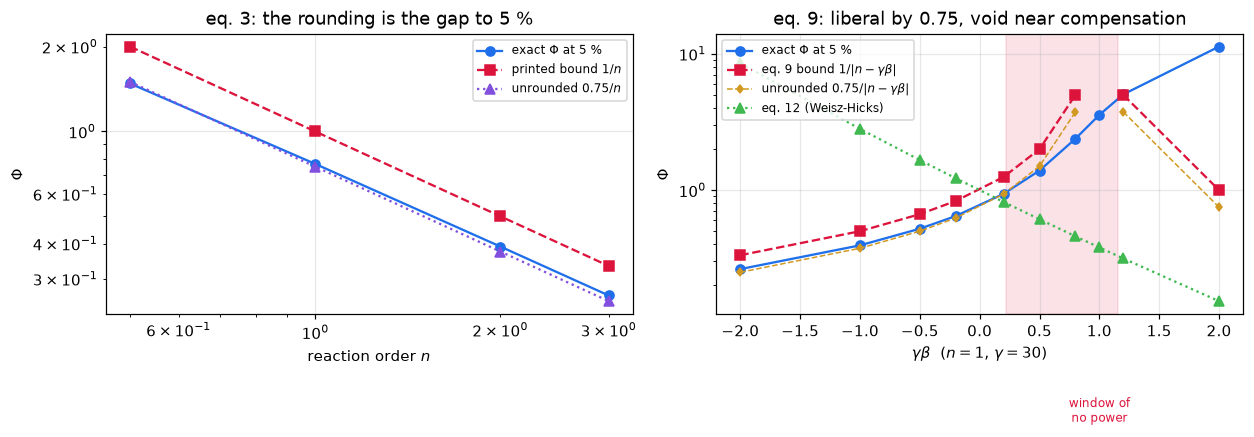
fig, axes = plt.subplots(1, 2, figsize=(11.5, 4.4))
om = np.linspace(0, 0.6, 200)
for n, c in zip((0.5, 1.0, 2.0), ("#8250df", "#1f6feb", "#3fb950")):
    axes[0].plot(om, film_mass_dev(om, n) * 100, color=c, label=rf"$n$ = {n}")
    axes[0].axvline(0.15 / n, color=c, ls=":", lw=0.8)
axes[0].axhline(5, color="0.4", lw=0.8, ls="--")
axes[0].set_xlabel(r"$\omega = \mathcal{R}r_p/(C_bk_c)$")
axes[0].set_ylabel("rate deviation, %")
axes[0].set_title(r"eq. 17: dev = $1-(1-\omega/3)^n$; exact at $n=1$")
axes[0].legend(fontsize=8)
Xs = np.linspace(0.05, 0.995, 60)
axes[1].plot(Xs, [axial_dev(X) * 100 for X in Xs], color="#1f6feb", lw=1.6, label="first order (closed form)")
axes[1].plot(list(AX2), [d * 100 for d in AX2.values()], "s", color="#3fb950", label="second order (pymrm)")
axes[1].axhline(5, color="0.4", lw=0.8, ls="--")
axes[1].set_xlabel("conversion $X$")
axes[1].set_ylabel(r"deviation in required $k\tau$, %")
axes[1].set_ylim(0, 6)
axes[1].set_title("eq. 30/32 at their own boundary: the claim that holds")
axes[1].legend(fontsize=8)
fig.tight_layout()
plt.show()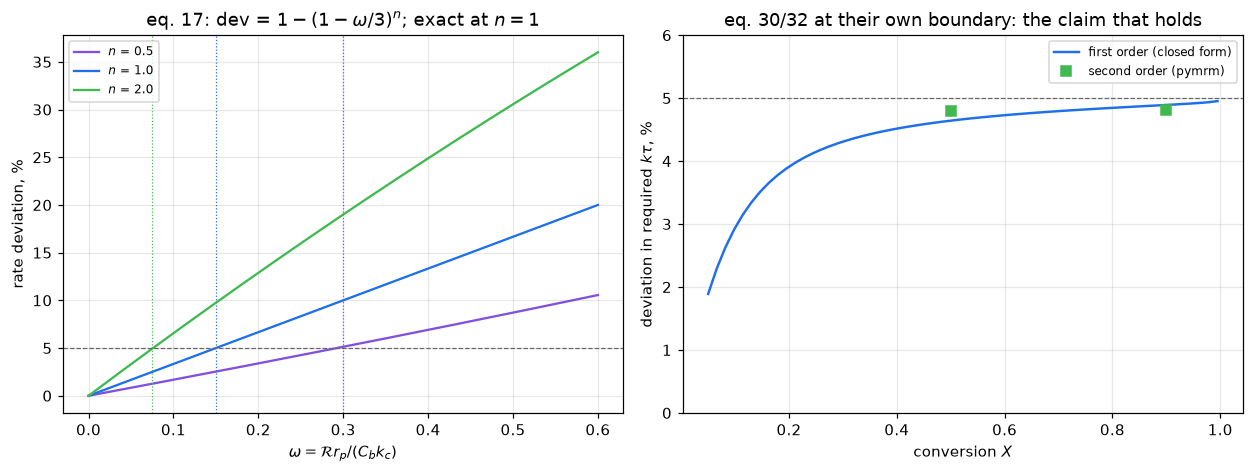
Validation
Tier 6: nothing on this page is compared with a measurement; the source contains none. The evidence, strongest first:
- Three routes to the headline number, the deviation admitted by eq. 1: closed form, shooting and pymrm (Section 2).
- pymrm against the shooting reference at eight audited threshold states, Dirichlet and film surfaces, isothermal and not, on a grid ladder; and the axial vessel against the classical closed form on its own ladder. Each observed order is backed by a bound that the finest-grid difference is at least 1e3 times the round-off of the quantity, measured as its spread under the solver tolerance, the LU column ordering and the initial guess (pellet), or under the solver route and tolerance (vessel).
- The two solvers of each discrete system agree: the exact-Jacobian and the
NumJacpellet; Newton withConvFluxTVDand deferred correction for the vessel. Each pair solves the same discrete equations, so this checks the solvers, not the discretisation. - The paper’s printed numbers reproduced from other printed numbers (Section 1). None is used as an input to anything.
- The break table below: one injected defect per row, through an argument or a physical parameter, and whether the claim’s own check catches it.
What no row can detect: a convention shared by every route. If “deviation” meant something else to Mears than to this page, or \(r_p\) meant a diameter, every route would move together and agree. Those readings are guarded only by the transcription (the nomenclature page prints “\(r_p\) = particle radius, cm”) and by Section 1’s paper-internal identities.
# pymrm against shooting at eight threshold states, reference at DOP853 rtol 1e-12.
def ref_states(rtol=RT_REF):
    out = []
    for n in ORDERS:
        out.append((f"iso n={n:g}", Power(n), None,
                    cross(Power(n), lambda p, e, P, o, ys: e - 0.95, lo=1e-3, rtol=rtol)))
    for gb in (-1.0, 0.5, 1.0):
        R = WeiszHicks(1.0, gb, GAMMA)
        out.append((f"WH gb={gb:g}", R, None,
                    cross(R, lambda p, e, P, o, ys: abs(e - 1) - 0.05, lo=1e-4, hi=22.0, rtol=rtol)))
    out.append(("film Bi_m=3", Power(1.0), 3.0,
                cross(Power(1.0), lambda p, e, P, o, ys: e - 0.95, lo=1e-3, hi=18.0, bim=3.0, rtol=rtol)))
    return out


STATES = ref_states()
SEEDS = {}
for name, R, bim, s in STATES:
    sol = shoot(R, s[0], bim=bim, rtol=RT_REF, dense=True)[5]
    SEEDS[name] = (sol, s[1])


def pm_eta(name, R, bim, n, read="face", nu=2, tol=1e-12, permc="COLAMD", seed=True, jacobian="exact",
           maxfev=60):
    """eta of the pymrm pellet at a reference state's phi, seeded from the shooting profile."""
    sol, phi = SEEDS[name]
    p = Pellet(n, nu=nu, bim=bim)
    y0 = (np.clip(sol.sol(np.clip(p.u_c * phi, sol.t[0], phi))[0], 0.0, 1.0) if seed else np.ones(n))
    y, _ = p.solve(phi, R, y_init=y0.reshape(-1, 1), tol=tol, jacobian=jacobian, maxfev=maxfev,
                   check=maxfev > 1, lin_solver_kwargs={"permc_spec": permc})
    return p.eta(y, phi, read=read)


def ladder(ns=(100, 200, 400, 800), **kw):
    return {name: {n: pm_eta(name, R, bim, n, **kw) for n in ns} for name, R, bim, _ in STATES}


def roundoff(n):
    """Largest relative spread of eta on n cells under newton tol 1e-12 vs 1e-10, COLAMD vs
    NATURAL column ordering, and a seeded vs a flat initial guess, per state."""
    out = {}
    for name, R, bim, _ in STATES:
        v = [pm_eta(name, R, bim, n, tol=t, permc=pc, seed=sd)
             for t in (1e-12, 1e-10) for pc in ("COLAMD", "NATURAL") for sd in (True, False)]
        out[name] = max(max(abs(x / v[0] - 1) for x in v), 2.2e-16)
    return out


def ladder_stats(lad, ns, ro):
    errs = {name: {n: abs(lad[name][n] / s[2] - 1) for n in ns} for name, _, _, s in STATES}
    orders = {name: observed_orders(lambda n: lad[name][n], ns)["orders"] for name in lad}
    ratio = {name: abs(lad[name][ns[-2]] - lad[name][ns[-1]]) / abs(lad[name][ns[-1]]) / ro[name] for name in lad}
    return errs, orders, ratio


NS = (100, 200, 400, 800)
LAD = ladder(NS)
RO = roundoff(800)
ERR, ORD, RATIO = ladder_stats(LAD, NS, RO)
print(f"{'state':>13} {'phi':>9} " + " ".join(f"{'n = %d' % n:>10}" for n in NS) + "   orders (successive differences)")
for name, _, _, s in STATES:
    print(f"{name:>13} {s[1]:9.5f} " + " ".join(f"{ERR[name][n]:10.1e}" for n in NS)
          + "   " + ", ".join(f"{o:.2f}" for o in ORD[name]))
_iso = [k for k in ERR if k.startswith("iso")]
_wh = [k for k in ERR if k.startswith("WH")]
_all_ord = [o for v in ORD.values() for o in v]
claims.value("pymrm_vs_shooting_iso_n800", float("%.2g" % max(ERR[k][800] for k in _iso)))  # 2 digits: round-off of eta
claims.value("pymrm_vs_shooting_wh_n800", float("%.2g" % max(ERR[k][800] for k in _wh)))  # 2 digits: round-off of eta
claims.value("pymrm_vs_shooting_robin_n800", float("%.2g" % ERR["film Bi_m=3"][800]))  # 2 digits: round-off of eta
claims.bound("pymrm_vs_shooting_iso_order", min(_all_ord), min=1.95, max=2.05, basis="theory",
             note="smallest observed order over the eight states, 100 to 800 cells; second order expected")
claims.bound("pymrm_vs_shooting_order_max", max(_all_ord), min=1.95, max=2.05, basis="theory",
             note="largest observed order over the eight states, 100 to 800 cells")
claims.bound("pymrm_vs_shooting_finest_over_roundoff_min", min(RATIO.values()), min=1e3, basis="theory",
             note="|eta(400) - eta(800)| over the round-off of eta on 800 cells, per state")


def ref_shift(rtol):
    """Largest |eta change| of the reference states when RT_REF is replaced by ``rtol``, over the 800-cell error."""
    return max(abs(st[3][2] / s[2] - 1) / ERR[name][800]
               for (name, _, _, s), st in zip(STATES, ref_states(rtol)))


claims.bound("reference_tol_shift_frac_of_err_n800", ref_shift(1e-13), max=1e-2, basis="chosen",
             note="reference states recomputed at DOP853 rtol 1e-13: the change in eta over the 800-cell "
                  "error, worst of the eight states")
brk("shooting reference at rtol 1e-8 instead of 1e-12", "reference_tol_shift_frac_of_err_n800", ref_shift(1e-8))
print(f"reference tolerance 1e-12 to 1e-13 moves eta by at most {claims['reference_tol_shift_frac_of_err_n800']:.0e} "
      "of the 800-cell error.")
LAD_CELL = ladder(NS, read="cell")
E_C, O_C, _ = ladder_stats(LAD_CELL, NS, RO)
_lab = "eta read by a two-point gradient from the last cell centre"
brk(_lab, "pymrm_vs_shooting_iso_n800", max(E_C[k][800] for k in _iso))
brk(_lab, "pymrm_vs_shooting_wh_n800", max(E_C[k][800] for k in _wh))
brk(_lab, "pymrm_vs_shooting_robin_n800", E_C["film Bi_m=3"][800])
brk(_lab, "pymrm_vs_shooting_iso_order", min(o for v in O_C.values() for o in v))
brk(_lab, "pymrm_vs_shooting_order_max", max(o for v in O_C.values() for o in v))
NS_F = (400, 800, 1600, 3200)
_lf = ladder(NS_F)
_, _, _rf = ladder_stats(_lf, NS_F, roundoff(3200))
brk("orders read at 3200 cells instead of 800 (finest grid two factors of 2 up)",
    "pymrm_vs_shooting_finest_over_roundoff_min", min(_rf.values()))
print(f"\nworst at 800 cells: {claims['pymrm_vs_shooting_iso_n800']:.1e} (isothermal), "
      f"{claims['pymrm_vs_shooting_wh_n800']:.1e} (Weisz-Hicks), "
      f"{claims['pymrm_vs_shooting_robin_n800']:.1e} (film)")
print(f"observed orders {min(_all_ord):.2f} to {max(_all_ord):.2f}; the round-off of eta on 800 cells is at most "
      f"(here {max(RO.values()):.0e}),")
print(f"so the finest difference is at least 1e3 times it in every state (here from "
      f"{claims['pymrm_vs_shooting_finest_over_roundoff_min']:.0e} times).")

# exact Jacobian against NumJac on the same discrete equations
GAP_NJ = max(abs(pm_eta(name, R, bim, 800, jacobian="numjac") / LAD[name][800] - 1) for name, R, bim, _ in STATES)
claims.bound("pellet_exact_vs_numjac", GAP_NJ, max=1e-10, basis="tolerance",
             note="newton tol 1e-12, both Jacobians, eight states on 800 cells")
brk("NumJac route stopped after one newton iteration from y = 1 (maxfev=1)", "pellet_exact_vs_numjac",
    max(abs(pm_eta(name, R, bim, 800, jacobian="numjac", maxfev=1, seed=False) / LAD[name][800] - 1)
        for name, R, bim, _ in STATES))
print(f"exact Jacobian (construct_coefficient_matrix) against NumJac((n, 1)): eta equal to below 1e-10 "
      f"(here {GAP_NJ:.0e})")
_lnj = ladder((800,), nu=0)
brk("pymrm pellet assembled as a slab (nu = 0)", "pymrm_vs_shooting_iso_n800",
    max(abs(_lnj[k][800] / s[2] - 1) for k, _, _, s in STATES if k.startswith("iso")))
brk("pymrm pellet assembled as a slab (nu = 0)", "pymrm_vs_shooting_wh_n800",
    max(abs(_lnj[k][800] / s[2] - 1) for k, _, _, s in STATES if k.startswith("WH")))
brk("pymrm pellet assembled as a slab (nu = 0)", "pymrm_vs_shooting_robin_n800",
    abs(_lnj["film Bi_m=3"][800] / STATES[-1][3][2] - 1))
state phi n = 100 n = 200 n = 400 n = 800 orders (successive differences)
iso n=0.5 1.24808 5.1e-06 1.3e-06 3.2e-07 7.9e-08 2.00, 2.00
iso n=1 0.89859 5.2e-06 1.3e-06 3.2e-07 8.1e-08 2.00, 2.00
iso n=2 0.64114 5.2e-06 1.3e-06 3.3e-07 8.2e-08 2.00, 2.00
iso n=3 0.52506 5.2e-06 1.3e-06 3.3e-07 8.2e-08 2.00, 2.00
WH gb=-1 0.64380 5.3e-06 1.3e-06 3.3e-07 8.2e-08 2.00, 2.00
WH gb=0.5 1.21101 4.9e-06 1.2e-06 3.1e-07 7.7e-08 2.00, 2.00
WH gb=1 1.93831 2.1e-06 5.3e-07 1.3e-07 3.3e-08 2.00, 2.00
film Bi_m=3 0.54496 1.9e-06 4.8e-07 1.2e-07 3.0e-08 2.00, 2.00
reference tolerance 1e-12 to 1e-13 moves eta by at most 3e-05 of the 800-cell error.
worst at 800 cells: 8.2e-08 (isothermal), 8.2e-08 (Weisz-Hicks), 3.0e-08 (film)
observed orders 2.00 to 2.00; the round-off of eta on 800 cells is at most (here 2e-11),
so the finest difference is at least 1e3 times it in every state (here from 6e+03 times).
exact Jacobian (construct_coefficient_matrix) against NumJac((n, 1)): eta equal to below 1e-10 (here 1e-11)True# The axial vessel against the closed form at X = 0.632 (Pe_L = 20), and its two solvers.
X_CHK, NZ = 0.632, (200, 400, 800, 1600)
def axial_ladder(ns=NZ, **kw):
return {n: axial_dev(X_CHK, n_z=n, **kw) for n in ns}
AXL = axial_ladder()
AX_ERR = {n: abs(v - AX1[X_CHK]) for n, v in AXL.items()}
AX_ORD = observed_orders(lambda n: AXL[n], NZ)["orders"]
def axial_roundoff(n):
v = [axial_dev(X_CHK, n_z=n, tol=1e-12), axial_dev(X_CHK, n_z=n, tol=1e-10),
axial_dev(X_CHK, n_z=n, route="deferred")]
return max(max(abs(x - v[0]) for x in v), 1e-17)
AX_RO = axial_roundoff(NZ[-1])
print(f"pymrm vessel against the closed form at X = {X_CHK} (dev = {AX1[X_CHK] * 100:.3f} %):")
print(" " + " ".join(f"n_z={n}: {e:.2e}" for n, e in AX_ERR.items())
+ " orders " + ", ".join(f"{o:.2f}" for o in AX_ORD))
claims.value("pymrm_axial_vs_closed_form", AX_ERR[1600])
claims.bound("axial_order_min", min(AX_ORD), min=1.75, max=2.05, basis="chosen",
note="van Leer: second order where the limiter is inactive; the observed orders rise towards 2 "
"with refinement, pre-asymptotic on this ladder")
claims.bound("axial_order_max", max(AX_ORD), min=1.75, max=2.05, basis="chosen",
note="as axial_order_min")
claims.bound("axial_finest_over_roundoff", abs(AXL[800] - AXL[1600]) / AX_RO, min=1e3, basis="theory",
note="|dev(800) - dev(1600)| over the spread of dev on 1600 cells under newton tol and solver route")
_up = axial_ladder(limiter=None)
_up_ord = observed_orders(lambda n: _up[n], NZ)["orders"]
brk("first-order upwind convection (no TVD limiter)", "pymrm_axial_vs_closed_form", abs(_up[1600] - AX1[X_CHK]))
brk("first-order upwind convection (no TVD limiter)", "axial_order_min", min(_up_ord))
brk("first-order upwind convection (no TVD limiter)", "axial_order_max", max(_up_ord))
brk("outlet read at the last cell centre", "pymrm_axial_vs_closed_form",
abs(axial_dev(X_CHK, n_z=1600, read="cell") - AX1[X_CHK]))
brk("Dirichlet inlet instead of Danckwerts", "pymrm_axial_vs_closed_form",
abs(axial_dev(X_CHK, n_z=1600, inlet="dirichlet") - AX1[X_CHK]))
_NZF = (1600, 3200, 6400, 12800)
_axf = axial_ladder(_NZF)
brk("orders read at 12800 cells instead of 1600 (finest grid three factors of 2 up)",
"axial_finest_over_roundoff", abs(_axf[6400] - _axf[12800]) / axial_roundoff(12800))
print(f"error {claims['pymrm_axial_vs_closed_form']:.2e} on 1600 cells; the spread of dev under newton tol "
f"and solver route is at most (here {AX_RO:.0e}),")
print(f"so the finest difference is at least 1e3 times it (here {claims['axial_finest_over_roundoff']:.0e} times).")
# the two solvers of the vessel's discrete equations
_pairs = [(X, n, 1) for X in (0.2, 0.632, 0.99) for n in NZ] + [(X, 800, 2) for X in (0.5, 0.9)]
GAP_ND = max(abs(axial_dev(X, n_react=r, n_z=n) - axial_dev(X, n_react=r, n_z=n, route="deferred"))
for X, n, r in _pairs)
claims.bound("axial_newton_vs_deferred", GAP_ND, max=1e-8, basis="tolerance",
note="newton tol 1e-12 against sweeps to a change below 1e-13; three conversions on 200 to "
"1600 cells, and second order at two conversions on 800 cells")
brk("deferred-correction route only with a Dirichlet inlet", "axial_newton_vs_deferred",
abs(axial_dev(0.632, n_z=800) - axial_dev(0.632, n_z=800, route="deferred", inlet="dirichlet")))
print(f"\nNewton with ConvFluxTVD and van Leer deferred correction solve the same discrete equations; "
f"over {len(_pairs)} cases")
print(f"their deviations agree to below 1e-8 (here {GAP_ND:.0e}). Both converge on these smooth steady profiles")
print("(newton step tolerance 1e-12; sweeps until the largest change is below 1e-13). Deferred correction")
print("is a fixed-point iteration whose convergence depends on the profile (pymrm pitfall P10); the exact")
print("Jacobian of ConvFluxTVD makes the production route a Newton solve.")pymrm vessel against the closed form at X = 0.632 (dev = 4.751 %):
n_z=200: 3.68e-06 n_z=400: 1.03e-06 n_z=800: 2.74e-07 n_z=1600: 7.11e-08 orders 1.81, 1.89
error 7.11e-08 on 1600 cells; the spread of dev under newton tol and solver route is at most (here 8e-12),
so the finest difference is at least 1e3 times it (here 3e+04 times).
Newton with ConvFluxTVD and van Leer deferred correction solve the same discrete equations; over 14 cases
their deviations agree to below 1e-8 (here 4e-10). Both converge on these smooth steady profiles
(newton step tolerance 1e-12; sweeps until the largest change is below 1e-13). Deferred correction
is a fixed-point iteration whose convergence depends on the profile (pymrm pitfall P10); the exact
Jacobian of ConvFluxTVD makes the production route a Newton solve.The break table
Every number above is registered as a claim; each row injects one defect through an argument or a parameter and reports what the claim becomes, and whether the claim’s own check catches it. Rows a claim does not catch are kept: they show what that check is blind to.
print(f"{'injected defect':<76} {'claim':<44} {'clean':>11} {'broken':>12}  caught")
# grid errors carry the round-off of eta (a few 1e-4 of their size): shown to 2 digits
_coarse_print = {"pymrm_vs_shooting_iso_n800", "pymrm_vs_shooting_wh_n800", "pymrm_vs_shooting_robin_n800",
                 "pymrm_axial_vs_closed_form", "headline_three_route_spread"}
for name, metric, clean, broken, caught in BREAK:
    is_bound = claims.metrics[metric]["kind"] == "bound"
    fmt = "11.2g" if metric in _coarse_print else "11.5g"
    shown = f"(here {clean:.0e})" if is_bound else f"{float(clean):{fmt}}"
    br = f"(here {float(broken):.0e})" if is_bound else f"{float(broken):12.5g}"
    print(f"{name[:76]:<76} {metric[:44]:<44} {shown:>11} {br:>12}  {'yes' if caught else 'NO'}")
_caught = {m for _, m, _, _, c in BREAK if c}
_structural = sorted(k for k, c in claims.metrics.items() if c.get("structural"))
_open = sorted(k for k in claims.metrics if k not in _caught and k not in _structural)
print(f"\n{len(BREAK)} rows; {len(_caught)} of {len(claims.metrics)} claims are failed by at least one row; "
      f"structural: {', '.join(_structural) or 'none'}; open: {', '.join(_open) or 'none'}")
print("rows that do not fail their claim: "
      + ("; ".join(f"{n} -> {m}" for n, m, _, _, c in BREAK if not c) or "none"))
injected defect claim clean broken caught
pellet traced as a slab (nu = 0) perturbation_slope_rel_err (here 3e-06) (here 4e+00) yes
pellet traced as a slab (nu = 0) iso_Phi5_n1 0.76709 0.15159 yes
source exponent 2 where 1 is claimed iso_Phi5_n1 0.76709 0.3905 yes
pellet traced as a slab (nu = 0) eq1_dev_at_bound_n1 0.064722 0.30518 yes
pellet traced as a slab (nu = 0) eq3_dev_at_bound_n05 0.067876 0.3778 yes
pellet traced as a slab (nu = 0) eq3_dev_at_bound_n2 0.063306 0.28085 yes
pellet traced as a slab (nu = 0) eq3_dev_at_bound_n3 0.062854 0.27386 yes
pellet traced as a slab (nu = 0) eq3_dev_at_unrounded_075_n05 0.050691 0.27664 yes
pellet traced as a slab (nu = 0) eq3_dev_at_unrounded_075_n1 0.048912 0.23505 yes
pellet traced as a slab (nu = 0) eq3_dev_at_unrounded_075_n2 0.048091 0.22 yes
pellet traced as a slab (nu = 0) eq3_dev_at_unrounded_075_n3 0.047827 0.21556 yes
pellet traced as a slab (nu = 0) weisz_06_dev_n1 0.039305 0.19076 yes
pellet traced as a slab (nu = 0) weisz_03_dev_n2 0.038771 0.18063 yes
shooting branch traced as a cylinder (nu = 1) headline_shooting_vs_closed (here 1e-10) (here 5e-02) yes
pymrm route only assembled as a slab (nu = 0) headline_three_route_spread 1e-07 0.24046 yes
source exponent 1 where 0 is claimed zero_order_profile_err (here 7e-14) (here 4e-01) yes
source exponent 1 where 0 is claimed zero_order_eta_dev (here 4e-13) (here 2e-01) yes
pellet traced as a slab (nu = 0) neg_order_Phi5 0.68439 0.14009 yes
pellet traced as a slab (nu = 0) neg_order_eta_at_bound 1.0766 1.7081 yes
pellet traced as a slab (nu = 0) hudgins_LH_eta_at_bound 1.0759 1.5248 yes
pellet traced as a slab (nu = 0) LH_Phi5 1.0317 2.9055 yes
pellet traced as a slab (nu = 0) LH_eta_at_Phi1_vs_B14 1.0483 1.3141 yes
pellet traced as a slab (nu = 0) LH_bound_over_Phi5 1.4539 0.51626 yes
pellet traced as a slab (nu = 0) LH_eta_at_Phi1_gap_to_B14 (here 3e-11) (here 3e-01) yes
film area a = 2/r_p instead of 3/r_p eq17_dev_at_bound_n1 (here 5e-02) (here 7e-02) yes
film area a = 2/r_p instead of 3/r_p eq17_dev_at_bound_n05 0.051317 0.078046 yes
film area a = 2/r_p instead of 3/r_p eq17_dev_at_bound_n2 0.049375 0.073594 yes
film area a = 2/r_p instead of 3/r_p eq17_dev_at_bound_n3 0.049171 0.073141 yes
film area a = 2/r_p instead of 3/r_p eq16_carberry_dev 0.1 0.15 yes
film area a = 2/r_p instead of 3/r_p eq16_carberry_dev_surface 0.090909 0.13636 yes
film area a = 2/r_p in Carberry's deviation only carberry_over_eq17 2 3 yes
film area a = 2/r_p in Carberry's deviation only carberry_surface_over_eq17 1.8182 2.7273 yes
sign of the heat of reaction flipped in the film balance eq14_dev_exo_gamma10 0.05101 -0.04901 yes
sign of the heat of reaction flipped in the film balance eq14_dev_exo_gamma30 0.051184 -0.04885 yes
sign of the heat of reaction flipped in the film balance eq14_dev_exo_gamma40 0.051205 -0.04883 yes
sign of the heat of reaction flipped in the film balance eq14_dev_endo_gamma30 0.04885 -0.051184 yes
closed form with a = 2/r_p film_mass_dimensional_xcheck (here 0e+00) (here 2e-02) yes
closed form with a = 2/r_p film_heat_dimensional_xcheck (here 2e-15) (here 3e-02) yes
film heat transfer coefficient ten times larger film_steady_states 3 1 yes
closed form with a = 2/r_p film_closed_form_collapse_rel (here 2e-14) (here 1e+00) yes
film mass transfer coefficient ten times larger film_states_passing_eq17 1 2 yes
film heat transfer coefficient ten times larger film_states_failing_eq14 2 0 yes
pellet traced as a cylinder (nu = 1) eq9_dev_at_bound_gbm2 0.062348 0.1122 yes
pellet traced as a cylinder (nu = 1) eq9_dev_at_bound_gbm1 0.062687 0.11323 yes
pellet traced as a cylinder (nu = 1) eq9_dev_at_bound_gbm05 0.063192 0.11476 yes
pellet traced as a cylinder (nu = 1) eq9_dev_at_bound_gbm02 0.063869 0.11684 yes
pellet traced as a cylinder (nu = 1) eq9_dev_at_bound_gb02 0.066339 0.1245 yes
pellet traced as a cylinder (nu = 1) eq9_dev_at_bound_gb05 0.07372 0.14754 yes
pellet traced as a cylinder (nu = 1) eq9_dev_at_bound_gb08 0.14042 0.32146 yes
pellet traced as a cylinder (nu = 1) eq9_dev_at_bound_gb12 0.048582 0.22409 yes
pellet traced as a cylinder (nu = 1) eq9_dev_at_bound_gb2 0.066867 0.12226 yes
pellet traced as a cylinder (nu = 1) eq12_dev_endo_gb_m1 0.27631 0.43685 yes
eq. 12's exponent with the wrong sign eq12_exo_conservative_cases 6 4 yes
printed constant 1 in place of the unrounded 0.75 eq9_unrounded_holds_endothermic 4 0 yes
window edge read off the 10-point scan (no Brent refinement) eq9_nopower_window_lo 0.22221 0.21595 yes
window edge read off the 10-point scan (no Brent refinement) eq9_nopower_window_hi 1.1586 1.1622 yes
pellet traced as a cylinder (nu = 1) eq9_window_inside_dev_gb095 0.43914 0.67783 yes
sign of beta flipped (gamma beta = -1) petersen13_dev_gamma20 0.37983 0.64903 yes
sign of beta flipped (gamma beta = -1) petersen13_dev_gamma30 0.37816 0.64849 yes
sign of beta flipped (gamma beta = -1) petersen13_dev_gamma40 0.37731 0.64822 yes
sign of beta flipped (gamma beta = -1) compensation_Phi5_gamma30 3.5692 0.39375 yes
sign of beta flipped (gamma beta = -1) compensation_centre_y 0.44984 0.93686 yes
band of +-1 % instead of +-5 % eq9_crossings_gb12 1 3 yes
sign of beta flipped eq9_crossings_gb15 3 1 yes
sign of beta flipped eq9_crossings_gb2 3 1 yes
deep-side crossing selected where the kinetic-side one is meant eq9_Phi5_gb2_kinetic 0.74623 11.309 yes
kinetic-side crossing selected where the deep-side one is meant eq9_Phi5_gb2_deep 11.309 0.74623 yes
eta peak read off a 40-state ladder (no Brent search) eq9_three_crossing_onset 1.4495 1.4503 yes
onset read off the 3-point scan (no Brent refinement) eq9_second_regime_onset 1.9544 1.9729 yes
pellet traced as a cylinder (nu = 1) eq9_outside_window_dev_gb2 0.050252 0.093082 yes
pellet traced as a cylinder (nu = 1) eq9_outside_window_dev_gb25 0.051682 0.098427 yes
pellet traced as a cylinder (nu = 1) eq9_outside_window_dev_gb3 0.052189 0.1003 yes
pellet traced as a cylinder (nu = 1) eq6_worst_devT 0.061126 0.20572 yes
band maximum read off the 400-state trace (edges not root-found) eq9_fold_worst_certified_dev 0.071992 0.056831 yes
band maximum read off the 400-state trace (edges not root-found) eq1_fold_worst_certified_dev 3135 3087.2 yes
band maxima read off the traces (edges not root-found) eq9_fold_worst_grid_shift (here 3e-11) (here 1e-02) yes
band maximum read off the 400-state trace (edges not root-found) eq9_fold_edge_centre_y 0.99236 0.99394 yes
turning point read off the 400-state trace eq9_fold_ignited_margin 2.3112 2.3141 yes
turning point read off the 400-state trace fold_Phi_turning_max 0.36837 0.36827 yes
pellet traced as a slab (nu = 0) eq21_ratio_Bim100 0.73076 0.14715 yes
pellet traced as a slab (nu = 0) eq21_ratio_Bim03 0.044439 0.013842 yes
worst read off a coarse Bi_m x t grid (edges not root-found) joint_pass_worst_dev 0.11149 0.090463 yes
worst read off a coarse Bi_m x t grid (edges not root-found) joint_pass_worst_bim 6.3333 10 yes
passing state read off the scan (edges not root-found) joint_eq17_slack (here 2e-12) (here 2e-02) yes
passing state read off the scan (edges not root-found) joint_eq1_slack (here 3e-07) (here 1e-01) yes
passing states read off the scan (edges not root-found) joint_worst_scan_density_shift (here 5e-11) (here 1e-02) yes
pymrm pellet with a Dirichlet surface instead of the film joint_worst_pymrm_vs_shooting (here 9e-08) (here 5e-02) yes
Dirichlet inlet instead of Danckwerts eq30_dev_X02 0.039106 0.33423 yes
Dirichlet inlet instead of Danckwerts eq30_dev_X0632 0.047513 0.10362 yes
Dirichlet inlet instead of Danckwerts eq30_dev_X099 0.049458 0.061218 yes
Dirichlet inlet instead of Danckwerts eq30_cases_below_5pc 8 0 yes
Dirichlet inlet instead of Danckwerts axial_dev_covarying_X02 0.038032 0.2564 yes
Dirichlet inlet instead of Danckwerts axial_dev_covarying_X0632 0.045546 0.094405 yes
Dirichlet inlet instead of Danckwerts axial_dev_covarying_X099 0.04725 0.057852 yes
Dirichlet inlet instead of Danckwerts eq32_dev_n2_X05 0.048033 0.087621 yes
Dirichlet inlet instead of Danckwerts eq32_dev_n2_worst 0.04812 0.087621 yes
Dirichlet inlet instead of Danckwerts eq28_petersen_dev_X0393 0.22909 1.5992 yes
Dirichlet inlet instead of Danckwerts eq28_petersen_dev_X0632 0.37377 1.1364 yes
Dirichlet inlet instead of Danckwerts eq28_petersen_dev_X09 0.50726 0.84534 yes
shooting reference at rtol 1e-8 instead of 1e-12 reference_tol_shift_frac_of_err_n800 (here 3e-05) (here 5e-01) yes
eta read by a two-point gradient from the last cell centre pymrm_vs_shooting_iso_n800 8.2e-08 0.00036183 yes
eta read by a two-point gradient from the last cell centre pymrm_vs_shooting_wh_n800 8.2e-08 0.00036194 yes
eta read by a two-point gradient from the last cell centre pymrm_vs_shooting_robin_n800 3e-08 0.0003309 yes
eta read by a two-point gradient from the last cell centre pymrm_vs_shooting_iso_order (here 2e+00) (here 1e+00) yes
eta read by a two-point gradient from the last cell centre pymrm_vs_shooting_order_max (here 2e+00) (here 1e+00) yes
orders read at 3200 cells instead of 800 (finest grid two factors of 2 up) pymrm_vs_shooting_finest_over_roundoff_min (here 6e+03) (here 3e+01) yes
NumJac route stopped after one newton iteration from y = 1 (maxfev=1) pellet_exact_vs_numjac (here 1e-11) (here 5e-02) yes
pymrm pellet assembled as a slab (nu = 0) pymrm_vs_shooting_iso_n800 8.2e-08 0.17901 yes
pymrm pellet assembled as a slab (nu = 0) pymrm_vs_shooting_wh_n800 8.2e-08 0.36004 yes
pymrm pellet assembled as a slab (nu = 0) pymrm_vs_shooting_robin_n800 3e-08 0.11994 yes
first-order upwind convection (no TVD limiter) pymrm_axial_vs_closed_form 7.1e-08 0.0002815 yes
first-order upwind convection (no TVD limiter) axial_order_min (here 2e+00) (here 1e+00) yes
first-order upwind convection (no TVD limiter) axial_order_max (here 2e+00) (here 1e+00) yes
outlet read at the last cell centre pymrm_axial_vs_closed_form 7.1e-08 1.0423e-06 yes
Dirichlet inlet instead of Danckwerts pymrm_axial_vs_closed_form 7.1e-08 0.056103 yes
orders read at 12800 cells instead of 1600 (finest grid three factors of 2 u axial_finest_over_roundoff (here 3e+04) (here 3e+01) yes
deferred-correction route only with a Dirichlet inlet axial_newton_vs_deferred (here 4e-10) (here 6e-02) yes
117 rows; 111 of 114 claims are failed by at least one row; structural: alpha_star_identity, bi_star_identity, symbolic_reductions_hold; open: none
rows that do not fail their claim: noneWhat pymrm adds
Nothing to the criteria themselves: each is one line of algebra, reproduced as printed. What the page adds is the exact solve behind every stated tolerance, which turns a family of rules of thumb into a table of measured guarantees. Most of the audit is carried by the shooting reference (SciPy integration, pymrm.checks.find_roots scans) and by closed forms. pymrm supplies the second route: the finite-volume pellet, whose surface physics (Dirichlet or film) is entirely a boundary-condition dict on the outward normal, with the exact Jacobian through construct_coefficient_matrix, newton with bounds and the surface flux from compute_boundary_values; and the dispersion vessel with ConvFluxTVD and newton, the only route for second order. The pellet converges at second order against its reference; the vessel’s observed orders rise towards 2 on the ladders of the Validation section (pre-asymptotic), which is what makes the audit’s numbers evidence rather than output.
display(Markdown(f"""
- **Eq. 17 is exact at first order**: the film balance makes the deviation $\\omega/3$
  identically, so its boundary admits 5 % to all digits. Zero order is exactly unaffected.
  Carberry's older 0.1 admits {claims['eq16_carberry_dev_surface'] * 100:.2f} % or
  {claims['eq16_carberry_dev'] * 100:.1f} %, depending on the reading of his $\\eta$.
- **The intraparticle family (eqs. 1-3) is liberal by its own rounding.** At the printed bounds
  the deviation is {min(_db) * 100:.2f}-{max(_db) * 100:.2f} % (eq. 1 alone:
  {claims['eq1_dev_at_bound_n1'] * 100:.2f} %); at the unrounded $0.75/n$ it is
  {min(_d75) * 100:.2f}-{max(_d75) * 100:.2f} %. An experimenter who wants the stated 5 % should use
  $0.75/n$, the number the paper had before rounding it away.
- **Eq. 9's exclusion zone has a width**: even with the unrounded 0.75 the bound certifies
  deviations beyond 5 % for $\\gamma\\beta$ in ({W_LO:.3f}, {W_HI:.3f}) at $n = 1$, $\\gamma = 30$,
  and Petersen's 13 there admits {claims['petersen13_dev_gamma30'] * 100:.0f} %, a transition-region
  marker. Past $\\gamma\\beta = {SECOND_ONSET:.2f}$ the unrounded bound re-admits a mild
  {min(OUT2.values()) * 100:.2f}-{max(OUT2.values()) * 100:.2f} %. On the folded branch of
  $\\gamma\\beta = 24$, eq. 1's band certifies a deviation of {claims['eq1_fold_worst_certified_dev']:.0f}
  while eq. 9's band admits {claims['eq9_fold_worst_certified_dev'] * 100:.2f} % at its edge.
- **Eq. 14 is liberal by construction but only just** ({claims['eq14_dev_exo_gamma10'] * 100:.2f}-{claims['eq14_dev_exo_gamma40'] * 100:.2f} % for $\\gamma$ = 10-40), and the film observables
  determine the deviation: the multiplicity blind spot of the pellet observable does not exist at the
  film.
- **Eq. 21 fails structurally at low $\\mathrm{{Bi}}_m$** (ratio of the exact 5 % state to its bound
  {claims['eq21_ratio_Bim03']:.3f} at $\\mathrm{{Bi}}_m = 0.3$) and must be applied with eq. 17. Passing
  eqs. 1, 17 and 21 at once still admits {JOINT_WORST * 100:.1f} %, at an interior optimum
  $\\mathrm{{Bi}}_m = {JOINT_BIM:.2f}$ where two criteria bind at once.
- **Eq. 30/32, Mears' axial criterion, holds its claim everywhere tested**:
  {claims['eq30_dev_X02'] * 100:.2f}-{claims['eq30_dev_X099'] * 100:.2f} % at first order,
  {claims['eq32_dev_n2_worst'] * 100:.2f} % at most at second order; Petersen's $\\alpha < 1$ admits
  {claims['eq28_petersen_dev_X0393'] * 100:.0f}-{claims['eq28_petersen_dev_X09'] * 100:.0f} %.
"""))- Eq. 17 is exact at first order: the film balance makes the deviation \(\omega/3\) identically, so its boundary admits 5 % to all digits. Zero order is exactly unaffected. Carberry’s older 0.1 admits 9.09 % or 10.0 %, depending on the reading of his \(\eta\).
- The intraparticle family (eqs. 1-3) is liberal by its own rounding. At the printed bounds the deviation is 6.29-6.79 % (eq. 1 alone: 6.47 %); at the unrounded \(0.75/n\) it is 4.78-5.07 %. An experimenter who wants the stated 5 % should use \(0.75/n\), the number the paper had before rounding it away.
- Eq. 9’s exclusion zone has a width: even with the unrounded 0.75 the bound certifies deviations beyond 5 % for \(\gamma\beta\) in (0.222, 1.159) at \(n = 1\), \(\gamma = 30\), and Petersen’s 13 there admits 38 %, a transition-region marker. Past \(\gamma\beta = 1.95\) the unrounded bound re-admits a mild 5.03-5.22 %. On the folded branch of \(\gamma\beta = 24\), eq. 1’s band certifies a deviation of 3135 while eq. 9’s band admits 7.20 % at its edge.
- Eq. 14 is liberal by construction but only just (5.10-5.12 % for \(\gamma\) = 10-40), and the film observables determine the deviation: the multiplicity blind spot of the pellet observable does not exist at the film.
- Eq. 21 fails structurally at low \(\mathrm{Bi}_m\) (ratio of the exact 5 % state to its bound 0.044 at \(\mathrm{Bi}_m = 0.3\)) and must be applied with eq. 17. Passing eqs. 1, 17 and 21 at once still admits 11.1 %, at an interior optimum \(\mathrm{Bi}_m = 6.33\) where two criteria bind at once.
- Eq. 30/32, Mears’ axial criterion, holds its claim everywhere tested: 3.91-4.95 % at first order, 4.81 % at most at second order; Petersen’s \(\alpha < 1\) admits 23-51 %.
Reuse
| Change | Where |
|---|---|
| Audit your own criterion | write it as val(phi, eta, Phi, omega, y_s) and hand it to cross, which finds the state where it binds; the default returns the deep-side (largest-\(\Phi\)) state, so use which="all" wherever the condition can cross more than once |
| Different kinetics | any object with r(y) and dr(y) into shoot, cross and Pellet.solve; keep \(\mathcal{F}(1)=1\) so \(\Phi\) stays the printed observable |
| Film instead of Dirichlet surface | Pellet(bim=...) and shoot(..., bim=...): one bc dict, {a:1, b:Bim, d:Bim} on the outward normal |
| Slab or cylinder | nu=0 or 1; the printed thresholds are for the sphere, and the break table shows how much that matters |
| A tolerance other than 5 % | change the 0.05 in the cross conditions; the bounds scale linearly only at first order |
| Axial criterion at your conversion and order | axial_dev(X, n_react=..., n_z=...); the closed form is first order only |
How to screen a measurement, given what is above. Use eq. 17 as printed: it is exact at first order and close otherwise. For the pellet, use \(0.75/n\), not \(1/n\), if the 5 % is meant literally, and take \(r_p\) as a radius. If the reaction is exothermic, compute \(\gamma\beta\) first: inside the window printed in Section 4 not even the unrounded constant makes eq. 9 a 5 % test, so measure at two particle sizes instead (the paper’s own empirical fallback). Apply eq. 17 alongside eq. 21, never eq. 21 alone, and remember that passing every test still admits the stacked deviation of Section 5 when two resistances sit at their boundaries at once. The axial criterion can be trusted as printed.
Reading the paper. The scan’s text layer destroys the criteria; read every threshold off a 300 dpi render (the native resolution, so higher renders only interpolate). The PDF opens with the tail of the preceding article; the paper starts partway down page 1 of the file.
Related pages. B1.4, the same audit for eq. 1 alone, with the fold analysis this page leans on; B1.1, the forward problem behind Section 4; B1.6, the reduction used in the pellet model; A2.1, the axial vessel and its boundary conditions; B1.2/B1.3, the generalised moduli, i.e. the length-scale question underneath every threshold here.
References
Mears, D. E. (1971). Tests for transport limitations in experimental catalytic reactors. Ind. Eng. Chem. Process Des. Develop. 10(4), 541-547. doi:10.1021/i260040a020. The source read; every criterion and threshold transcribed from 300 dpi native renders of journal pages 541-547.
Mears, D. E. (1971a). Chem. Eng. Sci., cited by the source as “in press”; the origin of the axial criterion (eqs. 29-32). Not consulted.
Mears, D. E. (1971b). J. Catal. 20, 127; the origin of the interphase and interparticle heat criteria (eqs. 14, 23). Not consulted.
Cited by the source for the criteria it reviews, none consulted: Weisz & Prater (1954); Weisz (1957); Weisz & Hicks (1962), the source of B1.1/B1.4/B1.6, not needed here; Hudgins (1968); Anderson (1963); Kubota & Yamanaka (1969); Carberry (1961); Satterfield, Pelossof & Sherwood (1969); Petersen (1965b, 1968); Stewart & Villadsen (1969); van den Bleek, van der Wiele & van den Berg (1969).
# Claims: prints every registered number, writes agreement.json for CI, and
# raises when a claim fails its own check or has no break row.
claims.report();   # the semicolon keeps the notebook from echoing the payload
Claims for B1.7:
alpha_star_identity = (here 2.2e-01) bound bound [0.2236, 0.2237] [identity]
perturbation_slope_rel_err = (here 3.2e-06) bound bound <= 0.0001 [chosen]
bi_star_identity = (here 1.0e+01) bound bound [10, 10] [identity]
symbolic_reductions_hold = True exact exact
iso_Phi5_n1 = 0.76709 value rtol 1e-05
eq1_dev_at_bound_n1 = 0.064722 value rtol 1e-05
eq3_dev_at_bound_n05 = 0.067876 value rtol 1e-05
eq3_dev_at_bound_n2 = 0.063306 value rtol 1e-05
eq3_dev_at_bound_n3 = 0.062854 value rtol 1e-05
eq3_dev_at_unrounded_075_n05 = 0.050691 value rtol 1e-05
eq3_dev_at_unrounded_075_n1 = 0.048912 value rtol 1e-05
eq3_dev_at_unrounded_075_n2 = 0.048091 value rtol 1e-05
eq3_dev_at_unrounded_075_n3 = 0.047827 value rtol 1e-05
weisz_06_dev_n1 = 0.039305 value rtol 1e-05
weisz_03_dev_n2 = 0.038771 value rtol 1e-05
headline_shooting_vs_closed = (here 1.2e-10) bound bound <= 1e-08 [tolerance]
headline_three_route_spread = 1.0408e-07 value rtol 0.05
zero_order_profile_err = (here 6.7e-14) bound bound <= 1e-10 [tolerance]
zero_order_eta_dev = (here 4.1e-13) bound bound <= 1e-10 [tolerance]
neg_order_Phi5 = 0.68439 value rtol 1e-05
neg_order_eta_at_bound = 1.0766 value rtol 1e-05
hudgins_LH_eta_at_bound = 1.0759 value rtol 1e-05
LH_Phi5 = 1.0317 value rtol 1e-05
LH_eta_at_Phi1_vs_B14 = 1.0483 value rtol 1e-05
LH_bound_over_Phi5 = 1.4539 value rtol 1e-05
LH_eta_at_Phi1_gap_to_B14 = (here 3.3e-11) bound bound <= 1e-08 [tolerance]
eq17_dev_at_bound_n1 = (here 5.0e-02) bound bound [0.05, 0.05] [identity]
eq17_dev_at_bound_n05 = 0.051317 value rtol 1e-09
eq17_dev_at_bound_n2 = 0.049375 value rtol 1e-09
eq17_dev_at_bound_n3 = 0.049171 value rtol 1e-09
eq16_carberry_dev = 0.1 value rtol 1e-09
eq16_carberry_dev_surface = 0.090909 value rtol 1e-09
carberry_over_eq17 = 2 value rtol 1e-09
carberry_surface_over_eq17 = 1.8182 value rtol 1e-09
eq14_dev_exo_gamma10 = 0.05101 value rtol 1e-09
eq14_dev_exo_gamma30 = 0.051184 value rtol 1e-09
eq14_dev_exo_gamma40 = 0.051205 value rtol 1e-09
eq14_dev_endo_gamma30 = 0.04885 value rtol 1e-09
film_mass_dimensional_xcheck = (here 0.0e+00) bound bound <= 1e-12 [tolerance]
film_heat_dimensional_xcheck = (here 1.9e-15) bound bound <= 1e-12 [tolerance]
film_steady_states = 3 exact exact
film_closed_form_collapse_rel = (here 2.1e-14) bound bound <= 1e-12 [tolerance]
film_states_passing_eq17 = 1 exact exact, margin 1
film_states_failing_eq14 = 2 exact exact, margin 1
eq9_dev_at_bound_gbm2 = 0.062348 value rtol 1e-05
eq9_dev_at_bound_gbm1 = 0.062687 value rtol 1e-05
eq9_dev_at_bound_gbm05 = 0.063192 value rtol 1e-05
eq9_dev_at_bound_gbm02 = 0.063869 value rtol 1e-05
eq9_dev_at_bound_gb02 = 0.066339 value rtol 1e-05
eq9_dev_at_bound_gb05 = 0.07372 value rtol 1e-05
eq9_dev_at_bound_gb08 = 0.14042 value rtol 1e-05
eq9_dev_at_bound_gb12 = 0.048582 value rtol 1e-05
eq9_dev_at_bound_gb2 = 0.066867 value rtol 1e-05
eq12_dev_endo_gb_m1 = 0.27631 value rtol 1e-05
eq12_exo_conservative_cases = 6 exact exact, margin 0.121
eq9_unrounded_holds_endothermic = 4 exact exact, margin 0.0317
eq9_nopower_window_lo = 0.22221 value rtol 2e-05
eq9_nopower_window_hi = 1.1586 value rtol 2e-05
eq9_window_inside_dev_gb095 = 0.43914 value rtol 1e-05
petersen13_dev_gamma20 = 0.37983 value rtol 1e-05
petersen13_dev_gamma30 = 0.37816 value rtol 1e-05
petersen13_dev_gamma40 = 0.37731 value rtol 1e-05
compensation_Phi5_gamma30 = 3.5692 value rtol 1e-05
compensation_centre_y = 0.44984 value rtol 1e-05
eq9_crossings_gb12 = 1 exact exact, margin 0.0368
eq9_crossings_gb15 = 3 exact exact, margin 0.00991
eq9_crossings_gb2 = 3 exact exact, margin 0.144
eq9_Phi5_gb2_kinetic = 0.74623 value rtol 1e-05
eq9_Phi5_gb2_deep = 11.309 value rtol 1e-05
eq9_three_crossing_onset = 1.4495 value rtol 1e-05
eq9_second_regime_onset = 1.9544 value rtol 1e-05
eq9_outside_window_dev_gb2 = 0.050252 value rtol 1e-05
eq9_outside_window_dev_gb25 = 0.051682 value rtol 1e-05
eq9_outside_window_dev_gb3 = 0.052189 value rtol 1e-05
eq6_worst_devT = 0.061126 value rtol 1e-05
eq9_fold_worst_certified_dev = 0.071992 value rtol 1e-06
eq1_fold_worst_certified_dev = 3135 value rtol 1e-06
eq9_fold_worst_grid_shift = (here 2.8e-11) bound bound <= 1e-09 [tolerance]
eq9_fold_edge_centre_y = 0.99236 value rtol 1e-06
eq9_fold_ignited_margin = 2.3112 value rtol 1e-06
fold_Phi_turning_max = 0.36837 value rtol 1e-06
eq21_ratio_Bim100 = 0.73076 value rtol 1e-05
eq21_ratio_Bim03 = 0.044439 value rtol 1e-05
joint_pass_worst_dev = 0.11149 value rtol 1e-05
joint_pass_worst_bim = 6.3333 value rtol 0.001
joint_eq17_slack = (here 2.4e-12) bound bound <= 1e-09 [tolerance]
joint_eq1_slack = (here 3.1e-07) bound bound <= 1e-05 [tolerance]
joint_worst_scan_density_shift = (here 4.6e-11) bound bound <= 1e-09 [tolerance]
joint_worst_pymrm_vs_shooting = (here 8.8e-08) bound bound <= 1e-06 [chosen]
eq30_dev_X02 = 0.039106 value rtol 0.0001
eq30_dev_X0632 = 0.047513 value rtol 0.0001
eq30_dev_X099 = 0.049458 value rtol 0.0001
eq30_cases_below_5pc = 8 exact exact, margin 0.0108
axial_dev_covarying_X02 = 0.038032 value rtol 0.0001
axial_dev_covarying_X0632 = 0.045546 value rtol 0.0001
axial_dev_covarying_X099 = 0.04725 value rtol 0.0001
eq32_dev_n2_X05 = 0.048033 value rtol 0.0001
eq32_dev_n2_worst = 0.04812 value rtol 0.0001
eq28_petersen_dev_X0393 = 0.22909 value rtol 0.0001
eq28_petersen_dev_X0632 = 0.37377 value rtol 0.0001
eq28_petersen_dev_X09 = 0.50726 value rtol 0.0001
pymrm_vs_shooting_iso_n800 = 8.2e-08 value rtol 0.05
pymrm_vs_shooting_wh_n800 = 8.2e-08 value rtol 0.05
pymrm_vs_shooting_robin_n800 = 3e-08 value rtol 0.05
pymrm_vs_shooting_iso_order = (here 2.0e+00) bound bound [1.95, 2.05] [theory]
pymrm_vs_shooting_order_max = (here 2.0e+00) bound bound [1.95, 2.05] [theory]
pymrm_vs_shooting_finest_over_roundoff_min = (here 6.3e+03) bound bound >= 1000 [theory]
reference_tol_shift_frac_of_err_n800 = (here 2.9e-05) bound bound <= 0.01 [chosen]
pellet_exact_vs_numjac = (here 1.0e-11) bound bound <= 1e-10 [tolerance]
pymrm_axial_vs_closed_form = 7.1079e-08 value rtol 0.05
axial_order_min = (here 1.8e+00) bound bound [1.75, 2.05] [chosen]
axial_order_max = (here 1.9e+00) bound bound [1.75, 2.05] [chosen]
axial_finest_over_roundoff = (here 2.7e+04) bound bound >= 1000 [theory]
axial_newton_vs_deferred = (here 3.7e-10) bound bound <= 1e-08 [tolerance]