Background
This notebook extends the reactor-particle coupling from L8 with an external multicomponent mass-transfer layer. The reactor gas concentration and the gas concentration at the particle boundary are separate unknowns. Their difference is not prescribed with a single scalar film coefficient per species; instead it follows the linearized Maxwell-Stefan film relation used in Exercise 7.2.
The model solves one monolithic residual for
reactor gas concentration, particle-boundary gas concentration, particle concentration profileat every axial cell. The example reaction is
inside a spherical catalyst particle. The external film connects the gas phase to the particle surface.
Governing Equations
The reactor gas balance for species is
where is the apparent particle source term per particle volume and is the solid holdup. In the implementation below this apparent source is computed from the diffusive flux through the outer particle face,
For a consumed species the outward flux is negative, so the apparent source is also negative. At steady state this boundary-flux expression is equivalent to the volume-averaged particle source term, but it matches the direct reactor-particle coupling formulation used in the previous notebook.
The particle model is a spherical diffusion-reaction balance,
with symmetry at the particle center and a Dirichlet boundary value at the particle surface,
The particle source term is first order in ,
The boundary concentration is coupled to the reactor concentration by a linearized Maxwell-Stefan film model. With as the source per reactor volume and as pairwise volumetric film-transfer coefficients,
where the mole fractions are evaluated from the film midpoint concentration,
For a consumed species this relation gives a lower boundary concentration than the reactor bulk. For produced species it gives a higher boundary concentration.
Parameters and Assumptions
The numerical example is intentionally compact. It is meant to show the coupling pattern, not to represent a specific catalyst or gas mixture. The axial reactor has convection and a small amount of axial dispersion. The particles are spherical and radially resolved with grid refinement near the surface.
from __future__ import annotations

from dataclasses import dataclass, field
from pathlib import Path
import sys

import matplotlib.pyplot as plt
import numpy as np
import pandas as pd

for candidate in (Path.cwd(), Path.cwd().parent):
    pymrm_src = candidate / "pymrm" / "src"
    if pymrm_src.exists() and str(pymrm_src) not in sys.path:
        sys.path.insert(0, str(pymrm_src))

from pymrm import (
    NumJac,
    construct_coefficient_matrix,
    construct_convflux_upwind,
    construct_div,
    construct_grad,
    newton,
    non_uniform_grid,
    compute_boundary_values,
)
@dataclass
class ModelConfig:
n_z: int = 40
n_r: int = 14
n_c: int = 3
length: float = 1.0
velocity: float = 0.30
d_ax: float = 2.0e-5
particle_radius: float = 1.0e-3
particle_diffusivity: np.ndarray = field(default_factory=lambda: np.array([2.0e-6, 1.5e-6, 1.5e-6]))
k_rxn: float = 3.0
eps_s: float = 0.35
inlet_concentration: np.ndarray = field(default_factory=lambda: np.array([1.0, 0.0, 0.0]))
film_pair_coefficients: np.ndarray = field(
default_factory=lambda: np.array(
[
[np.inf, 2.0e-3, 2.0e-3],
[2.0e-3, np.inf, 4.0e-3],
[2.0e-3, 4.0e-3, np.inf],
]
)
)
tol: float = 1.0e-8
maxfev: int = 20
@property
def external_area(self):
return 3.0 * self.eps_s / self.particle_radius
@property
def kma(self):
return self.film_pair_coefficients * self.external_area
cfg = ModelConfig()
pd.Series(
{
"axial cells": cfg.n_z,
"particle radial cells": cfg.n_r,
"reactor length [m]": cfg.length,
"velocity [m/s]": cfg.velocity,
"particle radius [mm]": 1e3 * cfg.particle_radius,
"solid holdup [-]": cfg.eps_s,
"external area [1/m]": cfg.external_area,
"reaction rate constant [1/s]": cfg.k_rxn,
},
name="settings",
)axial cells 40.00
particle radial cells 14.00
reactor length [m] 1.00
velocity [m/s] 0.30
particle radius [mm] 1.00
solid holdup [-] 0.35
external area [1/m] 1050.00
reaction rate constant [1/s] 3.00
Name: settings, dtype: float64PyMRM Implementation
The state array has shape (n_z, n_r + 2, n_c):
u[:, 0, :]is the reactor gas concentration ;u[:, 1, :]is the particle-boundary gas concentration ;u[:, 2:, :]is the resolved particle concentration .
This keeps the spatial coordinate first and the species index last. The constant reactor and particle transport operators are assembled once. The particle diffusion flux matrix is also retained at the outer particle face, where it gives the apparent source term through . The volume-averaged source is kept only as a numerical consistency check.
The full coupled Jacobian is generated with NumJac using a sparse block-banded stencil: each axial cell may couple all local region/species variables, while the reactor transport also couples neighboring axial cells.
class ReactorParticleMaxwellStefanModel:
    species_labels = ("A", "B", "C")
    stoich = np.array([-1.0, 1.0, 1.0])

    def __init__(self, cfg: ModelConfig):
        self.cfg = cfg
        self.gas_shape = (cfg.n_z, cfg.n_c)
        self.boundary_shape = (cfg.n_z, 1, cfg.n_c)
        self.particle_shape = (cfg.n_z, cfg.n_r, cfg.n_c)
        self.shape = (cfg.n_z, cfg.n_r + 2, cfg.n_c)
        self._build_grids()
        self._build_operators()
        self.numjac = NumJac(self.shape, axes_diagonals=[0], axes_blocks=[1, 2])
        self.u0 = self.initial_state()
        self.u = self.u0.copy()

    def _build_grids(self):
        cfg = self.cfg
        self.z_f = np.linspace(0.0, cfg.length, cfg.n_z + 1)
        self.z_c = 0.5 * (self.z_f[:-1] + self.z_f[1:])
        self.r_f = non_uniform_grid(0.0, cfg.particle_radius, cfg.n_r + 1, 0.15 * cfg.particle_radius, 0.75)
        self.r_c = 0.5 * (self.r_f[:-1] + self.r_f[1:])
        self.volume_weights = np.diff(self.r_f**3) / self.r_f[-1] ** 3

    def _build_operators(self):
        cfg = self.cfg
        inlet_flux = cfg.velocity * cfg.inlet_concentration
        bc_axial = (
            {"a": cfg.d_ax, "b": cfg.velocity, "d": inlet_flux},
            {"a": 1.0, "b": 0.0, "d": 0.0},
        )
        self.bc_axial = bc_axial
        grad_mat, grad_bc = construct_grad(self.gas_shape, self.z_f, self.z_c, bc=bc_axial, axis=0)
        conv_mat, conv_bc = construct_convflux_upwind(self.gas_shape, self.z_f, self.z_c, bc=bc_axial, v=cfg.velocity, axis=0)
        div_mat = construct_div(self.gas_shape, self.z_f, axis=0)
        d_ax_mat = construct_coefficient_matrix(cfg.d_ax, self.gas_shape, axis=0)
        self.gas_transport_mat = div_mat @ (conv_mat - d_ax_mat @ grad_mat)
        self.gas_transport_const = div_mat @ (conv_bc - d_ax_mat @ grad_bc)

        bc_particle = (
            {"a": 1.0, "b": 0.0, "d": 0.0},
            {"a": 0.0, "b": 1.0, "d": 1.0},
        )
        grad_p_mat, _, grad_p_bc = construct_grad(
            self.particle_shape,
            self.r_f,
            self.r_c,
            bc=bc_particle,
            axis=1,
            shapes_d=(None, self.boundary_shape),
        )
        div_p_mat = construct_div(self.particle_shape, self.r_f, nu=2, axis=1)
        d_p = cfg.particle_diffusivity.reshape(1, 1, cfg.n_c)
        d_p_mat = construct_coefficient_matrix(d_p, self.particle_shape, axis=1)
        flux_p_mat = -d_p_mat @ grad_p_mat
        flux_p_bc = -d_p_mat @ grad_p_bc
        self.particle_diffusion_mat = div_p_mat @ flux_p_mat
        self.particle_boundary_mat = div_p_mat @ flux_p_bc

        face_shape = (cfg.n_z, cfg.n_r + 1, cfg.n_c)
        outer_face_rows = (
            face_shape[2] * face_shape[1] * np.arange(face_shape[0]).reshape((-1, 1))
            + face_shape[2] * cfg.n_r
            + np.arange(face_shape[2]).reshape((1, -1))
        ).ravel()
        self.particle_apparent_mat = (3.0 / cfg.particle_radius) * flux_p_mat[outer_face_rows, :]
        self.particle_apparent_bc_mat = (3.0 / cfg.particle_radius) * flux_p_bc[outer_face_rows, :]

    def initial_state(self):
        u = np.zeros(self.shape)
        u[:, :, :] = self.cfg.inlet_concentration.reshape(1, 1, self.cfg.n_c)
        return u

    def split_state(self, u):
        u = u.reshape(self.shape)
        return u[:, 0, :], u[:, 1, :], u[:, 2:, :]

    def particle_source(self, c_p):
        rate = self.cfg.k_rxn * c_p[..., 0]
        return self.stoich.reshape(1, 1, self.cfg.n_c) * rate[..., None]

    def particle_average_source(self, c_p):
        source = self.particle_source(c_p)
        return np.sum(source * self.volume_weights.reshape(1, -1, 1), axis=1)

    def particle_apparent_source(self, c_p, c_b):
        c_p_vec = c_p.reshape(-1, 1)
        c_b_vec = c_b[:, None, :].reshape(-1, 1)
        return (
            self.particle_apparent_mat @ c_p_vec
            + self.particle_apparent_bc_mat @ c_b_vec
        ).reshape(self.gas_shape)

    def maxwell_stefan_film_residual(self, c_g, c_b, source_reactor):
        c_mid = 0.5 * (c_g + c_b)
        y_mid = c_mid / np.maximum(np.sum(c_mid, axis=-1, keepdims=True), 1.0e-30)
        correction = np.zeros_like(c_g)
        for i in range(self.cfg.n_c):
            for j in range(self.cfg.n_c):
                if i != j:
                    correction[:, i] += (
                        y_mid[:, j] * source_reactor[:, i]
                        - y_mid[:, i] * source_reactor[:, j]
                    ) / self.cfg.kma[i, j]
        return c_b - c_g - correction

    def residual_values(self, u):
        c_g, c_b, c_p = self.split_state(u)
        source_particle = self.particle_source(c_p)
        source_reactor = self.cfg.eps_s * self.particle_apparent_source(c_p, c_b)

        residual = np.zeros_like(u)
        residual[:, 0, :] = (
            self.gas_transport_const
            + self.gas_transport_mat @ c_g.reshape(-1, 1)
        ).reshape(self.gas_shape) - source_reactor
        residual[:, 1, :] = self.maxwell_stefan_film_residual(c_g, c_b, source_reactor)
        residual[:, 2:, :] = (
            self.particle_diffusion_mat @ c_p.reshape(-1, 1)
            + self.particle_boundary_mat @ c_b[:, None, :].reshape(-1, 1)
        ).reshape(self.particle_shape) - source_particle
        return residual

    def residual(self, u):
        u = u.reshape(self.shape)
        residual = self.residual_values(u)
        residual, jac = self.numjac(self.residual_values, u, f_value=residual)
        return residual.ravel(), jac

    def solve(self):
        result = newton(self.residual, self.u, tol=self.cfg.tol, maxfev=self.cfg.maxfev, solver="spsolve")
        self.u = result.x.reshape(self.shape)
        self.result = result
        return result

    def fields(self):
        return self.split_state(self.u)

    def outlet_gas_concentration(self):
        # face value at z = L, consistent with the transported flux (not the last cell centre)
        c_g, _c_b, _c_p = self.fields()
        _, _, c_out, _ = compute_boundary_values(c_g, self.z_f, self.z_c, self.bc_axial, axis=0)
        return np.ravel(c_out)

    def effectiveness_profile(self):
        _c_g, c_b, c_p = self.fields()
        rate_apparent = self.particle_apparent_source(c_p, c_b)[:, 0] / self.stoich[0]
        rate_surface = self.cfg.k_rxn * c_b[:, 0]
        return rate_apparent / np.maximum(rate_surface, 1.0e-30)
model = ReactorParticleMaxwellStefanModel(cfg)
result = model.solve()
c_g, c_b, c_p = model.fields()
source_reactor = cfg.eps_s * model.particle_apparent_source(c_p, c_b)
pd.Series(
{
"success": result.success,
"message": result.message,
"Newton iterations": result.nit,
"final residual norm": np.linalg.norm(result.fun, ord=np.inf),
"minimum concentration [mol/m3]": np.min(model.u),
"outlet A conversion": 1.0 - model.outlet_gas_concentration()[0] / cfg.inlet_concentration[0],
"outlet gas c_A (face) [mol/m3]": model.outlet_gas_concentration()[0],
"outlet boundary c_A [mol/m3]": c_b[-1, 0],
},
name="solve summary",
)success True
message Converged
Newton iterations 4
final residual norm 0.0
minimum concentration [mol/m3] 0.04295
outlet A conversion 0.862781
outlet gas c_A (face) [mol/m3] 0.137219
outlet boundary c_A [mol/m3] 0.093007
Name: solve summary, dtype: objectResults
The gas and boundary concentrations separate because the film transfer is finite. The boundary concentration of reactant is below the reactor gas concentration, while the products are enriched at the particle boundary.
fig, axes = plt.subplots(1, 2, figsize=(12, 4), sharex=True)
for i, label in enumerate(model.species_labels):
    axes[0].plot(model.z_c, c_g[:, i], label=f"gas {label}")
    axes[0].plot(model.z_c, c_b[:, i], "--", label=f"boundary {label}")
axes[0].set_xlabel("z [m]")
axes[0].set_ylabel("concentration [mol m$^{-3}$]")
axes[0].legend(ncol=2, fontsize=8)
axes[0].grid(True)

for i, label in enumerate(model.species_labels):
    axes[1].plot(model.z_c, c_b[:, i] - c_g[:, i], label=label)
axes[1].axhline(0.0, color="k", linewidth=0.8)
axes[1].set_xlabel("z [m]")
axes[1].set_ylabel("$c_b-c_g$ [mol m$^{-3}$]")
axes[1].legend()
axes[1].grid(True)
plt.tight_layout()
plt.show()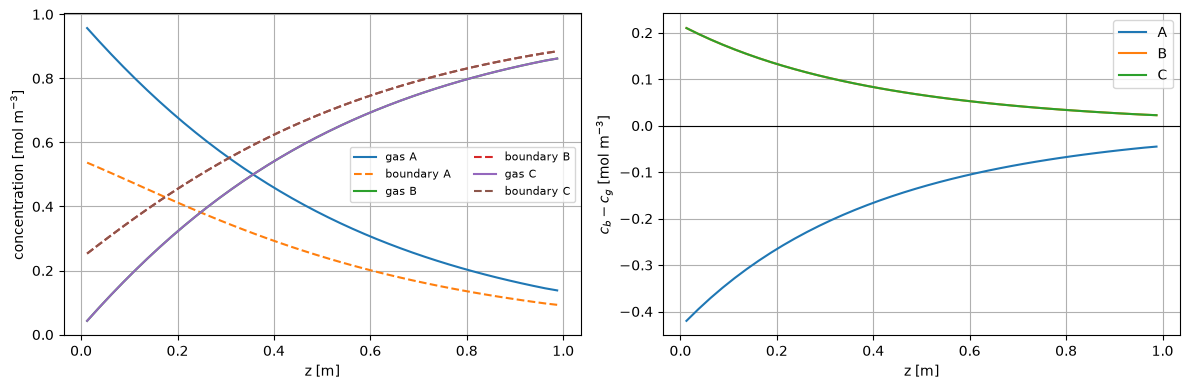
fig, axes = plt.subplots(1, 2, figsize=(12, 4))
positions = [0, cfg.n_z // 2, cfg.n_z - 1]
colors = ["tab:blue", "tab:orange", "tab:green"]
for idx, color in zip(positions, colors):
    axes[0].plot(1e3 * model.r_c, c_p[idx, :, 0], color=color, label=f"z = {model.z_c[idx]:.2f} m")
axes[0].set_xlabel("r [mm]")
axes[0].set_ylabel("particle $c_A$ [mol m$^{-3}$]")
axes[0].legend()
axes[0].grid(True)

for i, label in enumerate(model.species_labels):
    axes[1].plot(model.z_c, source_reactor[:, i], label=label)
axes[1].set_xlabel("z [m]")
axes[1].set_ylabel("reactor source [mol m$^{-3}$ s$^{-1}$]")
axes[1].legend()
axes[1].grid(True)
plt.tight_layout()
plt.show()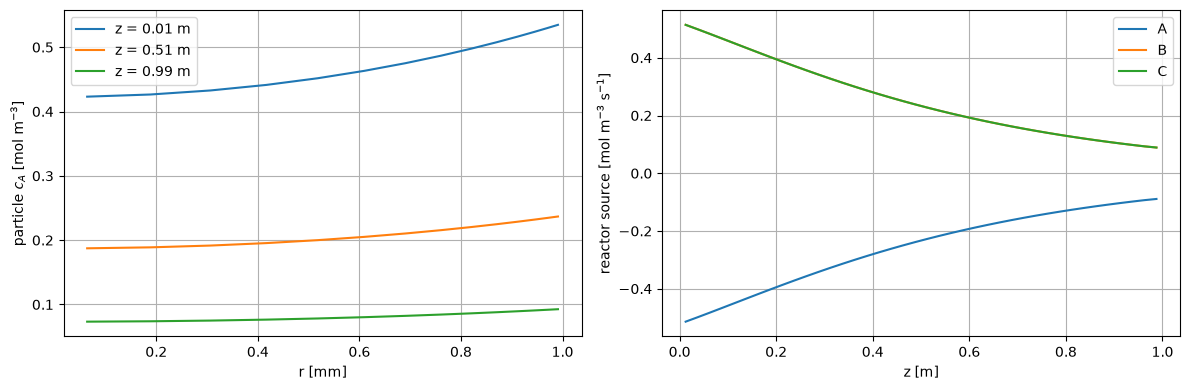
effectiveness = model.effectiveness_profile()
fig, ax = plt.subplots(figsize=(7, 4))
ax.plot(model.z_c, effectiveness)
ax.set_xlabel("z [m]")
ax.set_ylabel("particle effectiveness factor [-]")
ax.grid(True)
plt.show()
Validation
The checks below are numerical consistency checks for the coupled residual. The residual norm verifies the monolithic solve. The Maxwell-Stefan row check recomputes only the film equation. The signs of the film concentration differences should also be physically consistent: reactant is consumed in the particle, so , while products are generated and tend to have .
source_particle_average = cfg.eps_s * model.particle_average_source(c_p)
film_residual = model.maxwell_stefan_film_residual(c_g, c_b, source_reactor)
particle_residual = model.residual_values(model.u)[:, 2:, :]

pd.Series(
    {
        "monolithic residual norm": np.linalg.norm(result.fun, ord=np.inf),
        "film residual norm": np.linalg.norm(film_residual.ravel(), ord=np.inf),
        "particle residual norm": np.linalg.norm(particle_residual.ravel(), ord=np.inf),
        "max apparent-average source diff": np.max(np.abs(source_reactor - source_particle_average)),
        "relative apparent-average source diff": np.max(np.abs(source_reactor - source_particle_average)) / np.maximum(np.max(np.abs(source_reactor)), 1.0e-30),
        "min(c_b,A - c_g,A) [mol/m3]": np.min(c_b[:, 0] - c_g[:, 0]),
        "max(c_b,B - c_g,B) [mol/m3]": np.max(c_b[:, 1] - c_g[:, 1]),
        "max(c_b,C - c_g,C) [mol/m3]": np.max(c_b[:, 2] - c_g[:, 2]),
    },
    name="checks",
)
monolithic residual norm 4.921098e-09
film residual norm 1.341705e-13
particle residual norm 5.750511e-12
max apparent-average source diff 1.143391e-13
relative apparent-average source diff 2.224193e-13
min(c_b,A - c_g,A) [mol/m3] -4.201240e-01
max(c_b,B - c_g,B) [mol/m3] 2.100620e-01
max(c_b,C - c_g,C) [mol/m3] 2.100620e-01
Name: checks, dtype: float64Discussion
The extra boundary concentration block is the main modeling change compared with direct reactor-particle coupling. The reactor no longer supplies the particle-surface concentration directly. Instead, the reactor concentration , boundary concentration , and particle profile are solved together.
The linearized Maxwell-Stefan film equation is algebraic, but it is strongly coupled to the particle because the apparent source term comes from the resolved particle boundary flux. The resulting block structure is useful for lecture purposes:
the reactor transport row contains axial convection-dispersion and the flux-based apparent particle source;
the film row contains the Maxwell-Stefan relation between , , and the same apparent source;
the particle rows contain radial diffusion-reaction with as the surface boundary value.
The flux-based apparent source and the particle-volume averaged source should agree at steady state. The numerical check above compares them directly, so the implementation remains consistent with the earlier volume-average interpretation while using the same boundary-flux definition as the direct reactor-particle coupling notebook.
For very large pairwise film coefficients, the correction term becomes small and . For smaller coefficients, the boundary concentration difference becomes the external mass-transfer driving force. This is the point where a simple scalar film coefficient and a multicomponent Maxwell-Stefan film model start to behave differently.