This notebook builds the sparse gradient () and divergence () operators used in pymrm, applies second-order boundary conditions via Lagrange interpolation, and solves steady-state and transient 1D diffusion-reaction problems using Newton–Raphson iteration.
Governing equations
Unsteady 1D convection-diffusion-reaction:
Written using gradient and divergence operators:
Euler backward (implicit, unconditionally A-stable):
This is a nonlinear system in ; linearise with Newton–Raphson.
Second-order boundary conditions
pymrm uses Lagrange interpolation through the boundary face and the two nearest cell centres , to evaluate the gradient at the boundary:
with Lagrange coefficients , , .
The general Robin boundary condition is:
| BC type | Meaning | |||
|---|---|---|---|---|
| Dirichlet | 0 | 1 | at wall | |
| Neumann | 1 | 0 | at wall | |
| Robin | 1 | Film model |
construct_grad incorporates these automatically at second-order accuracy when bc=({'a':..,'b':..,'d':..}, {...}) is passed.
PyMRM building blocks
| Function | Signature | Role |
|---|---|---|
construct_grad | (shape, x_f, bc=(bc_L, bc_R)) | : maps cell values → face gradients (2nd-order BCs) |
construct_div | (shape, x_f, nu=0) | : maps face fluxes → cell divergences |
construct_convflux_upwind | (shape, x_f, bc, v) | Upwind convective flux matrix |
NumJac | (shape) | Finite-difference Jacobian for nonlinear terms |
newton | (func, x0) | Newton–Raphson with automatic Jacobian |
Example 1 — Steady-state diffusion: Dirichlet BCs
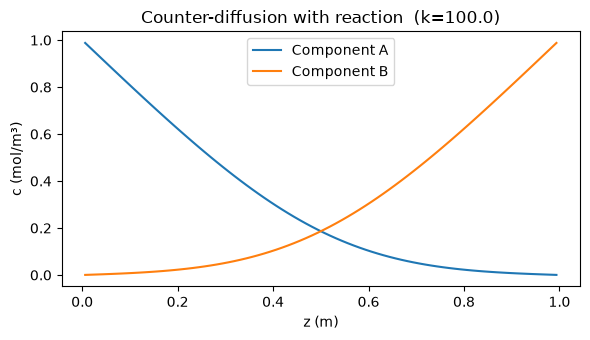
Two components counter-diffusing through a slab of thickness , with a fast reaction products. Both components have fixed concentrations at the walls.
import numpy as np
import matplotlib.pyplot as plt
import scipy.sparse.linalg as sla
from pymrm import construct_grad, construct_div, NumJac

# Physical parameters
n_c = 2
L = 1.0
D = 1.0
k = 100.0
bc_L = {'a': 0, 'b': 1, 'd': [1.0, 0.0]}  # Dirichlet: c_A=1, c_B=0 at left
bc_R = {'a': 0, 'b': 1, 'd': [0.0, 1.0]}  # Dirichlet: c_A=0, c_B=1 at right

def reaction(c):
    r = k * c[:, 0] * c[:, 1]
    f = np.empty_like(c)
    f[:, 0] = -r
    f[:, 1] = -r
    return f

# Grid
n_x = 80
shape = (n_x, n_c)
x_f = np.linspace(0, L, n_x + 1)
x_c = 0.5*(x_f[:-1] + x_f[1:])

# Build operators — BCs encoded in Grad (second-order Lagrange)
grad_mat, grad_bc = construct_grad(shape, x_f, x_c, bc=(bc_L, bc_R), axis=0)
div_mat = construct_div(shape, x_f, nu=0, axis=0)
jac_diff = div_mat @ (D * grad_mat)        # diffusion operator
g_diff_bc = div_mat @ (D * grad_bc)  # BC source vector

numjac = NumJac(shape)
c = np.zeros(shape)
for _ in range(12):
    f_rxn, jac_rxn = numjac(reaction, c)
    g = jac_diff @ c.reshape(-1, 1) + g_diff_bc + f_rxn.reshape(-1, 1)
    lu = sla.splu(jac_diff + jac_rxn)
    c -= lu.solve(g).reshape(shape)

plt.figure(figsize=(6, 3.5))
plt.plot(x_c, c[:, 0], label='Component A')
plt.plot(x_c, c[:, 1], label='Component B')
plt.xlabel('z (m)'); plt.ylabel('c (mol/m³)')
plt.title(f'Counter-diffusion with reaction  (k={k})')
plt.legend(); plt.tight_layout(); plt.show()
Example 2 — Transient diffusion-reaction with general BCs
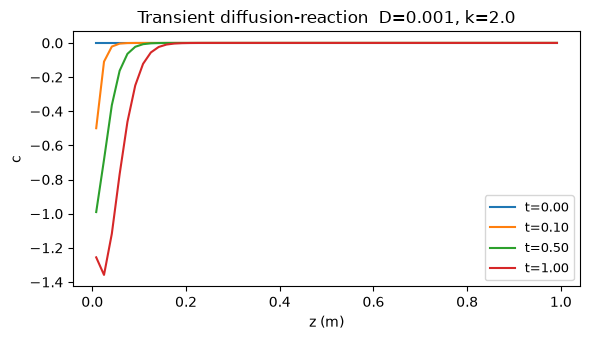
Unsteady diffusion of a single species with first-order reaction, Dirichlet BC at left (), Neumann (zero-flux) at right.
from pymrm import construct_grad, construct_div
import scipy.sparse as sp, scipy.sparse.linalg as sla

n_x, length, d_eff, k_rxn = 60, 1.0, 1e-3, 2.0
x_f = np.linspace(0, length, n_x+1)
x_c = 0.5*(x_f[:-1] + x_f[1:])
dt = 0.05
t_end = 1.0

bc_left  = {'a': 0, 'b': 1, 'd': 1.0}  # Dirichlet: c = 1
bc_right = {'a': 1, 'b': 0, 'd': 0.0}  # Neumann: dc/dn = 0

grad_mat, grad_bc = construct_grad(n_x, x_f, x_c, bc=(bc_left, bc_right))
div_mat = construct_div(n_x, x_f)
jac_diff = div_mat @ (d_eff * grad_mat)
g_diff_bc = div_mat @ (d_eff * grad_bc)

# Backward Euler: (I/dt - L - k*I) c^{n+1} = c^n/dt - bc
A_sys = sp.eye(n_x, format='csc') / dt - jac_diff - k_rxn * sp.eye(n_x, format='csc')
lu = sla.splu(A_sys)

c = np.zeros(n_x)
t = 0.0
snapshots = {}
while t < t_end + 1e-10:
    if any(abs(t - ts) < dt/2 for ts in [0, 0.1, 0.5, 1.0]):
        snapshots[f't={t:.2f}'] = c.copy()
    rhs = c / dt - g_diff_bc.toarray().ravel()
    c = lu.solve(rhs)
    t += dt

plt.figure(figsize=(6, 3.5))
for label, snap in snapshots.items():
    plt.plot(x_c, snap, label=label)
plt.xlabel('z (m)'); plt.ylabel('c')
plt.title(f'Transient diffusion-reaction  D={d_eff}, k={k_rxn}')
plt.legend(fontsize=9); plt.tight_layout(); plt.show()
Summary
construct_grad(shape, x_f, bc=(bc_L, bc_R))returns(Grad, grad_bc)— the BC source vectorgrad_bccarries the inhomogeneous part; addDiv @ D * grad_bcto the RHSBCs are second-order via Lagrange interpolation using the two nearest cells — not first-order ghost cells
Robin form covers Dirichlet (), Neumann (), and film-model () conditions
Backward Euler is unconditionally stable for diffusion; the linear system is solved once per time step by LU factorisation
For nonlinear kinetics, use
NumJacfor the reaction Jacobian and iterate with Newton–Raphson