Convection is the dominant transport mechanism in tubular reactors and column flows. This notebook covers the method of lines (MOL) discretisation of the 1D convection-reaction equation on a cell-centred grid, the stability requirement (Courant condition), and the improvement in accuracy achieved by TVD schemes using the Normalised Variable Diagram (NVD), as implemented in pymrm.
Governing equation
Discretised on cells of width with first-order upwind (FOU):
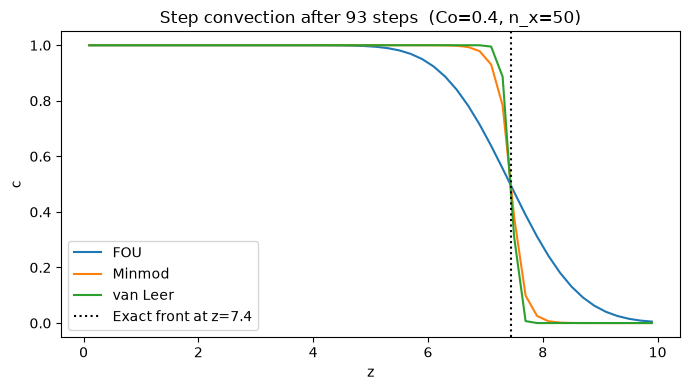
FOU is first-order accurate: it introduces numerical diffusion proportional to , which smears sharp fronts.
TVD via the Normalised Variable Diagram (NVD)
For a face between cells (upwind) and (downwind), define the upstream cell as the cell one step further upwind of . The normalised variable is:
The face concentration is written as:
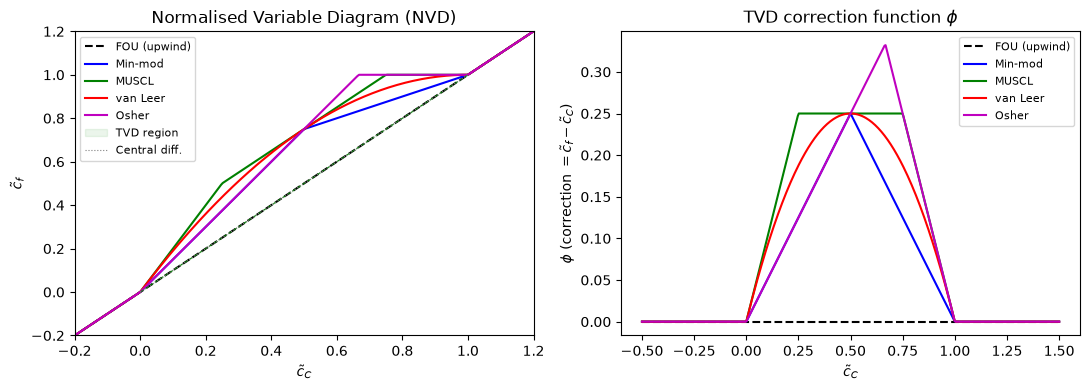
FOU: — no correction, highest numerical diffusion
Central differencing: — may introduce oscillations
TVD (Sweby region): for — no new extrema, bounded between FOU and linear
The pymrm limiter functions return the correction , so that .
PyMRM building blocks
| Function | Role |
|---|---|
construct_convflux_upwind(shape, x_f, bc, v) | Sparse matrix for FOU convective fluxes |
interp_cntr_to_stagg_tvd(c, x_f, x_c, bc, v, tvd_limiter) | Returns (c_f, dc_f): face concentrations and TVD correction |
construct_div(shape, x_f) | Divergence: maps face fluxes to cell residuals |
minmod, vanleer, muscl, osher, clam | NVD limiter functions |
Boundary conditions use the form {'a': a, 'b': b, 'd': d} meaning :
Dirichlet (specify face value):
{'a': 0, 'b': 1, 'd': c_in}Neumann (specify normal gradient):
{'a': 1, 'b': 0, 'd': grad_n}Zero-gradient outlet:
{'a': 1, 'b': 0, 'd': 0}
Example 1 — NVD diagram: comparing limiter functions
On a uniform grid and . The correction as a function of shows each scheme’s behaviour.
import numpy as np
import matplotlib.pyplot as plt
from pymrm import minmod, osher, clam, muscl, vanleer, upwind

x_norm_C = 0.5   # normalised cell-centre position (uniform grid)
x_norm_d = 0.75  # normalised face position (midpoint between C and D)
c_norm = np.linspace(-0.5, 1.5, 400)

limiters = [
    (upwind,  'FOU (upwind)',  'k--'),
    (minmod,  'Min-mod',       'b-'),
    (muscl,   'MUSCL',         'g-'),
    (vanleer, 'van Leer',      'r-'),
    (osher,   'Osher',         'm-'),
]

fig, (ax1, ax2) = plt.subplots(1, 2, figsize=(11, 4))

# Left: NVD diagram — normalised face value vs normalised cell value
for func, name, ls in limiters:
    phi = func(c_norm, x_norm_C, x_norm_d)
    ax1.plot(c_norm, c_norm + phi, ls, label=name)
# Sweby TVD region boundary
ax1.fill_between([0, 1], [0, 1], [0, 1], alpha=0.08, color='green', label='TVD region')
ax1.plot([0, 1], [0, 1], 'g--', lw=0.8)
ax1.plot([0, x_norm_d, 1], [0, x_norm_d, 1], 'gray', lw=0.8, ls=':', label='Central diff.')
ax1.set_xlim(-0.2, 1.2); ax1.set_ylim(-0.2, 1.2)
ax1.set_xlabel(r'$\tilde{c}_C$'); ax1.set_ylabel(r'$\tilde{c}_f$')
ax1.set_title('Normalised Variable Diagram (NVD)')
ax1.legend(fontsize=8)

# Right: the correction phi
for func, name, ls in limiters:
    phi = func(c_norm, x_norm_C, x_norm_d)
    ax2.plot(c_norm, phi, ls, label=name)
ax2.set_xlabel(r'$\tilde{c}_C$')
ax2.set_ylabel(r'$\phi$ (correction $= \tilde{c}_f - \tilde{c}_C$)')
ax2.set_title('TVD correction function $\phi$')
ax2.legend(fontsize=8)

plt.tight_layout(); plt.show()
<>:38: SyntaxWarning: invalid escape sequence '\p'
<>:38: SyntaxWarning: invalid escape sequence '\p'
/tmp/ipykernel_4136/1651591632.py:38: SyntaxWarning: invalid escape sequence '\p'
ax2.set_title('TVD correction function $\phi$')
Example 2 — Step convection: FOU vs TVD limiters
Explicit Euler time integration with Courant number . interp_cntr_to_stagg_tvd returns (c_f, dc_f) where dc_f is the TVD correction; the sum c_f + dc_f gives the TVD face concentration directly.
import math
from pymrm import construct_div, interp_cntr_to_stagg_tvd
from pymrm import upwind, minmod, vanleer

length, n_x = 10.0, 50
x_f = np.linspace(0, length, n_x+1)
x_c = 0.5*(x_f[:-1] + x_f[1:])
v = 1.0
Co = 0.4
dt = Co * (x_f[1]-x_f[0]) / v
n_steps = int(0.75 * length / (v*dt))

# Boundary conditions: inlet face value = 1 (a=0,b=1,d=1)
# outlet: zero gradient (a=1,b=0,d=0)
bc = ({'a': 0, 'b': 1, 'd': 1.0}, {'a': 1, 'b': 0, 'd': 0.0})
div_mat = construct_div(n_x, x_f)

fig, ax = plt.subplots(figsize=(7, 4))
for func, name in [(upwind, 'FOU'), (minmod, 'Minmod'), (vanleer, 'van Leer')]:
    c = np.zeros(n_x)
    for _ in range(n_steps):
        c_f, dc_f = interp_cntr_to_stagg_tvd(c, x_f, x_c, bc, v,
                                              tvd_limiter=func, axis=0)
        c += -dt * (div_mat @ (v * c_f)).ravel()
    ax.plot(x_c, c, label=name)

t_final = n_steps * dt
ax.axvline(v*t_final, ls=':', color='k', label=f'Exact front at z={v*t_final:.1f}')
ax.set_xlabel('z'); ax.set_ylabel('c')
ax.set_title(f'Step convection after {n_steps} steps  (Co={Co}, n_x={n_x})')
ax.legend(); plt.tight_layout(); plt.show()
Example 3 — Implicit convection with deferred TVD correction
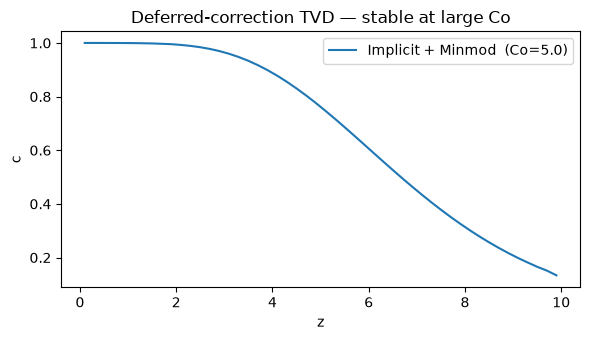
For stiff problems, use implicit (backward-Euler) FOU as the base scheme and apply the TVD correction explicitly as a deferred correction: solve the linear FOU system and then correct the right-hand side with .
import scipy.sparse as sp, scipy.sparse.linalg as sla
from pymrm import construct_convflux_upwind, construct_div
from pymrm import minmod

L2, n_x = 10.0, 50
x_f2 = np.linspace(0, L2, n_x+1)
x_c2 = 0.5*(x_f2[:-1] + x_f2[1:])
v2, Co2 = 1.0, 5.0   # large Courant number — explicit would be unstable!
dt2 = Co2 * (x_f2[1]-x_f2[0]) / v2
n2 = int(0.75 * L2 / (v2*dt2))
bc2 = ({'a': 0, 'b': 1, 'd': 1.0}, {'a': 1, 'b': 0, 'd': 0.0})

conv_mat, conv_bc = construct_convflux_upwind(n_x, x_f2, x_c2, bc2, v2)
div_mat = construct_div(n_x, x_f2)
# Implicit FOU Jacobian (constant → factor once)
jac_const = sp.eye(n_x, format='csc') / dt2 + div_mat @ conv_mat
jac_lu = sla.splu(jac_const)

c2 = np.zeros(n_x)
for _ in range(n2):
    c_old = c2.copy()
    for _ in range(2):  # 1-2 inner iterations sufficient
        _, dc_f2 = interp_cntr_to_stagg_tvd(c2, x_f2, x_c2, bc2, v2,
                                             tvd_limiter=minmod, axis=0)
        rhs = c_old / dt2 - (div_mat @ (conv_bc + v2*dc_f2.reshape(-1,1))).ravel()
        c2 = jac_lu.solve(rhs)

plt.figure(figsize=(6, 3.5))
plt.plot(x_c2, c2, label=f'Implicit + Minmod  (Co={Co2})')
plt.xlabel('z'); plt.ylabel('c')
plt.title('Deferred-correction TVD — stable at large Co')
plt.legend(); plt.tight_layout(); plt.show()
Summary
| Scheme | (NVD) | Order | Stable? |
|---|---|---|---|
| FOU (upwind) | 1 | Yes, | |
| Central | 2 | No (oscillations) | |
| Minmod | 2 in smooth regions | Yes (TVD) | |
| van Leer | 2 | Yes (TVD) |
NVD normalises concentration relative to upstream/downstream pair: scheme properties become independent of grid size
Deferred correction: solve implicit FOU system, correct RHS with TVD term — combines A-stability of implicit with accuracy of TVD
Numerical diffusion of FOU ∝ — reduces with grid refinement or with TVD
pymrm:
interp_cntr_to_stagg_tvdreturns(c_f, dc_f); addDiv @ (v*dc_f)to the explicit RHS correction