Taylor dispersion is caused by the presence of a velocity profile. Solute particles experience different flow velocities depending on their radial position. By means of molecular diffusion, the particles sample these different velocities, which gives a spread in residence time.
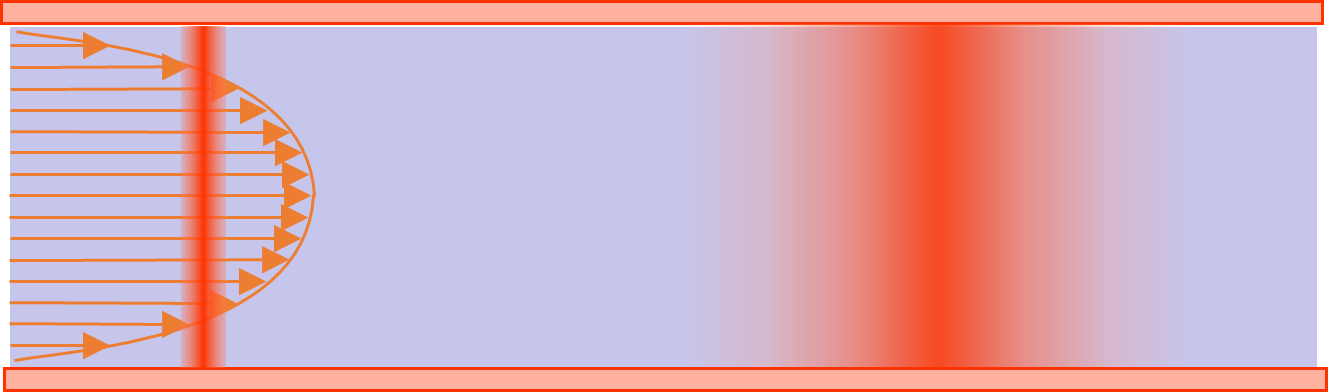
Taylor Dispersion
The spread of the solute can be described by a 2D convection-diffusion equation:
In a tube with laminar (Poiseuille) flow, the velocity profile is:
Questions:
Implement the 2D time-dependent convection-diffusion equations for a cylinder with developed Poiseuille flow.
Obtain the molar flow leaving the reactor as a function of time and construct a cumulative residence time distribution (RTD) from that.
Critically compare the RTD with results of the 1D models in Exercise 4.5.
Note that all numerical implementations should be consistent with the provided equations and boundary conditions.