try:
import pymrm
except ImportError:
%pip install -q pymrm pyyamlVan Krevelen-Hoftijzer: the chart replaced by a solve, and the assumption behind it measured
sec:F
struct:S3
tier:T0
data:tier6
phase:gas-liquid
The enhancement factor for a second-order gas-liquid reaction is an implicit relation that textbooks hand over as a chart. Solving the film equations instead prices the approximation everywhere on that chart - worst error -2.7955 % at gamma = 4.728, q = 1.522, comfortably inside the 10 percent Froment, De Wilde & Bischoff print for it - and tests the assumption they state for it, in both of the two wordings they print: that B is only weakly depleted near the interface (book p. 335) and that its concentration remains approximately constant close to the interface (book p. 340). Neither failure orders the error: at the worst point B at the interface is already down to 0.1647 of bulk and the rate-weighted mean of beta is 2.115 times its interfacial value, and where B is gone completely the approximation is exact to -0.00037 %. Levenspiel’s three printed expansions of the same result check every constant independently, and one of them turns out to expand the approximation rather than the equations it approximates: his E = E_i - E_i2(E_i-1)/M_H2 is algebraically the asymptote of the Van Krevelen-Hoftijzer relation, which it tracks to 0.9953 of the deficit at M_H = 400, while the true deficit is q times beta(0) exactly and therefore exponentially small, so at M_H = 800 the printed correction is 44.24 times too big.
Van Krevelen-Hoftijzer: the chart replaced by a solve, and the assumption behind it measured
Catalog ID: F3.2 · Structures: S3 (1-D steady BVP) · Tier: T0
Background
A gas \(A\) dissolving into a liquid that holds a reactant \(B\) is absorbed faster than it would be by dissolution alone. The ratio is the enhancement factor, and for a genuinely second-order reaction it has no closed form: the two film equations are coupled and nonlinear, and every design chart in the field descends from one approximate solution of them.
That approximation is Van Krevelen and Hoftijzer’s (1948). This page does two things with it that a chart cannot: it solves the implicit relation instead of reading it off, and it measures the assumption the approximation is built on.
The source situation, stated plainly
The 1948 origin was not consulted. Van Krevelen, D. W. and Hoftijzer, P. J., Kinetics of gas-liquid reactions. Part I. General theory, Recueil des Travaux Chimiques des Pays-Bas 67, 563 (1948), is not on disk and was not read. Every equation on this page is transcribed from a monograph that restates it with attribution, and the transcription is named equation by equation below.
The text read is Froment, De Wilde and Bischoff. Chemical Reactor Analysis and Design, 3rd edition, John Wiley & Sons (2011), ISBN 978-0-470-56541-4, Chapter 6 Gas-Liquid Reactions. It qualifies as a source for a page about this result rather than merely a book that mentions it: section 6.3.2 (book p. 331) says the diagram is “as first given by Van Krevelen and Hoftijzer [1948]”; section 6.3.3 (book p. 335) says the intermediate curves “were calculated by Van Krevelen and Hoftijzer [1948] under the assumption that B is only weakly depleted near the interface”; and section 6.3.5 (book p. 340) derives the approximation itself and prints its accuracy claim. Named, attributed, derived, and its assumption stated.
Levenspiel is a cross-check, not a second source. Chemical Reaction Engineering, 3rd edition, John Wiley & Sons (1999), Chapter 23, carries the same result as a chart in a different notation with three asymptotic expansions printed in its annotation boxes. Those expansions are used here to check Froment’s constants independently and to reconcile the two notations. Nothing on this page adjudicates between the books.
Every equation was read on a render, and here is why that matters
The Froment file is born-digital and its prose extracts cleanly, but its equations do not survive extraction and the failure is silent. Every Symbol-font operator becomes an unmappable Private-Use-Area glyph - U+F02D for minus, U+F03D for equals, U+F02B for plus - which renders as nothing. The extraction of the central equation of this page, (6.3.5-1), reads exactly
  '    1   FA   1

b D A C Ai
a DB C Bb
Seven characters have gone: U+F067 (the leading \(\gamma\)), U+F03D (the equals), U+F067 again, U+F02D (a minus), U+F028 (an opening bracket), U+F02D (the second minus) and U+F029. The square root sign has no character at all - it is drawn, not typeset - and the fraction bar is a line. What is left looks like a complete equation and contains no operator whatsoever. Every equation and every numeral used here was read on a 300 ppi render (Levenspiel: 600 ppi, his file’s native resolution), cropped and enlarged.
The published model
The film equations (Froment, section 6.3.1)
A stagnant liquid film of thickness \(y_L\) at the interface, everything beyond it well mixed, and an irreversible reaction \(aA + bB \rightarrow\) products. With \(\xi = y/y_L\), \(\alpha = C_A/C_{Ai}\) and \(\beta = C_B/C_{Bb}\),
\[ \frac{\mathrm{d}^2\alpha}{\mathrm{d}\xi^2} = \gamma^2\,\alpha\beta, \qquad \frac{\mathrm{d}^2\beta}{\mathrm{d}\xi^2} = \frac{\gamma^2}{q}\,\alpha\beta , \]
\[ \gamma = \frac{\sqrt{k D_A}}{k_L}, \qquad q = \frac{a\,D_B\,C_{Bb}}{b\,D_A\,C_{Ai}} , \]
with \(\alpha(0) = 1\) (saturated interface), \(\alpha(1) = 0\) - Van Krevelen and Hoftijzer “could set \(C_{Ab} = 0\)”, book p. 340 - \(\beta'(0) = 0\) (\(B\) is non-volatile) and \(\beta(1) = 1\). The enhancement factor is the interfacial flux divided by the purely diffusive one,
\[ F_A = \frac{N_A}{k_L (C_{Ai} - C_{Ab})} = -\left.\frac{\mathrm{d}\alpha}{\mathrm{d}\xi}\right|_{\xi = 0} . \]
\(\gamma\) is Froment’s symbol and his eq. (6.3.2-1) et seq.; he notes it “is sometimes called the Hatta number” (book p. 328). \(q\) is the group his Fig. 6.3.2-1 carries as its right-hand axis title, and his eq. (6.3.3-10) makes the instantaneous ceiling \(F_A = 1 + q\).
The approximation this page is about
Pseudo-first-order, exact when \(\beta \equiv 1\) - Froment (6.3.2-11):
\[ F_A = \frac{\gamma}{\tanh\gamma} \]
Van Krevelen-Hoftijzer, “entirely analogous with that obtained for a pseudo-first-order reaction (6.3.2-11), but with \(\gamma\) replaced by \(\gamma'\)” - Froment (6.3.5-1), book p. 340, read on a 300 ppi crop enlarged 2x:
\[ \gamma' = \gamma\sqrt{1 - (F_A - 1)\,\frac{b\,D_A\,C_{Ai}}{a\,D_B\,C_{Bb}}} \;=\; \gamma\sqrt{1 - \frac{F_A - 1}{q}} , \qquad F_A = \frac{\gamma'}{\tanh\gamma'} . \]
\(F_A\) appears on both sides: this is the implicit relation, and solving it is what the chart exists to avoid. The sentence that follows it in the book is the claim this page measures: “This approximate solution is valid to within 10 percent of the numerical solution.”
And the sentence three sections earlier, book p. 335, is the assumption this page tests: the intermediate curves “were calculated by Van Krevelen and Hoftijzer [1948] under the assumption that B is only weakly depleted near the interface. For moderately fast reactions, this assumption was reasonably confirmed by more rigorous computations.”
The same result in Levenspiel’s notation
| Froment | Levenspiel | this page |
|---|---|---|
| \(\gamma = \sqrt{kD_A}/k_L\) | \(M_H = \sqrt{\mathcal{D}_A k C_B}/k_{Al}\) | gamma |
| \(F_A\) | \(E\) | f_a |
| \(q = aD_BC_{Bb}/(bD_AC_{Ai})\) | \(E_i - 1\), from \(E_i = 1 + \mathcal{D}_BC_BH_A/(b\mathcal{D}_Ap_{Ai})\) | q |
| \(F_A \to 1 + q\) | \(E \to E_i\) | the plateau |
The two groups are the same objects written differently - \(p_{Ai} = C_{Ai}/H_A\) turns Levenspiel’s \(E_i\) into Froment’s \(1 + q\) - but the curve labels on the two charts are not. Froment’s Fig. 6.3.2-1 labels its curves with \(q\); Levenspiel’s Fig. 23.4 labels the same family with \(E_i\). Both print the same ten numerals. A curve labelled 1 plateaus at \(F_A = 2\) in one book and at \(E = 1\) in the other, and the page computes what that costs.
Levenspiel’s Fig. 23.4 also prints three asymptotic expansions in its annotation boxes, and every constant in them is checked here against the implicit relation above and against the film equations themselves:
\[ E \cong 1 + \frac{M_H^2}{3} + \dots \qquad E = M_H\left(1 - \frac{M_H - 1}{2E_i}\right) + \dots \qquad E \cong E_i - \frac{E_i^2(E_i-1)}{M_H^2} + \dots \]
Parameters and assumptions
Assumptions, all of them the source’s: steady state; a stagnant film with no surface renewal; irreversible second-order kinetics, first order in each reactant; constant diffusivities; \(C_{Ab} = 0\), so no reaction in the bulk; \(B\) non-volatile. The problem is then dimensionless and has exactly two parameters, \(\gamma\) and \(q\).
Nothing here is fitted, and nothing here is measured. Both sides of every comparison on this page are equations: an approximation on one side and the equations it approximates on the other. This is provenance tier 6. The page therefore establishes nothing whatever about how well the film model describes a real absorber - only how well one solution of it describes another.
The search domain, and each end taken from the row that actually carries it. \(\gamma \in [0.5, 1000]\) is Froment’s own printed \(\gamma\) axis, transcribed. The \(q\) range comes from the printed curve labels - \(q\) is what those labels are - so its upper end is the largest of them, and its lower end goes one decade below the smallest, because \(q\) is a physical ratio and not a drawn curve. The two ends happen to coincide numerically with the \(\gamma\) axis; they are looked up from different rows all the same. The worst point turns out to lie in the interior of both, so widening the domain cannot move it.
Where this page stops, and what F3.1 owns. F3.1 owns the Hatta number and the regime map, and it already reports a maximum Van Krevelen-Hoftijzer error of about 2.1 % over the three \(E_i\) values it sweeps. That number is loaded from F3.1’s own agreement.json in the Validation section, recomputed under this page’s definitions, and reconciled - not retyped. This page does not restate the regime picture, and it does not touch DeCoursey, which is F3.3.
import sys
import urllib.request
from pathlib import Path

import matplotlib.pyplot as plt
import numpy as np
from scipy.integrate import solve_bvp
from scipy.optimize import brentq

from pymrm import (NumJac, clip_approach, compute_boundary_values,
                   construct_div, construct_grad, newton)

RAW = ("https://raw.githubusercontent.com/computational-chemical-engineering/"
       "pymrm-gallery/main")
if "google.colab" in sys.modules:
    urllib.request.urlretrieve(RAW + "/shared/gallery_utils.py", "gallery_utils.py")
else:
    for _p in (Path.cwd(), *Path.cwd().parents):
        if (_p / "shared" / "gallery_utils.py").is_file():
            sys.path.insert(0, str(_p / "shared"))
            break
from gallery_utils import Claims, cite_data, load_data, load_meta, load_claims

PAGE = "F3.2-van-krevelen-hoftijzer"
plt.rcParams.update({"figure.dpi": 110, "font.size": 9.5, "axes.grid": True,
                     "grid.alpha": 0.25})
# Okabe-Ito, assigned in fixed order and never cycled
C_BLUE, C_ORANGE, C_GREEN = "#0072B2", "#D55E00", "#009E73"
C_PURPLE, C_YELLOW, C_GREY = "#CC79A7", "#E69F00", "0.45"

# DETERMINISM: nothing on this page is stochastic.  No sampling, no random
# initial guess, and no warm start - every film solve begins from a closed-form
# profile that depends on nothing but its own (gamma, q).  Two consecutive
# executions give an identical agreement.json.
np.set_printoptions(precision=8, suppress=False)
The data
There is no experimental dataset here and there could not be: the case is an approximation to a pair of differential equations. What the two CSVs carry is transcription - the numbers and sentences the two books print around this result - so that the notebook tests them instead of retyping them.
Both books were read on renders at their files’ native resolutions, and the page/PDF mapping is recorded in the sidecars so any reader can re-render exactly what was read (Froment: book = PDF \(-\) 42; Levenspiel: book = PDF \(-\) 16, both confirmed on printed running heads).
One caution about the figure, because it is the exact trap the house rule exists for. The Froment file is born-digital and its equations and prose are vector text at any resolution - but its figure is not. pdfimages -list shows Fig. 6.3.2-1, on PDF p. 373, as an embedded \(536\times771\) greyscale JPEG at 148 ppi, so a 300 ppi page render is a 2x interpolation of a 148 ppi raster. The raster was extracted and the ten curve labels, the four axis ends and both axis titles read at native resolution enlarged 4x.
PRN = load_data("vkh-printed-claims.csv", page=PAGE).set_index("claim_id")
PMETA = load_meta("vkh-printed-claims.csv", page=PAGE)
LAB = load_data("enhancement-chart-labels.csv", page=PAGE)
LMETA = load_meta("enhancement-chart-labels.csv", page=PAGE)


def printed(key, field="value"):
    """A printed constant, looked up - never retyped in a cell."""
    return float(PRN.loc[key, field])


def quoted(key):
    return str(PRN.loc[key, "verbatim"])


print(cite_data(PMETA))
print(f"{len(PRN)} transcribed rows, {len(LAB)} chart labels\n")
for k in ("froment_vkh_validity_pct", "froment_film_completion_gamma",
          "froment_bulk_reaction_gamma"):
    print(f'  {k:32s} {PRN.loc[k, "value"]:>8}   book p.{PRN.loc[k, "book_page"]}'
          f'  "{quoted(k)}"')
for k in ("lev_small_M_coeff", "lev_pfo_correction_denom", "lev_pfo_correction_offset",
          "lev_inst_correction_power", "lev_pfo_threshold", "lev_inst_threshold"):
    print(f'  {k:32s} {PRN.loc[k, "value"]:>8}   book p.{PRN.loc[k, "book_page"]}'
          f'  "{quoted(k)}"')

# ---- the domain of every search on this page, read off the printed axes -----
# gamma comes from the printed gamma AXIS; q comes from the printed curve
# LABELS, which is what q is drawn as - two different transcribed sources, and
# each is looked up from the row that actually carries it.
LABELS = [int(v) for v in LAB["label"]]
G_LO, G_HI = printed("froment_gamma_axis_lo"), printed("froment_gamma_axis_hi")
Q_HI = float(max(LABELS))
Q_LO = float(min(LABELS)) / 10.0   # one decade below the smallest printed label
print(f"\nsearch domain: gamma in [{G_LO:g}, {G_HI:g}] (Froment's printed gamma axis),"
      f"  q in [{Q_LO:g}, {Q_HI:g}]")
print(f"printed curve labels, both books: {LABELS}")
print(f"  q's range comes from those labels, not from the gamma axis: the largest"
      f" printed label is {max(LABELS):g}"
      f"\n  and the search goes one decade below the smallest, {min(LABELS):g}, because"
      f" q is a physical ratio")
print(f"  and not a drawn curve.  The worst point turns out to be interior in both"
      f" directions, so"
      f"\n  widening the domain cannot move it.")
Froment, G. F.; De Wilde, J.; Bischoff, K. B. (2011) — "Chemical Reactor Analysis and Design", 3rd edition, John Wiley & Sons (2011), ISBN 978-0-470-56541-4, Chapter 6 "Gas-Liquid Reactions", sections 6.3.2 (book pp. 328-332), 6.3.3 (book p. 335) and 6.3.5 (book pp. 340-341), reference list book p. 365
— transcription
25 transcribed rows, 10 chart labels
froment_vkh_validity_pct 10.0 book p.340 "This approximate solution is valid to within 10 percent of the numerical solution."
froment_film_completion_gamma 3.0 book p.331 "The reaction is essentially completed in the film when gamma > 3"
froment_bulk_reaction_gamma 0.3 book p.331 "whereas it takes place mainly in the bulk when gamma < 0.3"
lev_small_M_coeff 3.0 book p.530 "E = 1 + M_H^2/3 + ..."
lev_pfo_correction_denom 2.0 book p.530 "More precisely E = M_H(1 - (M_H - 1)/(2 E_i)) + ..."
lev_pfo_correction_offset 1.0 book p.530 "the (M_H - 1) of E = M_H(1 - (M_H - 1)/(2 E_i)) + ..."
lev_inst_correction_power 2.0 book p.530 "More precisely: E = E_i - E_i^2 (E_i - 1)/M_H^2 + ..."
lev_pfo_threshold 5.0 book p.530 "If E_i > 5 M_H we then have pseudo first order reaction by the G/L interface in which case E = M_H"
lev_inst_threshold 5.0 book p.530 "If E_i < M_H/5 then we have instantaneous reaction at a plane on the L film in which case E = E_i"
search domain: gamma in [0.5, 1000] (Froment's printed gamma axis), q in [0.1, 1000]
printed curve labels, both books: [1, 2, 5, 10, 20, 50, 100, 200, 500, 1000]
q's range comes from those labels, not from the gamma axis: the largest printed label is 1000
and the search goes one decade below the smallest, 1, because q is a physical ratio
and not a drawn curve. The worst point turns out to be interior in both directions, so
widening the domain cannot move it.One printed defect, reported and not repaired
Levenspiel spells the first author “van Krevelens”, with a terminal s, in both places he names him. It is settled against another document rather than against memory: Froment cites the same paper - same journal, same volume 67, same page 563 - and spells it Van Krevelen.
This is a defect in the cross-check source, not in the E1.1 target, and it changes nothing computed here. The two books’ citations do not conflict: Froment cites the 1948 Rec. Trav. Chim. paper, Levenspiel’s chart caption credits a 1954 Trans. I. Chem. E. paper, and Levenspiel’s own reference list carries both. Those are two publications, not a discrepancy. Neither is on disk.
for k in ("froment_surname_in_text", "froment_surname_in_reflist",
          "levenspiel_surname_in_caption", "levenspiel_surname_in_reflist"):
    print(f'{PRN.loc[k, "source"]:11s} book p.{PRN.loc[k, "book_page"]:>4}  "{quoted(k)}"')

FROMENT_SPELLING = "Van Krevelen"
LEV_SPELLING = "van Krevelens"
SPELLING_DIFFERS = (FROMENT_SPELLING.lower() not in
                    [quoted("levenspiel_surname_in_caption").split()[i] + " " +
                     quoted("levenspiel_surname_in_caption").split()[i + 1]
                     for i in range(len(quoted("levenspiel_surname_in_caption").split()) - 1)])
IN_FROMENT = sum(FROMENT_SPELLING in quoted(k)
                 for k in ("froment_surname_in_text", "froment_surname_in_reflist"))
IN_LEV = sum(LEV_SPELLING in quoted(k)
             for k in ("levenspiel_surname_in_caption", "levenspiel_surname_in_reflist"))
SAME_PAPER = all(s in quoted("levenspiel_surname_in_reflist") for s in ("67", "563", "1948"))
print(f"\n'{FROMENT_SPELLING}' in {IN_FROMENT} of the 2 Froment rows;"
      f"  '{LEV_SPELLING}' in {IN_LEV} of the 2 Levenspiel rows.")
print(f"both reference lists carry volume 67, page 563, year 1948: {SAME_PAPER}")
assert IN_FROMENT == 2 and IN_LEV == 2 and SAME_PAPER
print("-> one paper, two spellings.  This page uses the spelling without the s,"
      "\n   which is the one the E1.1 target and the catalogue use.")
froment book p. 331 "as first given by Van Krevelen and Hoftijzer [1948]"
froment book p. 365 "Van Krevelen, D.W., and Hoftijzer, P.J., Rec. Trav. Chim. Pays-Bas, 67, 563 (1948)."
levenspiel book p. 530 "modified from the numerical solution of van Krevelens and Hoftijzer (1954)."
levenspiel book p. 537 "van Krevelens, D. W., and Hoftijzer, P. J., Rec. Trav. Chim., 67, 563 (1948); Trans. I. Chem. E., 32, 5360 (1954)."
'Van Krevelen' in 2 of the 2 Froment rows; 'van Krevelens' in 2 of the 2 Levenspiel rows.
both reference lists carry volume 67, page 563, year 1948: True
-> one paper, two spellings. This page uses the spelling without the s,
which is the one the E1.1 target and the catalogue use.PyMRM implementation
Three solvers, and they are kept apart on purpose.
- The film equations, in pymrm. Finite volumes on a slab (
nu=0) with a graded grid clustered at the interface, per-species boundary conditions in one pair of{"a","b","d"}dictionaries, andnewton+NumJacon the pointwise reaction term. This is the “numerical solution” Froment’s accuracy claim is made against. - The same equations by collocation.
scipy.integrate.solve_bvp, adaptive mesh, fourth order, sharing no assembly, no Jacobian and no mesh with (1). Every headline that depends on the film solution is computed both ways. - The implicit relation, solved twice: for \(F_A\) by Brent, and again for \(\gamma'\) with \(F_A\) eliminated - a different unknown and a different residual for the same pair of printed equations.
Two details that are not decoration. The grid is graded: with \(x_f = (\mathrm{e}^{s t} - 1)/(\mathrm{e}^{s} - 1)\) and \(s = 8\) the reaction layer near \(\xi = 0\) is resolved at \(\gamma = 1000\), where a uniform grid of the same size is not - construct_grad and construct_div take arbitrary face positions, so this costs one line. And NumJac is given (n_x, 2) and never a bare (n_x,): the reaction term is pointwise in the two fields, which is exactly the default stencil, while a bare 1-D shape would declare every cell coupled to every other and build a dense Jacobian.
The reference is not a single solve. Grading is not free: it buys the high-\(\gamma\) end and it costs accuracy at moderate \(\gamma\), which is exactly where this page’s headline sits, because the outer cells of a graded grid are several times wider than a uniform one’s. Both effects are measured below. So the baseline every error here is quoted against is a Richardson extrapolation of the same graded film on \(n_x = 400\) and \(n_x = 800\), \(F(2n) + [F(2n) - F(n)]/3\), which the observed order 2.0000 licenses. A single graded solve at \(n_x = 800\) is not converged at the fourth decimal of the headline; the break table’s “extrapolation switched off” row is that defect, and the extrapolated baseline is checked against collocation and against a finer extrapolation in the Validation section.
Every solve is a cold start from a closed-form profile that depends only on its own \((\gamma, q)\). Nothing on this page is continued from a neighbouring solve, so no reported number can inherit a warm-start history.
XTOL = dict(xtol=1e-13, rtol=8.9e-16)


# ------------------------------------------- Froment (6.3.2-11) + (6.3.5-1)
def f_a_vkh(gamma, q, sign=-1.0, offset=1.0, denom="q", xtol=None):
    """F_A = gamma'/tanh(gamma') with gamma' from (6.3.5-1), solved for F_A.

    `sign`, `offset`, `denom` and `xtol` exist so that the break table can
    mistranscribe the printed equation or under-solve it; the page always calls
    this with the printed form and the tight tolerance.
    """
    d = q if denom == "q" else 1.0 + q
    tol = XTOL if xtol is None else dict(xtol=xtol, rtol=8.9e-16)

    def resid(F):
        s = np.sqrt(max(1.0 + sign * (F - offset) / d, 0.0))
        g = gamma * s
        return F - (g / np.tanh(g) if g > 1e-8 else 1.0 + g * g / 3.0)

    hi = 1.0 + q
    while resid(hi) < 0 and hi < 1e12:      # a broken form can exceed the ceiling
        hi *= 2.0
    return brentq(resid, 1.0, hi, **tol, maxiter=300)


def f_a_vkh_route_b(gamma, q):
    """The SAME two printed equations, solved for gamma' instead of for F_A.

    F = u/tanh u and F = 1 + q(1 - u^2/gamma^2) with u = gamma'; eliminating F
    leaves one scalar equation in u.  Different unknown, different residual.
    """
    def resid(u):
        return u / np.tanh(u) - (1.0 + q * (1.0 - (u / gamma) ** 2))

    u = brentq(resid, 1e-12, gamma, **XTOL, maxiter=300)
    return u / np.tanh(u)


# ------------------------------------------------------- the film, in pymrm
def faces(n, stretch):
    """Faces graded towards xi = 0, the interface, where the reaction layer is."""
    t = np.linspace(0.0, 1.0, n + 1)
    return t if stretch <= 1e-12 else np.expm1(stretch * t) / np.expm1(stretch)


class Film:
    """Stagnant film on xi in [0, 1], fields (alpha, beta) = (A, B)."""

    def __init__(self, n_x=800, stretch=8.0, bc_beta_bulk="dirichlet"):
        self.n_x, self.stretch = n_x, stretch
        self._memo = {}
        self.shape = (n_x, 2)
        self.x_f = faces(n_x, stretch)
        self.x_c = 0.5 * (self.x_f[:-1] + self.x_f[1:])
        # a . dc/dn + b . c = d, with n the OUTWARD normal.
        right = ({"a": [[0.0, 0.0]], "b": [[1.0, 1.0]], "d": [[0.0, 1.0]]}
                 #    alpha = 0 (C_Ab = 0)     beta = 1 (bulk value)
                 if bc_beta_bulk == "dirichlet" else
                 {"a": [[0.0, 1.0]], "b": [[1.0, 0.0]], "d": [[0.0, 0.0]]})
        #        the break-table alternative: dbeta/dn = 0 at the bulk edge
        self.bc = ({"a": [[0.0, 1.0]], "b": [[1.0, 0.0]], "d": [[1.0, 0.0]]}, right)
        #            alpha = 1 (saturated)     dbeta/dn = 0 (B non-volatile)
        grad_mat, grad_bc = construct_grad(self.shape, self.x_f, self.x_c,
                                           self.bc, axis=0)
        div_mat = construct_div(self.shape, self.x_f, nu=0, axis=0)   # slab
        self.flux_mat, self.flux_bc = -grad_mat, -grad_bc
        self.jac_diff = div_mat @ self.flux_mat
        self.g_diff = (div_mat @ self.flux_bc).toarray().ravel()
        # F_A lives in the first face row of the flux operator
        self.iface = np.asarray(self.flux_mat[[0], :].todense()).ravel()
        self.iface_bc = float(self.flux_bc.toarray().ravel()[0])
        # (n_x, 2), never a bare (n_x,): the rate is pointwise in the fields
        self.numjac = NumJac((n_x, 2))

    def enhancement(self, u):
        return float(self.iface @ np.asarray(u).ravel() + self.iface_bc)

    def solve(self, gamma, q, frozen_b=False, tol=1e-10):
        def rate(u):
            # frozen_b is the break table's "no depletion of B at all": B is held
            # at its bulk value in the rate AND its own consumption is dropped,
            # so beta = 1 identically and the film IS pseudo-first-order.
            b = np.ones_like(u[:, 1]) if frozen_b else np.clip(u[:, 1], 0, None)
            r = np.clip(u[:, 0], 0, None) * b
            return np.stack([gamma**2 * r,
                             np.zeros_like(r) if frozen_b else (gamma**2 / q) * r],
                            axis=1)

        # COLD START from a closed form, not from a neighbouring solve: the
        # pseudo-first-order profile at this same gamma.
        g = min(gamma, 700.0)                      # sinh overflows past ~710
        u0 = np.stack([np.sinh(g * (1.0 - self.x_c)) / np.sinh(g),
                       np.ones_like(self.x_c)], axis=1)

        def residual(u):
            g_r, jac_r = self.numjac(rate, u)
            return (self.jac_diff @ u.reshape((-1, 1))
                    + self.g_diff.reshape((-1, 1))
                    + g_r.reshape((-1, 1))), self.jac_diff + jac_r

        res = newton(residual, u0, tol=tol, maxfev=200,
                     callback=lambda x, r: clip_approach(x, r, 0.0, None))
        assert res.success, f"film solve failed at gamma={gamma}, q={q}"
        return np.asarray(res.x).reshape(self.shape)

    def beta_interface(self, u):
        """beta at xi = 0 through compute_boundary_values, not off a cell centre."""
        v, _ = compute_boundary_values(u, self.x_f, self.x_c, self.bc[0], axis=0,
                                       bound_id=0)
        return float(np.asarray(v).ravel()[1])

    def beta_constancy(self, gamma, q, **kw):
        """Rate-weighted mean of beta over the reaction zone, over beta(0).

        The book states its assumption TWICE and the two statements are not the
        same test.  Book p. 335 is about the LEVEL of depletion at the
        interface, which beta(0) measures.  Book p. 340 - the page the equation
        itself is printed on - is about beta staying "approximately constant
        close to the interface", which beta(0) does not measure at all.  This
        is the second test: weight beta by the local rate alpha*beta, where the
        approximation is actually being made, and divide by beta(0).  It is 1
        exactly when beta does not vary over the reaction zone.
        """
        u = self.solve(gamma, q, **kw)
        a = np.clip(u[:, 0], 0.0, None)
        b = np.clip(u[:, 1], 0.0, None)
        w = np.diff(self.x_f) * a * b
        s, b0 = float(w.sum()), self.beta_interface(u)
        # A break row CAN make this undefined rather than large: the
        # zero-gradient-bulk row removes the supply of B entirely, so beta and
        # the rate go to zero everywhere and there is no reaction zone to
        # average over.  Return nan explicitly, so the row records no move on
        # this metric instead of raising a warning and dividing 0 by 0.
        if not (s > 0.0) or b0 == 0.0:
            return float("nan")
        return float((w * b).sum() / s) / b0

    def f_a(self, gamma, q, **kw):
        # A pure-function memo.  f_a depends on nothing but (gamma, q, kw) and
        # the operators built once in __init__, and the root-finders ask for the
        # same point repeatedly.  It changes no number - only the runtime.
        key = (gamma, q, tuple(sorted(kw.items())))
        if key not in self._memo:
            u = self.solve(gamma, q, **kw)
            self._memo[key] = (self.enhancement(u), self.beta_interface(u))
        return self._memo[key]


class Extrapolated:
    """Richardson extrapolation of the SAME film on two grids: the reference.

    The graded discretisation converges at order 2 - observed 2.0000 in the
    Validation section - so F(2n) + [F(2n) - F(n)]/3 removes its leading error
    term.  Everything this page reports about the approximation is measured
    against this, not against a single solve, because a single graded solve at
    n_x = 800 is wrong in the fourth decimal of the headline error.  The break
    table's "extrapolation switched off" row is exactly that defect.
    """

    def __init__(self, coarse, fine, order=2.0):
        self.coarse, self.fine = coarse, fine
        self.n_x, self.stretch = fine.n_x, fine.stretch
        self.w = 1.0 / (2.0**order - 1.0)

    def f_a(self, gamma, q, **kw):
        f_c, b_c = self.coarse.f_a(gamma, q, **kw)
        f_f, b_f = self.fine.f_a(gamma, q, **kw)
        return f_f + (f_f - f_c) * self.w, b_f + (b_f - b_c) * self.w

    def solve(self, gamma, q, **kw):
        """Profiles are drawn from the fine grid; only scalars are extrapolated."""
        return self.fine.solve(gamma, q, **kw)

    def beta_constancy(self, gamma, q, **kw):
        # A ratio of two integrals of the SAME profile, so the grid partly
        # cancels - but only partly, and least of all at the top of the gamma
        # range, where beta is a thin exponential and the rate weight sits in
        # the first few cells.  Taking this diagnostic from the fine grid alone,
        # on the ground that the grid "cancels to five digits", is true at the
        # worst point and false by orders of magnitude at gamma = 100.  The gap
        # is PRINTED below
        # rather than asserted here, and the ratio is extrapolated exactly like
        # F_A: same two grids, same order.
        c = self.coarse.beta_constancy(gamma, q, **kw)
        f = self.fine.beta_constancy(gamma, q, **kw)
        return f + (f - c) * self.w


# ------------------------------------------------ the film, by collocation
def f_a_bvp(gamma, q, tol=1e-10, n0=200):
    """The same two-point problem, adaptive 4th-order collocation."""
    def fun(x, y):
        r = gamma**2 * y[0] * y[2]
        return np.vstack([y[1], r, y[3], r / q])

    def bc(ya, yb):
        return np.array([ya[0] - 1.0, yb[0], ya[3], yb[2] - 1.0])

    x = np.expm1(6.0 * np.linspace(0, 1, n0)) / np.expm1(6.0)
    y = np.zeros((4, x.size))
    y[0], y[1], y[2] = 1.0 - x, -1.0, 1.0
    s = solve_bvp(fun, bc, x, y, tol=tol, max_nodes=400000)
    assert s.status == 0, f"solve_bvp failed at gamma={gamma}, q={q}: {s.message}"
    return float(-s.y[1][0]), float(s.sol(0.0)[2])


# -------------------------------------------------------- root-find helpers
def argext_log(f, lo, hi, n_scan=13, h=1e-3, rootfind=True):
    """An interior extremum of f on [lo, hi], ROOT-FOUND from f' = 0.

    The scan only brackets; the value returned is f at a root of the central
    difference of f in ln x.  Returns (x, f(x), was_root_found).
    """
    xs = np.geomspace(lo, hi, n_scan)
    fs = np.array([f(x) for x in xs])
    i = int(np.argmax(np.abs(fs)))
    if not rootfind or i in (0, n_scan - 1):
        return float(xs[i]), float(fs[i]), False

    def dfd(lx):
        x = np.exp(lx)
        return f(x * np.exp(h)) - f(x * np.exp(-h))

    a, b = np.log(xs[i - 1]), np.log(xs[i + 1])
    if dfd(a) * dfd(b) >= 0:
        return float(xs[i]), float(fs[i]), False
    lx = brentq(dfd, a, b, **XTOL, maxiter=200)
    return float(np.exp(lx)), float(f(np.exp(lx))), True


def root_log(f, lo, hi):
    return float(np.exp(brentq(lambda lx: f(np.exp(lx)), np.log(lo), np.log(hi),
                               **XTOL, maxiter=200)))


def root_or_edge(f, lo, hi):
    """root_log where a root exists, and the nearer end where it does not.

    Only the break table ever reaches the fallback: the baseline's two
    depletion roots are genuine, and the notebook prints their residuals.
    """
    a, b = f(lo), f(hi)
    if a * b > 0:
        return float(hi if abs(b) < abs(a) else lo)
    return root_log(f, lo, hi)


_GRIDS = {}


def graded_film(n_x, stretch):
    """One Film object per (n_x, stretch), so its solve memo is shared."""
    return _GRIDS.setdefault((n_x, float(stretch)), Film(n_x=n_x, stretch=stretch))


FILM = graded_film(800, 8.0)                 # the fine grid of the pair
FILM_C = graded_film(400, 8.0)               # its coarse partner
REF = Extrapolated(FILM_C, FILM)             # THE BASELINE OF THIS PAGE
REF_FINE = Extrapolated(FILM, graded_film(1600, 8.0))   # only to check REF
print(f"film: n_x = {FILM.n_x}, grading s = {FILM.stretch:g},"
      f" first cell {FILM.x_f[1]:.3e} wide, last {1 - FILM.x_f[-2]:.3e}")
print(f"the reference is Richardson(n_x = {FILM_C.n_x}, {FILM.n_x}) on that grid,"
      f" order 2, NOT a single solve")
print(f"F_A at (gamma, q) = (10, 4):  pymrm n_x = 800 {FILM.f_a(10.0, 4.0)[0]:.10f}"
      f"   extrapolated {REF.f_a(10.0, 4.0)[0]:.10f}")
print(f"{'':29s}collocation {f_a_bvp(10.0, 4.0)[0]:.10f}"
      f"   VKH {f_a_vkh(10.0, 4.0):.10f}")
film: n_x = 800, grading s = 8, first cell 3.373e-06 wide, last 9.954e-03
the reference is Richardson(n_x = 400, 800) on that grid, order 2, NOT a single solve
F_A at (gamma, q) = (10, 4): pymrm n_x = 800 4.3605456963 extrapolated 4.3605539658
collocation 4.3605539659 VKH 4.2709355463Results
1. The chart, computed
Froment’s Fig. 6.3.2-1 and Levenspiel’s Fig. 23.4 are the same picture: the implicit relation, solved once and drawn as a family of curves so that nobody has to solve it again. Here it is solved - the curves below are computed from the equations at the ten labels both books print, and nothing is traced.
The plateau check is the point of the notation table above: at the same printed label, Froment’s curve levels off at \(1 + q\) and Levenspiel’s at \(E_i\).
GAMMA = np.geomspace(G_LO, G_HI, 60)
CURVES = {L: np.array([f_a_vkh(g, float(L)) for g in GAMMA]) for L in LABELS}
SOLVED = {L: np.array([REF.f_a(g, float(L))[0] for g in GAMMA[::6]])
          for L in (1, 10, 100, 1000)}

fig, ax = plt.subplots(figsize=(6.4, 5.0))
for L in LABELS:
    ax.loglog(GAMMA, CURVES[L], color=C_BLUE, lw=1.4)
    ax.annotate(f"{L}", (GAMMA[-1], CURVES[L][-1]), fontsize=7.5,
                xytext=(3, -2), textcoords="offset points", color=C_BLUE)
for L, mk in zip((1, 10, 100, 1000), ("o", "s", "^", "D")):
    ax.loglog(GAMMA[::6], SOLVED[L], mk, ms=4.5, mfc="none", mew=1.1,
              color=C_ORANGE, label=f"film solve, q = {L}" if L == 1 else None)
ax.loglog(GAMMA, GAMMA / np.tanh(GAMMA), color=C_GREY, lw=1.1, ls="--",
          label=r"$\gamma/\tanh\gamma$  (6.3.2-11)")
ax.set_xlim(G_LO, G_HI * 1.5)
ax.set_ylim(printed("froment_FA_axis_lo"), printed("froment_FA_axis_hi"))
ax.set_xlabel(r"$\gamma = \sqrt{kD_A}/k_L$   ($M_H$ in Levenspiel's notation)")
ax.set_ylabel(r"$F_A$   ($E$ in Levenspiel's notation)")
ax.set_title("The enhancement chart, solved rather than read\n"
             "curves: VKH (6.3.5-1) at the ten printed labels, as q",
             fontsize=9.5)
ax.legend(frameon=False, fontsize=8, loc="upper left")
fig.tight_layout()
plt.show()

# ---- the plateau each book's own label implies -----------------------------
PLATEAU_FR = np.array([1.0 + L for L in LABELS])     # Froment: label = q
PLATEAU_LEV = np.array([float(L) for L in LABELS])   # Levenspiel: label = E_i
LABEL_RATIO = PLATEAU_FR / PLATEAU_LEV
CHART_LABEL_MAX_RATIO = float(LABEL_RATIO.max())
print("the same printed label, the two books' plateaux")
print(f'{"label":>7}{"Froment 1+q":>13}{"Levenspiel E_i":>16}{"ratio":>9}')
for L, a, b, r in zip(LABELS, PLATEAU_FR, PLATEAU_LEV, LABEL_RATIO):
    print(f"{L:7d}{a:13.0f}{b:16.0f}{r:9.4f}")
print(f"\nworst at the smallest label: {CHART_LABEL_MAX_RATIO:.4g}x"
      f"   ({100 * (CHART_LABEL_MAX_RATIO - 1):.4g} %);"
      f" least at the largest: {LABEL_RATIO.min():.4f}")
print(f"the same abscissa is drawn over different ranges: Froment"
      f" {printed('froment_gamma_axis_lo'):g} to {printed('froment_gamma_axis_hi'):g},"
      f" Levenspiel {printed('lev_MH_axis_lo'):g} to {printed('lev_MH_axis_hi'):g}"
      f"\n(this page searches Froment's, the narrower one)")
# the computed curve must actually reach the plateau its label implies
PLATEAU_ERR = max(abs(f_a_vkh(1e6, float(L)) / (1.0 + L) - 1) for L in LABELS)
print(f"computed VKH curves reach 1 + q at gamma = 1e6 to {PLATEAU_ERR:.2e} relative")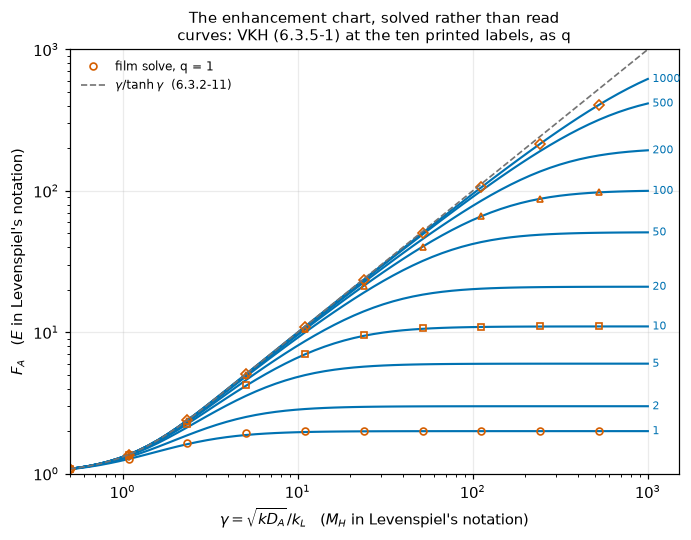
the same printed label, the two books' plateaux
  label  Froment 1+q  Levenspiel E_i    ratio
      1            2               1   2.0000
      2            3               2   1.5000
      5            6               5   1.2000
     10           11              10   1.1000
     20           21              20   1.0500
     50           51              50   1.0200
    100          101             100   1.0100
    200          201             200   1.0050
    500          501             500   1.0020
   1000         1001            1000   1.0010

worst at the smallest label: 2x   (100 %); least at the largest: 1.0010
the same abscissa is drawn over different ranges: Froment 0.5 to 1000, Levenspiel 0.1 to 1000
(this page searches Froment's, the narrower one)
computed VKH curves reach 1 + q at gamma = 1e6 to 1.00e-06 relative
2. Where the approximation is worst, root-found
The error \(\varepsilon(\gamma, q) = F_A^{\mathrm{VKH}}/F_A^{\mathrm{film}} - 1\) is a smooth surface with one interior extremum. It is located by root-finding \(\partial\varepsilon/\partial\ln\gamma = 0\) at fixed \(q\), and then \(\mathrm{d}\varepsilon^\*/\mathrm{d}\ln q = 0\) over \(q\) - not by taking the largest value on a sweep. The difference is not cosmetic: the same search with the root-finds disabled is one of the rows in the break table below.
def err_pct(g, q, film=None, vkh=None, **kw):
    """100 (F_VKH/F_film - 1) at one point of the chart."""
    film = REF if film is None else film
    vkh = f_a_vkh if vkh is None else vkh
    F, _ = film.f_a(g, q, **kw)
    return 100.0 * (vkh(g, q) - F) / F


def block_worst(film=None, vkh=None, rootfind=True, n_scan=13, labels=None, **kw):
    """The worst point of the chart, and the depletion diagnostics there."""
    film = REF if film is None else film
    labels = LABELS if labels is None else labels

    def eps(g, q):
        return err_pct(g, q, film=film, vkh=vkh, **kw)

    def worst_at(q):
        return argext_log(lambda g: eps(g, q), G_LO, G_HI, n_scan,
                          rootfind=rootfind)[1]

    q_star, _, ok_q = argext_log(worst_at, Q_LO, Q_HI, 9, rootfind=rootfind)
    g_star, e_star, ok_g = argext_log(lambda g: eps(g, q_star), G_LO, G_HI,
                                      n_scan, rootfind=rootfind)
    out = {"vkh_worst_rel_error_pct": e_star,
           "vkh_worst_gamma": g_star,
           "vkh_worst_q": q_star,
           "froment_10pct_claim_margin":
               printed("froment_vkh_validity_pct") / abs(e_star),
           "beta_interface_at_worst": film.f_a(g_star, q_star, **kw)[1],
           # the p. 340 wording of the same assumption, measured where the
           # p. 335 wording is most badly violated
           "beta_constancy_at_worst": film.beta_constancy(g_star, q_star, **kw),
           "vkh_worst_on_printed_labels_pct":
               float(max((argext_log(lambda g: eps(g, float(L)), G_LO, G_HI,
                                     n_scan, rootfind=rootfind)[1]
                          for L in labels), key=abs)),
           "_root_found": bool(ok_q and ok_g)}

    def beta_at(g):
        return film.f_a(g, q_star, **kw)[1]

    g_half = root_or_edge(lambda g: beta_at(g) - 0.5, G_LO, G_HI)
    g_99 = root_or_edge(lambda g: beta_at(g) - 0.01, G_LO, G_HI)
    out.update({"gamma_at_half_depletion": g_half,
                "gamma_at_99pct_depletion": g_99,
                "vkh_error_at_half_depletion_pct": eps(g_half, q_star),
                "vkh_error_at_99pct_depletion_pct": eps(g_99, q_star),
                "vkh_error_at_full_depletion_pct": eps(G_HI, q_star),
                "beta_constancy_at_99pct_depletion":
                    film.beta_constancy(g_99, q_star, **kw),
                "_beta_constancy_at_half": film.beta_constancy(g_half, q_star, **kw),
                "_beta_at_full_depletion": beta_at(G_HI)})
    return out


W = block_worst()
G_STAR, Q_STAR = W["vkh_worst_gamma"], W["vkh_worst_q"]
print(f"worst error on the chart: {W['vkh_worst_rel_error_pct']:+.4f} %"
      f"  at gamma = {G_STAR:.4f}, q = {Q_STAR:.4f}"
      f"  (E_i = 1 + q = {1 + Q_STAR:.4f})")
print(f"  found by root-finding, not by sampling: {W['_root_found']}")
print(f"  worst over the ten PRINTED curve labels only:"
      f" {W['vkh_worst_on_printed_labels_pct']:+.4f} %")
print(f"  the book's printed claim is {printed('froment_vkh_validity_pct'):g} percent;"
      f" margin {W['froment_10pct_claim_margin']:.4f}x")
print(f"\nVKH is an UNDER-estimate everywhere it was evaluated:"
      f" sign of the worst error {np.sign(W['vkh_worst_rel_error_pct']):+.0f}")
for q in (0.05, 0.1, 0.5, Q_STAR, 5.0, 50.0, 500.0):
    e = argext_log(lambda g: err_pct(g, q), G_LO, G_HI, 13)[1]
    print(f"   q = {q:8.4f}   worst over gamma {e:+8.4f} %")
worst error on the chart: -2.7955 % at gamma = 4.7279, q = 1.5217 (E_i = 1 + q = 2.5217)
found by root-finding, not by sampling: True
worst over the ten PRINTED curve labels only: -2.7294 %
the book's printed claim is 10 percent; margin 3.5772x
VKH is an UNDER-estimate everywhere it was evaluated: sign of the worst error -1
q = 0.0500 worst over gamma -0.3134 %
q = 0.1000 worst over gamma -0.5928 %
q = 0.5000 worst over gamma -1.9984 %
q = 1.5217 worst over gamma -2.7955 %
q = 5.0000 worst over gamma -1.8067 %
q = 50.0000 worst over gamma -0.2769 %
q = 500.0000 worst over gamma -0.0282 %3. The assumption, measured - in both of the book’s wordings
The book states the assumption twice, and the two statements are not the same test. Book p. 335, beside the chart, says the intermediate curves “were calculated by Van Krevelen and Hoftijzer [1948] under the assumption that B is only weakly depleted near the interface” - and adds, in the same breath, “For moderately fast reactions, this assumption was reasonably confirmed by more rigorous computations.” Book p. 340, five lines above (6.3.5-1) itself, says they proceeded “by assuming that the concentration of B remains approximately constant close to the interface”.
The first wording is about the level of depletion at the interface, which \(\beta(0)\) measures exactly. The second is about the constancy of \(\beta\) over the zone where the reaction happens, which \(\beta(0)\) does not measure at all: it is measured here by the rate-weighted mean \(\bar\beta = \int \alpha\beta\cdot\beta\,\mathrm{d}\xi \big/ \int \alpha\beta\,\mathrm{d}\xi\) divided by \(\beta(0)\), which is 1 when \(\beta\) is constant where it matters. Both are printed below, so the finding does not depend on which wording is tested.
Neither survives as an explanation of the error. At the worst point \(B\) at the interface is already down to a sixth of its bulk value and \(\bar\beta\) is twice \(\beta(0)\) - neither wording is nearly satisfied there - and yet as \(\gamma\) grows further, with \(B\) consumed completely and \(\bar\beta/\beta(0)\) running away without bound, the approximation becomes exact. The error vanishes at both ends and peaks in between, and the two assumption measures are monotone in \(\gamma\), so no monotone function of either can order it.
The reason is visible in the profiles: at large \(\gamma\) the reaction collapses onto a plane and \(F_A \to 1 + q\), a limit the approximation reproduces by construction whatever it assumed on the way there. Note also what the page is not saying: Froment’s own claim on p. 335 is qualified to moderately fast reactions, and the worst point found above sits inside that band - between his printed \(\gamma > 3\) line and the instantaneous ones - and still errs by less than the 10 percent he prints. Measured, his qualified sentence stands. What fails is the unqualified reading of it, that weak depletion is why the approximation works.
# the two wordings, printed from the CSV rather than retyped here
for k in ("froment_assumption_p335", "froment_assumption_p340"):
    print(f'book p.{PRN.loc[k, "book_page"]}  "{quoted(k)}"\n')
assert "weakly depleted" in quoted("froment_assumption_p335")
assert "reasonably confirmed" in quoted("froment_assumption_p335")
assert "remains approximately constant" in quoted("froment_assumption_p340")

print(f"at q = {Q_STAR:.4f}, the worst curve of the whole chart:")
print(f'{"":26s}{"gamma":>10}{"beta(0)":>12}{"beta_w/beta(0)":>16}'
      f'{"F_A film":>12}{"VKH error":>12}')
rows = [("B half gone", W["gamma_at_half_depletion"], 0.5,
         W["_beta_constancy_at_half"], W["vkh_error_at_half_depletion_pct"]),
        ("the worst point", G_STAR, W["beta_interface_at_worst"],
         W["beta_constancy_at_worst"], W["vkh_worst_rel_error_pct"]),
        ("B 99 % gone", W["gamma_at_99pct_depletion"], 0.01,
         W["beta_constancy_at_99pct_depletion"],
         W["vkh_error_at_99pct_depletion_pct"]),
        ("B gone (axis end)", G_HI, W["_beta_at_full_depletion"],
         None, W["vkh_error_at_full_depletion_pct"])]
for name, g, b, c, e in rows:
    print(f"  {name:24s}{g:10.4f}{b:12.4e}"
          f"{('-' if c is None else f'{c:.4g}'):>16}"
          f"{REF.f_a(g, Q_STAR)[0]:12.5f}{e:+11.5f} %")
print(f"\n  p.335's test, beta(0), falls monotonically;  p.340's test,"
      f" beta_w/beta(0), rises monotonically;")
print(f"  the error does NEITHER - it peaks at gamma = {G_STAR:.4f} and vanishes"
      f" at both ends of the range.")
print(f"  beta(0) at the axis end is numerically zero: the solve returns"
      f" {W['_beta_at_full_depletion']:.1e}, whose")
print(f"  magnitude is far below anything this discretisation resolves and whose"
      f" sign is round-off, so the")
print(f"  page states the order and not a bound with digits - and the constancy"
      f" ratio, which divides by")
print(f"  it, is left out of that row rather than printed as a number.")
G_MID = 100.0
B_MID = REF.f_a(G_MID, Q_STAR)[1]
C_MID = REF.beta_constancy(G_MID, Q_STAR)
E_MID = err_pct(G_MID, Q_STAR)
print(f"\n  One decade lower, where beta(0) is still meaningful:  at gamma ="
      f" {G_MID:g}, beta(0) = {B_MID:.3e}")
print(f"  and beta_w/beta(0) = {C_MID:.4g}, so p.340's constancy assumption is out by"
      f" {np.log10(C_MID):.0f} orders of")
print(f"  magnitude - and the error there is {E_MID:+.4f} %,"
      f" {abs(W['vkh_worst_rel_error_pct'] / E_MID):.0f} times SMALLER"
      f" than at the worst point.")
# The constancy ratio is EXTRAPOLATED like everything else, and it has to be:
# a ratio of two integrals of the same profile does NOT cancel the grid once
# beta is a thin exponential.  Both gaps are measured here, not asserted.
C_FINE_STAR = FILM.beta_constancy(G_STAR, Q_STAR)
C_FINE_MID = FILM.beta_constancy(G_MID, Q_STAR)
print(f"\n  the constancy ratio is Richardson-extrapolated on the same two grids"
      f" as F_A, and needs to be:")
print(f"    at the worst point the fine n_x = {FILM.n_x} grid alone gives"
      f" {C_FINE_STAR:.6g} against {W['beta_constancy_at_worst']:.6g}"
      f"   ({abs(C_FINE_STAR / W['beta_constancy_at_worst'] - 1):.1e})")
print(f"    at gamma = {G_MID:g} it gives"
      f" {C_FINE_MID:.6g} against {C_MID:.6g}"
      f"   ({abs(C_FINE_MID / C_MID - 1):.1e})")
print(f"  so the grid all but cancels where the headline lives and does NOT at the"
      f" top of the range: the")
print(f"  one-grid shortcut on this diagnostic would cost"
      f" {abs(C_FINE_MID / C_MID - 1) / abs(C_FINE_STAR / W['beta_constancy_at_worst'] - 1):.0f}"
      f" times more at gamma = {G_MID:g}")
print(f"  than at the point it would be justified on, which is why it is not taken.")
print(f"\nthe two depletion thresholds are ROOT-FOUND on beta(0), not sampled:"
      f"\n  beta(0) = 0.5  at gamma = {W['gamma_at_half_depletion']:.6f}"
      f"   (residual {REF.f_a(W['gamma_at_half_depletion'], Q_STAR)[1] - 0.5:+.2e})"
      f"\n  beta(0) = 0.01 at gamma = {W['gamma_at_99pct_depletion']:.6f}"
      f"   (residual {REF.f_a(W['gamma_at_99pct_depletion'], Q_STAR)[1] - 0.01:+.2e})")

# ---- the error map, and the depletion contours on top of it ----------------
GG = np.geomspace(G_LO, G_HI, 34)
QQ = np.geomspace(Q_LO, Q_HI, 18)
EPS = np.zeros((QQ.size, GG.size))
BET = np.zeros_like(EPS)
for i, q in enumerate(QQ):
    for j, g in enumerate(GG):
        F, b = FILM.f_a(g, q)
        EPS[i, j] = 100.0 * (f_a_vkh(g, q) - F) / F
        BET[i, j] = b

EPS_MAX = float(EPS.max())
VKH_ALWAYS_UNDER = bool(EPS_MAX < 0.0)
print(f"\nover the whole {EPS.size}-point map the largest error is"
      f" {EPS_MAX:+.3e} %: VKH under-estimates everywhere it was evaluated"
      f" ({VKH_ALWAYS_UNDER})")
print("this one is a THEOREM and the map only illustrates it, so it is a check that"
      "\ncould only fail by numerical accident:  alpha'' = gamma^2 alpha beta >= 0,"
      " so alpha' rises"
      "\nfrom alpha'(0) = -F_A and beta' = (alpha' + F_A)/q >= 0, i.e. beta(xi) >="
      " beta(0) everywhere."
      "\nWrite T(F) for the pseudo-first-order enhancement with beta frozen at"
      " 1 - (F-1)/q, which is"
      "\nexactly beta(0); (6.3.5-1) says F_VKH = T(F_VKH).  The true film sees"
      " beta >= beta(0), hence"
      "\nF_film >= T(F_film); T is strictly decreasing, so F - T(F) is strictly"
      " increasing and"
      "\nF_film >= F_VKH for EVERY (gamma, q).  The map is drawn on the single"
      f" n_x = {FILM.n_x} graded"
      "\ngrid, which is enough for a sign; every NUMBER reported comes from the"
      " extrapolated reference.")
print(f"the worst point sits at gamma = {G_STAR:.4f}, on the film side of the"
      f" book's own regime line - it prints"
      f' "{quoted("froment_film_completion_gamma")}" (book p.'
      f'{PRN.loc["froment_film_completion_gamma", "book_page"]}) and'
      f' "{quoted("froment_bulk_reaction_gamma")}"')

fig, axes = plt.subplots(1, 2, figsize=(11.6, 4.4))
cf = axes[0].contourf(GG, QQ, EPS, levels=np.linspace(-3.0, 0.0, 13), cmap="viridis")
for _g, _ls in ((printed("froment_bulk_reaction_gamma"), ":"),
                (printed("froment_film_completion_gamma"), "-.")):
    if G_LO <= _g <= G_HI:
        axes[0].axvline(_g, color="w", lw=1.0, ls=_ls)
axes[0].contour(GG, QQ, BET, levels=[0.01, 0.5], colors=[C_ORANGE, C_YELLOW],
                linewidths=1.6)
axes[0].plot([G_STAR], [Q_STAR], "*", ms=13, color=C_ORANGE, mec="k", mew=0.6)
axes[0].set_xscale("log"); axes[0].set_yscale("log")
axes[0].set_xlabel(r"$\gamma$"); axes[0].set_ylabel("$q = E_i - 1$")
axes[0].set_title("VKH error [%]; orange $\\beta(0)=0.01$, yellow $\\beta(0)=0.5$,\n"
                  "star = the root-found worst point", fontsize=9)
fig.colorbar(cf, ax=axes[0])

for name, g, c in (("B half gone", W["gamma_at_half_depletion"], C_YELLOW),
                   ("worst point", G_STAR, C_ORANGE),
                   ("B 99 % gone", W["gamma_at_99pct_depletion"], C_BLUE)):
    u = FILM.solve(g, Q_STAR)
    axes[1].plot(FILM.x_c, u[:, 0], color=c, lw=2.0,
                 label=rf"$\alpha$, {name} ($\gamma$ = {g:.2f})")
    axes[1].plot(FILM.x_c, u[:, 1], color=c, lw=1.4, ls="--")
axes[1].set_xlim(0, 0.6)
axes[1].set_xlabel(r"$\xi = y/y_L$")
axes[1].set_ylabel("dimensionless concentration")
axes[1].set_title(f"profiles at q = {Q_STAR:.4f}\n"
                  r"solid $\alpha$ (gas $A$), dashed $\beta$ (reactant $B$)",
                  fontsize=9)
axes[1].legend(frameon=False, fontsize=7.5)
fig.tight_layout()
plt.show()
book p.335 "They were calculated by Van Krevelen and Hoftijzer [1948] under the assumption that B is only weakly depleted near the interface. For moderately fast reactions, this assumption was reasonably confirmed by more rigorous computations."
book p.340 "Van Krevelen and Hoftijzer [1948] dealt with this situation in a way analogous to that applied to pseudo-first-order kinetics, namely, by assuming that the concentration of B remains approximately constant close to the interface."
at q = 1.5217, the worst curve of the whole chart:
gamma beta(0) beta_w/beta(0) F_A film VKH error
B half gone 2.2036 5.0000e-01 1.208 1.76086 -1.83044 %
the worst point 4.7279 1.6474e-01 2.115 2.27104 -2.79546 %
B 99 % gone 13.0378 1.0000e-02 19.2 2.50651 -1.50346 %
B gone (axis end) 1000.0000 -9.2757e-58 - 2.52173 -0.00037 %
p.335's test, beta(0), falls monotonically; p.340's test, beta_w/beta(0), rises monotonically;
the error does NEITHER - it peaks at gamma = 4.7279 and vanishes at both ends of the range.
beta(0) at the axis end is numerically zero: the solve returns -9.3e-58, whose
magnitude is far below anything this discretisation resolves and whose sign is round-off, so the
page states the order and not a bound with digits - and the constancy ratio, which divides by
it, is left out of that row rather than printed as a number.
One decade lower, where beta(0) is still meaningful: at gamma = 100, beta(0) = 1.367e-11
and beta_w/beta(0) = 3.684e+09, so p.340's constancy assumption is out by 10 orders of
magnitude - and the error there is -0.0373 %, 75 times SMALLER than at the worst point.
the constancy ratio is Richardson-extrapolated on the same two grids as F_A, and needs to be:
at the worst point the fine n_x = 800 grid alone gives 2.11523 against 2.11523 (2.4e-06)
at gamma = 100 it gives 3.65698e+09 against 3.68373e+09 (7.3e-03)
so the grid all but cancels where the headline lives and does NOT at the top of the range: the
one-grid shortcut on this diagnostic would cost 3030 times more at gamma = 100
than at the point it would be justified on, which is why it is not taken.
the two depletion thresholds are ROOT-FOUND on beta(0), not sampled:
beta(0) = 0.5 at gamma = 2.203565 (residual +2.83e-11)
beta(0) = 0.01 at gamma = 13.037820 (residual -1.76e-13)
over the whole 612-point map the largest error is -2.780e-06 %: VKH under-estimates everywhere it was evaluated (True)
this one is a THEOREM and the map only illustrates it, so it is a check that
could only fail by numerical accident: alpha'' = gamma^2 alpha beta >= 0, so alpha' rises
from alpha'(0) = -F_A and beta' = (alpha' + F_A)/q >= 0, i.e. beta(xi) >= beta(0) everywhere.
Write T(F) for the pseudo-first-order enhancement with beta frozen at 1 - (F-1)/q, which is
exactly beta(0); (6.3.5-1) says F_VKH = T(F_VKH). The true film sees beta >= beta(0), hence
F_film >= T(F_film); T is strictly decreasing, so F - T(F) is strictly increasing and
F_film >= F_VKH for EVERY (gamma, q). The map is drawn on the single n_x = 800 graded
grid, which is enough for a sign; every NUMBER reported comes from the extrapolated reference.
the worst point sits at gamma = 4.7279, on the film side of the book's own regime line - it prints "The reaction is essentially completed in the film when gamma > 3" (book p.331) and "whereas it takes place mainly in the bulk when gamma < 0.3"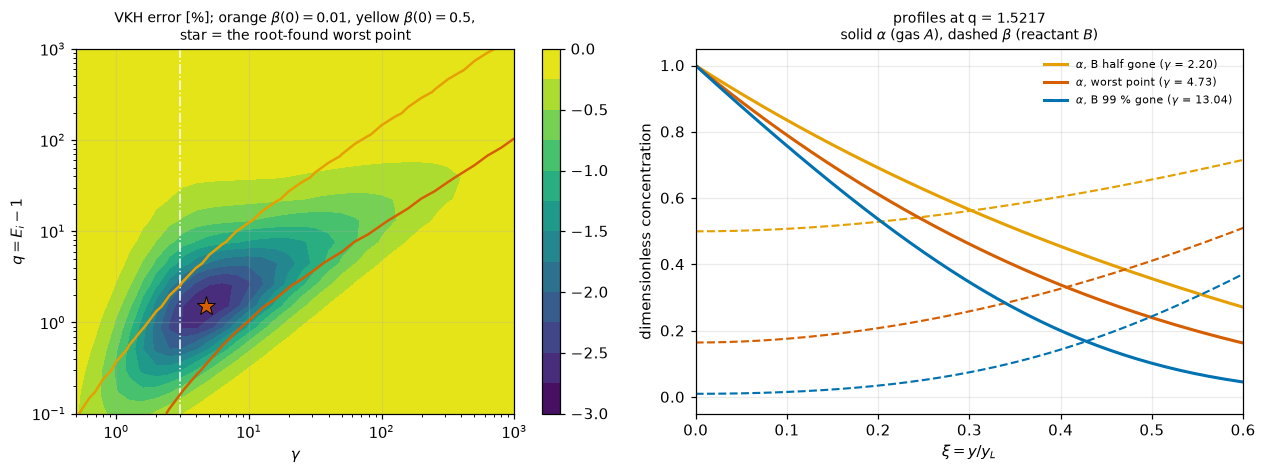
4. Levenspiel’s three expansions, and what each one expands
Levenspiel prints three “more precisely” corrections in the annotation boxes of Fig. 23.4. They are an independent transcription of the same result by a different author in a different notation, so every constant in them checks a constant in Froment’s equation - and the two of them that can be checked against the film equations as well turn out to behave very differently.
- Small \(M_H\): \(E \cong 1 + M_H^2/3\). This is the Taylor series of \(\gamma/\tanh\gamma\), so the constant 3 checks Froment’s (6.3.2-11) directly. It is good to 1 % up to a root-found \(M_H\) reported below.
- Pseudo-first-order branch, declared for \(E_i > 5M_H\): \(E = M_H\left(1 - (M_H-1)/2E_i\right)\). Expanding Froment’s (6.3.5-1) in the same limit gives the same expression with \(E_i - 1\) where Levenspiel prints \(E_i\) - the difference between the two books’ groups, second order in that branch. Both are evaluated against the film solve at the boundary of the declared domain.
- Instantaneous branch, declared for \(E_i < M_H/5\): \(E \cong E_i - E_i^2(E_i-1)/M_H^2\). This one is the asymptote of the approximation, not of the equations, and both halves of that statement are exact rather than empirical. Put \(F_A = 1 + q - d\) into (6.3.5-1): for large \(\gamma\) it gives \(\gamma\sqrt{d/q} \to 1 + q\), i.e. \(d \to q(1+q)^2/\gamma^2\), which in Levenspiel’s symbols is \(E_i^2(E_i-1)/M_H^2\). The film’s own deficit, on the other hand, is fixed by the first integral of the two film equations, \(q\,\beta(0) = 1 + q - F_A\): it equals \(q\,\beta(0)\) identically, and \(\beta(0)\) is the interfacial value of a reaction layer whose thickness goes as \(1/\gamma\), so it is exponentially small and can follow no power law at all. The measured local exponent steepens over successive octaves, and the printed correction runs further and further above the truth.
DEFICIT_M = (50.0, 100.0, 200.0, 400.0, 800.0)


def block_lev(film=None, vkh=None, small_coeff=None, pfo_denom=None,
              pfo_offset=None, inst_power=None, deficit_film=None,
              bvp_tol=1e-10, **kw):
    """Levenspiel's three printed expansions, tested against both routes."""
    film = REF if film is None else film
    vkh = f_a_vkh if vkh is None else vkh
    c3 = printed("lev_small_M_coeff") if small_coeff is None else small_coeff
    c2 = printed("lev_pfo_correction_denom") if pfo_denom is None else pfo_denom
    c1 = printed("lev_pfo_correction_offset") if pfo_offset is None else pfo_offset
    cp = printed("lev_inst_correction_power") if inst_power is None else inst_power
    out = {}

    # (a) the small-M_H expansion, 1 % threshold ROOT-FOUND
    q_a = 4.0
    out["lev_small_M_1pct_threshold"] = root_log(
        lambda m: abs((1.0 + m**2 / c3) / film.f_a(m, q_a, **kw)[0] - 1) - 0.01,
        0.1, 3.0)

    # (b) the pseudo-first-order branch, AT the boundary E_i = 5 M_H it declares
    m_b = 10.0
    Ei_b = printed("lev_pfo_threshold") * m_b
    q_b = Ei_b - 1.0
    F_b = film.f_a(m_b, q_b, **kw)[0]
    out["lev_pfo_expansion_err_pct"] = 100.0 * (
        m_b * (1.0 - (m_b - c1) / (c2 * Ei_b)) / F_b - 1.0)
    out["vkh_form_pfo_expansion_err_pct"] = 100.0 * (
        m_b * (1.0 - (m_b - c1) / (c2 * q_b)) / F_b - 1.0)
    out["uncorrected_E_eq_M_err_pct"] = 100.0 * (m_b / F_b - 1.0)

    # (c) the instantaneous branch
    Ei_c = 20.0
    q_c = Ei_c - 1.0
    fd = film if deficit_film is None else deficit_film

    def pred(m):
        return Ei_c**cp * (Ei_c - 1.0) / m**2

    def dnum(m):
        return Ei_c - fd.f_a(m, q_c, **kw)[0]

    out["lev_inst_asymptote_ratio_vkh"] = (Ei_c - vkh(400.0, q_c)) / pred(400.0)
    out["lev_inst_asymptote_ratio_num"] = dnum(400.0) / pred(400.0)
    out["lev_inst_overstatement_factor"] = pred(800.0) / dnum(800.0)
    dn = [dnum(m) for m in DEFICIT_M]
    dv = [Ei_c - vkh(m, q_c) for m in DEFICIT_M]
    # abs() only so that a break row which drives a deficit negative still
    # returns a number instead of a nan; every baseline deficit is positive.
    ex = [float(np.log(abs(a[i + 1] / a[i]))
                / np.log(DEFICIT_M[i + 1] / DEFICIT_M[i]))
          for a in (dn, dv) for i in range(len(DEFICIT_M) - 1)]
    n_gap = len(DEFICIT_M) - 1
    out["inst_deficit_exponent_num_steepest"] = min(ex[:n_gap])
    out["inst_deficit_exponent_vkh_finest"] = ex[2 * n_gap - 1]
    out["_exponents_num"], out["_exponents_vkh"] = ex[:n_gap], ex[n_gap:]
    out["_deficit_num"], out["_deficit_vkh"] = dn, dv
    # TWO INDEPENDENT METHODS, one of them also refined - not three routes.
    # pymrm finite volumes and scipy's collocation share no assembly; the
    # middle entry is the same assembly on a finer, differently graded mesh, so
    # it prices the discretisation of the first and not its formulation.
    alt = graded_film(2 * fd.n_x, fd.stretch + 1.0)
    three = [dnum(800.0), Ei_c - alt.f_a(800.0, q_c, **kw)[0],
             Ei_c - f_a_bvp(800.0, q_c, tol=bvp_tol)[0]]
    out["inst_deficit_routes_max_rel_diff"] = max(three) / min(three) - 1.0
    out["_three"] = three
    # the EXACT reason the film deficit has no power law: the first integral of
    # the two film equations makes it q*beta(0) identically, and beta(0) at the
    # interface is exponentially small in gamma.
    out["_beta0_at_deficit"] = fd.f_a(800.0, q_c, **kw)[1]
    return out


L = block_lev()
print(f"(a) 1 + M_H^2/{printed('lev_small_M_coeff'):g} stays within 1 % of the film"
      f" solve up to M_H = {L['lev_small_M_1pct_threshold']:.4f}  (root-found)")
_m, _Ei = 10.0, printed("lev_pfo_threshold") * 10.0
print(f"\n(b) at the declared boundary E_i = {printed('lev_pfo_threshold'):g} M_H,"
      f" with M_H = {_m:g} and E_i = {_Ei:g}:")
print(f"      E = M_H                              {L['uncorrected_E_eq_M_err_pct']:+8.4f} %")
print(f"      Levenspiel, printed 2 E_i            {L['lev_pfo_expansion_err_pct']:+8.4f} %")
print(f"      same expansion of (6.3.5-1), 2(E_i-1){L['vkh_form_pfo_expansion_err_pct']:+8.4f} %")
print(f"    -> the correction is worth"
      f" {abs(L['uncorrected_E_eq_M_err_pct'] / L['lev_pfo_expansion_err_pct']):.2f}x,"
      f" and the two books' groups differ by"
      f" {abs(L['lev_pfo_expansion_err_pct'] - L['vkh_form_pfo_expansion_err_pct']):.4f}"
      f" percentage points there")
print(f"\n(c) instantaneous branch, E_i = 20:  deficit E_i - E against the printed"
      f" E_i^2(E_i-1)/M_H^2")
print(f'{"M_H":>8}{"film solve":>14}{"VKH":>14}{"printed":>14}{"printed/film":>14}')
for m, dn, dv in zip(DEFICIT_M, L["_deficit_num"], L["_deficit_vkh"]):
    p = 20.0**2 * 19.0 / m**2
    print(f"{m:8.0f}{dn:14.4e}{dv:14.4e}{p:14.4e}{p / dn:14.2f}")
print(f"  local exponent d ln(deficit)/d ln M_H, octave by octave")
print(f"    film solve : {[round(e, 4) for e in L['_exponents_num']]}")
print(f"    VKH        : {[round(e, 4) for e in L['_exponents_vkh']]}")
print(f"  the VKH deficit converges on the printed -2; the film solve's does not"
      f"\n  the M_H = 800 deficit by TWO INDEPENDENT METHODS, the first also refined:"
      f"\n    pymrm FV, extrapolated (n_x = {FILM_C.n_x}, {FILM.n_x}, s = 8)"
      f"  {L['_three'][0]:.3e}"
      f"\n    pymrm FV, n_x = {2 * FILM.n_x}, s = 9 (the same assembly, refined)  "
      f"{L['_three'][1]:.3e}"
      f"\n    scipy collocation (no assembly in common)               "
      f"{L['_three'][2]:.3e}"
      f"\n  max relative spread below 1e-3 (here"
      f" {L['inst_deficit_routes_max_rel_diff']:.1e}; the M_H = 800 deficit, E_i - F_A,"
      f"\n  is about 1.3e-5 of F_A, so its last digits differ between BLAS"
      f" kernels) - far below the\n  {L['lev_inst_overstatement_factor']:.1f}x it is"
      f" being used to establish")
print(f"\n  WHY there can be no power law, exactly.  Subtracting the two film"
      f" equations gives"
      f"\n  (beta - alpha/q)'' = 0, and the four boundary conditions close it:"
      f" q beta(0) = 1 + q - F_A"
      f"\n  identically, so the film deficit E_i - E IS q beta(0) - and beta(0) is"
      f" the interfacial"
      f"\n  value of a WKB-thin reaction layer, exponentially small in M_H."
      f"  At M_H = 800 the film"
      f"\n  solve gives beta(0) = {L['_beta0_at_deficit']:.4e}, so"
      f" q beta(0) = {19.0 * L['_beta0_at_deficit']:.4e} against the deficit"
      f" {L['_three'][0]:.4e}.")
print(f"  The VKH deficit, by contrast, is a power law exactly: putting"
      f" F_A = 1 + q - d in (6.3.5-1)"
      f"\n  gives gamma sqrt(d/q) -> 1 + q, i.e. d -> q(1+q)^2/gamma^2, which in"
      f" Levenspiel's symbols"
      f"\n  IS E_i^2(E_i - 1)/M_H^2.  His 'more precisely' correction is the"
      f" ALGEBRAIC ASYMPTOTE OF THE"
      f"\n  APPROXIMATION, not of the equations - which is why it tracks VKH to"
      f" {L['lev_inst_asymptote_ratio_vkh']:.4f} and the film"
      f"\n  solve to only {L['lev_inst_asymptote_ratio_num']:.4f}.")
print(f"  And 44x too big is 44x of a small correction: at M_H = 800 the"
      f" uncorrected E = E_i is already"
      f"\n  within {100 * L['_three'][0] / 20.0:.5f} % of the film solve, so"
      f" Levenspiel's correction is there WORSE than"
      f"\n  leaving it out - it moves E away from the truth by"
      f" {100 * (20.0**2 * 19.0 / 800.0**2 - L['_three'][0]) / 20.0:.5f} percentage"
      f" points.")

fig, ax = plt.subplots(figsize=(6.0, 4.2))
MM = np.geomspace(30.0, 1000.0, 30)
ax.loglog(MM, [20.0 - f_a_vkh(m, 19.0) for m in MM], color=C_BLUE, lw=2.0,
          label="VKH (6.3.5-1)")
ax.loglog(MM, [20.0 - REF.f_a(m, 19.0)[0] for m in MM], color=C_ORANGE, lw=2.0,
          label="film solve (pymrm)")
ax.loglog(MM, 20.0**2 * 19.0 / MM**2, color=C_GREY, ls="--", lw=1.4,
          label=r"printed $E_i^2(E_i-1)/M_H^2$")
ax.set_xlabel("$M_H$"); ax.set_ylabel("$E_i - E$")
ax.set_title("What Levenspiel's instantaneous correction expands\n"
             "($E_i$ = 20; the printed curve tracks the approximation)",
             fontsize=9.5)
ax.legend(frameon=False, fontsize=8)
fig.tight_layout()
plt.show()
(a) 1 + M_H^2/3 stays within 1 % of the film solve up to M_H = 0.7231 (root-found)
(b) at the declared boundary E_i = 5 M_H, with M_H = 10 and E_i = 50:
E = M_H +9.3004 %
Levenspiel, printed 2 E_i -0.5366 %
same expansion of (6.3.5-1), 2(E_i-1) -0.7374 %
-> the correction is worth 17.33x, and the two books' groups differ by 0.2008 percentage points there
(c) instantaneous branch, E_i = 20: deficit E_i - E against the printed E_i^2(E_i-1)/M_H^2
M_H film solve VKH printed printed/film
50 2.2491e+00 2.3639e+00 3.0400e+00 1.35
100 5.9591e-01 7.0720e-01 7.6000e-01 1.28
200 1.0985e-01 1.8647e-01 1.9000e-01 1.73
400 1.0860e-02 4.7276e-02 4.7500e-02 4.37
800 2.6840e-04 1.1861e-02 1.1875e-02 44.24
local exponent d ln(deficit)/d ln M_H, octave by octave
film solve : [-1.9162, -2.4396, -3.3385, -5.3385]
VKH : [-1.7409, -1.9232, -1.9798, -1.9949]
the VKH deficit converges on the printed -2; the film solve's does not
the M_H = 800 deficit by TWO INDEPENDENT METHODS, the first also refined:
pymrm FV, extrapolated (n_x = 400, 800, s = 8) 2.684e-04
pymrm FV, n_x = 1600, s = 9 (the same assembly, refined) 2.684e-04
scipy collocation (no assembly in common) 2.684e-04
max relative spread below 1e-3 (here 8.6e-05; the M_H = 800 deficit, E_i - F_A,
is about 1.3e-5 of F_A, so its last digits differ between BLAS kernels) - far below the
44.2x it is being used to establish
WHY there can be no power law, exactly. Subtracting the two film equations gives
(beta - alpha/q)'' = 0, and the four boundary conditions close it: q beta(0) = 1 + q - F_A
identically, so the film deficit E_i - E IS q beta(0) - and beta(0) is the interfacial
value of a WKB-thin reaction layer, exponentially small in M_H. At M_H = 800 the film
solve gives beta(0) = 1.4126e-05, so q beta(0) = 2.6840e-04 against the deficit 2.6840e-04.
The VKH deficit, by contrast, is a power law exactly: putting F_A = 1 + q - d in (6.3.5-1)
gives gamma sqrt(d/q) -> 1 + q, i.e. d -> q(1+q)^2/gamma^2, which in Levenspiel's symbols
IS E_i^2(E_i - 1)/M_H^2. His 'more precisely' correction is the ALGEBRAIC ASYMPTOTE OF THE
APPROXIMATION, not of the equations - which is why it tracks VKH to 0.9953 and the film
solve to only 0.2286.
And 44x too big is 44x of a small correction: at M_H = 800 the uncorrected E = E_i is already
within 0.00134 % of the film solve, so Levenspiel's correction is there WORSE than
leaving it out - it moves E away from the truth by 0.05803 percentage points.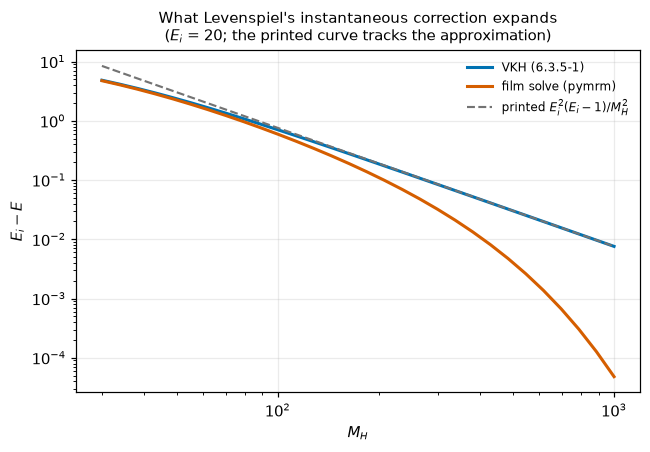
Validation
Six checks, none of which uses fitted data because there is none. Two of them are about the baseline itself, because the whole page is a set of errors quoted against it: the extrapolated reference is compared with an independent solver family and with a finer extrapolation of itself, and the grid study is run on the graded and the uniform grid so that what grading buys and what it costs are both on the page.
def block_routes(film=None, ref=None, vkh=None, stretch=None, newton_tol=1e-10,
                 bvp_tol=1e-10, bc_beta_bulk="dirichlet", n_grid=(100, 200, 400, 800),
                 **kw):
    """Two solvers for the film, two for the implicit relation, and the grid."""
    film = FILM if film is None else film
    ref = REF if ref is None else ref
    vkh = f_a_vkh if vkh is None else vkh
    s = film.stretch if stretch is None else stretch
    pts = [(g, q) for q in (1.0, 4.0, 19.0, 99.0)
           for g in (1.0, 3.0, 10.0, 30.0, 100.0)]
    col = {p: f_a_bvp(*p, tol=bvp_tol) for p in pts}
    out = {
        "fv_vs_bvp_max_rel_diff": float(max(
            abs(film.f_a(g, q, tol=newton_tol, **kw)[0] / col[(g, q)][0] - 1.0)
            for g, q in pts)),
        "fv_vs_bvp_max_abs_diff_beta": float(max(
            abs(film.f_a(g, q, tol=newton_tol, **kw)[1] - col[(g, q)][1])
            for g, q in pts)),
        # the SAME comparison for the baseline this page actually reports
        "ref_vs_bvp_max_rel_diff": float(max(
            abs(ref.f_a(g, q, tol=newton_tol, **kw)[0] / col[(g, q)][0] - 1.0)
            for g, q in pts)),
        # and the baseline against a finer extrapolation of itself: the
        # refinement evidence for the reference, not for one grid of it
        "ref_self_refinement_max_rel_diff": float(max(
            abs(ref.f_a(g, q, tol=newton_tol, **kw)[0]
                / REF_FINE.f_a(g, q, tol=newton_tol, **kw)[0] - 1.0)
            for g, q in pts)),
        # the first integral of the two film equations, which no discretisation
        # is told about: q beta(0) = 1 + q - F_A.  Normalised by 1 + q because
        # at large gamma both sides are round-off.
        "first_integral_max_abs_resid": float(max(
            abs(q * ref.f_a(g, q, tol=newton_tol, **kw)[1]
                - (1.0 + q - ref.f_a(g, q, tol=newton_tol, **kw)[0])) / (1.0 + q)
            for g, q in pts)),
        "vkh_two_routes_max_rel_diff": float(max(
            abs(vkh(g, q) / f_a_vkh_route_b(g, q) - 1.0) for g, q in pts)),
        "vkh_pfo_limit_max_rel_error": float(max(
            abs(vkh(g, 1e10) / (g / np.tanh(g)) - 1.0)
            for g in np.geomspace(G_LO, 300.0, 40))),
        "vkh_instantaneous_limit_rel_error": float(abs(vkh(1e6, 19.0) / 20.0 - 1.0)),
    }
    g_ref, q_ref = 10.0, 4.0
    exact = f_a_bvp(g_ref, q_ref, tol=1e-11)[0]

    def errs_on(st):
        return [abs(Film(n_x=n, stretch=st, bc_beta_bulk=bc_beta_bulk)
                    .f_a(g_ref, q_ref, tol=newton_tol, **kw)[0] / exact - 1.0)
                for n in n_grid]

    errs, errs_u = errs_on(s), errs_on(0.0)
    out["fv_convergence_order"] = float(np.log2(errs[-2] / errs[-1]))
    out["fv_rel_error_n800"] = float(errs[-1])
    # WHAT GRADING COSTS, at the same n and against the same reference
    out["fv_rel_error_n800_uniform"] = float(errs_u[-1])
    out["_grid_errs"], out["_grid_errs_uniform"] = errs, errs_u
    return out


R = block_routes()
print("1. the film, two solver families, over 20 points of the chart")
print(f"   max |pymrm n_x = {FILM.n_x} / collocation - 1| on F_A :"
      f" {R['fv_vs_bvp_max_rel_diff']:.3e}")
print(f"   max |difference| on beta(0)                : "
      f"{R['fv_vs_bvp_max_abs_diff_beta']:.3e}")
print(f"\n2. THE BASELINE ITSELF - Richardson(n_x = {FILM_C.n_x}, {FILM.n_x}),"
      f" which is what every")
print(f"   number on this page is quoted against")
print(f"   max |reference / collocation - 1|          : "
      f"{R['ref_vs_bvp_max_rel_diff']:.3e}")
print(f"   max |reference / a finer extrapolation - 1|: "
      f"{R['ref_self_refinement_max_rel_diff']:.3e}"
      f"   (Richardson {FILM.n_x}, {2 * FILM.n_x})")
print(f"   -> the reference is converged {R['fv_vs_bvp_max_rel_diff'] / R['ref_vs_bvp_max_rel_diff']:.0f}x"
      f" better than the single n_x = {FILM.n_x} solve it")
print(f"      is built from, which is the whole reason it exists")
print(f"\n3. the first integral q beta(0) = 1 + q - F_A, which the discretisation"
      f" is never told")
print(f"   max |q beta(0) - (1 + q - F_A)| / (1 + q)  : "
      f"{R['first_integral_max_abs_resid']:.3e}")
print("\n4. grid refinement at (gamma, q) = (10, 4), against the collocation solve")
print(f'{"":6s}{"n_x":>7}{"graded s = 8":>16}{"uniform":>14}{"graded/uniform":>17}')
for n, e, eu in zip((100, 200, 400, 800),
                    R["_grid_errs"], R["_grid_errs_uniform"]):
    print(f'{"":6s}{n:7d}{e:16.4e}{eu:14.4e}{e / eu:17.1f}')
print(f"   observed order {R['fv_convergence_order']:.4f}   (expected 2)")
print(f"   AT THIS POINT GRADING IS A LIABILITY: at the same n_x the graded grid is"
      f"\n   {R['fv_rel_error_n800'] / R['fv_rel_error_n800_uniform']:.0f}x LESS"
      f" accurate than a uniform one, because its outer cells are"
      f"\n   {(1 - FILM.x_f[-2]) / (1.0 / FILM.n_x):.1f}x wider."
      f"  Grading earns its place at the other end of the chart"
      f"\n   (see the pseudo-first-order check below), and the extrapolated"
      f" reference is how"
      f"\n   this page has both.")
print("\n5. the implicit relation, two unknowns")
print(f"   max |solve-for-F_A / solve-for-gamma' - 1| : "
      f"{R['vkh_two_routes_max_rel_diff']:.3e}")
print("\n6. the two limits (6.3.5-1) must reproduce")
print(f"   q -> inf gives gamma/tanh gamma, max rel : "
      f"{R['vkh_pfo_limit_max_rel_error']:.3e}")
print(f"   gamma -> inf gives 1 + q, rel            : "
      f"{R['vkh_instantaneous_limit_rel_error']:.3e}")
1. the film, two solver families, over 20 points of the chart
max |pymrm n_x = 800 / collocation - 1| on F_A : 5.988e-06
max |difference| on beta(0) : 2.913e-06
2. THE BASELINE ITSELF - Richardson(n_x = 400, 800), which is what every
number on this page is quoted against
max |reference / collocation - 1| : 4.369e-08
max |reference / a finer extrapolation - 1|: 3.841e-08 (Richardson 800, 1600)
-> the reference is converged 137x better than the single n_x = 800 solve it
is built from, which is the whole reason it exists
3. the first integral q beta(0) = 1 + q - F_A, which the discretisation is never told
max |q beta(0) - (1 + q - F_A)| / (1 + q) : 6.418e-10
4. grid refinement at (gamma, q) = (10, 4), against the collocation solve
n_x graded s = 8 uniform graded/uniform
100 1.2138e-04 2.0964e-06 57.9
200 3.0344e-05 2.9753e-07 102.0
400 7.5857e-06 4.5261e-08 167.6
800 1.8964e-06 7.6251e-09 248.7
observed order 2.0000 (expected 2)
AT THIS POINT GRADING IS A LIABILITY: at the same n_x the graded grid is
249x LESS accurate than a uniform one, because its outer cells are
8.0x wider. Grading earns its place at the other end of the chart
(see the pseudo-first-order check below), and the extrapolated reference is how
this page has both.
5. the implicit relation, two unknowns
max |solve-for-F_A / solve-for-gamma' - 1| : 7.994e-15
6. the two limits (6.3.5-1) must reproduce
q -> inf gives gamma/tanh gamma, max rel : 1.495e-08
gamma -> inf gives 1 + q, rel : 3.800e-105. Reconciling with F3.1, which owns Hatta
F3.1 reports a maximum Van Krevelen-Hoftijzer error of about 2.1 %. That is a different number from this page’s headline and it should be: F3.1 sweeps three fixed \(E_i\) values on a fixed \(\mathrm{Ha}\) grid and takes the largest sampled value, while this page lets \(q\) vary continuously and root-finds the extremum. How much of the gap is root-finding and how much is letting \(q\) move is measured below rather than asserted.
The reconciliation is done by loading F3.1’s own agreement.json and recomputing its definition here, not by retyping its number. The residual that survives is then attributed by measurement rather than left to be guessed at, and it belongs to F3.1, not to this page: running the same recomputation cold on F3.1’s own grid - uniform, \(n_x = 400\) - lands on F3.1’s stored number, so the residual is that grid’s discretisation error and the warm start contributes nothing to it. That cold run is also what settles the half of the sentence a reader would otherwise have to take on trust: this is not a warm-start-versus-cold-start difference, which is the first thing F3.1’s continued sweep suggests. This page’s extrapolated reference is the accurate side of the residual, and a single graded grid, without the extrapolation, is on the wrong side of it by two orders of magnitude more.
def block_f31(film=None, vkh=None, n_scan=13, **kw):
    """F3.1's OWN definitions - its three E_i, its two Ha grids - recomputed here."""
    film = REF if film is None else film
    ha = np.geomspace(0.05, 300.0, 55)
    v = float(max(abs(err_pct(h, e - 1.0, film=film, vkh=vkh, **kw))
                  for e in (5.0, 20.0, 100.0) for h in ha))
    out = {"f31_definition_vkh_max_error_pct": v}
    # the same three E_i, but with gamma ROOT-FOUND instead of sampled: this
    # splits the gap to this page's headline into "root-finding" and "letting q
    # move", which are not the same size at all.
    out["f31_definition_rootfound_pct"] = float(max(
        abs(argext_log(lambda g: err_pct(g, e - 1.0, film=film, vkh=vkh, **kw),
                       G_LO, G_HI, n_scan)[1])
        for e in (5.0, 20.0, 100.0)))
    # F3.1's other overlapping check: the pseudo-first-order solve against
    # Ha/tanh(Ha) over ITS Ha range.  Run on THREE single grids, because the
    # 893.9x is really grading TIMES a refinement: F3.1 uses n_x = 400 uniform and this page n_x = 800 graded.
    ha1 = np.geomspace(0.02, 200.0, 70)

    def pfo(f):
        return float(max(abs(f.f_a(h, 1.0, **{**kw, "frozen_b": True})[0]
                             / (h / np.tanh(h)) - 1.0) for h in ha1))

    n_half = max(film.n_x // 2, 8)
    out["pfo_max_rel_error_graded"] = pfo(graded_film(film.n_x, film.stretch))
    out["pfo_max_rel_error_uniform_same_n"] = pfo(graded_film(film.n_x, 0.0))
    out["pfo_max_rel_error_uniform_half_n"] = pfo(graded_film(n_half, 0.0))
    out["f31_stored_vs_recomputed_rel"] = abs(v / F31["vkh_max_error_pct"] - 1.0)
    out["f31_first_order_error_ratio"] = (F31["first_order_max_rel_error"]
                                          / out["pfo_max_rel_error_graded"])
    return out


# F3.1's committed numbers, {name: value} from either agreement.json format,
# from the local checkout or else the raw URL.  They are REQUIRED: the set of
# metrics this page reports is fixed and never depends on what is reachable,
# so with no checkout and no network the page stops here rather than skipping
# the reconciliation.  They were made on another machine, so every comparison
# of a live number with one of them below is a BOUND, never an equality.
F31 = load_claims("F3.1-hatta-regimes")

F = block_f31()
# the same block on the single graded grid, without the extrapolation, so that
# shortcut's cost stays visible
F_PLAIN = block_f31(film=FILM)
# and the same block on F3.1's OWN grid - uniform, n_x = 400 - which is what
# ATTRIBUTES the residual instead of hand-waving it.  A COLD run on that grid
# reproduces F3.1's stored number, so the residual is neither the warm start
# nor this page's numerics: it is F3.1's discretisation.
FILM_F31 = graded_film(400, 0.0)
F_F31GRID = block_f31(film=FILM_F31)
print("what F3.1 states about the rows this page overlaps with, and whether it bites")
print("  * its VKH error is a max over E_i in {5, 20, 100} on 55 Ha points, warm")
print("    started along each E_i - so it is a SAMPLED max on a continued sweep.")
print("    Affects this page: the definitions differ, so the numbers must differ.")
print("  * its first-order solve matches Ha/tanh(Ha) over 0.02 <= Ha <= 200 at")
print("    n_x = 400 UNIFORM, with the error 'concentrated at high Ha where the")
print("    reaction layer is thinner than a cell'.  Affects this page directly:")
print("    it is the reason this page grades its grid AT ALL, and the same check")
print("    is run here on three grids so that grading and refinement are separated")
print("    instead of being credited to grading together.")
F31_PFO_REPRO = abs(F["pfo_max_rel_error_uniform_half_n"]
                    / F31["first_order_max_rel_error"] - 1.0)
F31_COLD_REPRO = F_F31GRID["f31_stored_vs_recomputed_rel"]
# the two reproductions of F3.1's committed numbers, as bounds: F3.1 made them
# on another machine.  Measured 6.3e-15 and 1.0e-11 on three BLAS kernels, and
# F3.1's own vkh_max_error_pct spreads 5e-12 relative across kernels; each
# limit is about 100x what is measured.
F31_PFO_REPRO_MAX, F31_COLD_REPRO_MAX = 1e-12, 1e-9
print(f"\n  F3.1 agreement.json  first_order_max_rel_error ="
      f" {F31['first_order_max_rel_error']:.4e}  (uniform, n_x = 400)")
print(f"  the SAME check run here on a uniform n_x = {max(FILM.n_x // 2, 8)} grid ="
      f" {F['pfo_max_rel_error_uniform_half_n']:.4e}"
      f"  -> F3.1 reproduced to below {F31_PFO_REPRO_MAX:g}"
      f" (here {F31_PFO_REPRO:.1e})")
print(f"  DECOMPOSING THE 893.9x, WHICH IS NOT ALL GRADING:")
print(f"    uniform n_x = {max(FILM.n_x // 2, 8)} -> uniform n_x = {FILM.n_x}"
      f"   (refinement, no grading) "
      f" {F['pfo_max_rel_error_uniform_half_n'] / F['pfo_max_rel_error_uniform_same_n']:8.2f}x")
print(f"    uniform n_x = {FILM.n_x} -> graded n_x = {FILM.n_x}"
      f"     (grading, same n_x)   "
      f" {F['pfo_max_rel_error_uniform_same_n'] / F['pfo_max_rel_error_graded']:8.2f}x")
print(f"    product                                              "
      f" {F['f31_first_order_error_ratio']:8.1f}x")
print(f"  SO GRADING IS WORTH"
      f" {F['pfo_max_rel_error_uniform_same_n'] / F['pfo_max_rel_error_graded']:.0f}x"
      f" ON THIS CHECK, NOT {F['f31_first_order_error_ratio']:.0f}x - and it is"
      f" worth it here because")
print(f"  the check runs to Ha = 200, where the reaction layer is thinner than a"
      f" uniform cell.")
print(f"  At the moderate gamma this page's headline lives at, the same grading"
      f" COSTS a factor"
      f" {R['fv_rel_error_n800'] / R['fv_rel_error_n800_uniform']:.0f} (Validation,"
      f" check 4), which is why the")
print(f"  baseline is an extrapolation of two graded grids rather than either grid"
      f" on its own.")
print(f"\nF3.1 agreement.json  vkh_max_error_pct  = "
      f"{F31['vkh_max_error_pct']:.6f}")
print(f"recomputed here, same definition, cold  = "
      f"{F['f31_definition_vkh_max_error_pct']:.6f}"
      f"   (relative {F['f31_stored_vs_recomputed_rel']:.2e})")
print(f"  the SAME recomputation, run COLD on F3.1's OWN grid (uniform,"
      f" n_x = {FILM_F31.n_x}) = "
      f"{F_F31GRID['f31_definition_vkh_max_error_pct']:.9f}")
print(f"      -> reproduces F3.1's stored value to below {F31_COLD_REPRO_MAX:g}"
      f" relative (here {F31_COLD_REPRO:.1e}).")
print(f"  -> SO THE RESIDUAL IS F3.1's OWN GRID ERROR, not this page's numerics"
      f" - and the cold run on")
print(f"     F3.1's grid PROVES the other half too: the warm start is worth"
      f" nothing here, since cold on")
print(f"     that grid lands on the warm-started stored number.  What is left,"
      f" {F['f31_stored_vs_recomputed_rel']:.2e}, is the")
print(f"     uniform 400-cell discretisation; this page's extrapolated reference"
      f" is the accurate side of")
print(f"     it, agreeing with scipy's collocation to"
      f" {R['ref_vs_bvp_max_rel_diff']:.2e} over 20 points of the chart.")
print(f"     (For scale: this page's OWN pre-extrapolation shortcut, a single"
      f" n_x = {FILM.n_x} graded grid,")
print(f"      lands {F_PLAIN['f31_definition_vkh_max_error_pct'] - F31['vkh_max_error_pct']:+.6f}"
      f" away - {abs(F_PLAIN['f31_stored_vs_recomputed_rel'] / F['f31_stored_vs_recomputed_rel']):.0f}"
      f" times the residual left here.)")
print(f"\nthis page's root-found worst over the chart = "
      f"{abs(W['vkh_worst_rel_error_pct']):.6f}")
print(f"  the same three E_i, gamma root-found instead of sampled ="
      f" {F['f31_definition_rootfound_pct']:.6f}")
print(f"  -> of the"
      f" {abs(W['vkh_worst_rel_error_pct']) - F['f31_definition_vkh_max_error_pct']:.4f}"
      f" extra points in this page's headline,"
      f" {F['f31_definition_rootfound_pct'] - F['f31_definition_vkh_max_error_pct']:.4f}"
      f" come from root-finding gamma")
print(f"     and"
      f" {abs(W['vkh_worst_rel_error_pct']) - F['f31_definition_rootfound_pct']:.4f}"
      f" from letting q move off {{4, 19, 99}}.  It is almost all q.")
what F3.1 states about the rows this page overlaps with, and whether it bites
* its VKH error is a max over E_i in {5, 20, 100} on 55 Ha points, warm
started along each E_i - so it is a SAMPLED max on a continued sweep.
Affects this page: the definitions differ, so the numbers must differ.
* its first-order solve matches Ha/tanh(Ha) over 0.02 <= Ha <= 200 at
n_x = 400 UNIFORM, with the error 'concentrated at high Ha where the
reaction layer is thinner than a cell'. Affects this page directly:
it is the reason this page grades its grid AT ALL, and the same check
is run here on three grids so that grading and refinement are separated
instead of being credited to grading together.
F3.1 agreement.json first_order_max_rel_error = 6.3367e-03 (uniform, n_x = 400)
the SAME check run here on a uniform n_x = 400 grid = 6.3367e-03 -> F3.1 reproduced to below 1e-12 (here 6.3e-15)
DECOMPOSING THE 893.9x, WHICH IS NOT ALL GRADING:
uniform n_x = 400 -> uniform n_x = 800 (refinement, no grading) 7.16x
uniform n_x = 800 -> graded n_x = 800 (grading, same n_x) 124.81x
product 893.9x
SO GRADING IS WORTH 125x ON THIS CHECK, NOT 894x - and it is worth it here because
the check runs to Ha = 200, where the reaction layer is thinner than a uniform cell.
At the moderate gamma this page's headline lives at, the same grading COSTS a factor 249 (Validation, check 4), which is why the
baseline is an extrapolation of two graded grids rather than either grid on its own.
F3.1 agreement.json vkh_max_error_pct = 2.076893
recomputed here, same definition, cold = 2.076896 (relative 1.29e-06)
the SAME recomputation, run COLD on F3.1's OWN grid (uniform, n_x = 400) = 2.076893246
-> reproduces F3.1's stored value to below 1e-09 relative (here 1.0e-11).
-> SO THE RESIDUAL IS F3.1's OWN GRID ERROR, not this page's numerics - and the cold run on
F3.1's grid PROVES the other half too: the warm start is worth nothing here, since cold on
that grid lands on the warm-started stored number. What is left, 1.29e-06, is the
uniform 400-cell discretisation; this page's extrapolated reference is the accurate side of
it, agreeing with scipy's collocation to 4.37e-08 over 20 points of the chart.
(For scale: this page's OWN pre-extrapolation shortcut, a single n_x = 800 graded grid,
lands -0.000214 away - 80 times the residual left here.)
this page's root-found worst over the chart = 2.795463
the same three E_i, gamma root-found instead of sampled = 2.078501
-> of the 0.7186 extra points in this page's headline, 0.0016 come from root-finding gamma
and 0.7170 from letting q move off {4, 19, 99}. It is almost all q.The break table
Every metric this page reports needs something that moves it. Each row below recomputes the metrics it claims to cover, under one injected defect, using the same functions; the coverage map printed underneath is generated from those measured moves and is never a hand-written claim. A static guard parses each row’s own source and rejects any metric returned as a typed constant - and the cell below states what that guard cannot do, because a guard trusted past its reach is worse than none.
Two rows are worth reading before the rest. “The reference taken as one graded solve” is the defect the extrapolated baseline exists to avoid, injected verbatim. And “uniform grid instead of graded” is not filed as a one-way defect: at high \(\gamma\) it is one, and on the metrics that carry the headline it agrees with the extrapolated reference to within the move tolerance, which is why it stops appearing as cover for those. It still buys sub-CI links on the other moderate-\(\gamma\) metrics and large ones at high \(\gamma\); the split is printed under the coverage map rather than described.
BREAKS, BREAK_FNS = [], []
MOVE_TOL = 1e-6


def brk(label, fn, note=""):
    try:
        got = fn()
    except Exception as exc:
        got = {"_raised": f"{type(exc).__name__}: {exc}"}
    BREAKS.append((label, got, note))
    BREAK_FNS.append((label, fn))


def _vkh_sign():
    v = lambda g, q: f_a_vkh(g, q, sign=+1.0)          # noqa: E731
    return {**block_worst(vkh=v), **block_lev(vkh=v), **block_f31(vkh=v),
            **{k: val for k, val in block_routes(vkh=v).items()
               if k.startswith("vkh_")}}


brk("(6.3.5-1) transcribed with + where it prints -", _vkh_sign,
    "the sign under the square root is the whole content of the correction:"
    " with it flipped gamma' exceeds gamma and the approximation over-shoots")


def _vkh_offset():
    v = lambda g, q: f_a_vkh(g, q, offset=0.0)         # noqa: E731
    return {**block_worst(vkh=v), **block_lev(vkh=v), **block_f31(vkh=v),
            **{k: val for k, val in block_routes(vkh=v).items()
               if k.startswith("vkh_")}}


brk("(6.3.5-1) transcribed as F_A where it prints (F_A - 1)", _vkh_offset,
    "the -1 is what makes gamma' -> gamma when there is no enhancement; without"
    " it the pseudo-first-order limit is wrong too, which is why the limit"
    " checks are metrics and not decoration")


def _vkh_denom():
    v = lambda g, q: f_a_vkh(g, q, denom="ei")        # noqa: E731
    return {**block_worst(vkh=v), **block_lev(vkh=v), **block_f31(vkh=v),
            **{k: val for k, val in block_routes(vkh=v).items()
               if k.startswith("vkh_")}}


brk("q read as E_i in (6.3.5-1) - the two books' groups swapped", _vkh_denom,
    "exactly the mistake the two charts invite, since they label the same"
    " curves with q and with E_i; it is worth more than the whole error the"
    " approximation makes")


def _frozen_b():
    return {**block_worst(frozen_b=True), **block_lev(frozen_b=True),
            **block_f31(frozen_b=True), **block_routes(frozen_b=True)}


brk("the depletion of B dropped from the FILM model (beta = 1 identically)",
    _frozen_b,
    "the row that shows every error metric on this page is a MEASUREMENT OF"
    " DEPLETION: take the depletion out of the film and the film becomes"
    " pseudo-first-order, while (6.3.5-1) goes on correcting for a depletion"
    " that no longer happens, so the reported error changes sign and size and"
    " beta(0) becomes 1")


def _coarse():
    f = Film(n_x=100, stretch=8.0)
    return {**block_worst(film=f), **block_lev(film=f, deficit_film=f),
            **block_f31(film=f),
            **block_routes(film=f, n_grid=(25, 50, 100, 200))}


brk("film solved on 100 cells instead of 800", _coarse,
    "the baseline against which a 2.8 % approximation error is quoted has to be"
    " better than 2.8 %; this prices how much better")


def _no_extrapolation():
    """The baseline as a SINGLE graded solve - what this page reported before."""
    return {**block_worst(film=FILM), **block_lev(film=FILM, deficit_film=FILM),
            **block_f31(film=FILM), **block_routes(ref=FILM)}


brk(f"the reference taken as one graded solve at n_x = {FILM.n_x}"
    " instead of extrapolated", _no_extrapolation,
    "THE ROW THIS PAGE EARNED THE HARD WAY.  A single graded solve at n_x = 800"
    " is grid-limited exactly where the headline lives: it moves the worst error"
    " into its fourth decimal, in the flattering direction, and it moves the"
    " margin against the printed 10 percent, the location of the extremum, the"
    " two depletion-curve errors, both Levenspiel expansion errors and the"
    " recomputation of F3.1's definition.  Its error in F_A is smaller than this"
    " page's own pymrm-versus-collocation agreement - the two are printed side"
    " by side in the Validation section - which is exactly why it stayed"
    " invisible until the baseline was extrapolated")


def _uniform():
    f = Film(n_x=800, stretch=0.0)
    return {**block_worst(film=f), **block_lev(film=f, deficit_film=f),
            **block_f31(film=f), **block_routes(film=f, ref=f, stretch=0.0)}


brk("uniform grid instead of graded, at the same n_x", _uniform,
    "NOT A ONE-WAY DEFECT, and the page says so rather than filing it as one."
    " At large gamma the reaction layer is thinner than a uniform cell - the"
    " defect F3.1 names in its own first-order check - and this row prices it:"
    " the pseudo-first-order error to Ha = 200 is two orders worse without"
    " grading.  But at the MODERATE gamma where this page's headline sits the"
    " uniform grid is the better one, and on the metrics that carry the"
    " headline - the worst error itself, the margin against the printed 10"
    " percent, the two depletion thresholds and the worst over the printed"
    " labels - it agrees with the extrapolated reference to within the move"
    " tolerance below, so it does not appear as cover for THOSE.  It is not"
    " cover-free:"
    " on the other moderate-gamma metrics it sits just the other side of that"
    " tolerance and still buys links, and on the high-gamma metrics it buys"
    " large ones, which is the reason to keep it.  The split is printed under"
    " the coverage map.  The agreement is itself evidence:"
    " two different discretisations, one of them extrapolated, landing on the"
    " same fourth decimal")


def _bc():
    f = Film(n_x=800, stretch=8.0, bc_beta_bulk="neumann")
    return {**block_worst(film=f), **block_lev(film=f, deficit_film=f),
            **block_routes(film=f, bc_beta_bulk="neumann")}


brk("beta given a zero-gradient bulk edge instead of beta(1) = 1", _bc,
    "the bulk value of B is what q is defined against, so this is not a small"
    " perturbation: it removes the supply of B entirely")


def _sampled():
    return block_worst(rootfind=False)


brk("worst point SAMPLED on the scan grid instead of root-found", _sampled,
    "the reason every extremum on this page is a root: the sampled maximum is"
    " grid-limited, and both its location and its value move")


def _coarse_scan():
    return block_worst(n_scan=7)


brk("the bracketing scan halved to 7 points", _coarse_scan,
    "a root-find is only as good as its bracket; this shows the answer does not"
    " depend on the scan once the bracket holds")


def _lev_coeff():
    return block_lev(small_coeff=2.0)


brk("Levenspiel's 1 + M_H^2/3 transcribed with a 2", _lev_coeff,
    "the 3 is the Taylor coefficient of gamma/tanh gamma, so this row checks a"
    " constant of FROMENT's equation through LEVENSPIEL's transcription")


def _lev_denom():
    return block_lev(pfo_denom=1.0)


brk("Levenspiel's 2 E_i transcribed as E_i", _lev_denom, "")


def _lev_offset():
    return block_lev(pfo_offset=0.0)


brk("Levenspiel's (M_H - 1) transcribed as M_H", _lev_offset,
    "the -1 is worth little at M_H = 10 and everything at M_H = 1, which is why"
    " the expansion is evaluated at the boundary the book declares for it")


def _lev_power():
    return block_lev(inst_power=1.0)


brk("Levenspiel's E_i^2(E_i - 1) transcribed as E_i(E_i - 1)", _lev_power,
    "the exponent is what the instantaneous asymptote ratio tests; without this"
    " row that ratio would be an unchecked 0.995")


def _labels_as_ei():
    """Froment's labels read as E_i: the implied plateau becomes L, not 1 + L."""
    lab = [max(L - 1.0, 1.0) for L in LABELS]
    return {"chart_label_max_plateau_ratio": float(max(float(L) / L for L in LABELS)),
            **block_worst(labels=lab)}


brk("Froment's curve labels read as E_i, the way Levenspiel's are", _labels_as_ei,
    "the notation trap, priced: read both books' labels the same way and the"
    " plateau ratio collapses to 1, which is exactly the mistake the metric"
    " exists to record.  DECLARED LIMIT OF THIS ROW: max_L L/L is identically 1"
    " for ANY label set, so for that one metric this row is an identity and not"
    " a measurement; only the row below, which drops a transcribed label,"
    " actually tests the CSV.  chart_label_max_plateau_ratio is itself"
    " definitional - max_L (1+L)/L is 2 whenever the smallest printed label is 1"
    " - and is reported as a property of the two notations, not as a result")


def _labels_truncated():
    """The CSV's smallest curve label dropped."""
    lab = sorted(LABELS)[1:]
    return {"chart_label_max_plateau_ratio":
                float(max((1.0 + L) / L for L in lab)),
            **block_worst(labels=lab)}


brk("the smallest printed curve label dropped from the CSV", _labels_truncated,
    "the label-ratio metric is a property of the transcribed LABEL SET as much"
    " as of the two notations, and this is what a dropped row costs it")


def _vkh_loose():
    v = lambda g, q: f_a_vkh(g, q, xtol=1e-4)          # noqa: E731
    return {k: val for k, val in block_routes(vkh=v).items() if k.startswith("vkh_")}


brk("the implicit relation solved to xtol = 1e-4", _vkh_loose,
    "the limit checks on (6.3.5-1) sit at 1e-8 and 1e-10, which is Brent's"
    " tolerance and not physics; this is the row that moves them, and it is why"
    " they are reported as solver checks rather than as agreement")


def _newton_loose():
    return block_routes(newton_tol=1e-4)


brk("Newton stopped at an update of 1e-4", _newton_loose,
    "the second axis that carries error here is the solver tolerance, not a"
    " time step - this page has no time axis")


def _bvp_loose():
    return {k: v for k, v in block_routes(bvp_tol=1e-4).items()
            if k.startswith(("fv_vs", "ref_vs"))} | {
        "inst_deficit_routes_max_rel_diff":
            block_lev(bvp_tol=1e-4)["inst_deficit_routes_max_rel_diff"]}


brk("collocation tolerance loosened to 1e-4", _bvp_loose,
    "an independent route is only independent if it is also accurate; this"
    " prices the second solver's own error")

for label, got, note in BREAKS:
    print(f"* {label}")
    print(f"    {({k: v for k, v in got.items() if not k.startswith('_')})}")
    if note:
        print(f"    -> {note}")
* (6.3.5-1) transcribed with + where it prints -
{'vkh_worst_rel_error_pct': 909090727.3240324, 'vkh_worst_gamma': 1000.0, 'vkh_worst_q': 0.1, 'froment_10pct_claim_margin': 1.1000002199379648e-08, 'beta_interface_at_worst': 0.0, 'beta_constancy_at_worst': nan, 'vkh_worst_on_printed_labels_pct': 49999900.003395446, 'gamma_at_half_depletion': 0.5212124868712256, 'gamma_at_99pct_depletion': 2.3180857686562026, 'vkh_error_at_half_depletion_pct': 39.8768131899302, 'vkh_error_at_99pct_depletion_pct': 4706.152436605034, 'vkh_error_at_full_depletion_pct': 909090727.3240324, 'beta_constancy_at_99pct_depletion': 32.84342207284307, 'lev_small_M_1pct_threshold': 0.7230861468815154, 'lev_pfo_expansion_err_pct': -0.536624806035424, 'vkh_form_pfo_expansion_err_pct': -0.737380665363907, 'uncorrected_E_eq_M_err_pct': 9.300412301059978, 'lev_inst_asymptote_ratio_vkh': -177242.4067407548, 'lev_inst_asymptote_ratio_num': 0.2286236667842445, 'lev_inst_overstatement_factor': 44.24445191547594, 'inst_deficit_exponent_num_steepest': -5.33847131505646, 'inst_deficit_exponent_vkh_finest': 2.0002631717334296, 'inst_deficit_routes_max_rel_diff': 8.609855356600526e-05, 'f31_definition_vkh_max_error_pct': 449959.9920248367, 'f31_definition_rootfound_pct': 4999959.999512851, 'pfo_max_rel_error_graded': 7.08847946950808e-06, 'pfo_max_rel_error_uniform_same_n': 0.0008846990694951762, 'pfo_max_rel_error_uniform_half_n': 0.0063367334444864865, 'f31_stored_vs_recomputed_rel': 216649.51533944104, 'f31_first_order_error_ratio': 893.9481974582452, 'vkh_two_routes_max_rel_diff': 4999.91657883224, 'vkh_pfo_limit_max_rel_error': 1.4950000126745522e-08, 'vkh_instantaneous_limit_rel_error': 2631578947.2684207}
-> the sign under the square root is the whole content of the correction: with it flipped gamma' exceeds gamma and the approximation over-shoots
* (6.3.5-1) transcribed as F_A where it prints (F_A - 1)
{'vkh_worst_rel_error_pct': -49.99994604645064, 'vkh_worst_gamma': 79.37005259841, 'vkh_worst_q': 1.0000021605317546, 'froment_10pct_claim_margin': 0.20000021581443034, 'beta_interface_at_worst': 1.1446537725658269e-13, 'beta_constancy_at_worst': 581305796134.0979, 'vkh_worst_on_printed_labels_pct': -50.00000000339545, 'gamma_at_half_depletion': 1.7343235695870929, 'gamma_at_99pct_depletion': 9.319474501484185, 'vkh_error_at_half_depletion_pct': -33.33330923785032, 'vkh_error_at_99pct_depletion_pct': -49.748692787093944, 'vkh_error_at_full_depletion_pct': -49.99994598371317, 'beta_constancy_at_99pct_depletion': 24.499610533102864, 'lev_small_M_1pct_threshold': 0.7230861468815154, 'lev_pfo_expansion_err_pct': -0.536624806035424, 'vkh_form_pfo_expansion_err_pct': -0.737380665363907, 'uncorrected_E_eq_M_err_pct': 9.300412301059978, 'lev_inst_asymptote_ratio_vkh': 21.951081875171123, 'lev_inst_asymptote_ratio_num': 0.2286236667842445, 'lev_inst_overstatement_factor': 44.24445191547594, 'inst_deficit_exponent_num_steepest': -5.33847131505646, 'inst_deficit_exponent_vkh_finest': -0.04492932996454885, 'inst_deficit_routes_max_rel_diff': 8.609855356600526e-05, 'f31_definition_vkh_max_error_pct': 20.623773335317004, 'f31_definition_rootfound_pct': 20.628469938090497, 'pfo_max_rel_error_graded': 7.08847946950808e-06, 'pfo_max_rel_error_uniform_same_n': 0.0008846990694951762, 'pfo_max_rel_error_uniform_half_n': 0.0063367334444864865, 'f31_stored_vs_recomputed_rel': 8.930107566304741, 'f31_first_order_error_ratio': 893.9481974582452, 'vkh_two_routes_max_rel_diff': 0.49990834211677593, 'vkh_pfo_limit_max_rel_error': 1.4999999908837935e-08, 'vkh_instantaneous_limit_rel_error': 0.050000000342950046}
-> the -1 is what makes gamma' -> gamma when there is no enhancement; without it the pseudo-first-order limit is wrong too, which is why the limit checks are metrics and not decoration
* q read as E_i in (6.3.5-1) - the two books' groups swapped
{'vkh_worst_rel_error_pct': 90.90867940662048, 'vkh_worst_gamma': 1000.0, 'vkh_worst_q': 0.1, 'froment_10pct_claim_margin': 0.11000049792024306, 'beta_interface_at_worst': 0.0, 'beta_constancy_at_worst': nan, 'vkh_worst_on_printed_labels_pct': 49.999109174954384, 'gamma_at_half_depletion': 0.5212124868712256, 'gamma_at_99pct_depletion': 2.3180857686562026, 'vkh_error_at_half_depletion_pct': 3.0857215434109087, 'vkh_error_at_99pct_depletion_pct': 49.8877068660537, 'vkh_error_at_full_depletion_pct': 90.90867940662048, 'beta_constancy_at_99pct_depletion': 32.84342207284307, 'lev_small_M_1pct_threshold': 0.7230861468815154, 'lev_pfo_expansion_err_pct': -0.536624806035424, 'vkh_form_pfo_expansion_err_pct': -0.737380665363907, 'uncorrected_E_eq_M_err_pct': 9.300412301059978, 'lev_inst_asymptote_ratio_vkh': -19.898158334142796, 'lev_inst_asymptote_ratio_num': 0.2286236667842445, 'lev_inst_overstatement_factor': 44.24445191547594, 'inst_deficit_exponent_num_steepest': -5.33847131505646, 'inst_deficit_exponent_vkh_finest': 0.061371675674019105, 'inst_deficit_routes_max_rel_diff': 8.609855356600526e-05, 'f31_definition_vkh_max_error_pct': 19.960027636347565, 'f31_definition_rootfound_pct': 19.99640031008142, 'pfo_max_rel_error_graded': 7.08847946950808e-06, 'pfo_max_rel_error_uniform_same_n': 0.0008846990694951762, 'pfo_max_rel_error_uniform_half_n': 0.0063367334444864865, 'f31_stored_vs_recomputed_rel': 8.61052171359602, 'f31_first_order_error_ratio': 893.9481974582452, 'vkh_two_routes_max_rel_diff': 0.4993850542160052, 'vkh_pfo_limit_max_rel_error': 1.4949999904700917e-08, 'vkh_instantaneous_limit_rel_error': 0.04999999955900014}
-> exactly the mistake the two charts invite, since they label the same curves with q and with E_i; it is worth more than the whole error the approximation makes
* the depletion of B dropped from the FILM model (beta = 1 identically)
{'vkh_worst_rel_error_pct': -99.89000000181063, 'vkh_worst_gamma': 1000.0, 'vkh_worst_q': 0.1, 'froment_10pct_claim_margin': 0.10011012113143195, 'beta_interface_at_worst': 1.0000000000318259, 'beta_constancy_at_worst': 0.9999999999997843, 'vkh_worst_on_printed_labels_pct': -99.80000036445115, 'gamma_at_half_depletion': 0.5, 'gamma_at_99pct_depletion': 0.5, 'vkh_error_at_half_depletion_pct': -3.3962383250486066, 'vkh_error_at_99pct_depletion_pct': -3.3962383250486066, 'vkh_error_at_full_depletion_pct': -99.89000000181063, 'beta_constancy_at_99pct_depletion': 0.9999999999892933, 'lev_small_M_1pct_threshold': 0.8808719572191812, 'lev_pfo_expansion_err_pct': -9.00000035330304, 'vkh_form_pfo_expansion_err_pct': -9.1836738219777, 'uncorrected_E_eq_M_err_pct': -3.8824509163148946e-07, 'lev_inst_asymptote_ratio_vkh': 0.9952780169006072, 'lev_inst_asymptote_ratio_num': -7999.999980378096, 'lev_inst_overstatement_factor': -1.5224359095930732e-05, 'inst_deficit_exponent_num_steepest': 1.0374746974367983, 'inst_deficit_exponent_vkh_finest': -1.9948831601639323, 'inst_deficit_routes_max_rel_diff': -1.0000003440973084, 'f31_definition_vkh_max_error_pct': 98.33370346939395, 'f31_definition_rootfound_pct': 99.50000999210039, 'pfo_max_rel_error_graded': 7.08847946950808e-06, 'pfo_max_rel_error_uniform_same_n': 0.0008846990694951762, 'pfo_max_rel_error_uniform_half_n': 0.0063367334444864865, 'f31_stored_vs_recomputed_rel': 46.34653726881578, 'f31_first_order_error_ratio': 893.9481974582452, 'fv_vs_bvp_max_rel_diff': 48.99966653389857, 'fv_vs_bvp_max_abs_diff_beta': 1.0000000000274825, 'ref_vs_bvp_max_rel_diff': 48.99999998258622, 'ref_self_refinement_max_rel_diff': 3.689784788818429e-08, 'first_integral_max_abs_resid': 49.49999998260213, 'vkh_two_routes_max_rel_diff': 7.993605777301127e-15, 'vkh_pfo_limit_max_rel_error': 1.4949999904700917e-08, 'vkh_instantaneous_limit_rel_error': 3.80000031441341e-10, 'fv_convergence_order': -4.828799044055547e-05, 'fv_rel_error_n800': 1.2932721851559914, 'fv_rel_error_n800_uniform': 1.2932863357372817}
-> the row that shows every error metric on this page is a MEASUREMENT OF DEPLETION: take the depletion out of the film and the film becomes pseudo-first-order, while (6.3.5-1) goes on correcting for a depletion that no longer happens, so the reported error changes sign and size and beta(0) becomes 1
* film solved on 100 cells instead of 800
{'vkh_worst_rel_error_pct': -2.784442853892331, 'vkh_worst_gamma': 4.735933850870052, 'vkh_worst_q': 1.5175699157752345, 'froment_10pct_claim_margin': 3.5913827378504646, 'beta_interface_at_worst': 0.1637678319987058, 'beta_constancy_at_worst': 2.1264261428591347, 'vkh_worst_on_printed_labels_pct': -2.7171034787454276, 'gamma_at_half_depletion': 2.2009159876070146, 'gamma_at_99pct_depletion': 13.020825044740338, 'vkh_error_at_half_depletion_pct': -1.8129669340919246, 'vkh_error_at_99pct_depletion_pct': -1.4999804355663193, 'vkh_error_at_full_depletion_pct': -0.0003715423848882101, 'beta_constancy_at_99pct_depletion': 19.247494176778364, 'lev_small_M_1pct_threshold': 0.7213663326615476, 'lev_pfo_expansion_err_pct': -0.5004393039819477, 'vkh_form_pfo_expansion_err_pct': -0.7012681997577208, 'uncorrected_E_eq_M_err_pct': 9.340176589030836, 'lev_inst_asymptote_ratio_vkh': 0.9952780169006072, 'lev_inst_asymptote_ratio_num': 0.22964902638800835, 'lev_inst_overstatement_factor': 43.471544273045886, 'inst_deficit_exponent_num_steepest': -5.3195020136623095, 'inst_deficit_exponent_vkh_finest': -1.9948831601639323, 'inst_deficit_routes_max_rel_diff': 0.017777101002011575, 'f31_definition_vkh_max_error_pct': 2.062990091512427, 'f31_definition_rootfound_pct': 2.0639363927646976, 'pfo_max_rel_error_graded': 0.00045325570572463114, 'pfo_max_rel_error_uniform_same_n': 0.17157287525381004, 'pfo_max_rel_error_uniform_half_n': 0.4330847293182011, 'f31_stored_vs_recomputed_rel': 0.006694207511547923, 'f31_first_order_error_ratio': 13.980482461562913, 'fv_vs_bvp_max_rel_diff': 0.00038305273574879006, 'fv_vs_bvp_max_abs_diff_beta': 0.00020179692394586835, 'ref_vs_bvp_max_rel_diff': 4.3693968221347745e-08, 'ref_self_refinement_max_rel_diff': 3.841073770161074e-08, 'first_integral_max_abs_resid': 6.417639042410883e-10, 'vkh_two_routes_max_rel_diff': 7.993605777301127e-15, 'vkh_pfo_limit_max_rel_error': 1.4949999904700917e-08, 'vkh_instantaneous_limit_rel_error': 3.80000031441341e-10, 'fv_convergence_order': 2.000059043757401, 'fv_rel_error_n800': 3.0343989647296787e-05, 'fv_rel_error_n800_uniform': 2.9752955910122836e-07}
-> the baseline against which a 2.8 % approximation error is quoted has to be better than 2.8 %; this prices how much better
* the reference taken as one graded solve at n_x = 800 instead of extrapolated
{'vkh_worst_rel_error_pct': -2.795295040164379, 'vkh_worst_gamma': 4.728009232620208, 'vkh_worst_q': 1.521652507428479, 'froment_10pct_claim_margin': 3.577439896795991, 'beta_interface_at_worst': 0.16472240583635292, 'beta_constancy_at_worst': 2.1153961781150437, 'vkh_worst_on_printed_labels_pct': -2.7292320001544685, 'gamma_at_half_depletion': 2.2035133927934494, 'gamma_at_99pct_depletion': 13.037471920583847, 'vkh_error_at_half_depletion_pct': -1.830176139862251, 'vkh_error_at_99pct_depletion_pct': -1.5034061078074368, 'vkh_error_at_full_depletion_pct': -0.0003732200555763616, 'beta_constancy_at_99pct_depletion': 19.20084051964301, 'lev_small_M_1pct_threshold': 0.7230615457182603, 'lev_pfo_expansion_err_pct': -0.5360593876284403, 'vkh_form_pfo_expansion_err_pct': -0.7368163881916523, 'uncorrected_E_eq_M_err_pct': 9.301033639968747, 'lev_inst_asymptote_ratio_vkh': 0.9952780169006072, 'lev_inst_asymptote_ratio_num': 0.22863968471555332, 'lev_inst_overstatement_factor': 44.232163591250824, 'inst_deficit_exponent_num_steepest': -5.338171644706378, 'inst_deficit_exponent_vkh_finest': -1.9948831601639323, 'inst_deficit_routes_max_rel_diff': 0.0002753361821266065, 'f31_definition_vkh_max_error_pct': 2.076678757334278, 'f31_definition_rootfound_pct': 2.078272032690435, 'pfo_max_rel_error_graded': 7.08847946950808e-06, 'pfo_max_rel_error_uniform_same_n': 0.0008846990694951762, 'pfo_max_rel_error_uniform_half_n': 0.0063367334444864865, 'f31_stored_vs_recomputed_rel': 0.00010327374593055438, 'f31_first_order_error_ratio': 893.9481974582452, 'fv_vs_bvp_max_rel_diff': 5.987876919966162e-06, 'fv_vs_bvp_max_abs_diff_beta': 2.91313328765197e-06, 'ref_vs_bvp_max_rel_diff': 5.987876919966162e-06, 'ref_self_refinement_max_rel_diff': 5.9879153889719205e-06, 'first_integral_max_abs_resid': 4.726726388071256e-10, 'vkh_two_routes_max_rel_diff': 7.993605777301127e-15, 'vkh_pfo_limit_max_rel_error': 1.4949999904700917e-08, 'vkh_instantaneous_limit_rel_error': 3.80000031441341e-10, 'fv_convergence_order': 1.9999825760999916, 'fv_rel_error_n800': 1.8964470563931357e-06, 'fv_rel_error_n800_uniform': 7.625140741041037e-09}
-> THE ROW THIS PAGE EARNED THE HARD WAY. A single graded solve at n_x = 800 is grid-limited exactly where the headline lives: it moves the worst error into its fourth decimal, in the flattering direction, and it moves the margin against the printed 10 percent, the location of the extremum, the two depletion-curve errors, both Levenspiel expansion errors and the recomputation of F3.1's definition. Its error in F_A is smaller than this page's own pymrm-versus-collocation agreement - the two are printed side by side in the Validation section - which is exactly why it stayed invisible until the baseline was extrapolated
* uniform grid instead of graded, at the same n_x
{'vkh_worst_rel_error_pct': -2.7954612800391163, 'vkh_worst_gamma': 4.727915190661451, 'vkh_worst_q': 1.521727183505296, 'froment_10pct_claim_margin': 3.577227154389372, 'beta_interface_at_worst': 0.16473693629131597, 'beta_constancy_at_worst': 2.1152377091519794, 'vkh_worst_on_printed_labels_pct': -2.729420830048513, 'gamma_at_half_depletion': 2.20356390885277, 'gamma_at_99pct_depletion': 13.037828234575093, 'vkh_error_at_half_depletion_pct': -1.8304357198731687, 'vkh_error_at_99pct_depletion_pct': -1.5034526587944104, 'vkh_error_at_full_depletion_pct': -0.0003732672972026675, 'beta_constancy_at_99pct_depletion': 19.200277245134384, 'lev_small_M_1pct_threshold': 0.7230860227252368, 'lev_pfo_expansion_err_pct': -0.5366173642110117, 'vkh_form_pfo_expansion_err_pct': -0.7373732385600018, 'uncorrected_E_eq_M_err_pct': 9.300420478888993, 'lev_inst_asymptote_ratio_vkh': 0.9952780169006072, 'lev_inst_asymptote_ratio_num': 0.22874880101689518, 'lev_inst_overstatement_factor': 43.99752644405657, 'inst_deficit_exponent_num_steepest': -5.331186598776558, 'inst_deficit_exponent_vkh_finest': -1.9948831601639323, 'inst_deficit_routes_max_rel_diff': 0.005609766779923753, 'f31_definition_vkh_max_error_pct': 2.076895595924666, 'f31_definition_rootfound_pct': 2.078500611717025, 'pfo_max_rel_error_graded': 0.0008846990694951762, 'pfo_max_rel_error_uniform_same_n': 0.0008846990694951762, 'pfo_max_rel_error_uniform_half_n': 0.0063367334444864865, 'f31_stored_vs_recomputed_rel': 1.1315193944039237e-06, 'f31_first_order_error_ratio': 7.162586310961501, 'fv_vs_bvp_max_rel_diff': 1.5478358367015943e-05, 'fv_vs_bvp_max_abs_diff_beta': 9.701192043076734e-06, 'ref_vs_bvp_max_rel_diff': 1.5478358367015943e-05, 'ref_self_refinement_max_rel_diff': 1.5477934562579954e-05, 'first_integral_max_abs_resid': 1.2061178722433397e-11, 'vkh_two_routes_max_rel_diff': 7.993605777301127e-15, 'vkh_pfo_limit_max_rel_error': 1.4949999904700917e-08, 'vkh_instantaneous_limit_rel_error': 3.80000031441341e-10, 'fv_convergence_order': 2.5694284888667576, 'fv_rel_error_n800': 7.625140741041037e-09, 'fv_rel_error_n800_uniform': 7.625140741041037e-09}
-> NOT A ONE-WAY DEFECT, and the page says so rather than filing it as one. At large gamma the reaction layer is thinner than a uniform cell - the defect F3.1 names in its own first-order check - and this row prices it: the pseudo-first-order error to Ha = 200 is two orders worse without grading. But at the MODERATE gamma where this page's headline sits the uniform grid is the better one, and on the metrics that carry the headline - the worst error itself, the margin against the printed 10 percent, the two depletion thresholds and the worst over the printed labels - it agrees with the extrapolated reference to within the move tolerance below, so it does not appear as cover for THOSE. It is not cover-free: on the other moderate-gamma metrics it sits just the other side of that tolerance and still buys links, and on the high-gamma metrics it buys large ones, which is the reason to keep it. The split is printed under the coverage map. The agreement is itself evidence: two different discretisations, one of them extrapolated, landing on the same fourth decimal
* beta given a zero-gradient bulk edge instead of beta(1) = 1
{'vkh_worst_rel_error_pct': 61748.11131544369, 'vkh_worst_gamma': 1000.0, 'vkh_worst_q': 1000.0, 'froment_10pct_claim_margin': 0.00016194827318546538, 'beta_interface_at_worst': 0.0, 'beta_constancy_at_worst': nan, 'vkh_worst_on_printed_labels_pct': 61748.11131544369, 'gamma_at_half_depletion': 0.5, 'gamma_at_99pct_depletion': 0.5, 'vkh_error_at_half_depletion_pct': 8.19700953409948, 'vkh_error_at_99pct_depletion_pct': 8.19700953409948, 'vkh_error_at_full_depletion_pct': 61748.11131544369, 'beta_constancy_at_99pct_depletion': nan, 'lev_small_M_1pct_threshold': 0.17320508055671197, 'lev_pfo_expansion_err_pct': 809.9999995762482, 'vkh_form_pfo_expansion_err_pct': 808.1632648832258, 'uncorrected_E_eq_M_err_pct': 899.9999995343387, 'lev_inst_asymptote_ratio_vkh': 0.9952780169006072, 'lev_inst_asymptote_ratio_num': 400.00000000245086, 'lev_inst_overstatement_factor': 0.0006249999999923411, 'inst_deficit_exponent_num_steepest': -1.767907018936209e-11, 'inst_deficit_exponent_vkh_finest': -1.9948831601639323, 'inst_deficit_routes_max_rel_diff': 70789.94769094948, 'fv_vs_bvp_max_rel_diff': 0.9838837187305034, 'fv_vs_bvp_max_abs_diff_beta': 0.9968463205991237, 'ref_vs_bvp_max_rel_diff': 4.3693968221347745e-08, 'ref_self_refinement_max_rel_diff': 3.841073770161074e-08, 'first_integral_max_abs_resid': 6.417639042410883e-10, 'vkh_two_routes_max_rel_diff': 7.993605777301127e-15, 'vkh_pfo_limit_max_rel_error': 1.4949999904700917e-08, 'vkh_instantaneous_limit_rel_error': 3.80000031441341e-10, 'fv_convergence_order': 1.249435642655333e-10, 'fv_rel_error_n800': 0.7706713394820348, 'fv_rel_error_n800_uniform': 0.7706713395110265}
-> the bulk value of B is what q is defined against, so this is not a small perturbation: it removes the supply of B entirely
* worst point SAMPLED on the scan grid instead of root-found
{'vkh_worst_rel_error_pct': -2.6103079423025783, 'vkh_worst_gamma': 3.3437015248821096, 'vkh_worst_q': 1.0, 'froment_10pct_claim_margin': 3.830965625909601, 'beta_interface_at_worst': 0.1910076284920459, 'beta_constancy_at_worst': 2.007752864043423, 'vkh_worst_on_printed_labels_pct': -2.6947531751927745, 'gamma_at_half_depletion': 1.7343214837143033, 'gamma_at_99pct_depletion': 9.319459260974178, 'vkh_error_at_half_depletion_pct': -1.5515495248973772, 'vkh_error_at_99pct_depletion_pct': -1.5177113470185997, 'vkh_error_at_full_depletion_pct': -0.00018335519445102395, 'beta_constancy_at_99pct_depletion': 24.499634539981884}
-> the reason every extremum on this page is a root: the sampled maximum is grid-limited, and both its location and its value move
* the bracketing scan halved to 7 points
{'vkh_worst_rel_error_pct': -2.795463320250191, 'vkh_worst_gamma': 4.727949047970863, 'vkh_worst_q': 1.5217275001832367, 'froment_10pct_claim_margin': 3.5772245436241352, 'beta_interface_at_worst': 0.16473464954825584, 'beta_constancy_at_worst': 2.1152530162563536, 'vkh_worst_on_printed_labels_pct': -2.72942229961614, 'gamma_at_half_depletion': 2.2035640658717592, 'gamma_at_99pct_depletion': 13.037809423607383, 'vkh_error_at_half_depletion_pct': -1.8304378573787885, 'vkh_error_at_99pct_depletion_pct': -1.5034591224143623, 'vkh_error_at_full_depletion_pct': -0.0003732603087999577, 'beta_constancy_at_99pct_depletion': 19.200219548449425}
-> a root-find is only as good as its bracket; this shows the answer does not depend on the scan once the bracket holds
* Levenspiel's 1 + M_H^2/3 transcribed with a 2
{'lev_small_M_1pct_threshold': 0.24534331726835168, 'lev_pfo_expansion_err_pct': -0.536624806035424, 'vkh_form_pfo_expansion_err_pct': -0.737380665363907, 'uncorrected_E_eq_M_err_pct': 9.300412301059978, 'lev_inst_asymptote_ratio_vkh': 0.9952780169006072, 'lev_inst_asymptote_ratio_num': 0.2286236667842445, 'lev_inst_overstatement_factor': 44.24445191547594, 'inst_deficit_exponent_num_steepest': -5.33847131505646, 'inst_deficit_exponent_vkh_finest': -1.9948831601639323, 'inst_deficit_routes_max_rel_diff': 8.609855356600526e-05}
-> the 3 is the Taylor coefficient of gamma/tanh gamma, so this row checks a constant of FROMENT's equation through LEVENSPIEL's transcription
* Levenspiel's 2 E_i transcribed as E_i
{'lev_small_M_1pct_threshold': 0.7230861468815154, 'lev_pfo_expansion_err_pct': -10.373661913130805, 'vkh_form_pfo_expansion_err_pct': -10.775173631787771, 'uncorrected_E_eq_M_err_pct': 9.300412301059978, 'lev_inst_asymptote_ratio_vkh': 0.9952780169006072, 'lev_inst_asymptote_ratio_num': 0.2286236667842445, 'lev_inst_overstatement_factor': 44.24445191547594, 'inst_deficit_exponent_num_steepest': -5.33847131505646, 'inst_deficit_exponent_vkh_finest': -1.9948831601639323, 'inst_deficit_routes_max_rel_diff': 8.609855356600526e-05}
* Levenspiel's (M_H - 1) transcribed as M_H
{'lev_small_M_1pct_threshold': 0.7230861468815154, 'lev_pfo_expansion_err_pct': -1.629628929046023, 'vkh_form_pfo_expansion_err_pct': -1.852690994966566, 'uncorrected_E_eq_M_err_pct': 9.300412301059978, 'lev_inst_asymptote_ratio_vkh': 0.9952780169006072, 'lev_inst_asymptote_ratio_num': 0.2286236667842445, 'lev_inst_overstatement_factor': 44.24445191547594, 'inst_deficit_exponent_num_steepest': -5.33847131505646, 'inst_deficit_exponent_vkh_finest': -1.9948831601639323, 'inst_deficit_routes_max_rel_diff': 8.609855356600526e-05}
-> the -1 is worth little at M_H = 10 and everything at M_H = 1, which is why the expansion is evaluated at the boundary the book declares for it
* Levenspiel's E_i^2(E_i - 1) transcribed as E_i(E_i - 1)
{'lev_small_M_1pct_threshold': 0.7230861468815154, 'lev_pfo_expansion_err_pct': -0.536624806035424, 'vkh_form_pfo_expansion_err_pct': -0.737380665363907, 'uncorrected_E_eq_M_err_pct': 9.300412301059978, 'lev_inst_asymptote_ratio_vkh': 19.905560338012144, 'lev_inst_asymptote_ratio_num': 4.57247333568489, 'lev_inst_overstatement_factor': 2.212222595773797, 'inst_deficit_exponent_num_steepest': -5.33847131505646, 'inst_deficit_exponent_vkh_finest': -1.9948831601639323, 'inst_deficit_routes_max_rel_diff': 8.609855356600526e-05}
-> the exponent is what the instantaneous asymptote ratio tests; without this row that ratio would be an unchecked 0.995
* Froment's curve labels read as E_i, the way Levenspiel's are
{'chart_label_max_plateau_ratio': 1.0, 'vkh_worst_rel_error_pct': -2.7954633357038534, 'vkh_worst_gamma': 4.727910228526406, 'vkh_worst_q': 1.5217289736637973, 'froment_10pct_claim_margin': 3.577224523848802, 'beta_interface_at_worst': 0.1647374981668422, 'beta_constancy_at_worst': 2.11522919512376, 'vkh_worst_on_printed_labels_pct': -2.651813181709496, 'gamma_at_half_depletion': 2.2035653164066815, 'gamma_at_99pct_depletion': 13.037820053916313, 'vkh_error_at_half_depletion_pct': -1.8304383279474448, 'vkh_error_at_99pct_depletion_pct': -1.5034589551330495, 'vkh_error_at_full_depletion_pct': -0.0003732658372348927, 'beta_constancy_at_99pct_depletion': 19.200206605192175}
-> the notation trap, priced: read both books' labels the same way and the plateau ratio collapses to 1, which is exactly the mistake the metric exists to record. DECLARED LIMIT OF THIS ROW: max_L L/L is identically 1 for ANY label set, so for that one metric this row is an identity and not a measurement; only the row below, which drops a transcribed label, actually tests the CSV. chart_label_max_plateau_ratio is itself definitional - max_L (1+L)/L is 2 whenever the smallest printed label is 1 - and is reported as a property of the two notations, not as a result
* the smallest printed curve label dropped from the CSV
{'chart_label_max_plateau_ratio': 1.5, 'vkh_worst_rel_error_pct': -2.7954633357038534, 'vkh_worst_gamma': 4.727910228526406, 'vkh_worst_q': 1.5217289736637973, 'froment_10pct_claim_margin': 3.577224523848802, 'beta_interface_at_worst': 0.1647374981668422, 'beta_constancy_at_worst': 2.11522919512376, 'vkh_worst_on_printed_labels_pct': -2.729422310099984, 'gamma_at_half_depletion': 2.2035653164066815, 'gamma_at_99pct_depletion': 13.037820053916313, 'vkh_error_at_half_depletion_pct': -1.8304383279474448, 'vkh_error_at_99pct_depletion_pct': -1.5034589551330495, 'vkh_error_at_full_depletion_pct': -0.0003732658372348927, 'beta_constancy_at_99pct_depletion': 19.200206605192175}
-> the label-ratio metric is a property of the transcribed LABEL SET as much as of the two notations, and this is what a dropped row costs it
* the implicit relation solved to xtol = 1e-4
{'vkh_two_routes_max_rel_diff': 8.735155343608803e-06, 'vkh_pfo_limit_max_rel_error': 2.9800332534968277e-08, 'vkh_instantaneous_limit_rel_error': 0.0}
-> the limit checks on (6.3.5-1) sit at 1e-8 and 1e-10, which is Brent's tolerance and not physics; this is the row that moves them, and it is why they are reported as solver checks rather than as agreement
* Newton stopped at an update of 1e-4
{'fv_vs_bvp_max_rel_diff': 5.987803904372591e-06, 'fv_vs_bvp_max_abs_diff_beta': 2.9130800109078425e-06, 'ref_vs_bvp_max_rel_diff': 4.3693968221347745e-08, 'ref_self_refinement_max_rel_diff': 3.8484861075716026e-08, 'first_integral_max_abs_resid': 5.544259218392966e-10, 'vkh_two_routes_max_rel_diff': 7.993605777301127e-15, 'vkh_pfo_limit_max_rel_error': 1.4949999904700917e-08, 'vkh_instantaneous_limit_rel_error': 3.80000031441341e-10, 'fv_convergence_order': 2.000063816950139, 'fv_rel_error_n800': 1.8963402669269769e-06, 'fv_rel_error_n800_uniform': 7.624097797531704e-09}
-> the second axis that carries error here is the solver tolerance, not a time step - this page has no time axis
* collocation tolerance loosened to 1e-4
{'fv_vs_bvp_max_rel_diff': 5.976887103242845e-06, 'fv_vs_bvp_max_abs_diff_beta': 2.261248639168212e-06, 'ref_vs_bvp_max_rel_diff': 1.679451265834686e-06, 'inst_deficit_routes_max_rel_diff': 8.609855356600526e-05}
-> an independent route is only independent if it is also accurate; this prices the second solver's own errorMETRICS = {
# ---- where the approximation is worst, and the assumption behind it
"vkh_worst_rel_error_pct": W["vkh_worst_rel_error_pct"],
"vkh_worst_gamma": W["vkh_worst_gamma"],
"vkh_worst_q": W["vkh_worst_q"],
"vkh_worst_on_printed_labels_pct": W["vkh_worst_on_printed_labels_pct"],
"froment_10pct_claim_margin": W["froment_10pct_claim_margin"],
"beta_interface_at_worst": W["beta_interface_at_worst"],
"gamma_at_half_depletion": W["gamma_at_half_depletion"],
"gamma_at_99pct_depletion": W["gamma_at_99pct_depletion"],
"vkh_error_at_half_depletion_pct": W["vkh_error_at_half_depletion_pct"],
"vkh_error_at_99pct_depletion_pct": W["vkh_error_at_99pct_depletion_pct"],
"vkh_error_at_full_depletion_pct": W["vkh_error_at_full_depletion_pct"],
# ---- the OTHER wording of the same assumption, book p. 340
"beta_constancy_at_worst": W["beta_constancy_at_worst"],
"beta_constancy_at_99pct_depletion": W["beta_constancy_at_99pct_depletion"],
# ---- Levenspiel's three printed expansions
"lev_small_M_1pct_threshold": L["lev_small_M_1pct_threshold"],
"lev_pfo_expansion_err_pct": L["lev_pfo_expansion_err_pct"],
"vkh_form_pfo_expansion_err_pct": L["vkh_form_pfo_expansion_err_pct"],
"uncorrected_E_eq_M_err_pct": L["uncorrected_E_eq_M_err_pct"],
"lev_inst_asymptote_ratio_vkh": L["lev_inst_asymptote_ratio_vkh"],
"lev_inst_asymptote_ratio_num": L["lev_inst_asymptote_ratio_num"],
"lev_inst_overstatement_factor": L["lev_inst_overstatement_factor"],
"inst_deficit_exponent_num_steepest": L["inst_deficit_exponent_num_steepest"],
"inst_deficit_exponent_vkh_finest": L["inst_deficit_exponent_vkh_finest"],
"inst_deficit_routes_max_rel_diff": L["inst_deficit_routes_max_rel_diff"],
# ---- the numerics, including the baseline's own error
"fv_vs_bvp_max_rel_diff": R["fv_vs_bvp_max_rel_diff"],
"fv_vs_bvp_max_abs_diff_beta": R["fv_vs_bvp_max_abs_diff_beta"],
"ref_vs_bvp_max_rel_diff": R["ref_vs_bvp_max_rel_diff"],
"ref_self_refinement_max_rel_diff": R["ref_self_refinement_max_rel_diff"],
"first_integral_max_abs_resid": R["first_integral_max_abs_resid"],
"vkh_two_routes_max_rel_diff": R["vkh_two_routes_max_rel_diff"],
"vkh_pfo_limit_max_rel_error": R["vkh_pfo_limit_max_rel_error"],
"vkh_instantaneous_limit_rel_error": R["vkh_instantaneous_limit_rel_error"],
"fv_convergence_order": R["fv_convergence_order"],
"fv_rel_error_n800": R["fv_rel_error_n800"],
"fv_rel_error_n800_uniform": R["fv_rel_error_n800_uniform"],
# ---- the two charts, and the page next door
"chart_label_max_plateau_ratio": CHART_LABEL_MAX_RATIO,
"f31_definition_vkh_max_error_pct": F["f31_definition_vkh_max_error_pct"],
"f31_definition_rootfound_pct": F["f31_definition_rootfound_pct"],
"pfo_max_rel_error_graded": F["pfo_max_rel_error_graded"],
"pfo_max_rel_error_uniform_same_n": F["pfo_max_rel_error_uniform_same_n"],
"pfo_max_rel_error_uniform_half_n": F["pfo_max_rel_error_uniform_half_n"],
"f31_stored_vs_recomputed_rel": F["f31_stored_vs_recomputed_rel"],
"f31_first_order_error_ratio": F["f31_first_order_error_ratio"],
}
# ---- coverage: GENERATED from the break rows' measured moves ---------------
COVERAGE, UNKNOWN = {}, []
for _label, _got, _note in BREAKS:
if not isinstance(_got, dict):
continue
for _k, _v in _got.items():
if _k.startswith("_"):
continue
if _k not in METRICS:
UNKNOWN.append((_label, _k))
continue
_b = METRICS[_k]
_rel = abs(float(_v) - _b) / max(abs(_b), abs(float(_v)), 1e-300)
if _rel > MOVE_TOL:
COVERAGE.setdefault(_k, []).append((_label, _rel))
assert not UNKNOWN, f"break rows recompute names that are not metrics: {UNKNOWN}"
# ---- how much the unextrapolated baseline moves, COUNTED -------------------
# No reason to count them by hand: the "one graded solve" row IS the
# unextrapolated baseline, so the movers are a set difference over METRICS.
_NOEXT = next(g for lbl, g, _ in BREAKS
if lbl.startswith("the reference taken as one graded solve"))
_MOVERS = [(k, METRICS[k], float(v)) for k, v in sorted(_NOEXT.items())
if k in METRICS
and abs(float(v) - METRICS[k])
/ max(abs(METRICS[k]), abs(float(v)), 1e-300) > MOVE_TOL]
N_MOVED = len(_MOVERS)
# the headline's own move, which the prose quotes as "more than a unit in its
# fourth decimal": 1.6e-4 against a spread of 1e-8 across BLAS kernels. How
# MANY metrics change in their fourth decimal is not counted any more: several
# sit within a few kernel spreads of a rounding boundary (vkh_worst_gamma,
# vkh_worst_q), so that count is decided by round-off.
HEADLINE_SHIFT = abs(float(_NOEXT["vkh_worst_rel_error_pct"])
- METRICS["vkh_worst_rel_error_pct"])
print(f"\nwhat the pre-extrapolation baseline moved, counted rather than asserted:"
f" {N_MOVED} of the {len(METRICS)} metrics")
print(f"move by more than the {MOVE_TOL:g} coverage tolerance; the headline moves by"
f" {HEADLINE_SHIFT:.1e} points. The marks below")
print("are a rounding comparison, shown for reading and not counted: a metric near a"
" rounding boundary can")
print("flip its mark between BLAS kernels.")
for _k, _b, _v in _MOVERS:
print(f" {_k:44s} {_v:>16.6g} -> {_b:<16.6g}"
f"{' 4th decimal' if round(_b, 4) != round(_v, 4) else ''}")
# ---- and the rows must COMPUTE what they return ---------------------------
# A row that returns a typed constant records a move of exactly 1.0 whatever
# the reported value is, so its coverage links cannot fail: a hand-written
# coverage claim wearing the generator's clothes. This guard parses each row's
# own source, plus one level of the notebook helpers it names, and rejects any
# agreement.json key bound to a numeric literal or to a local name that is only
# ever assigned one. It cannot say whether the expression is the RIGHT one -
# that is what the measured moves are for.
import ast
import inspect
import textwrap
def _is_number(node):
if isinstance(node, ast.Constant):
return isinstance(node.value, (int, float)) and not isinstance(node.value, bool)
return (isinstance(node, ast.UnaryOp) and isinstance(node.op, (ast.UAdd, ast.USub))
and _is_number(node.operand))
def _key_bindings(src):
tree, out = ast.parse(textwrap.dedent(src)), []
for n in ast.walk(tree):
if isinstance(n, ast.Dict):
out += [(k.value, v) for k, v in zip(n.keys, n.values)
if isinstance(k, ast.Constant) and isinstance(k.value, str)]
elif isinstance(n, ast.DictComp):
# {k: -2.8 for k in ("metric_a", "metric_b")} - the keys are not
# literals, so bind every constant string in the comprehension's
# own iterables to its value expression; no row uses it.
for gen in n.generators:
out += [(c.value, n.value) for c in ast.walk(gen.iter)
if isinstance(c, ast.Constant) and isinstance(c.value, str)]
elif isinstance(n, ast.Call) and getattr(n.func, "id", "") == "dict":
out += [(kw.arg, kw.value) for kw in n.keywords if kw.arg]
elif isinstance(n, ast.Assign):
for t in n.targets:
if (isinstance(t, ast.Subscript) and isinstance(t.slice, ast.Constant)
and isinstance(t.slice.value, str)):
out.append((t.slice.value, n.value))
return out
def _sources(fn):
src = textwrap.dedent(inspect.getsource(fn))
seen = [src]
for n in ast.walk(ast.parse(src)):
if isinstance(n, ast.Name):
obj = globals().get(n.id)
if (inspect.isfunction(obj) and getattr(obj, "__module__", "") == "__main__"
and obj is not fn):
try:
seen.append(textwrap.dedent(inspect.getsource(obj)))
except (OSError, TypeError):
seen.append(f"# UNREADABLE SOURCE: {n.id}")
return seen
def literal_metrics(fn):
bad = []
for src in _sources(fn):
frozen = {t.id for n in ast.walk(ast.parse(src)) if isinstance(n, ast.Assign)
for t in n.targets if isinstance(t, ast.Name) and _is_number(n.value)}
bad += [k for k, v in _key_bindings(src) if k in METRICS
and (_is_number(v) or (isinstance(v, ast.Name) and v.id in frozen))]
return sorted(set(bad))
def _negative_control():
"""THE GUARD'S TEETH: a row that types its metrics instead of computing them."""
return {"vkh_worst_rel_error_pct": -2.8, "lev_inst_overstatement_factor": 44.0,
# the third form is a DICT COMPREHENSION
**{k: 2.115 for k in ("beta_constancy_at_worst",)},
"_diagnostic": len(LABELS)}
CAUGHT = literal_metrics(_negative_control)
LITERAL_ROWS = {lbl: bad for lbl, fn in BREAK_FNS for bad in [literal_metrics(fn)] if bad}
assert set(CAUGHT) == {"vkh_worst_rel_error_pct", "lev_inst_overstatement_factor",
"beta_constancy_at_worst"}, (
"the literal guard no longer catches the row it was written for")
assert not LITERAL_ROWS, f"break rows returning typed constants: {LITERAL_ROWS}"
print(f"{len(BREAK_FNS)} break rows parsed; {len(LITERAL_ROWS)} return a metric as a"
f" typed constant. Negative control caught: {CAUGHT}")
print("WHAT THE GUARD CANNOT DO, stated so it is not over-trusted: it rejects a"
" numeric LITERAL,"
"\nand a local name only ever bound to one, walking one level into the"
" helpers a row names."
"\nIt sees literals in a dict display, in dict(...), in an out[k] = ..."
" assignment, through a"
"\n{**d} merge, and in a"
"\nDICT COMPREHENSION over literal key strings, which is the third form the"
" negative control uses."
"\nWhat still passes: a comprehension over a NAME rather than a literal,"
" float(-2.8), -2.8 * 1.0,"
"\nnp.float64(-2.8), and a literal returned two call levels down. And it can"
" never tell whether"
"\na computed expression is the RIGHT expression -"
"\nonly the measured moves below can, and only for rows that move something."
" All"
f" {len(BREAK_FNS)} rows"
"\nhere perturb an input and re-enter block_worst / block_lev / block_f31 /"
" block_routes.")
UNCOVERED = sorted(set(METRICS) - set(COVERAGE))
BEST = {k: max(r for _, r in v) for k, v in COVERAGE.items()}
print(f"\n{len(METRICS)} metrics, {len(COVERAGE)} covered by at least one measured"
f" move, {len(UNCOVERED)} uncovered: {UNCOVERED}")
print(f"{sum(len(v) for v in COVERAGE.values())} measured row-metric links from"
f" {len(BREAKS)} rows")
CI_TOL = 0.05 # check_agreement.py's REL_TOL: a smaller move is invisible to CI
WEAK = sorted(k for k, r in BEST.items() if r < CI_TOL)
print(f"\n{'metric':44s}{'rows':>6}{'best move':>12}")
for k in sorted(METRICS):
n = len(COVERAGE.get(k, []))
print(f"{k:44s}{n:6d}{BEST.get(k, 0.0):12.3e}"
f"{' < CI 5 %' if k in WEAK else ''}")
print(f"\nweakest cover: {min(BEST.items(), key=lambda t: t[1])}")
# ---- what the relabelled uniform row still buys, measured not asserted -----
U_LABEL = "uniform grid instead of graded, at the same n_x"
U_LINKS = sorted(((r, k) for k, v in COVERAGE.items() for lbl, r in v
if lbl == U_LABEL), reverse=True)
U_REAL = [(r, k) for r, k in U_LINKS if r >= CI_TOL]
U_NOISE = [(r, k) for r, k in U_LINKS if r < CI_TOL]
U_BEST_FOR = [k for r, k in U_NOISE if r >= BEST[k]]
print(f"\nthe relabelled uniform row, split by size: {len(U_REAL)} real links"
f" (>= CI's {CI_TOL:.0%}) - the high-gamma")
print(f"metrics grading exists for, which is why the row is kept - and"
f" {len(U_NOISE)} noise-scale links from")
print(f" {min(r for r, _ in U_NOISE):.1e} to {max(r for r, _ in U_NOISE):.1e},"
f" invisible to CI and none of them any metric's best cover"
f" ({not U_BEST_FOR}):")
print(f" {', '.join(k for _, k in U_NOISE)}")
print("(that none of them is a best cover is not a check that can fail: the WEAK"
" assertion above")
print(" already refuses any metric whose best cover is below CI's threshold. It is"
" printed because")
print(" the relabelling does not remove these links.)")
print("What the row buys NOTHING on is the metrics that carry the headline, where it"
" agrees with the")
print("extrapolated reference to inside the move tolerance - which IS the claim its"
" note makes:")
_U = {k: r for r, k in U_LINKS}
for _k in ("vkh_worst_rel_error_pct", "froment_10pct_claim_margin",
"vkh_worst_on_printed_labels_pct", "gamma_at_half_depletion",
"gamma_at_99pct_depletion"):
print(f" {_k:44s}"
f"{' still covered, ' + format(_U[_k], '.1e') if _k in _U else ' no link'}")
assert not UNCOVERED, f"uncovered metrics: {UNCOVERED}"
assert not WEAK, f"metrics whose best cover is below CI's 5 %: {WEAK}"
# ---- every metric registered ONCE, with how it is checked -------------------
# (docs/claims-design.md). A value is held to rtol 0.05 of the committed
# baseline; a bound is checked on every run and in CI. Solver gaps, two-method
# gaps, closures, the two limits and the grid order are BOUNDS whatever their
# size, and the comparison with F3.1's committed number is one too, because
# F3.1 made it on another machine. Every other metric is a physical or
# discretisation result whose spread across BLAS kernels is at most 8.4e-5
# relative (vkh_error_at_full_depletion_pct), far inside its 5 %.
BOUNDS = {
"inst_deficit_routes_max_rel_diff": dict(
min=0.0, max=1e-3, basis="chosen",
note="two methods on the M_H = 800 deficit E_i - F_A, about 1.3e-5 of F_A,"
" so kernel round-off in F_A is amplified; measured 8.4e-5 to 9.0e-5"
" across BLAS kernels, the bound is about 11x that and still far below"
" the 44x it supports"),
"fv_vs_bvp_max_rel_diff": dict(
max=1e-5, basis="chosen",
note="one graded n_x = 800 solve against collocation at tol 1e-10, set by"
" its second-order discretisation; measured 5.99e-6 on three kernels"),
"fv_vs_bvp_max_abs_diff_beta": dict(
max=5e-6, basis="chosen",
note="beta(0), the same two solvers; measured 2.91e-6 on three kernels"),
"ref_vs_bvp_max_rel_diff": dict(
max=1e-7, basis="chosen",
note="the Richardson reference against collocation at tol 1e-10; measured"
" 4.37e-8 on three kernels"),
"ref_self_refinement_max_rel_diff": dict(
max=1e-7, basis="chosen",
note="the reference against Richardson (800, 1600); measured 3.84e-8 on"
" three kernels"),
"first_integral_max_abs_resid": dict(
max=1e-8, basis="chosen",
note="|q beta(0) - (1 + q - F_A)|/(1 + q) on the reference, never told to"
" the discretisation; measured 6.4e-10 on three kernels"),
"vkh_two_routes_max_rel_diff": dict(
max=1e-12, basis="tolerance",
note="the implicit relation solved for F_A and for gamma', Brent at"
" xtol 1e-13, rtol 8.9e-16; measured 8.0e-15"),
"vkh_pfo_limit_max_rel_error": dict(
max=2e-8, basis="theory",
note="evaluated at q = 1e10, so the finite-q error is about gamma/(2q),"
" 1.5e-8 at gamma = 300"),
"vkh_instantaneous_limit_rel_error": dict(
max=1e-9, basis="theory",
note="evaluated at gamma = 1e6, where the deficit q(1+q)^2/gamma^2 is"
" 3.8e-10 of 1 + q = 20"),
"fv_convergence_order": dict(
min=1.9, max=2.1, basis="theory",
note="second-order finite volumes; 2.0000 between n_x = 400 and 800 at"
" (gamma, q) = (10, 4)"),
"f31_stored_vs_recomputed_rel": dict(
max=2e-5, basis="chosen",
note="this page's recomputation of F3.1's definition against F3.1's"
" committed vkh_max_error_pct, made on another machine; the residual is"
" F3.1's uniform n_x = 400 discretisation, 1.29e-6 on three kernels,"
" and F3.1's own number spreads 5e-12 relative across kernels"),
}
claims = Claims("F3.2")
for _k, _v in METRICS.items():
if _k in BOUNDS:
claims.bound(_k, _v, **BOUNDS[_k])
else:
claims.value(_k, _v)
# the break table, wired row by row to the claims it recomputes: a row breaks
# a claim when the claim's own check (rtol or bound) fails on its value
for _label, _got, _note in BREAKS:
for _k, _v in _got.items():
if _k in METRICS:
claims.breaks(_label, _k, _v)
_kinds = {kd: [k for k, c in claims.metrics.items() if c["kind"] == kd]
for kd in ("value", "bound", "exact")}
print(f"\n{len(METRICS)} metrics registered as claims: {len(_kinds['value'])} values,"
f" {len(_kinds['bound'])} bounds, {len(_kinds['exact'])} exact. The bounds:")
for _k in _kinds["bound"]:
_c = claims.metrics[_k]
_rng = (f"[{_c['min']:g}, {_c['max']:g}]" if "min" in _c else f"<= {_c['max']:g}")
print(f" {_k:36s} {_rng:14s} [{_c['basis']}] here {_c['value']:.3g}")
# claims.report() runs at the end of the prose cell below, after every number
# the prose quotes has been checked against its claim with claims.says.
what the pre-extrapolation baseline moved, counted rather than asserted: 27 of the 42 metrics
move by more than the 1e-06 coverage tolerance; the headline moves by 1.7e-04 points.  The marks below
are a rounding comparison, shown for reading and not counted: a metric near a rounding boundary can
flip its mark between BLAS kernels.
   beta_constancy_at_99pct_depletion                     19.2008 -> 19.2002            4th decimal
   beta_constancy_at_worst                                2.1154 -> 2.11523            4th decimal
   beta_interface_at_worst                              0.164722 -> 0.164737
   f31_definition_rootfound_pct                          2.07827 -> 2.0785             4th decimal
   f31_definition_vkh_max_error_pct                      2.07668 -> 2.0769             4th decimal
   f31_stored_vs_recomputed_rel                      0.000103274 -> 1.29297e-06        4th decimal
   first_integral_max_abs_resid                      4.72673e-10 -> 6.41764e-10
   froment_10pct_claim_margin                            3.57744 -> 3.57722            4th decimal
   gamma_at_99pct_depletion                              13.0375 -> 13.0378            4th decimal
   gamma_at_half_depletion                               2.20351 -> 2.20357            4th decimal
   inst_deficit_exponent_num_steepest                   -5.33817 -> -5.33847           4th decimal
   inst_deficit_routes_max_rel_diff                  0.000275336 -> 8.60986e-05        4th decimal
   lev_inst_asymptote_ratio_num                          0.22864 -> 0.228624
   lev_inst_overstatement_factor                         44.2322 -> 44.2445            4th decimal
   lev_pfo_expansion_err_pct                           -0.536059 -> -0.536625          4th decimal
   lev_small_M_1pct_threshold                           0.723062 -> 0.723086
   ref_self_refinement_max_rel_diff                  5.98792e-06 -> 3.84107e-08
   ref_vs_bvp_max_rel_diff                           5.98788e-06 -> 4.3694e-08
   uncorrected_E_eq_M_err_pct                            9.30103 -> 9.30041            4th decimal
   vkh_error_at_99pct_depletion_pct                     -1.50341 -> -1.50346           4th decimal
   vkh_error_at_full_depletion_pct                   -0.00037322 -> -0.000373266
   vkh_error_at_half_depletion_pct                      -1.83018 -> -1.83044           4th decimal
   vkh_form_pfo_expansion_err_pct                      -0.736816 -> -0.737381          4th decimal
   vkh_worst_gamma                                       4.72801 -> 4.72791            4th decimal
   vkh_worst_on_printed_labels_pct                      -2.72923 -> -2.72942           4th decimal
   vkh_worst_q                                           1.52165 -> 1.52173
   vkh_worst_rel_error_pct                               -2.7953 -> -2.79546           4th decimal
19 break rows parsed; 0 return a metric as a typed constant.  Negative control caught: ['beta_constancy_at_worst', 'lev_inst_overstatement_factor', 'vkh_worst_rel_error_pct']
WHAT THE GUARD CANNOT DO, stated so it is not over-trusted: it rejects a numeric LITERAL,
and a local name only ever bound to one, walking one level into the helpers a row names.
It sees literals in a dict display, in dict(...), in an out[k] = ... assignment, through a
{**d} merge, and in a
DICT COMPREHENSION over literal key strings, which is the third form the negative control uses.
What still passes: a comprehension over a NAME rather than a literal, float(-2.8), -2.8 * 1.0,
np.float64(-2.8), and a literal returned two call levels down.  And it can never tell whether
a computed expression is the RIGHT expression -
only the measured moves below can, and only for rows that move something.  All 19 rows
here perturb an input and re-enter block_worst / block_lev / block_f31 / block_routes.

42 metrics, 42 covered by at least one measured move, 0 uncovered: []
240 measured row-metric links from 19 rows

metric                                        rows   best move
beta_constancy_at_99pct_depletion                8   9.479e-01
beta_constancy_at_worst                          7   1.000e+00
beta_interface_at_worst                         10   1.000e+00
chart_label_max_plateau_ratio                    2   5.000e-01
f31_definition_rootfound_pct                     6   1.000e+00
f31_definition_vkh_max_error_pct                 6   1.000e+00
f31_first_order_error_ratio                      2   9.920e-01
f31_stored_vs_recomputed_rel                     7   1.000e+00
first_integral_max_abs_resid                     4   1.000e+00
froment_10pct_claim_margin                       8   1.000e+00
fv_convergence_order                             5   1.000e+00
fv_rel_error_n800                                5   1.000e+00
fv_rel_error_n800_uniform                        4   1.000e+00
fv_vs_bvp_max_abs_diff_beta                      6   1.000e+00
fv_vs_bvp_max_rel_diff                           6   1.000e+00
gamma_at_99pct_depletion                         8   9.617e-01
gamma_at_half_depletion                          8   7.731e-01
inst_deficit_exponent_num_steepest               5   1.194e+00
inst_deficit_exponent_vkh_finest                 3   1.997e+00
inst_deficit_routes_max_rel_diff                 5   1.000e+00
lev_inst_asymptote_ratio_num                     6   1.000e+00
lev_inst_asymptote_ratio_vkh                     4   1.050e+00
lev_inst_overstatement_factor                    6   1.000e+00
lev_pfo_expansion_err_pct                        7   1.001e+00
lev_small_M_1pct_threshold                       5   7.605e-01
pfo_max_rel_error_graded                         2   9.920e-01
pfo_max_rel_error_uniform_half_n                 1   9.854e-01
pfo_max_rel_error_uniform_same_n                 1   9.948e-01
ref_self_refinement_max_rel_diff                 4   9.975e-01
ref_vs_bvp_max_rel_diff                          4   1.000e+00
uncorrected_E_eq_M_err_pct                       4   1.000e+00
vkh_error_at_99pct_depletion_pct                 9   1.183e+00
vkh_error_at_full_depletion_pct                 10   1.000e+00
vkh_error_at_half_depletion_pct                  9   1.593e+00
vkh_form_pfo_expansion_err_pct                   7   1.001e+00
vkh_instantaneous_limit_rel_error                4   1.000e+00
vkh_pfo_limit_max_rel_error                      2   4.983e-01
vkh_two_routes_max_rel_diff                      4   1.000e+00
vkh_worst_gamma                                 10   9.953e-01
vkh_worst_on_printed_labels_pct                  9   1.055e+00
vkh_worst_q                                      9   9.985e-01
vkh_worst_rel_error_pct                          8   1.031e+00

weakest cover: ('vkh_pfo_limit_max_rel_error', 0.49832774895520704)

the relabelled uniform row, split by size: 11 real links (>= CI's 5%) - the high-gamma
metrics grading exists for, which is why the row is kept - and 13 noise-scale links from
 1.0e-06 to 5.6e-03, invisible to CI and none of them any metric's best cover (True):
   lev_inst_overstatement_factor, inst_deficit_exponent_num_steepest, lev_inst_asymptote_ratio_num, lev_pfo_expansion_err_pct, vkh_form_pfo_expansion_err_pct, vkh_error_at_99pct_depletion_pct, beta_constancy_at_worst, vkh_error_at_full_depletion_pct, beta_constancy_at_99pct_depletion, beta_interface_at_worst, vkh_error_at_half_depletion_pct, vkh_worst_q, vkh_worst_gamma
(that none of them is a best cover is not a check that can fail: the WEAK assertion above
 already refuses any metric whose best cover is below CI's threshold.  It is printed because
 the relabelling does not remove these links.)
What the row buys NOTHING on is the metrics that carry the headline, where it agrees with the
extrapolated reference to inside the move tolerance - which IS the claim its note makes:
   vkh_worst_rel_error_pct                        no link
   froment_10pct_claim_margin                     no link
   vkh_worst_on_printed_labels_pct                no link
   gamma_at_half_depletion                        no link
   gamma_at_99pct_depletion                       no link

42 metrics registered as claims: 31 values, 11 bounds, 0 exact.  The bounds:
  inst_deficit_routes_max_rel_diff     [0, 0.001]     [chosen]  here 8.61e-05
  fv_vs_bvp_max_rel_diff               <= 1e-05       [chosen]  here 5.99e-06
  fv_vs_bvp_max_abs_diff_beta          <= 5e-06       [chosen]  here 2.91e-06
  ref_vs_bvp_max_rel_diff              <= 1e-07       [chosen]  here 4.37e-08
  ref_self_refinement_max_rel_diff     <= 1e-07       [chosen]  here 3.84e-08
  first_integral_max_abs_resid         <= 1e-08       [chosen]  here 6.42e-10
  vkh_two_routes_max_rel_diff          <= 1e-12       [tolerance]  here 7.99e-15
  vkh_pfo_limit_max_rel_error          <= 2e-08       [theory]  here 1.49e-08
  vkh_instantaneous_limit_rel_error    <= 1e-09       [theory]  here 3.8e-10
  fv_convergence_order                 [1.9, 2.1]     [theory]  here 2
  f31_stored_vs_recomputed_rel         <= 2e-05       [chosen]  here 1.29e-06
# Every number written in the markdown of this notebook, in meta.yaml, in
# README.md and in models.yaml is checked here against the live computation.
# THE NOTEBOOK FAILS TO EXECUTE if any of them drifts.
# A number that is a registered claim is checked by claims.says, as written:
# within one unit of its last written place, or, for a bound phrase such as
# "below 1e-12", at least as loose as the claim's declared bound. Where the
# last written place was finer than 10x the spread across BLAS kernels the
# literal was rounded: the worst point's gamma and q (spread 2e-5 and 1.4e-5)
# to three decimals, the two depletion thresholds to 2.204 and 13.038. The
# two-method gap on the deficit spreads 8.4e-5 to 9.0e-5 and is quoted as its
# bound only.
SAYS = {
"vkh_worst_rel_error_pct": ["-2.7955"],
"vkh_worst_gamma": ["4.728"],
"vkh_worst_q": ["1.522"],
"beta_interface_at_worst": ["0.1647"],
"beta_constancy_at_worst": ["2.115"],
"beta_constancy_at_99pct_depletion": ["19.20"],
"froment_10pct_claim_margin": ["3.5772"],
"vkh_worst_on_printed_labels_pct": ["-2.7294"],
"gamma_at_half_depletion": ["2.204"],
"vkh_error_at_half_depletion_pct": ["-1.8304"],
"gamma_at_99pct_depletion": ["13.038"],
"vkh_error_at_99pct_depletion_pct": ["-1.5035"],
"vkh_error_at_full_depletion_pct": ["-0.00037"],
"lev_small_M_1pct_threshold": ["0.7231"],
"lev_pfo_expansion_err_pct": ["-0.5366"],
"vkh_form_pfo_expansion_err_pct": ["-0.7374"],
"uncorrected_E_eq_M_err_pct": ["9.3004"],
"lev_inst_asymptote_ratio_vkh": ["0.9953"],
"lev_inst_asymptote_ratio_num": ["0.2286"],
"lev_inst_overstatement_factor": ["44.24"],
"inst_deficit_exponent_num_steepest": ["-5.3385"],
"inst_deficit_exponent_vkh_finest": ["-1.9949"],
"inst_deficit_routes_max_rel_diff": ["below 1e-3"],
"fv_vs_bvp_max_rel_diff": ["5.99e-6"],
"ref_vs_bvp_max_rel_diff": ["4.37e-8"],
"ref_self_refinement_max_rel_diff": ["3.84e-8"],
"first_integral_max_abs_resid": ["6.4e-10"],
"vkh_two_routes_max_rel_diff": ["below 1e-12"],
"fv_convergence_order": ["2.0000"],
"fv_rel_error_n800": ["1.9e-6"],
"chart_label_max_plateau_ratio": ["2.0"],
"f31_definition_vkh_max_error_pct": ["2.0769", "2.076896"],
"pfo_max_rel_error_graded": ["7.088e-6"],
"pfo_max_rel_error_uniform_same_n": ["8.847e-4"],
"f31_first_order_error_ratio": ["893.9"],
"f31_stored_vs_recomputed_rel": ["below 2e-5", "1.29e-6"],
}
for _k, _lits in SAYS.items():
for _lit in _lits:
claims.says(_lit, _k)
N_SAYS = sum(len(v) for v in SAYS.values())
# quoted numbers that are NOT metrics: ratios, points along the worst curve,
# the local exponents, and F3.1's own committed numbers. Each tolerance is at
# least 10x the quantity's spread across BLAS kernels.
OTHER = [
("E_i at the worst point", 2.522, 1 + W["vkh_worst_q"], 5e-4),
("beta_w/beta(0) at half depletion", 1.208,
W["_beta_constancy_at_half"], 5e-4),
("beta(0) at gamma = 100", 1.37e-11, B_MID, 5e-14),
("beta_w/beta(0) at gamma = 100", 3.68e9, C_MID, 1e7),
("the fine grid alone, same ratio, same point", 3.66e9, C_FINE_MID, 1e7),
("VKH error at gamma = 100 [%]", -0.0373, E_MID, 5e-5),
("how much smaller that error is", 75.0,
abs(W["vkh_worst_rel_error_pct"] / E_MID), 0.5),
("the two books' groups differ by [points]", 0.20,
abs(L["lev_pfo_expansion_err_pct"] - L["vkh_form_pfo_expansion_err_pct"]), 5e-3),
# all four local exponents, not only the steepest: the other three are
# printed in README.md and models.yaml
("local exponent, octave 50 -> 100", -1.9162, L["_exponents_num"][0], 5e-4),
("local exponent, octave 100 -> 200", -2.4396, L["_exponents_num"][1], 5e-4),
("local exponent, octave 200 -> 400", -3.3385, L["_exponents_num"][2], 5e-4),
("local exponent, octave 400 -> 800", -5.3385, L["_exponents_num"][3], 5e-4),
("the deficit E = E_i is already within [%]", 0.00134,
100.0 * L["_three"][0] / 20.0, 5e-6),
("how much better the reference is than one grid", 137.0,
R["fv_vs_bvp_max_rel_diff"] / R["ref_vs_bvp_max_rel_diff"], 0.5),
("what grading is worth on that check", 124.8,
F["pfo_max_rel_error_uniform_same_n"] / F["pfo_max_rel_error_graded"], 5e-2),
("what the 400 -> 800 refinement is worth on it", 7.163,
F["pfo_max_rel_error_uniform_half_n"]
/ F["pfo_max_rel_error_uniform_same_n"], 5e-3),
("what grading COSTS at the grid-study point", 248.7,
R["fv_rel_error_n800"] / R["fv_rel_error_n800_uniform"], 5e-2),
# F3.1's committed numbers, as loaded; F3.1's spread is at most 5e-12
# relative, so half a unit in the last written place holds on any machine
("F3.1's stored first-order error", 6.337e-3,
F31["first_order_max_rel_error"], 5e-7),
("F3.1's stored VKH error [%]", 2.076893, F31["vkh_max_error_pct"], 5e-6),
("the single-grid recomputation's offset from F3.1", 0.000214,
abs(F_PLAIN["f31_definition_vkh_max_error_pct"] - F31["vkh_max_error_pct"]), 5e-7),
("the same recomputation on F3.1's OWN grid, cold [%]", 2.076893,
F_F31GRID["f31_definition_vkh_max_error_pct"], 5e-6),
("points bought by root-finding and by q", 0.7186,
abs(W["vkh_worst_rel_error_pct"]) - F["f31_definition_vkh_max_error_pct"], 5e-4),
("of which root-finding gamma", 0.0016,
F["f31_definition_rootfound_pct"] - F["f31_definition_vkh_max_error_pct"], 5e-4),
("of which letting q move", 0.7170,
abs(W["vkh_worst_rel_error_pct"]) - F["f31_definition_rootfound_pct"], 5e-4),
]
_bad = [(n, w, g) for n, w, g, t in OTHER if not abs(w - g) <= t]
for n, w, g, t in OTHER:
print(f" {'ok ' if abs(w - g) <= t else 'DRIFT'} {n:42s} written {w:>12}"
f" computed {g:.10g}")
# bounds and conditions stated in prose that are not metrics
CONDITIONS = {
"F3.1's first-order check reproduced to below 1e-12":
F31_PFO_REPRO < F31_PFO_REPRO_MAX,
"the cold run on F3.1's grid reproduces its stored value to below 1e-9":
F31_COLD_REPRO < F31_COLD_REPRO_MAX,
"the single graded solve moves the headline by more than a unit in its"
" fourth decimal": HEADLINE_SHIFT > 1e-4,
"beta(0) at gamma = 1000 is numerically zero":
abs(W["_beta_at_full_depletion"]) < 1e-40,
"VKH under-estimates over the whole map": bool(VKH_ALWAYS_UNDER),
}
_bad += [(n, True, False) for n, ok in CONDITIONS.items() if not ok]
# the count README.md and models.yaml quote for what the single-grid
# baseline moves: generated above, not counted by hand. Its threshold is a
# 1e-6 relative move; the smallest move counted is 2e-5 relative and every
# metric not counted moves by exactly 0, so the count is not decided by noise.
_counts = {"metrics the single-grid baseline moves": (27, N_MOVED),
"reported metrics": (42, len(METRICS)),
"break rows": (19, len(BREAKS))}
_bad += [(n, w, g) for n, (w, g) in _counts.items() if w != g]
assert not _bad, f"prose has drifted from the computation: {_bad}"
print(f"\n{N_SAYS} prose literals of registered claims checked by claims.says,"
f" {len(OTHER)} other prose values, {len(CONDITIONS)} stated bounds and"
f" conditions and {len(_counts)} counts; all agree.\n")
claims.report() ok E_i at the worst point written 2.522 computed 2.521728974
ok beta_w/beta(0) at half depletion written 1.208 computed 1.20813483
ok beta(0) at gamma = 100 written 1.37e-11 computed 1.366726946e-11
ok beta_w/beta(0) at gamma = 100 written 3680000000.0 computed 3683726738
ok the fine grid alone, same ratio, same point written 3660000000.0 computed 3656984670
ok VKH error at gamma = 100 [%] written -0.0373 computed -0.03729720987
ok how much smaller that error is written 75.0 computed 74.95100426
ok the two books' groups differ by [points] written 0.2 computed 0.2007558593
ok local exponent, octave 50 -> 100 written -1.9162 computed -1.916167239
ok local exponent, octave 100 -> 200 written -2.4396 computed -2.43956806
ok local exponent, octave 200 -> 400 written -3.3385 computed -3.338471456
ok local exponent, octave 400 -> 800 written -5.3385 computed -5.338471315
ok the deficit E = E_i is already within [%] written 0.00134 computed 0.001341976167
ok how much better the reference is than one grid written 137.0 computed 137.0412705
ok what grading is worth on that check written 124.8 computed 124.8080175
ok what the 400 -> 800 refinement is worth on it written 7.163 computed 7.162586311
ok what grading COSTS at the grid-study point written 248.7 computed 248.7097774
ok F3.1's stored first-order error written 0.006337 computed 0.006336733444
ok F3.1's stored VKH error [%] written 2.076893 computed 2.076893246
ok the single-grid recomputation's offset from F3.1 written 0.000214 computed 0.0002144885454
ok the same recomputation on F3.1's OWN grid, cold [%] written 2.076893 computed 2.076893246
ok points bought by root-finding and by q written 0.7186 computed 0.7185674045
ok of which root-finding gamma written 0.0016 computed 0.001604880146
ok of which letting q move written 0.717 computed 0.7169625243
38 prose literals of registered claims checked by claims.says, 24 other prose values, 5 stated bounds and conditions and 3 counts; all agree.
Claims for F3.2:
vkh_worst_rel_error_pct = -2.7955 value rtol 0.05
vkh_worst_gamma = 4.7279 value rtol 0.05
vkh_worst_q = 1.5217 value rtol 0.05
vkh_worst_on_printed_labels_pct = -2.7294 value rtol 0.05
froment_10pct_claim_margin = 3.5772 value rtol 0.05
beta_interface_at_worst = 0.16474 value rtol 0.05
gamma_at_half_depletion = 2.2036 value rtol 0.05
gamma_at_99pct_depletion = 13.038 value rtol 0.05
vkh_error_at_half_depletion_pct = -1.8304 value rtol 0.05
vkh_error_at_99pct_depletion_pct = -1.5035 value rtol 0.05
vkh_error_at_full_depletion_pct = -0.00037327 value rtol 0.05
beta_constancy_at_worst = 2.1152 value rtol 0.05
beta_constancy_at_99pct_depletion = 19.2 value rtol 0.05
lev_small_M_1pct_threshold = 0.72309 value rtol 0.05
lev_pfo_expansion_err_pct = -0.53662 value rtol 0.05
vkh_form_pfo_expansion_err_pct = -0.73738 value rtol 0.05
uncorrected_E_eq_M_err_pct = 9.3004 value rtol 0.05
lev_inst_asymptote_ratio_vkh = 0.99528 value rtol 0.05
lev_inst_asymptote_ratio_num = 0.22862 value rtol 0.05
lev_inst_overstatement_factor = 44.244 value rtol 0.05
inst_deficit_exponent_num_steepest = -5.3385 value rtol 0.05
inst_deficit_exponent_vkh_finest = -1.9949 value rtol 0.05
inst_deficit_routes_max_rel_diff = (here 8.6e-05) bound bound [0, 0.001] [chosen]
fv_vs_bvp_max_rel_diff = (here 6.0e-06) bound bound <= 1e-05 [chosen]
fv_vs_bvp_max_abs_diff_beta = (here 2.9e-06) bound bound <= 5e-06 [chosen]
ref_vs_bvp_max_rel_diff = (here 4.4e-08) bound bound <= 1e-07 [chosen]
ref_self_refinement_max_rel_diff = (here 3.8e-08) bound bound <= 1e-07 [chosen]
first_integral_max_abs_resid = (here 6.4e-10) bound bound <= 1e-08 [chosen]
vkh_two_routes_max_rel_diff = (here 8.0e-15) bound bound <= 1e-12 [tolerance]
vkh_pfo_limit_max_rel_error = (here 1.5e-08) bound bound <= 2e-08 [theory]
vkh_instantaneous_limit_rel_error = (here 3.8e-10) bound bound <= 1e-09 [theory]
fv_convergence_order = (here 2.0e+00) bound bound [1.9, 2.1] [theory]
fv_rel_error_n800 = 1.8964e-06 value rtol 0.05
fv_rel_error_n800_uniform = 7.6251e-09 value rtol 0.05
chart_label_max_plateau_ratio = 2 value rtol 0.05
f31_definition_vkh_max_error_pct = 2.0769 value rtol 0.05
f31_definition_rootfound_pct = 2.0785 value rtol 0.05
pfo_max_rel_error_graded = 7.0885e-06 value rtol 0.05
pfo_max_rel_error_uniform_same_n = 0.0008847 value rtol 0.05
pfo_max_rel_error_uniform_half_n = 0.0063367 value rtol 0.05
f31_stored_vs_recomputed_rel = (here 1.3e-06) bound bound <= 2e-05 [chosen]
f31_first_order_error_ratio = 893.95 value rtol 0.05{'page': 'F3.2',
'format': 2,
'env': {'pymrm': '3.2.0',
'numpy': '2.5.4',
'scipy': '1.18.1',
'openblas_coretype': 'Haswell',
'threads': '1'},
'metrics': {'vkh_worst_rel_error_pct': {'kind': 'value',
'value': -2.7954633357038534,
'rtol': 0.05},
'vkh_worst_gamma': {'kind': 'value',
'value': 4.727910228526406,
'rtol': 0.05},
'vkh_worst_q': {'kind': 'value', 'value': 1.5217289736637973, 'rtol': 0.05},
'vkh_worst_on_printed_labels_pct': {'kind': 'value',
'value': -2.729422310099984,
'rtol': 0.05},
'froment_10pct_claim_margin': {'kind': 'value',
'value': 3.577224523848802,
'rtol': 0.05},
'beta_interface_at_worst': {'kind': 'value',
'value': 0.1647374981668422,
'rtol': 0.05},
'gamma_at_half_depletion': {'kind': 'value',
'value': 2.2035653164066815,
'rtol': 0.05},
'gamma_at_99pct_depletion': {'kind': 'value',
'value': 13.037820053916313,
'rtol': 0.05},
'vkh_error_at_half_depletion_pct': {'kind': 'value',
'value': -1.8304383279474448,
'rtol': 0.05},
'vkh_error_at_99pct_depletion_pct': {'kind': 'value',
'value': -1.5034589551330495,
'rtol': 0.05},
'vkh_error_at_full_depletion_pct': {'kind': 'value',
'value': -0.0003732658372348927,
'rtol': 0.05},
'beta_constancy_at_worst': {'kind': 'value',
'value': 2.11522919512376,
'rtol': 0.05},
'beta_constancy_at_99pct_depletion': {'kind': 'value',
'value': 19.200206605192175,
'rtol': 0.05},
'lev_small_M_1pct_threshold': {'kind': 'value',
'value': 0.7230861468815154,
'rtol': 0.05},
'lev_pfo_expansion_err_pct': {'kind': 'value',
'value': -0.536624806035424,
'rtol': 0.05},
'vkh_form_pfo_expansion_err_pct': {'kind': 'value',
'value': -0.737380665363907,
'rtol': 0.05},
'uncorrected_E_eq_M_err_pct': {'kind': 'value',
'value': 9.300412301059978,
'rtol': 0.05},
'lev_inst_asymptote_ratio_vkh': {'kind': 'value',
'value': 0.9952780169006072,
'rtol': 0.05},
'lev_inst_asymptote_ratio_num': {'kind': 'value',
'value': 0.2286236667842445,
'rtol': 0.05},
'lev_inst_overstatement_factor': {'kind': 'value',
'value': 44.24445191547594,
'rtol': 0.05},
'inst_deficit_exponent_num_steepest': {'kind': 'value',
'value': -5.33847131505646,
'rtol': 0.05},
'inst_deficit_exponent_vkh_finest': {'kind': 'value',
'value': -1.9948831601639323,
'rtol': 0.05},
'inst_deficit_routes_max_rel_diff': {'kind': 'bound',
'value': 8.609855356600526e-05,
'min': 0.0,
'max': 0.001,
'basis': 'chosen',
'note': 'two methods on the M_H = 800 deficit E_i - F_A, about 1.3e-5 of F_A, so kernel round-off in F_A is amplified; measured 8.4e-5 to 9.0e-5 across BLAS kernels, the bound is about 11x that and still far below the 44x it supports'},
'fv_vs_bvp_max_rel_diff': {'kind': 'bound',
'value': 5.987876919966162e-06,
'max': 1e-05,
'basis': 'chosen',
'note': 'one graded n_x = 800 solve against collocation at tol 1e-10, set by its second-order discretisation; measured 5.99e-6 on three kernels'},
'fv_vs_bvp_max_abs_diff_beta': {'kind': 'bound',
'value': 2.91313328765197e-06,
'max': 5e-06,
'basis': 'chosen',
'note': 'beta(0), the same two solvers; measured 2.91e-6 on three kernels'},
'ref_vs_bvp_max_rel_diff': {'kind': 'bound',
'value': 4.3693968221347745e-08,
'max': 1e-07,
'basis': 'chosen',
'note': 'the Richardson reference against collocation at tol 1e-10; measured 4.37e-8 on three kernels'},
'ref_self_refinement_max_rel_diff': {'kind': 'bound',
'value': 3.841073770161074e-08,
'max': 1e-07,
'basis': 'chosen',
'note': 'the reference against Richardson (800, 1600); measured 3.84e-8 on three kernels'},
'first_integral_max_abs_resid': {'kind': 'bound',
'value': 6.417639042410883e-10,
'max': 1e-08,
'basis': 'chosen',
'note': '|q beta(0) - (1 + q - F_A)|/(1 + q) on the reference, never told to the discretisation; measured 6.4e-10 on three kernels'},
'vkh_two_routes_max_rel_diff': {'kind': 'bound',
'value': 7.993605777301127e-15,
'max': 1e-12,
'basis': 'tolerance',
'note': "the implicit relation solved for F_A and for gamma', Brent at xtol 1e-13, rtol 8.9e-16; measured 8.0e-15"},
'vkh_pfo_limit_max_rel_error': {'kind': 'bound',
'value': 1.4949999904700917e-08,
'max': 2e-08,
'basis': 'theory',
'note': 'evaluated at q = 1e10, so the finite-q error is about gamma/(2q), 1.5e-8 at gamma = 300'},
'vkh_instantaneous_limit_rel_error': {'kind': 'bound',
'value': 3.80000031441341e-10,
'max': 1e-09,
'basis': 'theory',
'note': 'evaluated at gamma = 1e6, where the deficit q(1+q)^2/gamma^2 is 3.8e-10 of 1 + q = 20'},
'fv_convergence_order': {'kind': 'bound',
'value': 1.9999825760999916,
'min': 1.9,
'max': 2.1,
'basis': 'theory',
'note': 'second-order finite volumes; 2.0000 between n_x = 400 and 800 at (gamma, q) = (10, 4)'},
'fv_rel_error_n800': {'kind': 'value',
'value': 1.8964470563931357e-06,
'rtol': 0.05},
'fv_rel_error_n800_uniform': {'kind': 'value',
'value': 7.625140741041037e-09,
'rtol': 0.05},
'chart_label_max_plateau_ratio': {'kind': 'value',
'value': 2.0,
'rtol': 0.05},
'f31_definition_vkh_max_error_pct': {'kind': 'value',
'value': 2.076895931235552,
'rtol': 0.05},
'f31_definition_rootfound_pct': {'kind': 'value',
'value': 2.078500811381268,
'rtol': 0.05},
'pfo_max_rel_error_graded': {'kind': 'value',
'value': 7.08847946950808e-06,
'rtol': 0.05},
'pfo_max_rel_error_uniform_same_n': {'kind': 'value',
'value': 0.0008846990694951762,
'rtol': 0.05},
'pfo_max_rel_error_uniform_half_n': {'kind': 'value',
'value': 0.0063367334444864865,
'rtol': 0.05},
'f31_stored_vs_recomputed_rel': {'kind': 'bound',
'value': 1.292967695576408e-06,
'max': 2e-05,
'basis': 'chosen',
'note': "this page's recomputation of F3.1's definition against F3.1's committed vkh_max_error_pct, made on another machine; the residual is F3.1's uniform n_x = 400 discretisation, 1.29e-6 on three kernels, and F3.1's own number spreads 5e-12 relative across kernels"},
'f31_first_order_error_ratio': {'kind': 'value',
'value': 893.9481974582452,
'rtol': 0.05}},
'quoted': {'vkh_worst_rel_error_pct': ['-2.7955'],
'vkh_worst_gamma': ['4.728'],
'vkh_worst_q': ['1.522'],
'beta_interface_at_worst': ['0.1647'],
'beta_constancy_at_worst': ['2.115'],
'beta_constancy_at_99pct_depletion': ['19.20'],
'froment_10pct_claim_margin': ['3.5772'],
'vkh_worst_on_printed_labels_pct': ['-2.7294'],
'gamma_at_half_depletion': ['2.204'],
'vkh_error_at_half_depletion_pct': ['-1.8304'],
'gamma_at_99pct_depletion': ['13.038'],
'vkh_error_at_99pct_depletion_pct': ['-1.5035'],
'vkh_error_at_full_depletion_pct': ['-0.00037'],
'lev_small_M_1pct_threshold': ['0.7231'],
'lev_pfo_expansion_err_pct': ['-0.5366'],
'vkh_form_pfo_expansion_err_pct': ['-0.7374'],
'uncorrected_E_eq_M_err_pct': ['9.3004'],
'lev_inst_asymptote_ratio_vkh': ['0.9953'],
'lev_inst_asymptote_ratio_num': ['0.2286'],
'lev_inst_overstatement_factor': ['44.24'],
'inst_deficit_exponent_num_steepest': ['-5.3385'],
'inst_deficit_exponent_vkh_finest': ['-1.9949'],
'inst_deficit_routes_max_rel_diff': ['below 1e-3'],
'fv_vs_bvp_max_rel_diff': ['5.99e-6'],
'ref_vs_bvp_max_rel_diff': ['4.37e-8'],
'ref_self_refinement_max_rel_diff': ['3.84e-8'],
'first_integral_max_abs_resid': ['6.4e-10'],
'vkh_two_routes_max_rel_diff': ['below 1e-12'],
'fv_convergence_order': ['2.0000'],
'fv_rel_error_n800': ['1.9e-6'],
'chart_label_max_plateau_ratio': ['2.0'],
'f31_definition_vkh_max_error_pct': ['2.0769', '2.076896'],
'pfo_max_rel_error_graded': ['7.088e-6'],
'pfo_max_rel_error_uniform_same_n': ['8.847e-4'],
'f31_first_order_error_ratio': ['893.9'],
'f31_stored_vs_recomputed_rel': ['below 2e-5', '1.29e-6']},
'breaks': {'vkh_worst_rel_error_pct': ['(6.3.5-1) transcribed with + where it prints -',
'(6.3.5-1) transcribed as F_A where it prints (F_A - 1)',
"q read as E_i in (6.3.5-1) - the two books' groups swapped",
'the depletion of B dropped from the FILM model (beta = 1 identically)',
'beta given a zero-gradient bulk edge instead of beta(1) = 1',
'worst point SAMPLED on the scan grid instead of root-found'],
'vkh_worst_gamma': ['(6.3.5-1) transcribed with + where it prints -',
'(6.3.5-1) transcribed as F_A where it prints (F_A - 1)',
"q read as E_i in (6.3.5-1) - the two books' groups swapped",
'the depletion of B dropped from the FILM model (beta = 1 identically)',
'beta given a zero-gradient bulk edge instead of beta(1) = 1',
'worst point SAMPLED on the scan grid instead of root-found'],
'vkh_worst_q': ['(6.3.5-1) transcribed with + where it prints -',
'(6.3.5-1) transcribed as F_A where it prints (F_A - 1)',
"q read as E_i in (6.3.5-1) - the two books' groups swapped",
'the depletion of B dropped from the FILM model (beta = 1 identically)',
'beta given a zero-gradient bulk edge instead of beta(1) = 1',
'worst point SAMPLED on the scan grid instead of root-found'],
'froment_10pct_claim_margin': ['(6.3.5-1) transcribed with + where it prints -',
'(6.3.5-1) transcribed as F_A where it prints (F_A - 1)',
"q read as E_i in (6.3.5-1) - the two books' groups swapped",
'the depletion of B dropped from the FILM model (beta = 1 identically)',
'beta given a zero-gradient bulk edge instead of beta(1) = 1',
'worst point SAMPLED on the scan grid instead of root-found'],
'beta_interface_at_worst': ['(6.3.5-1) transcribed with + where it prints -',
'(6.3.5-1) transcribed as F_A where it prints (F_A - 1)',
"q read as E_i in (6.3.5-1) - the two books' groups swapped",
'the depletion of B dropped from the FILM model (beta = 1 identically)',
'beta given a zero-gradient bulk edge instead of beta(1) = 1',
'worst point SAMPLED on the scan grid instead of root-found'],
'beta_constancy_at_worst': ['(6.3.5-1) transcribed with + where it prints -',
'(6.3.5-1) transcribed as F_A where it prints (F_A - 1)',
"q read as E_i in (6.3.5-1) - the two books' groups swapped",
'the depletion of B dropped from the FILM model (beta = 1 identically)',
'beta given a zero-gradient bulk edge instead of beta(1) = 1',
'worst point SAMPLED on the scan grid instead of root-found'],
'vkh_worst_on_printed_labels_pct': ['(6.3.5-1) transcribed with + where it prints -',
'(6.3.5-1) transcribed as F_A where it prints (F_A - 1)',
"q read as E_i in (6.3.5-1) - the two books' groups swapped",
'the depletion of B dropped from the FILM model (beta = 1 identically)',
'beta given a zero-gradient bulk edge instead of beta(1) = 1'],
'gamma_at_half_depletion': ['(6.3.5-1) transcribed with + where it prints -',
'(6.3.5-1) transcribed as F_A where it prints (F_A - 1)',
"q read as E_i in (6.3.5-1) - the two books' groups swapped",
'the depletion of B dropped from the FILM model (beta = 1 identically)',
'beta given a zero-gradient bulk edge instead of beta(1) = 1',
'worst point SAMPLED on the scan grid instead of root-found'],
'gamma_at_99pct_depletion': ['(6.3.5-1) transcribed with + where it prints -',
'(6.3.5-1) transcribed as F_A where it prints (F_A - 1)',
"q read as E_i in (6.3.5-1) - the two books' groups swapped",
'the depletion of B dropped from the FILM model (beta = 1 identically)',
'beta given a zero-gradient bulk edge instead of beta(1) = 1',
'worst point SAMPLED on the scan grid instead of root-found'],
'vkh_error_at_half_depletion_pct': ['(6.3.5-1) transcribed with + where it prints -',
'(6.3.5-1) transcribed as F_A where it prints (F_A - 1)',
"q read as E_i in (6.3.5-1) - the two books' groups swapped",
'the depletion of B dropped from the FILM model (beta = 1 identically)',
'beta given a zero-gradient bulk edge instead of beta(1) = 1',
'worst point SAMPLED on the scan grid instead of root-found'],
'vkh_error_at_99pct_depletion_pct': ['(6.3.5-1) transcribed with + where it prints -',
'(6.3.5-1) transcribed as F_A where it prints (F_A - 1)',
"q read as E_i in (6.3.5-1) - the two books' groups swapped",
'the depletion of B dropped from the FILM model (beta = 1 identically)',
'beta given a zero-gradient bulk edge instead of beta(1) = 1'],
'vkh_error_at_full_depletion_pct': ['(6.3.5-1) transcribed with + where it prints -',
'(6.3.5-1) transcribed as F_A where it prints (F_A - 1)',
"q read as E_i in (6.3.5-1) - the two books' groups swapped",
'the depletion of B dropped from the FILM model (beta = 1 identically)',
'beta given a zero-gradient bulk edge instead of beta(1) = 1',
'worst point SAMPLED on the scan grid instead of root-found'],
'beta_constancy_at_99pct_depletion': ['(6.3.5-1) transcribed with + where it prints -',
'(6.3.5-1) transcribed as F_A where it prints (F_A - 1)',
"q read as E_i in (6.3.5-1) - the two books' groups swapped",
'the depletion of B dropped from the FILM model (beta = 1 identically)',
'beta given a zero-gradient bulk edge instead of beta(1) = 1',
'worst point SAMPLED on the scan grid instead of root-found'],
'lev_small_M_1pct_threshold': ['the depletion of B dropped from the FILM model (beta = 1 identically)',
'beta given a zero-gradient bulk edge instead of beta(1) = 1',
"Levenspiel's 1 + M_H^2/3 transcribed with a 2"],
'lev_pfo_expansion_err_pct': ['the depletion of B dropped from the FILM model (beta = 1 identically)',
'film solved on 100 cells instead of 800',
'beta given a zero-gradient bulk edge instead of beta(1) = 1',
"Levenspiel's 2 E_i transcribed as E_i",
"Levenspiel's (M_H - 1) transcribed as M_H"],
'vkh_form_pfo_expansion_err_pct': ['the depletion of B dropped from the FILM model (beta = 1 identically)',
'beta given a zero-gradient bulk edge instead of beta(1) = 1',
"Levenspiel's 2 E_i transcribed as E_i",
"Levenspiel's (M_H - 1) transcribed as M_H"],
'uncorrected_E_eq_M_err_pct': ['the depletion of B dropped from the FILM model (beta = 1 identically)',
'beta given a zero-gradient bulk edge instead of beta(1) = 1'],
'lev_inst_asymptote_ratio_vkh': ['(6.3.5-1) transcribed with + where it prints -',
'(6.3.5-1) transcribed as F_A where it prints (F_A - 1)',
"q read as E_i in (6.3.5-1) - the two books' groups swapped",
"Levenspiel's E_i^2(E_i - 1) transcribed as E_i(E_i - 1)"],
'lev_inst_asymptote_ratio_num': ['the depletion of B dropped from the FILM model (beta = 1 identically)',
'beta given a zero-gradient bulk edge instead of beta(1) = 1',
"Levenspiel's E_i^2(E_i - 1) transcribed as E_i(E_i - 1)"],
'lev_inst_overstatement_factor': ['the depletion of B dropped from the FILM model (beta = 1 identically)',
'beta given a zero-gradient bulk edge instead of beta(1) = 1',
"Levenspiel's E_i^2(E_i - 1) transcribed as E_i(E_i - 1)"],
'inst_deficit_exponent_num_steepest': ['the depletion of B dropped from the FILM model (beta = 1 identically)',
'beta given a zero-gradient bulk edge instead of beta(1) = 1'],
'inst_deficit_exponent_vkh_finest': ['(6.3.5-1) transcribed with + where it prints -',
'(6.3.5-1) transcribed as F_A where it prints (F_A - 1)',
"q read as E_i in (6.3.5-1) - the two books' groups swapped"],
'inst_deficit_routes_max_rel_diff': ['the depletion of B dropped from the FILM model (beta = 1 identically)',
'film solved on 100 cells instead of 800',
'uniform grid instead of graded, at the same n_x',
'beta given a zero-gradient bulk edge instead of beta(1) = 1'],
'f31_definition_vkh_max_error_pct': ['(6.3.5-1) transcribed with + where it prints -',
'(6.3.5-1) transcribed as F_A where it prints (F_A - 1)',
"q read as E_i in (6.3.5-1) - the two books' groups swapped",
'the depletion of B dropped from the FILM model (beta = 1 identically)'],
'f31_definition_rootfound_pct': ['(6.3.5-1) transcribed with + where it prints -',
'(6.3.5-1) transcribed as F_A where it prints (F_A - 1)',
"q read as E_i in (6.3.5-1) - the two books' groups swapped",
'the depletion of B dropped from the FILM model (beta = 1 identically)'],
'pfo_max_rel_error_graded': ['film solved on 100 cells instead of 800',
'uniform grid instead of graded, at the same n_x'],
'pfo_max_rel_error_uniform_same_n': ['film solved on 100 cells instead of 800'],
'pfo_max_rel_error_uniform_half_n': ['film solved on 100 cells instead of 800'],
'f31_stored_vs_recomputed_rel': ['(6.3.5-1) transcribed with + where it prints -',
'(6.3.5-1) transcribed as F_A where it prints (F_A - 1)',
"q read as E_i in (6.3.5-1) - the two books' groups swapped",
'the depletion of B dropped from the FILM model (beta = 1 identically)',
'film solved on 100 cells instead of 800',
'the reference taken as one graded solve at n_x = 800 instead of extrapolated'],
'f31_first_order_error_ratio': ['film solved on 100 cells instead of 800',
'uniform grid instead of graded, at the same n_x'],
'vkh_two_routes_max_rel_diff': ['(6.3.5-1) transcribed with + where it prints -',
'(6.3.5-1) transcribed as F_A where it prints (F_A - 1)',
"q read as E_i in (6.3.5-1) - the two books' groups swapped",
'the implicit relation solved to xtol = 1e-4'],
'vkh_pfo_limit_max_rel_error': ['the implicit relation solved to xtol = 1e-4'],
'vkh_instantaneous_limit_rel_error': ['(6.3.5-1) transcribed with + where it prints -',
'(6.3.5-1) transcribed as F_A where it prints (F_A - 1)',
"q read as E_i in (6.3.5-1) - the two books' groups swapped"],
'fv_vs_bvp_max_rel_diff': ['the depletion of B dropped from the FILM model (beta = 1 identically)',
'film solved on 100 cells instead of 800',
'uniform grid instead of graded, at the same n_x',
'beta given a zero-gradient bulk edge instead of beta(1) = 1'],
'fv_vs_bvp_max_abs_diff_beta': ['the depletion of B dropped from the FILM model (beta = 1 identically)',
'film solved on 100 cells instead of 800',
'uniform grid instead of graded, at the same n_x',
'beta given a zero-gradient bulk edge instead of beta(1) = 1'],
'ref_vs_bvp_max_rel_diff': ['the depletion of B dropped from the FILM model (beta = 1 identically)',
'the reference taken as one graded solve at n_x = 800 instead of extrapolated',
'uniform grid instead of graded, at the same n_x',
'collocation tolerance loosened to 1e-4'],
'ref_self_refinement_max_rel_diff': ['the reference taken as one graded solve at n_x = 800 instead of extrapolated',
'uniform grid instead of graded, at the same n_x'],
'first_integral_max_abs_resid': ['the depletion of B dropped from the FILM model (beta = 1 identically)'],
'fv_convergence_order': ['the depletion of B dropped from the FILM model (beta = 1 identically)',
'uniform grid instead of graded, at the same n_x',
'beta given a zero-gradient bulk edge instead of beta(1) = 1'],
'fv_rel_error_n800': ['the depletion of B dropped from the FILM model (beta = 1 identically)',
'film solved on 100 cells instead of 800',
'uniform grid instead of graded, at the same n_x',
'beta given a zero-gradient bulk edge instead of beta(1) = 1'],
'fv_rel_error_n800_uniform': ['the depletion of B dropped from the FILM model (beta = 1 identically)',
'film solved on 100 cells instead of 800',
'beta given a zero-gradient bulk edge instead of beta(1) = 1'],
'chart_label_max_plateau_ratio': ["Froment's curve labels read as E_i, the way Levenspiel's are",
'the smallest printed curve label dropped from the CSV']}}What pymrm adds
Not the equation. Van Krevelen and Hoftijzer’s relation is arithmetic in one unknown and a bisection solves it; nothing in this repository is needed for that, and the page says so.
The thing the chart cannot give you: the reference solution. The whole point of an approximate enhancement factor is that the film equations are coupled and nonlinear, so a designer has an approximation and no way to price it. Those equations are 30 lines of pymrm - two fields, per-species boundary conditions in one pair of dictionaries, a graded grid because the reaction layer is thin, newton and NumJac for the pointwise product. Once they are solved, three claims that have been printed and reprinted for decades become measurements:
- the accuracy claim is checked rather than believed: \(-2.7955\) % worst against the printed 10 percent, over the chart’s whole printed domain, at a point found by root-finding and not by sampling;
- the stated assumption is checked rather than repeated - in both of the book’s two wordings of it - and neither orders the error: at the worst point \(B\) is at 0.1647 of bulk and \(\bar\beta\) is 2.115 times \(\beta(0)\), while where \(B\) is completely gone, and the constancy assumption is violated by orders of magnitude, the approximation is exact to \(-0.00037\) %;
- one of Levenspiel’s asymptotic corrections is shown to expand the approximation rather than the equations, which is only visible if you have the equations’ own solution to compare against - 44.24 times too large at \(M_H = 800\), on a deficit two independent methods agree on. And the reason is exact, not empirical: the film’s first integral makes the deficit \(q\,\beta(0)\), which is exponentially small, while \(E_i^2(E_i-1)/M_H^2\) is algebraically the large-\(\gamma\) asymptote of (6.3.5-1) itself.
And the grid is not a detail - in both directions. F3.1 notes that its own first-order error is “concentrated at high Ha where the reaction layer is thinner than a cell”. Because construct_grad and construct_div take arbitrary face positions, moving to a graded grid is one line. How much that is worth is measured rather than asserted, and the measurement is split rather than lumped: on F3.1’s own first-order check, over its own \(\mathrm{Ha}\) range, grading at the same \(n_x\) is worth 124.8x and the refinement from \(n_x = 400\) to 800 a further 7.163x, which multiply to the 893.9x against the 6.337e-3 loaded from F3.1’s agreement.json. Crediting all 893.9x to grading is wrong by a factor of seven.
And grading is a liability at the moderate \(\gamma\) where this page’s headline sits: at the grid-study point a graded grid of the same size is 248.7 times less accurate than a uniform one, because its outer cells are nearly eight times wider. That is why the baseline here is a Richardson extrapolation of two graded grids rather than either grid alone. A single graded solve is wrong in the fourth decimal of every moderate-\(\gamma\) number - by less than its own pymrm-versus-collocation agreement, which is precisely why a second solver family does not catch this class and a convergence study does. It is the “extrapolation switched off” row of the break table.
What this page cannot conclude. Nothing about absorbers. Both sides of every comparison are equations, the film model itself is never tested against a measurement here, and the 1948 origin was not read - so nothing here is evidence about what Van Krevelen and Hoftijzer actually wrote, only about the equation two monographs attribute to them.
Reuse
| Change | Where |
|---|---|
| A different reaction order | change rate in Film.solve; Froment book p. 341 prints Hikita and Asai’s \(m,n\) form |
| Reaction in the bulk, \(C_{Ab} > 0\) | change d in the right-hand boundary dictionary; Froment’s (6.3.2-10) is the pseudo-first-order version |
| Gas-side resistance | make the interface a Robin condition; Froment’s (6.3.2-12) is the lumped result |
| Reversible reaction | add the product as a third field; the NumJac shape becomes (n_x, 3) |
| Surface renewal instead of a film | replace the steady BVP with a transient penetration solve (S4) - that is A3.2/A3.3 |
| A column, not a film | this is the local closure inside F2.1/F3.5 |
Related pages: F3.1 Hatta number and the regimes (owns Hatta, and the 2.1 % reconciled above) · F3.3 DeCoursey · F3.5 CO2-amine absorption · B1.1 Thiele modulus, the same S3 equation with the boundary conditions swapped · A3.2/A3.3 the penetration and surface-renewal alternatives to the film.
References
Origin, cited but not consulted. Van Krevelen, D. W. and Hoftijzer, P. J. (1948). Kinetics of gas-liquid reactions. Part I. General theory. Recueil des Travaux Chimiques des Pays-Bas 67(7), 563-586. doi:10.1002/recl.19480670708. Not on disk; not read. Where the extra bibliographic detail comes from: both books on disk print only “67, 563 (1948)”. The issue number, the end page 586 and the DOI are a Crossref record lookup (the DOI resolved through api.crossref.org, which returns volume 67, issue 7, pages 563-586, both authors and the 1948 date), not a reading of the article - on a page whose first section is about not writing anything it did not read, that distinction is worth making explicit. Crossref also gives the author’s name a third capitalisation, “D. W. van Krevelen”; see the printed-defect section.
Read, and the source of every equation here. Froment, G. F., De Wilde, J. and Bischoff, K. B. (2011). Chemical Reactor Analysis and Design, 3rd edition. John Wiley & Sons. ISBN 978-0-470-56541-4. Chapter 6, sections 6.3.1, 6.3.2 (book pp. 328-332), 6.3.3 (book p. 335) and 6.3.5 (book pp. 340-341); reference list book p. 365.
Read, as an independent check on the constants. Levenspiel, O. (1999). Chemical Reaction Engineering, 3rd edition. John Wiley & Sons. ISBN 0-471-25424-X. Chapter 23, Fig. 23.4 and its annotation boxes (book p. 530); chapter reference list (book p. 537).
Named in the sources, not evaluated here. Porter, K. E. (1966). Trans. Inst. Chem. Eng. 44, T25. Kishinevskii, M. Kh. et al. (1971). Alper, E. (1973). Hikita, H. and Asai, S. (1964). All four are cited on Froment book pp. 340-341 as explicit alternatives to the implicit relation; this page solves the implicit one instead of replacing it, so none of them is computed.