# Bootstrap: the pymrm this page was checked with, and the gallery files it was
# published with. Works in a checkout, in CI and on a fresh Colab VM.
GALLERY_REF = "gallery-2026.11.10.3"  # replaced by the release tag at publication
PYMRM = ">=3.3.0,<4"  # equals meta.yaml pymrm_min_version, up to the next major
PAGE = "E2.1-kunii-levenspiel-bubbling-bed"  # equals the page directory

import os, sys, urllib.request
from pathlib import Path
_shared = next((p / "shared" for p in (Path.cwd(), *Path.cwd().parents)
                if (p / "shared" / "gallery_bootstrap.py").is_file()), None)
if _shared is None:
    _shared = (Path(os.environ.get("XDG_CACHE_HOME") or Path.home() / ".cache")
               / "pymrm-gallery" / GALLERY_REF)
    _shared.mkdir(parents=True, exist_ok=True)
    urllib.request.urlretrieve(
        "https://raw.githubusercontent.com/computational-chemical-engineering/"
        f"pymrm-gallery/{GALLERY_REF}/shared/gallery_bootstrap.py",
        _shared / "gallery_bootstrap.py")
sys.path.insert(0, str(_shared))
sys.modules.pop("gallery_bootstrap", None)
from gallery_bootstrap import setup
setup(PAGE, PYMRM, GALLERY_REF); # the semicolon stops the cell echoing the pathThe bubbling bed, and the conversion ceiling nobody can buy their way past
sec:E
struct:S7
tier:T0
data:tier6
phase:gas-solid
Kunii and Levenspiel’s 1968 model of a fluidized bed reduces to one algebraic expression. Reproducing their three worked appendices verifies it, and then the same expression says a bed cannot exceed 99.1 % conversion however good the catalyst is.
The bubbling bed, and the conversion ceiling nobody can buy their way past
Catalog ID: E2.1 · Structures: S7 (multiphase coupling) · Tier: T0
A fluidized bed is the only common reactor that routinely converts less than a perfectly stirred tank. Feed a catalytic bed hard enough and conversion stops responding to the catalyst altogether: gas rides up inside bubbles, and bubbles have almost no catalyst in them.
Kunii and Levenspiel’s 1968 paper is where that behaviour got a quantitative model with one adjustable parameter, the effective bubble diameter, instead of the six that competing two-region models needed. This page reproduces it, checks it against the three worked examples the authors printed, asks the question the model answers but the paper never states (how good can a bubbling bed get?), and then puts back the gas transport in the cloud and the emulsion that the published model leaves out.
# Imports. The page's model.py is put on sys.path by setup().
import numpy as np
import matplotlib.pyplot as plt
from pymrm.checks import find_roots, observed_orders
from gallery_utils import load_data, load_meta, cite_data, Claims
from model import (KL, BubblingBed, Kf_closed, Kf_over_Km, Kr_of_Km, appendix_A,
                   appendix_B, backmix_crossing, ceiling_Kf, extended_exact,
                   hydrodynamics, velocities)

plt.rcParams.update({"figure.dpi": 110, "axes.grid": True, "grid.alpha": 0.3})
claims = Claims(PAGE.split("-")[0])
EPS = np.finfo(float).eps
BREAK = []   # (injected defect, claim, clean value, broken value, caught)


def brk(row, metric, broken):
    """One injected defect: ``broken`` is what claim ``metric`` becomes with it."""
    caught = claims.breaks(row, metric, broken)
    BREAK.append((row, metric, claims[metric], broken, caught))
Background
Above minimum fluidization the excess gas travels as bubbles. A fast bubble drags a thin shell of emulsion round with it, the cloud, plus a wake of solids behind it, and the whole assembly rises faster than the gas percolating through the emulsion. Fresh reactant therefore enters the bed almost entirely inside bubbles, which contain hardly any catalyst, and it can only react after crossing into the cloud and then into the emulsion.
That gives a chain of resistances in series and parallel:
| step | rate coefficient |
|---|---|
| reaction on the few solids dispersed in the bubble | \(\gamma_b K_r\) |
| interchange bubble \(\to\) cloud+wake | \(K_{bc}\) |
| reaction on the solids in the cloud+wake | \(\gamma_c K_r\) |
| interchange cloud \(\to\) emulsion | \(K_{ce}\) |
| reaction on the solids in the emulsion | \(\gamma_e K_r\) |
Every one of these follows from one fitted quantity, the effective bubble size \(d_b\). That is the claim of the paper, and it is what makes the model usable: the same \(d_b\) has to explain gas–solid mass transfer, gas–solid heat transfer and catalytic conversion, and the paper works all three.
Two of the older explanations are worth naming because the model has to beat them. Tanks-in-series and axial-dispersion models can only produce conversions between plug flow and backmix flow; measured beds routinely fall below backmix. And a dozen two-region models with up to six parameters could each fit one data set and no other.
The published model
Everything below was read off 600 dpi renders of the printed pages. The scan’s text layer renders equations 49, 50 and 56 as loose fragments and drops decimal points (appendix C’s \(13.2\,\mathcal{K}_m\) comes out as 1.32 K_m), so it was not used. Equation numbers are the paper’s.
Flow. With \(u_0 > 2u_{mf}\) only large fast bubbles survive, and
\[ \delta = \frac{u_0-u_{mf}}{u_b},\qquad u_b = u_0 - u_{mf} + u_{br},\qquad u_{br} = 0.711\,(g d_b)^{1/2} \tag{2, 3, 51} \]
\[ 1-\delta = \frac{L_{mf}}{L_f} = \frac{1-\varepsilon_f}{1-\varepsilon_{mf}}, \qquad \frac{L_{mf}}{L_m} = \frac{1-\varepsilon_m}{1-\varepsilon_{mf}} \tag{4} \]
Interchange, per unit bubble volume per second:
\[ K_{bc} = 4.5\left(\frac{u_{mf}}{d_b}\right) + 5.85\,\frac{\mathfrak{D}^{1/2}g^{1/4}}{d_b^{5/4}}, \qquad K_{ce} \cong 6.78\left(\frac{\varepsilon_{mf}\mathfrak{D}_e u_b}{d_b^{3}}\right)^{1/2} \tag{10, 12} \]
Solids distribution, as volume of solids per volume of bubble:
\[ \gamma_b \cong 0.001\text{–}0.01, \qquad \gamma_c = (1-\varepsilon_{mf})\left(\frac{3u_{mf}/\varepsilon_{mf}}{0.711(gd_b)^{1/2}-u_{mf}/\varepsilon_{mf}} + \alpha\right), \] \[ \delta(\gamma_b+\gamma_c+\gamma_e) = (1-\varepsilon_{mf})(1-\delta) \tag{15, 16, 17} \]
with \(\alpha = V_w/V_b\) the wake-to-bubble volume ratio, 0.25–0.4 by equation 6.
Reaction. For a first-order reaction the three regions balance as
\[ -u_b\frac{dC_{Ab}}{dl} = (K_r)_b C_{Ab} = \gamma_b K_r C_{Ab} + K_{bc}(C_{Ab}-C_{Ac}) \tag{48a} \] \[ K_{bc}(C_{Ab}-C_{Ac}) \cong \gamma_c K_r C_{Ac} + K_{ce}(C_{Ac}-C_{Ae}), \qquad K_{ce}(C_{Ac}-C_{Ae}) \cong \gamma_e K_r C_{Ae} \tag{48b, 48c} \]
Equations 48b and 48c are algebraic: the cloud and the emulsion are assumed to be in local steady state, with no axial transport of their own. Eliminating \(C_{Ac}\) and \(C_{Ae}\) collapses the whole reactor to one number:
\[ \mathcal{K}_f = (K_r)_b\left(\frac{L_f}{u_b}\right) = K_r\left(\frac{L_f}{u_b}\right) \left[\gamma_b + \cfrac{1}{\cfrac{K_r}{K_{bc}} + \cfrac{1}{\gamma_c + \cfrac{1}{\cfrac{K_r}{K_{ce}}+\cfrac{1}{\gamma_e}}}}\right] \tag{49} \]
\[ K_r\left(\frac{L_f}{u_b}\right) = \frac{1}{1-\varepsilon_{mf}}\left(\frac{u_0}{u_{br}}\right)\mathcal{K}_m, \qquad \mathcal{K}_m = (1-\varepsilon_m)K_r L_m/u_0 \tag{50, 45} \]
and the exit gas, taken to be bubble gas only, gives
\[ 1 - X_A = e^{-\mathcal{K}_f} \tag{54} \]
against \(e^{-\mathcal{K}_m}\) for plug flow (eq. 42) and \(1/(1+\mathcal{K}_m)\) for backmix flow (eq. 46).
This is algebra, not a differential equation. The published model is a continued fraction, and evaluating it needs numpy and nothing else. The differential equation only comes back when the assumption behind equations 48b and 48c is relaxed, which is what the PyMRM section below does.
The same structure, three times over
The mass-transfer result (eq. 27), the heat-transfer result (eq. 38) and the reaction result are the same expression with \(B_d\), \(H_{bc}\) or \(K_r\) in the reacting slot:
\[ (\mathrm{Sh})_{\text{over-all}} \cong \frac{\delta}{1-\varepsilon_f} \left[\gamma_b(\mathrm{Sh}^*)_t + \frac{y\varphi_s d_p^2}{6\mathfrak{D}}K_{bc}\right], \qquad \mathrm{Nu}_{\text{apparent}} \cong \frac{1}{1-\varepsilon_f} \left[\gamma_b(\mathrm{Nu}^*)_t + \frac{\varphi_s d_p^2}{6k_g}H_{bc}\right] \]
The two prefactors differ deliberately: the text says equation 38 was obtained after “replacing \(u_b\) by \(u_0/\delta\)”, which cancels the \(\delta\). The local coefficients come from the single-sphere correlation, equation 1, \(\mathrm{Sh}^* = 2 + 0.6\,\mathrm{Sc}^{1/3}\mathrm{Re}^{1/2}\), evaluated at the particle’s terminal velocity.
Parameters and assumptions
Three worked examples are printed as appendices, and between them they exercise every equation above. Their inputs, as printed, are in the dataset’s sidecar and in the cell below; the one used throughout the reaction sections is appendix C, Kobayashi and Arai’s ozone-decomposition bed.
Assumptions that matter. The emulsion stays exactly at minimum fluidizing conditions at every gas velocity; all bubbles have one size; bubbles are solid-free apart from \(\gamma_b\); the exit stream is bubble gas only. And \(\alpha = 0.47\) here sits outside the 0.25–0.40 range equation 6 quotes: the paper takes it from a different source and says so.
Two printed slips, recorded rather than repaired. Appendix C prints \(u_0 = (6.6+9.9+13.2+20)/5 = 13.2\), four terms over five. The value 13.2 is used everywhere downstream and is confirmed by the paper’s own \(u_b = 13.2-2.1+42.8 = 53.9\), so nothing is in doubt; a term was dropped in typesetting. Appendix B prints \((1-\varepsilon_f)(u_0+5.8) = 8.70\) where its own stated \(\varepsilon_{mf} = 0.50\) gives a different number. Both are carried into the dataset as printed, and the Validation section shows what each implies.
# Appendix C: Kobayashi and Arai's ozone bed, CGS, as printed.
C = dict(u0=13.2,      # cm/s, superficial gas velocity (the printed mean)
         umf=2.1,      # cm/s, minimum fluidisation
         emf=0.50,     # -, voidage at minimum fluidisation
         em=0.45,      # -, fixed-bed voidage
         Lm=34.0,      # cm, fixed-bed height
         db=3.7,       # cm, effective bubble diameter (fitted by the authors)
         alpha=0.47,   # -, wake fraction (Rowe and Partridge, 1965)
         D=0.204,      # cm^2/s, ozone in air, also used for the emulsion
         gamma_b=0.0)  # -, no solids in the bubbles
# Appendix A: smallest solid of Resnick and White (1949), gas-solid mass transfer.
A = dict(dp=0.028, phis=0.40, ut=41.0, D=0.065, y=0.9, Sc=2.39,
         umf=1.21, emf=0.50, gb=0.005, db=0.35)
# Appendix B: smallest solid of Heertjes and McKibbins, gas-solid heat transfer.
B = dict(dp=0.036, phis=0.806, ut=86.0, kg=6.25e-5, Cpg=0.24, Pr=0.69,
         umf=10.0, emf=0.50, gb=0.001, db=0.5)
KM_LIST = (0.5, 1.0, 2.0, 4.0, 8.0)   # the K_m range of the paper's figure 9
The data
There is no experimental data on this page, and that is a deliberate choice. The paper’s experimental content is figures 3, 5, 7, 8 and 9, all scatter plots that would have to be digitised. On figure 9, the sharpest of them, the markers at low \(\mathcal{K}_m\) overlap into a solid mass in which individual centres cannot be located, so the extraction is staged for maintainer review rather than published here.
What is loaded is a tier-6 reference set: the numbers Kunii and Levenspiel printed while working their own three appendices, read off 600 dpi renders. Reproducing them tests this reimplementation and the reading of the equations. It does not test whether the model describes a real bed, and the page does not claim otherwise. The same file is loaded by E1.2, which rebuilds the 4.5 of equation 10 from a Davidson-bubble flow field.
ref = load_data("kunii_levenspiel_1968_appendix_values.csv", page=PAGE)
meta = load_meta("kunii_levenspiel_1968_appendix_values.csv", page=PAGE)
print(cite_data(meta))
print()
print(ref.to_string(index=False))


def printed(appendix, symbol):
    """The value as printed in the paper."""
    row = ref[(ref.appendix == appendix) & (ref.symbol == symbol)]
    return float(row.value.iloc[0])
Kunii, D.; Levenspiel, O. (1968) — Industrial & Engineering Chemistry Process Design and Development 7(4) 481-492 — doi:10.1021/i260028a001 — table
appendix symbol description value units
A Re_t particle Reynolds number at terminal velocity 7.54000 -
A Sh_star_t local Sherwood number from eq. (1) at Re_t 4.20000 -
A K_bc bubble-to-cloud interchange coefficient from eq. (10) 46.50000 1/s
A ub_minus_u0 rise velocity offset u_b - u_0 from eq. (3) 12.00000 cm/s
A one_minus_ef_times_ub (1 - eps_f)(u_0 + 12) from eq. (4) 6.60000 cm/s
A Re_per_u0 Re/u_0 for these solids 0.18400 s/cm
A Sh_slope_u0 slope of (Sh)_over-all on u_0 0.00829 s/cm
A Sh_intercept intercept of (Sh)_over-all -0.01010 -
A Sh_slope_Re slope of (Sh)_over-all on Re (line A of figure 3) 0.04500 -
B Re_t particle Reynolds number at terminal velocity 20.30000 -
B Nu_star_t local Nusselt number from eq. (1) at Re_t 4.39000 -
B H_bc bubble-to-cloud heat interchange coefficient from eq. (11) 0.03600 cal/(cc s C)
B ub_minus_u0 rise velocity offset u_b - u_0 from eq. (3) 5.80000 cm/s
B one_minus_ef_times_ub (1 - eps_f)(u_0 + 5.8) from eq. (4) as printed 8.70000 cm/s
B Re_per_u0 Re/u_0 for these solids 0.23600 s/cm
B Nu_intercept intercept of (Nu)_apparent (line A' of figure 5) 0.07000 -
B Nu_slope_Re slope of (Nu)_apparent on Re (line A' of figure 5) 0.05100 -
C u_br rise velocity of a single bubble from eq. (51) 42.80000 cm/s
C u_b bubble rise velocity in the bed from eq. (3) 53.90000 cm/s
C delta bubble volume fraction of the bed from eq. (2) 0.20600 -
C K_bc bubble-to-cloud interchange coefficient from eq. (10) 5.44000 1/s
C K_ce cloud-to-emulsion interchange coefficient from eq. (12) 2.23000 1/s
C gamma_c solids in cloud and wake per bubble volume from eq. (17) 0.40000 -
C gamma_e solids in emulsion per bubble volume from eq. (15) 1.53000 -
C Kr_per_Km K_r divided by the fixed-bed rate group from eq. (45) 0.70600 1/sPyMRM implementation
Two layers, and they are different in character.
The published model is closed form. hydrodynamics, Kf_closed and ceiling_Kf in model.py are equations 2, 3, 10, 12, 15, 17, 45, 49, 50 and 51 transcribed. No solver is involved and none is needed.
The distributed model. Equations 48b and 48c freeze the cloud and the emulsion: they carry no gas, they only exchange sideways. The paper flags the limitation itself: for \(u_0/u_{mf} < 6\sim11\) the emulsion gas flows upward and, in its words, “the conversion of emulsion gas will have to be found by an extension of the present analysis”. Kobayashi’s runs are at \(u_0/u_{mf} = 3.1\)–\(9.6\), straddling that boundary.
BubblingBed solves all three regions as a 1-D convection–exchange system on the fluidized height, state C of shape (n, 3) (height first, then bubble, cloud+wake, emulsion), with
- bubble gas at superficial velocity \(v_b = u_0 - u_{mf}\) (equation 2),
- cloud+wake gas carried up with the bubble at \(u_b\), so \(v_c = \delta(V_c/V_b+\alpha)\varepsilon_{mf}u_b\),
- emulsion gas at whatever is left, \(v_e = u_{mf} - v_c\), which is negative for these conditions: the emulsion gas flows down.
The last line is a closure choice and is stated as one: the three superficial velocities are required to sum to \(u_0\). The paper’s own equations 5 and 7 give an emulsion velocity too, from the solids circulation, and it does not satisfy that balance; the Results section runs both.
Downflow makes this a two-point problem: the emulsion enters at the top, carrying gas that has already been through the bed, and rejoins the feed at the bottom. That recirculation loop is the flow pattern of the paper’s figure 6, and it is what the closed form cannot represent. The discretisation choices:
- Each region has its own upwind operator,
construct_convflux_upwindon shape(n, 1)with that region’s velocity, embedded in the(n, 3)system withkron. The regions need different boundaries: an inlet where the gas enters,{"a": 0, "b": 1, "d": 1}(\(C = C_{\rm inlet}\)), and{"outflow": True}where it leaves, which takes the outlet face value from the last cell, exact for a convection-only equation. With no outlet dictionary at all the matrix is singular; a zero-gradient outlet makes the upwind flux carry an extrapolated face value, and the Validation section shows what that does to the balance. - The recirculation is part of the linear system. The inlet values enter through
shapes_das two extra unknowns, \(C_{\rm in}\) at the bottom (feed mixed with the emulsion gas leaving there) and \(C_{\rm top}\) at the top (the mixing cup of the gas leaving upward), with the two mixing equations as two extra rows. Onespsolvegives profiles and loop together; nothing iterates. - The problem is linear, so there is no
newtonand noNumJac: the transport operator is assembled once per grid in__init__, and each \(\mathcal{K}_m\) adds its constant exchange block (equations 48a–c per unit bed volume) and solves once.
A linear system of three first-order ODEs also has an exact solution: extended_exact writes it through the eigenmodes of \(V^{-1}S\), each normalised at the end where it is largest so that no exponential overflows, and solves five linear equations for the mode amplitudes and the two loop values. It solves the same equations as BubblingBed, so it checks the discretisation and the assembly, not the model.
hC = hydrodynamics(**C)
print("Appendix C bed, recomputed from equations 2, 3, 10, 12, 15, 17, 51:")
for k in ("ubr", "ub", "delta", "Kbc", "Kce", "gc", "ge", "Lf"):
    print(f"  {k:6s} = {hC[k]:10.4f}")
print(f"  K_r    = {Kr_of_Km(1.0, hC):10.4f} x K_m")
v_bal = velocities(hC)
v_pap = velocities(hC, ve_mode="paper")
print(f"\nSuperficial velocities [cm/s]: bubble {v_bal[0]:.2f}, cloud+wake {v_bal[1]:.2f}, "
      f"emulsion {v_bal[2]:.2f}  (sum {v_bal.sum():.2f}, u_0 = {C['u0']})")
print(f"Equations 5 and 7 give emulsion {v_pap[2]:.2f} cm/s; the three then sum to "
      f"{v_pap.sum():.2f}, {100 * (v_pap.sum() / C['u0'] - 1):.1f} % above u_0.")
print(f"Cloud+wake gas is {100 * v_bal[1] / (v_bal[0] + v_bal[1]):.1f} % of the upward gas flow.")
claims.value("paper_ve_sum_excess", v_pap.sum() / C["u0"] - 1, rtol=1e-4,
             note="eqs. 5 and 7: (v_b + v_c + v_e)/u_0 - 1")
claims.value("cloud_wake_share_upflow", v_bal[1] / (v_bal[0] + v_bal[1]), rtol=1e-4)
Appendix C bed, recomputed from equations 2, 3, 10, 12, 15, 17, 51:
ubr = 42.8138
ub = 53.9138
delta = 0.2059
Kbc = 5.4349
Kce = 2.2340
gc = 0.3982
ge = 1.5304
Lf = 47.0964
K_r = 0.7059 x K_m
Superficial velocities [cm/s]: bubble 11.10, cloud+wake 4.42, emulsion -2.32 (sum 13.20, u_0 = 13.2)
Equations 5 and 7 give emulsion -1.03 cm/s; the three then sum to 14.49, 9.7 % above u_0.
Cloud+wake gas is 28.5 % of the upward gas flow.Results
Km = np.linspace(1e-3, 8.0, 400)
fig, ax = plt.subplots(figsize=(6.8, 4.8))
for db, style in ((3.7, "-"), (4.2, "--"), (5.0, "-.")):
    h = hydrodynamics(**{**C, "db": db})
    ax.semilogy(Km, np.exp(-Kf_closed(Km, h)), style, color="C0", lw=1.8,
                label=f"bubbling bed, $d_b$ = {db} cm")
ax.semilogy(Km, np.exp(-Km), ":", color="0.35", lw=1.6, label="plug flow (eq. 42)")
ax.semilogy(Km, 1.0 / (1.0 + Km), color="C3", lw=1.6, label="backmix flow (eq. 46)")
ceil37 = ceiling_Kf(hC)
ax.axhline(np.exp(-ceil37), color="C1", lw=1.2, ls=(0, (1, 1)))
ax.text(3.4, np.exp(-ceil37) * 1.25, f"ceiling for $d_b$ = 3.7 cm: "
        f"{100 * (1 - np.exp(-ceil37)):.2f} % conversion", color="C1", fontsize=8.5)
ax.set_xlim(0, 8); ax.set_ylim(0.006, 1.05)
ax.set_xlabel(r"$\mathcal{K}_m = (1-\varepsilon_m)L_m K_r/u_0$")
ax.set_ylabel(r"$1-X_A$")
ax.set_title("Kobayashi's ozone bed: the three curves of the paper's figure 9")
ax.legend(fontsize=8.5, loc="lower left")
fig.tight_layout(); plt.show()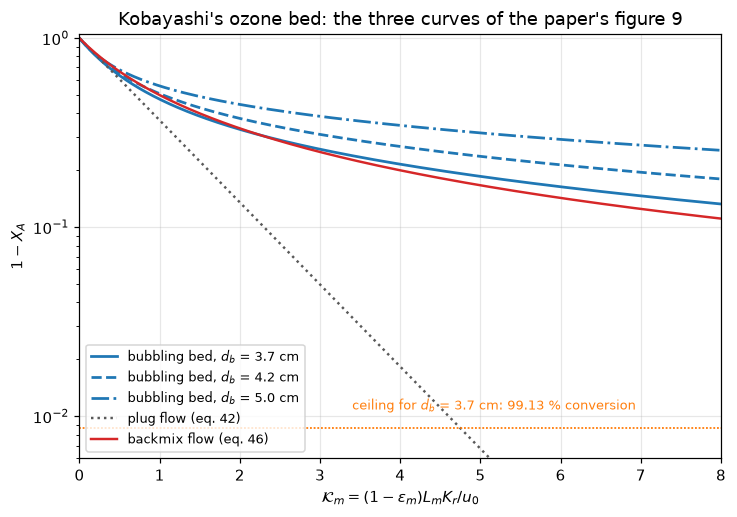
The three solid curves are the ones printed on the paper’s figure 9, at the bubble sizes the authors fitted. Two features are worth naming.
The bed falls below backmix flow. Not asymptotically: it crosses. Beyond a finite \(\mathcal{K}_m\) a bubbling bed converts less than a perfectly stirred tank of the same catalyst, which no dispersion model can reproduce at all.
And it flattens. As \(K_r \to \infty\) equation 49’s bracket collapses to \(K_{bc}/K_r\), and \(\mathcal{K}_f \to K_{bc}L_f/u_b\), a finite ceiling that does not contain the rate constant. Reaction stops being the limiting step and bubble-to-cloud interchange takes over completely.
Since the ceiling is finite and \(1/(1+\mathcal{K}_m)\) falls without bound, every bed crosses backmix flow somewhere, though for the smaller bubbles only at a \(\mathcal{K}_m\) two to five orders of magnitude beyond the 8 of figure 9, where equation 54 sits at its ceiling and the model is no longer a description of any bed. The crossing is a root of \(\ln(1+\mathcal{K}_m) - \mathcal{K}_f\), located by pymrm.checks.find_roots on a logarithmic scan of \(10^{-6}\) to \(10^{9}\), which must find exactly one.
DB_LIST = (2.0, 3.0, 3.7, 4.2, 5.0, 7.0)
print("Where the bubbling bed becomes worse than a stirred tank, and where it stops:")
print(f"  {'d_b [cm]':>9}{'crosses backmix at K_m':>25}{'ceiling K_f':>14}{'max conversion':>17}")
cross, ceil_conv = {}, {}
for db in DB_LIST:
    h = hydrodynamics(**{**C, "db": db})
    cross[db] = backmix_crossing(h)
    ceil_conv[db] = 1 - np.exp(-ceiling_Kf(h))
    print(f"  {db:9.1f}{cross[db]:25.4g}{ceiling_Kf(h):14.3f}{100 * ceil_conv[db]:16.4f} %")
print(f"\nAt the fitted d_b = 3.7 cm this bed cannot exceed {100 * ceil_conv[3.7]:.2f} % "
      "conversion, however active the catalyst.")
claims.value("ceiling_conversion_db37", ceil_conv[3.7], rtol=1e-6)
claims.value("ceiling_conversion_db50", ceil_conv[5.0], rtol=1e-6)
claims.value("ceiling_conversion_db70", ceil_conv[7.0], rtol=1e-6)
claims.value("backmix_crossing_db37", cross[3.7], rtol=1e-6,
             note="find_roots, xtol 1e-12")
claims.value("backmix_crossing_db30", cross[3.0], rtol=1e-6, note="find_roots, xtol 1e-12")
claims.value("backmix_crossing_db20", cross[2.0], rtol=1e-6, note="find_roots, xtol 1e-12")
print(f"The crossings for d_b = 2 and 3 cm, at K_m = {cross[2.0]:.2g} and {cross[3.0]:.1f}, are "
      f"equation 54 at its ceiling: {cross[2.0] / 8:.0f} and {cross[3.0] / 8:.0f} times the K_m = 8 "
      "at the edge of figure 9, and outside any physical range. They state a property of "
      "equation 54, not a prediction for a bed.")


def crossings_found(hi):
    """How many of the d_b values cross backmix flow below K_m = hi."""
    return sum(backmix_crossing(hydrodynamics(**{**C, "db": db}), hi=hi) is not None
               for db in DB_LIST)


claims.exact("backmix_crossings_found", crossings_found(1e9),
             note=f"of the {len(DB_LIST)} bubble sizes in the table")
print(f"{crossings_found(1e9)} of {len(DB_LIST)} bubble sizes cross backmix flow below K_m = 1e9.")
Where the bubbling bed becomes worse than a stirred tank, and where it stops:
d_b [cm] crosses backmix at K_m ceiling K_f max conversion
2.0 4.417e+05 12.999 99.9998 %
3.0 634.6 6.688 99.8755 %
3.7 2.267 4.748 99.1328 %
4.2 0.8137 3.861 97.8948 %
5.0 0.3525 2.906 94.5310 %
7.0 0.1238 1.682 81.3995 %
At the fitted d_b = 3.7 cm this bed cannot exceed 99.13 % conversion, however active the catalyst.
The crossings for d_b = 2 and 3 cm, at K_m = 4.4e+05 and 634.6, are equation 54 at its ceiling: 55207 and 79 times the K_m = 8 at the edge of figure 9, and outside any physical range. They state a property of equation 54, not a prediction for a bed.
6 of 6 bubble sizes cross backmix flow below K_m = 1e9.The ceiling has a closed form, and the interesting thing about it is what it does not contain. Substituting equation 4 for \(L_f\) and \((1-\delta)u_b = u_{br}\):
\[ \mathcal{K}_f^{\max} = \frac{K_{bc}L_f}{u_b} = \frac{K_{bc}(d_b)\,(1-\varepsilon_m)L_m}{(1-\varepsilon_{mf})\,u_{br}(d_b)} \]
Both \(K_{bc}\) and \(u_{br}\) depend on the bubble size and not on the gas velocity, so at a fixed bubble size the ceiling is independent of \(u_0\). Push more gas through a bed and, at fixed bubble size, the best conversion it can ever reach does not move.
db_grid = np.linspace(1.5, 8.0, 300)
fig, ax = plt.subplots(figsize=(6.6, 4.3))
for Lm, style in ((17.0, ":"), (34.0, "-"), (68.0, "--")):
    ceil = np.array([ceiling_Kf(hydrodynamics(**{**C, "db": db, "Lm": Lm})) for db in db_grid])
    ax.plot(db_grid, 100 * (1 - np.exp(-ceil)), style, lw=1.9,
            label=f"$L_m$ = {Lm:.0f} cm" + ("  (appendix C)" if Lm == 34 else ""))
ax.plot(C["db"], 100 * ceil_conv[3.7], "o", ms=7, color="C3")
ax.annotate(f"{100 * ceil_conv[3.7]:.2f} %", (C["db"], 100 * ceil_conv[3.7]),
            textcoords="offset points", xytext=(8, -12), color="C3")
ax.set_xlabel(r"effective bubble diameter $d_b$ [cm]")
ax.set_ylabel("maximum attainable conversion [%]")
ax.set_title("The ceiling: what an infinitely fast catalyst would give")
ax.set_ylim(30, 101); ax.legend(fontsize=9)
fig.tight_layout(); plt.show()

U0_SET = (5.0, 13.2, 40.0, 200.0)


def ceiling_u0_spread(hydro=hydrodynamics):
    """Relative spread of the ceiling K_f over U0_SET, at fixed d_b."""
    cs = np.array([ceiling_Kf(hydro(**{**C, "u0": u0})) for u0 in U0_SET])
    return float(np.ptp(cs) / np.mean(cs)), cs


spread, cs = ceiling_u0_spread()
print("ceiling K_f at u_0 =", ", ".join(f"{u:g}" for u in U0_SET), "cm/s:",
      ", ".join(f"{c:.10f}" for c in cs))
print(f"relative spread below 1e-14 (here {spread:.1e}): an algebraic identity, since")
print("K_bc(d_b) and u_br(d_b) contain no u_0 for any coefficient values.")
claims.bound("ceiling_u0_spread", spread, max=1e-14, basis="identity")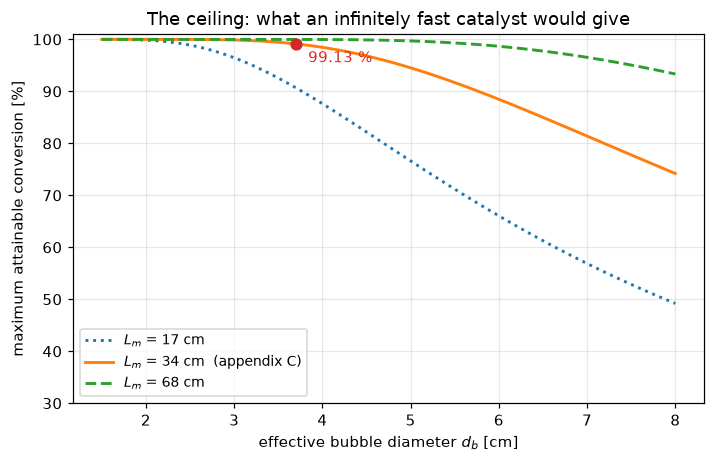
ceiling K_f at u_0 = 5, 13.2, 40, 200 cm/s: 4.7476911297, 4.7476911297, 4.7476911297, 4.7476911297
relative spread below 1e-14 (here 3.7e-16): an algebraic identity, since
K_bc(d_b) and u_br(d_b) contain no u_0 for any coefficient values.
This is a statement about equation 49 and about this bed’s \(L_m\), \(\varepsilon_m\), \(\varepsilon_{mf}\) and \(u_{mf}\), not a universal chart. What it shows is that the ceiling is governed by \(d_b\) and by how deep the bed is. Doubling the bubble size from 3 to 6 cm costs more conversion than any catalyst can give back, and the only lever left is bed depth, which enters linearly in \(\mathcal{K}_f^{\max}\) and therefore only logarithmically in the conversion.
The caveat is the one the paper spends its conclusion on: real bubbles grow with gas velocity, so \(u_0\) does move the ceiling, through \(d_b\), which the model does not predict.
The distributed model: what the frozen cloud and emulsion leave out
The table compares equation 54 with the distributed model, both emulsion closures, at the \(\mathcal{K}_m\) of the paper’s figure 9. The extended values are the exact eigenmode solution; the pymrm solve on 1600 cells is printed beside them and its error is measured in the Validation section.
N_REP = 1600
bed_bal = BubblingBed(hC, N_REP)
bed_pap = BubblingBed(hC, N_REP, ve_mode="paper")
change = {"balance": [], "paper": []}
print(f"  {'K_m':>5}{'1-X eq. 54':>12}{'exact':>10}{'pymrm':>10}{'change':>9}"
      f"   |{'exact':>9}{'pymrm':>10}{'change':>9}")
print(f"  {'':5}{'':12}{'v_e from overall balance':>29}   |{'v_e from eqs. 5 and 7':>28}")
for km in KM_LIST:
    base = np.exp(-Kf_closed(km, hC))
    line = f"  {km:5.1f}{base:12.4f}"
    for mode, bed in (("balance", bed_bal), ("paper", bed_pap)):
        ex = extended_exact(km, hC, mode)
        assert ex["imag"] < 1e-12
        change[mode].append(ex["c_exit"] / base - 1)
        line += ("   |" if mode == "paper" else "") + \
            f"{ex['c_exit']:10.4f}{bed.solve(km).c_exit:10.4f}{100 * change[mode][-1]:8.1f} %"
    print(line)
ch_b, ch_p = np.array(change["balance"]), np.array(change["paper"])
print(f"\nwith the overall balance the fraction unconverted rises by {100 * ch_b.min():.1f} to "
      f"{100 * ch_b.max():.1f} %; with eqs. 5 and 7 by {100 * ch_p.min():.2f} to {100 * ch_p.max():.1f} %")
claims.value("extension_min_change", ch_b.min(), rtol=1e-6, note="exact eigenmode route")
claims.value("extension_max_change", ch_b.max(), rtol=1e-6, note="exact eigenmode route")
claims.value("extension_paper_ve_min_change", ch_p.min(), rtol=1e-6)
claims.value("extension_paper_ve_max_change", ch_p.max(), rtol=1e-6)
IK4, IK8 = list(KM_LIST).index(4.0), list(KM_LIST).index(8.0)
claims.value("extension_exact_change_Km4", ch_b[IK4], rtol=1e-6)
claims.value("extension_exact_change_Km8", ch_b[IK8], rtol=1e-6)
claims.value("extension_paper_exact_change_Km8", ch_p[IK8], rtol=1e-6)
KM_PY = {"balance": bed_bal, "paper": bed_pap}


def pymrm_change(mode, km, **kw):
    """Change of 1 - X from the pymrm solve on N_REP cells (what the earlier page printed)."""
    return KM_PY[mode].solve(km, **kw).c_exit / np.exp(-Kf_closed(km, hC)) - 1


print(f"on {N_REP} cells the pymrm exit gives {100 * pymrm_change('balance', 4.0):.1f} % and "
      f"{100 * pymrm_change('balance', 8.0):.1f} % at K_m = 4 and 8 (overall balance), "
      f"{100 * pymrm_change('paper', 8.0):.1f} % at K_m = 8 (eqs. 5 and 7); the exact "
      f"values are {100 * ch_b[IK4]:.1f} %, {100 * ch_b[IK8]:.1f} % and {100 * ch_p[IK8]:.1f} %")
claims.value("extension_pymrm_change_Km4_n1600", pymrm_change("balance", 4.0), rtol=1e-4)
claims.value("extension_pymrm_change_Km8_n1600", pymrm_change("balance", 8.0), rtol=1e-4)
claims.value("extension_paper_pymrm_change_Km8_n1600", pymrm_change("paper", 8.0), rtol=1e-4)
cond = max(extended_exact(km, hC, m)["cond"] for km in KM_LIST for m in ("balance", "paper"))
print(f"condition number of the 5 x 5 eigenmode system below 1e3 (here {cond:.0f})")
claims.bound("exact_route_condition", cond, max=1e3, basis="chosen",
             note="well below 1/eps: the scaled modes keep the route exact to round-off")
K_m 1-X eq. 54 exact pymrm change | exact pymrm change
v_e from overall balance | v_e from eqs. 5 and 7
0.5 0.6347 0.6804 0.6804 7.2 % | 0.6363 0.6363 0.3 %
1.0 0.4754 0.5282 0.5283 11.1 % | 0.4994 0.4995 5.0 %
2.0 0.3292 0.3763 0.3764 14.3 % | 0.3597 0.3598 9.3 %
4.0 0.2155 0.2470 0.2471 14.6 % | 0.2388 0.2389 10.8 %
8.0 0.1327 0.1468 0.1469 10.6 % | 0.1435 0.1436 8.1 %
with the overall balance the fraction unconverted rises by 7.2 to 14.6 %; with eqs. 5 and 7 by 0.25 to 10.8 %
on 1600 cells the pymrm exit gives 14.7 % and 10.7 % at K_m = 4 and 8 (overall balance), 8.2 % at K_m = 8 (eqs. 5 and 7); the exact values are 14.6 %, 10.6 % and 8.1 %
condition number of the 5 x 5 eigenmode system below 1e3 (here 28)# What the profiles look like once the regions can carry gas.
r = BubblingBed(hC, 800).solve(2.0)
r0 = BubblingBed(hC, 800, convect=False).solve(2.0)
fig, ax = plt.subplots(1, 2, figsize=(10.2, 4.2), sharey=True)
labels = ("bubble", "cloud + wake", "emulsion")
for k in range(3):
ax[0].plot(r0.C[:, k], r0.bed.x_c, lw=1.8, label=labels[k])
ax[1].plot(r.C[:, k], r.bed.x_c, lw=1.8, label=labels[k])
ax[0].set_title("equations 48a-c as published\n(cloud and emulsion frozen)")
ax[1].set_title("with cloud-wake carried up and\nemulsion flowing down")
for a in ax:
a.set_xlabel(r"$C_A/C_{Ai}$"); a.set_xlim(0, 1.02); a.legend(fontsize=9)
ax[0].set_ylabel("height above the distributor [cm]")
fig.suptitle(r"$\mathcal{K}_m = 2$, appendix C bed", y=1.0)
fig.tight_layout(); plt.show()
print(f"Feed mixed with recirculated emulsion gas at the bottom: C_in/C_Ai = {r.c_in:.4f} "
f"(exact {extended_exact(2.0, hC)['c_in']:.4f})")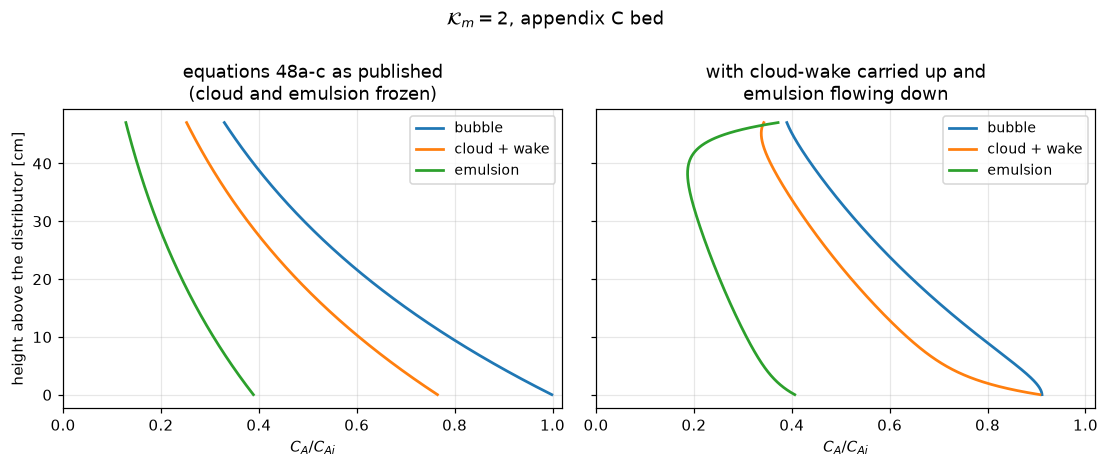
Feed mixed with recirculated emulsion gas at the bottom: C_in/C_Ai = 0.9112 (exact 0.9114)Can the fitted bubble size absorb the extension? For each \(\mathcal{K}_m\), the bubble size at which equation 54 gives the extended model’s exit (a root on \(3 \le d_b \le 6\) cm, which must be unique):
def one_root(f, lo=0.05, hi=50.0, strict=True):
    """The single root of f on [lo, hi]; raises (or, not strict, gives nan) otherwise."""
    res = find_roots(f, lo, hi, n_scan=200, log=True)
    if len(res["roots"]) != 1 or res["failed"]:
        if strict:
            raise RuntimeError(res["message"])
        print(f"   not one root: {res['message']}")
        return np.nan
    return res["roots"][0]


def equivalent_db(coef=None, strict=True):
    """Per K_m, the d_b at which eq. 54 equals the extended exit at d_b = 3.7 cm."""
    h = hydrodynamics(**C, coef=coef)
    out = []
    for km in KM_LIST:
        try:
            c_ext = extended_exact(km, h)["c_exit"]
            if not c_ext > 0:
                raise ValueError(f"extended exit {c_ext:.3g} is not a concentration")
            target = np.log(c_ext)
        except ValueError:
            if strict:
                raise
            out.append(np.nan)
            continue
        out.append(one_root(lambda d: Kf_closed(km, hydrodynamics(**{**C, "db": d}, coef=coef))
                            + target, 3.0, 6.0, strict=strict))
    return np.array(out)


EQ_DB = equivalent_db()
for km, d in zip(KM_LIST, EQ_DB):
    print(f"   K_m = {km:3.1f}: equation 54 needs d_b = {d:.3f} cm")
print(f"   one bubble size absorbs the extension only at one K_m: {EQ_DB.min():.2f} to "
      f"{EQ_DB.max():.2f} cm over figure 9's range")
claims.value("equivalent_db_min", EQ_DB.min(), rtol=1e-6)
claims.value("equivalent_db_max", EQ_DB.max(), rtol=1e-6)
claims.value("equivalent_db_Km2", EQ_DB[list(KM_LIST).index(2.0)], rtol=1e-6)
K_m = 0.5: equation 54 needs d_b = 5.002 cm
K_m = 1.0: equation 54 needs d_b = 4.503 cm
K_m = 2.0: equation 54 needs d_b = 4.200 cm
K_m = 4.0: equation 54 needs d_b = 4.002 cm
K_m = 8.0: equation 54 needs d_b = 3.851 cm
one bubble size absorbs the extension only at one K_m: 3.85 to 5.00 cm over figure 9's rangeValidation
The checks are not of equal weight, and the break table at the end of this section measures it: every claim is re-evaluated with one defect injected.
The appendix comparisons have power. They are the only checks on this page that can see a wrong number: each takes the coefficients transcribed out of equations 10, 12 and 51 and puts them against arithmetic the authors printed.
The identities do not. The \(K_r \to 0\) limit, the reactant balance of the distributed model and the ceiling’s \(u_0\)-independence hold for any values of the printed coefficients, so they catch a wrong formula and never a wrong number. They are kept because a wrong formula is a real error class, each with the formula defect it catches.
The distributed model has its own ladder against the exact eigenmode solution, on the branch the extension numbers are reported on.
1. Appendix C, every printed intermediate
PAIRS_C = (("u_br", "ubr"), ("u_b", "ub"), ("delta", "delta"), ("K_bc", "Kbc"),
           ("K_ce", "Kce"), ("gamma_c", "gc"), ("gamma_e", "ge"))


def appendix_C_devs(coef=None):
    """Relative deviation of each recomputed appendix C intermediate."""
    h = hydrodynamics(**C, coef=coef)
    got = {s: h[k] for s, k in PAIRS_C} | {"Kr_per_Km": Kr_of_Km(1.0, h)}
    return {s: abs(g - printed("C", s)) / abs(printed("C", s)) for s, g in got.items()}, got


devC, gotC = appendix_C_devs()
print(f"   {'quantity':>10}{'printed':>12}{'recomputed':>14}{'deviation':>12}")
for s in devC:
    print(f"   {s:>10}{printed('C', s):12.4g}{gotC[s]:14.6g}{100 * devC[s]:11.2f} %")
print(f"   worst deviation {100 * max(devC.values()):.2f} %, over {len(devC)} numbers, nothing fitted")
claims.value("appendixC_max_dev", max(devC.values()), rtol=1e-4)
quantity printed recomputed deviation
u_br 42.8 42.8138 0.03 %
u_b 53.9 53.9138 0.03 %
delta 0.206 0.205884 0.06 %
K_bc 5.44 5.43494 0.09 %
K_ce 2.23 2.23397 0.18 %
gamma_c 0.4 0.398154 0.46 %
gamma_e 1.53 1.53039 0.03 %
Kr_per_Km 0.706 0.705882 0.02 %
worst deviation 0.46 %, over 8 numbers, nothing fitted2. Appendix A: the same flow model, for gas–solid mass transfer
def appendix_A_dev(coef=None):
    got = appendix_A(A, coef)
    return max(abs(v - printed("A", s)) / abs(printed("A", s)) for s, v in got.items()), got


devA, gotA = appendix_A_dev()
print(f"   {'quantity':>22}{'printed':>12}{'recomputed':>14}{'deviation':>12}")
for s, val in gotA.items():
    want = printed("A", s)
    print(f"   {s:>22}{want:12.4g}{val:14.6g}{100 * abs(val - want) / abs(want):11.2f} %")
print(f"   (Sh)_over-all = {gotA['Sh_slope_Re']:.4f} Re - {-gotA['Sh_intercept']:.4f}"
      f"   against the printed 0.045 Re - 0.0101")
claims.value("appendixA_max_dev", devA, rtol=1e-4)
quantity printed recomputed deviation
Re_t 7.54 7.52578 0.19 %
Sh_star_t 4.2 4.20069 0.02 %
K_bc 46.5 46.5552 0.12 %
ub_minus_u0 12 11.9579 0.35 %
one_minus_ef_times_ub 6.6 6.58395 0.24 %
Re_per_u0 0.184 0.183556 0.24 %
Sh_slope_u0 0.00829 0.00830733 0.21 %
Sh_intercept -0.0101 -0.0100519 0.48 %
Sh_slope_Re 0.045 0.0452579 0.57 %
(Sh)_over-all = 0.0453 Re - 0.0101 against the printed 0.045 Re - 0.01013. Appendix B: the same flow model again, for gas–solid heat transfer
def appendix_B_line(b, x):
    """(Nu)_apparent = intercept + slope Re for (1 - eps_f)(u_0 + 5.8) = x."""
    return b["brack"] / x * b["ub_minus_u0"], b["brack"] / x / b["Re_per_u0"]


def appendix_B_dev(coef=None):
    b = appendix_B(B, coef)
    devs = [abs(b[s] - printed("B", s)) / abs(printed("B", s))
            for s in ("Re_t", "Nu_star_t", "H_bc", "ub_minus_u0", "Re_per_u0")]
    inter, slope = appendix_B_line(b, printed("B", "one_minus_ef_times_ub"))
    devs += [abs(slope / printed("B", "Nu_slope_Re") - 1),
             abs(inter / printed("B", "Nu_intercept") - 1)]
    x_pr = printed("B", "one_minus_ef_times_ub")
    return max(devs), b, 1 - x_pr / b["ubr"], x_pr / b["one_minus_ef_own"] - 1


devB, b, emf_implied, own_shift = appendix_B_dev()
x_pr = printed("B", "one_minus_ef_times_ub")
print(f"   {'quantity':>22}{'printed':>12}{'recomputed':>14}{'deviation':>12}")
for s in ("Re_t", "Nu_star_t", "H_bc", "ub_minus_u0", "Re_per_u0"):
    want = printed("B", s)
    print(f"   {s:>22}{want:12.4g}{b[s]:14.6g}{100 * abs(b[s] - want) / abs(want):11.2f} %")
for tag, x in ((f"as printed, {x_pr:.2f}", x_pr),
               ("from its own eps_mf = 0.50", b["one_minus_ef_own"])):
    inter, slope = appendix_B_line(b, x)
    print(f"   (Nu)_apparent = {inter:.4f} + {slope:.4f} Re   [{tag}]")
print(f"   the printed answer is        {printed('B', 'Nu_intercept'):.4f} + "
      f"{printed('B', 'Nu_slope_Re'):.4f} Re")
print(f"\n   Only the printed {x_pr:.2f} reproduces the printed answer, so it is what the")
print(f"   authors used. Their stated eps_mf = 0.50 gives {b['one_minus_ef_own']:.2f}, which would")
print(f"   move the line by {100 * own_shift:.1f} %. {x_pr:.2f} corresponds to "
      f"eps_mf = {emf_implied:.3f}. Recorded, not repaired.")
claims.value("appendixB_max_dev", devB, rtol=1e-4)
claims.value("appendixB_emf_implied", emf_implied, rtol=1e-4)
claims.value("appendixB_own_emf_shift", own_shift, rtol=1e-4)
quantity printed recomputed deviation
Re_t 20.3 20.296 0.02 %
Nu_star_t 4.39 4.38858 0.03 %
H_bc 0.036 0.0358451 0.43 %
ub_minus_u0 5.8 5.73866 1.06 %
Re_per_u0 0.236 0.236 0.00 %
(Nu)_apparent = 0.0688 + 0.0508 Re [as printed, 8.70]
(Nu)_apparent = 0.0760 + 0.0561 Re [from its own eps_mf = 0.50]
the printed answer is 0.0700 + 0.0510 Re
Only the printed 8.70 reproduces the printed answer, so it is what the
authors used. Their stated eps_mf = 0.50 gives 7.87, which would
move the line by 10.6 %. 8.70 corresponds to eps_mf = 0.447. Recorded, not repaired.4. The frozen distributed solve against equation 54
With \(v_c = v_e = 0\) the cloud and emulsion rows are algebraic and the bubble row is first-order upwind with an exact inlet value and an outflow outlet: the discrete exit is then exactly the backward-Euler product \((1+\mathcal{K}_f/n)^{-n}\), an identity of the scheme. Its error against \(e^{-\mathcal{K}_f}\) is first order, and a first-order Richardson step removes it. This branch never enters the recirculation loop, so it licenses the operator assembly and nothing about the extension numbers.
NS_FROZEN = (200, 400, 800, 1600)
KM_FROZEN = (0.5, 2.0, 8.0)


def frozen_metrics(outlet="outflow", kbc_asym=1.0, cap=None):
    """Frozen ladder: identity gap, errors against eq. 54, orders, Richardson."""
    gap, rows = 0.0, []
    for km in KM_FROZEN:
        base = np.exp(-Kf_closed(km, hC))
        cs = []
        for n in NS_FROZEN:
            m = n if cap is None else min(n, cap)
            c = BubblingBed(hC, m, convect=False, outlet=outlet).solve(km, kbc_asym).c_exit
            gap = max(gap, abs(c / (1 + Kf_closed(km, hC) / m) ** -m - 1))
            cs.append(c)
        err = np.abs(np.array(cs) / base - 1)
        rows.append((km, base, err, np.log2(err[:-1] / err[1:]),
                     abs((2 * cs[-1] - cs[-2]) / base - 1),
                     abs(cs[-1] - cs[-2]) / (NS_FROZEN[-1] * EPS)))
    return gap, rows


gap_be, rows_fr = frozen_metrics()
print(f"   {'K_m':>5}{'eq. 54':>10}" + "".join(f"{'n=' + str(n):>11}" for n in NS_FROZEN)
      + f"{'orders':>20}{'Richardson':>12}")
for km, base, err, orders, rich, _fl in rows_fr:
    print(f"   {km:5.1f}{base:10.5f}" + "".join(f"{e:11.2e}" for e in err)
          + "  " + " ".join(f"{o:.3f}" for o in orders) + f"{rich:12.1e}")
orders_fr = np.concatenate([r[3] for r in rows_fr])
print(f"   observed orders from {orders_fr.min():.3f} to {orders_fr.max():.3f}, within 0.02 of 1; "
      f"exit equals (1 + K_f/n)^-n to below 1e-11 (here {gap_be:.1e})")
fl_fr = min(r[5] for r in rows_fr)
print(f"   finest difference / (n eps): {fl_fr:.1e}, above 1e3")
claims.bound("frozen_vs_backward_euler", gap_be, max=1e-11, basis="identity")
claims.value("distributed_vs_eq54_n1600", max(r[2][-1] for r in rows_fr), rtol=1e-3)
claims.value("distributed_vs_eq54_richardson", max(r[4] for r in rows_fr), rtol=1e-3)
claims.bound("frozen_order_worst_dev", np.max(np.abs(orders_fr - 1)), max=0.02, basis="theory",
             note="first-order upwind; every consecutive pair at every K_m")
claims.bound("frozen_finest_over_roundoff", fl_fr, min=1e3, basis="theory")
K_m eq. 54 n=200 n=400 n=800 n=1600 orders Richardson
0.5 0.63471 5.16e-04 2.58e-04 1.29e-04 6.46e-05 0.999 1.000 1.000 2.0e-08
2.0 0.32922 3.08e-03 1.54e-03 7.71e-04 3.86e-04 0.998 0.999 1.000 2.1e-07
8.0 0.13271 1.02e-02 5.09e-03 2.55e-03 1.27e-03 0.999 0.999 1.000 5.2e-07
observed orders from 0.998 to 1.000, within 0.02 of 1; exit equals (1 + K_f/n)^-n to below 1e-11 (here 1.5e-13)
finest difference / (n eps): 1.2e+08, above 1e35. The slow-reaction limit (an identity)
Equation 57 asserts \(\mathcal{K}_f = \mathcal{K}_m\) for slow reaction. As \(K_r \to 0\) the bracket of equation 49 collapses to \(\gamma_b+\gamma_c+\gamma_e\), which equation 15 defines as \((1-\varepsilon_{mf})(1-\delta)/\delta\), and with \((1-\delta)u_b = u_{br}\) every coefficient cancels except \(u_0/(u_0-u_{mf})\), because the exit stream is bubble gas only. Kf_over_Km is evaluated at \(\mathcal{K}_m = 0\) exactly.
def eq57_dev(h):
    """Deviation of lim K_f/K_m (K_m -> 0) from u_0/(u_0 - u_mf)."""
    lim = h["u0"] / (h["u0"] - h["umf"])
    return abs(Kf_over_Km(0.0, h) / lim - 1)


print(f"   lim K_f/K_m = {Kf_over_Km(0.0, hC):.6f}, u_0/(u_0 - u_mf) = "
      f"{C['u0'] / (C['u0'] - C['umf']):.6f}; deviation below 1e-14 (here {eq57_dev(hC):.1e})")
print(f"   so equation 57's K_f = K_m is {100 * (Kf_over_Km(0.0, hC) - 1):.1f} % optimistic "
      "for this bed; it is exact only as u_0/u_mf -> infinity.")
claims.bound("eq57_limit_dev", eq57_dev(hC), max=1e-14, basis="identity")
claims.value("eq57_optimism", Kf_over_Km(0.0, hC) - 1, rtol=1e-6)
lim K_f/K_m = 1.189189, u_0/(u_0 - u_mf) = 1.189189; deviation below 1e-14 (here 2.2e-16)
so equation 57's K_f = K_m is 18.9 % optimistic for this bed; it is exact only as u_0/u_mf -> infinity.6. The reactant balance of the distributed model (an identity)
The reaction integrated over the bed must equal what the gas loses between feed and exit, \(u_0(1-C_{\rm exit})\). With the outlet face values the operator transports, the discrete fluxes telescope, the exchange block has column sums \(-\delta\gamma_k K_r\) (the \(K_{bc}\) and \(K_{ce}\) terms cancel pairwise), and the velocities sum to \(u_0\) by the closure, so the balance closes to round-off on every grid. It is checked on every \(\mathcal{K}_m\) of the table and every rung of the ladder below.
NS_EXT = (200, 400, 800, 1600, 3200, 6400)


def worst_balance(ns=NS_EXT, kms=KM_LIST, **bed_kw):
    """Largest |mass_balance_dev| over the grids and K_m."""
    solve_kw = {k: bed_kw.pop(k) for k in ("kbc_asym",) if k in bed_kw}
    return max(abs(BubblingBed(hC, n, **bed_kw).solve(km, **solve_kw).mass_balance_dev())
               for n in ns for km in kms)


mb = worst_balance()
s2 = BubblingBed(hC, N_REP).solve(2.0)
print(f"   K_m = 2, n = {N_REP}: consumed {s2.consumed():.8f}, u_0 (1 - C_exit) "
      f"{C['u0'] * (1 - s2.c_exit):.8f}")
print(f"   worst relative closure over {len(NS_EXT)} grids and {len(KM_LIST)} K_m: "
      f"below 1e-10 (here {mb:.1e})")
claims.bound("mass_balance_dev", mb, max=1e-10, basis="identity")


def zero_gradient_gap(n=2000, km=2.0, **kw):
    """Signed reactant-balance gap with zero-gradient outlets (the construction this page retired)."""
    kb = {k: kw.pop(k) for k in ("kbc_asym",) if k in kw}
    return BubblingBed(hC, n, outlet="zero_gradient", **kw).solve(km, **kb).mass_balance_dev()


zg = zero_gradient_gap()
print(f"   zero-gradient outlets with the exit read from the last cells, K_m = 2, n = 2000: "
      f"gap {zg:.4e}, against {abs(BubblingBed(hC, 2000).solve(2.0).mass_balance_dev()):.1e} "
      "with outflow outlets")
claims.value("mass_balance_zero_gradient_n2000", zg, rtol=1e-3,
             note="signed gap of the retired zero-gradient construction")
K_m = 2, n = 1600: consumed 8.23190923, u_0 (1 - C_exit) 8.23190923
worst relative closure over 6 grids and 5 K_m: below 1e-10 (here 1.7e-12)
zero-gradient outlets with the exit read from the last cells, K_m = 2, n = 2000: gap -8.1061e-06, against 1.3e-14 with outflow outlets7. The distributed model against its exact solution
The extension numbers are taken on the convect=True branch, so that branch gets its own ladder: the exit concentration on six nested grids at every \(\mathcal{K}_m\) of the table, the observed order from pymrm.checks.observed_orders (no exact solution needed), and the error against the eigenmode solution. The finest difference is compared with a round-off floor \(n\,\varepsilon\), so that the order is not fitted to noise.
def ext_ladder(ns=NS_EXT, cap=None, **solve_kw):
    """Per K_m: observed_orders result and the exact exit, on the balance closure."""
    beds = {n: BubblingBed(hC, n if cap is None else min(n, cap)) for n in ns}
    out = []
    for km in KM_LIST:
        oo = observed_orders(lambda n: beds[n].solve(km, **solve_kw).c_exit, ns)
        out.append((km, oo, extended_exact(km, hC)["c_exit"]))
    return out


def ext_metrics(lad, ns=NS_EXT):
    orders = np.concatenate([oo["orders"] for _, oo, _ in lad])
    err = [abs(oo["values"][ns.index(N_REP)] / ex - 1) for _, oo, ex in lad]
    rich = [abs(oo["extrapolated"] / ex - 1) for _, oo, ex in lad]
    finest = min(abs(oo["values"][-1] - oo["values"][-2]) for _, oo, _ in lad)
    return orders, max(err), max(rich), finest / (ns[-1] * EPS)


LAD = ext_ladder()
print(f"   {'K_m':>5}{'exact':>14}" + "".join(f"{'n=' + str(n):>10}" for n in NS_EXT[::2])
      + f"{'orders':>34}")
for km, oo, ex in LAD:
    errs = np.abs(np.array(oo["values"]) / ex - 1)
    print(f"   {km:5.1f}{ex:14.10f}" + "".join(f"{e:10.2e}" for e in errs[::2]) + "  "
          + " ".join(f"{o:.4f}" for o in oo["orders"]))
ord_e, err_e, rich_e, fl_e = ext_metrics(LAD)
print(f"   observed orders {ord_e.min():.4f} to {ord_e.max():.4f}, within 0.02 of 1; at n = {N_REP} the worst "
      f"error against the exact exit is {err_e:.2e}")
print(f"   Richardson limit of the finest triple against exact: {rich_e:.1e}; "
      f"finest difference / (n eps): {fl_e:.1e}")
claims.bound("extension_order_worst_dev", np.max(np.abs(ord_e - 1)), max=0.02, basis="theory",
             note="observed_orders, every triple at every K_m")
claims.value("extension_pymrm_vs_exact_n1600", err_e, rtol=1e-3)
claims.value("extension_richardson_vs_exact", rich_e, rtol=0.05)
claims.bound("extension_finest_over_roundoff", fl_e, min=1e3, basis="theory")
K_m exact n=200 n=800 n=3200 orders
0.5 0.6804091040 2.32e-04 5.78e-05 1.44e-05 1.0048 1.0025 1.0013 1.0007
1.0 0.5282386368 6.45e-04 1.61e-04 4.01e-05 1.0055 1.0029 1.0015 1.0008
2.0 0.3762976687 1.56e-03 3.87e-04 9.68e-05 1.0063 1.0034 1.0017 1.0009
4.0 0.2469840740 3.36e-03 8.35e-04 2.09e-04 1.0067 1.0036 1.0019 1.0010
8.0 0.1468090188 6.74e-03 1.68e-03 4.19e-04 1.0064 1.0035 1.0019 1.0009
observed orders 1.0007 to 1.0067, within 0.02 of 1; at n = 1600 the worst error against the exact exit is 8.38e-04
Richardson limit of the finest triple against exact: 1.8e-07; finest difference / (n eps): 3.5e+068. Two claims the paper makes in passing
Both are stated without support, and both are cheap to test once the model runs. Each limit is a root located by find_roots, which must find exactly one.
def gamma_b_change(km, coef=None):
    h0 = hydrodynamics(**C, coef=coef)
    h1 = hydrodynamics(**{**C, "gamma_b": 0.01}, coef=coef)
    return np.exp(-Kf_closed(km, h1)) / np.exp(-Kf_closed(km, h0)) - 1


def cloud_wake_change(km, coef=None):
    """Adding the cloud-wake gas (eqs. 48b, 48c) to the exit: relative change of 1 - X."""
    h = hydrodynamics(**C, coef=coef)
    Kr, Cb = Kr_of_Km(km, h), np.exp(-Kf_closed(km, h))
    ge_eff = h["Kce"] * h["ge"] * Kr / (h["Kce"] + h["ge"] * Kr)
    Cc = h["Kbc"] * Cb / (h["Kbc"] + h["gc"] * Kr + ge_eff)
    vb, vc = velocities(h)[:2]
    return (vb * Cb + vc * Cc) / (vb + vc) / Cb - 1


def passing_claims(coef=None, strict=True):
    gb = max(abs(gamma_b_change(km, coef)) for km in KM_LIST)
    cw = max(abs(cloud_wake_change(km, coef)) for km in KM_LIST)
    return (gb, one_root(lambda K: abs(gamma_b_change(K, coef)) - 0.01, strict=strict),
            cw, one_root(lambda K: abs(cloud_wake_change(K, coef)) - 0.10, strict=strict))


print("Claim 1 (appendix C): gamma_b anywhere in 0 to 0.01 changes the outlet")
print("concentration by less than 1 %.  Claim 2 (after eq. 53): adding the cloud-wake")
print("gas to the exit stream changes the fraction unconverted by 10 % at most.")
print(f"   {'K_m':>5}{'gamma_b 0 -> 0.01':>20}{'+ cloud-wake gas':>19}")
for km in KM_LIST:
    print(f"   {km:5.1f}{100 * gamma_b_change(km):19.2f} %{100 * cloud_wake_change(km):18.1f} %")
gb_w, gb_lim, cw_w, cw_lim = passing_claims()
print(f"   claim 1 holds up to K_m = {gb_lim:.2f}; at K_m = 8 the change is {100 * gb_w:.1f} %")
print(f"   claim 2 holds up to K_m = {cw_lim:.2f}; at K_m = 8 the change is {100 * cw_w:.1f} %")
claims.value("gamma_b_claim_worst", gb_w, rtol=1e-4)
claims.value("gamma_b_claim_Km_limit", gb_lim, rtol=1e-6)
claims.value("cloud_wake_claim_worst", cw_w, rtol=1e-4)
claims.value("cloud_wake_claim_Km_limit", cw_lim, rtol=1e-6)
cw_05 = cloud_wake_change(0.5)
print(f"   at K_m = 0.5 the cloud-wake gas alone changes the fraction unconverted by "
      f"{100 * cw_05:.1f} %, against {100 * ch_b.min():.1f} % for the whole extension")
claims.value("cloud_wake_change_Km05", cw_05, rtol=1e-4)
Claim 1 (appendix C): gamma_b anywhere in 0 to 0.01 changes the outlet
concentration by less than 1 %. Claim 2 (after eq. 53): adding the cloud-wake
gas to the exit stream changes the fraction unconverted by 10 % at most.
K_m gamma_b 0 -> 0.01 + cloud-wake gas
0.5 -0.14 % -2.7 %
1.0 -0.42 % -4.5 %
2.0 -1.04 % -6.7 %
4.0 -2.31 % -9.2 %
8.0 -4.75 % -12.1 %
claim 1 holds up to K_m = 1.94; at K_m = 8 the change is 4.7 %
claim 2 holds up to K_m = 4.88; at K_m = 8 the change is 12.1 %
at K_m = 0.5 the cloud-wake gas alone changes the fraction unconverted by -2.7 %, against 7.2 % for the whole extensionThe break table
Transcription defects. The model has four printed numerical coefficients, the 0.711 of equation 51, the 4.5 and 5.85 of equation 10 and the 6.78 of equation 12, and the error that happens when a number is read off a 1968 scan is a transposed digit. Each is perturbed through the coef argument and every closed-form claim recomputed. Formula defects are injected through an argument or a modified parameter set: an exchange block that does not conserve the reactant, the emulsion velocity of equations 5 and 7, zero-gradient outlets, \(\gamma_e\) off equation 15’s closure, a spurious \(u_0\) dependence in \(K_{bc}\), a backmix scan that stops at \(\mathcal{K}_m = 50\), and a ladder whose finest rung is not refined.
INJECT = [(key, val) for key, val in (("c_kbc_visc", 3.5), ("c_kbc_diff", 5.58),
                                      ("c_kce", 8.76), ("c_ubr", 0.171))]
IDENTITY_STILL = []      # (row, eq57 inside its bound, balance inside its bound)
for key, val in INJECT:
    coef = {**KL, key: val}
    row = f"{key} {KL[key]} -> {val} (coef)"
    h = hydrodynamics(**C, coef=coef)
    brk(row, "appendixC_max_dev", max(appendix_C_devs(coef)[0].values()))
    brk(row, "appendixA_max_dev", appendix_A_dev(coef)[0])
    dB, _, emf_i, shift_i = appendix_B_dev(coef)
    brk(row, "appendixB_max_dev", dB)
    brk(row, "appendixB_emf_implied", emf_i)
    brk(row, "appendixB_own_emf_shift", shift_i)
    for db, name in ((3.7, "ceiling_conversion_db37"), (5.0, "ceiling_conversion_db50"),
                     (7.0, "ceiling_conversion_db70")):
        brk(row, name, 1 - np.exp(-ceiling_Kf(hydrodynamics(**{**C, "db": db}, coef=coef))))
    try:
        brk(row, "backmix_crossing_db37", backmix_crossing(h))
    except RuntimeError as err:          # more than one crossing: reported, and caught
        print(f"{row}: {err}")
        brk(row, "backmix_crossing_db37", np.nan)
    for db, name in ((3.0, "backmix_crossing_db30"), (2.0, "backmix_crossing_db20")):
        try:
            brk(row, name, backmix_crossing(hydrodynamics(**{**C, "db": db}, coef=coef)))
        except RuntimeError:
            brk(row, name, np.nan)
    brk(row, "eq57_optimism", Kf_over_Km(0.0, h) - 1)
    vv = velocities(h)
    brk(row, "cloud_wake_share_upflow", vv[1] / (vv[0] + vv[1]))
    brk(row, "paper_ve_sum_excess", velocities(h, ve_mode="paper").sum() / C["u0"] - 1)
    gb_i, gbl_i, cw_i, cwl_i = passing_claims(coef, strict=False)
    brk(row, "cloud_wake_change_Km05", cloud_wake_change(0.5, coef))
    for name, x in (("gamma_b_claim_worst", gb_i), ("gamma_b_claim_Km_limit", gbl_i),
                    ("cloud_wake_claim_worst", cw_i), ("cloud_wake_claim_Km_limit", cwl_i)):
        brk(row, name, x)
    for mode, lo, hi in (("balance", "extension_min_change", "extension_max_change"),
                         ("paper", "extension_paper_ve_min_change",
                          "extension_paper_ve_max_change")):
        try:
            chg = [extended_exact(km, h, mode)["c_exit"] / np.exp(-Kf_closed(km, h)) - 1
                   for km in KM_LIST]
        except ValueError as err:        # the flow pattern itself changed: caught
            print(f"{row}, {mode}: {err}; velocities {np.round(velocities(h, ve_mode=mode), 2)}")
            chg = [np.nan]
        brk(row, lo, min(chg))
        brk(row, hi, max(chg))
        chg = chg if len(chg) == len(KM_LIST) else [np.nan] * len(KM_LIST)
        if mode == "balance":
            brk(row, "extension_exact_change_Km4", chg[IK4])
            brk(row, "extension_exact_change_Km8", chg[IK8])
        else:
            brk(row, "extension_paper_exact_change_Km8", chg[IK8])
    eqd = equivalent_db(coef, strict=False)
    brk(row, "equivalent_db_min", np.min(eqd))
    brk(row, "equivalent_db_max", np.max(eqd))
    brk(row, "equivalent_db_Km2", eqd[list(KM_LIST).index(2.0)])
    mb_i = max(abs(BubblingBed(h, n).solve(km).mass_balance_dev())
               for n in (200, N_REP) for km in KM_LIST)
    IDENTITY_STILL.append((row, eq57_dev(h) <= 1e-14, mb_i <= 1e-10,
                           ceiling_u0_spread(lambda **p: hydrodynamics(**p, coef=coef))[0] <= 1e-14))

# formula defects
row = "K_bc x 1.1 in the cloud row only (kbc_asym)"
brk(row, "mass_balance_dev", worst_balance(ns=(200, N_REP), kbc_asym=1.1))
_, rows_a = frozen_metrics(kbc_asym=1.1)
brk(row, "distributed_vs_eq54_n1600", max(r[2][-1] for r in rows_a))
brk(row, "distributed_vs_eq54_richardson", max(r[4] for r in rows_a))
_o, err_a, rich_a, _f = ext_metrics(ext_ladder(kbc_asym=1.1))
brk(row, "extension_pymrm_vs_exact_n1600", err_a)
brk(row, "extension_pymrm_change_Km4_n1600", pymrm_change("balance", 4.0, kbc_asym=1.1))
brk(row, "extension_pymrm_change_Km8_n1600", pymrm_change("balance", 8.0, kbc_asym=1.1))
brk(row, "extension_paper_pymrm_change_Km8_n1600", pymrm_change("paper", 8.0, kbc_asym=1.1))
brk(row, "extension_richardson_vs_exact", rich_a)
brk("emulsion velocity from eqs. 5 and 7, sum != u_0 (ve_mode)", "mass_balance_dev",
    worst_balance(ns=(200, N_REP), ve_mode="paper"))
row = "zero-gradient outlets, exit read from the last cells (outlet)"
brk(row, "mass_balance_dev", worst_balance(ns=(200, N_REP), outlet="zero_gradient"))
brk(row, "frozen_vs_backward_euler", frozen_metrics(outlet="zero_gradient")[0])
row = "K_bc x 1.1 in the cloud row only, zero-gradient outlets (kbc_asym, outlet)"
brk(row, "mass_balance_zero_gradient_n2000", zero_gradient_gap(kbc_asym=1.1))
brk("emulsion velocity from eqs. 5 and 7, zero-gradient outlets (ve_mode, outlet)",
    "mass_balance_zero_gradient_n2000", zero_gradient_gap(ve_mode="paper"))
h_ge = {**hC, "ge": hC["ge"] * 1.10}
row = "gamma_e x 1.10, off eq. 15's closure (parameter set)"
brk(row, "eq57_limit_dev", eq57_dev(h_ge))
brk(row, "eq57_optimism", Kf_over_Km(0.0, h_ge) - 1)
h_sw = {**hC, "gc": hC["ge"], "ge": hC["gc"]}
brk("gamma_c and gamma_e swapped (parameter set)", "eq57_limit_dev", eq57_dev(h_sw))
brk("K_bc x (u_0/13.2)^0.1 (parameter set)", "ceiling_u0_spread",
    ceiling_u0_spread(lambda **p: (lambda h: {**h, "Kbc": h["Kbc"] * (p["u0"] / 13.2) ** 0.1})(
        hydrodynamics(**p)))[0])
brk("backmix scan stopped at K_m = 50 (hi)", "backmix_crossings_found", crossings_found(50.0))
row = f"finest rung solved on n = {NS_EXT[-2]} again (cap)"
ord_s, _e, _r, fl_s = ext_metrics(ext_ladder(cap=NS_EXT[-2]))
brk(row, "extension_order_worst_dev", np.max(np.abs(ord_s - 1)))
brk(row, "extension_finest_over_roundoff", fl_s)
row = f"frozen ladder with its finest rung on n = {NS_FROZEN[-2]} again (cap)"
_g, rows_s = frozen_metrics(cap=NS_FROZEN[-2])
orders_s = np.concatenate([r[3] for r in rows_s])
brk(row, "frozen_order_worst_dev", np.max(np.abs(orders_s - 1)))
brk(row, "frozen_finest_over_roundoff", min(r[5] for r in rows_s))
brk("eigenmodes left unscaled, exp(lam z) for every mode (scaled)", "exact_route_condition",
    max(extended_exact(km, hC, m, scaled=False)["cond"] for km in KM_LIST
        for m in ("balance", "paper")))

blind = sum(all(r[1:]) for r in IDENTITY_STILL)
print(f"Coefficient injections under which all three identities stay inside their bounds: "
      f"{blind} of {len(IDENTITY_STILL)}")
claims.exact("identities_blind_to_coefficients", blind, structural=True,
             note="the identities hold for any coefficient values; that is what this counts")

print(f"\n{'injected defect':<64} {'claim':<32} {'clean':>11} {'broken':>11}  caught")
for row, metric, clean, broken, caught in BREAK:
    if claims.metrics[metric]["kind"] == "bound":
        shown = f"(here {clean:.2g})"
        br = (f"(here {float(broken):.0e})" if abs(float(broken)) < 1e-12
              else f"{float(broken):.3g}")
    else:
        shown, br = f"{float(clean):11.5g}", f"{float(broken):11.5g}"
    print(f"{row[:64]:<64} {metric[:32]:<32} {shown:>11} {br:>11}  {'yes' if caught else 'NO'}")
_caught = {mt for _, mt, _, _, c in BREAK if c}
_open = sorted(k for k in claims.metrics if k not in _caught and not claims.metrics[k].get("structural"))
print(f"\n{len(BREAK)} rows; {len(_caught)} of {len(claims.metrics)} claims are failed by at least "
      f"one row; open: {', '.join(_open) or 'none'}")
print("rows that do not fail their claim: "
      + ("; ".join(f"{r} -> {mt}" for r, mt, _, _, c in BREAK if not c) or "none"))
c_ubr 0.711 -> 0.171 (coef): backmix crossing: 3 roots: multiplicity, report all of them
not one root: 3 roots: multiplicity, report all of them
c_ubr 0.711 -> 0.171 (coef), paper: extended_exact needs bubble and cloud up, emulsion down; velocities [11.1 14.08 7.42]
not one root: no sign change in the scanned range
not one root: no sign change in the scanned range
Coefficient injections under which all three identities stay inside their bounds: 4 of 4
injected defect claim clean broken caught
c_kbc_visc 4.5 -> 3.5 (coef) appendixC_max_dev 0.0046144 0.10526 yes
c_kbc_visc 4.5 -> 3.5 (coef) appendixA_max_dev 0.0057304 0.073161 yes
c_kbc_visc 4.5 -> 3.5 (coef) appendixB_max_dev 0.017773 0.16644 yes
c_kbc_visc 4.5 -> 3.5 (coef) appendixB_emf_implied 0.44722 0.44722 NO
c_kbc_visc 4.5 -> 3.5 (coef) appendixB_own_emf_shift 0.10556 0.10556 NO
c_kbc_visc 4.5 -> 3.5 (coef) ceiling_conversion_db37 0.99133 0.98576 yes
c_kbc_visc 4.5 -> 3.5 (coef) ceiling_conversion_db50 0.94531 0.92502 yes
c_kbc_visc 4.5 -> 3.5 (coef) ceiling_conversion_db70 0.814 0.77495 yes
c_kbc_visc 4.5 -> 3.5 (coef) backmix_crossing_db37 2.2667 1.718 yes
c_kbc_visc 4.5 -> 3.5 (coef) backmix_crossing_db30 634.62 264.88 yes
c_kbc_visc 4.5 -> 3.5 (coef) backmix_crossing_db20 4.4166e+05 1.2662e+05 yes
c_kbc_visc 4.5 -> 3.5 (coef) eq57_optimism 0.18919 0.18919 NO
c_kbc_visc 4.5 -> 3.5 (coef) cloud_wake_share_upflow 0.28477 0.28477 NO
c_kbc_visc 4.5 -> 3.5 (coef) paper_ve_sum_excess 0.097399 0.097399 NO
c_kbc_visc 4.5 -> 3.5 (coef) cloud_wake_change_Km05 -0.027267 -0.03011 yes
c_kbc_visc 4.5 -> 3.5 (coef) gamma_b_claim_worst 0.047475 0.047536 yes
c_kbc_visc 4.5 -> 3.5 (coef) gamma_b_claim_Km_limit 1.9371 1.922 yes
c_kbc_visc 4.5 -> 3.5 (coef) cloud_wake_claim_worst 0.12114 0.12887 yes
c_kbc_visc 4.5 -> 3.5 (coef) cloud_wake_claim_Km_limit 4.8823 4.0925 yes
c_kbc_visc 4.5 -> 3.5 (coef) extension_min_change 0.072002 0.066216 yes
c_kbc_visc 4.5 -> 3.5 (coef) extension_max_change 0.14636 0.12587 yes
c_kbc_visc 4.5 -> 3.5 (coef) extension_exact_change_Km4 0.14636 0.1172 yes
c_kbc_visc 4.5 -> 3.5 (coef) extension_exact_change_Km8 0.10626 0.066216 yes
c_kbc_visc 4.5 -> 3.5 (coef) extension_paper_ve_min_change 0.0025022 -0.00044492 yes
c_kbc_visc 4.5 -> 3.5 (coef) extension_paper_ve_max_change 0.10829 0.079739 yes
c_kbc_visc 4.5 -> 3.5 (coef) extension_paper_exact_change_Km8 0.081143 0.041788 yes
c_kbc_visc 4.5 -> 3.5 (coef) equivalent_db_min 3.8508 3.7972 yes
c_kbc_visc 4.5 -> 3.5 (coef) equivalent_db_max 5.002 4.9263 yes
c_kbc_visc 4.5 -> 3.5 (coef) equivalent_db_Km2 4.2003 4.1425 yes
c_kbc_diff 5.85 -> 5.58 (coef) appendixC_max_dev 0.0046144 0.025373 yes
c_kbc_diff 5.85 -> 5.58 (coef) appendixA_max_dev 0.0057304 0.029581 yes
c_kbc_diff 5.85 -> 5.58 (coef) appendixB_max_dev 0.017773 0.03032 yes
c_kbc_diff 5.85 -> 5.58 (coef) appendixB_emf_implied 0.44722 0.44722 NO
c_kbc_diff 5.85 -> 5.58 (coef) appendixB_own_emf_shift 0.10556 0.10556 NO
c_kbc_diff 5.85 -> 5.58 (coef) ceiling_conversion_db37 0.99133 0.99026 yes
c_kbc_diff 5.85 -> 5.58 (coef) ceiling_conversion_db50 0.94531 0.94143 yes
c_kbc_diff 5.85 -> 5.58 (coef) ceiling_conversion_db70 0.814 0.80678 yes
c_kbc_diff 5.85 -> 5.58 (coef) backmix_crossing_db37 2.2667 2.1194 yes
c_kbc_diff 5.85 -> 5.58 (coef) backmix_crossing_db30 634.62 517.53 yes
c_kbc_diff 5.85 -> 5.58 (coef) backmix_crossing_db20 4.4166e+05 3.1399e+05 yes
c_kbc_diff 5.85 -> 5.58 (coef) eq57_optimism 0.18919 0.18919 NO
c_kbc_diff 5.85 -> 5.58 (coef) cloud_wake_share_upflow 0.28477 0.28477 NO
c_kbc_diff 5.85 -> 5.58 (coef) paper_ve_sum_excess 0.097399 0.097399 NO
c_kbc_diff 5.85 -> 5.58 (coef) cloud_wake_change_Km05 -0.027267 -0.027884 yes
c_kbc_diff 5.85 -> 5.58 (coef) gamma_b_claim_worst 0.047475 0.047489 yes
c_kbc_diff 5.85 -> 5.58 (coef) gamma_b_claim_Km_limit 1.9371 1.9337 yes
c_kbc_diff 5.85 -> 5.58 (coef) cloud_wake_claim_worst 0.12114 0.12287 yes
c_kbc_diff 5.85 -> 5.58 (coef) cloud_wake_claim_Km_limit 4.8823 4.6926 yes
c_kbc_diff 5.85 -> 5.58 (coef) extension_min_change 0.072002 0.071358 yes
c_kbc_diff 5.85 -> 5.58 (coef) extension_max_change 0.14636 0.13977 yes
c_kbc_diff 5.85 -> 5.58 (coef) extension_exact_change_Km4 0.14636 0.13977 yes
c_kbc_diff 5.85 -> 5.58 (coef) extension_exact_change_Km8 0.10626 0.097043 yes
c_kbc_diff 5.85 -> 5.58 (coef) extension_paper_ve_min_change 0.0025022 0.0018619 yes
c_kbc_diff 5.85 -> 5.58 (coef) extension_paper_ve_max_change 0.10829 0.10184 yes
c_kbc_diff 5.85 -> 5.58 (coef) extension_paper_exact_change_Km8 0.081143 0.072081 yes
c_kbc_diff 5.85 -> 5.58 (coef) equivalent_db_min 3.8508 3.8391 yes
c_kbc_diff 5.85 -> 5.58 (coef) equivalent_db_max 5.002 4.9873 yes
c_kbc_diff 5.85 -> 5.58 (coef) equivalent_db_Km2 4.2003 4.1883 yes
c_kce 6.78 -> 8.76 (coef) appendixC_max_dev 0.0046144 0.29433 yes
c_kce 6.78 -> 8.76 (coef) appendixA_max_dev 0.0057304 0.0057304 NO
c_kce 6.78 -> 8.76 (coef) appendixB_max_dev 0.017773 0.017773 NO
c_kce 6.78 -> 8.76 (coef) appendixB_emf_implied 0.44722 0.44722 NO
c_kce 6.78 -> 8.76 (coef) appendixB_own_emf_shift 0.10556 0.10556 NO
c_kce 6.78 -> 8.76 (coef) ceiling_conversion_db37 0.99133 0.99133 NO
c_kce 6.78 -> 8.76 (coef) ceiling_conversion_db50 0.94531 0.94531 NO
c_kce 6.78 -> 8.76 (coef) ceiling_conversion_db70 0.814 0.814 NO
c_kce 6.78 -> 8.76 (coef) backmix_crossing_db37 2.2667 4.8992 yes
c_kce 6.78 -> 8.76 (coef) backmix_crossing_db30 634.62 635.44 yes
c_kce 6.78 -> 8.76 (coef) backmix_crossing_db20 4.4166e+05 4.4166e+05 NO
c_kce 6.78 -> 8.76 (coef) eq57_optimism 0.18919 0.18919 NO
c_kce 6.78 -> 8.76 (coef) cloud_wake_share_upflow 0.28477 0.28477 NO
c_kce 6.78 -> 8.76 (coef) paper_ve_sum_excess 0.097399 0.097399 NO
c_kce 6.78 -> 8.76 (coef) cloud_wake_change_Km05 -0.027267 -0.028122 yes
c_kce 6.78 -> 8.76 (coef) gamma_b_claim_worst 0.047475 0.047231 yes
c_kce 6.78 -> 8.76 (coef) gamma_b_claim_Km_limit 1.9371 2.0005 yes
c_kce 6.78 -> 8.76 (coef) cloud_wake_claim_worst 0.12114 0.1276 yes
c_kce 6.78 -> 8.76 (coef) cloud_wake_claim_Km_limit 4.8823 4.1931 yes
c_kce 6.78 -> 8.76 (coef) extension_min_change 0.072002 0.074027 yes
c_kce 6.78 -> 8.76 (coef) extension_max_change 0.14636 0.15265 yes
c_kce 6.78 -> 8.76 (coef) extension_exact_change_Km4 0.14636 0.15265 yes
c_kce 6.78 -> 8.76 (coef) extension_exact_change_Km8 0.10626 0.10349 yes
c_kce 6.78 -> 8.76 (coef) extension_paper_ve_min_change 0.0025022 0.0048694 yes
c_kce 6.78 -> 8.76 (coef) extension_paper_ve_max_change 0.10829 0.11132 yes
c_kce 6.78 -> 8.76 (coef) extension_paper_exact_change_Km8 0.081143 0.074648 yes
c_kce 6.78 -> 8.76 (coef) equivalent_db_min 3.8508 3.8382 yes
c_kce 6.78 -> 8.76 (coef) equivalent_db_max 5.002 5.1419 yes
c_kce 6.78 -> 8.76 (coef) equivalent_db_Km2 4.2003 4.2226 yes
c_ubr 0.711 -> 0.171 (coef) appendixC_max_dev 0.0046144 2.1707 yes
c_ubr 0.711 -> 0.171 (coef) appendixA_max_dev 0.0057304 3.1817 yes
c_ubr 0.711 -> 0.171 (coef) appendixB_max_dev 0.017773 2.0715 yes
c_ubr 0.711 -> 0.171 (coef) appendixB_emf_implied 0.44722 -1.2984 yes
c_ubr 0.711 -> 0.171 (coef) appendixB_own_emf_shift 0.10556 3.5968 yes
c_ubr 0.711 -> 0.171 (coef) ceiling_conversion_db37 0.99133 1 yes
c_ubr 0.711 -> 0.171 (coef) ceiling_conversion_db50 0.94531 0.99999 yes
c_ubr 0.711 -> 0.171 (coef) ceiling_conversion_db70 0.814 0.99908 yes
c_ubr 0.711 -> 0.171 (coef) backmix_crossing_db37 2.2667 nan yes
c_ubr 0.711 -> 0.171 (coef) backmix_crossing_db30 634.62 nan yes
c_ubr 0.711 -> 0.171 (coef) backmix_crossing_db20 4.4166e+05 nan yes
c_ubr 0.711 -> 0.171 (coef) eq57_optimism 0.18919 0.18919 NO
c_ubr 0.711 -> 0.171 (coef) cloud_wake_share_upflow 0.28477 0.55914 yes
c_ubr 0.711 -> 0.171 (coef) paper_ve_sum_excess 0.097399 1.4694 yes
c_ubr 0.711 -> 0.171 (coef) cloud_wake_change_Km05 -0.027267 -0.0093018 yes
c_ubr 0.711 -> 0.171 (coef) gamma_b_claim_worst 0.047475 5.3635e+14 yes
c_ubr 0.711 -> 0.171 (coef) gamma_b_claim_Km_limit 1.9371 nan yes
c_ubr 0.711 -> 0.171 (coef) cloud_wake_claim_worst 0.12114 1.7067 yes
c_ubr 0.711 -> 0.171 (coef) cloud_wake_claim_Km_limit 4.8823 1.5035 yes
c_ubr 0.711 -> 0.171 (coef) extension_min_change 0.072002 -426.87 yes
c_ubr 0.711 -> 0.171 (coef) extension_max_change 0.14636 -0.11981 yes
c_ubr 0.711 -> 0.171 (coef) extension_exact_change_Km4 0.14636 -426.87 yes
c_ubr 0.711 -> 0.171 (coef) extension_exact_change_Km8 0.10626 -3.2228 yes
c_ubr 0.711 -> 0.171 (coef) extension_paper_ve_min_change 0.0025022 nan yes
c_ubr 0.711 -> 0.171 (coef) extension_paper_ve_max_change 0.10829 nan yes
c_ubr 0.711 -> 0.171 (coef) extension_paper_exact_change_Km8 0.081143 nan yes
c_ubr 0.711 -> 0.171 (coef) equivalent_db_min 3.8508 nan yes
c_ubr 0.711 -> 0.171 (coef) equivalent_db_max 5.002 nan yes
c_ubr 0.711 -> 0.171 (coef) equivalent_db_Km2 4.2003 nan yes
K_bc x 1.1 in the cloud row only (kbc_asym) mass_balance_dev (here 1.7e-12) 13.2 yes
K_bc x 1.1 in the cloud row only (kbc_asym) distributed_vs_eq54_n1600 0.0012744 0.5362 yes
K_bc x 1.1 in the cloud row only (kbc_asym) distributed_vs_eq54_richardson 5.2057e-07 0.5362 yes
K_bc x 1.1 in the cloud row only (kbc_asym) extension_pymrm_vs_exact_n1600 0.00083801 0.42712 yes
K_bc x 1.1 in the cloud row only (kbc_asym) extension_pymrm_change_Km4_n1600 0.14684 0.53045 yes
K_bc x 1.1 in the cloud row only (kbc_asym) extension_pymrm_change_Km8_n1600 0.10719 0.4362 yes
K_bc x 1.1 in the cloud row only (kbc_asym) extension_paper_pymrm_change_Km8 0.082104 0.40274 yes
K_bc x 1.1 in the cloud row only (kbc_asym) extension_richardson_vs_exact 1.8222e-07 0.42713 yes
emulsion velocity from eqs. 5 and 7, sum != u_0 (ve_mode) mass_balance_dev (here 1.7e-12) 0.171 yes
zero-gradient outlets, exit read from the last cells (outlet) mass_balance_dev (here 1.7e-12) 8.15e-05 yes
zero-gradient outlets, exit read from the last cells (outlet) frozen_vs_backward_euler (here 1.5e-13) 0.00111 yes
K_bc x 1.1 in the cloud row only, zero-gradient outlets (kbc_asy mass_balance_zero_gradient_n2000 -8.1061e-06 0.57961 yes
emulsion velocity from eqs. 5 and 7, zero-gradient outlets (ve_m mass_balance_zero_gradient_n2000 -8.1061e-06 -0.05474 yes
gamma_e x 1.10, off eq. 15's closure (parameter set) eq57_limit_dev (here 2.2e-16) 0.0794 yes
gamma_e x 1.10, off eq. 15's closure (parameter set) eq57_optimism 0.18919 0.28356 yes
gamma_c and gamma_e swapped (parameter set) eq57_limit_dev (here 2.2e-16) (here 2e-16) NO
K_bc x (u_0/13.2)^0.1 (parameter set) ceiling_u0_spread (here 3.7e-16) 0.373 yes
backmix scan stopped at K_m = 50 (hi) backmix_crossings_found 6 4 yes
finest rung solved on n = 3200 again (cap) extension_order_worst_dev (here 0.0067) nan yes
finest rung solved on n = 3200 again (cap) extension_finest_over_roundoff (here 3.5e+06) (here 0e+00) yes
frozen ladder with its finest rung on n = 800 again (cap) frozen_order_worst_dev (here 0.0016) 1 yes
frozen ladder with its finest rung on n = 800 again (cap) frozen_finest_over_roundoff (here 1.2e+08) (here 0e+00) yes
eigenmodes left unscaled, exp(lam z) for every mode (scaled) exact_route_condition (here 28) 7.67e+59 yes
139 rows; 47 of 48 claims are failed by at least one row; open: none
rows that do not fail their claim: c_kbc_visc 4.5 -> 3.5 (coef) -> appendixB_emf_implied; c_kbc_visc 4.5 -> 3.5 (coef) -> appendixB_own_emf_shift; c_kbc_visc 4.5 -> 3.5 (coef) -> eq57_optimism; c_kbc_visc 4.5 -> 3.5 (coef) -> cloud_wake_share_upflow; c_kbc_visc 4.5 -> 3.5 (coef) -> paper_ve_sum_excess; c_kbc_diff 5.85 -> 5.58 (coef) -> appendixB_emf_implied; c_kbc_diff 5.85 -> 5.58 (coef) -> appendixB_own_emf_shift; c_kbc_diff 5.85 -> 5.58 (coef) -> eq57_optimism; c_kbc_diff 5.85 -> 5.58 (coef) -> cloud_wake_share_upflow; c_kbc_diff 5.85 -> 5.58 (coef) -> paper_ve_sum_excess; c_kce 6.78 -> 8.76 (coef) -> appendixA_max_dev; c_kce 6.78 -> 8.76 (coef) -> appendixB_max_dev; c_kce 6.78 -> 8.76 (coef) -> appendixB_emf_implied; c_kce 6.78 -> 8.76 (coef) -> appendixB_own_emf_shift; c_kce 6.78 -> 8.76 (coef) -> ceiling_conversion_db37; c_kce 6.78 -> 8.76 (coef) -> ceiling_conversion_db50; c_kce 6.78 -> 8.76 (coef) -> ceiling_conversion_db70; c_kce 6.78 -> 8.76 (coef) -> backmix_crossing_db20; c_kce 6.78 -> 8.76 (coef) -> eq57_optimism; c_kce 6.78 -> 8.76 (coef) -> cloud_wake_share_upflow; c_kce 6.78 -> 8.76 (coef) -> paper_ve_sum_excess; c_ubr 0.711 -> 0.171 (coef) -> eq57_optimism; gamma_c and gamma_e swapped (parameter set) -> eq57_limit_devWhat the table shows. The appendix comparisons fail on every transcription defect; the three identities stay inside their bounds under every one of them (the count above) and fail only on the formula defects. The swap of \(\gamma_c\) and \(\gamma_e\) is the row the \(K_r \to 0\) limit does not catch: only their sum survives the limit. The reactant balance closes to round-off only because the outlets carry the face values the operator transports: with zero-gradient outlets and the exit read from the last cells it does not close, and the frozen solve is no longer the backward-Euler product. That miss is a reading error at the outlet, not a discretisation error of the interior.
What pymrm adds
Not a solver for the published model. Equations 49, 50 and 54 are a continued fraction and an exponential; they need numpy and nothing else. What the reimplementation buys is that the three appendices become an executable regression test: appendix C’s intermediates reproduced to 0.46 %, appendix A’s chain to 0.57 %, and appendix B only when its printed 8.70 is used, which localises a slip in the printed arithmetic.
A ceiling the paper never states. The same expression the authors fitted contains \(\mathcal{K}_f \to K_{bc}L_f/u_b\) as \(K_r \to \infty\). For their own appendix C bed that is 99.13 % conversion and no more, whatever catalyst is loaded; it falls to 94.53 % at \(d_b\) = 5 cm and 81.40 % at 7 cm; and at a fixed bubble size it does not depend on the gas velocity. This follows from equation 49 alone; it is not a new model.
The extension the paper defers. Putting the convection back (bubble gas up at \(u_0-u_{mf}\), cloud-and-wake gas up with the bubble, emulsion gas taking the rest, which is downward here, with the recirculation loop of the paper’s figure 6) raises the unconverted fraction by 7.2 % to 14.6 % over the \(\mathcal{K}_m\) of figure 9, in the direction of less conversion. Two contributions pull opposite ways. The cloud-wake stream reaching the exit without passing the emulsion works the other way: at \(\mathcal{K}_m = 0.5\) it alone changes the fraction unconverted by -2.7 % (claim 2 of section 8). The rest of the change, more than the whole 7.2 % rise there, comes from the other parts of the convection, of which the downflowing emulsion gas fed back to the bed inlet is the obvious candidate; the page does not separate them further. With the emulsion velocity of equations 5 and 7 instead, the rise is 0.25 % to 10.8 %. That is not a correction to the paper. It is the size of the assumption, set against the one parameter the authors fitted: equation 54 reproduces the extended exit at \(d_b\) = 4.20 cm for \(\mathcal{K}_m = 2\), but the bubble size it needs runs from 5.00 cm at \(\mathcal{K}_m = 0.5\) down to 3.85 cm at \(\mathcal{K}_m = 8\). A fitted bubble size absorbs the extension at one rate constant, not over the whole of figure 9.
What the pymrm solve adds to those numbers. They are linear ODEs, and the eigenmode solution gives them exactly; the reported values are the exact ones. The finite-volume model reproduces them at first order with the error measured (Validation, check 7), it closes the reactant balance to round-off, and it is the part that carries over where no eigenmodes exist: a rate law that is not first order, a velocity that varies with height, axial dispersion. There the same (n, 3) layout and operators stand, with newton and NumJac on the last axis for a pointwise rate.
Reuse
from model import hydrodynamics, Kf_closed, BubblingBed, extended_exact

h = hydrodynamics(u0=13.2, umf=2.1, emf=0.50, em=0.45, Lm=34.0,
                  db=3.7, alpha=0.47, D=0.204)
X = 1 - np.exp(-Kf_closed(2.0, h))           # the published model, eq. 54
s = BubblingBed(h, n=1600).solve(2.0)        # with the convection put back
s.c_exit, extended_exact(2.0, h)["c_exit"]   # pymrm and the exact route
What transfers. hydrodynamics is the whole bubbling-bed flow model and is reusable for any first-order process in a bubbling bed; the paper itself uses it three times, for mass transfer, heat transfer and reaction. Change \(K_r\) for \(B_d\) or \(H_{bc}\) and equations 27, 38 and 49 are the same continued fraction. BubblingBed is the pattern for any set of streams that move in opposite directions and are joined at the ends: one upwind operator per stream with its own inlet and {"outflow": True} outlet, the end mixing as extra unknowns through shapes_d, one sparse solve.
What does not. \(d_b\) is fitted, not predicted. The paper is explicit that relating its “effective bubble size” to bubbles anyone has measured is unfinished business; do not read \(d_b\) = 3.7 cm as a physical diameter. The continued fraction and the eigenmode solution are first order only: equations 48a–c are linear in \(C_A\). The distributed solve is not, once its linear solve is replaced by newton with the rate as a pointwise source.
Where else this structure appears. A fast, catalyst-poor channel exchanging with a slow, catalyst-rich one is the same S7 problem as the large/small bubble split in F2.3. The single-bubble results this page takes as inputs (\(u_{br}\), the cloud of equation 9, the 4.5 of equation 10) are derived on E1.2, and the two-phase split behind \(\delta\) is tested on E1.1.
# Numbers stated in the Markdown cells, each checked against its claim.
PROSE = [("99.1 %", "ceiling_conversion_db37"), ("4.20", "equivalent_db_Km2"),
         ("5.00", "equivalent_db_max"), ("3.85", "equivalent_db_min"),
         ("0.46 %", "appendixC_max_dev"), ("0.57 %", "appendixA_max_dev"),
         ("8.70", None), ("99.13 %", "ceiling_conversion_db37"),
         ("94.53 %", "ceiling_conversion_db50"), ("81.40 %", "ceiling_conversion_db70"),
         ("-2.7 %", "cloud_wake_change_Km05"), ("7.2 %", "extension_min_change"), ("14.6 %", "extension_max_change"),
         ("0.25 %", "extension_paper_ve_min_change"), ("10.8 %", "extension_paper_ve_max_change")]
for _lit, _name in PROSE:
    if _name is None:
        assert float(_lit) == printed("B", "one_minus_ef_times_ub")   # a CSV value
        continue
    claims.says(_lit, _name)
print(f"{sum(n is not None for _, n in PROSE)} prose literals checked against claims; "
      f"{len(claims.metrics)} claims, {len(BREAK)} break rows")
14 prose literals checked against claims; 48 claims, 139 break rows# Claims: prints every registered number, writes agreement.json for CI, and
# raises when a claim fails its own check or has no break row.
claims.report(); # the semicolon keeps the notebook from echoing the payloadClaims for E2.1:
paper_ve_sum_excess = 0.097399 value rtol 0.0001
cloud_wake_share_upflow = 0.28477 value rtol 0.0001
ceiling_conversion_db37 = 0.99133 value rtol 1e-06
ceiling_conversion_db50 = 0.94531 value rtol 1e-06
ceiling_conversion_db70 = 0.814 value rtol 1e-06
backmix_crossing_db37 = 2.2667 value rtol 1e-06
backmix_crossing_db30 = 634.62 value rtol 1e-06
backmix_crossing_db20 = 4.4166e+05 value rtol 1e-06
backmix_crossings_found = 6 exact exact
ceiling_u0_spread = (here 3.7e-16) bound bound <= 1e-14 [identity]
extension_min_change = 0.072002 value rtol 1e-06
extension_max_change = 0.14636 value rtol 1e-06
extension_paper_ve_min_change = 0.0025022 value rtol 1e-06
extension_paper_ve_max_change = 0.10829 value rtol 1e-06
extension_exact_change_Km4 = 0.14636 value rtol 1e-06
extension_exact_change_Km8 = 0.10626 value rtol 1e-06
extension_paper_exact_change_Km8 = 0.081143 value rtol 1e-06
extension_pymrm_change_Km4_n1600 = 0.14684 value rtol 0.0001
extension_pymrm_change_Km8_n1600 = 0.10719 value rtol 0.0001
extension_paper_pymrm_change_Km8_n1600 = 0.082104 value rtol 0.0001
exact_route_condition = (here 2.8e+01) bound bound <= 1000 [chosen]
equivalent_db_min = 3.8508 value rtol 1e-06
equivalent_db_max = 5.002 value rtol 1e-06
equivalent_db_Km2 = 4.2003 value rtol 1e-06
appendixC_max_dev = 0.0046144 value rtol 0.0001
appendixA_max_dev = 0.0057304 value rtol 0.0001
appendixB_max_dev = 0.017773 value rtol 0.0001
appendixB_emf_implied = 0.44722 value rtol 0.0001
appendixB_own_emf_shift = 0.10556 value rtol 0.0001
frozen_vs_backward_euler = (here 1.5e-13) bound bound <= 1e-11 [identity]
distributed_vs_eq54_n1600 = 0.0012744 value rtol 0.001
distributed_vs_eq54_richardson = 5.2057e-07 value rtol 0.001
frozen_order_worst_dev = (here 1.6e-03) bound bound <= 0.02 [theory]
frozen_finest_over_roundoff = (here 1.2e+08) bound bound >= 1000 [theory]
eq57_limit_dev = (here 2.2e-16) bound bound <= 1e-14 [identity]
eq57_optimism = 0.18919 value rtol 1e-06
mass_balance_dev = (here 1.7e-12) bound bound <= 1e-10 [identity]
mass_balance_zero_gradient_n2000 = -8.1061e-06 value rtol 0.001
extension_order_worst_dev = (here 6.7e-03) bound bound <= 0.02 [theory]
extension_pymrm_vs_exact_n1600 = 0.00083801 value rtol 0.001
extension_richardson_vs_exact = 1.8222e-07 value rtol 0.05
extension_finest_over_roundoff = (here 3.5e+06) bound bound >= 1000 [theory]
gamma_b_claim_worst = 0.047475 value rtol 0.0001
gamma_b_claim_Km_limit = 1.9371 value rtol 1e-06
cloud_wake_claim_worst = 0.12114 value rtol 0.0001
cloud_wake_claim_Km_limit = 4.8823 value rtol 1e-06
cloud_wake_change_Km05 = -0.027267 value rtol 0.0001
identities_blind_to_coefficients = 4 exact exact