# Bootstrap: the pymrm this page was checked with, and the gallery files it was
# published with. Works in a checkout, in CI and on a fresh Colab VM.
GALLERY_REF = "gallery-2026.11.10.3"  # replaced by the release tag at publication
PYMRM = ">=3.3.0,<4"  # equals meta.yaml pymrm_min_version, up to the next major
PAGE = "B2.3-levenspiel-deactivation-classes"  # equals the page directory

import os, sys, urllib.request
from pathlib import Path
_shared = next((p / "shared" for p in (Path.cwd(), *Path.cwd().parents)
                if (p / "shared" / "gallery_bootstrap.py").is_file()), None)
if _shared is None:
    _shared = (Path(os.environ.get("XDG_CACHE_HOME") or Path.home() / ".cache")
               / "pymrm-gallery" / GALLERY_REF)
    _shared.mkdir(parents=True, exist_ok=True)
    urllib.request.urlretrieve(
        "https://raw.githubusercontent.com/computational-chemical-engineering/"
        f"pymrm-gallery/{GALLERY_REF}/shared/gallery_bootstrap.py",
        _shared / "gallery_bootstrap.py")
sys.path.insert(0, str(_shared))
sys.modules.pop("gallery_bootstrap", None)
from gallery_bootstrap import setup
setup(PAGE, PYMRM, GALLERY_REF); # the semicolon stops the cell echoing the pathLevenspiel’s four deactivation classes: which reactor can tell them apart
sec:B
struct:S1
struct:S5
tier:T0
data:tier6
phase:gas-solid
Levenspiel (1972) asks whether experiments can be devised that return the orders of an nth-order deactivating rate equation, for the four classes parallel, series, side-by-side and independent. The paper prints no data at all, so this page proves its printed structure (26 symbolic identities) and then measures the question it poses: all four classes solved in all four of its batch-solids contactings, and every class fitted to every other class’s response - 64 fits. The answer is harder than the taxonomy suggests. FIVE exact degeneracy families reach ALL FOUR devices, the plug-flow bed included: in a well-mixed fluid series deactivation of order (n’, d) IS parallel of order (n n’, d+n’) for any n; in the held-C_A device parallel, series and independent are literally the same equation; and at the base orders n = n’ = d = 1, in a batch of fluid or a bed, side-by-side deactivation with poison group sigma IS parallel deactivation with n’ -> lambda sigma / kappa, for EVERY sigma - the poison profile is a power of the reactant profile there, and it is NOT in the two well-mixed devices, where the same identity fails by more than 1e-1. What the bed and the batch keep - and the two well-mixed devices do not - is a distinction between parallel, series and independent; what the bed alone has is a spatial coordinate. At a 0.2-percentage-point conversion resolution NO device separates more than one of the twelve class pairs. What does discriminate is not the outlet history but the activity PROFILE: after the same run the bed’s inlet sits at exactly a = 1 under series decay (no R has been made there) and at exactly a = e^(-lambda) = 0.0498 under parallel, a contrast of opposite sign that one spent-catalyst assay would see. Eq. (24) as printed is offset from the paper’s own eq. (21) by exactly ln(k_d/k).
Levenspiel’s four deactivation classes: which reactor can tell them apart
Catalog ID: B2.3 · Structures: S1, S5 · Tier: T0
A deactivating catalyst has three things going on at once (temperature, composition, and the activity of the pellet itself), and only two of them are under the experimenter’s control. Levenspiel’s 1972 paper is about the third. It writes the rate of a deactivating pellet as a product,
\[-r'_{\rm A} = f_1(\text{fluid conditions})\cdot f_2(\text{present activity}), \tag{1}\]
instantiates it as \(n\)th-order kinetics with \(n'\)-order, \(d\)-order decay in four broad classes: parallel, series, side-by-side, independent (its eqs. 4–7), and then asks the question this page is about:
“We ask in particular whether experiments can be devised so as to give simply the orders and rate constants of these equations.” (p. 272)
That is a question about experimental design, and the paper answers it in words: one particular contacting, it says, “alone allows decoupling of concentration and activity effects”. This page answers it with numbers. It solves all four classes in all four of the paper’s own batch-solids contactings, and then does the only thing that can settle a claim of discriminability: fits every class to every other class’s response and reports the conversion resolution an experiment would need to tell them apart.
The answer is harder than the taxonomy suggests, in two stages.
First, the four devices are not merely poor at separating the classes: every one of them is exactly degenerate somewhere, by algebraic identities the page proves symbolically and then confirms by subtraction. In any well-mixed fluid at constant flow, series deactivation of order \((n', d)\) is parallel deactivation of order \((n n',\, d+n')\), for any reaction order \(n\): same observable, every time. In the held-\(C_{\rm A}\) device Levenspiel recommends, parallel, series and independent are literally the same equation: decoupling concentration from activity is exactly what destroys the class distinction inside one run. And in a batch of fluid or a plug-flow bed, the two devices that do keep parallel, series and independent apart, side-by-side deactivation with poison group \(\sigma\) is parallel deactivation with \(n' \to \lambda\sigma/\kappa\), for every \(\sigma\), at the base orders \(n = n' = d = 1\). The bed is not the exception to the degeneracies; it is one of the two devices whose degeneracy is narrower.
Second, the two devices that keep those three classes apart are still not enough. At a conversion resolution of 0.2 percentage points, the plug-flow bed separates one of the twelve class pairs, and no other device separates any. Parallel and series in a bed differ by 8.1e-4 in RMS conversion: real, but a tenth of a percentage point.
What does discriminate is not the outlet history at all, and it is the one thing only the bed has: an activity profile. After the same run, a bed decaying in parallel ends with its inlet at \(a = e^{-\lambda}\) and its outlet near 0.19, while the same bed decaying in series ends with its inlet at exactly 1 (no R has been made at the feed face, so nothing has decayed there) and its outlet near 0.18. Both inlet values are exact, not computed; the contrast reverses sign, and one assay of the spent catalyst reads it off. That is B2.2’s finding (the profile names the mechanism), arrived at from the opposite direction.
Background
The source, precisely. Octave Levenspiel, “Experimental Search for a Simple Rate Equation to Describe Deactivating Porous Catalyst Particles”, Journal of Catalysis 25(2) 265–272 (1972), doi:10.1016/0021-9517(72)90227-8, Department of Chemical Engineering, Oregon State University, Corvallis, Oregon 97331; received September 28, 1971. Identified from the document’s own first page, running head “JOURNAL OF CATALYSIS 25, 265–272 (1972)”, display title, the single-author by-line “OCTAVE LEVENSPIEL”, the affiliation block, the received date and the abstract, on a native-resolution render. The scan is CCITT-G4 bilevel at 300 ppi native, 8 pages, complete.
The text layer of this file is not usable and was not used. Its OCR mangles the abstract into “the experimental detrrmination of the ordrrs of reaction and deactivation”, “deactivation of catalyst particlrs”, “parallrl”, “the various rractor types which may he usctf”. Every symbol, subscript, prime and exponent on this page was read from a cropped 300 ppi render at glyph scale, which matters more here than usual, because the whole paper turns on telling \(n\) from \(n'\), \(k\) from \(k'\) from \(k_d\) from \(k'_d\), and \(C_{\rm A}\) from \(C_{\rm R}\) from \(C_{\rm P}\).
This is Levenspiel the author, not Levenspiel the book. Chemical Reaction Engineering is a different work (this paper cites its 2nd edition, Chap. 15, as its own ref. 3); it remains outstanding as a textbook-canonical source and is what A2.4 is catalogued to. Nothing on this page closes that.
Where it sits. Third of a ladder. B2.1 is Voorhies (1945): coke as a power of time-on-stream, \(C_c = A\theta^n\), activity correlated with the clock. B2.2 is Froment & Bischoff (1961): activity correlated with the carbon actually deposited, which becomes a profile along a bed whose direction names the fouling mechanism. This paper takes the third step: activity as a state variable \(a\) with its own \(n'\)-, \(d\)-order rate law, and the question of what experiment could ever measure those orders. The connection to B2.2 turns out to be sharper than a shared subject: the single device here that supports a spatial gradient is also the one whose exact degeneracy is narrowest, and the measurement that actually separates the classes in it is the shape of the deposit, which is B2.2’s finding arrived at from the opposite direction.
What the paper contains, and what it does not. It contains 32 numbered equations, six figures and no measurements. There is no table anywhere in the eight pages; Figs. 2–6 are schematic test plots with unlabelled axes, no tick values, and open circles drawn to illustrate a straight line (“A straight line on this plot indicates that the guessed order of deactivation is correct”, Fig. 6 caption). The paper’s title word is Search, and its Discussion states the subject plainly: whether experiments can be devised. No comparison against any measured order is attempted or promised on this page, because the paper reports none.
The published model
All equation numbers are the paper’s. Every symbol below was read from a cropped native-resolution render.
The four classes (eqs. 4–7, p. 266)
Each class pairs the same \(n\)th-order reaction rate with a different driving concentration for the decay. \(a\) is the activity, defined in eq. (3) as the ratio of the pellet’s present rate to its rate when fresh, so \(a(0) = 1\).
| eq. | class | scheme | rate of reaction | rate of decay |
|---|---|---|---|---|
| (4) | parallel | A→R, A→P↓ | \(-r'_{\rm A} = k\,C_{\rm A}^{\,n} a\) | \(-\dfrac{da}{dt} = k_d\,C_{\rm A}^{\,n'} a^{\,d}\) |
| (5) | series | A→R→P↓ | \(-r'_{\rm A} = k\,C_{\rm A}^{\,n} a\) | \(-\dfrac{da}{dt} = k_d\,C_{\rm R}^{\,n'} a^{\,d}\) |
| (6) | side-by-side | A→R, P→P↓ | \(-r'_{\rm A} = k\,C_{\rm A}^{\,n} a\) | \(-\dfrac{da}{dt} = k_d\,C_{\rm P}^{\,n'} a^{\,d}\) |
| (7) | independent | - | \(-r'_{\rm A} = k\,C_{\rm A}^{\,n} a\) | \(-\dfrac{da}{dt} = k_d\,a^{\,d}\) |
A fifth scheme (eq. 8, A→R with both A and R poisoning) is dismissed by the paper in one line: \(-da/dt = k_d(C_{\rm A}+C_{\rm R})^{n'}a^d\) and “since \(C_{\rm A} + C_{\rm R}\) remains constant for a specific feed, this type of deactivation reduces to the simple-to-treat independent deactivation of Eq. 7”. Verified below.
The Nomenclature (p. 265) defines the shorthands that carry the rest of the paper: \(k' = k\,C_{\rm A}^{\,n}\), \(k'_d = k_d\,C_{\rm A}^{\,n'}\), \(k'' = kW/V\), and the weight-time \(\tau' = W C_{\rm A0}/F_{\rm A0}\) (g cat·sec/liter of fluid), the capacity factor that plays the role of space time for a fixed weight of catalyst.
The four contactings (Fig. 1, p. 268)
Fig. 1’s top row is the batch-solids family this paper is “primarily concerned with”: (a) batch of both solid and fluid, (b) plug flow of fluid, (c) mixed flow of fluid, (d) recycle flow of fluid. (The bottom row, raining solids and a fluidised bed, is for deactivation “in the order of seconds or less” and is out of scope here, as is (d), which the paper itself says “offers no particular advantage”.) On top of the contacting pattern the paper adds a second axis: the flow rate may be held constant, or lowered continually so as to hold a concentration constant.
For the illustrative first-order, concentration-independent case (eq. 9, \(-r'_{\rm A} = kC_{\rm A}a\) with \(-da/dt = k_d a\)) the paper works each contacting through to a straight-line test:
| contacting | performance relation | test plot |
|---|---|---|
| (a) batch fluid | \(\ln\ln\dfrac{C_{\rm A}}{C_{\rm A\infty}} = \ln\ln\dfrac{C_{\rm A0}}{C_{\rm A\infty}} - k_d t\) (15) | Fig. 2 |
| (c) mixed, constant flow | \(\ln\!\left(\dfrac{C_{\rm A0}}{C_{\rm A}}-1\right) = \ln(k\tau') - k_d t\) (19) | Fig. 3 |
| (b) plug, constant flow | \(\ln\ln\dfrac{C_{\rm A0}}{C_{\rm A}} = \ln(k\tau') - k_d t\) (22) | Fig. 4 |
| (c) mixed, \(C_{\rm A}\) held | \(\ln\tau' = k_d t + \ln\dfrac{C_{\rm A0}-C_{\rm A}}{k\,C_{\rm A}}\) (23) | Fig. 5 |
| (b) plug, \(C_{\rm A,out}\) held | \(\ln\tau' = k_d t + \ln\!\left(\dfrac{1}{k_d}\ln\dfrac{C_{\rm A0}}{C_{\rm A}}\right)\) (24) | Fig. 5, shifted |
Eq. (24) is transcribed exactly as printed, and it is wrong as printed. The paper derives it from its own eq. (21) one line above, and eq. (21) gives \(1/k\) where eq. (24) prints \(1/k_d\). The discrepancy is settled symbolically and dimensionally below; it is reported, not repaired, and the CSV carries the printed form.
The general-order analysis (eqs. 25–32, p. 271)
The paper’s recommendation. Hold \(C_{\rm A}\) constant by lowering the flow rate; then \(k' = kC_{\rm A}^{\,n}\) and \(k'_d = k_dC_{\rm A}^{\,n'}\) are constants, eqs. (4) collapse to
\[-r'_{\rm A} = k'a \tag{25}\]
\[-\frac{da}{dt} = k'_d\,a^{\,d} \tag{26}\]
the mixed-flow performance relation becomes \(\tau' = (C_{\rm A0}-C_{\rm A})/(k'a)\) (27), and integrating (26) for each \(d\) gives the four printed straight lines (28)–(31) and their general form
\[(\tau')^{\,d-1} = C_1 + C_2\,t, \qquad C_1 = \left(\frac{C_{\rm A0}-C_{\rm A}}{k'}\right)^{d-1}, \quad C_2 = C_1\,(d-1)\,k'_d \tag{32}\]
with \(C_1\), \(C_2\) printed on Fig. 6 as its intercept and slope. All of (28)–(32) are re-derived symbolically below.
Parameters and assumptions
Everything is dimensionless, and every group is a ratio the paper itself defines. Writing \(c = C_{\rm A}/C_{\rm A0}\), \(r = 1-c = C_{\rm R}/C_{\rm A0}\) (constant density, A→R one-for-one), \(p = C_{\rm P}/C_{\rm P0}\), \(s = w/W\) the fraction of the catalyst weight passed, and \(\theta = t/t_{\rm obs}\) the time in units of the observation window:
| group | definition | meaning | base value |
|---|---|---|---|
| \(\kappa\) | \(k\,C_{\rm A0}^{\,n-1}\tau'\) | Damköhler number on fresh catalyst | 1.5 |
| \(\lambda\) | \(k_d\,C_{\rm ref}^{\,n'}\,t_{\rm obs}\) | decay rate × observation window | 3.0 |
| \(n\) | - | reaction order (the paper’s own worked case is \(n=1\)) | 1 |
| \(n'\) | - | concentration order of the decay | 1 |
| \(d\) | - | order of the decay in activity | 1 |
| \(\sigma\) | see below | poison consumed per unit activity lost | 0.8 |
| \(c_{\rm set}\) | - | the level \(C_{\rm A}\) is held at in the constant-\(C_{\rm A}\) device | 0.4 |
The base point puts fresh-catalyst conversion at the values printed by the imports cell below, and runs until the activity has fallen by roughly an order of magnitude: i.e. a run an experimenter would actually design. Every conclusion below is stated with the \((n, n', d)\) it was computed at, and the ones that depend on those orders are mapped, not asserted.
\(\sigma\) is not printed, and is declared here. Eq. (6) reads “P → P↓”: the poison is consumed by depositing, so a poison mass balance is unavoidable, but the paper never gives the stoichiometry. \(\sigma\) is the dimensionless group multiplying it: moles of P removed from the fluid per unit of activity destroyed, scaled by \(\tau'/C_{\rm P0}\). It is a reconstruction, not a transcription; it is swept, and the \(\sigma \to 0\) limit (a poison in such excess that its concentration never moves) is reported separately because it is exactly degenerate with independent deactivation.
Assumptions carried from the source.
- Pseudo-steady fluid, stated by the paper on p. 269: “this and the following derivations for a batch of solids are based on the pseudo-steady-state assumption … Since a batch of solids can only be used in experimentation if deactivation is not too rapid this assumption is reasonable.” Everything except the last section assumes it. The last section drops it and measures what it costs.
- Isothermal, constant density, single reaction A→R with no volume change (\(\epsilon_{\rm A} = 0\)), so \(C_{\rm R} = C_{\rm A0} - C_{\rm A}\) everywhere. This is the paper’s own setting: it prints \(\epsilon_{\rm A}\) in the Nomenclature but never uses it.
- \(a(0) = 1\) for the whole batch of solids (“The activity starts at unity”, p. 266).
Measurement resolution. A discriminability claim is meaningless without one, so every separability number below is reported as a raw RMS deviation in fractional conversion: the resolution an experiment must have to refute the wrong class. For labelling only, RES_X = 2e-3 (0.2 conversion percentage points, a good laboratory chromatograph) and RES_TAU = 0.01 (1 % in flow rate) are used; the raw numbers are printed beside every verdict so a reader with a different instrument can rescale.
Direction of the separability claim, stated once. \(D(T\!\to\!C)\) is the minimum misfit of class \(C\) to a response generated by class \(T\). An optimiser returns an upper bound on that minimum. So a large \(D\) means “no fit this good was found”: separation could be worse than reported, never better. The claims that run the other way, \(D = 0\), not separable, are therefore the safe ones, and every one of them is backed here by an exact algebraic identity rather than by an optimiser.
"""Imports, data, and the two ledgers (metrics M, break rows BREAKS)."""
import numpy as np
import pandas as pd
import sympy as sp
import matplotlib.pyplot as plt
from IPython.display import Markdown, display
from scipy.integrate import solve_ivp
from scipy.optimize import brentq, least_squares, minimize_scalar
from pymrm import interp_cntr_to_stagg
from pymrm.checks import observed_orders
from gallery_utils import Claims, cite_data, load_claims, load_data, load_meta
from model import (TH, PLUG, Bed, PlugExact, _cascade, _mixed_p, _pow, respond,
                   run_batch, run_const_c, run_mixed)

EQS    = load_data("levenspiel-1972-printed-equations.csv", page=PAGE)
EQS["eq"] = EQS["eq"].astype(str)
EQS = EQS.set_index("eq")
CLAIMS = load_data("levenspiel-1972-printed-claims.csv", page=PAGE).set_index("claim_id")
print(cite_data(load_meta("levenspiel-1972-printed-equations.csv", page=PAGE)))

def md_table(df, index=False):
    """DataFrame -> pipe table (no tabulate dependency; requirements.txt has none)."""
    d = df.reset_index() if index else df
    cols = [str(c) for c in d.columns]
    lines = ["| " + " | ".join(cols) + " |",
             "|" + "|".join(["---"] * len(cols)) + "|"]
    for _, r in d.iterrows():
        lines.append("| " + " | ".join(str(v) for v in r.values) + " |")
    return "\n".join(lines)

M = {}          # every published number, registered as a claim at the end
BREAKS = []     # defect-injection rows: (metric, base, injection, result, note)
plt.rcParams.update({"figure.dpi": 110, "font.size": 9.5})

CLASSES = ("parallel", "series", "side-by-side", "independent")
SHORT = {"parallel": "par", "series": "ser", "side-by-side": "s-b-s",
         "independent": "ind"}
# Okabe-Ito, colour-vision-deficiency safe; fixed order used on every figure
COL = {"parallel": "#0072B2", "series": "#E69F00",
       "side-by-side": "#009E73", "independent": "#CC79A7"}
DEV = {"batch": "Fig. 1a  batch fluid",
       "plug": "Fig. 1b  plug flow, constant rate",
       "mixed": "Fig. 1c  mixed flow, constant rate",
       "constC": "Fig. 1c  mixed flow, $C_A$ held"}

RES_X   = 2.0e-3     # illustrative conversion resolution (0.2 percentage points)
RES_TAU = 1.0e-2     # illustrative resolution in ln(tau'), i.e. 1 % in flow rate
BASE = dict(kappa=1.5, lam=3.0, d=1.0, nprime=1.0, n=1.0, sig=0.8, c_set=0.4)
assert TH.size == 41 and TH[0] == 0.0 and TH[-1] == 1.0   # observation times, theta = t/t_obs
print(f"{len(EQS)} printed equations and {len(CLAIMS)} printed claims loaded")
print(f"fresh-catalyst conversion at the base point: "
      f"{1.0 - 1.0 / (1.0 + BASE['kappa']):.2f} (mixed flow), "
      f"{1.0 - np.exp(-BASE['kappa']):.2f} (plug flow)")
Levenspiel, O. (1972) — Journal of Catalysis 25(2) 265-272 — doi:10.1016/0021-9517(72)90227-8 — table
29 printed equations and 17 printed claims loaded
fresh-catalyst conversion at the base point: 0.60 (mixed flow), 0.78 (plug flow)The data
There are none. This paper publishes no measurement of any kind, and that is a claim about the source, so here is the search that establishes it.
All eight pages (265–272) were rendered at the scan’s native 300 ppi and read as images. There is no table in the document: no TABLE head, no ruled block, no column of numbers anywhere in the eight pages. (The two-column Nomenclature on p. 265 is a list of symbol definitions, not data.) The numeral density is 70–112 glyphs per page and is almost entirely equation numbers: the only numerals in the body text that are not equation numbers, figure or section cross-references, page numbers, dates or bibliographic detail are the two timescales on p. 267 (“0.1–1 sec”, “minutes”) and the orders on p. 272,
\(n = 1;\quad n' = 0,1;\quad d = 1,3\)
and those are attributed to the paper’s refs. 3 and 4 (Levenspiel’s own monograph and Kunii & Levenspiel’s Fluidization Engineering) as the orders those books show how to test, not as anything measured here. Neither was consulted, and no number from either appears on this page.
Figs. 2–6 are schematic, not data. Their abscissa is an unlabelled \(t\); their ordinate is an algebraic expression, not a scale; there is not a single tick value on any of the ten axes; and the open circles are drawn to illustrate what a correct guess would look like. The Fig. 6 caption says so: “A straight line on this plot indicates that the guessed order of deactivation is correct.” Nothing was digitised, and nothing could have been.
The Discussion states the paper’s own subject in the same terms (p. 272): “We ask in particular whether experiments can be devised so as to give simply the orders and rate constants of these equations.” The abstract’s damaged phrase “the experimental detrrmination of the ordrrs” means how to determine them; the title word is Search.
Consequence for this page. Nothing here is fitted to measurement and nothing here is validated against measurement. Every number is one of three things, labelled wherever it appears: (i) exact reproduction of printed algebra; (ii) an exact algebraic identity between the paper’s own rate forms; (iii) a computed property of those rate forms in a reactor. The two CSVs under data/ are transcriptions: the printed equations this page uses, and the printed claims it tests, quoted verbatim; both counts are printed by the bootstrap cell above rather than typed here.
Data tier 6 (model-defining constants transcribed from the source, no experimental dataset).
"""The transcription, and the one thing it can be checked against: the paper's
own cross-references.  Each of eqs. (12)-(32) is derived by the paper from a
numbered predecessor, so the transcription is re-derived, line by line, in the
symbolic section below rather than merely retyped."""
display(Markdown("**The four classes as printed (eqs. 4-7):**\n\n" +
                 md_table(EQS.loc[["4", "5", "6", "7"],
                                  ["ascii_form", "describes"]], index=True)))
n_defect = int((EQS["status"] != "verified").sum())
print(f"\nrows flagged as printed defects in the transcription: {n_defect} "
      f"-> {list(EQS.index[EQS['status'] != 'verified'])}")
print(f"claims tested: {len(CLAIMS)};  of these, "
      f"{int(CLAIMS['tested_as'].str.startswith('not tested').sum())} explicitly out of scope")
The four classes as printed (eqs. 4-7):
| eq | ascii_form | describes |
|---|---|---|
| 4 | -r’A = k CA^n a ; -da/dt = kd CA^n’ a^d | parallel deactivation: A -> R and A -> P(down) |
| 5 | -r’A = k CA^n a ; -da/dt = kd CR^n’ a^d | series deactivation: A -> R -> P(down) |
| 6 | -r’A = k CA^n a ; -da/dt = kd CP^n’ a^d | side-by-side deactivation: A -> R and P -> P(down) |
| 7 | -r’A = k CA^n a ; -da/dt = kd a^d | independent deactivation (concentration independent) |
rows flagged as printed defects in the transcription: 1 -> ['24']
claims tested: 17;  of these, 1 explicitly out of scope
PyMRM implementation
Three of the four contactings are lumped systems (a batch of fluid, or a well-mixed fluid over a batch of solids) and are ODEs in \(\theta\) (S1). The fourth, plug flow of fluid over a batch of solids, is a one-dimensional convection problem in the catalyst-weight coordinate \(s = w/W\) with a distributed activity \(a(s,\theta)\) (S5), and that is the pymrm model:
\[\varepsilon\,\frac{\partial c}{\partial \theta} + \frac{\partial c}{\partial s} = -\kappa\,c^{\,n} a, \qquad \frac{\partial a}{\partial \theta} = -\lambda\,\phi^{\,n'} a^{\,d}\]
with \(\phi = c\), \(1-c\), \(p\) or \(1\) for the four classes, \(c(0,\theta) = 1\) at the feed, and
\[\varepsilon \;=\; \frac{\text{fluid residence time}}{\text{observation window}}\]
the small parameter the paper’s pseudo-steady assumption sets to zero. The model code is in model.py next to this notebook (Bed, and the lumped contactings run_batch, run_mixed, run_const_c).
- Transport assembled once in
Bed.__init__:ConvFluxTVDwith the van Leer limiter for the second-order face fluxes and their exact Jacobian, andconstruct_divwithnu=0(Cartesian: \(s\) is a weight fraction, not a radius, so there is no area factor). - Boundary conditions on the outward normal. Inlet
{a:0, b:1, d:1}is \(c = 1\) (the feed). Outlet{"outflow": True}: the face carries the last cell value, which sits half a cell upstream of the face, so a constant correction matrix moves the outlet face to the linear extrapolation of the last two cells (the last row ofinterp_cntr_to_stagg). The outlet concentration is read on that face, the value the operators transported. - Each fluid profile is one
newtonsolve (damping="monotone",stagnation=True, step tolerance 1e-12, an error when it does not report success), with the Jacobiandiv @ jacofConvFluxTVDplus the reaction on the diagonal byconstruct_coefficient_matrix. At frozen \(a\) the continuous fluid equation is linear for \(n = 1\), but the limited face values are not, so the discrete system is nonlinear for every \(n\); it converges in a few iterations (the count for one profile is printed below). The activity is a pointwise ODE at each cell centre with no neighbour coupling and is marched with Heun’s method (second order). - The pseudo-steady route (\(\varepsilon = 0\)) and the full transient (\(\varepsilon > 0\)) use the same operators and the same boundary conditions; only the accumulation term differs. The transient is a method of lines in \((c, w)\), integrated by BDF with the exact Jacobian (the
ConvFluxTVDJacobian and coefficient matrices). That is what makes the cost of the paper’s assumption measurable rather than arguable.
Validation routes. For the pseudo-steady bed at frozen \(a(s)\) the fluid equation is a first-order cascade in \(s\), so \(c(s) = [\,1-(1-n)\kappa\!\int_0^s a\,]^{1/(1-n)}\) exactly (and \(e^{-\kappa\int a}\) for \(n = 1\)). PlugExact evaluates it by cumulative Simpson quadrature on its own nodes: no operator, no grid stencil and no linear solve in common with the finite-volume bed. It is the reference the bed is measured against, and, being much cheaper, the engine of the separability sweep once the bed has been checked against it. A second solver for the same discrete equations, van Leer deferred correction (the upwind operator implicit, the limiter correction of the previous sweep explicit, swept to a change below 1e-12), is Bed(route="deferred"); its agreement with the newton route is measured below.
"""The pymrm bed: operators assembled once, and the two solvers of its fluid
equation on one frozen activity profile."""
BED = Bed(m=200)
print(f"pymrm bed assembled: {BED.m} cells, ConvFluxTVD (van Leer) with an "
      f"extrapolated outlet face, construct_div(nu=0)")
_a = 0.2 + 0.8 * BED.s_c ** 2                      # a frozen activity profile
_cn = BED.steady_c(BASE["kappa"], _a)
_nit = BED.last_nit
_bd = Bed(m=200, route="deferred")
_cd = _bd.steady_c(BASE["kappa"], _a)
M["bed_route_gap_frozen"] = float(np.max(np.abs(_cn - _cd)))
print(f"newton: {_nit} iterations; deferred correction: {_bd.last_nit} sweeps; "
      f"the two profiles agree to below 1e-11 (here {M['bed_route_gap_frozen']:.1e})")
pymrm bed assembled: 200 cells, ConvFluxTVD (van Leer) with an extrapolated outlet face, construct_div(nu=0)
newton: 3 iterations; deferred correction: 17 sweeps; the two profiles agree to below 1e-11 (here 1.5e-13)Results
1. The printed structure, proved
A symbolic identity per printed step: the count is printed by the cell below, not typed here. Each equation is re-derived from the numbered predecessor the paper derives it from, so the transcription is checked line by line rather than retyped: a mis-read subscript or prime surfaces as a nonzero residual instead of as a plausible wrong equation. These are identities: once the transcription is right they cannot fail, and they are labelled that way in the coverage map. What they protect against is the transcription itself, which on this scan is the real risk.
"""Symbolic verification of eqs. (8), (12)-(15), (17), (19), (21)-(23),
(25)-(32) and the slope/intercept printed on Fig. 6."""
t = sp.Symbol("t", nonnegative=True)
k, kd, kpp, kp, kdp = sp.symbols("k k_d k'' k' k_d'", positive=True)
CA0, CA, CAinf, CR, Q = sp.symbols("C_A0 C_A C_Ainf C_R Q", positive=True)
tau = sp.Symbol("tau'", positive=True)
npr = sp.Symbol("n'", nonnegative=True)
dd = sp.Symbol("d", positive=True)
aF = sp.Function("a")(t)
av = sp.Symbol("a", positive=True)
SYM = {}

# (8) -> (7): C_A + C_R is constant for a specific feed
SYM["eq8_reduces_to_eq7"] = sp.simplify(
    (kd * (CA + CR) ** npr).subs(CR, CA0 - CA) - kd * CA0 ** npr)

# (11) -> (12) -> (13) -> (14) -> (15): the batch-fluid chain
a12 = sp.dsolve(sp.Derivative(aF, t) + kd * aF, aF, ics={aF.subs(t, 0): 1}).rhs
SYM["eq12"] = sp.simplify(a12 - sp.exp(-kd * t))
CAt = sp.dsolve(sp.Derivative(sp.Function("C")(t), t)
                + kpp * sp.exp(-kd * t) * sp.Function("C")(t),
                sp.Function("C")(t),
                ics={sp.Function("C")(0): CA0}).rhs
SYM["eq13"] = sp.simplify(sp.log(CA0 / CAt) - kpp / kd * (1 - sp.exp(-kd * t)))
SYM["eq14"] = sp.simplify(sp.limit(sp.log(CA0 / CAt), t, sp.oo) - kpp / kd)
CAinf_e = CA0 * sp.exp(-kpp / kd)
SYM["eq15"] = sp.simplify(sp.expand_log(
    sp.log(sp.log(CAt / CAinf_e)) - sp.log(sp.log(CA0 / CAinf_e)) + kd * t,
    force=True))

# (16) -> (17) -> (18) -> (19): mixed flow at constant flow rate
XA = 1 - CA / CA0
SYM["eq17"] = sp.simplify(CA0 * (XA / (k * av * CA)) * k * av + 1 - CA0 / CA)
SYM["eq19"] = sp.simplify(sp.log((1 + k * sp.exp(-kd * t) * tau) - 1)
                          - (sp.log(k * tau) - kd * t))

# (20) -> (21) -> (22): plug flow at constant flow rate
X = sp.Symbol("X", nonnegative=True)
e20 = sp.integrate(1 / (k * av * CA0 * (1 - X)), (X, 0, XA))
SYM["eq21"] = sp.simplify(CA0 * e20 - sp.log(CA0 / CA) / (k * av))
tau21 = sp.log(CA0 / CA) / (k * sp.exp(-kd * t))
SYM["eq22"] = sp.simplify(sp.log(sp.log(CA0 / CA)) - (sp.log(k * tau21) - kd * t))

# (23): mixed flow with C_A held constant
tau18 = (CA0 / CA - 1) / (k * sp.exp(-kd * t))
SYM["eq23"] = sp.simplify(sp.log(tau18)
                          - (kd * t + sp.log((CA0 - CA) / (k * CA))))

# (25)-(27) and (28)-(31): the general-order chain at constant C_A
# (27): tau' = C_A0 (W/F_A0) with W/F_A0 = X_A/(-r'_A) and -r'_A = k' a  (eq. 25)
SYM["eq27"] = sp.simplify(CA0 * ((1 - CA / CA0) / (kp * av)) - (CA0 - CA) / (kp * av))
a_d = {0: 1 - kdp * t, 1: sp.exp(-kdp * t), 2: 1 / (1 + kdp * t),
       3: 1 / sp.sqrt(1 + 2 * kdp * t)}
for j, expr in a_d.items():
    SYM[f"eq26_solution_d{j}"] = sp.simplify(sp.diff(expr, t) + kdp * expr ** j)
    SYM[f"eq26_ic_d{j}"] = sp.simplify(expr.subs(t, 0) - 1)
taud = {j: Q / e for j, e in a_d.items()}          # Q = (C_A0 - C_A)/k' , eq. 27
SYM["eq28"] = sp.simplify(1 / taud[0] - (kp / (CA0 - CA)
                                         - kp * kdp / (CA0 - CA) * t)
                          ).subs(Q, (CA0 - CA) / kp)
SYM["eq28"] = sp.simplify(SYM["eq28"])
SYM["eq29"] = sp.simplify((sp.log(taud[1]) - (sp.log((CA0 - CA) / kp) + kdp * t)
                           ).subs(Q, (CA0 - CA) / kp))
SYM["eq30"] = sp.simplify((taud[2] - ((CA0 - CA) / kp + (CA0 - CA) * kdp / kp * t)
                           ).subs(Q, (CA0 - CA) / kp))
SYM["eq31"] = sp.simplify((taud[3] ** 2 - (((CA0 - CA) / kp) ** 2
                                           + ((CA0 - CA) / kp) ** 2 * 2 * kdp * t)
                           ).subs(Q, (CA0 - CA) / kp))

# (32) and Fig. 6, for GENERAL d - via the substitution the paper itself uses
SUB = {sp.Derivative(aF, t): -kdp * aF ** dd}
SYM["eq32_substitution"] = sp.simplify(sp.powsimp(
    sp.diff(aF ** (1 - dd), t).subs(SUB) - (dd - 1) * kdp, force=True))
SYM["fig6_slope_general_d"] = sp.simplify(sp.powsimp(
    sp.diff((Q / aF) ** (dd - 1), t).subs(SUB) - Q ** (dd - 1) * (dd - 1) * kdp,
    force=True))
SYM["fig6_intercept_general_d"] = sp.simplify(sp.powsimp(
    ((Q / aF) ** (dd - 1)).subs(aF, 1) - Q ** (dd - 1), force=True))

bad = [kk for kk, vv in SYM.items() if sp.simplify(vv) != 0]
print(f"symbolic identities checked: {len(SYM)};  nonzero residuals: {bad if bad else 'none'}")
M["printed_chain_identities"] = float(len(SYM))
M["printed_chain_nonzero"] = float(len(bad))
assert not bad, bad
# what the count is for: one mis-read rate constant in eq. (12) (k for k_d) is
# caught as a nonzero residual
SYM_TYPO_NONZERO = float(sp.simplify(a12 - sp.exp(-k * t)) != 0)
symbolic identities checked: 26; nonzero residuals: none2. Eq. (24) is wrong as printed, by a constant offset
The paper introduces eq. (24) with “At any instant in the plug flow reactor Eq. 21 applies. Also noting that \(\tau'\) and \(t\) are the two variables we obtain on suitable rearrangement”. Eq. (21) is \(\tau' = \dfrac{1}{k\,e^{-k_dt}}\ln\dfrac{C_{\rm A0}}{C_{\rm A}}\), so the rearrangement is forced. Two independent arguments settle it, and the second does not use the first:
"""Eq. (24): printed vs required by the paper's own eq. (21) -- and the units."""
printed_24  = kd * t + sp.log(sp.log(CA0 / CA) / kd)     # AS PRINTED, p. 270
required_24 = kd * t + sp.log(sp.log(CA0 / CA) / k)      # from eq. (21)
gap = sp.simplify(sp.log(tau21) - printed_24)
M["eq24_residual_is_log_kd_over_k"] = float(sp.simplify(gap - sp.log(kd / k)) == 0)
M["eq24_repaired_residual"] = float(sp.simplify(sp.log(tau21) - required_24) == 0)
# the break rows: each boolean flips when the other form is read in its place
EQ24_BROKEN = (float(sp.simplify(sp.simplify(sp.log(tau21) - required_24)
                                 - sp.log(kd / k)) == 0),
               float(sp.simplify(sp.log(tau21) - printed_24) == 0))
print(f"eq. (21) minus eq. (24) as printed  =  {gap}")
print(f"eq. (21) minus eq. (24) with 1/k    =  {sp.simplify(sp.log(tau21) - required_24)}")

# --- the dimensional argument, from the paper's own Nomenclature -------------
# k   : liter^n / (mol^(n-1) sec g cat)          -> [k]  = L^n mol^(1-n) s^-1 g^-1
# k_d : liter^n' / (sec mol^n')                  -> [k_d] = L^n' mol^-n' s^-1
# tau': g cat sec / liter of fluid
# At n = 1, n' = 0:  1/k = g s / L  = [tau']   while  1/k_d = s.
dims = pd.DataFrame(
    [["1/k   (eq. 21 requires)", "g cat sec / liter", "yes"],
     ["1/k_d (eq. 24 prints)",   "sec",               "no"],
     ["tau'  (the quantity)",    "g cat sec / liter", "-"]],
    columns=["quantity", "units at n = 1, n' = 0 (Nomenclature, p. 265)",
             "can sit inside ln tau'?"])
display(Markdown("**Eq. (24)'s printed argument is dimensionally impossible:**\n\n"
                 + md_table(dims)))

# --- and numerically, on the device eq. (24) is the test plot for ------------
_k, _kd, _CA0, _CA = 2.0, 0.7, 1.0, 0.35
off = np.log(np.log(_CA0 / _CA) / _kd) - np.log(np.log(_CA0 / _CA) / _k)
M["eq24_numeric_offset"] = float(off)
M["eq24_offset_expected"] = float(np.log(_k / _kd))
print(f"\nintercept as printed minus intercept required, at k = {_k}, k_d = {_kd}: "
      f"{off:.6f}  vs  ln(k/k_d) = {np.log(_k/_kd):.6f}")
print("The slope of Fig. 5 is unaffected; only the intercept - i.e. only the "
      "recovered value of k - is. REPORTED, NOT REPAIRED: the CSV and the table "
      "above carry the printed form.")
BREAKS.append(("eq24_numeric_offset", off, "read eq. (24) as if it printed 1/k",
               0.0, "the defect metric is exactly the printed-vs-required gap"))
eq. (21) minus eq. (24) as printed = log(k_d/k)
eq. (21) minus eq. (24) with 1/k = 0Eq. (24)’s printed argument is dimensionally impossible:
| quantity | units at n = 1, n’ = 0 (Nomenclature, p. 265) | can sit inside ln tau’? |
|---|---|---|
| 1/k (eq. 21 requires) | g cat sec / liter | yes |
| 1/k_d (eq. 24 prints) | sec | no |
| tau’ (the quantity) | g cat sec / liter | - |
intercept as printed minus intercept required, at k = 2.0, k_d = 0.7: 1.049822  vs  ln(k/k_d) = 1.049822
The slope of Fig. 5 is unaffected; only the intercept - i.e. only the recovered value of k - is. REPORTED, NOT REPAIRED: the CSV and the table above carry the printed form.
3. The four classes in the four devices
Every class solved in every contacting, at the base orders \((n, n', d) = (1, 1, 1)\). The curves differ visibly. The rest of this page is about how much of that difference survives a fit.
"""Figure 1: the observable of each device, for each class, at the base point."""
RESP = {}
for cfg in ("batch", "plug", "mixed", "constC"):
    for cls in CLASSES:
        RESP[(cfg, cls)] = respond(cfg, cls, BASE["kappa"], BASE["lam"], BASE["d"],
                                   BASE["nprime"], BASE["sig"], n=BASE["n"],
                                   c_set=BASE["c_set"])
fig, axes = plt.subplots(2, 2, figsize=(8.4, 6.0), sharex=True)
for ax, cfg in zip(axes.ravel(), ("batch", "plug", "mixed", "constC")):
    for cls in CLASSES:
        ax.plot(TH, RESP[(cfg, cls)], color=COL[cls], lw=1.6, label=cls)
    ax.set_title(DEV[cfg], fontsize=9)
    ax.set_ylabel(r"$\ln\,\tau'/\tau'_0$" if cfg == "constC" else r"conversion $X_A$")
    ax.grid(alpha=0.25, lw=0.5)
axes[1, 0].set_xlabel(r"$\theta = t/t_{\rm obs}$")
axes[1, 1].set_xlabel(r"$\theta = t/t_{\rm obs}$")
axes[0, 0].legend(fontsize=8, frameon=False)
fig.suptitle("The four deactivation classes of eqs. (4)-(7), in the paper's own "
             "batch-solids contactings", fontsize=10)
fig.tight_layout(); plt.show()
for cfg in ("batch", "plug", "mixed", "constC"):
    for cls in CLASSES:
        M[f"span_{cfg}_{SHORT[cls]}"] = float(np.ptp(RESP[(cfg, cls)]))
print("observable spans (the signal a fit has to reproduce):")
print(pd.DataFrame({cfg: {cls: np.ptp(RESP[(cfg, cls)]) for cls in CLASSES}
                    for cfg in ("batch", "plug", "mixed", "constC")}).round(4)
      .to_string())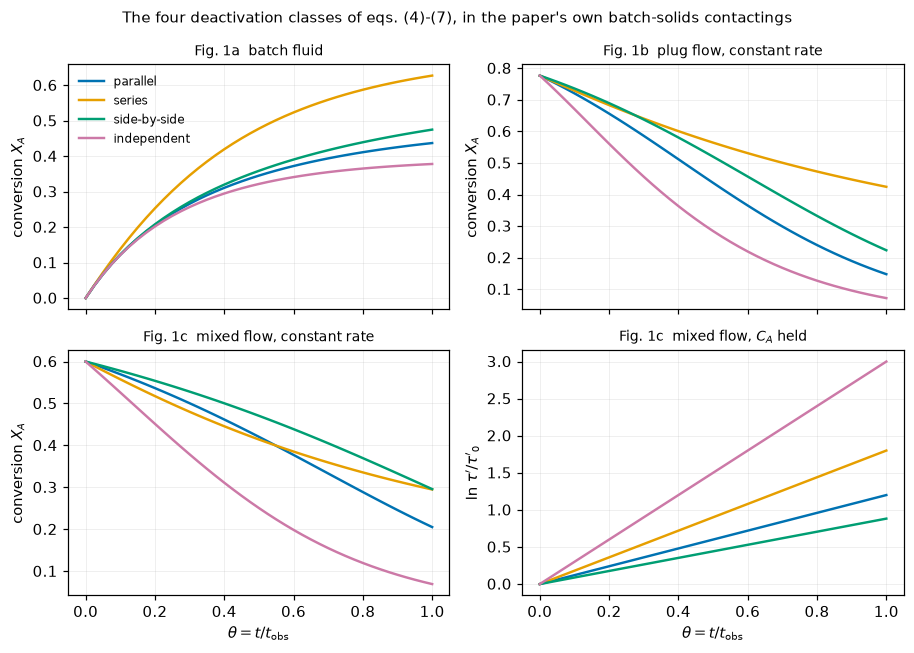
observable spans (the signal a fit has to reproduce):
               batch    plug   mixed  constC
parallel      0.4372  0.6291  0.3946  1.2000
series        0.6274  0.3523  0.3050  1.8000
side-by-side  0.4751  0.5533  0.3041  0.8824
independent   0.3782  0.7049  0.5305  3.0000
4. Five exact degeneracies, and they reach every device
Before any optimiser runs: every one of the four devices collapses some pair of classes onto another identically, and each collapse is a one-line algebraic fact about the device, not a numerical coincidence. Each is stated, proved symbolically, and then confirmed by running the two “different” classes and subtracting.
- \(n' = 0\) collapses all four, everywhere. With no concentration in the decay law, eqs. (4)–(6) are eq. (7). This is the paper’s own statement (p. 267, “When concentration independent (or \(n' = 0\)) then any type of batch-solids system may be used”), and it is why the taxonomy has a fourth member at all.
- Mixed flow at constant rate: series is parallel, relabelled. The performance relation (16) is algebraic, so \(C_{\rm R}/C_{\rm A0} = \kappa\,(C_{\rm A}/C_{\rm A0})^{n} a\) exactly at every instant. Hence \(C_{\rm R}^{\,n'} \propto C_{\rm A}^{\,n n'} a^{\,n'}\), and series with orders \((n', d)\) is identical to parallel with orders \((n\,n',\, d+n')\) and \(k_d \to k_d \kappa^{n'}\). Every observable, at every time. A well-mixed fluid cannot tell the two apart, ever.
- Held-\(C_{\rm A}\) mixed flow: everything is independent deactivation. That is what “decoupling” means. With \(C_{\rm A}\) (hence \(C_{\rm R}\)) held fixed, \(k'_d = k_dC_{\rm A}^{n'}\) or \(k_dC_{\rm R}^{n'}\) or \(k_d\) are all just constants, and eq. (26) is the same equation for all three classes. At \(d = 1\) side-by-side joins them, because the poison consumed per unit time then goes as \(a^{d-1}\) = const and \(C_{\rm P}\) settles at a fixed value: all four classes are one equation there. The device Levenspiel recommends is the one in which, within a single run, the classes are least distinguishable.
- Side-by-side is parallel wherever the poison profile equals the reactant profile. The poison obeys the same first-order form as the reactant, \(-dp/d(\cdot) = \sigma\lambda\,a^{\,d}p^{\,n'}\) against \(-dc/d(\cdot) = \kappa\,a\,c^{\,n}\), so at \(d = 1\), \(n' = n\) and \(\sigma = \kappa/\lambda\) the two are the same differential equation with the same initial value: \(p \equiv c\), identically, and eq. (6) becomes eq. (4) with the same constants. This holds in the batch, in the plug-flow bed and in the constant-flow mixed reactor alike: it is a property of the rate forms, not of the contacting.
- And with \(\sigma\) free: side-by-side is parallel with a relabelled \(n'\). At \(n = n' = d = 1\) the two profiles are powers of one another: \(p = c^{\lambda\sigma/\kappa}\) in the bed (both are \(\exp(-\text{const} \int a)\)), and \(c = p^{\kappa/(\lambda\sigma)}\) in a batch of fluid (where \(p = 1-\sigma(1-a)\) is exactly affine in the activity). So the side-by-side driver is a power of the parallel driver, and side-by-side with any \(\sigma\) is parallel with \(n' \to \lambda\sigma/\kappa\), same \(\kappa,\lambda,d\). Degeneracy 4 is the equal-parameter slice of this family (\(\sigma = \kappa/\lambda\) makes the relabelled order 1 again). This one holds in the batch and the bed and nowhere else: in the two well-mixed devices the profiles are not powers of each other, and the measurement below shows the identity failing there by more than 1e-1.
So the plug-flow bed is not the one device without an exact degeneracy. It carries degeneracies 1, 4 and 5, exactly as the batch of fluid does. What separates the bed and the batch from the two well-mixed devices is narrower and still real: they are the two devices in which parallel, series and independent remain algebraically distinct. What separates the bed from the batch is narrower again, and is what §6 is about: it is the only contacting with a spatial coordinate, so it is the only one whose activity carries a profile.
Each identity is checked on its condition and off it.
"""The degeneracies: predicted from algebra, then measured by subtraction."""
def below(v, b):
    """A round-off or tolerance-sized number, printed as the bound it is checked
    against; its digits differ between machines and are given only as 'here'."""
    return f"below {b:g} (here {v:.1e})"
rows = []

# (1) n' = 0 collapses the four classes in every device
for cfg in ("batch", "plug", "mixed", "constC"):
    ref = respond(cfg, "independent", 1.5, 3.0, 1.0, 0.0, 0.0, c_set=BASE["c_set"])
    worst = 0.0
    for cls in ("parallel", "series", "side-by-side"):
        y = respond(cfg, cls, 1.5, 3.0, 1.0, 0.0, 0.0, c_set=BASE["c_set"])
        worst = max(worst, float(np.max(np.abs(y - ref))))
    M[f"degen_nprime0_{cfg}"] = worst
    rows.append([f"n' = 0: all four classes identical", DEV[cfg], below(worst, 1e-12)])
# ... and the control: give the decay a concentration order and it stops holding
worst_np0, OFF_NP0 = 0.0, {}
for cfg in ("batch", "plug", "mixed", "constC"):
    ref = respond(cfg, "independent", 1.5, 3.0, 1.0, 0.0, 0.0, c_set=BASE["c_set"])
    y = respond(cfg, "parallel", 1.5, 3.0, 1.0, 0.7, 0.0, c_set=BASE["c_set"])
    OFF_NP0[cfg] = float(np.max(np.abs(y - ref)))
    worst_np0 = max(worst_np0, OFF_NP0[cfg])
M["degen_nprime0_off_condition"] = worst_np0
rows.append(["...the same comparison at n' = 0.7", "worst of the four",
             f"{worst_np0:.2e}"])

# (2) mixed flow: series(n', d) == parallel(n n', d + n'), lam -> lam kappa^n'
def _degen2(rtol):
    worst = 0.0
    for nn in (0.5, 1.0, 2.0):
        for npv, dv, lm, kp_ in ((1.0, 1.0, 3.0, 1.5), (0.5, 2.0, 2.0, 4.0),
                                 (2.0, 0.5, 1.0, 0.8)):
            ys = run_mixed("series", kp_, lm, dv, npv, n=nn, rtol=rtol)[0]
            yp = run_mixed("parallel", kp_, lm * kp_ ** npv, dv + npv, nn * npv,
                           n=nn, rtol=rtol)[0]
            worst = max(worst, float(np.max(np.abs(ys - yp))))
    return worst
worst2 = _degen2(1e-9)                 # the production tolerance
# the break row: the same nine comparisons WITHOUT the relabelling of the orders
# and of lam (series(n', d) against parallel(n', d)) are not an identity at all
DEGEN2_UNMAPPED = max(
    float(np.max(np.abs(run_mixed("series", kp_, lm, dv, npv, n=nn)[0]
                        - run_mixed("parallel", kp_, lm, dv, npv, n=nn)[0])))
    for nn in (0.5, 1.0, 2.0)
    for npv, dv, lm, kp_ in ((1.0, 1.0, 3.0, 1.5), (0.5, 2.0, 2.0, 4.0),
                             (2.0, 0.5, 1.0, 0.8)))
M["degen_mixed_series_is_parallel"] = worst2
M["degen_mixed_series_is_parallel_rtol1e-13"] = _degen2(1e-13)
rows.append(["series(n',d) == parallel(n n', d+n')", DEV["mixed"], below(worst2, 1e-8)])

# (3) held-C_A device: parallel == series == independent after relabelling lam,
#     and at d = 1 side-by-side joins them (consumption ~ a^(d-1) = const, so
#     C_P settles and its driver is a constant like the other three)
cs = BASE["c_set"]; worst3 = 0.0
for npv, dv in ((1.0, 1.0), (2.0, 3.0), (0.5, 0.0)):
    t1 = np.log(run_const_c("parallel", 1.5, 3.0, dv, npv, cs)[0])
    t2 = np.log(run_const_c("series", 1.5, 3.0 * (cs / (1 - cs)) ** npv, dv, npv, cs)[0])
    t3 = np.log(run_const_c("independent", 1.5, 3.0 * cs ** npv, dv, npv, cs)[0])
    worst3 = max(worst3, float(max(np.max(np.abs(t1 - t2)), np.max(np.abs(t1 - t3)))))
M["degen_constC_par_ser_ind"] = worst3
# the break row: series WITHOUT the relabelling lam -> lam (c/(1-c))^n'
DEGEN3_UNMAPPED = float(np.max(np.abs(
    np.log(run_const_c("parallel", 1.5, 3.0, 1.0, 1.0, cs)[0])
    - np.log(run_const_c("series", 1.5, 3.0, 1.0, 1.0, cs)[0]))))
rows.append(["parallel == series == independent", DEV["constC"], below(worst3, 1e-12)])

# (4) side-by-side(sigma = kappa/lambda, n' = n, d = 1) == parallel, IDENTICAL
#     parameters, because the poison then solves the reactant's own equation.
#     Checked in every device that has one, not just the batch.
KA, LA = 1.5, 3.0
famA = {}
for cfg, runner in (("batch", run_batch), ("plug", PLUG.run),
                    ("mixed", run_mixed)):
    on = 0.0
    for nn, dv in ((1.0, 1.0), (2.0, 1.0), (1.5, 1.0)):     # n' = n on condition
        yp = runner("parallel", KA, LA, dv, nn, n=nn)[0]
        ys = runner("side-by-side", KA, LA, dv, nn, n=nn, sig=KA / LA)[0]
        on = max(on, float(np.max(np.abs(yp - ys))))
    famA[cfg] = on
    M[f"degen_sbs_is_parallel_famA_{cfg}"] = on
    rows.append(["side-by-side(sig=kappa/lam) == parallel, n'=n and d=1",
                 DEV[cfg], below(on, 1e-12)])
OFF_A = {}                                                  # per device
for cfg, runner in (("batch", run_batch), ("plug", PLUG.run),
                    ("mixed", run_mixed)):
    OFF_A[cfg] = 0.0
    for nn, npv, dv in ((1.0, 1.0, 2.0), (1.0, 2.0, 1.0)):  # d != 1, or n' != n
        yp = runner("parallel", KA, LA, dv, npv, n=nn)[0]
        ys = runner("side-by-side", KA, LA, dv, npv, n=nn, sig=KA / LA)[0]
        OFF_A[cfg] = max(OFF_A[cfg], float(np.max(np.abs(yp - ys))))
off_cond = OFF_A["batch"]
M["degen_batch_sbs_is_parallel_on_condition"] = famA["batch"]
M["degen_batch_sbs_off_condition"] = off_cond
rows.append(["...the same comparison OFF that condition (d = 2, or n' != n)",
             DEV["batch"], f"{off_cond:.2e}"])

# (5) sigma FREE: at n = n' = d = 1 the poison profile is a POWER of the
#     reactant profile, so side-by-side(sigma) == parallel(n' -> lam sig/kap).
#     Bed:   p = exp(-sig lam I), c = exp(-kap I)  ->  p = c^(sig lam/kap).
#     Batch: p = 1 - sig(1-a) and dln c/dln p = kap/(lam sig) -> c = p^(kap/lam sig).
#     True in those two devices ONLY; the control below is the other two.
SIG_FAM = (0.2, 0.5, 0.8, 1.5, 3.0)
famB, famB_rows = {}, []
for cfg in ("batch", "plug", "mixed", "constC"):
    worst = 0.0
    for sv in SIG_FAM:
        ys = respond(cfg, "side-by-side", KA, LA, 1.0, 1.0, sv, n=1.0,
                     c_set=BASE["c_set"])
        yp = respond(cfg, "parallel", KA, LA, 1.0, LA * sv / KA, 0.0, n=1.0,
                     c_set=BASE["c_set"])
        worst = max(worst, float(np.max(np.abs(ys - yp))))
    famB[cfg] = worst
    M[f"degen_sbs_is_parallel_famB_{cfg}"] = worst
famB_off = 0.0                       # off the n = n' = d = 1 condition, in the bed
for nn, npv, dv in ((1.0, 0.5, 1.0), (1.0, 2.0, 1.0), (1.0, 1.0, 2.0), (2.0, 1.0, 1.0)):
    ys = PLUG.run("side-by-side", KA, LA, dv, npv, n=nn, sig=BASE["sig"])[0]
    yp = PLUG.run("parallel", KA, LA, dv, npv * LA * BASE["sig"] / KA, n=nn)[0]
    famB_off = max(famB_off, float(np.max(np.abs(ys - yp))))
M["degen_sbs_famB_off_condition"] = famB_off
for cfg in ("batch", "plug"):
    rows.append([f"side-by-side(any sig) == parallel(n' = lam sig/kap), n=n'=d=1",
                 DEV[cfg], below(famB[cfg], {"batch": 1e-7, "plug": 1e-8}[cfg])])
rows.append(["...the same identity in the two WELL-MIXED devices (it fails)",
             "mixed / constC",
             f"{famB['mixed']:.2e} / {famB['constC']:.2e}"])
rows.append(["...and in the bed OFF the n = n' = d = 1 condition", DEV["plug"],
             f"{famB_off:.2e}"])

display(Markdown("**Exact degeneracies, measured as max |difference| in the "
                 "device's observable:**\n\n"
                 + md_table(pd.DataFrame(rows, columns=["identity", "device",
                                                        "max |difference|"]))))
# A ratio to a round-off residual is a ratio to noise, so every control is
# stated against the BOUND the identity is checked at, never divided by it.
print(f"\nControls. Degeneracy 4 holds to below 1e-12 on its condition and off "
      f"it (d = 2, or n' != n) separates by {off_cond:.2e}, more than 1e10 times "
      f"that bound. Degeneracy 5 holds in the batch (below 1e-7) and the bed "
      f"(below 1e-8, the integrator tolerance) over sigma = "
      f"{SIG_FAM[0]:g}-{SIG_FAM[-1]:g}, and FAILS in the mixed reactor "
      f"({famB['mixed']:.1e}) and the held-C_A device ({famB['constC']:.1e}), "
      f"each more than 1e6 times the bed's bound, and in the bed itself off "
      f"n = n' = d = 1 ({famB_off:.1e}). The identities are sharp, not "
      f"approximate.")
assert min(off_cond / 1e-12, min(famB['mixed'], famB['constC'], famB_off) / 1e-8) > 1e6
print(f"\nDegeneracy 2 is reported at the production integrator tolerance "
      f"(rtol 1e-9): below 1e-8 (here {worst2:.1e}). It is a TOLERANCE, not a "
      f"separation - re-integrating the same nine order combinations at rtol "
      f"1e-13 gives below 1e-11 (here "
      f"{M['degen_mixed_series_is_parallel_rtol1e-13']:.1e}), i.e. the identity "
      f"is exact and the printed number measures the ODE solver.")
BREAKS.append(("degen_batch_sbs_is_parallel_on_condition", famA["batch"],
               "step off the n' = n, d = 1 condition (d = 2)", off_cond,
               "shows the identity is conditional, not a numerical artefact"))
BREAKS.append(("degen_sbs_is_parallel_famB_plug", famB["plug"],
               "evaluate the same sigma-family identity in the MIXED reactor",
               famB["mixed"],
               "degeneracy 5 is a property of the batch and the bed only"))
BREAKS.append(("degen_mixed_series_is_parallel", worst2,
               "tighten the integrator from rtol 1e-9 to 1e-13",
               M["degen_mixed_series_is_parallel_rtol1e-13"],
               "the metric measures the ODE tolerance; the identity itself is exact"))
Exact degeneracies, measured as max |difference| in the device’s observable:
| identity | device | max |
|---|---|---|
| n’ = 0: all four classes identical | Fig. 1a batch fluid | below 1e-12 (here 0.0e+00) |
| n’ = 0: all four classes identical | Fig. 1b plug flow, constant rate | below 1e-12 (here 0.0e+00) |
| n’ = 0: all four classes identical | Fig. 1c mixed flow, constant rate | below 1e-12 (here 0.0e+00) |
| n’ = 0: all four classes identical | Fig. 1c mixed flow, \(C_A\) held | below 1e-12 (here 0.0e+00) |
| …the same comparison at n’ = 0.7 | worst of the four | 1.42e+00 |
| series(n’,d) == parallel(n n’, d+n’) | Fig. 1c mixed flow, constant rate | below 1e-08 (here 1.3e-09) |
| parallel == series == independent | Fig. 1c mixed flow, \(C_A\) held | below 1e-12 (here 8.9e-16) |
| side-by-side(sig=kappa/lam) == parallel, n’=n and d=1 | Fig. 1a batch fluid | below 1e-12 (here 0.0e+00) |
| side-by-side(sig=kappa/lam) == parallel, n’=n and d=1 | Fig. 1b plug flow, constant rate | below 1e-12 (here 0.0e+00) |
| side-by-side(sig=kappa/lam) == parallel, n’=n and d=1 | Fig. 1c mixed flow, constant rate | below 1e-12 (here 7.3e-15) |
| …the same comparison OFF that condition (d = 2, or n’ != n) | Fig. 1a batch fluid | 1.66e-02 |
| side-by-side(any sig) == parallel(n’ = lam sig/kap), n=n’=d=1 | Fig. 1a batch fluid | below 1e-07 (here 2.5e-09) |
| side-by-side(any sig) == parallel(n’ = lam sig/kap), n=n’=d=1 | Fig. 1b plug flow, constant rate | below 1e-08 (here 1.9e-11) |
| …the same identity in the two WELL-MIXED devices (it fails) | mixed / constC | 1.19e-01 / 3.53e-01 |
| …and in the bed OFF the n = n’ = d = 1 condition | Fig. 1b plug flow, constant rate | 1.12e-01 |
Controls. Degeneracy 4 holds to below 1e-12 on its condition and off it (d = 2, or n' != n) separates by 1.66e-02, more than 1e10 times that bound. Degeneracy 5 holds in the batch (below 1e-7) and the bed (below 1e-8, the integrator tolerance) over sigma = 0.2-3, and FAILS in the mixed reactor (1.2e-01) and the held-C_A device (3.5e-01), each more than 1e6 times the bed's bound, and in the bed itself off n = n' = d = 1 (1.1e-01). The identities are sharp, not approximate.

Degeneracy 2 is reported at the production integrator tolerance (rtol 1e-9): below 1e-8 (here 1.3e-09). It is a TOLERANCE, not a separation - re-integrating the same nine order combinations at rtol 1e-13 gives below 1e-11 (here 1.1e-13), i.e. the identity is exact and the printed number measures the ODE solver.
5. Separability, measured
The only honest test of a discriminability claim is to inject the wrong class and see whether anything moves. For every device and every pair \((T, C)\) of classes, the response generated by \(T\) is handed to a fitter that is free to choose \(C\)’s parameters (\(\kappa\), \(\lambda\), \(d\), \(n'\) and, for side-by-side, \(\sigma\)), and the residual it cannot remove is reported.
\(D(T\!\to\!C)\) is therefore the RMS conversion resolution an experiment needs before it can refute \(C\). Read it against your own instrument: 2e-3 is a good laboratory chromatograph, 1e-4 is not achievable.
An optimiser bound is not a measurement, and where §4 supplies an exact twin the twin is used instead. Each of the five degeneracies names a specific parameter vector at which some candidate reproduces some truth exactly: \(n'=0\) for degeneracy 1, \((nn', d+n')\) with \(\lambda\kappa^{n'}\) for degeneracy 2, and so on. Those points are inside the fitter’s own bounds and next to its own seed grid, and yet the optimiser does not always find them: with the fit alone, an entry whose exact minimum is zero can come out well above it. The count and the size are printed below, not typed here. So every entry is evaluated both ways (the multistart fit, and the identity twin where §4 predicts one), and the matrix reports the smaller, flagged as an identity. An entry with no predicted twin is the fit alone and is an upper bound; the table below says which is which.
The diagonal’s exact minimum is zero by construction, since it is a class fitted to its own response with every parameter free. Any non-zero diagonal is therefore an optimiser stall, not a null and not a result, and the twin (the truth itself) sets those entries to zero exactly. The fit alone is still reported, with one caveat stated up front: for parallel, series and independent the seed grid contains the truth (to the last bit of its log transform), so those twelve diagonal fits only evaluate the truth and test nothing about recovery. The side-by-side column is the real test, because \(\sigma\) is seeded at 1 and the truth is 0.8: from that off-truth start the fit gets below \(10^{-9}\), the integrator’s own tolerance, on all four devices, so the fitter’s floor sits six orders below the instrument resolution and no threshold on this page needs anything beyond the instrument.
That the five constants of eq. (6) trade against each other is measured with a profile, not read off where an optimiser stopped. One constant is held away from the truth, the other four are refitted, and the smallest residual left is reported; it is compared with what a +1 % move of a single constant costs when the other four are held at the truth. Both tables are printed below.
"""The separability matrices.  Two-stage multistart: screen every seed cheaply,
then polish the best two.  Deterministic - a fixed seed list, no randomness."""
def _unpack(cls, x):
    kappa, lam, d = np.exp(x[0]), np.exp(x[1]), x[2]
    if cls == "independent":
        return kappa, lam, d, 0.0, 0.0
    if cls == "side-by-side":
        return kappa, lam, d, x[3], np.exp(x[4])
    return kappa, lam, d, x[3], 0.0

def _bounds(cls):
    # deliberately physical: d and n' are ORDERS in eqs. (4)-(7), kappa and lam
    # are a Damkoehler number and a decay-per-window.  Wider boxes only add
    # pathological corners where the ODE is expensive and no fit ever lands.
    lo, hi = [np.log(5e-2), np.log(5e-2), 0.0], [np.log(3e1), np.log(6e1), 4.0]
    if cls != "independent":
        lo.append(0.0); hi.append(3.0)
    if cls == "side-by-side":
        lo.append(np.log(1e-2)); hi.append(np.log(2e1))
    return np.array(lo), np.array(hi)

def _seeds(cls, kappa0, lam0):
    """A fixed, class-independent seed grid over the two ORDERS - the parameters
    the landscape is nonconvex in.  It contains the base point (d, n') = (1, 1)
    for every candidate alike, which is what makes the diagonal (the fitter
    recovering the truth) a meaningful null rather than a lucky start."""
    out = []
    for dv in (0.5, 1.0, 2.0, 3.0):
        base = [np.log(kappa0), np.log(lam0), dv]
        if cls == "independent":
            out.append(base)
        elif cls == "side-by-side":
            # sigma is a smooth scale, not an order: one seed, found by descent
            out += [base + [npv, np.log(1.0)] for npv in (0.5, 1.0, 2.0)]
        else:
            out += [base + [npv] for npv in (0.5, 1.0, 2.0)]
    return out

class _Budget(Exception):
    """Raised inside the residual to cap the cost of one fit."""

CAPPED = []          # entries whose evaluation budget bound
EVALS = {}           # tag -> share of the budget that fit used

def fit_class(config, target, cls, kappa0=1.5, lam0=3.0, n=1.0, c_set=0.4,
              theta=TH, nfev=300, keep=2, rounds=5, seeds=None, budget=10000,
              tag=None):
    """Best fit of one class to one response.  Deterministic: a fixed seed grid
    over the two ORDERS (the parameters the landscape is nonconvex in), ranked
    by a direct residual evaluation, then the best `keep` polished with
    x_scale='jac'.

    The Jacobian is a CENTRAL difference with a relative step of 1e-4. The
    residual is an ODE solution, accurate to rtol 1e-9 and not smooth below
    that, so scipy's default (a one-sided step of about 1.5e-8) differentiates
    the integrator's error rather than the model, and on an ill-conditioned
    valley the trust region then stops at a point set by round-off. With the
    step well above the integrator noise the side-by-side diagonal (the fitter
    recovering the truth from off-truth seeds) is measured below.

    `budget` caps the residual evaluations of ONE fit, Jacobian evaluations
    included.  The best value seen is kept, so a capped fit can only report a
    residual that is too LARGE.  Capped entries are listed, and the summary
    below refuses to call anything separable on one; the largest share of the
    budget any fit used is a claim of its own."""
    lo, hi = _bounds(cls)
    state = {"n": 0, "best": np.inf, "capped": False, "bx": None}
    def res(x):
        state["n"] += 1
        if state["n"] > budget:
            state["capped"] = True
            raise _Budget
        kk, ll, dv, npv, sg = _unpack(cls, x)
        try:
            y = respond(config, cls, kk, ll, dv, npv, sg, n=n, c_set=c_set,
                        theta=theta)
        except Exception:
            return np.full(target.size, 1e2)
        r = (y - target) if np.all(np.isfinite(y)) else np.full(target.size, 1e2)
        v_ = float(np.sqrt(np.mean(r ** 2)))
        if v_ < state["best"]:          # keep the ARGMIN, not just the minimum:
            state["best"] = v_          # the recovered parameters are a result
            state["bx"] = np.array(x, float)
        return r
    grid = [np.clip(np.asarray(x0, float), lo + 1e-9, hi - 1e-9)
            for x0 in (seeds or _seeds(cls, kappa0, lam0))]
    try:
        ranked = sorted(grid, key=lambda x0: float(np.sqrt(np.mean(res(x0) ** 2))))
    except _Budget:
        ranked = grid
    bx = ranked[0]
    for x0 in ranked[:keep]:
        x, prev = x0, np.inf
        for _ in range(rounds):
            # a trust-region solve can stall well short of the minimum; restart
            # it from its own answer while it keeps gaining.  This is what takes
            # the exact degeneracies from ~1e-6 to machine zero.
            try:
                r = least_squares(res, x, bounds=(lo, hi), xtol=1e-15, ftol=1e-15,
                                  gtol=1e-15, max_nfev=nfev, x_scale="jac",
                                  jac="3-point", diff_step=1e-4)
            except _Budget:
                break
            except Exception:
                break
            v = float(np.sqrt(np.mean(r.fun ** 2)))
            x = r.x
            if v <= state["best"] + 1e-300:
                bx = r.x
            if v < 1e-13 or v > 0.9 * prev:
                break
            prev = v
        if state["capped"]:
            break
    if tag is not None:
        EVALS[tag] = min(state["n"], budget + 1) / budget
    if state["capped"] and tag is not None:
        CAPPED.append(tag)
    return state["best"], (bx if state["bx"] is None else state["bx"])

# ------------------------------------------------- the identity twins, sec. 4
def _in_bounds(cls, p):
    """Is this parameter vector inside the box the fitter is allowed to search?
    A twin the optimiser could not legally reach is NOT a fair replacement."""
    kk, ll, dv, npv, sg = p
    x = [np.log(kk), np.log(ll), dv]
    if cls != "independent":
        x.append(npv)
    if cls == "side-by-side":
        x.append(np.log(max(sg, 1e-300)))
    lo, hi = _bounds(cls)
    return bool(np.all(np.asarray(x) >= lo - 1e-12)
                and np.all(np.asarray(x) <= hi + 1e-12))

def twin_params(config, truth, cand, kap, lam, d, npv, sig, n, c_set):
    """The parameter vector at which `cand` reproduces `truth` EXACTLY, from the
    identities of section 4 - or None where no identity predicts one.  This is
    an algebraic prediction; the residual it produces is measured, not asserted."""
    if cand == truth:                                   # its own truth: exact
        return (kap, lam, d, npv, sig)
    if truth == "independent":                          # degeneracy 1: n' = 0
        return (kap, lam, d, 0.0, 1.0)
    if config == "constC" and (truth != "side-by-side" or d == 1.0):
        # degeneracy 3: every driver is a CONSTANT, so only lam' = lam f^n' shows
        f = {"parallel": c_set, "series": 1.0 - c_set,
             "independent": 1.0}.get(truth)
        if f is None:       # side-by-side at d = 1: C_P settles at a fixed value
            f = _mixed_p(sig * lam * (1.0 - c_set) / (kap * _pow(c_set, n)), npv)
        lam_eff = lam * _pow(f, npv)
        if cand == "parallel":
            return (kap, lam_eff / c_set, d, 1.0, 0.0)
        if cand == "series":
            return (kap, lam_eff / (1.0 - c_set), d, 1.0, 0.0)
        if cand == "independent":
            return (kap, lam_eff, d, 0.0, 0.0)
        return (kap, lam_eff, d, 0.0, 1.0)              # s-b-s with n' = 0
    if config == "mixed" and truth == "series" and cand == "parallel":
        return (kap, lam * _pow(kap, npv), d + npv, n * npv, 0.0)   # degeneracy 2
    if config == "mixed" and truth == "parallel" and cand == "series":
        ds = d - npv / n                                # the twin needs d_s >= 0
        return None if ds < 0.0 else (kap, lam * _pow(kap, -npv / n), ds,
                                      npv / n, 0.0)
    if truth == "parallel" and cand == "side-by-side":
        if d == 1.0 and npv == n:                       # degeneracy 4: p == c
            return (kap, lam, d, npv, kap / lam)
        if config in ("batch", "plug") and d == 1.0 and n == 1.0:
            return (kap, lam, 1.0, 1.0, kap * npv / lam)          # degeneracy 5
        return None
    if truth == "side-by-side" and cand == "parallel":
        if d == 1.0 and npv == n and sig == kap / lam:  # degeneracy 4
            return (kap, lam, d, npv, 0.0)
        if config in ("batch", "plug") and d == 1.0 and n == 1.0 and npv == 1.0:
            return (kap, lam, 1.0, lam * sig / kap, 0.0)          # degeneracy 5
        return None
    return None

def twin_residual(config, truth, cand, base, n, theta=TH):
    """RMS residual of the identity twin, or (None, None) if none is predicted."""
    p = twin_params(config, truth, cand, base["kappa"], base["lam"], base["d"],
                    base["nprime"], base["sig"], n, base["c_set"])
    if p is None or not _in_bounds(cand, p):
        return None, p
    y = respond(config, truth, base["kappa"], base["lam"], base["d"],
                base["nprime"], base["sig"], n=n, c_set=base["c_set"],
                theta=theta)
    yt = respond(config, cand, p[0], p[1], p[2], p[3], p[4], n=n,
                 c_set=base["c_set"], theta=theta)
    return float(np.sqrt(np.mean((yt - y) ** 2))), p

def sep_matrix(config, base=BASE, n=None, **kw):
    """D[i, j] = min(multistart fit, identity twin).  FIT records what the
    optimiser alone found; TWIN records the identity, where section 4 predicts
    one; BX records the parameters the optimiser recovered."""
    n = base["n"] if n is None else n
    D = np.zeros((4, 4)); FIT = np.zeros((4, 4)); TWIN = np.full((4, 4), np.nan)
    BX = {}
    for i, truth in enumerate(CLASSES):
        y = respond(config, truth, base["kappa"], base["lam"], base["d"],
                    base["nprime"], base["sig"], n=n, c_set=base["c_set"])
        for j, cand in enumerate(CLASSES):
            v, bx = fit_class(config, y, cand, base["kappa"], base["lam"], n=n,
                              c_set=base["c_set"], tag=(config, truth, cand),
                              **kw)
            FIT[i, j] = v; BX[(truth, cand)] = _unpack(cand, bx)
            tw, _ = twin_residual(config, truth, cand, base, n)
            if tw is not None:
                TWIN[i, j] = tw
            D[i, j] = v if tw is None else min(v, tw)
    return D, FIT, TWIN, BX

# 64 fits: 4 devices x 4 truths x 4 candidates.  No timing is printed - two
# executions of this notebook must produce byte-identical content.
SEP, SEP_FIT, SEP_TWIN, SEP_BX = {}, {}, {}, {}
for cfg in ("batch", "plug", "mixed", "constC"):
    SEP[cfg], SEP_FIT[cfg], SEP_TWIN[cfg], SEP_BX[cfg] = sep_matrix(cfg)
print(f"{4 * len(CLASSES) ** 2} fits done "
      f"({len(_seeds('side-by-side', 1.5, 3.0))} seeds for the 5-parameter "
      f"side-by-side candidate, {len(_seeds('parallel', 1.5, 3.0))} for the "
      f"others, no randomness anywhere)")
for cfg, D in SEP.items():
    lab = np.where(np.isfinite(SEP_TWIN[cfg]), "*", " ")
    # identity-backed entries are at the integrator's round-off, whose digits
    # differ between machines: they are printed as the bound they are checked at
    df = pd.DataFrame([[("0*" if D[i, j] == 0.0 else "<1e-8*") if lab[i, j] == "*"
                        else f"{D[i, j]:.2e}" for j in range(4)]
                       for i in range(4)],
                      index=[f"truth: {c}" for c in CLASSES],
                      columns=[f"fit {SHORT[c]}" for c in CLASSES])
    display(Markdown(f"**{DEV[cfg]}** - min(multistart fit, identity twin); "
                     f"`*` marks an entry whose minimum is an EXACT identity of "
                     f"section 4, not a measured separation (units: "
                     + ("ln tau'" if cfg == "constC" else "fractional conversion")
                     + ")\n\n" + md_table(df, index=True)))
    for i, tr in enumerate(CLASSES):
        for j, cd in enumerate(CLASSES):
            M[f"sep_{cfg}_{SHORT[tr]}_vs_{SHORT[cd]}"] = float(D[i, j])

# --- how much of the matrix is identity, and how far the optimiser alone was --
tw_all = np.concatenate([SEP_TWIN[c].ravel() for c in SEP])
ft_all = np.concatenate([SEP_FIT[c].ravel() for c in SEP])
has = np.isfinite(tw_all)
over = ft_all[has] - tw_all[has]
M["sep_identity_backed"] = float(has.sum())
M["sep_identity_twin_worst"] = float(np.max(tw_all[has]))
# registered as a thresholded count with its margin; differences below 1e-8 are
# the integrator's round-off and are recorded as 0, so the margin is not noise
SEP_OVER = np.where(np.abs(over) < 1e-8, 0.0, over)
M["sep_optimiser_worst_overstatement"] = float(np.max(over))
ov_rows = [[DEV[cfg], f"truth {tr}", f"fit {SHORT[cd]}",
            f"{SEP_FIT[cfg][i, j]:.2e}", "<1e-8"]
           for cfg in SEP for i, tr in enumerate(CLASSES)
           for j, cd in enumerate(CLASSES)
           if np.isfinite(SEP_TWIN[cfg][i, j])
           and SEP_FIT[cfg][i, j] - SEP_TWIN[cfg][i, j] > 1e-6]
display(Markdown(
    f"**{int(M['sep_identity_backed'])} of 64 entries have an exact identity "
    f"behind them** (every twin residual below 1e-8, the ODE tolerance, not a "
    f"separation; here at worst {M['sep_identity_twin_worst']:.1e}). For "
    f"{int((over > 1e-6).sum())} of them the multistart alone stopped "
    f"more than 1e-6 short - the entries a fit-only matrix would have "
    f"printed as measured separations:\n\n"
    + md_table(pd.DataFrame(ov_rows, columns=["device", "truth", "candidate",
                                              "multistart fit alone",
                                              "identity twin"]))))
print(f"Every such error is in the SAFE direction (an optimiser bound is an "
      f"upper bound on a minimum), and none crosses a threshold below: the "
      f"largest, {M['sep_optimiser_worst_overstatement']:.2e}, is under the "
      f"{RES_X:g} conversion resolution. But printed as a fit it would have read "
      f"as the measurement of a separation that is exactly zero.")
assert M["sep_optimiser_worst_overstatement"] < RES_X, \
    "an optimiser shortfall now crosses the instrument resolution - a verdict "\
    "would change, and the sentence above would be false"
# the break row: the worst entry refitted with the twin's own parameters added
# as a seed
_worst = max(((cfg, i, j) for cfg in SEP for i in range(4) for j in range(4)
              if np.isfinite(SEP_TWIN[cfg][i, j])),
             key=lambda e: SEP_FIT[e[0]][e[1], e[2]] - SEP_TWIN[e[0]][e[1], e[2]])
_cfg, _i, _j = _worst
_tw = twin_params(_cfg, CLASSES[_i], CLASSES[_j], BASE["kappa"], BASE["lam"],
                  BASE["d"], BASE["nprime"], BASE["sig"], BASE["n"], BASE["c_set"])
_x = [np.log(_tw[0]), np.log(_tw[1]), _tw[2]]
if CLASSES[_j] != "independent":
    _x.append(_tw[3])
if CLASSES[_j] == "side-by-side":
    _x.append(np.log(_tw[4]))
_y = respond(_cfg, CLASSES[_i], BASE["kappa"], BASE["lam"], BASE["d"], BASE["nprime"],
             BASE["sig"], n=BASE["n"], c_set=BASE["c_set"])
OVER_TWIN_SEEDED = float(fit_class(_cfg, _y, CLASSES[_j], BASE["kappa"], BASE["lam"],
                                   n=BASE["n"], c_set=BASE["c_set"],
                                   seeds=_seeds(CLASSES[_j], BASE["kappa"], BASE["lam"])
                                   + [_x])[0] - SEP_TWIN[_cfg][_i, _j])
print(f"The largest shortfall ({DEV[_cfg]}, truth {CLASSES[_i]}, candidate "
      f"{CLASSES[_j]}) is a wrong basin, not noise: with the twin's parameters "
      f"added to the seed list the same fit closes it to below 1e-8 (here "
      f"{abs(OVER_TWIN_SEEDED):.0e}).")
# and the twin bound's break row: degeneracy 2's twin WITHOUT the lam mapping
_b = BASE
_ys = respond("mixed", "series", _b["kappa"], _b["lam"], _b["d"], _b["nprime"], 0.0)
_yp = respond("mixed", "parallel", _b["kappa"], _b["lam"], _b["d"] + _b["nprime"],
              _b["n"] * _b["nprime"], 0.0)
TWIN_UNMAPPED = float(np.sqrt(np.mean((_ys - _yp) ** 2)))

# ------------------------------------------------------- the optimiser's stall
# The diagonal is a class fitted to its OWN response with every parameter free,
# so its exact minimum is identically zero: any non-zero diagonal is an
# optimiser stall, not a null and not a result.  The twin (the truth itself)
# sets the diagonal of the matrix above to zero; what is reported here is how
# far the multistart ALONE got.  It is a BOUND, below 1e-9, the ODE tolerance.
for cfg in SEP:
    M[f"sep_stall_{cfg}"] = float(np.max(np.diag(SEP_FIT[cfg])))
M["sep_stall_worst"] = float(max(M[f"sep_stall_{cfg}"] for cfg in SEP))
M["sep_stall_worst_not_sbs"] = float(max(
    SEP_FIT[cfg][i, i] for cfg in SEP for i, c in enumerate(CLASSES)
    if c != "side-by-side"))
# printed as the bound each entry is checked at: the digits are round-off
stall_df = pd.DataFrame({DEV[cfg]: {c: ("<1e-9" if SEP_FIT[cfg][i, i] < 1e-9
                                        else f"{SEP_FIT[cfg][i, i]:.1e}")
                                    + ("" if c == "side-by-side" else " (seed = truth)")
                                    for i, c in enumerate(CLASSES)} for cfg in SEP})
display(Markdown("**The multistart on the diagonal** - the same machinery asked "
                 "to recover the truth, whose exact minimum is 0 by "
                 "construction. Only the side-by-side row starts off the truth "
                 "(sigma seeded at 1, truth 0.8); the other three rows only "
                 "evaluate it:\n\n" + md_table(stall_df, index=True)))
print(f"every side-by-side diagonal fit, started off the truth, reaches below "
      f"1e-9 (here at worst {max(SEP_FIT[c][2, 2] for c in SEP):.1e}), so the "
      f"fitter's own floor is six orders below the {RES_X:g} conversion "
      f"resolution and binds nowhere.")
assert M["sep_stall_worst"] < 1e-9, "the fitter no longer recovers the truth"
# the break row for the stall bounds: the same diagonal fits stopped after
# three evaluations of the polish, i.e. an optimiser that quits early.  The
# parallel seed grid contains the truth itself, so that fit starts from one
# seed off it, (kappa, lam) x (1.2, 0.8) and (d, n') = (1.5, 1.5)
STALL_EARLY = {}
for cfg in SEP:
    for cls in ("parallel", "side-by-side"):
        y_ = respond(cfg, cls, BASE["kappa"], BASE["lam"], BASE["d"],
                     BASE["nprime"], BASE["sig"], n=BASE["n"], c_set=BASE["c_set"])
        sd = ([[np.log(1.2 * BASE["kappa"]), np.log(0.8 * BASE["lam"]), 1.5, 1.5]]
              if cls == "parallel" else None)
        STALL_EARLY[(cfg, cls)] = fit_class(cfg, y_, cls, BASE["kappa"], BASE["lam"],
                                            n=BASE["n"], c_set=BASE["c_set"],
                                            nfev=3, keep=1, rounds=1, seeds=sd)[0]
# the break row for the shortfall count: the same count recomputed with the
# early-stopped diagonal fits in place of the converged ones
_fit_e = {c: SEP_FIT[c].copy() for c in SEP}
for (c, cl), v in STALL_EARLY.items():
    _fit_e[c][CLASSES.index(cl), CLASSES.index(cl)] = v
_over_e = (np.concatenate([_fit_e[c].ravel() for c in SEP])[has] - tw_all[has])
OVER_COUNT_EARLY = float(int((_over_e > 1e-6).sum()))

# ------------------------------------- identifiability: a profile, not a stall
# Whether eq. (6)'s five constants trade against each other is a property of
# the model, so it is measured as one: hold ONE constant away from the truth,
# refit the other four (central-difference Jacobian, the response integrated at
# rtol 1e-12), and report the smallest residual that is left.  Each profile is
# walked outward from the truth on either side, every point started from the
# previous one and from the truth.  A profile value is an optimiser UPPER bound
# on that minimum, which is the safe direction for a non-identifiability claim.
PROF_RTOL = 1e-12
X_TRUE = np.array([np.log(BASE["kappa"]), np.log(BASE["lam"]), BASE["d"],
                   BASE["nprime"], np.log(BASE["sig"])])
TRU = np.array([BASE["kappa"], BASE["lam"], BASE["d"], BASE["nprime"], BASE["sig"]])
PNAMES = ("kappa", "lambda", "d", "n'", "sigma")

def _sbs_resp(cfg, x, rtol=PROF_RTOL):
    runner = run_batch if cfg == "batch" else run_mixed
    return runner("side-by-side", np.exp(x[0]), np.exp(x[1]), x[2], x[3],
                  n=BASE["n"], sig=np.exp(x[4]), rtol=rtol)[0]

def profile(cfg, q, values):
    """Min RMS residual over the four other constants, constant q held fixed."""
    lo, hi = _bounds("side-by-side")
    y0 = _sbs_resp(cfg, X_TRUE)
    free = [i for i in range(5) if i != q]
    out, xprev = {}, X_TRUE.copy()
    for val in values:
        if (val - X_TRUE[q]) * (xprev[q] - X_TRUE[q]) < 0:
            xprev = X_TRUE.copy()                    # the other side: restart
        def r(z, val=val):
            x = X_TRUE.copy(); x[free] = z; x[q] = val
            return (_sbs_resp(cfg, x) - y0) / np.sqrt(y0.size)
        best = None
        for z0 in (xprev[free], X_TRUE[free]):
            s_ = least_squares(r, z0, bounds=(lo[free], hi[free]), jac="3-point",
                               diff_step=1e-4, x_scale="jac", xtol=1e-14,
                               ftol=1e-14, gtol=1e-14, max_nfev=400)
            if best is None or s_.cost < best.cost:
                best = s_
        xprev = X_TRUE.copy(); xprev[free] = best.x; xprev[q] = val
        out[val] = (float(np.sqrt(2.0 * best.cost)), xprev.copy())
    # the break row: the end of the range with the other four NOT refitted
    far = max(values, key=lambda v: abs(v - X_TRUE[q]))
    x_far = X_TRUE.copy(); x_far[q] = far
    unfit = float(np.sqrt(np.mean((_sbs_resp(cfg, x_far) - y0) ** 2)))
    return out, unfit

PROFILES = {   # claim name -> (device, constant held, values, bound)
    "sep_profile_d_batch": ("batch", 2, (1.05, 1.1, 1.2, 1.35, 1.5,
                                          0.95, 0.9, 0.8, 0.65, 0.5), 2e-4),
    "sep_profile_d_mixed": ("mixed", 2, (1.05, 1.1, 1.2, 1.35, 1.5,
                                          0.95, 0.9, 0.8, 0.65, 0.5), 2e-4),
    "sep_profile_nprime_mixed": ("mixed", 3, (1.1, 1.2, 1.35, 1.5,
                                               0.9, 0.8, 0.65, 0.5), 2e-4),
}
_plo, _phi = _bounds("side-by-side")
PROF, PROF_UNFIT, prof_rows = {}, {}, []
for name, (cfg, q, vals, bnd) in PROFILES.items():
    PROF[name], PROF_UNFIT[name] = profile(cfg, q, vals)
    M[name] = float(max(v for v, _ in PROF[name].values()))
    for val in sorted(PROF[name]):
        v, x = PROF[name][val]
        p_ = [np.exp(x[0]), np.exp(x[1]), x[2], x[3], np.exp(x[4])]
        # a free constant pinned at the edge of the fitter's box: that point is
        # an upper bound limited by the box, not by the model
        edge = [PNAMES[i] for i in range(5) if i != q
                and min(x[i] - _plo[i], _phi[i] - x[i]) < 1e-6]
        prof_rows.append([DEV[cfg], f"{PNAMES[q]} = {val:g}", f"{v:.1e}"]
                         + [f"{w:.3f}" for w in p_]
                         + [", ".join(edge) if edge else "-"])
display(Markdown("**Profiles of the side-by-side self-fit** (one constant held, "
                 "the other four refitted; truth "
                 + ", ".join(f"{p} = {v:g}" for p, v in zip(PNAMES, TRU))
                 + "):\n\n"
                 + md_table(pd.DataFrame(prof_rows, columns=["device", "held",
                                                             "min RMS residual"]
                                         + list(PNAMES)
                                         + ["free constant at the box edge"]))))

# ... against what a move along a single coordinate costs when nothing refits
cost_rows, COST_2PCT = [], {}
for cfg in ("batch", "mixed"):
    y0 = respond(cfg, "side-by-side", *TRU, n=BASE["n"], c_set=BASE["c_set"])
    costs = []
    for q in range(5):
        p = TRU.copy(); p[q] *= 1.01
        y1 = respond(cfg, "side-by-side", *p, n=BASE["n"], c_set=BASE["c_set"])
        costs.append(float(np.sqrt(np.mean((y1 - y0) ** 2))))
    M[f"sep_stall_1pct_cheapest_{cfg}"] = float(min(costs))
    # break row: the cheapest constant moved by 2 % instead of 1 %
    p = TRU.copy(); p[int(np.argmin(costs))] *= 1.02
    y2 = respond(cfg, "side-by-side", *p, n=BASE["n"], c_set=BASE["c_set"])
    COST_2PCT[cfg] = float(np.sqrt(np.mean((y2 - y0) ** 2)))
    cost_rows.append([DEV[cfg]] + [f"{c:.2e}" for c in costs])
display(Markdown("**What a move along a single coordinate costs** (+1 % in one "
                 "constant, the others held at the truth, RMS change in the "
                 "response):\n\n"
                 + md_table(pd.DataFrame(cost_rows, columns=["device"]
                                         + [f"+1 % {p}" for p in PNAMES]))))
_edge = [r[:2] for r in prof_rows if r[-1] != "-"]
print(f"Read the two tables together. Holding d anywhere in [0.5, 1.5], in "
      f"either device, or n' anywhere in [0.5, 1.5] (mixed flow), the other four "
      f"constants refit to an RMS residual below 2e-4, a tenth of the "
      f"conversion resolution (here at most {M['sep_profile_d_batch']:.1e} "
      f"batch d, {M['sep_profile_d_mixed']:.1e} mixed d, "
      f"{M['sep_profile_nprime_mixed']:.1e} mixed n'), while +1 % on any single "
      f"constant with the other four held at the truth costs at least "
      f"{min(M['sep_stall_1pct_cheapest_batch'], M['sep_stall_1pct_cheapest_mixed']):.1e}. "
      f"That is what 'the five constants of eq. (6) trade against each other' "
      f"means quantitatively: an ORDER held up to 50 % away from the truth is "
      f"absorbed by the other constants to below what a 1 % move of one "
      f"constant costs, so the constants of eq. (6) are not separately "
      f"identifiable from one run in either device. The profile values are "
      f"optimiser upper bounds on a minimum, the safe direction for that "
      f"claim; where a free constant ends on the edge of the fitter's box "
      f"({'; '.join(f'{a}, {b}' for a, b in _edge) if _edge else 'nowhere'}) the "
      f"bound is set by the box, which can only make it larger.")
assert max(M[n] for n in PROFILES) < min(M['sep_stall_1pct_cheapest_batch'],
                                         M['sep_stall_1pct_cheapest_mixed'])
M["fits_capped"] = float(len(CAPPED))
# break row: the same machinery with a budget of 50 evaluations is recorded
_n0 = len(CAPPED)
fit_class("batch", respond("batch", "side-by-side", *TRU, n=BASE["n"]), "side-by-side",
          BASE["kappa"], BASE["lam"], n=BASE["n"], budget=50, tag=("budget-break",))
FITS_CAPPED_BROKEN = float(len(CAPPED)); del CAPPED[_n0:]
print(f"\nfits whose evaluation budget bound: {len(CAPPED)} of 64"
      + (f" -> {CAPPED}" if CAPPED else ""))
64 fits done (12 seeds for the 5-parameter side-by-side candidate, 12 for the others, no randomness anywhere)Fig. 1a batch fluid - min(multistart fit, identity twin); * marks an entry whose minimum is an EXACT identity of section 4, not a measured separation (units: fractional conversion)
| index | fit par | fit ser | fit s-b-s | fit ind |
|---|---|---|---|---|
| truth: parallel | 0* | 1.59e-04 | <1e-8* | 1.59e-04 |
| truth: series | 1.76e-03 | 0* | 1.76e-03 | 1.76e-03 |
| truth: side-by-side | <1e-8* | 1.03e-04 | 0* | 1.03e-04 |
| truth: independent | 0* | 0* | 0* | 0* |
Fig. 1b plug flow, constant rate - min(multistart fit, identity twin); * marks an entry whose minimum is an EXACT identity of section 4, not a measured separation (units: fractional conversion)
| index | fit par | fit ser | fit s-b-s | fit ind |
|---|---|---|---|---|
| truth: parallel | 0* | 8.07e-04 | 0* | 2.20e-03 |
| truth: series | 3.74e-05 | 0* | 1.39e-05 | 2.55e-04 |
| truth: side-by-side | <1e-8* | 9.85e-04 | 0* | 1.92e-03 |
| truth: independent | 0* | 0* | 0* | 0* |
Fig. 1c mixed flow, constant rate - min(multistart fit, identity twin); * marks an entry whose minimum is an EXACT identity of section 4, not a measured separation (units: fractional conversion)
| index | fit par | fit ser | fit s-b-s | fit ind |
|---|---|---|---|---|
| truth: parallel | 0* | <1e-8* | 0* | 9.35e-04 |
| truth: series | <1e-8* | 0* | 3.45e-05 | 4.02e-04 |
| truth: side-by-side | 7.36e-06 | 8.13e-05 | 0* | 3.98e-04 |
| truth: independent | 0* | 0* | 0* | 0* |
Fig. 1c mixed flow, \(C_A\) held - min(multistart fit, identity twin); * marks an entry whose minimum is an EXACT identity of section 4, not a measured separation (units: ln tau’)
| index | fit par | fit ser | fit s-b-s | fit ind |
|---|---|---|---|---|
| truth: parallel | 0* | 0* | 0* | 0* |
| truth: series | 0* | 0* | 0* | 0* |
| truth: side-by-side | <1e-8* | <1e-8* | 0* | <1e-8* |
| truth: independent | 0* | 0* | 0* | 0* |
44 of 64 entries have an exact identity behind them (every twin residual below 1e-8, the ODE tolerance, not a separation; here at worst 1.5e-09). For 1 of them the multistart alone stopped more than 1e-6 short - the entries a fit-only matrix would have printed as measured separations:
| device | truth | candidate | multistart fit alone | identity twin |
|---|---|---|---|---|
| Fig. 1b plug flow, constant rate | truth independent | fit ser | 1.31e-03 | <1e-8 |
Every such error is in the SAFE direction (an optimiser bound is an upper bound on a minimum), and none crosses a threshold below: the largest, 1.31e-03, is under the 0.002 conversion resolution. But printed as a fit it would have read as the measurement of a separation that is exactly zero.
The largest shortfall (Fig. 1b  plug flow, constant rate, truth independent, candidate series) is a wrong basin, not noise: with the twin's parameters added to the seed list the same fit closes it to below 1e-8 (here 6e-11).
The multistart on the diagonal - the same machinery asked to recover the truth, whose exact minimum is 0 by construction. Only the side-by-side row starts off the truth (sigma seeded at 1, truth 0.8); the other three rows only evaluate it:
| index | Fig. 1a batch fluid | Fig. 1b plug flow, constant rate | Fig. 1c mixed flow, constant rate | Fig. 1c mixed flow, \(C_A\) held |
|---|---|---|---|---|
| parallel | <1e-9 (seed = truth) | <1e-9 (seed = truth) | <1e-9 (seed = truth) | <1e-9 (seed = truth) |
| series | <1e-9 (seed = truth) | <1e-9 (seed = truth) | <1e-9 (seed = truth) | <1e-9 (seed = truth) |
| side-by-side | <1e-9 | <1e-9 | <1e-9 | <1e-9 |
| independent | <1e-9 (seed = truth) | <1e-9 (seed = truth) | <1e-9 (seed = truth) | <1e-9 (seed = truth) |
every side-by-side diagonal fit, started off the truth, reaches below 1e-9 (here at worst 5.1e-11), so the fitter's own floor is six orders below the 0.002 conversion resolution and binds nowhere.Profiles of the side-by-side self-fit (one constant held, the other four refitted; truth kappa = 1.5, lambda = 3, d = 1, n’ = 1, sigma = 0.8):
| device | held | min RMS residual | kappa | lambda | d | n’ | sigma | free constant at the box edge |
|---|---|---|---|---|---|---|---|---|
| Fig. 1a batch fluid | d = 0.5 | 2.6e-06 | 1.500 | 2.992 | 0.500 | 1.432 | 0.899 | - |
| Fig. 1a batch fluid | d = 0.65 | 2.1e-06 | 1.500 | 2.994 | 0.650 | 1.293 | 0.881 | - |
| Fig. 1a batch fluid | d = 0.8 | 1.4e-06 | 1.500 | 2.996 | 0.800 | 1.160 | 0.856 | - |
| Fig. 1a batch fluid | d = 0.9 | 7.8e-07 | 1.500 | 2.998 | 0.900 | 1.076 | 0.833 | - |
| Fig. 1a batch fluid | d = 0.95 | 4.2e-07 | 1.500 | 2.999 | 0.950 | 1.037 | 0.818 | - |
| Fig. 1a batch fluid | d = 1.05 | 4.9e-07 | 1.500 | 3.002 | 1.050 | 0.967 | 0.779 | - |
| Fig. 1a batch fluid | d = 1.1 | 1.1e-06 | 1.500 | 3.003 | 1.100 | 0.938 | 0.752 | - |
| Fig. 1a batch fluid | d = 1.2 | 2.6e-06 | 1.500 | 3.009 | 1.200 | 0.911 | 0.675 | - |
| Fig. 1a batch fluid | d = 1.35 | 6.6e-06 | 1.501 | 3.024 | 1.350 | 1.216 | 0.406 | - |
| Fig. 1a batch fluid | d = 1.5 | 3.9e-05 | 1.498 | 2.972 | 1.500 | 3.000 | 0.099 | n’ |
| Fig. 1c mixed flow, constant rate | d = 0.5 | 1.6e-04 | 1.499 | 0.994 | 0.500 | 0.023 | 1.160 | - |
| Fig. 1c mixed flow, constant rate | d = 0.65 | 4.3e-05 | 1.500 | 1.315 | 0.650 | 0.169 | 1.037 | - |
| Fig. 1c mixed flow, constant rate | d = 0.8 | 1.5e-05 | 1.500 | 1.844 | 0.800 | 0.450 | 0.916 | - |
| Fig. 1c mixed flow, constant rate | d = 0.9 | 6.0e-06 | 1.500 | 2.344 | 0.900 | 0.702 | 0.853 | - |
| Fig. 1c mixed flow, constant rate | d = 0.95 | 2.7e-06 | 1.500 | 2.650 | 0.950 | 0.845 | 0.825 | - |
| Fig. 1c mixed flow, constant rate | d = 1.05 | 2.3e-06 | 1.500 | 3.400 | 1.050 | 1.165 | 0.777 | - |
| Fig. 1c mixed flow, constant rate | d = 1.1 | 4.2e-06 | 1.500 | 3.858 | 1.100 | 1.339 | 0.756 | - |
| Fig. 1c mixed flow, constant rate | d = 1.2 | 7.4e-06 | 1.500 | 4.977 | 1.200 | 1.716 | 0.719 | - |
| Fig. 1c mixed flow, constant rate | d = 1.35 | 1.1e-05 | 1.500 | 7.324 | 1.350 | 2.343 | 0.673 | - |
| Fig. 1c mixed flow, constant rate | d = 1.5 | 1.3e-05 | 1.500 | 10.766 | 1.500 | 3.000 | 0.640 | n’ |
| Fig. 1c mixed flow, constant rate | n’ = 0.5 | 1.3e-05 | 1.500 | 1.943 | 0.823 | 0.500 | 0.902 | - |
| Fig. 1c mixed flow, constant rate | n’ = 0.65 | 7.4e-06 | 1.500 | 2.240 | 0.882 | 0.650 | 0.864 | - |
| Fig. 1c mixed flow, constant rate | n’ = 0.8 | 3.6e-06 | 1.500 | 2.552 | 0.935 | 0.800 | 0.834 | - |
| Fig. 1c mixed flow, constant rate | n’ = 0.9 | 1.7e-06 | 1.500 | 2.772 | 0.968 | 0.900 | 0.816 | - |
| Fig. 1c mixed flow, constant rate | n’ = 1.1 | 1.4e-06 | 1.500 | 3.239 | 1.031 | 1.100 | 0.786 | - |
| Fig. 1c mixed flow, constant rate | n’ = 1.2 | 2.7e-06 | 1.500 | 3.488 | 1.060 | 1.200 | 0.772 | - |
| Fig. 1c mixed flow, constant rate | n’ = 1.35 | 4.3e-06 | 1.500 | 3.883 | 1.102 | 1.350 | 0.755 | - |
| Fig. 1c mixed flow, constant rate | n’ = 1.5 | 5.7e-06 | 1.500 | 4.306 | 1.143 | 1.500 | 0.739 | - |
What a move along a single coordinate costs (+1 % in one constant, the others held at the truth, RMS change in the response):
| device | +1 % kappa | +1 % lambda | +1 % d | +1 % n’ | +1 % sigma |
|---|---|---|---|---|---|
| Fig. 1a batch fluid | 2.66e-03 | 1.16e-03 | 5.35e-04 | 3.93e-04 | 5.15e-04 |
| Fig. 1c mixed flow, constant rate | 2.39e-03 | 7.93e-04 | 3.99e-04 | 7.30e-04 | 1.23e-03 |
Read the two tables together. Holding d anywhere in [0.5, 1.5], in either device, or n' anywhere in [0.5, 1.5] (mixed flow), the other four constants refit to an RMS residual below 2e-4, a tenth of the conversion resolution (here at most 3.9e-05 batch d, 1.6e-04 mixed d, 1.3e-05 mixed n'), while +1 % on any single constant with the other four held at the truth costs at least 3.9e-04. That is what 'the five constants of eq. (6) trade against each other' means quantitatively: an ORDER held up to 50 % away from the truth is absorbed by the other constants to below what a 1 % move of one constant costs, so the constants of eq. (6) are not separately identifiable from one run in either device. The profile values are optimiser upper bounds on a minimum, the safe direction for that claim; where a free constant ends on the edge of the fitter's box (Fig. 1a  batch fluid, d = 1.5; Fig. 1c  mixed flow, constant rate, d = 1.5) the bound is set by the box, which can only make it larger.

fits whose evaluation budget bound: 0 of 64
"""Read the matrices: which pairs are separable, and at what resolution."""
res_of = {"constC": RES_TAU}
rows, SEP_OFF, N_SEP = [], {}, {}
for cfg, D in SEP.items():
# The threshold is the INSTRUMENT RESOLUTION, and nothing else: the
# fitter's own floor (the diagonal, above) is below 1e-9 on every device.
thr = res_of.get(cfg, RES_X)
M[f"sep_threshold_{cfg}"] = float(thr)
off = [(CLASSES[i], CLASSES[j], D[i, j]) for i in range(4) for j in range(4)
if i != j]
sep = [o for o in off if o[2] > thr]
for o in sep:
assert (cfg, o[0], o[1]) not in CAPPED, \
f"separability claimed on a capped fit: {(cfg, o[0], o[1])}"
best = max(off, key=lambda o: o[2])
# every pair within 1e-4 relative of the largest is listed: ties (the batch
# has three at 1.764e-3) are decided by round-off, so no one of them is
# "the" pair; and where every entry is at round-off there is no pair at all
tied = [o for o in off if o[2] >= best[2] * (1 - 1e-4)]
rnd = lambda v: "<1e-8" if v < 1e-8 else f"{v:.2e}"
rows.append([DEV[cfg], f"{thr:.1e}", f"{len(sep)}/12", rnd(best[2]),
"none (all at round-off)" if best[2] < 1e-8 else
"; ".join(f"{a} vs {b}" for a, b, _ in tied),
rnd(min(o[2] for o in off))])
M[f"sep_{cfg}_best_pair"] = float(best[2])
SEP_OFF[cfg] = [0.0 if o[2] < 1e-8 else o[2] for o in off] # round-off as 0
N_SEP[cfg] = float(len(sep))
display(Markdown(
"**Which devices can separate anything at all?**\n\n"
+ md_table(pd.DataFrame(rows, columns=[
"device", "threshold used", "pairs above it",
"hardest-to-confuse pair (RMS)", "which pair", "easiest confusion"]))))
print(f"threshold = the instrument resolution: conversion {RES_X:g}, "
f"ln tau' {RES_TAU:g}. Raw residuals are in the matrices above - rescale "
f"at will.")
Which devices can separate anything at all?
| device | threshold used | pairs above it | hardest-to-confuse pair (RMS) | which pair | easiest confusion |
|---|---|---|---|---|---|
| Fig. 1a batch fluid | 2.0e-03 | 0/12 | 1.76e-03 | series vs parallel; series vs side-by-side; series vs independent | <1e-8 |
| Fig. 1b plug flow, constant rate | 2.0e-03 | 1/12 | 2.20e-03 | parallel vs independent | <1e-8 |
| Fig. 1c mixed flow, constant rate | 2.0e-03 | 0/12 | 9.35e-04 | parallel vs independent | <1e-8 |
| Fig. 1c mixed flow, \(C_A\) held | 1.0e-02 | 0/12 | <1e-8 | none (all at round-off) | <1e-8 |
threshold = the instrument resolution: conversion 0.002, ln tau' 0.01. Raw residuals are in the matrices above - rescale at will.6. Why the bed is different: the profile
The plug-flow bed is the only one of the four contactings in which \(C_{\rm A}\) and \(C_{\rm R}\) vary along the catalyst, so it is the only one whose activity is a field rather than a number. And the two classes lay down opposite profiles: under parallel decay the inlet, richest in A, dies first; under series decay the inlet stays fresh, because no R has been made yet, and the damage starts at the outlet. That is B2.2’s “descending vs ascending” signature reappearing one level of abstraction up, and it is what a well-mixed fluid throws away.
Both inlet values are exact, and neither needs the grid. At \(s = 0\) the feed is imposed, so \(c(0,\theta) = 1\) and \(C_{\rm R}(0,\theta) = 0\) at every time. Hence
- parallel: \(\partial a/\partial\theta = -\lambda\,c^{n'}a^{d} = -\lambda a\) at the feed face, so \(a(0,\theta) = e^{-\lambda\theta}\) exactly;
- series: \(\partial a/\partial\theta = -\lambda(1-c)^{n'}a^{d} = 0\) at the feed face for any \(n' > 0\), so \(a(0,\theta) \equiv 1\) exactly, at every time.
A finite-volume bed does not carry either number: its first unknown sits at the cell centre \(s = 1/2m\), and that value approaches the face value at first order in \(1/m\). The refinement is measured below, and the exact values are what the page reports.
The outlet has no closed form in the bed, so it is read on the outlet face and extrapolated twice. The activity is read where the outlet concentration is read, on the linear extrapolation of the last two cells to \(s = 1\), which is second order in \(1/m\). It is Richardson-extrapolated in space from the two finest grids, and then in time, because the space extrapolation is performed at a fixed step count and Heun’s temporal error there is larger than what the space extrapolation leaves behind. Both refinements are printed below with their observed orders, and the result is compared with the quadrature route, which has a node at \(s = 1\) and shares no operator with the bed.
This, and not the conversion history, is where the bed’s information is. The outlet histories of the two classes are a fitted RMS conversion apart that §5 printed (sep_plug_par_vs_ser, a tenth of a percentage point), while the inlet activities differ by more than an order of magnitude and the sign of the gradient differs. An assay of the spent catalyst that resolves 10 % (coke burn-off, a crushed-and-retested activity) reads that inlet contrast directly.
One caveat carried from B2.2. B2.2 measured its own within-bed coke contrast at its operating point and found the descending (parallel) signature too weak for 10 % carbon assays (its numbers are loaded below). That does not contradict what is claimed here, because the two are different quantities: B2.2’s discriminator is the gradient of the deposit along the bed, this page’s is the inlet activity itself, at one sampling point. But a reader taking the “one assay is enough” advice to a real bed should size the contrast they can actually reach, B2.2-style, before designing on it. The recommendation this page ends on is therefore not about which reactor to run but about what to measure in it.
"""Figure 2: activity profiles down the pymrm bed, parallel vs series."""
NT_PROF = 200                       # the march grid the profiles are recorded on
prof = {}
for cls in ("parallel", "series"):
    Xb, Ab, tsb = BED.march(cls, BASE["kappa"], BASE["lam"], BASE["d"],
                            BASE["nprime"], n=BASE["n"], nt=NT_PROF, theta=TH)
    prof[cls] = (Xb, Ab)
fig, axes = plt.subplots(1, 2, figsize=(8.4, 3.2))
for ax, cls in zip(axes, ("parallel", "series")):
    for tt in (0.0, 0.25, 0.5, 1.0):
        j = int(round(tt * NT_PROF))
        ax.plot(BED.s_c, prof[cls][1][:, j], color=COL[cls],
                alpha=0.35 + 0.65 * tt, lw=1.6,
                label=rf"$\theta$ = {j / NT_PROF:.2f}")
    ax.set_title(f"{cls} deactivation (eq. {4 if cls=='parallel' else 5})",
                 fontsize=9)
    ax.set_xlabel("$s = w/W$  (fraction of the catalyst passed)")
    ax.set_ylabel("activity $a$"); ax.set_ylim(-0.02, 1.02)
    ax.grid(alpha=0.25, lw=0.5); ax.legend(fontsize=7.5, frameon=False)
fig.tight_layout(); plt.show()

# --- the inlet is EXACT, and is not read off the grid -----------------------
# At s = 0 the feed is imposed: c = 1, so C_R = 0.  Hence
#   parallel: da/dtheta = -lam c^n' a^d = -lam a  ->  a(0, theta) = exp(-lam t)
#   series:   da/dtheta = -lam (1-c)^n' a^d = 0   ->  a(0, theta) = 1, exactly
# The first finite-volume unknown sits at s = 1/2m, not at s = 0, and converges
# to these at FIRST order.  The exact values are what is reported.
M["bed_a_inlet_end_par"] = float(np.exp(-BASE["lam"] * TH[-1]))
M["bed_a_inlet_end_ser"] = 1.0
GRIDS = (100, 200, 400, 800)
NT_CONV = 100          # base step count of the refinement study; the outlet is
                       # extrapolated in nt as well, and the break table halves
                       # NT_CONV to show what that is worth.
INL, OUT, OUTC = {}, {}, {}   # (class, m, nt, scheme) -> floats at theta = 1

def bed_ends(cls, m, nt, scheme="heun", limiter="vanleer"):
    """a at theta = 1: first cell centre, outlet face (linear extrapolation of
    the last two cells), last cell centre.  Cached, and returned as floats."""
    key = (cls, m, nt, scheme, limiter)
    if key not in OUT:
        b = Bed(m) if limiter == "vanleer" else Bed(m, limiter=None)
        _, Ag, _ = b.march(cls, BASE["kappa"], BASE["lam"], BASE["d"], BASE["nprime"],
                           n=BASE["n"], nt=nt, theta=TH[[0, -1]], scheme=scheme)
        INL[key] = float(Ag[0, -1])
        OUT[key] = float(interp_cntr_to_stagg(Ag[:, -1:], b.s_f, b.s_c, axis=0)[-1, 0])
        OUTC[key] = float(Ag[-1, -1])
    return INL[key], OUT[key]

gr, INLET_ERRS, OUT_ORD = [], {}, {}
FINEST6 = {"inlet": [], "space": [], "time": []}   # finest changes of the section-6 ladders
for cls in ("parallel", "series"):
    ex = M[f"bed_a_inlet_end_{SHORT[cls]}"]
    errs, outs = [], []
    for m in GRIDS:
        ain, aout = bed_ends(cls, m, NT_CONV)
        errs.append(abs(ain - ex)); outs.append(aout)
        gr.append([cls, m, f"{ain:.6f}", f"{errs[-1]:.3e}",
                   "" if len(errs) == 1 else f"{np.log2(errs[-2]/errs[-1]):.2f}",
                   f"{outs[-1]:.8f}",
                   "" if len(outs) == 1 else f"{outs[-1]-outs[-2]:+.2e}"])
    M[f"bed_a_inlet_cellcentre_err_{SHORT[cls]}"] = float(errs[-1])
    INLET_ERRS[cls] = errs
    M[f"bed_a_inlet_cellcentre_order_{SHORT[cls]}"] = float(
        np.log2(errs[-2] / errs[-1]))
    d_out = np.abs(np.diff(outs))
    FINEST6["inlet"].append(float(abs(errs[-2] - errs[-1])))
    FINEST6["space"].append(float(d_out[-1]))
    OUT_ORD[cls] = np.log2(d_out[:-1] / d_out[1:])
    M[f"bed_a_outlet_space_order_{SHORT[cls]}"] = float(OUT_ORD[cls][-1])
display(Markdown(
    "**The bed's first cell centre and outlet face, refined in SPACE** (the inlet "
    "column is measured against the EXACT face value; the outlet, which has no "
    f"closed form in the bed, is read on the outlet face at nt = {NT_CONV} and "
    "Richardson-extrapolated from the last pair, then extrapolated again, in "
    "time, in the table below):\n\n"
    + md_table(pd.DataFrame(gr, columns=[
        "class", "cells m", "a at s = 1/2m", "|error| vs the exact inlet",
        "observed order", "a at the outlet face", "change in it"]))))
print("observed order of the outlet-face activity from the changes between grids: "
      + "; ".join(f"{c} " + ", ".join(f"{o:.3f}" for o in OUT_ORD[c])
                  for c in ("parallel", "series")))

# --- the INLET study is spatial; the OUTLET reading is not -------------------
MF = GRIDS[-1]
M["bed_inlet_time_sensitivity"] = float(max(
    abs(bed_ends(c, MF, 2 * NT_CONV)[0] - bed_ends(c, MF, NT_CONV)[0])
    for c in ("parallel", "series")))
M["bed_profile_time_sensitivity"] = float(max(
    abs(bed_ends(c, MF, 2 * NT_CONV)[1] - bed_ends(c, MF, NT_CONV)[1])
    for c in ("parallel", "series")))
print(f"observed order of the cell-centre error: "
      f"{M['bed_a_inlet_cellcentre_order_par']:.2f} (parallel), "
      f"{M['bed_a_inlet_cellcentre_order_ser']:.2f} (series): first order, "
      f"which is what a 1/2m offset from the face demands.")
print(f"The INLET study is purely spatial: doubling nt at m = {MF} moves "
      f"either inlet reading by below 1e-7 (here "
      f"{M['bed_inlet_time_sensitivity']:.1e}), against a parallel cell-centre "
      f"error of {M['bed_a_inlet_cellcentre_err_par']:.2e} and a series one of "
      f"{M['bed_a_inlet_cellcentre_err_ser']:.2e}.")
print(f"The OUTLET reading is NOT: the same doubling moves it by "
      f"{M['bed_profile_time_sensitivity']:.1e}. So the outlet is extrapolated a "
      f"SECOND time, in nt.")

# --- second extrapolation: in TIME ------------------------------------------
# Richardson in space (the face reading is second order, ratio 2, so the
# correction is the last change over 3) at each of three step counts, then
# Richardson in time (Heun is second order: the last change over 3 again).
def space_rich(cls, nt, pair=None):
    o = [bed_ends(cls, m, nt)[1] for m in (GRIDS[-2:] if pair is None else pair)]
    return o[-1] + (o[-1] - o[-2]) / 3.0

NT_SET = (NT_CONV // 2, NT_CONV, 2 * NT_CONV)
QREF = {}                                  # the quadrature route, a(s = 1, theta = 1)
for cls in ("parallel", "series"):
    _q = [float(PlugExact(ns).run(cls, BASE["kappa"], BASE["lam"], BASE["d"],
                                  BASE["nprime"], n=BASE["n"], rtol=1e-12)[1][-1, -1])
          for ns in (161, 321)]
    QREF[cls] = _q[1]
    M[f"bed_a_outlet_quadrature_change_{SHORT[cls]}"] = abs(_q[1] - _q[0])
RR, tr = {}, []
for cls in ("parallel", "series"):
    sh = SHORT[cls]
    R = [space_rich(cls, nt) for nt in NT_SET]
    RR[cls] = R
    dR = (R[1] - R[0], R[2] - R[1])
    FINEST6["time"].append(float(abs(dR[1])))
    M[f"bed_a_outlet_time_order_{sh}"] = float(np.log2(dR[0] / dR[1]))
    M[f"bed_a_outlet_spaceonly_{sh}"] = float(R[1])
    M[f"bed_a_outlet_end_{sh}"] = float(R[2] + dR[1] / 3.0)
    M[f"bed_a_outlet_altpair_{sh}"] = float(R[1] + dR[0] / 3.0)
    M[f"bed_a_outlet_time_bias_{sh}"] = float(
        M[f"bed_a_outlet_spaceonly_{sh}"] - M[f"bed_a_outlet_end_{sh}"])
    # how far the SPACE extrapolation itself can still be off: the two grid
    # pairs available disagree by this much, at the base step count
    M[f"bed_a_outlet_space_spread_{sh}"] = float(abs(
        space_rich(cls, NT_CONV, GRIDS[-3:-1]) - space_rich(cls, NT_CONV)))
    M[f"bed_a_outlet_residual_bound_{sh}"] = float(max(
        abs(dR[1] / 3.0), M[f"bed_a_outlet_space_spread_{sh}"]))
    M[f"bed_a_outlet_vs_quadrature_{sh}"] = float(abs(M[f"bed_a_outlet_end_{sh}"] - QREF[cls]))
    M[f"bed_profile_contrast_{sh}"] = float(
        M[f"bed_a_outlet_end_{sh}"] - M[f"bed_a_inlet_end_{sh}"])
    for j, (nt, r) in enumerate(zip(NT_SET, R)):
        tr.append([cls, nt, f"{r:.9f}", "" if j == 0 else f"{r - R[j-1]:+.2e}",
                   "" if j < 2 else f"{M[f'bed_a_outlet_time_order_{sh}']:.2f}"])
    tr.append([cls, "extrapolated", f"{M[f'bed_a_outlet_end_{sh}']:.9f}",
               f"{dR[1]/3.0:+.2e}", ""])
    tr.append([cls, "quadrature route", f"{QREF[cls]:.9f}",
               f"{QREF[cls] - M[f'bed_a_outlet_end_{sh}']:+.1e}", ""])
display(Markdown(
    "**The space-extrapolated outlet, refined in TIME** (each row repeats the "
    "Richardson of the two finest grids above at that step count; Heun is "
    "second order, so the change falls by 4 per doubling and the remaining "
    "correction is that change over 3; the last row of each class is the "
    "quadrature route, 321 Simpson nodes, LSODA at rtol 1e-12):\n\n"
    + md_table(pd.DataFrame(tr, columns=[
        "class", "steps nt", "space-Richardson outlet", "change in it",
        "observed order in nt"]))))
print(f"observed temporal order of the space-extrapolated outlet: "
      f"{M['bed_a_outlet_time_order_par']:.2f} (parallel), "
      f"{M['bed_a_outlet_time_order_ser']:.2f} (series), second order, as for "
      f"Heun.")
print(f"WHAT THE SECOND EXTRAPOLATION IS WORTH. The space-Richardson ALONE, at "
      f"nt = {NT_CONV}, gives {M['bed_a_outlet_spaceonly_par']:.7f} for the "
      f"parallel outlet, {abs(M['bed_a_outlet_time_bias_par']):.1e} above the "
      f"limit, while the two grid pairs of the space extrapolation disagree by "
      f"{M['bed_a_outlet_space_spread_par']:.1e}. A reading that is "
      f"space-converged can still be time-limited, and this one is.")
print(f"\nat theta = 1:  parallel  a(inlet) = {M['bed_a_inlet_end_par']:.6f} "
      f"(EXACT, = exp(-lambda)), a(outlet) = {M['bed_a_outlet_end_par']:.5f} "
      f"(space + time extrapolated, residual bound "
      f"{M['bed_a_outlet_residual_bound_par']:.1e})   -> descending")
print(f"               series    a(inlet) = {M['bed_a_inlet_end_ser']:.6f} "
      f"(EXACT, C_R = 0 at the feed face), a(outlet) = "
      f"{M['bed_a_outlet_end_ser']:.5f} (space + time extrapolated, residual "
      f"bound {M['bed_a_outlet_residual_bound_ser']:.1e})   -> ascending")
print(f"The doubly extrapolated outlets meet the quadrature route to below 1e-7 "
      f"(here {M['bed_a_outlet_vs_quadrature_par']:.1e} parallel, "
      f"{M['bed_a_outlet_vs_quadrature_ser']:.1e} series); the quadrature itself "
      f"moves by below 1e-8 from 161 to 321 nodes (here "
      f"{max(M['bed_a_outlet_quadrature_change_par'], M['bed_a_outlet_quadrature_change_ser']):.0e}). "
      f"The outlets are quoted to five decimals.")
# The reading rules, as rows: one that must move and one that must not.
for cls in ("parallel", "series"):
    sh = SHORT[cls]
    BREAKS.append((f"bed_a_outlet_spaceonly_{sh}", M[f"bed_a_outlet_spaceonly_{sh}"],
                   f"halve NT_CONV to {NT_SET[0]} and report the space-Richardson alone",
                   float(RR[cls][0]),
                   "the space-only reading IS a function of the step count, "
                   "which is why it is not what is reported"))
    BREAKS.append((f"bed_a_outlet_end_{sh}", M[f"bed_a_outlet_end_{sh}"],
                   f"read the time extrapolation off the nt = {NT_SET[0]}/"
                   f"{NT_SET[1]} pair instead of {NT_SET[1]}/{NT_SET[2]}",
                   M[f"bed_a_outlet_altpair_{sh}"],
                   "ROBUSTNESS (must NOT move): the reported outlet is the "
                   "limit of the march, so which pair the limit is read from "
                   "must not matter"))
# break rows for the refinement study, every one on numbers already computed
# except the Euler and upwind ladders: (1) the inlet error one grid coarser;
# (2) the inlet order against a reference 1e-3 off the exact face value;
# (3) the space extrapolation read off the coarsest grid pair, and the time
# extrapolation's residual off the coarser step pair; (4) the outlet's temporal
# order with Euler in place of Heun; (5) the outlet's spatial order with
# first-order upwind; (6) the outlet read at the last cell centre
BED_BROKEN, BED_BROKEN_LABEL = {}, {}
for cls in ("parallel", "series"):
    sh, ex = SHORT[cls], M[f"bed_a_inlet_end_{SHORT[cls]}"]
    BED_BROKEN[f"bed_a_inlet_cellcentre_err_{sh}"] = float(INLET_ERRS[cls][-2])
    BED_BROKEN_LABEL[f"bed_a_inlet_cellcentre_err_{sh}"] = f"the error read on {GRIDS[-2]} cells"
    e_off = [abs(bed_ends(cls, m, NT_CONV)[0] - (ex - 1e-3)) for m in GRIDS[-2:]]
    BED_BROKEN[f"bed_a_inlet_cellcentre_order_{sh}"] = float(np.log2(e_off[0] / e_off[1]))
    BED_BROKEN_LABEL[f"bed_a_inlet_cellcentre_order_{sh}"] = "the exact inlet value off by 1e-3"
    coarse = float(abs(space_rich(cls, NT_CONV, GRIDS[:2]) - space_rich(cls, NT_CONV)))
    BED_BROKEN[f"bed_a_outlet_space_spread_{sh}"] = coarse
    BED_BROKEN_LABEL[f"bed_a_outlet_space_spread_{sh}"] = f"the space extrapolation from {GRIDS[0]}/{GRIDS[1]} cells"
    BED_BROKEN[f"bed_a_outlet_residual_bound_{sh}"] = max(coarse, abs(RR[cls][1] - RR[cls][0]) / 3.0)
    BED_BROKEN_LABEL[f"bed_a_outlet_residual_bound_{sh}"] = (
        f"space pair {GRIDS[0]}/{GRIDS[1]}, time pair {NT_SET[0]}/{NT_SET[1]}")
    BED_BROKEN[f"bed_a_outlet_time_bias_{sh}"] = float(RR[cls][0] - M[f"bed_a_outlet_end_{sh}"])
    BED_BROKEN_LABEL[f"bed_a_outlet_time_bias_{sh}"] = f"the space-only reading at nt = {NT_SET[0]}"
    Re = [float(np.dot([-1.0 / 3.0, 4.0 / 3.0],
                       [bed_ends(cls, m, nt, scheme="euler")[1] for m in GRIDS[-2:]]))
          for nt in NT_SET]
    BED_BROKEN[f"bed_a_outlet_time_order_{sh}"] = float(np.log2((Re[1] - Re[0]) / (Re[2] - Re[1])))
    BED_BROKEN_LABEL[f"bed_a_outlet_time_order_{sh}"] = "forward Euler on the activity (march(..., scheme='euler'))"
    up = [bed_ends(cls, m, NT_CONV, limiter=None)[1] for m in GRIDS[1:]]
    BED_BROKEN[f"bed_a_outlet_space_order_{sh}"] = float(np.log2(abs(up[1] - up[0]) / abs(up[2] - up[1])))
    BED_BROKEN_LABEL[f"bed_a_outlet_space_order_{sh}"] = "first-order upwind convection (Bed(..., limiter=None))"
    cc = [OUTC[(cls, m, nt, "heun", "vanleer")] for nt in NT_SET for m in GRIDS[-2:]]
    rc = [cc[2 * j + 1] + (cc[2 * j + 1] - cc[2 * j]) / 3.0 for j in range(3)]
    BED_BROKEN[f"bed_a_outlet_vs_quadrature_{sh}"] = float(abs(rc[2] + (rc[2] - rc[1]) / 3.0 - QREF[cls]))
    BED_BROKEN_LABEL[f"bed_a_outlet_vs_quadrature_{sh}"] = "the outlet read at the last cell centre, not the face"
    BED_BROKEN[f"bed_a_outlet_quadrature_change_{sh}"] = abs(
        float(PLUG.run(cls, BASE["kappa"], BASE["lam"], BASE["d"], BASE["nprime"],
                       n=BASE["n"], rtol=1e-6)[1][-1, -1]) - QREF[cls])
    BED_BROKEN_LABEL[f"bed_a_outlet_quadrature_change_{sh}"] = (
        f"the quadrature on {PLUG.ns} nodes at LSODA rtol 1e-6")
print(f"the two contrasts have opposite sign: "
      f"{M['bed_profile_contrast_par']:+.4f} vs {M['bed_profile_contrast_ser']:+.4f}")
print(f"For comparison, the production grid (m = {BED.m}) reads its first cell "
      f"centre at {prof['series'][1][0, -1]:.4f} (series) and "
      f"{prof['parallel'][1][0, -1]:.6f} (parallel). Neither is reported as the "
      f"inlet activity: the exact statement is the stronger one, since the series "
      f"inlet does not merely stay high, it does not decay at all.")
_b22 = load_claims("B2.2-froment-bischoff-coking")
print(f"B2.2, at its own operating point: the parallel half-bed coke contrast is "
      f"{_b22['diag_halfcontrast_pe_base']:+.3f}, resolvable only with assays better "
      f"than {100 * _b22['diag_sigma_max_pe_base']:.1f} %, and "
      f"{_b22['diag_halfcontrast_pe_T20']:+.4f} at four times the coking time.")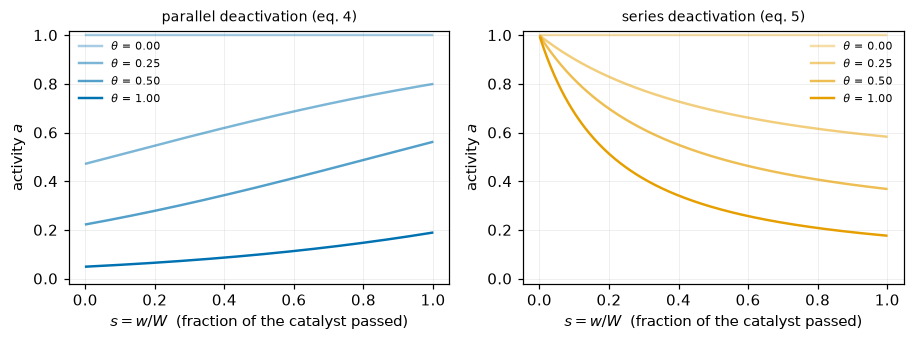
The bed’s first cell centre and outlet face, refined in SPACE (the inlet column is measured against the EXACT face value; the outlet, which has no closed form in the bed, is read on the outlet face at nt = 100 and Richardson-extrapolated from the last pair, then extrapolated again, in time, in the table below):
| class | cells m | a at s = 1/2m | error | vs the exact inlet | observed order | |
|---|---|---|---|---|---|---|
| parallel | 100 | 0.050143 | 3.560e-04 | 0.19016571 | ||
| parallel | 200 | 0.049965 | 1.777e-04 | 1.00 | 0.19017338 | +7.67e-06 |
| parallel | 400 | 0.049876 | 8.878e-05 | 1.00 | 0.19017530 | +1.92e-06 |
| parallel | 800 | 0.049831 | 4.437e-05 | 1.00 | 0.19017578 | +4.81e-07 |
| series | 100 | 0.978069 | 2.193e-02 | 0.17710753 | ||
| series | 200 | 0.988894 | 1.111e-02 | 0.98 | 0.17711201 | +4.49e-06 |
| series | 400 | 0.994411 | 5.589e-03 | 0.99 | 0.17711313 | +1.12e-06 |
| series | 800 | 0.997197 | 2.803e-03 | 1.00 | 0.17711341 | +2.79e-07 |
observed order of the outlet-face activity from the changes between grids: parallel 1.997, 1.999; series 2.004, 2.002
observed order of the cell-centre error: 1.00 (parallel), 1.00 (series): first order, which is what a 1/2m offset from the face demands.
The INLET study is purely spatial: doubling nt at m = 800 moves either inlet reading by below 1e-7 (here 2.5e-09), against a parallel cell-centre error of 4.44e-05 and a series one of 2.80e-03.
The OUTLET reading is NOT: the same doubling moves it by 7.3e-06. So the outlet is extrapolated a SECOND time, in nt.
The space-extrapolated outlet, refined in TIME (each row repeats the Richardson of the two finest grids above at that step count; Heun is second order, so the change falls by 4 per doubling and the remaining correction is that change over 3; the last row of each class is the quadrature route, 321 Simpson nodes, LSODA at rtol 1e-12):
| class | steps nt | space-Richardson outlet | change in it | observed order in nt |
|---|---|---|---|---|
| parallel | 50 | 0.190205092 | ||
| parallel | 100 | 0.190175938 | -2.92e-05 | |
| parallel | 200 | 0.190168616 | -7.32e-06 | 1.99 |
| parallel | extrapolated | 0.190166175 | -2.44e-06 | |
| parallel | quadrature route | 0.190166169 | -6.4e-09 | |
| series | 50 | 0.177116493 | ||
| series | 100 | 0.177113503 | -2.99e-06 | |
| series | 200 | 0.177112756 | -7.47e-07 | 2.00 |
| series | extrapolated | 0.177112508 | -2.49e-07 | |
| series | quadrature route | 0.177112508 | +1.4e-10 |
observed temporal order of the space-extrapolated outlet: 1.99 (parallel), 2.00 (series), second order, as for Heun.
WHAT THE SECOND EXTRAPOLATION IS WORTH. The space-Richardson ALONE, at nt = 100, gives 0.1901759 for the parallel outlet, 9.8e-06 above the limit, while the two grid pairs of the space extrapolation disagree by 6.5e-10. A reading that is space-converged can still be time-limited, and this one is.

at theta = 1:  parallel  a(inlet) = 0.049787 (EXACT, = exp(-lambda)), a(outlet) = 0.19017 (space + time extrapolated, residual bound 2.4e-06)   -> descending
               series    a(inlet) = 1.000000 (EXACT, C_R = 0 at the feed face), a(outlet) = 0.17711 (space + time extrapolated, residual bound 2.5e-07)   -> ascending
The doubly extrapolated outlets meet the quadrature route to below 1e-7 (here 6.4e-09 parallel, 1.4e-10 series); the quadrature itself moves by below 1e-8 from 161 to 321 nodes (here 2e-10). The outlets are quoted to five decimals.
the two contrasts have opposite sign: +0.1404 vs -0.8229
For comparison, the production grid (m = 200) reads its first cell centre at 0.9889 (series) and 0.049965 (parallel). Neither is reported as the inlet activity: the exact statement is the stronger one, since the series inlet does not merely stay high, it does not decay at all.
B2.2, at its own operating point: the parallel half-bed coke contrast is -0.244, resolvable only with assays better than 8.6 %, and -0.0526 at four times the coking time.
7. Where even the mixed reactor separates, and the boundary is analytic
Degeneracy 2 is one-way. Series with orders \((n', d)\) always has an exact parallel twin at \((n n', d+n')\). Going the other way, a parallel truth \((n'_p, d_p)\) has a series twin only if the required series order \(d_s = d_p - n'_p/n\) is non-negative, and \(d\) is an order in the paper’s own rate forms, so a negative one is not a member of the family.
So there is a line, \(d = n'/n\), below which the exact twin ceases to exist. The prediction is sharp; what it buys is not. Below the line the best series impersonation is no longer perfect, but it is not immediately bad either: the residual grows smoothly with distance from the line, and only becomes measurable at a realistic resolution well inside the region. Tested on both sides:
"""The predicted boundary d = n'/n in the constant-flow mixed reactor."""
rows = []
for npv, dv in ((1.0, 1.5), (1.0, 1.0), (1.0, 0.75), (1.0, 0.5), (1.0, 0.25),
                (2.0, 1.5)):
    y = respond("mixed", "parallel", BASE["kappa"], BASE["lam"], dv, npv, 0.0)
    D = fit_class("mixed", y, "series", BASE["kappa"], BASE["lam"],
                  tag=("mixed-boundary", npv, dv))[0]
    ds = dv - npv / BASE["n"]
    # where the twin exists it is evaluated directly, exactly as in section 5:
    # an optimiser bound must never stand in for an identity
    tw, _ = twin_residual("mixed", "parallel", "series",
                          dict(BASE, d=dv, nprime=npv, sig=0.0), BASE["n"])
    if tw is not None:
        D = min(D, tw)
    rows.append([npv, dv, f"{ds:+.2f}", "attainable" if ds >= 0 else "d < 0: none",
                 ("<1e-8*" if tw is not None and D < 1e-8 else
                  f"{D:.2e}{'*' if tw is not None else ''}"),
                 "no" if D <= RES_X else "YES"])
    M[f"mixed_boundary_np{npv:g}_d{dv:g}"] = float(D)
display(Markdown(
    "**Mixed flow, constant rate: can a series model impersonate a parallel "
    "truth?**\n\n" + md_table(pd.DataFrame(rows, columns=[
        "n'", "d", "d - n'/n", "series twin", "D(parallel -> series)",
        f"separable at {RES_X:g}?"]))))
inside = [r for r in rows if float(r[2]) >= 0]
outside = [r for r in rows if float(r[2]) < 0]
M["mixed_boundary_worst_inside"] = float(max(M[f"mixed_boundary_np{r[0]:g}_d{r[1]:g}"]
                                             for r in inside))
M["mixed_boundary_best_outside"] = float(min(M[f"mixed_boundary_np{r[0]:g}_d{r[1]:g}"]
                                             for r in outside))
print(f"\nInside the region where the exact twin exists (d >= n'/n) the best "
      f"series impersonation is below 1e-8 (here "
      f"{M['mixed_boundary_worst_inside']:.1e}), i.e. nothing. Outside it the "
      f"residual grows smoothly with distance from the line, from below 1e-3 at "
      f"d - n'/n = -0.25 (here {M['mixed_boundary_np1_d0.75']:.1e}) to "
      f"{M['mixed_boundary_np1_d0.25']:.1e} at -0.75, and only crosses the "
      f"{RES_X:g} resolution between d - n'/n = -0.25 and -0.5 (here "
      f"{M['mixed_boundary_np1_d0.5']:.1e} at -0.5).")
print("The line is a prediction about EXACTNESS, and it holds. It is not a "
      "prediction about measurability, and the (n' = 2, d = 1.5) row shows why: "
      f"it lies half a unit below the line yet is still fitted to below 1e-4 "
      f"(here {M['mixed_boundary_np2_d1.5']:.1e}), because an inexact series twin is "
      "still an excellent one there. Crossing the boundary is necessary for the "
      "mixed reactor to separate the two classes, and nowhere near sufficient.")
BREAKS.append(("mixed_boundary_np1_d0.5", M["mixed_boundary_np1_d0.5"],
               "move d back across the predicted boundary to d = 1.5",
               M["mixed_boundary_np1_d1.5"],
               "the separability of the mixed reactor is switched by the "
               "analytic condition, in both directions"))
Mixed flow, constant rate: can a series model impersonate a parallel truth?
| n’ | d | d - n’/n | series twin | D(parallel -> series) | separable at 0.002? |
|---|---|---|---|---|---|
| 1.0 | 1.5 | +0.50 | attainable | <1e-8* | no |
| 1.0 | 1.0 | +0.00 | attainable | <1e-8* | no |
| 1.0 | 0.75 | -0.25 | d < 0: none | 7.49e-04 | no |
| 1.0 | 0.5 | -0.50 | d < 0: none | 3.05e-03 | YES |
| 1.0 | 0.25 | -0.75 | d < 0: none | 4.02e-03 | YES |
| 2.0 | 1.5 | -0.50 | d < 0: none | 4.04e-05 | no |
Inside the region where the exact twin exists (d >= n'/n) the best series impersonation is below 1e-8 (here 3.3e-10), i.e. nothing. Outside it the residual grows smoothly with distance from the line, from below 1e-3 at d - n'/n = -0.25 (here 7.5e-04) to 4.0e-03 at -0.75, and only crosses the 0.002 resolution between d - n'/n = -0.25 and -0.5 (here 3.1e-03 at -0.5).
The line is a prediction about EXACTNESS, and it holds. It is not a prediction about measurability, and the (n' = 2, d = 1.5) row shows why: it lies half a unit below the line yet is still fitted to below 1e-4 (here 4.0e-05), because an inexact series twin is still an excellent one there. Crossing the boundary is necessary for the mixed reactor to separate the two classes, and nowhere near sufficient.
8. The recommended device, taken seriously
Levenspiel’s recommendation (Discussion, point 2, p. 272) is unambiguous:
“the most useful reactor set up uses a batch of solids and mixed flow of fluid with changing flow rate so as to keep the concentration of the pertinent reaction component unchanged with time within the reactor. Thus by constantly lowering the flow rate in a basket or recycle reactor the activity and concentration dependencies can be decoupled and studied separately.”
Everything about that is right, and the page confirms both halves: the decay order \(d\) comes straight out of the shape of \(\tau'(t)\) through eqs. (28)–(32) whatever \(n'\) is (that is the decoupling), and, from degeneracy 3, the class does not come out at all. The two facts are the same fact. So the question the device leaves open is: how many runs, over what span of held concentration, does the class actually take?
The recipe is the paper’s own: \(k'_d = k_dC_{\rm A}^{\,n'}\) under parallel and \(k_dC_{\rm R}^{\,n'}\) under series, so a set of runs at different held levels gives \(k'_d\) as a function of the level, and a power law in \(C_{\rm A}\) is not a power law in \(C_{\rm A0}-C_{\rm A}\). Below, the span required is root-found against a stated precision on \(k'_d\), not read off a sweep, and then swept over the two design choices it hides, because root-finding a function of an arbitrary parameter does not make that parameter less arbitrary.
The second half of this section prices a protocol the paper does not prescribe, and says so. For eq. (6) Levenspiel’s own instruction is to hold \(C_{\rm P}\); holding \(C_{\rm A}\) instead is the inverse of his priority. Both sentences are in data/levenspiel-1972-printed-claims.csv and both are printed below from it in full, hedge included. Under the author’s own instruction, a poison not consumed, so \(C_{\rm P}\) fixed, this page’s own \(\sigma = 0\) row shows no bias at all. What is priced below is the cost of the other choice, and it is a real cost only because one control knob cannot hold two concentrations.
"""How wide a set of held-C_A runs does it take to name the class?

At each held level c the device returns k'_d exactly (degeneracy 3 makes it
the ONLY thing it returns).  Under a parallel truth k'_d = lam c^n'; a series
reader fits ln k'_d = ln A + n'_s ln(1-c).  The relative misfit of that wrong
reading, over L levels spanning [c0, c0+dc], is the signal.  Root-found."""
L_LEVELS, C_LO = 5, 0.15
def wrong_class_misfit(dc, npv=BASE["nprime"], truth="parallel",
                       lo=None, levels=None):
    c = np.linspace(C_LO if lo is None else lo,
                    (C_LO if lo is None else lo) + dc,
                    L_LEVELS if levels is None else levels)
    kd_true = (c if truth == "parallel" else 1 - c) ** npv     # lam folded out
    x = np.log((1 - c) if truth == "parallel" else c)
    y = np.log(kd_true)
    A = np.vstack([np.ones_like(x), x]).T
    coef, *_ = np.linalg.lstsq(A, y, rcond=None)
    return float(np.sqrt(np.mean((y - A @ coef) ** 2)))   # RMS in ln k'_d

for prec in (0.02, 0.05, 0.10):
    f = lambda dc: wrong_class_misfit(dc) - prec
    dc_star = brentq(f, 1e-4, 0.80, xtol=1e-10)
    M[f"constC_span_needed_prec{int(prec*100)}pct"] = float(dc_star)
    print(f"k'_d known to {prec*100:4.1f} %  ->  held-C_A levels must span "
          f"dc = {dc_star:.3f} in C_A/C_A0 "
          f"(i.e. {C_LO:.2f} to {C_LO+dc_star:.2f}), with {L_LEVELS} levels")
M["constC_misfit_at_span_0p5"] = wrong_class_misfit(0.5)
print(f"\nover a half-decade of held concentration (dc = 0.5) the wrong reading "
      f"misses by {100*M['constC_misfit_at_span_0p5']:.1f} % in k'_d - "
      f"comfortable; over dc = 0.05 it misses by "
      f"{100*wrong_class_misfit(0.05):.2f} %, which no rate constant is known to.")

# --- and the span is a property of TWO choices that are not the paper's -----
# C_LO (where the set of held levels starts) and L_LEVELS (how many there are)
# are design choices, not printed constants.  Root-finding a function of an
# arbitrary parameter does not make the parameter less arbitrary, so both are
# swept and the answer is reported as a RANGE, with the base cell marked.
LO_SCAN, LEV_SCAN = (0.05, 0.10, 0.15, 0.25, 0.40), (3, 5, 9)
span_grid, all_spans = [], []
for lo in LO_SCAN:
    row = [f"{lo:.2f}" + ("  <-- base" if lo == C_LO else "")]
    for lv in LEV_SCAN:
        v = brentq(lambda dc: wrong_class_misfit(dc, lo=lo, levels=lv) - 0.05,
                   1e-4, min(0.80, 0.98 - lo), xtol=1e-10)
        all_spans.append(v)
        row.append(f"{v:.3f}" + ("*" if (lo == C_LO and lv == L_LEVELS) else ""))
    span_grid.append(row)
M["constC_span_prec5pct_min"] = float(min(all_spans))
M["constC_span_prec5pct_max"] = float(max(all_spans))
display(Markdown(
    "**The required span is a property of two unprinted design choices** - "
    "where the set of held levels starts (C_LO) and how many there are "
    "(L_LEVELS). Span needed at 5 % precision on k'_d, root-found in every "
    "cell; `*` is the base case quoted above:\n\n"
    + md_table(pd.DataFrame(span_grid,
                            columns=["C_LO \\ levels"]
                            + [str(lv) for lv in LEV_SCAN]))))
print(f"Range over the sweep: {M['constC_span_prec5pct_min']:.3f} to "
      f"{M['constC_span_prec5pct_max']:.3f} - a factor of "
      f"{M['constC_span_prec5pct_max']/M['constC_span_prec5pct_min']:.1f}, and "
      f"monotone in the starting level. The base answer "
      f"{M['constC_span_needed_prec5pct']:.3f} is therefore an ORDER, not a "
      f"design constant: a set of held levels must span a few tenths of "
      f"C_A/C_A0, and where it starts matters as much as how wide it is.")
BREAKS.append(("constC_span_prec5pct_max", M["constC_span_prec5pct_max"],
               f"start the level set at C_A/C_A0 = {LO_SCAN[0]:g} instead of "
               f"{LO_SCAN[-1]:g}",
               M["constC_span_prec5pct_min"],
               "the required span is set by the unprinted C_LO as much as by "
               "the demanded precision"))
BREAKS.append(("constC_span_needed_prec5pct",
               M["constC_span_needed_prec5pct"],
               "demand 2 % precision on k'_d instead of 5 %",
               M["constC_span_needed_prec2pct"],
               "the required span is set by the precision, and moves with it"))
k'_d known to 2.0 % -> held-C_A levels must span dc = 0.111 in C_A/C_A0 (i.e. 0.15 to 0.26), with 5 levels
k'_d known to 5.0 % -> held-C_A levels must span dc = 0.204 in C_A/C_A0 (i.e. 0.15 to 0.35), with 5 levels
k'_d known to 10.0 % -> held-C_A levels must span dc = 0.335 in C_A/C_A0 (i.e. 0.15 to 0.49), with 5 levels
over a half-decade of held concentration (dc = 0.5) the wrong reading misses by 17.1 % in k'_d - comfortable; over dc = 0.05 it misses by 0.52 %, which no rate constant is known to.The required span is a property of two unprinted design choices - where the set of held levels starts (C_LO) and how many there are (L_LEVELS). Span needed at 5 % precision on k’_d, root-found in every cell; * is the base case quoted above:
| C_LO levels | 3 | 5 | 9 |
|---|---|---|---|
| 0.05 | 0.073 | 0.078 | 0.087 |
| 0.10 | 0.135 | 0.146 | 0.162 |
| 0.15 <– base | 0.189 | 0.204* | 0.225 |
| 0.25 | 0.270 | 0.290 | 0.317 |
| 0.40 | 0.336 | 0.356 | 0.382 |
Range over the sweep: 0.073 to 0.382 - a factor of 5.3, and monotone in the starting level. The base answer 0.204 is therefore an ORDER, not a design constant: a set of held levels must span a few tenths of C_A/C_A0, and where it starts matters as much as how wide it is."""One knob, two constraints: side-by-side in the recommended device.
Holding C_A fixed sets the flow rate. If the poison is CONSUMED (eq. 6 prints
"P -> P(down)"), C_P then drifts as the flow rate falls, so k'_d is not constant
and the eq.-(32) straight line is bent. What the paper actually PRESCRIBES for
eq. (6) is printed below, from the claims CSV, in full."""
for cid in ("p271_keep_constant", "p271_side_by_side_hedge"):
display(Markdown(f"> *\"{CLAIMS.loc[cid, 'quote']}\"* (p. "
f"{CLAIMS.loc[cid, 'page']}, `{cid}`)"))
print("Read together: for eq. (6) the author's instruction is to keep C_P "
"constant, and holding C_A too is the conditional extra ('if possible'). "
"He then hedges the failure of the SECOND condition, not the first: 'If "
"C_A cannot be kept constant in side-by-side deactivation, analysis is "
"still not particularly difficult.' What follows holds C_A and lets C_P "
"drift - the inverse of that priority - because that is what a single "
"flow-rate knob does when the poison is consumed. The author's own "
"protocol is the sigma = 0 row below, and it is unbiased.")
def recovered_d(sig, d_true):
"""The order an experimenter would read off the paper's own Fig.-6 plot."""
tau, _ = run_const_c("side-by-side", BASE["kappa"], BASE["lam"], d_true,
BASE["nprime"], BASE["c_set"], n=BASE["n"], sig=sig)
def bend(dv):
# (tau^(d-1) - 1)/(d-1) loses digits to cancellation near d = 1, and no
# ODE tolerance recovers them; expm1 does
lt = np.log(tau)
y = lt if dv == 1.0 else np.expm1((dv - 1) * lt) / (dv - 1)
A = np.vstack([np.ones_like(TH), TH]).T
coef, *_ = np.linalg.lstsq(A, y, rcond=None)
return float(np.sqrt(np.mean((y - A @ coef) ** 2)) / max(np.ptp(y), 1e-300))
return float(minimize_scalar(bend, bounds=(0.05, 4.0), method="bounded",
options={"xatol": 1e-10}).x)
# --- d = 1 is a blind spot of the device, and exactly so --------------------
# In a mixed reactor at held C_A the poison consumed per unit time goes as
# tau' x rate ~ (1/a) x a^d = a^(d-1). At d = 1 that is CONSTANT: C_P settles
# at a fixed value and never drifts, so the eq.-(32) line stays perfectly
# straight no matter how much poison is consumed. The over-determination has
# no cost at all at d = 1 - and only at d = 1.
SIG_SCAN = np.geomspace(1e-3, 2e1, 21)
bias1 = np.array([abs(recovered_d(sv, 1.0) - 1.0) for sv in SIG_SCAN])
M["constC_sbs_bias_at_d1_max"] = float(bias1.max())
print(f"d = 1: the recovered order is unbiased to below 1e-7 (here "
f"{M['constC_sbs_bias_at_d1_max']:.1e}) for every sigma up to "
f"{SIG_SCAN[-1]:g} - an exact cancellation "
f"(consumption rate ~ a^(d-1) = const at d = 1), not a small number.")
# --- d = 2, where the drift is real ---------------------------------------
D_TRUE = 2.0
M["constC_sbs_recovered_d_sig0"] = recovered_d(0.0, D_TRUE)
M["constC_sbs_recovered_d_base"] = recovered_d(BASE["sig"], D_TRUE)
bias2 = np.array([abs(recovered_d(sv, D_TRUE) / D_TRUE - 1.0) for sv in SIG_SCAN])
M["constC_sbs_bias_max_scanned"] = float(bias2.max())
target = next((t for t in (0.05, 0.02, 0.01) if bias2.max() > t), None)
assert target is not None, f"no bias target reached; max scanned {bias2.max():.3g}"
j = int(np.argmax(bias2 > target))
M["constC_sbs_bias_target"] = float(target)
M["constC_sbs_sigma_for_bias"] = float(brentq(
lambda sv: abs(recovered_d(sv, D_TRUE) / D_TRUE - 1.0) - target,
SIG_SCAN[j - 1], SIG_SCAN[j], xtol=1e-9))
SIG_SCAN_READ = float(SIG_SCAN[j]) # break row: read off the scan, not root-found
M["constC_sbs_bias_sig0"] = float(abs(M["constC_sbs_recovered_d_sig0"] / D_TRUE
- 1.0))
print(f"\nd = {D_TRUE:g}: recovered {M['constC_sbs_recovered_d_sig0']:.4f} at "
f"sigma = 0 and {M['constC_sbs_recovered_d_base']:.4f} at "
f"the base sigma = {BASE['sig']} - a bias of "
f"{100*(M['constC_sbs_recovered_d_base']/D_TRUE - 1):+.2f} %.")
print(f"The sigma = 0 row IS the author's own protocol for eq. (6) - a poison "
f"in such excess that C_P does not move is C_P kept constant - and it "
f"recovers d to {M['constC_sbs_bias_sig0']:.1e} relative. The bias below "
f"is the price of the OTHER protocol, the one a single flow-rate knob "
f"forces on you if the poison is consumed and you choose to hold C_A.")
print(f"root-found (bracketed by the scan, not read off it): the bias reaches "
f"{100*target:.0f} % once sigma exceeds {M['constC_sbs_sigma_for_bias']:.4f}; "
f"the largest bias over sigma <= {SIG_SCAN[-1]:g} is "
f"{100*M['constC_sbs_bias_max_scanned']:.1f} %.")
BREAKS.append(("constC_sbs_recovered_d_base", M["constC_sbs_recovered_d_base"],
"set sigma = 0 (poison in such excess that C_P never moves)",
M["constC_sbs_recovered_d_sig0"],
"the bias IS the poison consumption; with none, d comes back exactly"))
BREAKS.append(("constC_sbs_bias_at_d1_max", M["constC_sbs_bias_at_d1_max"],
f"move off d = 1, where the a^(d-1) cancellation holds, to d = {D_TRUE:g}",
M["constC_sbs_bias_max_scanned"],
"the blind spot is exactly at d = 1 and nowhere else"))“For parallel deactivation (Eq. 4) keep C_A constant; For series deactivation (Eq. 5) keep C_R constant; For side-by-side deactivation (Eq. 6) keep C_P constant; For independent deactivation (Eq. 7) no concentration need be kept constant” (p. 271,
p271_keep_constant)
“The analysis is quite similar for series deactivation if C_A, hence C_R is kept constant, and for side-by-side deactivation if C_P and, if possible, C_A are kept constant. If C_A cannot be kept constant in side-by-side deactivation, analysis is still not particularly difficult” (p. 271,
p271_side_by_side_hedge)
Read together: for eq. (6) the author's instruction is to keep C_P constant, and holding C_A too is the conditional extra ('if possible'). He then hedges the failure of the SECOND condition, not the first: 'If C_A cannot be kept constant in side-by-side deactivation, analysis is still not particularly difficult.' What follows holds C_A and lets C_P drift - the inverse of that priority - because that is what a single flow-rate knob does when the poison is consumed. The author's own protocol is the sigma = 0 row below, and it is unbiased.
d = 1: the recovered order is unbiased to below 1e-7 (here 8.4e-09) for every sigma up to 20 - an exact cancellation (consumption rate ~ a^(d-1) = const at d = 1), not a small number.

d = 2: recovered 2.0000 at sigma = 0 and 1.3835 at the base sigma = 0.8 - a bias of -30.83 %.
The sigma = 0 row IS the author's own protocol for eq. (6) - a poison in such excess that C_P does not move is C_P kept constant - and it recovers d to 5.4e-09 relative. The bias below is the price of the OTHER protocol, the one a single flow-rate knob forces on you if the poison is consumed and you choose to hold C_A.
root-found (bracketed by the scan, not read off it): the bias reaches 5 % once sigma exceeds 0.0763; the largest bias over sigma <= 20 is 49.2 %.
Validation
Four layers, in order of what they can catch.
- The pymrm bed against an independent exact route. The pseudo-steady bed at frozen \(a(s)\) is a first-order cascade, so the outlet is a quadrature: no grid, no operator, no linear solve in common with the finite-volume bed. Both refinement axes are swept separately, each with the other axis’s error cancelled, and the two solvers of the bed’s fluid equation are compared.
- Every reactor against the paper’s own closed forms. Eqs. (15), (19),
- and (28)–(31) are exact solutions of the very systems solved here, for the illustrative first-order case; they are the strongest available check and they are the paper’s, not this page’s.
- A defect-injection table, with a row for every reported metric.
- The pseudo-steady assumption itself, dropped and costed.
"""(1a) SPATIAL order, isolated: frozen a(s), bed outlet vs exact quadrature."""
from scipy.integrate import cumulative_simpson as _csimp
def exact_outlet(kappa, n, afun, ns=20001):
    s = np.linspace(0, 1, ns)
    return _cascade(np.concatenate(([0.0], _csimp(afun(s), x=s))), kappa, n)[-1]

def frozen_outlet(m, kappa, n, afun, **kw):
    """Outlet concentration of the bed at a frozen activity profile."""
    b = Bed(m, **kw)
    return b.outlet(b.steady_c(kappa, afun(b.s_c), n))

FROZEN = (("a = e^{-3s}", "exp", lambda s: np.exp(-3 * s)),
          ("a = 0.2 + 0.8 s^2", "quad", lambda s: 0.2 + 0.8 * s ** 2))
rows, SPATIAL_BROKEN, SPATIAL_BROKEN_LABEL, FINEST = [], {}, {}, []
for label, tag, afun in FROZEN:
    for n_ in (1.0, 2.0):
        ref = exact_outlet(1.5, n_, afun)
        errs = []
        for m in (25, 50, 100, 200, 400):
            errs.append(abs(frozen_outlet(m, 1.5, n_, afun) - ref))
            rows.append([label, n_, m, f"{errs[-1]:.3e}",
                         "" if m == 25 else f"{np.log2(errs[-2] / errs[-1]):.2f}"])
        key = f"n{n_:g}_{tag}"
        M[f"bed_spatial_err_{key}"] = float(errs[-1])
        M[f"bed_spatial_order_{key}"] = float(np.log2(errs[-2] / errs[-1]))
        FINEST.append(errs[-1])
        # break rows: the error one grid coarser, and the observed order with
        # first-order upwind convection
        SPATIAL_BROKEN[f"bed_spatial_err_{key}"] = float(errs[-2])
        SPATIAL_BROKEN_LABEL[f"bed_spatial_err_{key}"] = "the error read on 200 cells"
        e_up = [abs(frozen_outlet(mm, 1.5, n_, afun, limiter=None) - ref) for mm in (200, 400)]
        SPATIAL_BROKEN[f"bed_spatial_order_{key}"] = float(np.log2(e_up[0] / e_up[1]))
        SPATIAL_BROKEN_LABEL[f"bed_spatial_order_{key}"] = "first-order upwind convection (Bed(..., limiter=None))"
display(Markdown("**Spatial convergence of the pymrm bed against the quadrature "
                 "(activity frozen, so no time error can leak in):**\n\n"
                 + md_table(pd.DataFrame(rows,
                                          columns=["frozen a(s)", "n", "cells m",
                                                   "|outlet error|",
                                                   "observed order"]))))
# the round-off of these errors: the newton/deferred gap of the fluid solve
M["bed_spatial_finest_over_roundoff"] = float(min(FINEST) / max(M["bed_route_gap_frozen"], 1e-16))
_bl = Bed(200, route="deferred", tol=1e-4)
GAP_LOOSE = float(np.max(np.abs(_bl.steady_c(BASE["kappa"], 0.2 + 0.8 * _bl.s_c ** 2) - _cn)))
print("Second order at both reaction orders, with the outlet read on the "
      "extrapolated outlet face. The smallest of these errors is "
      f"{M['bed_spatial_finest_over_roundoff']:.0e} times the newton/deferred gap "
      "of the fluid solve (at least 1e3).")
Spatial convergence of the pymrm bed against the quadrature (activity frozen, so no time error can leak in):
| frozen a(s) | n | cells m | outlet error | |
|---|---|---|---|---|
| a = e^{-3s} | 1.0 | 25 | 1.659e-04 | |
| a = e^{-3s} | 1.0 | 50 | 3.920e-05 | 2.08 |
| a = e^{-3s} | 1.0 | 100 | 9.480e-06 | 2.05 |
| a = e^{-3s} | 1.0 | 200 | 2.328e-06 | 2.03 |
| a = e^{-3s} | 1.0 | 400 | 5.765e-07 | 2.01 |
| a = e^{-3s} | 2.0 | 25 | 1.077e-04 | |
| a = e^{-3s} | 2.0 | 50 | 2.323e-05 | 2.21 |
| a = e^{-3s} | 2.0 | 100 | 5.284e-06 | 2.14 |
| a = e^{-3s} | 2.0 | 200 | 1.251e-06 | 2.08 |
| a = e^{-3s} | 2.0 | 400 | 3.038e-07 | 2.04 |
| a = 0.2 + 0.8 s^2 | 1.0 | 25 | 4.369e-05 | |
| a = 0.2 + 0.8 s^2 | 1.0 | 50 | 1.007e-05 | 2.12 |
| a = 0.2 + 0.8 s^2 | 1.0 | 100 | 2.414e-06 | 2.06 |
| a = 0.2 + 0.8 s^2 | 1.0 | 200 | 5.907e-07 | 2.03 |
| a = 0.2 + 0.8 s^2 | 1.0 | 400 | 1.461e-07 | 2.02 |
| a = 0.2 + 0.8 s^2 | 2.0 | 25 | 1.722e-05 | |
| a = 0.2 + 0.8 s^2 | 2.0 | 50 | 3.884e-06 | 2.15 |
| a = 0.2 + 0.8 s^2 | 2.0 | 100 | 9.218e-07 | 2.07 |
| a = 0.2 + 0.8 s^2 | 2.0 | 200 | 2.245e-07 | 2.04 |
| a = 0.2 + 0.8 s^2 | 2.0 | 400 | 5.541e-08 | 2.02 |
Second order at both reaction orders, with the outlet read on the extrapolated outlet face. The smallest of these errors is 4e+05 times the newton/deferred gap of the fluid solve (at least 1e3)."""(1b) TEMPORAL and SPATIAL order of the full march, each with the other axis's
error cancelled, and the production setting against the quadrature."""
args = (BASE["kappa"], BASE["lam"], BASE["d"], BASE["nprime"])
def x_history(nt, m=200, **kw):
"""Outlet conversion at the 41 observation times (all on the step grid)."""
scheme = kw.pop("scheme", "heun")
on_grid = kw.pop("on_grid", True)
return Bed(m, **kw).march("parallel", *args, n=BASE["n"], nt=nt,
scheme=scheme, on_grid=on_grid)[0]
NTS = (40, 80, 160, 320, 640) # multiples of 40: every observation time is a step
OT = {s: observed_orders(lambda nt: x_history(nt, scheme=s), NTS) for s in ("heun", "euler")}
OXM = observed_orders(lambda m: x_history(80, m=m), (50, 100, 200, 400, 800))
for s in ("heun", "euler"):
M[f"bed_time_order_{s}_min"] = float(min(OT[s]["orders"]))
M[f"bed_time_order_{s}_max"] = float(max(OT[s]["orders"]))
M["bed_space_order_march_min"] = float(min(OXM["orders"]))
M["bed_space_order_march_max"] = float(max(OXM["orders"]))
_dT = float(np.max(np.abs(OT["heun"]["values"][-1] - OT["heun"]["values"][-2])))
_dX = float(np.max(np.abs(OXM["values"][-1] - OXM["values"][-2])))
XN = BED.march("parallel", *args, n=BASE["n"], nt=200)[0]
XD = Bed(200, route="deferred").march("parallel", *args, n=BASE["n"], nt=200)[0]
M["bed_route_gap_march"] = float(np.max(np.abs(XN - XD)))
M["bed_axes_finest_over_roundoff"] = float(min(_dT, _dX) / max(M["bed_route_gap_march"], 1e-16))
# the round-off of the section-6 ladders: the same newton/deferred gap of the march
for _lad in ("inlet", "space", "time"):
M[f"bed_a_{'inlet_cellcentre' if _lad == 'inlet' else 'outlet_' + _lad}_finest_over_roundoff"] = float(
min(FINEST6[_lad]) / max(M["bed_route_gap_march"], 1e-16))
print("The finest changes of the section-6 ladders are at least 1e3 times the "
"newton/deferred gap of the march (here "
+ ", ".join(f"{k} {min(v) / max(M['bed_route_gap_march'], 1e-16):.0e}" for k, v in FINEST6.items())
+ " times).")
print("time alone (m = 200, nt = 40..640), Heun: orders "
+ ", ".join(f"{o:.4f}" for o in OT["heun"]["orders"]))
print("time alone (m = 200, nt = 40..640), Euler: orders "
+ ", ".join(f"{o:.4f}" for o in OT["euler"]["orders"]))
print("space alone (nt = 80, m = 50..800): orders "
+ ", ".join(f"{o:.4f}" for o in OXM["orders"]))
print(f"the newton and deferred-correction routes give the same production "
f"conversion history to below 1e-10 (here {M['bed_route_gap_march']:.0e}); "
f"the finest differences of both ladders are at least 1e3 times that "
f"(here {M['bed_axes_finest_over_roundoff']:.0e} times).")
# break rows of the ladders
OT_OFFGRID = observed_orders(lambda nt: x_history(nt, on_grid=False), (25, 50, 100, 200, 400))
print("for contrast, the conversion history interpolated between steps "
"(nt = 25..400, where 25, 50 and 100 steps miss observation times): orders "
+ ", ".join(f"{o:.2f}" for o in OT_OFFGRID["orders"]))
OXM_UP = observed_orders(lambda m: x_history(80, m=m, limiter=None), (50, 100, 200, 400, 800))
XD_LOOSE = Bed(200, route="deferred", tol=1e-4).march("parallel", *args, n=BASE["n"], nt=200)[0]
GAP_MARCH_LOOSE = float(np.max(np.abs(XN - XD_LOOSE)))
XD_LOOSER = Bed(200, route="deferred", tol=1e-2).march("parallel", *args, n=BASE["n"], nt=200)[0]
GAP_MARCH_LOOSER = float(np.max(np.abs(XN - XD_LOOSER))) # the inlet ladder's finest change is only 1.8e3 times the 1e-4 gap
ref_par = PlugExact(161).run("parallel", *args, n=BASE["n"], rtol=1e-11)[0]
ref_ser = PlugExact(161).run("series", *args, n=BASE["n"], rtol=1e-11)[0]
M["bed_vs_quadrature_production"] = float(np.max(np.abs(XN[1:] - ref_par[1:])))
M["bed_vs_quadrature_over_resolution"] = float(M["bed_vs_quadrature_production"] / RES_X)
print(f"production bed (m = {BED.m}, nt = 200) vs the quadrature over theta > 0 "
f"(at theta = 0 the bed is fresh and both classes share one profile): "
f"{M['bed_vs_quadrature_production']:.2e} in conversion, a fraction "
f"{M['bed_vs_quadrature_over_resolution']:.1e} of the {RES_X:g} resolution "
f"the separability verdicts are read at. That is what licenses the sweep "
f"to run on the quadrature.")
Xser, _, _ = BED.march("series", *args, n=BASE["n"], nt=200)
M["bed_vs_quadrature_series"] = float(np.max(np.abs(Xser[1:] - ref_ser[1:])))
print(f"same, series (ascending profile): {M['bed_vs_quadrature_series']:.2e}")The finest changes of the section-6 ladders are at least 1e3 times the newton/deferred gap of the march (here inlet 5e+10, space 3e+08, time 8e+08 times).
time alone (m = 200, nt = 40..640), Heun: orders 1.9911, 1.9956, 1.9978
time alone (m = 200, nt = 40..640), Euler: orders 1.0035, 1.0015, 1.0007
space alone (nt = 80, m = 50..800): orders 2.0111, 2.0055, 2.0027
the newton and deferred-correction routes give the same production conversion history to below 1e-10 (here 9e-16); the finest differences of both ladders are at least 1e3 times that (here 3e+08 times).
for contrast, the conversion history interpolated between steps (nt = 25..400, where 25, 50 and 100 steps miss observation times): orders 1.96, 1.99, 3.52
production bed (m = 200, nt = 200) vs the quadrature over theta > 0 (at theta = 0 the bed is fresh and both classes share one profile): 1.53e-06 in conversion, a fraction 7.6e-04 of the 0.002 resolution the separability verdicts are read at. That is what licenses the sweep to run on the quadrature.
same, series (ascending profile): 1.53e-06"""(2) Every device against the PAPER'S OWN closed forms, eqs. (15), (19), (22),
(28)-(31). These are exact solutions of the systems being solved, printed in
1972; they share no code with anything above."""
kap, lam = 1.2, 2.5 # first-order reaction, first-order decay, n' = 0
rows = []
# eq. (15): batch fluid. k'' t_obs = kap_b, k_d t_obs = lam
Xb, ab = run_batch("independent", kap, lam, 1.0, 0.0, n=1.0)
cb = 1.0 - Xb
c_inf = np.exp(-kap / lam)
lhs = np.log(np.log(cb / c_inf)); rhs = np.log(np.log(1.0 / c_inf)) - lam * TH
M["eq15_maxdev"] = float(np.max(np.abs(lhs - rhs)))
CF_BROKEN = {"eq15_maxdev": float(np.max(np.abs(lhs - (rhs - 0.01 * lam * TH))))}
rows.append(["(15)", "batch fluid, Fig. 2", f"below 1e-7 (here {M['eq15_maxdev']:.1e})"])
# eq. (19): mixed flow, constant rate
Xm, am = run_mixed("independent", kap, lam, 1.0, 0.0, n=1.0)
cm = 1.0 - Xm
M["eq19_maxdev"] = float(np.max(np.abs(np.log(1.0 / cm - 1.0)
- (np.log(kap) - lam * TH))))
CF_BROKEN["eq19_maxdev"] = float(np.max(np.abs(np.log(1.0 / cm - 1.0)
- (np.log(kap) - 1.01 * lam * TH))))
rows.append(["(19)", "mixed flow, Fig. 3", f"below 1e-7 (here {M['eq19_maxdev']:.1e})"])
# eq. (22): plug flow, constant rate - the pymrm BED, not the quadrature
Xp, Ap, _ = BED.march("independent", kap, lam, 1.0, 0.0, n=1.0, nt=200)
cp = 1.0 - Xp
M["eq22_maxdev_pymrm"] = float(np.max(np.abs(np.log(np.log(1.0 / cp))
- (np.log(kap) - lam * TH))))
CF_BROKEN["eq22_maxdev_pymrm"] = float(np.max(np.abs(np.log(np.log(1.0 / cp))
- (np.log(kap) - 1.01 * lam * TH))))
rows.append(["(22)", "plug flow, Fig. 4 - solved on the pymrm bed",
f"{M['eq22_maxdev_pymrm']:.2e}"])
# eqs. (28)-(31): the held-C_A device at d = 0, 1, 2, 3. lam_c < 1 so that the
# d = 0 branch, where the activity reaches zero at k'_d t = 1, stays alive across
# the whole window - the branch is exercised, not stepped over.
cs, lam_c = BASE["c_set"], 0.8
Qd = (1.0 - cs) / (kap * cs) # (C_A0 - C_A)/k' in tau'_ref units
for dv, form in ((0, "1/tau'"), (1, "ln tau'"), (2, "tau'"), (3, "(tau')^2")):
tau, aa = run_const_c("independent", kap, lam_c, float(dv), 0.0, cs, n=1.0)
if dv == 0:
lhs, rhs = 1.0 / tau, (1.0 / Qd) * (1.0 - lam_c * TH)
elif dv == 1:
lhs, rhs = np.log(tau), np.log(Qd) + lam_c * TH
elif dv == 2:
lhs, rhs = tau, Qd * (1.0 + lam_c * TH)
else:
lhs, rhs = tau ** 2, Qd ** 2 * (1.0 + 2.0 * lam_c * TH)
dev = float(np.max(np.abs(lhs - rhs)) / np.max(np.abs(rhs)))
M[f"eq{28+dv}_reldev"] = dev
M[f"a_end_d{dv}_branch"] = float(aa[-1])
# break rows: the closed form with k'_d off by 1 % (same lam_c in the run),
# and the branch activity with lam_c raised by a quarter
tau_b, _ = run_const_c("independent", kap, 1.01 * lam_c, float(dv), 0.0, cs, n=1.0)
lhs_b = {0: 1.0 / tau_b, 1: np.log(tau_b), 2: tau_b, 3: tau_b ** 2}[dv]
CF_BROKEN[f"eq{28+dv}_reldev"] = float(np.max(np.abs(lhs_b - rhs))
/ np.max(np.abs(rhs)))
CF_BROKEN[f"a_end_d{dv}_branch"] = float(run_const_c(
"independent", kap, 1.25 * lam_c, float(dv), 0.0, cs, n=1.0)[1][-1])
rows.append([f"({28+dv})", f"held C_A, d = {dv} ({form} linear in t)",
f"below 1e-7 (here {dev:.1e})"])
display(Markdown("**The paper's own closed forms, met by the reactors solved "
"here** (max deviation; relative for eqs. 28-31)\n\n"
+ md_table(pd.DataFrame(rows, columns=["printed eq.",
"device / branch",
"deviation"]))))
print("All four printed branches of the deactivation order (d = 0, 1, 2, 3) are "
"exercised on a LIVE activity: a(theta = 1) = "
+ ", ".join(f"{M[f'a_end_d{j}_branch']:.3f}" for j in range(4))
+ " for d = 0, 1, 2, 3. d = 0 is the branch on which the activity reaches "
"zero in finite time (at k'_d t = 1); the window stops short of it.")The paper’s own closed forms, met by the reactors solved here (max deviation; relative for eqs. 28-31)
| printed eq. | device / branch | deviation |
|---|---|---|
| (15) | batch fluid, Fig. 2 | below 1e-7 (here 8.6e-09) |
| (19) | mixed flow, Fig. 3 | below 1e-7 (here 2.7e-15) |
| (22) | plug flow, Fig. 4 - solved on the pymrm bed | 3.01e-06 |
| (28) | held C_A, d = 0 (1/tau’ linear in t) | below 1e-7 (here 1.4e-16) |
| (29) | held C_A, d = 1 (ln tau’ linear in t) | below 1e-7 (here 3.3e-16) |
| (30) | held C_A, d = 2 (tau’ linear in t) | below 1e-7 (here 2.0e-16) |
| (31) | held C_A, d = 3 ((tau’)^2 linear in t) | below 1e-7 (here 2.2e-16) |
All four printed branches of the deactivation order (d = 0, 1, 2, 3) are exercised on a LIVE activity: a(theta = 1) = 0.200, 0.449, 0.556, 0.620 for d = 0, 1, 2, 3. d = 0 is the branch on which the activity reaches zero in finite time (at k'_d t = 1); the window stops short of it."""(4) The paper's pseudo-steady assumption (p. 269), dropped and costed.
eps = (fluid residence time)/(observation window). The bed is re-solved with
eps dc/dtheta retained, on the same operators; the deviation from the
pseudo-steady answer is root-found against the conversion resolution."""
BEDT = Bed(m=80) # eps study: the O(eps) term, not the grid
NT_PS = 1600 # eps = 0 reference: its time error is far below the cost
X_PS, _, _ = BEDT.march("parallel", *args, n=BASE["n"], nt=NT_PS)
def pseudo_steady_cost(eps, cls="parallel", ref=None):
Xt, _ = BEDT.transient(cls, *args, eps, n=BASE["n"])
return float(np.max(np.abs(Xt - (X_PS if ref is None else ref))))
eps_grid = np.array([1e-4, 3e-4, 1e-3, 3e-3, 1e-2, 3e-2])
cost = np.array([pseudo_steady_cost(e) for e in eps_grid])
M["pseudo_steady_cost_eps1e-3"] = float(cost[2])
M["pseudo_steady_cost_eps3e-2"] = float(cost[-1])
M["pseudo_steady_cost_slope"] = float(np.polyfit(np.log(eps_grid[:4]),
np.log(cost[:4]), 1)[0])
eps_star = brentq(lambda e: pseudo_steady_cost(np.exp(e)) - RES_X,
np.log(1e-4), np.log(3e-2), xtol=1e-3)
M["pseudo_steady_eps_star"] = float(np.exp(eps_star))
# break rows: the slope with the accumulation term scaled by sqrt(eps) instead
# of eps (a wrong time scale); the slope against an eps = 0 reference marched in
# 200 steps; and eps* read at half the resolution off the grid
PS_SLOPE_SQRT = float(np.polyfit(np.log(eps_grid[:4]),
np.log([pseudo_steady_cost(np.sqrt(e))
for e in eps_grid[:4]]), 1)[0])
_X200 = BEDT.march("parallel", *args, n=BASE["n"], nt=200)[0]
PS_SLOPE_REF200 = float(np.polyfit(np.log(eps_grid[:4]),
np.log([pseudo_steady_cost(e, ref=_X200)
for e in eps_grid[:4]]), 1)[0])
PS_EPS_HALF = float(np.exp(np.interp(np.log(RES_X / 2), np.log(cost),
np.log(eps_grid))))
fig, ax = plt.subplots(figsize=(5.0, 3.1))
ax.loglog(eps_grid, cost, "o-", color="#0072B2", lw=1.5, ms=4)
ax.axhline(RES_X, color="0.4", ls="--", lw=1,
label=f"conversion resolution {RES_X:g}")
ax.axvline(M["pseudo_steady_eps_star"], color="#D55E00", ls=":", lw=1.2,
label=rf"$\varepsilon^*$ = {M['pseudo_steady_eps_star']:.2e}")
ax.set_xlabel(r"$\varepsilon$ = fluid residence time / observation window")
ax.set_ylabel("max error in $X_A$ from the\npseudo-steady assumption")
ax.grid(alpha=0.25, which="both", lw=0.5); ax.legend(fontsize=8, frameon=False)
fig.tight_layout(); plt.show()
print(f"cost is first order in eps (slope {M['pseudo_steady_cost_slope']:.3f} over "
f"eps = 1e-4 to 3e-3, against an eps = 0 reference marched in {NT_PS} steps; "
f"against one marched in 200 steps the slope reads {PS_SLOPE_REF200:.3f}, "
f"because that reference's time error is part of the smallest costs), and "
f"crosses the {RES_X:g} conversion resolution at "
f"eps* = {M['pseudo_steady_eps_star']:.2e}.")
print(f"Read as the paper reads it (p. 267): with a fluid residence time of 1 s, "
f"the assumption is worth its own error bar once the run lasts longer than "
f"{1.0/M['pseudo_steady_eps_star']:.0f} s = "
f"{1.0/M['pseudo_steady_eps_star']/60:.0f} min, the boundary the paper "
f"draws in words: \"Deactivation in the order of minutes or longer can use "
f"the fixed batch of solids.\"")
BREAKS.append(("pseudo_steady_cost_eps1e-3", M["pseudo_steady_cost_eps1e-3"],
"raise eps 30x, to 3e-2", M["pseudo_steady_cost_eps3e-2"],
"the assumption's cost is first order in eps and does move"))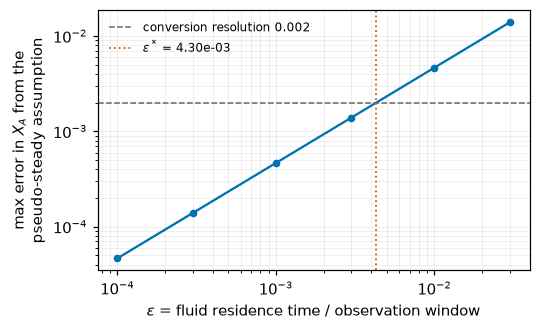
cost is first order in eps (slope 1.000 over eps = 1e-4 to 3e-3, against an eps = 0 reference marched in 1600 steps; against one marched in 200 steps the slope reads 1.009, because that reference's time error is part of the smallest costs), and crosses the 0.002 conversion resolution at eps* = 4.30e-03.
Read as the paper reads it (p. 267): with a fluid residence time of 1 s, the assumption is worth its own error bar once the run lasts longer than 233 s = 4 min, the boundary the paper draws in words: "Deactivation in the order of minutes or longer can use the fixed batch of solids."
The break table
Every reported number needs something that moves it. The table below holds the defects injected into the model and the solver; the claims cell after it wires those rows, and the breaks computed beside each result above, to the claim each one must fail. A claim that no row can move is an identity, and it is named as structural there.
"""Defect injection: break something on purpose, watch the number move."""
kap, lam, dv, npv = BASE["kappa"], BASE["lam"], BASE["d"], BASE["nprime"]

# (a) wrong nu in construct_div: cylindrical instead of Cartesian weight coord
Xnu, _, _ = Bed(200, nu=1).march("parallel", kap, lam, dv, npv, n=BASE["n"], nt=200)
BREAKS.append(("bed_vs_quadrature_production", M["bed_vs_quadrature_production"],
               "Bed(200, nu=1): cylindrical, not the Cartesian weight coordinate",
               float(np.max(np.abs(Xnu[1:] - ref_par[1:]))), "wrong geometry flag nu = 1 (inlet face area zero, feed cut off)"))

# (b) first-order upwind: no limiter
Xtvd, _, _ = Bed(200, limiter=None).march("parallel", kap, lam, dv, npv,
                                          n=BASE["n"], nt=200)
BREAKS.append(("bed_vs_quadrature_production", M["bed_vs_quadrature_production"],
               "Bed(200, limiter=None): first-order upwind",
               float(np.max(np.abs(Xtvd[1:] - ref_par[1:]))), "van Leer limiter removed"))

# (c) Euler instead of Heun on the activity: ORDER against ORDER, on the same
# ladder.  Setting an order against an ERROR cannot fail, because they are
# different quantities.
BREAKS.append(("bed_time_order_heun_min", M["bed_time_order_heun_min"],
               "march(..., scheme='euler') on the same ladder (m = 200, nt = 40..640)",
               M["bed_time_order_euler_min"],
               "observed order against observed order: 2 -> 1"))

# (d) the inlet boundary condition flipped to zero-gradient
Xbc, _, _ = Bed(200, feed=False).march("parallel", kap, lam, dv, npv, n=BASE["n"], nt=200)
BREAKS.append(("bed_vs_quadrature_production", M["bed_vs_quadrature_production"],
               "Bed(200, feed=False): inlet {a:1,b:0,d:0}, feed not imposed",
               float(np.max(np.abs(Xbc[1:] - ref_par[1:]))),
               "boundary condition on the outward normal. Not independent "
               "evidence from row (a): with nu = 1 the inlet face has zero "
               "area, so an un-fed bed and a bed with the wrong nu reach the "
               "same answer"))

# (e) the four rate forms, swapped one for another (the wrong-class injection)
for cfg in ("plug", "mixed"):
    y_true = respond(cfg, "parallel", kap, lam, dv, npv, BASE["sig"],
                     c_set=BASE["c_set"])
    y_wrong = respond(cfg, "series", kap, lam, dv, npv, BASE["sig"],
                      c_set=BASE["c_set"])
    BREAKS.append((f"sep_{cfg}_par_vs_ser", M[f"sep_{cfg}_par_vs_ser"],
                   "use eq. (5) where eq. (4) is true, WITHOUT refitting",
                   float(np.sqrt(np.mean((y_wrong - y_true) ** 2))),
                   "the unfitted gap - the fitted one is the metric itself"))

# (f) transcription: a mis-read subscript in eq. (5), C_R read as C_A
y_true = respond("plug", "series", kap, lam, dv, npv, 0.0)
y_typo = respond("plug", "parallel", kap, lam, dv, npv, 0.0)
BREAKS.append(("printed_chain_nonzero", 0.0,
               "eq. (5) transcribed with C_A for C_R (one subscript)",
               float(np.sqrt(np.mean((y_typo - y_true) ** 2))),
               "reported as the response gap; the symbolic residual is the guard"))

# (g) the n' = 0 collapse, broken by giving the decay a concentration
BREAKS.append(("degen_nprime0_plug", M["degen_nprime0_plug"],
               "give the decay a concentration order n' = 0.7",
               M["degen_nprime0_off_condition"],
               "the collapse is exactly at n' = 0 and nowhere else"))

# (h) the fitter itself: widen the multistart on the entry that carries the
# plug-flow count of 1 (parallel truth, independent candidate, 2.2e-3)
y_true = respond("plug", "parallel", kap, lam, dv, npv, BASE["sig"],
                 c_set=BASE["c_set"])
big = _seeds("independent", kap, lam) + [[np.log(kap * f), np.log(lam * g), dvv]
                                         for f in (0.5, 2.0) for g in (0.25, 4.0)
                                         for dvv in (0.25, 0.75, 1.5, 2.5)]
D_big = fit_class("plug", y_true, "independent", kap, lam, seeds=big, keep=6)[0]
BREAKS.append(("sep_plug_par_vs_ind", M["sep_plug_par_vs_ind"],
               f"multistart widened from {len(_seeds('independent', kap, lam))} to "
               f"{len(big)} seeds", D_big,
               "ROBUSTNESS (must NOT move): a separability number is an UPPER "
               "bound, and this bounds the bound - a lower value here would mean "
               "the headline overstates the separation"))
M["sep_plug_par_vs_ind_wideseed"] = float(D_big)

# (i) the resolution the verdicts are read at - ONE ROW PER DEVICE, so that the
# three counts carrying the page's negative headline (batch, mixed, constC) each
# have a mover of their own.  The alternative resolution is chosen per device to
# be one that actually moves that device's count.
for cfg, alt in (("plug", 1e-4), ("batch", 1e-4), ("mixed", 1e-4)):
    BREAKS.append((f"sep_{cfg}_n_separable", N_SEP[cfg],
                   f"read the {cfg} matrix at resolution {alt:g} instead of "
                   f"{M[f'sep_threshold_{cfg}']:g}",
                   float(sum(1 for i in range(4) for j in range(4)
                             if i != j and SEP[cfg][i, j] > alt)),
                   "the count is a function of the stated resolution, by design"))

# ... and the held-C_A count needs a PHYSICAL injection, because no resolution
# moves it: every pair in that device is exactly degenerate at the base point.
# Degeneracy 3's fourth member holds only at d = 1 (the poison consumed per unit
# time goes as a^(d-1)), so d = 2 is where side-by-side leaves the collapse.
# Where an identity of sec. 4 still applies the twin is used, so this costs
# three fits, not sixteen.
def constC_count_at(d_inj, res):
    b = dict(BASE, d=d_inj); cnt = 0
    for i, truth in enumerate(CLASSES):
        y = respond("constC", truth, b["kappa"], b["lam"], b["d"], b["nprime"],
                    b["sig"], n=BASE["n"], c_set=b["c_set"])
        for j, cand in enumerate(CLASSES):
            if i == j:
                continue
            v, _ = twin_residual("constC", truth, cand, b, BASE["n"])
            if v is None:
                v = fit_class("constC", y, cand, b["kappa"], b["lam"],
                              n=BASE["n"], c_set=b["c_set"],
                              tag=("constC-d2", truth, cand))[0]
            cnt += int(v > res)
    return float(cnt)
CONSTC_ALT_RES = 1e-4
BREAKS.append(("sep_constC_n_separable", N_SEP["constC"],
               f"move the held-C_A device to d = 2, where the a^(d-1) "
               f"cancellation that pins C_P fails, AND read at "
               f"{CONSTC_ALT_RES:g}",
               constC_count_at(2.0, CONSTC_ALT_RES),
               "COMPOUND, and deliberately so: at the page's own 1e-2 "
               "resolution this count stays 0 for every d tried, because the "
               "collapse of parallel/series/independent is exact at any d and "
               "only side-by-side ever leaves it"))

df = pd.DataFrame(BREAKS, columns=["metric", "as built", "injected defect",
                                   "with the defect", "note"])
df["kind"] = ["robustness" if str(nn).startswith("ROBUSTNESS") else "mover"
              for nn in df["note"]]
df["moves?"] = [("yes" if (not np.isfinite(b) or abs(b - a) >
                           max(1e-14, 1e-6 * max(abs(a), abs(b)))) else "no")
                for a, b in zip(df["as built"], df["with the defect"])]
# printed to four figures, and round-off-sized numbers as the bound they are
# checked at, so the table reads the same on every machine
_show = df.copy()
for col in ("as built", "with the defect"):
    _show[col] = [("<1e-8" if 0 < abs(v) < 1e-8 else f"{v:.4g}")
                  if np.isfinite(v) else str(v) for v in df[col]]
display(Markdown("**Defect-injection table**\n\n" + md_table(_show)))
movers = df[df["kind"] == "mover"]
assert (movers["moves?"] == "yes").all(), movers[movers["moves?"] != "yes"]
rob = df[df["kind"] == "robustness"]
for a, b in zip(rob["as built"], rob["with the defect"]):
    assert b >= 0.9 * a, f"robustness row improved: {a} -> {b}"
print(f"{len(movers)} injected defects, every one of which moves its metric; "
      f"{len(rob)} robustness row(s), which must NOT move and do not "
      f"(worst change {max((abs(b/a - 1) for a, b in zip(rob['as built'], rob['with the defect'])), default=0.0):.1e}).")
M["break_rows"] = float(len(movers))
M["break_robustness_rows"] = float(len(rob))
Defect-injection table
| metric | as built | injected defect | with the defect | note | kind | moves? |
|---|---|---|---|---|---|---|
| eq24_numeric_offset | 1.05 | read eq. (24) as if it printed 1/k | 0 | the defect metric is exactly the printed-vs-required gap | mover | yes |
| degen_batch_sbs_is_parallel_on_condition | 0 | step off the n’ = n, d = 1 condition (d = 2) | 0.0166 | shows the identity is conditional, not a numerical artefact | mover | yes |
| degen_sbs_is_parallel_famB_plug | <1e-8 | evaluate the same sigma-family identity in the MIXED reactor | 0.1185 | degeneracy 5 is a property of the batch and the bed only | mover | yes |
| degen_mixed_series_is_parallel | <1e-8 | tighten the integrator from rtol 1e-9 to 1e-13 | <1e-8 | the metric measures the ODE tolerance; the identity itself is exact | mover | yes |
| bed_a_outlet_spaceonly_par | 0.1902 | halve NT_CONV to 50 and report the space-Richardson alone | 0.1902 | the space-only reading IS a function of the step count, which is why it is not what is reported | mover | yes |
| bed_a_outlet_end_par | 0.1902 | read the time extrapolation off the nt = 50/100 pair instead of 100/200 | 0.1902 | ROBUSTNESS (must NOT move): the reported outlet is the limit of the march, so which pair the limit is read from must not matter | robustness | no |
| bed_a_outlet_spaceonly_ser | 0.1771 | halve NT_CONV to 50 and report the space-Richardson alone | 0.1771 | the space-only reading IS a function of the step count, which is why it is not what is reported | mover | yes |
| bed_a_outlet_end_ser | 0.1771 | read the time extrapolation off the nt = 50/100 pair instead of 100/200 | 0.1771 | ROBUSTNESS (must NOT move): the reported outlet is the limit of the march, so which pair the limit is read from must not matter | robustness | no |
| mixed_boundary_np1_d0.5 | 0.003055 | move d back across the predicted boundary to d = 1.5 | <1e-8 | the separability of the mixed reactor is switched by the analytic condition, in both directions | mover | yes |
| constC_span_prec5pct_max | 0.3819 | start the level set at C_A/C_A0 = 0.05 instead of 0.4 | 0.0725 | the required span is set by the unprinted C_LO as much as by the demanded precision | mover | yes |
| constC_span_needed_prec5pct | 0.2035 | demand 2 % precision on k’_d instead of 5 % | 0.1111 | the required span is set by the precision, and moves with it | mover | yes |
| constC_sbs_recovered_d_base | 1.383 | set sigma = 0 (poison in such excess that C_P never moves) | 2 | the bias IS the poison consumption; with none, d comes back exactly | mover | yes |
| constC_sbs_bias_at_d1_max | <1e-8 | move off d = 1, where the a^(d-1) cancellation holds, to d = 2 | 0.4916 | the blind spot is exactly at d = 1 and nowhere else | mover | yes |
| pseudo_steady_cost_eps1e-3 | 0.0004653 | raise eps 30x, to 3e-2 | 0.01398 | the assumption’s cost is first order in eps and does move | mover | yes |
| bed_vs_quadrature_production | 1.529e-06 | Bed(200, nu=1): cylindrical, not the Cartesian weight coordinate | 0.8523 | wrong geometry flag nu = 1 (inlet face area zero, feed cut off) | mover | yes |
| bed_vs_quadrature_production | 1.529e-06 | Bed(200, limiter=None): first-order upwind | 0.001201 | van Leer limiter removed | mover | yes |
| bed_time_order_heun_min | 1.991 | march(…, scheme=‘euler’) on the same ladder (m = 200, nt = 40..640) | 1.001 | observed order against observed order: 2 -> 1 | mover | yes |
| bed_vs_quadrature_production | 1.529e-06 | Bed(200, feed=False): inlet {a:1,b:0,d:0}, feed not imposed | 0.8523 | boundary condition on the outward normal. Not independent evidence from row (a): with nu = 1 the inlet face has zero area, so an un-fed bed and a bed with the wrong nu reach the same answer | mover | yes |
| sep_plug_par_vs_ser | 0.0008066 | use eq. (5) where eq. (4) is true, WITHOUT refitting | 0.1606 | the unfitted gap - the fitted one is the metric itself | mover | yes |
| sep_mixed_par_vs_ser | <1e-8 | use eq. (5) where eq. (4) is true, WITHOUT refitting | 0.03641 | the unfitted gap - the fitted one is the metric itself | mover | yes |
| printed_chain_nonzero | 0 | eq. (5) transcribed with C_A for C_R (one subscript) | 0.1606 | reported as the response gap; the symbolic residual is the guard | mover | yes |
| degen_nprime0_plug | 0 | give the decay a concentration order n’ = 0.7 | 1.42 | the collapse is exactly at n’ = 0 and nowhere else | mover | yes |
| sep_plug_par_vs_ind | 0.002202 | multistart widened from 4 to 20 seeds | 0.002202 | ROBUSTNESS (must NOT move): a separability number is an UPPER bound, and this bounds the bound - a lower value here would mean the headline overstates the separation | robustness | no |
| sep_plug_n_separable | 1 | read the plug matrix at resolution 0.0001 instead of 0.002 | 5 | the count is a function of the stated resolution, by design | mover | yes |
| sep_batch_n_separable | 0 | read the batch matrix at resolution 0.0001 instead of 0.002 | 7 | the count is a function of the stated resolution, by design | mover | yes |
| sep_mixed_n_separable | 0 | read the mixed matrix at resolution 0.0001 instead of 0.002 | 3 | the count is a function of the stated resolution, by design | mover | yes |
| sep_constC_n_separable | 0 | move the held-C_A device to d = 2, where the a^(d-1) cancellation that pins C_P fails, AND read at 0.0001 | 3 | COMPOUND, and deliberately so: at the page’s own 1e-2 resolution this count stays 0 for every d tried, because the collapse of parallel/series/independent is exact at any d and only side-by-side ever leaves it | mover | yes |
24 injected defects, every one of which moves its metric; 3 robustness row(s), which must NOT move and do not (worst change 2.4e-07)."""Claims: every published number, registered once with how it is checked.
docs/claims-design.md. A VALUE (a physical, data or discretisation result
above round-off) is held to the committed baseline within its rtol; a BOUND (a
residual, an identity, a solver-tolerance effect, an optimiser stall, an
observed order) is checked against its limit on every run and on any machine;
an EXACT result (a count, a boolean, a stated constant) by equality, and a
count decided by a threshold carries its margin to that threshold. The set of
names is fixed and never depends on a value."""
claims = Claims("B2.3")
B = {} # name -> bound arguments
RTOL = {} # value claims held tighter than 5 %, each with the reason
# -- identities measured by subtraction: degeneracies 1 to 5 --------------------
for cfg in ("batch", "plug", "mixed", "constC"):
B[f"degen_nprime0_{cfg}"] = dict(
max=1e-12, basis="identity",
note="n' = 0: the class enters only through f^n', and _pow(x, 0) is 1.0")
B["degen_mixed_series_is_parallel"] = dict(
max=1e-8, basis="tolerance",
note="degeneracy 2 over nine order combinations, LSODA at rtol 1e-9")
B["degen_mixed_series_is_parallel_rtol1e-13"] = dict(
max=1e-11, basis="tolerance", note="the same nine combinations at rtol 1e-13")
B["degen_constC_par_ser_ind"] = dict(
max=1e-12, basis="identity",
note="degeneracy 3: k'_d is a constant for three classes in one held-C_A run")
for cfg in ("batch", "plug", "mixed"):
B[f"degen_sbs_is_parallel_famA_{cfg}"] = dict(
max=1e-12, basis="identity",
note="degeneracy 4: the poison solves the reactant's own equation")
B["degen_batch_sbs_is_parallel_on_condition"] = dict(
max=1e-12, basis="identity", note="degeneracy 4 in the batch, as above")
B["degen_sbs_is_parallel_famB_batch"] = dict(
max=1e-7, basis="tolerance",
note="degeneracy 5 in the batch, five sigma, LSODA at rtol 1e-9")
B["degen_sbs_is_parallel_famB_plug"] = dict(
max=1e-8, basis="tolerance",
note="degeneracy 5 in the bed, five sigma")
# -- the separability matrices ---------------------------------------------------
FIT_BOUND = {("plug", "series", "side-by-side"), ("mixed", "series", "side-by-side"),
("mixed", "side-by-side", "parallel"), ("mixed", "side-by-side", "series")}
for cfg in SEP:
for i, tr in enumerate(CLASSES):
for j, cd in enumerate(CLASSES):
nm = f"sep_{cfg}_{SHORT[tr]}_vs_{SHORT[cd]}"
if i == j:
B[nm] = dict(max=0.0, basis="identity", structural=True,
note="a class against its own response: the twin is "
"the truth itself, residual exactly 0")
elif np.isfinite(SEP_TWIN[cfg][i, j]):
B[nm] = dict(max=1e-8, basis="tolerance",
note="identity-backed (a twin of sec. 4); what is left "
"is the integrator's, rtol 1e-9")
elif (cfg, tr, cd) in FIT_BOUND:
B[nm] = dict(max=2e-4, basis="chosen",
note="no twin: an optimiser upper bound on a minimum, "
"claimed only as a tenth of the conversion "
"resolution")
B["sep_identity_twin_worst"] = dict(
max=1e-8, basis="tolerance",
note="largest twin residual over the 44 identity-backed entries, rtol 1e-9")
for cfg in SEP:
B[f"sep_stall_{cfg}"] = dict(
max=1e-9, basis="tolerance",
note="largest diagonal fit (exact minimum 0) with the central-difference "
"Jacobian; ODE rtol 1e-9")
B["sep_stall_worst"] = dict(max=1e-9, basis="tolerance",
note="the largest of the four sep_stall_* bounds")
B["sep_stall_worst_not_sbs"] = dict(
max=1e-9, basis="tolerance",
note="as sep_stall_worst, side-by-side excluded. Close to vacuous: for these "
"classes the seed grid contains the truth, so the fits only evaluate it")
for name, (cfg, q, vals, bnd) in PROFILES.items():
B[name] = dict(max=bnd, basis="chosen",
note=f"profile of the side-by-side self-fit in {DEV[cfg]}: "
f"{PNAMES[q]} held at {min(vals):g} to {max(vals):g}, the other "
f"four refitted (ODE rtol 1e-12, central differences). A "
f"nonzero physical minimum, not a tolerance; the bound is a "
f"tenth of the 2e-3 conversion resolution, and below the "
f"{min(M['sep_stall_1pct_cheapest_batch'], M['sep_stall_1pct_cheapest_mixed']):.1e} "
f"a +1 % move of one constant costs. Optimiser upper "
f"bounds, safe in the direction of a non-identifiability "
f"claim; a point whose free constant ends on the box edge is "
f"limited by the box (printed)")
B["sep_constC_best_pair"] = dict(
max=1e-12, basis="identity",
note="every off-diagonal entry of the held-C_A matrix is a twin of degeneracy 3")
# -- the mixed-flow boundary -------------------------------------------------------
for nm in ("mixed_boundary_np1_d1.5", "mixed_boundary_np1_d1", "mixed_boundary_worst_inside"):
B[nm] = dict(max=1e-8, basis="tolerance",
note="inside d >= n'/n the exact twin exists; integrator rtol 1e-9")
B["mixed_boundary_np1_d0.75"] = dict(
max=1e-3, basis="chosen",
note="no twin: an optimiser upper bound, claimed only as below 1e-3, half the "
"2e-3 resolution")
for nm in ("mixed_boundary_np2_d1.5", "mixed_boundary_best_outside"):
B[nm] = dict(max=1e-4, basis="chosen",
note="no twin: an optimiser upper bound, claimed only as below 1e-4")
# -- held C_A, side-by-side --------------------------------------------------------
B["constC_sbs_bias_at_d1_max"] = dict(
max=1e-7, basis="tolerance",
note="|recovered d - 1| over 21 sigma at d = 1; minimize_scalar xatol 1e-10 on "
"an expm1 transform")
B["constC_sbs_bias_sig0"] = dict(
max=1e-7, basis="tolerance",
note="|recovered d / 2 - 1| at sigma = 0, the author's own protocol")
# -- the paper's closed forms ------------------------------------------------------
B["eq15_maxdev"] = dict(max=1e-7, basis="tolerance",
note="batch fluid against eq. (15), LSODA at rtol 1e-9, atol 1e-13")
for nm in ("eq19_maxdev", "eq28_reldev", "eq29_reldev", "eq30_reldev", "eq31_reldev"):
B[nm] = dict(max=1e-12, basis="identity",
note="independent decay: dw/dtheta = -lam is constant, so every "
"integrator step is exact and what is left is round-off")
# -- the bed: tolerance effects and observed orders --------------------------------
B["bed_inlet_time_sensitivity"] = dict(
max=1e-7, basis="chosen",
note="inlet cell centre, nt doubled at m = 800; the bound is 400x below the "
"parallel cell-centre error the spatial study measures")
for sh in ("par", "ser"):
B[f"bed_a_inlet_cellcentre_order_{sh}"] = dict(
min=0.9, max=1.1, basis="theory",
note="first order: the first cell centre sits 1/2m from the face")
B[f"bed_a_outlet_time_order_{sh}"] = dict(
min=1.8, max=2.2, basis="theory", note="Heun on the activity march")
B[f"bed_a_outlet_space_order_{sh}"] = dict(
min=1.9, max=2.1, basis="theory",
note="outlet-face activity (linear extrapolation of the last two cells), "
"changes between 200/400 and 400/800 cells at nt = 100")
B[f"bed_a_outlet_vs_quadrature_{sh}"] = dict(
max=1e-7, basis="chosen",
note="doubly extrapolated outlet activity against the quadrature route; "
"the bound is chosen above the measured Richardson error (the "
"quadrature itself converges to 1e-8)")
B[f"bed_a_outlet_quadrature_change_{sh}"] = dict(
max=1e-8, basis="tolerance",
note="quadrature route, 161 against 321 Simpson nodes, LSODA rtol 1e-12")
for key in ("n1_exp", "n2_exp", "n1_quad", "n2_quad"):
B[f"bed_spatial_order_{key}"] = dict(
min=1.9, max=2.1, basis="theory",
note="ConvFluxTVD (van Leer), outlet on the extrapolated face, m = 200 to 400")
B["bed_spatial_finest_over_roundoff"] = dict(
min=1e3, basis="theory",
note="smallest 400-cell frozen-profile error over the newton/deferred gap")
B["bed_route_gap_frozen"] = dict(
max=1e-11, basis="tolerance",
note="newton step tol 1e-12 against deferred sweeps to a change below 1e-12, "
"same discrete equations, 200 cells")
B["bed_route_gap_march"] = dict(
max=1e-11, basis="tolerance",
note="production conversion history (200 cells, 200 steps) by the two routes")
for _nm, _what in (("bed_a_inlet_cellcentre", "inlet cell-centre error ladder (last two grids)"),
("bed_a_outlet_space", "outlet-face activity, last two grids at nt = 100"),
("bed_a_outlet_time", "doubly extrapolated outlet, last two step counts")):
B[f"{_nm}_finest_over_roundoff"] = dict(
min=1e3, basis="theory",
note=f"finest change of the {_what} over the newton/deferred gap of the march")
B["bed_axes_finest_over_roundoff"] = dict(
min=1e3, basis="theory",
note="finest differences of the time and space ladders over the route gap")
for s_, lo, hi in (("heun", 1.95, 2.05), ("euler", 0.95, 1.05)):
for e_ in ("min", "max"):
B[f"bed_time_order_{s_}_{e_}"] = dict(
min=lo, max=hi, basis="theory",
note=f"{s_} on the activity, m = 200, nt = 40..640 (observation times "
f"on the step grid), space error cancelled")
for e_ in ("min", "max"):
B[f"bed_space_order_march_{e_}"] = dict(
min=1.95, max=2.05, basis="theory",
note="conversion history at nt = 80, m = 50..800, time error cancelled")
B["pseudo_steady_cost_slope"] = dict(
min=0.995, max=1.005, basis="theory",
note="the cost of the pseudo-steady assumption is first order in eps; fitted "
"over eps = 1e-4 to 3e-3 against an eps = 0 reference of 1600 steps")
# -- value claims held tighter than 5 %, so that their break rows fail them --------
# exact inlet values and the space-only outlet reading: held tight enough that
# their break rows (a cell centre for the exact value, nt halved) fail them
RTOL.update({"bed_a_inlet_end_par": 1e-4, "bed_a_inlet_end_ser": 1e-4,
"bed_a_outlet_spaceonly_par": 2e-6, "bed_a_outlet_spaceonly_ser": 2e-6})
EXACT = { # name -> structural note, or None when a break row moves it
"printed_chain_identities": "the number of symbolic identities checked",
"printed_chain_nonzero": None,
"eq24_residual_is_log_kd_over_k": None,
"eq24_repaired_residual": None,
"sep_identity_backed": "entries with a twin of sec. 4, decided by the algebra",
"fits_capped": None,
"constC_sbs_bias_target": "a stated target, the first of 5 %, 2 %, 1 % reached",
"break_rows": "rows of the break table",
"break_robustness_rows": "robustness rows of the break table",
**{f"sep_threshold_{cfg}": "the stated instrument resolution" for cfg in SEP},
}
STRUCT_VALUE = {"eq24_offset_expected": "ln(k/k_d) of the chosen constants, the "
"reference the numeric offset is compared with"}
for k_, v in M.items():
if k_ in B:
claims.bound(k_, v, **B[k_])
elif k_ in EXACT:
claims.exact(k_, v, structural=EXACT[k_] is not None, note=EXACT[k_])
elif k_ in STRUCT_VALUE:
claims.value(k_, v, note=STRUCT_VALUE[k_])
else:
claims.value(k_, v, rtol=RTOL.get(k_, 0.05))
assert set(B) <= set(M), set(B) - set(M)
# -- thresholded counts, with their margins ----------------------------------------
# the margin of fits_capped = 0: the largest share of its evaluation budget any
# production fit used (Jacobian evaluations included), against the budget
_share = {t: v for t, v in EVALS.items() if t != ("budget-break",)}
claims.bound("fits_budget_share_max", max(_share.values()), max=0.9, basis="chosen",
note=f"largest share of the 10000-evaluation budget used by any of the "
f"{len(_share)} production fits; 0 capped fits needs it below 1, "
f"and 0.9 keeps a margin")
print(f"largest share of the evaluation budget used by any production fit: "
f"below 0.9 (here {max(_share.values()):.2f}, {max(_share, key=_share.get)})")
claims.count("sep_optimiser_overstated", SEP_OVER, 1e-6, min_margin=0.5,
note="identity-backed entries where the fit alone stops more than 1e-6 "
"above the twin")
for cfg in SEP:
n_ = claims.count(f"sep_{cfg}_n_separable", SEP_OFF[cfg], res_of.get(cfg, RES_X),
min_margin=0.02,
note="off-diagonal entries above the instrument resolution")
assert n_ == N_SEP[cfg]
# -- break rows ----------------------------------------------------------------------
# Rows that only re-read a count at another resolution re-run nothing; they stay
# in the table as documentation of the threshold, and the counts get a row that
# recomputes the matrix (the candidates not refitted) instead.
for metric, base, inj, broken, note in BREAKS:
if metric == "printed_chain_nonzero": # wired below, on the count itself
continue
if metric.endswith("_n_separable") and metric != "sep_constC_n_separable":
continue
claims.breaks(inj, metric, broken)
claims.breaks("eq. (12) read with k for k_d", "printed_chain_nonzero", SYM_TYPO_NONZERO)
claims.breaks("eq. (24) taken with 1/k", "eq24_residual_is_log_kd_over_k", EQ24_BROKEN[0])
claims.breaks("eq. (24) taken as printed", "eq24_repaired_residual", EQ24_BROKEN[1])
claims.breaks("the reference inverted, ln(k_d/k)", "eq24_offset_expected", np.log(_kd / _k))
SWAP = {"parallel": "series", "series": "parallel",
"side-by-side": "independent", "independent": "side-by-side"}
for cfg in ("batch", "plug", "mixed", "constC"):
for cls in CLASSES:
claims.breaks("rate form swapped (eq. 5 for 4, eq. 7 for 6)",
f"span_{cfg}_{SHORT[cls]}", float(np.ptp(RESP[(cfg, SWAP[cls])])))
for cfg in ("batch", "plug", "mixed", "constC"):
claims.breaks("n' = 0.7 instead of 0", f"degen_nprime0_{cfg}", OFF_NP0[cfg])
claims.breaks("n' set back to 0", "degen_nprime0_off_condition",
max(M[f"degen_nprime0_{c}"] for c in ("batch", "plug", "mixed", "constC")))
claims.breaks("degeneracy 2 without relabelling the orders and lam",
"degen_mixed_series_is_parallel", DEGEN2_UNMAPPED)
claims.breaks("integrated at the production rtol 1e-9",
"degen_mixed_series_is_parallel_rtol1e-13", M["degen_mixed_series_is_parallel"])
claims.breaks("series without relabelling lam", "degen_constC_par_ser_ind", DEGEN3_UNMAPPED)
for cfg in ("batch", "plug", "mixed"):
claims.breaks("off the n' = n, d = 1 condition", f"degen_sbs_is_parallel_famA_{cfg}",
OFF_A[cfg])
claims.breaks("back on the n' = n, d = 1 condition", "degen_batch_sbs_off_condition",
M["degen_batch_sbs_is_parallel_on_condition"])
claims.breaks("the same identity in the mixed reactor", "degen_sbs_is_parallel_famB_batch",
M["degen_sbs_is_parallel_famB_mixed"])
for cfg in ("mixed", "constC"):
claims.breaks("the same identity in the batch, where it holds",
f"degen_sbs_is_parallel_famB_{cfg}", M["degen_sbs_is_parallel_famB_batch"])
claims.breaks("back on the n = n' = d = 1 condition", "degen_sbs_famB_off_condition",
M["degen_sbs_is_parallel_famB_plug"])
UNFIT = {} # the candidate's rate form at the truth's constants, not refitted
for cfg in SEP:
for i, tr in enumerate(CLASSES):
for j, cd in enumerate(CLASSES):
if i != j:
UNFIT[(cfg, i, j)] = float(np.sqrt(np.mean(
(RESP[(cfg, cd)] - RESP[(cfg, tr)]) ** 2)))
claims.breaks("candidate's rate form at the truth's constants, not "
"refitted", f"sep_{cfg}_{SHORT[tr]}_vs_{SHORT[cd]}",
UNFIT[(cfg, i, j)])
claims.breaks("not refitted", f"sep_{cfg}_best_pair",
max(v for (c, _, _), v in UNFIT.items() if c == cfg))
claims.breaks("not refitted", "sep_plug_par_vs_ind_wideseed", UNFIT[("plug", 0, 3)])
for cfg in ("batch", "plug", "mixed"):
claims.breaks("the matrix with the candidates not refitted", f"sep_{cfg}_n_separable",
float(sum(1 for (c, _, _), v in UNFIT.items()
if c == cfg and v > res_of.get(cfg, RES_X))))
claims.breaks("degeneracy 2's twin without the lam mapping", "sep_identity_twin_worst",
TWIN_UNMAPPED)
claims.breaks("the twin's parameters added as a seed", "sep_optimiser_worst_overstatement",
OVER_TWIN_SEEDED)
claims.breaks("the diagonal fits stopped after 3 evaluations",
"sep_optimiser_overstated", OVER_COUNT_EARLY)
for cfg in SEP:
claims.breaks("polish stopped after 3 evaluations", f"sep_stall_{cfg}",
max(STALL_EARLY[(cfg, c)] for c in ("parallel", "side-by-side")))
claims.breaks("polish stopped after 3 evaluations", "sep_stall_worst",
max(STALL_EARLY.values()))
claims.breaks("polish stopped after 3 evaluations", "sep_stall_worst_not_sbs",
max(v for (c, cl), v in STALL_EARLY.items() if cl == "parallel"))
for name in PROFILES:
claims.breaks("the far end of the range with the other four NOT refitted", name,
PROF_UNFIT[name])
for cfg in ("batch", "mixed"):
claims.breaks("the cheapest constant moved 2 %, not 1 %",
f"sep_stall_1pct_cheapest_{cfg}", COST_2PCT[cfg])
claims.breaks("a budget of 50 evaluations", "fits_capped", FITS_CAPPED_BROKEN)
claims.breaks("a budget of 50 evaluations", "fits_budget_share_max",
EVALS[("budget-break",)])
for nm in ("mixed_boundary_np1_d1.5", "mixed_boundary_np1_d1", "mixed_boundary_worst_inside",
"mixed_boundary_np1_d0.25"):
claims.breaks("d moved below the line to 0.5", nm, M["mixed_boundary_np1_d0.5"])
claims.breaks("d moved further from the line, to 0.25", "mixed_boundary_np1_d0.75",
M["mixed_boundary_np1_d0.25"])
for nm in ("mixed_boundary_np2_d1.5", "mixed_boundary_best_outside"):
claims.breaks("n' = 1, d = 0.5 instead", nm, M["mixed_boundary_np1_d0.5"])
claims.breaks("demand 5 % instead of 2 %", "constC_span_needed_prec2pct",
M["constC_span_needed_prec5pct"])
claims.breaks("demand 5 % instead of 10 %", "constC_span_needed_prec10pct",
M["constC_span_needed_prec5pct"])
claims.breaks("a span of 0.05", "constC_misfit_at_span_0p5", wrong_class_misfit(0.05))
claims.breaks("start the levels at 0.40", "constC_span_prec5pct_min",
M["constC_span_prec5pct_max"])
claims.breaks("base sigma instead of 0", "constC_sbs_recovered_d_sig0",
M["constC_sbs_recovered_d_base"])
claims.breaks("base sigma instead of 0", "constC_sbs_bias_sig0",
abs(M["constC_sbs_recovered_d_base"] / D_TRUE - 1.0))
claims.breaks("d = 1 instead of 2", "constC_sbs_bias_max_scanned",
M["constC_sbs_bias_at_d1_max"])
claims.breaks("read off the sigma scan, not root-found", "constC_sbs_sigma_for_bias",
SIG_SCAN_READ)
for nm, v in {**BED_BROKEN, **SPATIAL_BROKEN}.items():
claims.breaks({**BED_BROKEN_LABEL, **SPATIAL_BROKEN_LABEL}[nm], nm, v)
for nm, v in CF_BROKEN.items():
claims.breaks("k_d 1 % high in the closed form" if nm.startswith(("eq15", "eq19", "eq22"))
else "k'_d 1 % high in the run" if nm.endswith("reldev")
else "k'_d 25 % high in the run", nm, v)
for cls in ("parallel", "series"):
sh, other = SHORT[cls], SHORT[SWAP[cls]]
claims.breaks("the production cell centre in place of the exact inlet",
f"bed_a_inlet_end_{sh}", float(prof[cls][1][0, -1]))
for nm in ("bed_a_outlet_end", "bed_a_outlet_altpair", "bed_profile_contrast"):
claims.breaks("the other class's profile (eq. 5 for eq. 4)", f"{nm}_{sh}",
M[f"{nm}_{other}"])
claims.breaks("read at the outlet cell", "bed_inlet_time_sensitivity",
M["bed_profile_time_sensitivity"])
claims.breaks("read at the inlet cell", "bed_profile_time_sensitivity",
M["bed_inlet_time_sensitivity"])
claims.breaks("Heun for Euler", "bed_time_order_euler_min", M["bed_time_order_heun_min"])
claims.breaks("Heun for Euler", "bed_time_order_euler_max", M["bed_time_order_heun_max"])
claims.breaks("Euler for Heun", "bed_time_order_heun_max", M["bed_time_order_euler_max"])
claims.breaks("conversion interpolated between steps, nt = 25..400 (march(..., on_grid=False))",
"bed_time_order_heun_max", max(OT_OFFGRID["orders"]))
for e_, f_ in (("min", min), ("max", max)):
claims.breaks("first-order upwind convection (Bed(..., limiter=None))",
f"bed_space_order_march_{e_}", f_(OXM_UP["orders"]))
claims.breaks("deferred sweeps stopped at a change of 1e-4 (Bed(..., tol=1e-4))",
"bed_route_gap_frozen", GAP_LOOSE)
claims.breaks("deferred sweeps stopped at a change of 1e-4 (Bed(..., tol=1e-4))",
"bed_spatial_finest_over_roundoff", min(FINEST) / GAP_LOOSE)
claims.breaks("deferred sweeps stopped at a change of 1e-4 (Bed(..., tol=1e-4))",
"bed_route_gap_march", GAP_MARCH_LOOSE)
claims.breaks("deferred sweeps stopped at a change of 1e-4 (Bed(..., tol=1e-4))",
"bed_axes_finest_over_roundoff", min(_dT, _dX) / GAP_MARCH_LOOSE)
for _lad, _nm in (("inlet", "bed_a_inlet_cellcentre"), ("space", "bed_a_outlet_space"),
("time", "bed_a_outlet_time")):
claims.breaks("deferred sweeps stopped at a change of 1e-2 (Bed(..., tol=1e-2))",
f"{_nm}_finest_over_roundoff", min(FINEST6[_lad]) / GAP_MARCH_LOOSER)
claims.breaks("eps = 0 reference marched in 200 steps", "pseudo_steady_cost_slope",
PS_SLOPE_REF200)
_nu = [r for r in BREAKS if r[2].startswith("Bed(200, nu=1)")]
assert len(_nu) == 1
claims.breaks("Bed(200, nu=1)", "bed_vs_quadrature_over_resolution", _nu[0][3] / RES_X)
claims.breaks("series bed against the parallel quadrature", "bed_vs_quadrature_series",
float(np.max(np.abs(Xser[1:] - ref_par[1:]))))
claims.breaks("eps = 1e-3 instead of 3e-2", "pseudo_steady_cost_eps3e-2",
M["pseudo_steady_cost_eps1e-3"])
claims.breaks("accumulation scaled by sqrt(eps)", "pseudo_steady_cost_slope", PS_SLOPE_SQRT)
claims.breaks("eps* read at half the resolution", "pseudo_steady_eps_star", PS_EPS_HALF)
_kinds = {kd: [k_ for k_, c in claims.metrics.items() if c["kind"] == kd]
for kd in ("value", "bound", "exact")}
print(f"{len(claims.metrics)} claims registered: {len(_kinds['value'])} values, "
f"{len(_kinds['bound'])} bounds, {len(_kinds['exact'])} exact. The bounds that "
f"are not identities at 0:")
for k_ in _kinds["bound"]:
c = claims.metrics[k_]
if c.get("max") == 0.0:
continue
lo, hi = c.get("min"), c.get("max")
rng = (f"[{lo:g}, {hi:g}]" if lo is not None and hi is not None
else f">= {lo:g}" if lo is not None else f"<= {hi:g}")
print(f" {k_:44s} {rng:14s} [{c['basis']}] (here {c['value']:.3g})")
# -- numbers written in the prose of this page, checked against their claims -------
SAYS = {
"sep_stall_worst": ["below 1e-9"],
"sep_profile_d_batch": ["below 2e-4"],
"sep_profile_d_mixed": ["below 2e-4"],
"sep_profile_nprime_mixed": ["below 2e-4"],
"fits_budget_share_max": ["below 0.9"],
"mixed_boundary_worst_inside": ["below 1e-8"],
"mixed_boundary_np1_d0.75": ["below 1e-3"],
"mixed_boundary_np2_d1.5": ["below 1e-4"],
"constC_sbs_bias_at_d1_max": ["below 1e-7"],
"sep_optimiser_worst_overstatement": ["1.3e-3"],
"sep_plug_par_vs_ser": ["8.1e-4"],
"bed_a_inlet_end_par": ["0.0498"],
"bed_a_outlet_end_par": ["0.19"],
"bed_a_outlet_end_ser": ["0.18"],
"degen_sbs_is_parallel_famB_mixed": ["more than 1e-1"],
"degen_sbs_is_parallel_famB_constC": ["more than 1e-1"],
"printed_chain_identities": ["26"],
"constC_span_prec5pct_min": ["0.07"],
"constC_span_prec5pct_max": ["0.4"],
}
for k_, lits in SAYS.items():
for lit in lits:
claims.says(lit, k_)
# wall clock is deliberately neither printed nor reported: it is machine
# dependent, and two executions of this page must give identical content.largest share of the evaluation budget used by any production fit: below 0.9 (here 0.53, ('plug', 'series', 'side-by-side'))
226 claims registered: 92 values, 116 bounds, 18 exact. The bounds that are not identities at 0:
bed_route_gap_frozen <= 1e-11 [tolerance] (here 1.55e-13)
degen_nprime0_batch <= 1e-12 [identity] (here 0)
degen_nprime0_plug <= 1e-12 [identity] (here 0)
degen_nprime0_mixed <= 1e-12 [identity] (here 0)
degen_nprime0_constC <= 1e-12 [identity] (here 0)
degen_mixed_series_is_parallel <= 1e-08 [tolerance] (here 1.3e-09)
degen_mixed_series_is_parallel_rtol1e-13 <= 1e-11 [tolerance] (here 1.12e-13)
degen_constC_par_ser_ind <= 1e-12 [identity] (here 8.88e-16)
degen_sbs_is_parallel_famA_batch <= 1e-12 [identity] (here 0)
degen_sbs_is_parallel_famA_plug <= 1e-12 [identity] (here 0)
degen_sbs_is_parallel_famA_mixed <= 1e-12 [identity] (here 7.33e-15)
degen_batch_sbs_is_parallel_on_condition <= 1e-12 [identity] (here 0)
degen_sbs_is_parallel_famB_batch <= 1e-07 [tolerance] (here 2.48e-09)
degen_sbs_is_parallel_famB_plug <= 1e-08 [tolerance] (here 1.88e-11)
sep_batch_par_vs_s-b-s <= 1e-08 [tolerance] (here 3.98e-11)
sep_batch_s-b-s_vs_par <= 1e-08 [tolerance] (here 2.82e-11)
sep_batch_ind_vs_par <= 1e-08 [tolerance] (here 0)
sep_batch_ind_vs_ser <= 1e-08 [tolerance] (here 0)
sep_batch_ind_vs_s-b-s <= 1e-08 [tolerance] (here 0)
sep_plug_par_vs_s-b-s <= 1e-08 [tolerance] (here 0)
sep_plug_ser_vs_s-b-s <= 0.0002 [chosen] (here 1.39e-05)
sep_plug_s-b-s_vs_par <= 1e-08 [tolerance] (here 1.58e-15)
sep_plug_ind_vs_par <= 1e-08 [tolerance] (here 0)
sep_plug_ind_vs_ser <= 1e-08 [tolerance] (here 0)
sep_plug_ind_vs_s-b-s <= 1e-08 [tolerance] (here 0)
sep_mixed_par_vs_ser <= 1e-08 [tolerance] (here 3.34e-10)
sep_mixed_par_vs_s-b-s <= 1e-08 [tolerance] (here 0)
sep_mixed_ser_vs_par <= 1e-08 [tolerance] (here 1.32e-10)
sep_mixed_ser_vs_s-b-s <= 0.0002 [chosen] (here 3.45e-05)
sep_mixed_s-b-s_vs_par <= 0.0002 [chosen] (here 7.36e-06)
sep_mixed_s-b-s_vs_ser <= 0.0002 [chosen] (here 8.13e-05)
sep_mixed_ind_vs_par <= 1e-08 [tolerance] (here 0)
sep_mixed_ind_vs_ser <= 1e-08 [tolerance] (here 0)
sep_mixed_ind_vs_s-b-s <= 1e-08 [tolerance] (here 0)
sep_constC_par_vs_ser <= 1e-08 [tolerance] (here 0)
sep_constC_par_vs_s-b-s <= 1e-08 [tolerance] (here 0)
sep_constC_par_vs_ind <= 1e-08 [tolerance] (here 0)
sep_constC_ser_vs_par <= 1e-08 [tolerance] (here 0)
sep_constC_ser_vs_s-b-s <= 1e-08 [tolerance] (here 0)
sep_constC_ser_vs_ind <= 1e-08 [tolerance] (here 0)
sep_constC_s-b-s_vs_par <= 1e-08 [tolerance] (here 1.07e-16)
sep_constC_s-b-s_vs_ser <= 1e-08 [tolerance] (here 1.08e-16)
sep_constC_s-b-s_vs_ind <= 1e-08 [tolerance] (here 1.07e-16)
sep_constC_ind_vs_par <= 1e-08 [tolerance] (here 0)
sep_constC_ind_vs_ser <= 1e-08 [tolerance] (here 0)
sep_constC_ind_vs_s-b-s <= 1e-08 [tolerance] (here 0)
sep_identity_twin_worst <= 1e-08 [tolerance] (here 1.47e-09)
sep_stall_batch <= 1e-09 [tolerance] (here 6.28e-11)
sep_stall_plug <= 1e-09 [tolerance] (here 5.09e-11)
sep_stall_mixed <= 1e-09 [tolerance] (here 5.21e-11)
sep_stall_constC <= 1e-09 [tolerance] (here 7.29e-16)
sep_stall_worst <= 1e-09 [tolerance] (here 6.28e-11)
sep_stall_worst_not_sbs <= 1e-09 [tolerance] (here 6.28e-11)
sep_profile_d_batch <= 0.0002 [chosen] (here 3.86e-05)
sep_profile_d_mixed <= 0.0002 [chosen] (here 0.000156)
sep_profile_nprime_mixed <= 0.0002 [chosen] (here 1.27e-05)
sep_constC_best_pair <= 1e-12 [identity] (here 1.08e-16)
bed_a_inlet_cellcentre_order_par [0.9, 1.1] [theory] (here 1)
bed_a_outlet_space_order_par [1.9, 2.1] [theory] (here 2)
bed_a_inlet_cellcentre_order_ser [0.9, 1.1] [theory] (here 0.995)
bed_a_outlet_space_order_ser [1.9, 2.1] [theory] (here 2)
bed_inlet_time_sensitivity <= 1e-07 [chosen] (here 2.49e-09)
bed_a_outlet_quadrature_change_par <= 1e-08 [tolerance] (here 7.79e-13)
bed_a_outlet_quadrature_change_ser <= 1e-08 [tolerance] (here 1.87e-10)
bed_a_outlet_time_order_par [1.8, 2.2] [theory] (here 1.99)
bed_a_outlet_vs_quadrature_par <= 1e-07 [chosen] (here 6.37e-09)
bed_a_outlet_time_order_ser [1.8, 2.2] [theory] (here 2)
bed_a_outlet_vs_quadrature_ser <= 1e-07 [chosen] (here 1.4e-10)
mixed_boundary_np1_d1.5 <= 1e-08 [tolerance] (here 3.05e-11)
mixed_boundary_np1_d1 <= 1e-08 [tolerance] (here 3.34e-10)
mixed_boundary_np1_d0.75 <= 0.001 [chosen] (here 0.000749)
mixed_boundary_np2_d1.5 <= 0.0001 [chosen] (here 4.04e-05)
mixed_boundary_worst_inside <= 1e-08 [tolerance] (here 3.34e-10)
mixed_boundary_best_outside <= 0.0001 [chosen] (here 4.04e-05)
constC_sbs_bias_at_d1_max <= 1e-07 [tolerance] (here 8.35e-09)
constC_sbs_bias_sig0 <= 1e-07 [tolerance] (here 5.4e-09)
bed_spatial_order_n1_exp [1.9, 2.1] [theory] (here 2.01)
bed_spatial_order_n2_exp [1.9, 2.1] [theory] (here 2.04)
bed_spatial_order_n1_quad [1.9, 2.1] [theory] (here 2.02)
bed_spatial_order_n2_quad [1.9, 2.1] [theory] (here 2.02)
bed_spatial_finest_over_roundoff >= 1000 [theory] (here 3.58e+05)
bed_time_order_heun_min [1.95, 2.05] [theory] (here 1.99)
bed_time_order_heun_max [1.95, 2.05] [theory] (here 2)
bed_time_order_euler_min [0.95, 1.05] [theory] (here 1)
bed_time_order_euler_max [0.95, 1.05] [theory] (here 1)
bed_space_order_march_min [1.95, 2.05] [theory] (here 2)
bed_space_order_march_max [1.95, 2.05] [theory] (here 2.01)
bed_route_gap_march <= 1e-11 [tolerance] (here 8.88e-16)
bed_axes_finest_over_roundoff >= 1000 [theory] (here 3.32e+08)
bed_a_inlet_cellcentre_finest_over_roundoff >= 1000 [theory] (here 5e+10)
bed_a_outlet_space_finest_over_roundoff >= 1000 [theory] (here 3.14e+08)
bed_a_outlet_time_finest_over_roundoff >= 1000 [theory] (here 8.41e+08)
eq15_maxdev <= 1e-07 [tolerance] (here 8.63e-09)
eq19_maxdev <= 1e-12 [identity] (here 2.66e-15)
eq28_reldev <= 1e-12 [identity] (here 1.39e-16)
eq29_reldev <= 1e-12 [identity] (here 3.26e-16)
eq30_reldev <= 1e-12 [identity] (here 1.97e-16)
eq31_reldev <= 1e-12 [identity] (here 2.19e-16)
pseudo_steady_cost_slope [0.995, 1.005] [theory] (here 1)
fits_budget_share_max <= 0.9 [chosen] (here 0.529)# Claims: prints every registered number, writes agreement.json for CI, and
# raises when a claim fails its own check or has no break row.
claims.report(); # the semicolon keeps the notebook from echoing the payloadClaims for B2.3:
bed_route_gap_frozen = (here 1.5e-13) bound bound <= 1e-11 [tolerance]
printed_chain_identities = 26 exact exact
printed_chain_nonzero = 0 exact exact
eq24_residual_is_log_kd_over_k = 1 exact exact
eq24_repaired_residual = 1 exact exact
eq24_numeric_offset = 1.0498 value rtol 0.05
eq24_offset_expected = 1.0498 value rtol 0.05
span_batch_par = 0.43721 value rtol 0.05
span_batch_ser = 0.6274 value rtol 0.05
span_batch_s-b-s = 0.47511 value rtol 0.05
span_batch_ind = 0.37818 value rtol 0.05
span_plug_par = 0.62914 value rtol 0.05
span_plug_ser = 0.35228 value rtol 0.05
span_plug_s-b-s = 0.55333 value rtol 0.05
span_plug_ind = 0.70491 value rtol 0.05
span_mixed_par = 0.39462 value rtol 0.05
span_mixed_ser = 0.30501 value rtol 0.05
span_mixed_s-b-s = 0.30411 value rtol 0.05
span_mixed_ind = 0.53051 value rtol 0.05
span_constC_par = 1.2 value rtol 0.05
span_constC_ser = 1.8 value rtol 0.05
span_constC_s-b-s = 0.88235 value rtol 0.05
span_constC_ind = 3 value rtol 0.05
degen_nprime0_batch = (here 0.0e+00) bound bound <= 1e-12 [identity]
degen_nprime0_plug = (here 0.0e+00) bound bound <= 1e-12 [identity]
degen_nprime0_mixed = (here 0.0e+00) bound bound <= 1e-12 [identity]
degen_nprime0_constC = (here 0.0e+00) bound bound <= 1e-12 [identity]
degen_nprime0_off_condition = 1.4203 value rtol 0.05
degen_mixed_series_is_parallel = (here 1.3e-09) bound bound <= 1e-08 [tolerance]
degen_mixed_series_is_parallel_rtol1e-13 = (here 1.1e-13) bound bound <= 1e-11 [tolerance]
degen_constC_par_ser_ind = (here 8.9e-16) bound bound <= 1e-12 [identity]
degen_sbs_is_parallel_famA_batch = (here 0.0e+00) bound bound <= 1e-12 [identity]
degen_sbs_is_parallel_famA_plug = (here 0.0e+00) bound bound <= 1e-12 [identity]
degen_sbs_is_parallel_famA_mixed = (here 7.3e-15) bound bound <= 1e-12 [identity]
degen_batch_sbs_is_parallel_on_condition = (here 0.0e+00) bound bound <= 1e-12 [identity]
degen_batch_sbs_off_condition = 0.0166 value rtol 0.05
degen_sbs_is_parallel_famB_batch = (here 2.5e-09) bound bound <= 1e-07 [tolerance]
degen_sbs_is_parallel_famB_plug = (here 1.9e-11) bound bound <= 1e-08 [tolerance]
degen_sbs_is_parallel_famB_mixed = 0.11854 value rtol 0.05
degen_sbs_is_parallel_famB_constC = 0.35345 value rtol 0.05
degen_sbs_famB_off_condition = 0.1125 value rtol 0.05
sep_batch_par_vs_par = (here 0.0e+00) bound bound <= 0 [identity]
sep_batch_par_vs_ser = 0.00015921 value rtol 0.05
sep_batch_par_vs_s-b-s = (here 4.0e-11) bound bound <= 1e-08 [tolerance]
sep_batch_par_vs_ind = 0.00015921 value rtol 0.05
sep_batch_ser_vs_par = 0.001764 value rtol 0.05
sep_batch_ser_vs_ser = (here 0.0e+00) bound bound <= 0 [identity]
sep_batch_ser_vs_s-b-s = 0.001764 value rtol 0.05
sep_batch_ser_vs_ind = 0.001764 value rtol 0.05
sep_batch_s-b-s_vs_par = (here 2.8e-11) bound bound <= 1e-08 [tolerance]
sep_batch_s-b-s_vs_ser = 0.0001026 value rtol 0.05
sep_batch_s-b-s_vs_s-b-s = (here 0.0e+00) bound bound <= 0 [identity]
sep_batch_s-b-s_vs_ind = 0.0001026 value rtol 0.05
sep_batch_ind_vs_par = (here 0.0e+00) bound bound <= 1e-08 [tolerance]
sep_batch_ind_vs_ser = (here 0.0e+00) bound bound <= 1e-08 [tolerance]
sep_batch_ind_vs_s-b-s = (here 0.0e+00) bound bound <= 1e-08 [tolerance]
sep_batch_ind_vs_ind = (here 0.0e+00) bound bound <= 0 [identity]
sep_plug_par_vs_par = (here 0.0e+00) bound bound <= 0 [identity]
sep_plug_par_vs_ser = 0.00080659 value rtol 0.05
sep_plug_par_vs_s-b-s = (here 0.0e+00) bound bound <= 1e-08 [tolerance]
sep_plug_par_vs_ind = 0.0022016 value rtol 0.05
sep_plug_ser_vs_par = 3.74e-05 value rtol 0.05
sep_plug_ser_vs_ser = (here 0.0e+00) bound bound <= 0 [identity]
sep_plug_ser_vs_s-b-s = (here 1.4e-05) bound bound <= 0.0002 [chosen]
sep_plug_ser_vs_ind = 0.00025459 value rtol 0.05
sep_plug_s-b-s_vs_par = (here 1.6e-15) bound bound <= 1e-08 [tolerance]
sep_plug_s-b-s_vs_ser = 0.00098486 value rtol 0.05
sep_plug_s-b-s_vs_s-b-s = (here 0.0e+00) bound bound <= 0 [identity]
sep_plug_s-b-s_vs_ind = 0.0019168 value rtol 0.05
sep_plug_ind_vs_par = (here 0.0e+00) bound bound <= 1e-08 [tolerance]
sep_plug_ind_vs_ser = (here 0.0e+00) bound bound <= 1e-08 [tolerance]
sep_plug_ind_vs_s-b-s = (here 0.0e+00) bound bound <= 1e-08 [tolerance]
sep_plug_ind_vs_ind = (here 0.0e+00) bound bound <= 0 [identity]
sep_mixed_par_vs_par = (here 0.0e+00) bound bound <= 0 [identity]
sep_mixed_par_vs_ser = (here 3.3e-10) bound bound <= 1e-08 [tolerance]
sep_mixed_par_vs_s-b-s = (here 0.0e+00) bound bound <= 1e-08 [tolerance]
sep_mixed_par_vs_ind = 0.00093544 value rtol 0.05
sep_mixed_ser_vs_par = (here 1.3e-10) bound bound <= 1e-08 [tolerance]
sep_mixed_ser_vs_ser = (here 0.0e+00) bound bound <= 0 [identity]
sep_mixed_ser_vs_s-b-s = (here 3.5e-05) bound bound <= 0.0002 [chosen]
sep_mixed_ser_vs_ind = 0.00040188 value rtol 0.05
sep_mixed_s-b-s_vs_par = (here 7.4e-06) bound bound <= 0.0002 [chosen]
sep_mixed_s-b-s_vs_ser = (here 8.1e-05) bound bound <= 0.0002 [chosen]
sep_mixed_s-b-s_vs_s-b-s = (here 0.0e+00) bound bound <= 0 [identity]
sep_mixed_s-b-s_vs_ind = 0.00039772 value rtol 0.05
sep_mixed_ind_vs_par = (here 0.0e+00) bound bound <= 1e-08 [tolerance]
sep_mixed_ind_vs_ser = (here 0.0e+00) bound bound <= 1e-08 [tolerance]
sep_mixed_ind_vs_s-b-s = (here 0.0e+00) bound bound <= 1e-08 [tolerance]
sep_mixed_ind_vs_ind = (here 0.0e+00) bound bound <= 0 [identity]
sep_constC_par_vs_par = (here 0.0e+00) bound bound <= 0 [identity]
sep_constC_par_vs_ser = (here 0.0e+00) bound bound <= 1e-08 [tolerance]
sep_constC_par_vs_s-b-s = (here 0.0e+00) bound bound <= 1e-08 [tolerance]
sep_constC_par_vs_ind = (here 0.0e+00) bound bound <= 1e-08 [tolerance]
sep_constC_ser_vs_par = (here 0.0e+00) bound bound <= 1e-08 [tolerance]
sep_constC_ser_vs_ser = (here 0.0e+00) bound bound <= 0 [identity]
sep_constC_ser_vs_s-b-s = (here 0.0e+00) bound bound <= 1e-08 [tolerance]
sep_constC_ser_vs_ind = (here 0.0e+00) bound bound <= 1e-08 [tolerance]
sep_constC_s-b-s_vs_par = (here 1.1e-16) bound bound <= 1e-08 [tolerance]
sep_constC_s-b-s_vs_ser = (here 1.1e-16) bound bound <= 1e-08 [tolerance]
sep_constC_s-b-s_vs_s-b-s = (here 0.0e+00) bound bound <= 0 [identity]
sep_constC_s-b-s_vs_ind = (here 1.1e-16) bound bound <= 1e-08 [tolerance]
sep_constC_ind_vs_par = (here 0.0e+00) bound bound <= 1e-08 [tolerance]
sep_constC_ind_vs_ser = (here 0.0e+00) bound bound <= 1e-08 [tolerance]
sep_constC_ind_vs_s-b-s = (here 0.0e+00) bound bound <= 1e-08 [tolerance]
sep_constC_ind_vs_ind = (here 0.0e+00) bound bound <= 0 [identity]
sep_identity_backed = 44 exact exact
sep_identity_twin_worst = (here 1.5e-09) bound bound <= 1e-08 [tolerance]
sep_optimiser_worst_overstatement = 0.0013124 value rtol 0.05
sep_stall_batch = (here 6.3e-11) bound bound <= 1e-09 [tolerance]
sep_stall_plug = (here 5.1e-11) bound bound <= 1e-09 [tolerance]
sep_stall_mixed = (here 5.2e-11) bound bound <= 1e-09 [tolerance]
sep_stall_constC = (here 7.3e-16) bound bound <= 1e-09 [tolerance]
sep_stall_worst = (here 6.3e-11) bound bound <= 1e-09 [tolerance]
sep_stall_worst_not_sbs = (here 6.3e-11) bound bound <= 1e-09 [tolerance]
sep_profile_d_batch = (here 3.9e-05) bound bound <= 0.0002 [chosen]
sep_profile_d_mixed = (here 1.6e-04) bound bound <= 0.0002 [chosen]
sep_profile_nprime_mixed = (here 1.3e-05) bound bound <= 0.0002 [chosen]
sep_stall_1pct_cheapest_batch = 0.00039272 value rtol 0.05
sep_stall_1pct_cheapest_mixed = 0.00039884 value rtol 0.05
fits_capped = 0 exact exact
sep_threshold_batch = 0.002 exact exact
sep_batch_best_pair = 0.001764 value rtol 0.05
sep_threshold_plug = 0.002 exact exact
sep_plug_best_pair = 0.0022016 value rtol 0.05
sep_threshold_mixed = 0.002 exact exact
sep_mixed_best_pair = 0.00093544 value rtol 0.05
sep_threshold_constC = 0.01 exact exact
sep_constC_best_pair = (here 1.1e-16) bound bound <= 1e-12 [identity]
bed_a_inlet_end_par = 0.049787 value rtol 0.0001
bed_a_inlet_end_ser = 1 value rtol 0.0001
bed_a_inlet_cellcentre_err_par = 4.4373e-05 value rtol 0.05
bed_a_inlet_cellcentre_order_par = (here 1.0e+00) bound bound [0.9, 1.1] [theory]
bed_a_outlet_space_order_par = (here 2.0e+00) bound bound [1.9, 2.1] [theory]
bed_a_inlet_cellcentre_err_ser = 0.0028034 value rtol 0.05
bed_a_inlet_cellcentre_order_ser = (here 1.0e+00) bound bound [0.9, 1.1] [theory]
bed_a_outlet_space_order_ser = (here 2.0e+00) bound bound [1.9, 2.1] [theory]
bed_inlet_time_sensitivity = (here 2.5e-09) bound bound <= 1e-07 [chosen]
bed_profile_time_sensitivity = 7.3223e-06 value rtol 0.05
bed_a_outlet_quadrature_change_par = (here 7.8e-13) bound bound <= 1e-08 [tolerance]
bed_a_outlet_quadrature_change_ser = (here 1.9e-10) bound bound <= 1e-08 [tolerance]
bed_a_outlet_time_order_par = (here 2.0e+00) bound bound [1.8, 2.2] [theory]
bed_a_outlet_spaceonly_par = 0.19018 value rtol 2e-06
bed_a_outlet_end_par = 0.19017 value rtol 0.05
bed_a_outlet_altpair_par = 0.19017 value rtol 0.05
bed_a_outlet_time_bias_par = 9.7631e-06 value rtol 0.05
bed_a_outlet_space_spread_par = 6.4797e-10 value rtol 0.05
bed_a_outlet_residual_bound_par = 2.4408e-06 value rtol 0.05
bed_a_outlet_vs_quadrature_par = (here 6.4e-09) bound bound <= 1e-07 [chosen]
bed_profile_contrast_par = 0.14038 value rtol 0.05
bed_a_outlet_time_order_ser = (here 2.0e+00) bound bound [1.8, 2.2] [theory]
bed_a_outlet_spaceonly_ser = 0.17711 value rtol 2e-06
bed_a_outlet_end_ser = 0.17711 value rtol 0.05
bed_a_outlet_altpair_ser = 0.17711 value rtol 0.05
bed_a_outlet_time_bias_ser = 9.9536e-07 value rtol 0.05
bed_a_outlet_space_spread_ser = 4.4471e-10 value rtol 0.05
bed_a_outlet_residual_bound_ser = 2.4884e-07 value rtol 0.05
bed_a_outlet_vs_quadrature_ser = (here 1.4e-10) bound bound <= 1e-07 [chosen]
bed_profile_contrast_ser = -0.82289 value rtol 0.05
mixed_boundary_np1_d1.5 = (here 3.0e-11) bound bound <= 1e-08 [tolerance]
mixed_boundary_np1_d1 = (here 3.3e-10) bound bound <= 1e-08 [tolerance]
mixed_boundary_np1_d0.75 = (here 7.5e-04) bound bound <= 0.001 [chosen]
mixed_boundary_np1_d0.5 = 0.0030548 value rtol 0.05
mixed_boundary_np1_d0.25 = 0.0040219 value rtol 0.05
mixed_boundary_np2_d1.5 = (here 4.0e-05) bound bound <= 0.0001 [chosen]
mixed_boundary_worst_inside = (here 3.3e-10) bound bound <= 1e-08 [tolerance]
mixed_boundary_best_outside = (here 4.0e-05) bound bound <= 0.0001 [chosen]
constC_span_needed_prec2pct = 0.11105 value rtol 0.05
constC_span_needed_prec5pct = 0.20354 value rtol 0.05
constC_span_needed_prec10pct = 0.33546 value rtol 0.05
constC_misfit_at_span_0p5 = 0.17109 value rtol 0.05
constC_span_prec5pct_min = 0.0725 value rtol 0.05
constC_span_prec5pct_max = 0.38194 value rtol 0.05
constC_sbs_bias_at_d1_max = (here 8.4e-09) bound bound <= 1e-07 [tolerance]
constC_sbs_recovered_d_sig0 = 2 value rtol 0.05
constC_sbs_recovered_d_base = 1.3835 value rtol 0.05
constC_sbs_bias_max_scanned = 0.4916 value rtol 0.05
constC_sbs_bias_target = 0.05 exact exact
constC_sbs_sigma_for_bias = 0.0763 value rtol 0.05
constC_sbs_bias_sig0 = (here 5.4e-09) bound bound <= 1e-07 [tolerance]
bed_spatial_err_n1_exp = 5.7651e-07 value rtol 0.05
bed_spatial_order_n1_exp = (here 2.0e+00) bound bound [1.9, 2.1] [theory]
bed_spatial_err_n2_exp = 3.0378e-07 value rtol 0.05
bed_spatial_order_n2_exp = (here 2.0e+00) bound bound [1.9, 2.1] [theory]
bed_spatial_err_n1_quad = 1.4612e-07 value rtol 0.05
bed_spatial_order_n1_quad = (here 2.0e+00) bound bound [1.9, 2.1] [theory]
bed_spatial_err_n2_quad = 5.5411e-08 value rtol 0.05
bed_spatial_order_n2_quad = (here 2.0e+00) bound bound [1.9, 2.1] [theory]
bed_spatial_finest_over_roundoff = (here 3.6e+05) bound bound >= 1000 [theory]
bed_time_order_heun_min = (here 2.0e+00) bound bound [1.95, 2.05] [theory]
bed_time_order_heun_max = (here 2.0e+00) bound bound [1.95, 2.05] [theory]
bed_time_order_euler_min = (here 1.0e+00) bound bound [0.95, 1.05] [theory]
bed_time_order_euler_max = (here 1.0e+00) bound bound [0.95, 1.05] [theory]
bed_space_order_march_min = (here 2.0e+00) bound bound [1.95, 2.05] [theory]
bed_space_order_march_max = (here 2.0e+00) bound bound [1.95, 2.05] [theory]
bed_route_gap_march = (here 8.9e-16) bound bound <= 1e-11 [tolerance]
bed_axes_finest_over_roundoff = (here 3.3e+08) bound bound >= 1000 [theory]
bed_a_inlet_cellcentre_finest_over_roundoff = (here 5.0e+10) bound bound >= 1000 [theory]
bed_a_outlet_space_finest_over_roundoff = (here 3.1e+08) bound bound >= 1000 [theory]
bed_a_outlet_time_finest_over_roundoff = (here 8.4e+08) bound bound >= 1000 [theory]
bed_vs_quadrature_production = 1.5295e-06 value rtol 0.05
bed_vs_quadrature_over_resolution = 0.00076474 value rtol 0.05
bed_vs_quadrature_series = 1.5293e-06 value rtol 0.05
eq15_maxdev = (here 8.6e-09) bound bound <= 1e-07 [tolerance]
eq19_maxdev = (here 2.7e-15) bound bound <= 1e-12 [identity]
eq22_maxdev_pymrm = 3.0098e-06 value rtol 0.05
eq28_reldev = (here 1.4e-16) bound bound <= 1e-12 [identity]
a_end_d0_branch = 0.2 value rtol 0.05
eq29_reldev = (here 3.3e-16) bound bound <= 1e-12 [identity]
a_end_d1_branch = 0.44933 value rtol 0.05
eq30_reldev = (here 2.0e-16) bound bound <= 1e-12 [identity]
a_end_d2_branch = 0.55556 value rtol 0.05
eq31_reldev = (here 2.2e-16) bound bound <= 1e-12 [identity]
a_end_d3_branch = 0.62017 value rtol 0.05
pseudo_steady_cost_eps1e-3 = 0.00046531 value rtol 0.05
pseudo_steady_cost_eps3e-2 = 0.013978 value rtol 0.05
pseudo_steady_cost_slope = (here 1.0e+00) bound bound [0.995, 1.005] [theory]
pseudo_steady_eps_star = 0.0042972 value rtol 0.05
sep_plug_par_vs_ind_wideseed = 0.0022016 value rtol 0.05
break_rows = 24 exact exact
break_robustness_rows = 3 exact exact
fits_budget_share_max = (here 5.3e-01) bound bound <= 0.9 [chosen]
sep_optimiser_overstated = 1 exact exact, margin 1
sep_batch_n_separable = 0 exact exact, margin 0.118
sep_plug_n_separable = 1 exact exact, margin 0.0416
sep_mixed_n_separable = 0 exact exact, margin 0.532
sep_constC_n_separable = 0 exact exact, margin 1What pymrm adds
To the four rate equations, nothing: eqs. (4)–(7) are four lines of algebra, and three of the paper’s four contactings are lumped systems that need no discretisation at all. This page says so rather than dressing them up. What the reimplementation adds is below, and only the bed is the solver’s part:
- The question the paper asks becomes measurable. “Which reactor can tell the classes apart” is answered by 64 fits, not by an argument, and it comes out the opposite way round from the taxonomy: every one of the four devices is exactly degenerate somewhere, and the reason in each case is a one-line identity the paper does not state. Two of the four collapse parallel onto series or onto independent, which destroys the taxonomy outright; the other two, the batch of fluid and the plug-flow bed, collapse only side-by-side onto parallel, and do so for every value of the poison group \(\sigma\). The identity for the mixed reactor, series\((n',d) \equiv\) parallel\((nn',\,d+n')\), is the sharp form of the whole result, and it carries an analytic boundary, \(d < n'/n\), below which the exact twin ceases to exist; the boundary is predicted, and the measurement then shows what it is and is not worth (necessary for the mixed reactor to separate the two classes, nowhere near sufficient).
- And the identities are used, not just admired. Each one names a parameter vector at which some candidate reproduces some truth exactly. Those vectors are evaluated directly and reported beside the fits, because on one entry of the matrix the multistart, seeded next to the twin and free to reach it, fell into a wrong basin 1.3e-3 short and would have printed an exactly-zero separation as a measured one. That is the asymmetry this page is built on: a non-separability result is a proof, a separability result is only “no better fit was found”.
- And the honest negative. At a 0.2-percentage-point conversion resolution, one of the twelve class pairs is separable in one of the four devices. A page that only reported where separation is easy would have reported nothing at all here, which is why the measurement was worth making.
- The bed is where pymrm is load-bearing, and it changes the recommendation. The plug-flow contacting is the only one with a spatial coordinate; it is not the only one free of exact degeneracy, as §4 shows, and its outlet history is still a hard measurement. Its profile is not: descending for parallel, ascending for series, contrasts of opposite sign, with both inlet values known in closed form (\(a(0,\theta) = e^{-\lambda\theta}\) under parallel decay, and identically 1 under series, because no R has been made at the feed face). The page’s practical advice is therefore about what to measure, not which vessel to buy, and it is the same signature
B2.2found in the coke. Each fluid profile of the bed is onenewtonsolve with the exact Jacobian ofConvFluxTVD, which converges in a few iterations where van Leer deferred correction needs several times as many sweeps to the same profile (both counts are printed in the implementation section). And because the finite-volume bed keeps the fluid accumulation term, the pseudo-steady assumption the paper states on p. 269 can be dropped and priced: first order in \(\varepsilon\), crossing a 0.2 % conversion resolution at a run length that lands on the “minutes or longer” the paper writes in words on p. 267. - One printed defect, settled two ways. Eq. (24)’s \(1/k_d\) should be \(1/k\): symbolically the gap is exactly \(\ln(k_d/k)\), and dimensionally the printed argument is in seconds where \(\tau'\) is in g cat·sec/liter. Reported, not repaired.
What it cannot add. There is no measurement in this paper, so nothing here is validated in the sense of agreeing with an experiment: every number is reproduction of printed algebra, an exact identity, or a computed property of the printed rate forms. And a separability number is an upper bound produced by an optimiser: the non-separability results are proofs, the separability results are “no better fit was found”.
Reuse
If you are designing an experiment to find a deactivation mechanism, the short version of this page is:
- Check \(n'\) first. If the decay has no concentration dependence, there is only one class and no experiment can find another. Everything below is about \(n' > 0\).
- A well-mixed fluid throws the class away. In any constant-flow mixed reactor, series deactivation of order \((n', d)\) is exactly parallel deactivation of order \((nn', d+n')\): same conversion history, at every time, for any \(n\). Only below \(d = n'/n\) does the exact twin cease to exist, and even there the impersonation stays good until you are roughly half an order below the line.
- Side-by-side is not a separate class in a batch or in a bed. The poison profile is a power of the reactant profile there, so eq. (6) with poison group \(\sigma\) is eq. (4) with \(n' \to \lambda\sigma/\kappa\): exactly, for every \(\sigma\), at \(n = n' = d = 1\). No experiment in either device can distinguish them, and the plug-flow bed is no exception. (It fails in the two well-mixed devices, where the profiles are not powers of one another.)
- Levenspiel’s recommended device does what he says and no more. Holding \(C_{\rm A}\) constant by lowering the flow rate gives you \(d\) cleanly from the shape of \(\tau'(t)\): that is real, and eqs. (28)–(31) reproduce to round-off. It does not give you the class: within one run parallel, series and independent are the same equation. Recovering the class needs a set of runs at different held levels, and the span matters: with \(k'_d\) known to 5 % you need a span of a few hundredths to a few tenths in \(C_{\rm A}/C_{\rm A0}\) (the measured range is printed in §8), and where the set starts matters as much as how wide it is: the range is swept over plausible starting levels and level counts in §8. A narrow bracket of levels tells you nothing.
- Run a bed, and assay the bed. The gradient is the information, but it is in the solid, not in the effluent. Judged on conversion history alone the bed separates one class pair in twelve at a 0.2-percentage-point resolution; judged on the spent catalyst it separates parallel from series at a glance, because the profile’s gradient reverses sign, and the inlet activity is exactly \(e^{-\lambda\theta}\) under parallel decay against exactly 1 under series. One sample beats a whole campaign of outlet analyses. Before designing on it, size the contrast your assay can actually reach:
B2.2’s own within-bed parallel signature at its operating point needs carbon assays better than 10 % (its numbers are printed in §6), and that is the same family of measurement. - Hold \(C_{\rm P}\), not \(C_{\rm A}\), if the poison is consumed. That is the paper’s own instruction for eq. (6) and this page confirms it: with the poison in excess the deactivation order comes back exactly. Holding \(C_{\rm A}\) instead, one knob, two constraints, bends the Fig.-6 line and biases \(d\), except at \(d = 1\) where the \(a^{d-1}\) consumption rate makes the drift cancel exactly. The paper hedges the failure of the \(C_{\rm A}\) condition, not of the \(C_{\rm P}\) one; this page sizes what that hedge costs.
Structure reuse. The Bed class is a one-dimensional convection problem with a distributed, slowly-evolving source parameter: the machinery of B2.2 (coke profile), ConvFluxTVD + construct_div + one newton solve per fluid profile, with the outlet face moved to the linear extrapolation of the last two cells. The activity is marched in \(w = (a^{1-d}-1)/(1-d)\), the paper’s own linearising substitution (eqs. 28–32), which is worth copying: it removes \(a^d\) from every right-hand side and makes the finite-time extinction of \(d < 1\) ordinary rather than stiff.
Where this sits in the ladder. B2.1 (coke keeps time), B2.2 (coke keeps place), this page (what an experiment can actually recover). B2.4 (Beeckman–Froment) is the next rung.
Cite the source, not this page: Levenspiel, O., Experimental Search for a Simple Rate Equation to Describe Deactivating Porous Catalyst Particles, Journal of Catalysis 25(2) 265–272 (1972), doi:10.1016/0021-9517(72)90227-8. Note that this is Levenspiel the author; Chemical Reaction Engineering is a different work and is not reproduced anywhere here.
Fit/test, one line: nothing on this page is fitted to any measurement and nothing is validated against one: the paper reports no data. Every number is exact reproduction of printed algebra, an exact algebraic identity between the printed rate forms, or a computed property of those rate forms in a reactor.