# Bootstrap: the pymrm this page was checked with, and the gallery files it was
# published with. Works in a checkout, in CI and on a fresh Colab VM.
GALLERY_REF = "gallery-2026.11.10.3"  # replaced by the release tag at publication
PYMRM = ">=3.3.0,<4"  # equals meta.yaml pymrm_min_version, up to the next major
PAGE = "B1.2-aris-shape-factor"  # equals the page directory

import os, sys, urllib.request
from pathlib import Path
_shared = next((p / "shared" for p in (Path.cwd(), *Path.cwd().parents)
                if (p / "shared" / "gallery_bootstrap.py").is_file()), None)
if _shared is None:
    _shared = (Path(os.environ.get("XDG_CACHE_HOME") or Path.home() / ".cache")
               / "pymrm-gallery" / GALLERY_REF)
    _shared.mkdir(parents=True, exist_ok=True)
    urllib.request.urlretrieve(
        "https://raw.githubusercontent.com/computational-chemical-engineering/"
        f"pymrm-gallery/{GALLERY_REF}/shared/gallery_bootstrap.py",
        _shared / "gallery_bootstrap.py")
sys.path.insert(0, str(_shared))
sys.modules.pop("gallery_bootstrap", None)
from gallery_bootstrap import setup
setup(PAGE, PYMRM, GALLERY_REF); # the semicolon stops the cell echoing the pathAris’s shape factor, and the shapes he could not test
sec:B
struct:S3
struct:S13
tier:T0
data:tier6
phase:gas-solid
Dividing volume by external surface area makes the effectiveness factor almost shape-independent. Aris measured ‘almost’ on the three shapes that have closed-form answers. Eleven more shapes widen the band by about a quarter, and the sphere, which his table makes look like the extreme case, is not the floor.
Aris’s shape factor, and the shapes he could not test
Catalog ID: B1.2 · Structures: S3 (1D steady BVP), S13 (multi-dimensional / non-standard geometry) · Tier: T0
Thiele solved the catalyst pellet for a slab and for a sphere and got two different curves. Aris (1957) showed that they are nearly the same curve drawn against the wrong variable: use \(v_p/s_x\), the ratio of particle volume to external surface area, as the characteristic length and they very nearly collapse.
“Very nearly” is the entire content of the paper, and Aris quantified it on the only three shapes whose answer he could write down: flat plate, long cylinder, sphere. Of the general case he wrote that estimating the divergence “would be an excessively difficult task, equivalent to solving the problem completely.”
This page evaluates the shapes his table leaves out: the spherical shell he gave in closed form, the finite cylinder he left as an unevaluated series (from a long rod to a flat disc), a square rod and a cube. One pymrm class solves all of them, and each solve is checked against an independent series or closed form.
import numpy as np
import matplotlib.pyplot as plt
from IPython.display import Markdown, display
from scipy.optimize import minimize_scalar
from scipy.special import iv, jn_zeros
from pymrm.checks import find_roots, observed_orders
from gallery_utils import load_data, load_meta, cite_data, Claims
from model import (EXPOSED, Pellet, slab, long_cylinder, sphere,  # this page's model.py
                   spherical_shell, finite_cylinder, square_rod, cube)

plt.rcParams.update({"figure.dpi": 110, "axes.grid": True, "grid.alpha": 0.3})
claims = Claims(PAGE.split("-")[0])
BREAK = []
FLUX_GAPS = {}      # |eta from the surface flux - eta as volume average|, per solve


def brk(row, metric, broken):
    """One injected defect: ``broken`` is what claim ``metric`` becomes with it."""
    caught = claims.breaks(row, metric, broken)
    BREAK.append((row, metric, claims[metric], broken, caught))
    return caught


def rel(a, b):
    return a / b - 1


def eta_both(pel, lam, key=None):
    """Solve once; eta as the volume average, and the surface-flux gap recorded."""
    chi = pel.solve(lam)
    v = pel.eta(lam, chi)
    if key is not None:
        FLUX_GAPS[key] = abs(pel.eta_flux(lam, chi) - v)
    return v, chi
Background
A porous pellet with a first-order reaction in it obeys
\[\nabla^2 c = \lambda^2 c \quad\text{in } R, \qquad c = c_s \ \text{ on } S, \qquad \lambda^2 = \frac{k\sigma}{D},\]
and the effectiveness factor is the volume average of the normalised concentration, \(\eta = \langle c/c_s\rangle\). Everything about the pellet enters through the shape of \(R\) and the single group \(\lambda\), which has units of 1/length. To build a dimensionless modulus you must choose a length, and the choice is arbitrary until you demand that different shapes give the same answer.
Aris’s argument is short. For all three classical shapes the strong-diffusion asymptote is \(\eta \to m/(\lambda a)\) with \(m = 1, 2, 3\) for plate, cylinder and sphere, and in each case \(a/m\) is exactly \(v_p/s_x\). So the choice \(a = v_p/s_x\) makes the three curves coincide exactly at both ends. What is left to check is the middle.
Why this page is not B1.1. That page plots the collapse and reports the residual spread between Thiele’s three geometries, three curves that all have closed forms. The question here is the one Aris declined: what happens for shapes that have no closed form. Corners, edges, hollow interiors, finite aspect ratios.
The published model
Aris’s generalised modulus, and the three closed forms it produces (his eqs. 15-17):
\[\Lambda \;=\; \lambda\,\frac{v_p}{s_x} \;=\; \left(\frac{v_p^2\,k\sigma}{s_x^2\,D}\right)^{1/2}\]
| shape | characteristic length \(a\) | \(v_p/s_x\) | \(\eta(\Lambda)\) | eq. |
|---|---|---|---|---|
| flat plate | half-thickness | \(a\) | \(\tanh\Lambda/\Lambda\) | 15 |
| cylinder, ends sealed | radius | \(a/2\) | \(I_1(2\Lambda)/\bigl(\Lambda\,I_0(2\Lambda)\bigr)\) | 16 |
| sphere | radius | \(a/3\) | \((3\Lambda\coth 3\Lambda - 1)/(3\Lambda^2)\) | 17 |
Two further results in the paper carry more weight than the table.
The general asymptote, his eq. 18. For any shape, as \(\lambda\to\infty\) only a thin surface layer reacts, \(\chi \simeq e^{-\lambda\xi}\) normal to the surface, and
\[\eta \;=\; \frac{1}{\lambda^2 v_p}\oint_S \frac{\partial\chi}{\partial n}\,\mathrm{d}s \;\longrightarrow\; \frac{s_x}{\lambda\,v_p} \;=\; \frac{1}{\Lambda}.\]
That holds for every shape with a piecewise-smooth boundary. It is the reason the collapse works at all, and it is testable on shapes Aris never wrote down.
The spherical shell. Active catalyst between radii \(pa\) and \(a\), with only the outer surface exposed, so \(s_x = 4\pi a^2\) and \(v_p = 4\pi a^3(1-p^3)/3\). Setting \((1-p^3)\Lambda' = 3(1-p)\Lambda\), so that \(\Lambda' = \lambda a(1-p)\) is built on the shell thickness,
\[\eta = \frac{3(1-p)}{(1-p^3)\Lambda'^2}\cdot \frac{(1-p)^2\bigl(\Lambda' - \tanh\Lambda'\bigr) + p\,\Lambda'^2\tanh\Lambda'} {(1-p)\tanh\Lambda' + p\,\Lambda'} .\]
A one-parameter family joining the sphere (\(p=0\)) to the flat plate (\(p=1\)), and the paper says so explicitly, which makes it a free check on the transcription.
The finite cylinder, his case (iv): radius \(a\), flat ends porous rather than sealed, given only as a double Fourier-Bessel series,
\[\eta = 1 - \frac{32}{\pi^2}\sum_{m=1}^{\infty}\sum_{n=0}^{\infty} \frac{1}{(2n+1)^2 j_m^2}\cdot \frac{\lambda^2a^2}{\lambda^2a^2 + j_m^2 + (2n+1)^2p^2\pi^2},\]
with \(j_m\) the zeros of \(J_0\). He never evaluates it. And \(p\) is ambiguous: the nomenclature defines it as radius:length, the running text says “length \(= 2a/p\)”, and the two differ by the factor of 2 to which the axial eigenvalue \((2n+1)\pi/\mathrm{length}\) is most sensitive. The results section settles it with a two-dimensional solve instead of guessing.
Mixtures, his eqs. 19-20. For a bed of mixed sizes, \(\eta = \sum_i f_i\,\eta(\Lambda_i)\), and only in the strong-diffusion limit may a mean size be taken first, \(\bar\Lambda = (\sum_i f_i/\Lambda_i)^{-1}\).
Parameters and assumptions
Assumptions, all Aris’s: steady state; first-order irreversible kinetics; constant effective diffusivity; isothermal; no external film resistance, so \(c = c_s\) everywhere on the exposed surface; and the pellet small enough that \(c_s\) is uniform around it. His section 5 adds a film resistance in series, \(E^{-1} = \eta^{-1} + \eta_f^{-1}\); that is not needed here and is not reproduced.
There are no physical parameters. The problem is \(\nabla^2\chi = \lambda^2\chi\) with \(\chi = 1\) on the exposed boundary, and the only inputs are the shape and \(\Lambda\). Every number on this page is dimensionless.
How the paper was obtained, and what could not be. Aris (1957) is not open access. It was retrieved through the Elsevier article retrieval API under an institutional subscription (PII 0009250957850283). The 1957 scan’s text layer is the publisher’s OCR of a mid-dot-decimal typesetting and is unusable for numbers: it renders Table 1’s 0.698 as 898 and 0.432 as 482. Chemical Engineering Science reprinted the paper verbatim in 1995 for its Golden Jubilee (50(24) 3899-3903, PII 0009250996818197), and that re-typesetting OCRs cleanly. Both were retrieved, and every transcribed number is one on which the two agree, or where the disagreement is stated.
The entitlement returns a one-page preview PDF only (page 262 of the 1957 printing, page 3899 of the 1995 reprint), and Table 1 is on page 265 / 3901. The article-object endpoint holds no page images for either PII. So the gallery’s usual discipline of reading numbers off a 600 dpi render is not available for Table 1. What stands in for it is the paper’s own algebra, below.
The data
Three small tables of the author’s own computed values. They are not measurements: Aris (1957) reports no experiments, and this is a provenance tier 6 page. Reproducing them tests that his equations have been transcribed correctly and that the numerics here agree with his; it is not a test against nature.
tab1 = load_data("aris1957-table1.csv", page=PAGE)
shell_tab = load_data("aris1957-spherical-shell.csv", page=PAGE)
mix = load_data("aris1957-mixture-example.csv", page=PAGE)
for _f in ("aris1957-table1.csv", "aris1957-spherical-shell.csv",
           "aris1957-mixture-example.csv"):
    print(cite_data(load_meta(_f, page=PAGE)))
print(f"{len(tab1)} Table 1 entries, {tab1['shape'].nunique()} shapes, "
      f"Lambda {tab1['Lambda'].min()} to {tab1['Lambda'].max()}")
print(f"{len(shell_tab)} spherical-shell entries at Lambda = {shell_tab['Lambda'].unique()}")
print(f"mixture example: {int((mix['quantity'] == 'Lambda').sum())} sizes, "
      f"{int(mix['quantity'].str.startswith(('mean', 'eta')).sum())} printed results")
Aris, R. (1957) — Chemical Engineering Science 6(6) 262-268 — doi:10.1016/0009-2509(57)85028-3 — table
Aris, R. (1957) — Chemical Engineering Science 6(6) 262-268 — doi:10.1016/0009-2509(57)85028-3 — table
Aris, R. (1957) — Chemical Engineering Science 6(6) 262-268 — doi:10.1016/0009-2509(57)85028-3 — table
21 Table 1 entries, 3 shapes, Lambda 0.1 to 10.0
5 spherical-shell entries at Lambda = [1]
mixture example: 5 sizes, 4 printed resultsPyMRM implementation
The references first. Eqs. 15-17, the shell expression and the two eigenfunction series are written out here, independently of the solver. The finite-cylinder series takes the aspect ratio \(\tau\) (half-length / radius) as a separate argument from \(p\), so that the two readings of \(p\) can be tested against each other instead of one being assumed. Both series are truncated; their truncation error is measured in the validation section by doubling the number of terms.
def eta_plate(Lam):
    """Aris eq. 15, flat plate."""
    return np.tanh(Lam) / Lam


def eta_cylinder(Lam):
    """Aris eq. 16, long cylinder with sealed ends."""
    return iv(1, 2 * Lam) / (Lam * iv(0, 2 * Lam))


def eta_sphere(Lam):
    """Aris eq. 17, sphere."""
    return (3 * Lam / np.tanh(3 * Lam) - 1) / (3 * Lam**2)


def eta_shell(Lam, p, on_thickness=True):
    """Aris's spherical-shell expression; p = inner:outer radius ratio.

    on_thickness=False builds Lambda' on the outer radius instead of the shell
    thickness; it exists only for the break table.
    """
    if p <= 0.0:
        return eta_sphere(Lam)
    if p >= 1.0:
        return eta_plate(Lam)
    Lp = 3.0 * (1.0 - p if on_thickness else 1.0) * Lam / (1.0 - p**3)
    pre = 3.0 * (1.0 - p) / ((1.0 - p**3) * Lp**2)
    num = (1 - p) ** 2 * (Lp - np.tanh(Lp)) + p * Lp**2 * np.tanh(Lp)
    return pre * num / ((1 - p) * np.tanh(Lp) + p * Lp)


def eta_fincyl_series(Lam, p, tau, M=400, N=3000):
    """Aris case (iv), exactly as printed, truncated at M radial and N axial terms.

    p enters only through the axial term, as printed. tau = half-length/radius
    fixes the geometry, and with it v_p/s_x = a tau/(2 tau + 1). The paper's two
    definitions of p correspond to tau = 1/(2p) (nomenclature) and tau = 1/p
    (running text).
    """
    lam_a = Lam * (2.0 * tau + 1.0) / tau
    jm = jn_zeros(0, M)[:, None]
    n = np.arange(N)[None, :]
    weight = 1.0 / (jm**2 * (2 * n + 1) ** 2)          # sums to pi^2/32 over all m, n
    axial = (2 * n + 1) ** 2 * p**2 * np.pi**2
    return 1.0 - 32.0 / np.pi**2 * float(np.sum(
        weight * lam_a**2 / (lam_a**2 + jm**2 + axial)))


J0_ZEROS = jn_zeros(0, 12800)


def eta_fincyl_axial(Lam, p, tau, M=6400):
    """Case (iv) with the axial sum done in closed form, M radial terms.

    Uses sum_n 1/((2n+1)^2 (A + (2n+1)^2 c^2)) = (pi^2/8 - pi tanh(pi a/2)/(4a))/A
    with a = sqrt(A)/c, c = p pi. Needed where lambda a is large: the double
    series then needs thousands of radial terms.
    """
    lam_a = Lam * (2.0 * tau + 1.0) / tau
    j = J0_ZEROS[:M]
    A = lam_a**2 + j**2
    a = np.sqrt(A) / (p * np.pi)
    S = (np.pi**2 / 8 - np.pi * np.tanh(np.pi * a / 2) / (4 * a)) / A
    return 1.0 - 32.0 / np.pi**2 * float(np.sum(lam_a**2 / j**2 * S))


def eta_box_series(Lam, half, va, K=200):
    """Rectangular rod (2 half-widths) or box (3), by eigenfunction expansion.

    half : half-widths in units of a;  va : (v_p/s_x)/a for that box;
    K terms per direction. The 3-D case is summed one index at a time.
    """
    lam = Lam / va
    m = 2 * np.arange(K) + 1
    w = 8.0 / (m**2 * np.pi**2)                       # sums to 1 over all m
    b = [(m * np.pi / (2 * h)) ** 2 for h in half]
    if len(half) == 2:
        mu = b[0][:, None] + b[1][None, :]
        return 1.0 - float(np.sum(np.outer(w, w) * lam**2 / (lam**2 + mu)))
    ww = np.outer(w, w)
    bb = b[1][:, None] + b[2][None, :]
    total = sum(w[i] * float(np.sum(ww * lam**2 / (lam**2 + b[0][i] + bb)))
                for i in range(K))
    return 1.0 - total
The solver. One class, Pellet in this page’s model.py, covers every shape. The equation is linear, so there is no Newton loop: one sparse direct solve of \((A_\mathrm{diff} + \lambda^2 A_\mathrm{react})\,\chi = -g\) per \(\lambda\), with the diffusion operator \(A_\mathrm{diff}\) (from construct_grad and construct_div), its boundary vector \(g\), and the unit reaction operator \(A_\mathrm{react}\) (from construct_coefficient_matrix) all assembled once in __init__.
Axis 0 may carry a geometry factor nu (construct_div(nu=1) cylindrical, nu=2 spherical); every other axis is Cartesian. That single switch produces the slab, the long cylinder, the sphere, the spherical shell (nu=2 on a domain starting at \(r = pa\) instead of 0), the axisymmetric finite cylinder (nu=1 radial plus Cartesian axial), the square rod and the cube. Each axis runs from a symmetry or sealed face to an exposed face:
# a dchi/dn + b chi = d with the OUTWARD normal n
SEALED  = {"a": 1.0, "b": 0.0, "d": 0.0}   # dchi/dn = 0: symmetry plane, or a sealed face
EXPOSED = {"a": 0.0, "b": 1.0, "d": 1.0}   # chi = 1: face exposed to the bulk
\(\eta\) has two routes in the class. eta is the volume average of \(\chi\) with the cell volumes of the same \(x^{\nu}\) measure construct_div uses (Aris’s eq. 13). eta_flux integrates the face gradient over the exposed faces, read with compute_boundary_values, and divides by \(\lambda^2 v_p\) (the first form of eq. 18). For a conservative finite-volume scheme these are the same sum rearranged: the divergence telescopes to the boundary flux, so the two differ only by the residual of the linear solve. They are not independent, and the page uses the volume average throughout; the gap between them is registered as a check on the solve and on how the boundary is read. Every comparison that tests the discretisation is against the references above.
The grid may be graded toward the exposed faces with q > 1 (faces at \(1-(1-u)^q\) on uniform \(u\), a nested map). It is used where the reacting layer, \(O(1/\lambda)\) thick, is thin: the sweep over \(\Lambda\) and the strong-diffusion asymptote.
Results
Aris’s three shapes, and his Table 1
CLOSED = {"plate": eta_plate, "cylinder": eta_cylinder, "sphere": eta_sphere}


def table1_diffs(closed=CLOSED):
    return np.array([r.eta_printed - closed[r.shape](r.Lambda) for r in tab1.itertuples()])


def lambda_needed(printed, fn=eta_cylinder):
    """Every Lambda at which fn reaches the printed value (scan and refine)."""
    return find_roots(lambda x: fn(x) - printed, 0.5, 40.0, n_scan=200, log=True)


d1 = table1_diffs()
HALF_UNIT = 5e-4    # half a unit of the printed third decimal
FLAG = 2e-3         # four half-units: what an arithmetic slip, not a rounding, exceeds
print("Aris Table 1 against his own eqs. 15-17")
print(f"{'shape':10s}{'Lambda':>8}{'printed':>10}{'eq.15-17':>11}{'diff':>10}")
for r, d in zip(tab1.itertuples(), d1):
    mark = "   <-- slip" if abs(d) > FLAG else ("   (last digit)" if abs(d) > HALF_UNIT else "")
    print(f"{r.shape:10s}{r.Lambda:8.1f}{r.eta_printed:10.3f}{r.eta_printed - d:11.5f}{d:+10.5f}{mark}")

N_SLIP = claims.count("table1_entries_off_more_than_0p002", np.abs(d1), FLAG, min_margin=0.1)
N_ROUND = claims.count("table1_entries_not_rounding_to_printed", np.abs(d1), HALF_UNIT,
                       min_margin=0.01)
ok = np.abs(d1) <= FLAG
claims.value("table1_worst_19_entries", np.abs(d1[ok]).max())
_ps5 = (tab1["shape"] != "cylinder") & (tab1["Lambda"] >= 5)
claims.value("table1_plate_sphere_worst_Lambda_5_10", np.abs(d1[_ps5.to_numpy()]).max())

CYL_SLIP = {}
for L in (5.0, 10.0):
    pr = float(tab1[(tab1["shape"] == "cylinder") & (tab1["Lambda"] == L)]["eta_printed"].iloc[0])
    roots = lambda_needed(pr)
    CYL_SLIP[L] = (pr, rel(pr, eta_cylinder(L)), roots["roots"][0] / L, roots["message"])
    claims.value(f"cyl_printed_high_pct_Lambda{L:g}", 100 * CYL_SLIP[L][1])
    claims.value(f"cyl_printed_needs_Lambda_factor_{L:g}", CYL_SLIP[L][2])
print(f"\n{len(d1) - N_SLIP} of {len(d1)} entries agree to {claims['table1_worst_19_entries']:.5f}; "
      f"{len(d1) - N_ROUND} of them round to the printed digits.")
print(f"plate and sphere at Lambda = 5 and 10: worst error "
      f"{claims['table1_plate_sphere_worst_Lambda_5_10']:.5f}")
print("the Lambda eq. 16 would need to give the printed cylinder values (find_roots):")
for L, (pr, hi, fac, msg) in CYL_SLIP.items():
    print(f"  printed {pr:.3f} at Lambda = {L:4.1f}: {hi:+.1%} above eq. 16; "
          f"needs {fac:.3f} x Lambda ({msg})")
Aris Table 1 against his own eqs. 15-17
shape Lambda printed eq.15-17 diff
plate 0.1 0.997 0.99668 +0.00032
plate 0.2 0.987 0.98688 +0.00012
plate 0.5 0.924 0.92423 -0.00023
plate 1.0 0.762 0.76159 +0.00041
plate 2.0 0.482 0.48201 -0.00001
plate 5.0 0.200 0.19998 +0.00002
plate 10.0 0.100 0.10000 +0.00000
cylinder 0.1 0.995 0.99503 -0.00003
cylinder 0.2 0.981 0.98052 +0.00048
cylinder 0.5 0.892 0.89278 -0.00078 (last digit)
cylinder 1.0 0.698 0.69777 +0.00023
cylinder 2.0 0.432 0.43176 +0.00024
cylinder 5.0 0.197 0.18972 +0.00728 <-- slip
cylinder 10.0 0.100 0.09747 +0.00253 <-- slip
sphere 0.1 0.994 0.99405 -0.00005
sphere 0.2 0.977 0.97679 +0.00021
sphere 0.5 0.876 0.87625 -0.00025
sphere 1.0 0.672 0.67164 +0.00036
sphere 2.0 0.416 0.41667 -0.00067 (last digit)
sphere 5.0 0.187 0.18667 +0.00033
sphere 10.0 0.097 0.09667 +0.00033
19 of 21 entries agree to 0.00078; 17 of them round to the printed digits.
plate and sphere at Lambda = 5 and 10: worst error 0.00033
the Lambda eq. 16 would need to give the printed cylinder values (find_roots):
printed 0.197 at Lambda = 5.0: +3.8% above eq. 16; needs 0.961 x Lambda (one root)
printed 0.100 at Lambda = 10.0: +2.6% above eq. 16; needs 0.974 x Lambda (one root)Nineteen of the twenty-one entries come back to within one unit of the third decimal, and seventeen of them round to the printed digits exactly. The two that do not come back at all are both in the cylinder column, at the two largest moduli, and both are printed high.
Three things narrow what that can be:
- the plate and sphere columns are right at those same two moduli, so nothing global has gone wrong with the last two rows;
- the first five rows of the cylinder column are right, so the column really is eq. 16 evaluated at the stated \(\Lambda\), not some other quantity;
- no single rescaling of \(\Lambda\) rescues them. If the column had used a differently defined modulus (a diameter for a radius, say) one factor would fit both rows. The printed values need two different ones, each the only root in the scanned range.
The same digits appear in the 1957 printing and in the 1995 reprint, so this is not an OCR artefact either. What is left is two arithmetic slips at the end of one column.
But that is an inference, not a reading. The two cells have never been seen on a page image, only through two text layers that agree; the entitlement stops at page 262 and no page-image route exists. A maintainer holding the full PDF can close this, and until then it stays open. Reported, not repaired: nothing on this page depends on the two cells.
The spherical shell: sphere to plate in one parameter
p_print = shell_tab["p"].to_numpy()
eta_print = shell_tab["eta_printed"].to_numpy()


def shell_formula_vs_printed(printed=eta_print, **kw):
    return float(np.abs(np.array([eta_shell(1.0, p, **kw) for p in p_print]) - printed).max())


def shell_pymrm(p, bc_low=None, n=400):
    if p == 0.0:
        pel, va = sphere(n)
    elif p == 1.0:
        pel, va = slab(n)
    else:
        pel, va = spherical_shell(p, n) if bc_low is None else spherical_shell(p, n, bc_low=bc_low)
    return eta_both(pel, 1.0 / va, key=None if bc_low is not None else f"shell p={p}")[0]


print("Aris's spherical-shell table at Lambda = 1")
print(f"{'p':>6}{'printed':>10}{'formula':>10}{'pymrm':>10}")
SHELL_PYMRM = {}
for p, pr in zip(p_print, eta_print):
    SHELL_PYMRM[p] = shell_pymrm(p)
    print(f"{p:6.2f}{pr:10.3f}{eta_shell(1.0, p):10.5f}{SHELL_PYMRM[p]:10.5f}")

claims.value("shell_formula_vs_printed", shell_formula_vs_printed())
claims.value("shell_formula_p075", eta_shell(1.0, 0.75), rtol=1e-4)
claims.value("shell_pymrm_vs_formula",
             max(abs(v - eta_shell(1.0, p)) for p, v in SHELL_PYMRM.items()))
SHELL_INNER = [p for p in p_print if 0 < p < 1]
SHELL_OPEN = {p: shell_pymrm(p, bc_low=EXPOSED) for p in SHELL_INNER}   # inner face exposed
claims.value("shell_exposed_inner_face_dev",
             max(abs(v - eta_shell(1.0, p)) for p, v in SHELL_OPEN.items()))

# the limits: how the expression approaches eqs. 17 and 15
EPS = 10.0 ** -np.arange(2, 6)


def limit_orders(**kw):
    """Orders of approach in p (to the sphere) and in 1 - p (to the plate)."""
    d_s = np.array([abs(eta_shell(1.0, e, **kw) - eta_sphere(1.0)) for e in EPS[:2]])
    d_p = np.array([abs(eta_shell(1.0, 1 - e, **kw) - eta_plate(1.0)) for e in EPS])
    return float(np.log10(d_s[0] / d_s[1])), float(np.log10(d_p[-2] / d_p[-1])), d_s, d_p


ord_s, ord_p, d_s, d_p = limit_orders()
claims.value("shell_sphere_limit_order", ord_s)
claims.value("shell_plate_limit_order", ord_p)
claims.value("shell_plate_gap_1mp_1e-5", d_p[-1])
print(f"\nformula vs printed : {claims['shell_formula_vs_printed']:.5f}")
print(f"pymrm vs formula   : {claims['shell_pymrm_vs_formula']:.1e}  (n = 400)")
print(f"the same with the inner face exposed by mistake: {claims['shell_exposed_inner_face_dev']:.2f}")
print("p -> 0, |shell - eq. 17| at p = " + ", ".join(f"{e:.0e}: {d:.2e}" for e, d in zip(EPS, d_s))
      + f"   order {ord_s:.3f} in p")
print("p -> 1, |shell - eq. 15| at 1-p = " + ", ".join(f"{e:.0e}: {d:.2e}" for e, d in zip(EPS, d_p))
      + f"   order {ord_p:.4f} in 1-p")
Aris's spherical-shell table at Lambda = 1
p printed formula pymrm
0.00 0.672 0.67164 0.67164
0.25 0.675 0.67467 0.67467
0.50 0.691 0.69141 0.69141
0.75 0.723 0.72273 0.72273
1.00 0.762 0.76159 0.76159
formula vs printed : 0.00041
pymrm vs formula : 1.4e-06 (n = 400)
the same with the inner face exposed by mistake: 0.16
p -> 0, |shell - eq. 17| at p = 1e-02: 2.14e-07, 1e-03: 2.14e-10 order 3.000 in p
p -> 1, |shell - eq. 15| at 1-p = 1e-02: 1.60e-03, 1e-03: 1.60e-04, 1e-04: 1.60e-05, 1e-05: 1.60e-06 order 1.0000 in 1-pSix distinct terms, transcribed from a mangled scan, and they reproduce the five printed values and both stated limits: the expression approaches eq. 17 as \(p^3\) and eq. 15 linearly in \(1-p\), smoothly, not by a coincidence at one point.
It also settles a disagreement between the two printings: at \(p = 0.75\) the 1957 OCR gives 728 and the 1995 reprint 0.723. The expression evaluates to 0.7227, so the reprint is right and the 1957 reading is corrupt.
claims.says("0.7227", "shell_formula_p075")TrueThe finite cylinder, and which reading of p is right
Case (iv) is the one shape in the paper with no evaluated answer, only a double series, and its series and its running text disagree about the aspect ratio by a factor of two. A two-dimensional solve decides it: build the cylinder from its geometry, compute \(\eta\), and see which reading of the series matches.
FC_P, FC_L, FC_NR = (0.25, 0.5, 1.0, 2.0), (0.5, 1.0, 2.0, 5.0), 160
READINGS = {"nomenclature": lambda p: 1.0 / (2.0 * p), "running text": lambda p: 1.0 / p}


def fincyl_gaps(nu_r=1, n_r=FC_NR, record=False):
    """Worst |pymrm / series - 1| per reading of p, over FC_P x FC_L."""
    worst, table = {}, []
    for label, tau_of in READINGS.items():
        gaps = []
        for p in FC_P:
            tau = tau_of(p)
            pel, va = finite_cylinder(tau, n_r=n_r)
            if nu_r != 1:                                 # break table: wrong geometry factor
                pel = Pellet(pel.shape, (1.0, tau), (nu_r, 0))
            for L in FC_L:
                v, _ = eta_both(pel, L / va, key=f"fincyl {label} p={p} L={L}" if record else None)
                s = eta_fincyl_series(L, p, tau)
                gaps.append(abs(rel(s, v)))         # the series' error, relative to the solve
                if L == 1.0:
                    table.append((p, label, 2 * tau, pel.shape, v, s, gaps[-1]))
        worst[label] = max(gaps)
    return worst, table


FC_WORST, _tab = fincyl_gaps(record=True)
print("finite cylinder: 2-D pymrm against the series exactly as printed (Lambda = 1 shown)")
print(f"{'p':>6}{'reading':>14}{'length/radius':>15}{'grid':>12}{'pymrm':>10}{'series':>10}{'rel':>9}")
for p, label, l_a, shp, v, s, g in _tab:
    print(f"{p:6.2f}{label:>14}{l_a:15.2f}{str(shp):>12}{v:10.5f}{s:10.5f}{g:9.1e}")
claims.value("fincyl_series_p_as_nomenclature", FC_WORST["nomenclature"])
claims.value("fincyl_series_p_as_running_text", FC_WORST["running text"])
print(f"\nworst over p in {FC_P} and Lambda in {FC_L}:")
print(f"  p as radius:length (the nomenclature, length = a/p): {FC_WORST['nomenclature']:.1e}")
print(f"  p as in the running text (length = 2a/p)            : {FC_WORST['running text']:.1%}")
finite cylinder: 2-D pymrm against the series exactly as printed (Lambda = 1 shown)
p reading length/radius grid pymrm series rel
0.25 nomenclature 4.00 (160, 320) 0.66593 0.66593 5.3e-06
0.50 nomenclature 2.00 (160, 160) 0.65502 0.65502 5.0e-06
1.00 nomenclature 1.00 (160, 80) 0.66137 0.66137 5.8e-06
2.00 nomenclature 0.50 (160, 40) 0.68804 0.68805 1.6e-05
0.25 running text 8.00 (160, 320) 0.67861 0.70403 3.7e-02
0.50 running text 4.00 (160, 320) 0.66593 0.71966 8.1e-02
1.00 running text 2.00 (160, 160) 0.65502 0.76105 1.6e-01
2.00 running text 1.00 (160, 80) 0.66137 0.82042 2.4e-01
worst over p in (0.25, 0.5, 1.0, 2.0) and Lambda in (0.5, 1.0, 2.0, 5.0):
p as radius:length (the nomenclature, length = a/p): 4.2e-04
p as in the running text (length = 2a/p) : 47.4%The series is right as printed, provided \(p\) is the radius:length ratio its own nomenclature defines. Taking the running text’s “length \(= 2a/p\)” at face value puts it out by tens of percent. The 2-D solve settles this without having to guess which the author meant; an independent derivation of the series would settle it too, but the paper never evaluates its series, so it cannot settle it itself. The remaining gap under the nomenclature reading is the grid error of the 2-D solve: the validation section refines the worst case on a ladder and its extrapolated limit lands on the series.
display(Markdown(
    f"Under the running-text reading the worst gap is "
    f"{100 * claims['fincyl_series_p_as_running_text']:.0f} %; under the nomenclature "
    f"reading {claims['fincyl_series_p_as_nomenclature']:.1e}, on {FC_NR} radial cells."))
Under the running-text reading the worst gap is 47 %; under the nomenclature reading 4.2e-04, on 160 radial cells.
Shapes with corners
The square rod has the same \(v_p/s_x = a/2\) as the long circular cylinder, and the cube has the same \(v_p/s_x = a/3\) as the sphere. At equal \(\Lambda\) they are therefore a direct test of Aris’s proposition with everything except shape held fixed. Both are checked against an independent eigenfunction expansion before being used.
ROD_L = (0.2, 1.0, 5.0)
rod, rod_va = square_rod(n=200)
ROD = {L: eta_both(rod, L / rod_va, key=f"rod L={L}")[0] for L in ROD_L}
claims.value("square_rod_vs_series",
             max(abs(rel(ROD[L], eta_box_series(L, (1, 1), rod_va, 800))) for L in ROD_L))

CUBE_NS = (8, 16, 32)
CUBE_VA = 1.0 / 3.0
CUBE_SOL = {}


def cube_eta(n, lam=1.0 / CUBE_VA):
    pel, _ = cube(n)
    v, chi = eta_both(pel, lam, key=f"cube n={n}")
    CUBE_SOL[n] = (pel, chi)
    return v


cube_lad = observed_orders(cube_eta, CUBE_NS)
cube_ref = eta_box_series(1.0, (1, 1, 1), CUBE_VA, 200)
eta_cube32 = cube_lad["values"][-1]
claims.value("cube_vs_series_n32", abs(rel(eta_cube32, cube_ref)))
claims.bound("cube_order_8_16_32", cube_lad["orders"][-1], min=2.0, max=3.0, basis="chosen",
             note="second-order scheme; 8/16/32 is pre-asymptotic (1-D ladders: 2.0 at Lambda <= 1, "
                  "up to 3.0 where the layer is thin)")
claims.bound("cube_extrapolated_vs_series", abs(rel(cube_lad["extrapolated"], cube_ref)),
             max=2e-5, basis="chosen", note="Richardson limit of 8/16/32 against the series, "
             "below the n = 32 error (7.5e-5)")
claims.bound("cube_ladder_finest_diff", abs(rel(cube_lad["values"][-2], cube_lad["values"][-1])),
             min=1e-7, basis="chosen", note="ten times the flux-identity bound (1e-8)")

lam20 = 20.0 / CUBE_VA
cube24, _ = cube(24)
eta20 = {24: cube24.eta(lam20), 32: CUBE_SOL[32][0].eta(lam20)}
claims.value("cube_n24_n32_gap_Lambda20", abs(rel(eta20[24], eta20[32])))

print(f"square rod, 2-D pymrm (n = 200) vs its series : {claims['square_rod_vs_series']:.1e}")
print("cube, 3-D pymrm at Lambda = 1 against its series:")
for n, v in zip(CUBE_NS, cube_lad["values"]):
    print(f"   n = {n:2d}^3  eta {v:.6f}  error {rel(v, cube_ref):+.2e}")
print(f"   order from successive differences {cube_lad['orders'][-1]:.2f}; "
      f"Richardson limit off the series by {rel(cube_lad['extrapolated'], cube_ref):+.1e}")
print(f"cube at Lambda = 20: n = 24 and n = 32 differ by "
      f"{claims['cube_n24_n32_gap_Lambda20']:.0%}: the O(1/lambda) reacting layer "
      "is not resolved on these uniform 3-D grids")

eq_cyl, eq_va = finite_cylinder(1.0, n_r=200)     # length 2a, the 'equilateral' cylinder
eta_eq_cyl = eta_both(eq_cyl, 1.0 / eq_va, key="cylinder l=2a L=1")[0]


def order_label(values):
    """Shapes at v_p/s_x = a/3 and Lambda = 1, highest eta first, and the smallest gap."""
    s = sorted(values.items(), key=lambda kv: -kv[1])
    return " > ".join(k for k, _ in s), min(a[1] - b[1] for a, b in zip(s, s[1:]))


EQ_A3 = {"sphere": eta_sphere(1.0), "cylinder l=2a": eta_eq_cyl, "cube": eta_cube32}
_lab, _gap = order_label(EQ_A3)
claims.exact("order_at_va_a3_Lambda1", _lab, margin=_gap, min_margin=1e-3)
print("\nEqual v_p/s_x, different shape, at Lambda = 1:")
print(f"  v_p/s_x = a/2   long circular cylinder {eta_cylinder(1.0):.4f}"
      f"   long square rod {ROD[1.0]:.4f}")
print("  v_p/s_x = a/3   " + "   ".join(f"{k} {v:.4f}" for k, v in EQ_A3.items()))
print(f"  ordering: {_lab}  (smallest gap {_gap:.4f})")
square rod, 2-D pymrm (n = 200) vs its series : 8.2e-06
cube, 3-D pymrm at Lambda = 1 against its series:
n = 8^3 eta 0.643540 error -3.75e-03
n = 16^3 eta 0.645607 error -5.47e-04
n = 32^3 eta 0.645912 error -7.51e-05
order from successive differences 2.76; Richardson limit off the series by +6.5e-06
cube at Lambda = 20: n = 24 and n = 32 differ by 11%: the O(1/lambda) reacting layer is not resolved on these uniform 3-D grids
Equal v_p/s_x, different shape, at Lambda = 1:
v_p/s_x = a/2 long circular cylinder 0.6978 long square rod 0.6797
v_p/s_x = a/3 sphere 0.6716 cylinder l=2a 0.6550 cube 0.6459
ordering: sphere > cylinder l=2a > cube (smallest gap 0.0091)Where the cube’s curve comes from. The reacting layer thins as \(1/\lambda\), and the \(24^3\) and \(32^3\) uniform grids disagree badly at \(\Lambda = 20\), as printed above. So the sweep below takes the cube from its eigenfunction series at every \(\Lambda\); the 3-D pymrm ladder checks that series at \(\Lambda = 1\) only. The flat plate, long cylinder, sphere and the four shells come from their closed forms; the square rod and the five finite cylinders are pymrm solves on grids graded toward the exposed faces, each compared with its series at every swept \(\Lambda\).
How wide is the band, really?
Fourteen shapes: Aris’s three, four spherical shells, five finite cylinders from a long rod to a flat disc, the square rod and the cube.
Lams = np.geomspace(0.05, 20.0, 28)
SWEEP_Q = 2.0
TAUS = (2.0, 1.0, 0.5, 0.25, 0.125)


def cyl_name(tau):
    return f"cylinder l/a={2 * tau:g}"


curves = {"flat plate": eta_plate(Lams), "long cylinder": eta_cylinder(Lams),
          "sphere": eta_sphere(Lams)}
for p in (0.25, 0.5, 0.75, 0.9):
    curves[f"shell p={p}"] = np.array([eta_shell(L, p) for L in Lams])
refs = dict(curves)
rod_q, _ = square_rod(n=200, q=SWEEP_Q)
curves["square rod"] = np.array([rod_q.eta(L / rod_va) for L in Lams])
refs["square rod"] = np.array([eta_box_series(L, (1, 1), rod_va, 800) for L in Lams])
curves["cube"] = refs["cube"] = np.array([eta_box_series(L, (1, 1, 1), CUBE_VA, 200) for L in Lams])
for tau in TAUS:
    pel, va = finite_cylinder(tau, q=SWEEP_Q)
    curves[cyl_name(tau)] = np.array([pel.eta(L / va) for L in Lams])
    refs[cyl_name(tau)] = np.array([eta_fincyl_series(L, 1 / (2 * tau), tau) for L in Lams])

SOLVED = ["square rod"] + [cyl_name(t) for t in TAUS]
sweep_err = {k: np.abs(curves[k] / refs[k] - 1) for k in SOLVED}
claims.value("sweep_pymrm_vs_series_worst", max(e.max() for e in sweep_err.values()))
print("pymrm solves in the sweep against their series, worst over all 28 Lambda:")
for k, e in sweep_err.items():
    print(f"   {k:22s} {e.max():.1e} at Lambda = {Lams[e.argmax()]:.3g}")


def disc_uniform_worst(n_r=120):
    """The flattest disc of the sweep on a uniform grid: worst error over the sweep."""
    pel, va = finite_cylinder(TAUS[-1], n_r=n_r, q=1.0)
    e = np.abs(np.array([pel.eta(L / va) for L in Lams]) / refs[cyl_name(TAUS[-1])] - 1)
    return float(e.max()), float(Lams[e.argmax()])


_du = disc_uniform_worst()
claims.value("sweep_disc_uniform_grid_worst_pct", 100 * _du[0])
print(f"   the same {cyl_name(TAUS[-1])} on a uniform grid: {_du[0]:.1e} at Lambda = {_du[1]:.3g}")

names = list(curves)


def cube_lowest_margins(R=refs):
    """cube - lowest other reference, per Lambda (negative: the cube is lowest)."""
    others = np.array([R[k] for k in R if k != "cube"])
    return R["cube"] - others.min(axis=0)


def others_minus_plate(R=refs):
    return float((np.array([R[k] for k in R if k != "flat plate"]).max(axis=0)
                  - R["flat plate"]).max())


N_CUBE_LOW = claims.count("sweep_points_cube_lowest", cube_lowest_margins(), 0.0,
                          above=False, min_margin=1e-6)
def cyl2a_between_margins(R=refs):
    """min(sphere - cylinder l=2a, cylinder l=2a - cube), per Lambda (positive: between)."""
    c = R[cyl_name(1.0)]
    return np.minimum(R["sphere"] - c, c - R["cube"])


N_CYL_BETWEEN = claims.count("sweep_points_cyl2a_between_sphere_cube", cyl2a_between_margins(),
                             0.0, min_margin=1e-5)
claims.bound("sweep_others_minus_plate_max", others_minus_plate(), max=0.0, basis="chosen",
             note="the plate is the upper edge of the band at every swept Lambda (references)")
print(f"\non the references: the cube is the lowest curve at {N_CUBE_LOW} of {len(Lams)} Lambda, "
      f"the cylinder of length 2a between sphere and cube at {N_CYL_BETWEEN}, "
      f"the plate the highest at all (largest excess of another shape over it "
      f"{claims['sweep_others_minus_plate_max']:.1e})")


# The band's edges are the plate (eq. 15) and the cube (series), so its widest
# point is found on those two curves, not read off the 28 sweep points.
def widest(upper, lower, lo=0.3, hi=3.0):
    r = minimize_scalar(lambda L: -(upper(L) - lower(L)), bounds=(lo, hi), method="bounded",
                        options={"xatol": 1e-6})
    return -r.fun, r.x


def eta_cube_series(L, va=CUBE_VA):
    return eta_box_series(L, (1, 1, 1), va, 200)


band_all, L_band = widest(eta_plate, eta_cube_series)
band_aris, L_aris = widest(eta_plate, eta_sphere)
below_abs, L_below = widest(eta_sphere, eta_cube_series)
r_rel = minimize_scalar(lambda L: eta_cube_series(L) / eta_sphere(L), bounds=(0.3, 20.0),
                        method="bounded", options={"xatol": 1e-6})
below_rel, L_below_rel = 1 - r_rel.fun, r_rel.x
claims.value("band_all_shapes", band_all)
claims.value("band_all_Lambda", L_band)
claims.value("band_aris_plate_sphere_max", band_aris)
claims.value("band_aris_Lambda", L_aris)
claims.value("band_ratio_all_over_aris", band_all / band_aris)
claims.value("cube_below_sphere", below_abs)
claims.value("cube_below_sphere_pct_there", 100 * below_abs / eta_sphere(L_below))
claims.value("cube_below_sphere_max_pct", 100 * below_rel)
claims.value("cube_below_sphere_max_pct_Lambda", L_below_rel)
print(f"widest band over all 14 shapes : {band_all:.4f} at Lambda = {L_band:.3f} (plate to cube)")
print(f"Aris's plate-sphere band       : {band_aris:.4f} at Lambda = {L_aris:.3f}"
      f"   -> the full band is {band_all / band_aris:.3f} x wider")
print(f"deepest excursion below sphere : {below_abs:.4f} at Lambda = {L_below:.3f} "
      f"({claims['cube_below_sphere_pct_there']:.2f} % of the sphere's eta there); "
      f"relative, {below_rel:.2%} at Lambda = {L_below_rel:.2f}")
pymrm solves in the sweep against their series, worst over all 28 Lambda:
square rod 2.5e-04 at Lambda = 20
cylinder l/a=4 7.8e-04 at Lambda = 20
cylinder l/a=2 1.0e-03 at Lambda = 20
cylinder l/a=1 2.1e-03 at Lambda = 20
cylinder l/a=0.5 3.8e-03 at Lambda = 20
cylinder l/a=0.25 3.9e-03 at Lambda = 20
the same cylinder l/a=0.25 on a uniform grid: 3.3e-02 at Lambda = 20
on the references: the cube is the lowest curve at 28 of 28 Lambda, the cylinder of length 2a between sphere and cube at 28, the plate the highest at all (largest excess of another shape over it -8.6e-05)
widest band over all 14 shapes : 0.1165 at Lambda = 1.088 (plate to cube)
Aris's plate-sphere band : 0.0918 at Lambda = 1.147 -> the full band is 1.269 x wider
deepest excursion below sphere : 0.0261 at Lambda = 0.889 (3.65 % of the sphere's eta there); relative, 3.93% at Lambda = 1.21lo, hi = np.array([curves[k] for k in names]).min(0), np.array([curves[k] for k in names]).max(0)
fig, axes = plt.subplots(1, 2, figsize=(12.0, 4.6))
ax = axes[0]
ax.fill_between(Lams, lo, hi, color="tab:orange", alpha=0.30, lw=0, label="all 14 shapes")
ax.fill_between(Lams, eta_sphere(Lams), eta_plate(Lams), color="tab:blue",
alpha=0.30, lw=0, label="Aris's plate-sphere band")
for nm, col, ls in (("flat plate", "k", "-"), ("sphere", "tab:blue", "-"),
("cylinder l/a=2", "tab:green", "--"), ("cube", "tab:red", "-")):
ax.semilogx(Lams, curves[nm], color=col, ls=ls, lw=1.8, label=nm)
for shp, mk in (("plate", "s"), ("cylinder", "^"), ("sphere", "o")):
sub = tab1[tab1["shape"] == shp]
ax.semilogx(sub["Lambda"], sub["eta_printed"], mk, ms=6, mfc="white", mec="0.15",
mew=1.3, ls="none", label="Aris Table 1" if shp == "plate" else "_nolegend_")
ax.set_xlabel(r"generalised modulus $\Lambda = \lambda\,v_p/s_x$ [-]")
ax.set_ylabel(r"effectiveness factor $\eta$ [-]")
ax.set_ylim(0.0, 1.06)
ax.set_title("The collapse, and what it hides")
ax.legend(frameon=False, fontsize=8, loc="lower left")
ax = axes[1]
ax.semilogx(Lams, hi - lo, "-", color="tab:orange", lw=2.2, label="all 14 shapes")
ax.semilogx(Lams, eta_plate(Lams) - eta_sphere(Lams), "-", color="tab:blue", lw=2.2,
label="plate minus sphere (Aris)")
ax.plot([L_band], [band_all], "o", color="tab:orange", ms=7)
ax.plot([L_aris], [band_aris], "o", color="tab:blue", ms=7)
ax.set_xlabel(r"$\Lambda$ [-]")
ax.set_ylabel(r"spread in $\eta$ at fixed $\Lambda$ [-]")
ax.set_title("Width of the band")
ax.legend(frameon=False, fontsize=9)
fig.tight_layout()
plt.show()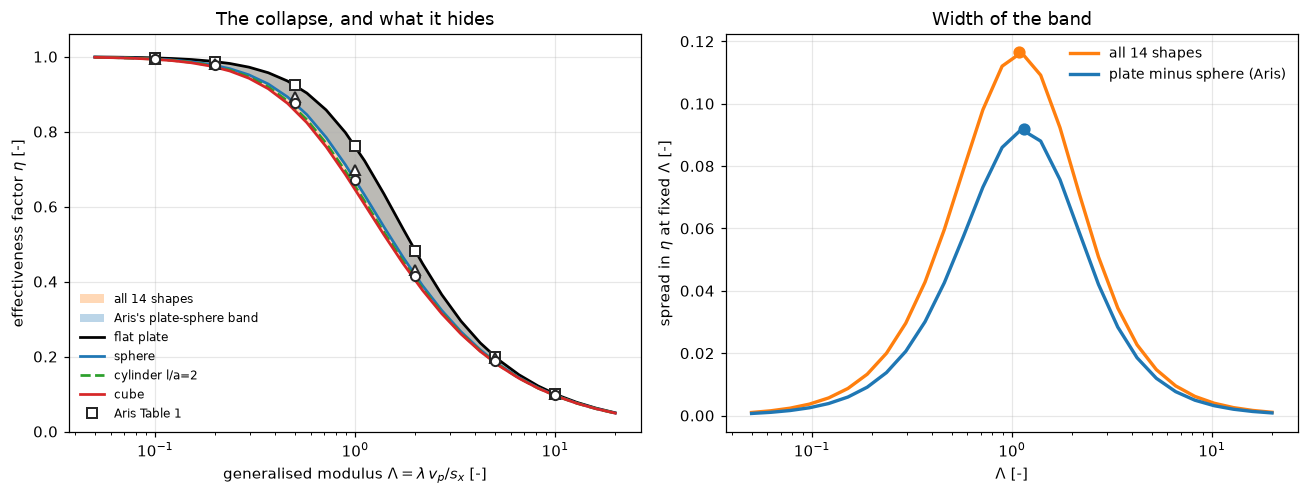
display(Markdown(
    f"The collapse is real: over nearly three decades of $\\Lambda$ every shape sits "
    f"inside a band that never exceeds {band_all:.3f} in $\\eta$ and closes to nothing "
    f"at both ends. Its upper edge is the flat plate at every swept modulus and its lower "
    f"edge the cube at {N_CUBE_LOW} of the {len(Lams)}. But two things about it are not what the paper's three "
    f"shapes suggest.\n\n"
    f"**The band is about a quarter wider than plate-to-sphere.** Aris's plate-sphere "
    f"spread peaks at {band_aris:.4f} ($\\Lambda$ = {L_aris:.2f}). Adding corners takes the "
    f"peak to {band_all:.4f} ($\\Lambda$ = {L_band:.2f}), {band_all / band_aris - 1:.0%} wider.\n\n"
    f"**The sphere is not the floor.** Table 1 makes it look like the extreme case, "
    f"lowest $\\eta$ at every $\\Lambda$, and the paper's Leva argument reinforces the "
    f"impression. But at fixed $v_p/s_x$ the cube sits up to {below_abs:.4f} below the "
    f"sphere (at $\\Lambda$ = {L_below:.2f}, {claims['cube_below_sphere_pct_there']:.1f} % of the "
    f"sphere's $\\eta$ there; the largest relative gap is {below_rel:.1%}, at "
    f"$\\Lambda$ = {L_below_rel:.1f}), and the finite cylinder of length $2a$ sits between "
    f"them at {N_CYL_BETWEEN} of the {len(Lams)} swept moduli. All three have exactly the same $v_p/s_x = a/3$."))
The collapse is real: over nearly three decades of \(\Lambda\) every shape sits inside a band that never exceeds 0.116 in \(\eta\) and closes to nothing at both ends. Its upper edge is the flat plate at every swept modulus and its lower edge the cube at 28 of the 28. But two things about it are not what the paper’s three shapes suggest.
The band is about a quarter wider than plate-to-sphere. Aris’s plate-sphere spread peaks at 0.0918 (\(\Lambda\) = 1.15). Adding corners takes the peak to 0.1165 (\(\Lambda\) = 1.09), 27% wider.
The sphere is not the floor. Table 1 makes it look like the extreme case, lowest \(\eta\) at every \(\Lambda\), and the paper’s Leva argument reinforces the impression. But at fixed \(v_p/s_x\) the cube sits up to 0.0261 below the sphere (at \(\Lambda\) = 0.89, 3.6 % of the sphere’s \(\eta\) there; the largest relative gap is 3.9%, at \(\Lambda\) = 1.2), and the finite cylinder of length \(2a\) sits between them at 28 of the 28 swept moduli. All three have exactly the same \(v_p/s_x = a/3\).
Two different comparisons, two different answers
Aris ends section 3 with: “of all catalyst particles of given volume, diffusion limitation is most severe in a spherical one.” That is a statement about the Leva shape factor \(\phi = (36\pi v_p^2)^{1/3}/s_x \le 1\): at given volume the sphere has the largest \(v_p/s_x\), hence the largest \(\Lambda\), hence the lowest \(\eta\). It is correct, and it is a different comparison from the one Table 1 invites.
SHAPES = {                                    # (v_p, s_x) in units of a
    "sphere":              (4 * np.pi / 3, 4 * np.pi),
    "cube":                (8.0, 24.0),
    "cylinder, length 2a": (2 * np.pi, 6 * np.pi),
    "cylinder, length 4a": (4 * np.pi, 10 * np.pi),
    "cylinder, length a":  (np.pi, 4 * np.pi),
}
LAM_STAR = 3.0                                # modulus of the equal-volume sphere, illustrative

print(f"{'shape':22s}{'v_p/s_x':>10}{'Leva phi':>10}{'Lambda at equal volume':>25}")
for nm, (v, s) in SHAPES.items():
    phi = (36 * np.pi * v**2) ** (1 / 3) / s
    print(f"{nm:22s}{v / s:10.4f}{phi:10.4f}{phi * LAM_STAR:25.3f}")
print("\nAt equal PARTICLE VOLUME every non-spherical particle sits at a smaller")
print("Lambda than the equal-volume sphere, hence a HIGHER eta: Aris's claim.")
print(f"\nAt equal v_p/s_x = a/3 and Lambda = 1: {claims['order_at_va_a3_Lambda1']}")
shape v_p/s_x Leva phi Lambda at equal volume
sphere 0.3333 1.0000 3.000
cube 0.3333 0.8060 2.418
cylinder, length 2a 0.3333 0.8736 2.621
cylinder, length 4a 0.4000 0.8320 2.496
cylinder, length a 0.2500 0.8255 2.476
At equal PARTICLE VOLUME every non-spherical particle sits at a smaller
Lambda than the equal-volume sphere, hence a HIGHER eta: Aris's claim.
At equal v_p/s_x = a/3 and Lambda = 1: sphere > cylinder l=2a > cubeBoth statements hold and they are not in conflict:
- At equal volume the sphere is the worst case, because it has the least surface per unit volume and therefore the largest \(\Lambda\). This is Aris’s claim, and the Leva shape factor proves it.
- At equal \(\Lambda\), that is after the collapse has already been applied, the sphere is the best of the three shapes that share \(v_p/s_x = a/3\). The cube has corners and edges, the finite cylinder edges only, the sphere neither, and \(\eta\) falls in that order: near an edge or a corner reactant arrives from two or three faces at once.
The second is the one that matters when you use the shortcut, and it is the one Table 1 cannot show, because all three of its shapes are smooth.
Eq. 18: the asymptote that makes the collapse work
\(\eta\Lambda \to 1\) as \(\Lambda\to\infty\), for every shape. This is the paper’s one rigorous general result, and unlike Table 1 it can be tested on shapes with edges. \(\eta\Lambda\) is extrapolated to \(1/\Lambda = 0\) by a straight line through \(\Lambda\) = 10, 20, 50, for the exact references and for pymrm solves on graded grids, so that the error of the fit and the error of the grid are seen separately.
BIG = np.array([5.0, 10.0, 20.0, 50.0, 100.0])
FIT = slice(1, 4)
ASYM_SHAPES = {   # name: (pymrm pellet maker, its reference)
    "square rod": (lambda q: square_rod(n=200, q=q),
                   lambda L: eta_box_series(L, (1, 1), 0.5, 1600)),
    "cylinder l=2a": (lambda q: finite_cylinder(1.0, n_r=200, q=q),
                      lambda L: eta_fincyl_axial(L, 0.5, 1.0)),
    "shell p=0.5": (lambda q: spherical_shell(0.5, n=400, q=q),
                    lambda L: eta_shell(L, 0.5)),
}


def extrapolated(etaL, fit=FIT):
    return float(np.polyfit(1.0 / BIG[fit], etaL[fit], 1)[1])


def asym_pymrm(q=2.0):
    out = {}
    for nm, (make, _) in ASYM_SHAPES.items():
        pel, va = make(q)
        out[nm] = np.array([pel.eta(L / va) for L in BIG]) * BIG
    return out


asym_ref = {"sphere (eq. 17)": eta_sphere(BIG) * BIG, "flat plate (eq. 15)": eta_plate(BIG) * BIG}
for nm, (_, ref) in ASYM_SHAPES.items():
    asym_ref[nm] = np.array([ref(L) for L in BIG]) * BIG
asym = asym_pymrm()


def asym_metrics(A, R=asym_ref, fit=FIT):
    ext_dev = max(abs(extrapolated(v, fit) - 1) for v in A.values())
    grid50 = max(abs(rel(A[k][3], R[k][3])) for k in A)
    return ext_dev, grid50


claims.value("eq18_cyl_reference_truncation_Lambda50",
             abs(rel(eta_fincyl_axial(50.0, 0.5, 1.0), eta_fincyl_axial(50.0, 0.5, 1.0, 12800))))
claims.bound("fincyl_axial_vs_double_series", abs(rel(eta_fincyl_axial(1.0, 0.5, 1.0),
             eta_fincyl_series(1.0, 0.5, 1.0))), max=1e-6, basis="chosen",
             note="the two forms of case (iv) at Lambda = 1, l = 2a; both truncated")
print(f"case (iv), closed-form axial sum against the double series at Lambda = 1: "
      f"{claims['fincyl_axial_vs_double_series']:.0e}; its truncation at Lambda = 50 "
      f"(6400 against 12800 radial terms): {claims['eq18_cyl_reference_truncation_Lambda50']:.0e}")
claims.value("eq18_reference_extrapolated_worst_dev",
             max(abs(extrapolated(v) - 1) for v in asym_ref.values()))
_ext, _g50 = asym_metrics(asym)
claims.value("eq18_extrapolated_worst_dev", _ext)
claims.value("eq18_pymrm_worst_rel_err_Lambda50", _g50)

fig, ax = plt.subplots(figsize=(7.2, 4.4))
for nm, v in asym_ref.items():
    ax.plot(1.0 / BIG, v, "-", lw=1.2, alpha=0.6)
for nm, v in asym.items():
    ax.plot(1.0 / BIG, v, "o", ms=5, label=f"{nm} (pymrm)")
ax.axhline(1.0, color="k", lw=1.0, ls="--")
ax.set_xlabel(r"$1/\Lambda$ [-]")
ax.set_ylabel(r"$\eta\,\Lambda$ [-]")
ax.set_xlim(-0.008, 0.21)
ax.set_title(r"Aris eq. 18: $\eta\Lambda \to 1$ for every shape (lines: references)")
ax.legend(frameon=False, fontsize=8)
fig.tight_layout()
plt.show()

print(f"{'eta*Lambda':30s}" + "".join(f"{L:>9.0f}" for L in BIG) + "   extrapolated")
for nm, v in asym_ref.items():
    print(f"{nm + ' (reference)':30s}" + "".join(f"{a:9.5f}" for a in v) + f"   {extrapolated(v):.5f}")
for nm, v in asym.items():
    print(f"{nm + ' (pymrm)':30s}" + "".join(f"{a:9.5f}" for a in v) + f"   {extrapolated(v):.5f}")
print(f"\nworst deviation of the extrapolated value from 1: references "
      f"{claims['eq18_reference_extrapolated_worst_dev']:.1e} (the straight-line fit), pymrm "
      f"{claims['eq18_extrapolated_worst_dev']:.1e}; pymrm grid error at Lambda = 50 up to "
      f"{claims['eq18_pymrm_worst_rel_err_Lambda50']:.1e}")
case (iv), closed-form axial sum against the double series at Lambda = 1: 3e-09; its truncation at Lambda = 50 (6400 against 12800 radial terms): 5e-08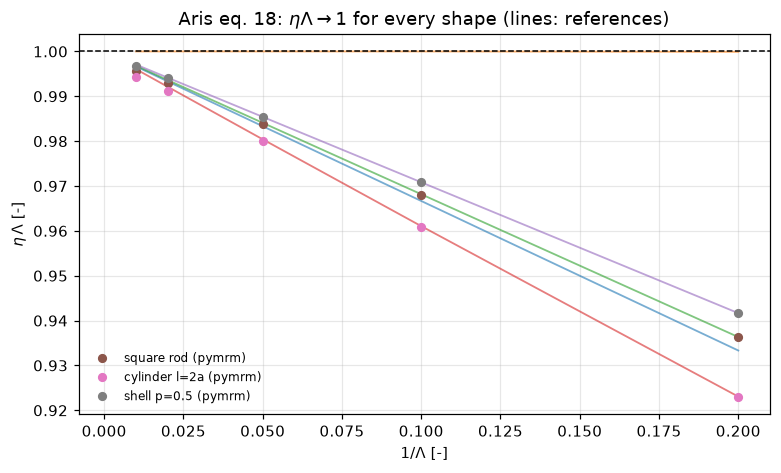
eta*Lambda                            5       10       20       50      100   extrapolated
sphere (eq. 17) (reference)     0.93333  0.96667  0.98333  0.99333  0.99667   1.00000
flat plate (eq. 15) (reference)  0.99991  1.00000  1.00000  1.00000  1.00000   1.00000
square rod (reference)          0.93634  0.96817  0.98408  0.99364  0.99683   1.00000
cylinder l=2a (reference)       0.92306  0.96106  0.98041  0.99214  0.99606   0.99988
shell p=0.5 (reference)         0.94167  0.97083  0.98542  0.99417  0.99708   1.00000
square rod (pymrm)              0.93628  0.96805  0.98384  0.99302  0.99558   0.99934
cylinder l=2a (pymrm)           0.92298  0.96088  0.98005  0.99121  0.99421   0.99889
shell p=0.5 (pymrm)             0.94165  0.97081  0.98536  0.99403  0.99682   0.99986

worst deviation of the extrapolated value from 1: references 1.2e-04 (the straight-line fit), pymrm 1.1e-03; pymrm grid error at Lambda = 50 up to 9.3e-04
Every shape heads to \(\eta\Lambda = 1\), the corner shapes included. On the references the straight-line extrapolation lands on 1 to within its own fit error (the curvature in \(1/\Lambda\); the cylinder reference is the closed-form axial sum, truncated far below that). The pymrm values extrapolate a little further from 1 because they carry a grid error at \(\Lambda = 50\), where \(\lambda h\) near the exposed faces is no longer small even on graded grids; that grid error, not the asymptote, is most of their deviation.
The mixture rule
Aris’s section 4: for a bed of mixed sizes the effectiveness must be averaged, not the size. He gives one worked example to show how badly the shortcut fails.
f_i = mix.loc[mix["quantity"] == "fraction", "value"].to_numpy()
Lam_i = mix.loc[mix["quantity"] == "Lambda", "value"].to_numpy()
PRINTED = {q: mix.loc[mix["quantity"] == q, ["value", "printing"]].to_numpy()
           for q in ("mean_modulus", "eta_at_mean_modulus", "eta_mixture")}


def mixture(mean=lambda f, L: 1.0 / np.sum(f / L), curve=eta_plate):
    Lam_bar = mean(f_i, Lam_i)                             # his eq. 20
    return Lam_bar, curve(Lam_bar), float(np.sum(f_i * curve(Lam_i)))   # and eq. 19


Lam_bar, eta_from_mean, eta_correct = mixture()
claims.value("mixture_mean_modulus_dev", abs(Lam_bar - PRINTED["mean_modulus"][0, 0]))
claims.value("mixture_eta_at_mean_dev", abs(eta_from_mean - PRINTED["eta_at_mean_modulus"][0, 0]))
claims.value("mixture_eta_eq19", eta_correct)
print(f"eq. 20, mean modulus  : {Lam_bar:.4f}   (printed {PRINTED['mean_modulus'][0, 0]})")
print(f"eta at that mean      : {eta_from_mean:.4f}   (printed {PRINTED['eta_at_mean_modulus'][0, 0]})")
print(f"eq. 19, averaging eta : {eta_correct:.4f}   (printed "
      + ", ".join(f"{v} in the {pr} printing" for v, pr in PRINTED["eta_mixture"]) + ")")
eq. 20, mean modulus : 1.3158 (printed 1.316)
eta at that mean : 0.6580 (printed 0.658)
eq. 19, averaging eta : 0.4936 (printed 0.397 in the 1995 printing, 0.897 in the 1957 printing)The first two reproduce the printed values to their last digit, which pins down both the formula and the fact that the example uses the flat-plate curve. The third does not, and the two printings disagree with each other as well as with eq. 19, so no reading of it can be established; it is left as printed. The point of the example, that taking the mean size first overstates \(\eta\), holds against eq. 19 whatever the third printed number is.
Validation
None of these checks compares the solver with itself.
| # | check |
|---|---|
| 1 | eqs. 15-17 against Aris’s Table 1 (above) |
| 2 | the shell expression against his five printed values and its two stated limits (above) |
| 3 | pymrm 1-D against eqs. 15-17 and the shell expression, with a grid ladder |
| 4 | pymrm 2-D finite cylinder against the printed double series, both readings of \(p\), with a grid ladder on the worst case |
| 5 | pymrm 2-D rod and 3-D cube against eigenfunction expansions, with a 3-D grid ladder (above) |
| 6 | the truncation of every series, by doubling its terms |
| 7 | eq. 18, \(\eta\Lambda \to 1\), on five shapes including two with edges (above) |
| 8 | eqs. 19-20 against his worked mixture example (above) |
Check 2 is the one the paper pays for. The shell expression has six distinct terms and had to be transcribed from a mangled scan. It must reduce to eq. 17 at \(p = 0\) and to eq. 15 at \(p = 1\), and it must reproduce five printed values in between. A mis-read coefficient would show in the limits or in the values.
Check 4 is the one that could not be settled from the page at all. The printed series and the printed geometry disagree by a factor of two in the aspect ratio, and since the paper never evaluates the series there is nothing on the page to break the tie. An independent solution of the actual shape breaks it.
PYMRM_1D_L = (0.1, 1.0, 5.0, 20.0)


def pymrm_1d(nu_sphere=2):
    out = {}
    for nm, (pel, va), fn, Ls in (
            ("slab", slab(), eta_plate, PYMRM_1D_L),
            ("long cylinder", long_cylinder(), eta_cylinder, PYMRM_1D_L),
            ("sphere", (Pellet((400,), (1.0,), (nu_sphere,)), 1.0 / 3.0), eta_sphere, PYMRM_1D_L),
            ("shell p=0.5", spherical_shell(0.5), lambda L: eta_shell(L, 0.5), PYMRM_1D_L[:3])):
        out[nm] = max(abs(rel(eta_both(pel, L / va, key=f"1-D {nm} L={L}" if nu_sphere == 2 else None)[0],
                              fn(L))) for L in Ls)
    return out


P1D = pymrm_1d()
claims.value("pymrm_1d_worst_rel", max(P1D.values()))
for nm, v in P1D.items():
    print(f"  pymrm 1-D {nm:14s} worst relative error {v:.1e}  (n = 400)")

# a grid ladder on the sphere, both eta routes from the same solves
SPH_NS, SPH_L = (100, 200, 400, 800, 1600), 1.0
_sph = {}


def sphere_eta(n, read=None):
    if n not in _sph:
        pel, va = sphere(n)
        _sph[n] = (pel, pel.solve(SPH_L / va), va)
    pel, chi, va = _sph[n]
    FLUX_GAPS[f"sphere ladder n={n}"] = abs(pel.eta_flux(SPH_L / va, chi) - pel.eta(SPH_L / va, chi))
    return pel.eta(SPH_L / va, chi) if read is None else pel.eta_flux(SPH_L / va, chi, read=read)


sph_lad = observed_orders(sphere_eta, SPH_NS)
claims.bound("sphere_order_Lambda1", sph_lad["orders"][-1], min=1.9, max=2.1, basis="theory",
             note="second-order finite volumes, layer resolved at Lambda = 1")
claims.bound("sphere_ladder_finest_diff", abs(rel(sph_lad["values"][-2], sph_lad["values"][-1])),
             min=1e-7, basis="chosen", note="ten times the flux-identity bound (1e-8), "
             "which bounds what the solve residual does to eta")
claims.bound("sphere_extrapolated_vs_eq17", abs(rel(sph_lad["extrapolated"], eta_sphere(SPH_L))),
             max=1e-8, basis="chosen", note="Richardson limit of the ladder against eq. 17")
print(f"\nsphere ladder at Lambda = {SPH_L:g}, n = {SPH_NS}: orders "
      + ", ".join(f"{o:.3f}" for o in sph_lad["orders"])
      + f"; Richardson limit against eq. 17 {rel(sph_lad['extrapolated'], eta_sphere(SPH_L)):+.1e}")
pymrm 1-D slab worst relative error 7.7e-06 (n = 400)
pymrm 1-D long cylinder worst relative error 7.4e-05 (n = 400)
pymrm 1-D sphere worst relative error 2.4e-04 (n = 400)
pymrm 1-D shell p=0.5 worst relative error 3.8e-06 (n = 400)
sphere ladder at Lambda = 1, n = (100, 200, 400, 800, 1600): orders 2.018, 2.009, 2.005; Richardson limit against eq. 17 -3.3e-10# The worst case of check 4 (p = 2 under the nomenclature, tau = 1/4) on a ladder
# that refines both axes together, ending one level above the production grid.
FC_LAD_P, FC_LAD_L, FC_LAD_K = 2.0, 5.0, (1, 2, 4, 8)
FC_LAD_TAU = READINGS["nomenclature"](FC_LAD_P)
_fc = {}
def fincyl_eta(k, read=None):
if k not in _fc:
pel, va = finite_cylinder(FC_LAD_TAU, n_r=40 * k, n_z=10 * k)
_fc[k] = (pel, pel.solve(FC_LAD_L / va), va)
pel, chi, va = _fc[k]
if read is None:
FLUX_GAPS[f"fincyl ladder k={k}"] = abs(pel.eta_flux(FC_LAD_L / va, chi) - pel.eta(FC_LAD_L / va, chi))
return pel.eta(FC_LAD_L / va, chi)
return pel.eta_flux(FC_LAD_L / va, chi, read=read)
fc_lad = observed_orders(fincyl_eta, FC_LAD_K, ratio=2.0)
fc_ref = eta_fincyl_series(FC_LAD_L, FC_LAD_P, FC_LAD_TAU)
claims.bound("fincyl_order_finest", fc_lad["orders"][-1], min=2.0, max=3.0, basis="chosen",
note="second-order scheme, pre-asymptotic where the layer is thin (Lambda = 5)")
claims.bound("fincyl_extrapolated_vs_series", abs(rel(fc_lad["extrapolated"], fc_ref)),
max=1e-5, basis="chosen", note="Richardson limit against the printed series; "
"the series truncation is measured separately")
claims.bound("fincyl_ladder_finest_diff", abs(rel(fc_lad["values"][-2], fc_lad["values"][-1])),
min=1e-7, basis="chosen", note="ten times the flux-identity bound (1e-8)")
def fincyl_all_extrapolated():
"""Richardson limit on n_r = 80, 160, 320 (n_z in proportion) for all 16 cases of
check 4 under the nomenclature reading: worst gap to the series, with the volume
average and with the two-point cell read (break table)."""
worst = {"face": 0.0, "cell": 0.0}
for p in FC_P:
tau = READINGS["nomenclature"](p)
n_z = finite_cylinder(tau, n_r=FC_NR)[0].shape[1]
va = tau / (2.0 * tau + 1.0)
pels = {k: finite_cylinder(tau, n_r=FC_NR * k // 4, n_z=n_z * k // 4)[0] for k in (2, 4, 8)}
for L in FC_L:
chis = {k: pel.solve(L / va) for k, pel in pels.items()}
s_ref = eta_fincyl_series(L, p, tau)
for read in worst:
f = (lambda k: pels[k].eta(L / va, chis[k])) if read == "face" else \
(lambda k: pels[k].eta_flux(L / va, chis[k], read="cell"))
lad = observed_orders(f, (2, 4, 8), ratio=2.0)
worst[read] = max(worst[read], abs(rel(lad["extrapolated"], s_ref)))
return worst
FC_ALL = fincyl_all_extrapolated()
claims.bound("fincyl_extrapolated_vs_series_all16", FC_ALL["face"], max=1e-5, basis="chosen",
note="Richardson limits on 80/160/320 radial cells, all 16 cases of check 4")
print(f"all 16 cases, Richardson limit on n_r = 80/{FC_NR}/320 against the series: worst "
f"{FC_ALL['face']:.1e}")
print(f"finite cylinder p = {FC_LAD_P:g}, Lambda = {FC_LAD_L:g}, grids "
+ ", ".join(str(_fc[k][0].shape) for k in FC_LAD_K))
print(" error against the series: "
+ ", ".join(f"{rel(v, fc_ref):+.2e}" for v in fc_lad["values"]))
print(" orders " + ", ".join(f"{o:.2f}" for o in fc_lad["orders"])
+ f"; Richardson limit against the series {rel(fc_lad['extrapolated'], fc_ref):+.1e}")all 16 cases, Richardson limit on n_r = 80/160/320 against the series: worst 1.6e-06
finite cylinder p = 2, Lambda = 5, grids (40, 10), (80, 20), (160, 40), (320, 80)
error against the series: -1.94e-02, -2.98e-03, -4.18e-04, -5.81e-05
orders 2.68, 2.83; Richardson limit against the series +7.3e-07# Series truncation: each series against itself with twice the terms, at the
# settings the page uses and over every case each comparison covers.
def trunc_fincyl(scale=1):
M, N = 400 // scale, 3000 // scale
return max(abs(rel(eta_fincyl_series(L, p, READINGS["nomenclature"](p), M, N),
eta_fincyl_series(L, p, READINGS["nomenclature"](p), 2 * M, 2 * N)))
for p in FC_P for L in FC_L)
def trunc_sweep(scale=1):
"""Worst relative truncation of the sweep's series curves, at the largest Lambda."""
L = Lams[-1]
out = [abs(rel(eta_box_series(L, (1, 1, 1), CUBE_VA, 200 // scale),
eta_box_series(L, (1, 1, 1), CUBE_VA, 400 // scale))),
abs(rel(eta_box_series(L, (1, 1), 0.5, 800 // scale),
eta_box_series(L, (1, 1), 0.5, 1600 // scale)))]
out += [abs(rel(eta_fincyl_series(L, 1 / (2 * t), t, 400 // scale, 3000 // scale),
eta_fincyl_series(L, 1 / (2 * t), t, 800 // scale, 6000 // scale))) for t in TAUS]
return max(out)
claims.value("fincyl_series_truncation_worst", trunc_fincyl())
claims.value("cube_series_truncation_Lambda1",
abs(rel(cube_ref, eta_box_series(1.0, (1, 1, 1), CUBE_VA, 400))))
claims.value("rod_series_truncation_worst",
max(abs(rel(eta_box_series(L, (1, 1), 0.5, 800), eta_box_series(L, (1, 1), 0.5, 1600)))
for L in ROD_L))
claims.value("sweep_series_truncation_Lambda20", trunc_sweep())
for k in ("fincyl_series_truncation_worst", "cube_series_truncation_Lambda1",
"rod_series_truncation_worst", "sweep_series_truncation_Lambda20"):
print(f" {k:36s} {claims[k]:.1e}") fincyl_series_truncation_worst 8.9e-07
cube_series_truncation_Lambda1 3.1e-08
rod_series_truncation_worst 1.2e-08
sweep_series_truncation_Lambda20 1.6e-04# The two eta routes: the same sum rearranged, so their gap is the solve residual.
claims.bound("eta_flux_vs_volume_worst", max(FLUX_GAPS.values()), max=1e-8, basis="identity",
note="finite-volume conservation; the gap is the residual of the direct solve")
_kmax = max(FLUX_GAPS, key=FLUX_GAPS.get)
print(f"surface-flux route against the volume average, worst over {len(FLUX_GAPS)} solves: "
f"below 1e-8 (here {claims['eta_flux_vs_volume_worst']:.0e}, {_kmax})")surface-flux route against the volume average, worst over 68 solves: below 1e-8 (here 8e-10, 1-D slab L=0.1)display(Markdown(
f"Checks 3 to 6 in numbers. In 1-D, pymrm reproduces eqs. 15-17 and the shell to "
f"{claims['pymrm_1d_worst_rel']:.1e} at $n = 400$ (worst over $\\Lambda$ up to 20; "
f"the error is largest where the layer is thinnest), and the sphere ladder at "
f"$\\Lambda = 1$ is second order ({claims['sphere_order_Lambda1']:.3f}). The finite-"
f"cylinder gap under the nomenclature reading is grid error: on the worst case the "
f"ladder converges at order {claims['fincyl_order_finest']:.2f} (pre-asymptotic, the "
f"layer is thin at $\\Lambda = 5$) and its Richardson limit lies "
f"{claims['fincyl_extrapolated_vs_series']:.0e} from the series (over all 16 cases, "
f"Richardson limits on 80/160/320 radial cells lie within "
f"{claims['fincyl_extrapolated_vs_series_all16']:.0e}). The cube's 8/16/32 "
f"ladder has order {claims['cube_order_8_16_32']:.2f} and a limit "
f"{claims['cube_extrapolated_vs_series']:.0e} from its series. Every series is "
f"truncated far below the gaps it is used to judge: at most "
f"{max(claims[k] for k in ('fincyl_series_truncation_worst', 'cube_series_truncation_Lambda1', 'rod_series_truncation_worst')):.0e} "
f"in the validation comparisons, and {claims['sweep_series_truncation_Lambda20']:.0e} "
f"at $\\Lambda = 20$ in the sweep, against a pymrm-to-series gap there of up to "
f"{claims['sweep_pymrm_vs_series_worst']:.1e}. The eq. 18 cylinder reference is "
f"truncated by {claims['eq18_cyl_reference_truncation_Lambda50']:.0e} at "
f"$\\Lambda = 50$, against a line-fit deviation of "
f"{claims['eq18_reference_extrapolated_worst_dev']:.1e}."))Checks 3 to 6 in numbers. In 1-D, pymrm reproduces eqs. 15-17 and the shell to 2.4e-04 at \(n = 400\) (worst over \(\Lambda\) up to 20; the error is largest where the layer is thinnest), and the sphere ladder at \(\Lambda = 1\) is second order (2.005). The finite-cylinder gap under the nomenclature reading is grid error: on the worst case the ladder converges at order 2.83 (pre-asymptotic, the layer is thin at \(\Lambda = 5\)) and its Richardson limit lies 7e-07 from the series (over all 16 cases, Richardson limits on 80/160/320 radial cells lie within 2e-06). The cube’s 8/16/32 ladder has order 2.76 and a limit 7e-06 from its series. Every series is truncated far below the gaps it is used to judge: at most 9e-07 in the validation comparisons, and 2e-04 at \(\Lambda = 20\) in the sweep, against a pymrm-to-series gap there of up to 3.9e-03. The eq. 18 cylinder reference is truncated by 5e-08 at \(\Lambda = 50\), against a line-fit deviation of 1.2e-04.
What is not validated here. Nothing on this page is compared with a measurement, and no version of it could be: Aris (1957) reports no experiments. Every number above is either the author’s own arithmetic or a mathematical identity. That is provenance tier 6, and it is the honest ceiling for this source.
The widened band is a statement about the idealised first-order isothermal problem, with a uniform surface concentration and no external film. A real pellet with a film resistance, a distribution of pore sizes or non-first-order kinetics will depart from the collapse for reasons that have nothing to do with shape: B1.3 (Bischoff) is the kinetics half of that story and Aris’s own section 5 is the film half. Neither is reproduced here.
And the cube is the numerically weakest shape on the page: its curve in the sweep is the eigenfunction series at every \(\Lambda\), not a pymrm solve. The series is checked against the 3-D solve at \(\Lambda = 1\), one modulus, not across the sweep.
The break table
Each row re-runs the affected computation with one thing deliberately wrong, injected through an argument, an input or a formula, and hands the result to claims.breaks, which records whether that claim’s own check fails.
# ---- Table 1
_lab = "cylinder column evaluated with the modulus on the radius (eq. 16 at 2 Lambda)"
_c2 = {**CLOSED, "cylinder": lambda L: eta_cylinder(2 * L)}
_d2 = table1_diffs(_c2)
brk(_lab, "table1_worst_19_entries", np.abs(_d2[np.abs(_d2) <= FLAG]).max())
brk(_lab, "table1_entries_off_more_than_0p002", int(np.sum(np.abs(_d2) > FLAG)))
brk(_lab, "table1_entries_not_rounding_to_printed", int(np.sum(np.abs(_d2) > HALF_UNIT)))
for L in (5.0, 10.0):
    brk(_lab, f"cyl_printed_high_pct_Lambda{L:g}", 100 * rel(CYL_SLIP[L][0], eta_cylinder(2 * L)))
    brk(_lab, f"cyl_printed_needs_Lambda_factor_{L:g}",
        lambda_needed(CYL_SLIP[L][0], lambda x: eta_cylinder(2 * x))["roots"][0] / L)
_lab = "sphere column evaluated with the modulus on the radius (eq. 17 at Lambda / 3)"
_d3 = table1_diffs({**CLOSED, "sphere": lambda L: eta_sphere(L / 3)})
brk(_lab, "table1_plate_sphere_worst_Lambda_5_10", np.abs(_d3[_ps5.to_numpy()]).max())

# ---- the shell
_lab = _lab_shell = "shell Lambda' built on the outer radius instead of the thickness"
brk(_lab, "shell_formula_vs_printed", shell_formula_vs_printed(on_thickness=False))
brk(_lab, "shell_formula_p075", eta_shell(1.0, 0.75, on_thickness=False))
_o = limit_orders(on_thickness=False)
brk(_lab, "shell_sphere_limit_order", _o[0])
brk(_lab, "shell_plate_limit_order", _o[1])
brk(_lab, "shell_plate_gap_1mp_1e-5", _o[3][-1])
_ocr = shell_tab["eta_1957_ocr"].to_numpy()
brk("shell table with the 1957 OCR reading where it differs (p = 0.75)", "shell_formula_vs_printed",
    shell_formula_vs_printed(np.where(np.isnan(_ocr), eta_print, _ocr)))
brk("shell's inner face exposed by mistake (EXPOSED at r = pa)", "shell_pymrm_vs_formula",
    claims["shell_exposed_inner_face_dev"])
brk(_lab_shell, "shell_exposed_inner_face_dev",
    max(abs(v - eta_shell(1.0, p, on_thickness=False)) for p, v in SHELL_OPEN.items()))

# ---- 1-D and the ladders
brk("sphere assembled with nu = 1 in construct_div", "pymrm_1d_worst_rel",
    max(pymrm_1d(nu_sphere=1).values()))
_cell = observed_orders(lambda n: sphere_eta(n, read="cell"), SPH_NS)
_lab = "eta read from a two-point gradient at the last cell centre"
brk(_lab, "sphere_order_Lambda1", _cell["orders"][-1])
brk(_lab, "sphere_extrapolated_vs_eq17", abs(rel(_cell["extrapolated"], eta_sphere(SPH_L))))
_fcc = observed_orders(lambda k: fincyl_eta(k, read="cell"), FC_LAD_K, ratio=2.0)
brk(_lab, "fincyl_order_finest", _fcc["orders"][-1])
brk(_lab, "fincyl_extrapolated_vs_series", abs(rel(_fcc["extrapolated"], fc_ref)))
brk(_lab, "fincyl_extrapolated_vs_series_all16", FC_ALL["cell"])
_cc = observed_orders(lambda n: CUBE_SOL[n][0].eta_flux(3.0, CUBE_SOL[n][1], read="cell"), CUBE_NS)
brk(_lab, "cube_order_8_16_32", _cc["orders"][-1])
brk(_lab, "cube_extrapolated_vs_series", abs(rel(_cc["extrapolated"], cube_ref)))
_p32, _x32 = CUBE_SOL[32]
brk(_lab, "eta_flux_vs_volume_worst", abs(_p32.eta_flux(3.0, _x32, read="cell") - _p32.eta(3.0, _x32)))
_lab = "finest ladder level built with the previous level's cells (refinement skipped)"
brk(_lab, "sphere_ladder_finest_diff", abs(rel(sphere_eta(SPH_NS[-2]), sphere_eta(SPH_NS[-2]))))
brk(_lab, "fincyl_ladder_finest_diff", abs(rel(fincyl_eta(FC_LAD_K[-2]), fincyl_eta(FC_LAD_K[-2]))))
brk(_lab, "cube_ladder_finest_diff", abs(rel(cube_lad["values"][-2], CUBE_SOL[16][0].eta(3.0))))

# ---- the finite cylinder, rod and cube
_lab = "finite cylinder assembled with nu = 0 on the radial axis"
_w0, _ = fincyl_gaps(nu_r=0)
brk(_lab, "fincyl_series_p_as_nomenclature", _w0["nomenclature"])
brk(_lab, "fincyl_series_p_as_running_text", _w0["running text"])
_rod1 = Pellet((200, 200), (1.0, 1.0), (1, 0))
brk("square rod assembled with nu = 1 on axis 0", "square_rod_vs_series",
    max(abs(rel(_rod1.eta(L / rod_va), eta_box_series(L, (1, 1), rod_va, 800))) for L in ROD_L))
brk("cube grid coarsened to n = 16", "cube_vs_series_n32", abs(rel(cube_lad["values"][1], cube_ref)))
_lam_bad = 20.0 / 1.0        # modulus taken on the half-width: v_p/s_x = a instead of a/3
brk("cube at Lambda = 20 with the modulus on the half-width (lambda a = 20, not 60)",
    "cube_n24_n32_gap_Lambda20", abs(rel(cube24.eta(_lam_bad), CUBE_SOL[32][0].eta(_lam_bad))))
_cube_a2 = CUBE_SOL[32][0].eta(1.0 / 0.5)
brk("cube taken at v_p/s_x = a/2 instead of a/3", "order_at_va_a3_Lambda1",
    order_label({**EQ_A3, "cube": _cube_a2})[0])

# ---- the sweep and the band
brk("sweep grids uniform (q = 1) for the flat disc, l/a = 0.25", "sweep_pymrm_vs_series_worst",
    max(_du[0], claims["sweep_pymrm_vs_series_worst"]))
brk("uniform disc grid with n_r halved to 60", "sweep_disc_uniform_grid_worst_pct",
    100 * disc_uniform_worst(n_r=60)[0])
_lab = "cube series built on v_p/s_x = a/2 instead of a/3"
_refs_b = {**refs, "cube": np.array([eta_cube_series(L, 0.5) for L in Lams])}
brk(_lab, "sweep_points_cube_lowest", int(np.sum(cube_lowest_margins(_refs_b) < 0)))
brk(_lab, "sweep_points_cyl2a_between_sphere_cube", int(np.sum(cyl2a_between_margins(_refs_b) > 0)))
_bb = widest(eta_plate, lambda L: eta_cube_series(L, 0.5))
brk(_lab, "band_all_shapes", _bb[0])
brk(_lab, "band_all_Lambda", _bb[1])
brk(_lab, "band_ratio_all_over_aris", _bb[0] / band_aris)
_sb = widest(eta_sphere, lambda L: eta_cube_series(L, 0.5))
brk(_lab, "cube_below_sphere", _sb[0])
brk(_lab, "cube_below_sphere_pct_there", 100 * _sb[0] / eta_sphere(_sb[1]))
_rb = minimize_scalar(lambda L: eta_cube_series(L, 0.5) / eta_sphere(L), bounds=(0.3, 20.0),
                      method="bounded", options={"xatol": 1e-6})
brk(_lab, "cube_below_sphere_max_pct", 100 * (1 - _rb.fun))
brk(_lab, "cube_below_sphere_max_pct_Lambda", _rb.x)
_lab = "sphere with the modulus on the radius (eq. 17 at Lambda / 3)"
_ab = widest(eta_plate, lambda L: eta_sphere(L / 3))
brk(_lab, "band_aris_plate_sphere_max", _ab[0])
brk(_lab, "band_aris_Lambda", _ab[1])
brk("plate with the modulus on the full thickness (eq. 15 at 2 Lambda)",
    "sweep_others_minus_plate_max", others_minus_plate({**refs, "flat plate": eta_plate(2 * Lams)}))
_lab = "series with half the terms"
brk(_lab, "fincyl_series_truncation_worst", trunc_fincyl(scale=2))
brk(_lab, "cube_series_truncation_Lambda1",
    abs(rel(eta_box_series(1.0, (1, 1, 1), CUBE_VA, 100), cube_ref)))
brk(_lab, "rod_series_truncation_worst",
    max(abs(rel(eta_box_series(L, (1, 1), 0.5, 400), eta_box_series(L, (1, 1), 0.5, 800)))
        for L in ROD_L))
brk(_lab, "sweep_series_truncation_Lambda20", trunc_sweep(scale=2))

# ---- eq. 18 and the mixture
brk("series with half the terms", "eq18_cyl_reference_truncation_Lambda50",
    abs(rel(eta_fincyl_axial(50.0, 0.5, 1.0, 3200), eta_fincyl_axial(50.0, 0.5, 1.0))))
brk("closed-form axial sum with p doubled", "fincyl_axial_vs_double_series",
    abs(rel(eta_fincyl_axial(1.0, 1.0, 1.0), eta_fincyl_series(1.0, 0.5, 1.0))))
_ext1, _g501 = asym_metrics(asym_pymrm(q=1.0))
brk("eq. 18 grids uniform (q = 1)", "eq18_extrapolated_worst_dev", _ext1)
brk("eq. 18 grids uniform (q = 1)", "eq18_pymrm_worst_rel_err_Lambda50", _g501)
brk("eq. 18 straight line fitted through Lambda = 5, 10, 20", "eq18_reference_extrapolated_worst_dev",
    max(abs(extrapolated(v, slice(0, 3)) - 1) for v in asym_ref.values()))
_m = mixture(mean=lambda f, L: float(np.sum(f * L)))
brk("mean modulus as the arithmetic mean of the sizes", "mixture_mean_modulus_dev",
    abs(_m[0] - PRINTED["mean_modulus"][0, 0]))
brk("mean modulus as the arithmetic mean of the sizes", "mixture_eta_at_mean_dev",
    abs(_m[1] - PRINTED["eta_at_mean_modulus"][0, 0]))
brk("eq. 19 averaged on the sphere curve", "mixture_eta_eq19", mixture(curve=eta_sphere)[2])Trueprint(f"{'injected defect':<74} {'claim':<40} {'clean':>11} {'broken':>11} caught")
for name, metric, clean, broken, caught in BREAK:
is_bound = claims.metrics[metric]["kind"] == "bound"
shown = f"(here {clean:.1e})" if is_bound else (f"{clean:11.4g}" if np.isscalar(clean) and not isinstance(clean, str) else str(clean)[:11])
bshow = str(broken)[:11] if isinstance(broken, str) else f"{broken:11.4g}"
print(f"{name[:74]:<74} {metric[:40]:<40} {shown:>11} {bshow:>11} "
f"{'yes' if caught else 'NO'}")
_caught = {m for _, m, _, _, c in BREAK if c}
_structural = sorted(k for k, c in claims.metrics.items() if c.get("structural"))
_open = sorted(k for k in claims.metrics if k not in _caught and k not in _structural)
print(f"\n{len(BREAK)} rows; {len(_caught)} of {len(claims.metrics)} claims are failed by at "
f"least one row; structural: {', '.join(_structural) or 'none'}; "
f"open: {', '.join(_open) or 'none'}")
_uncaught = [(n, m) for n, m, _, _, c in BREAK if not c]
print("rows that do not fail their claim: "
+ ("; ".join(f"{n} -> {m}" for n, m in _uncaught) or "none"))injected defect claim clean broken caught
cylinder column evaluated with the modulus on the radius (eq. 16 at 2 Lamb table1_worst_19_entries 0.0007799 0.0006728 yes
cylinder column evaluated with the modulus on the radius (eq. 16 at 2 Lamb table1_entries_off_more_than_0p002 2 7 yes
cylinder column evaluated with the modulus on the radius (eq. 16 at 2 Lamb table1_entries_not_rounding_to_printed 4 8 yes
cylinder column evaluated with the modulus on the radius (eq. 16 at 2 Lamb cyl_printed_high_pct_Lambda5 3.837 102.1 yes
cylinder column evaluated with the modulus on the radius (eq. 16 at 2 Lamb cyl_printed_needs_Lambda_factor_5 0.9609 0.4804 yes
cylinder column evaluated with the modulus on the radius (eq. 16 at 2 Lamb cyl_printed_high_pct_Lambda10 2.599 102.5 yes
cylinder column evaluated with the modulus on the radius (eq. 16 at 2 Lamb cyl_printed_needs_Lambda_factor_10 0.974 0.487 yes
sphere column evaluated with the modulus on the radius (eq. 17 at Lambda / table1_plate_sphere_worst_Lambda_5_10 0.0003333 0.2931 yes
shell Lambda' built on the outer radius instead of the thickness shell_formula_vs_printed 0.0004077 0.4851 yes
shell Lambda' built on the outer radius instead of the thickness shell_formula_p075 0.7227 0.2379 yes
shell Lambda' built on the outer radius instead of the thickness shell_sphere_limit_order 3 1.003 yes
shell Lambda' built on the outer radius instead of the thickness shell_plate_limit_order 1 -5.133e-05 yes
shell Lambda' built on the outer radius instead of the thickness shell_plate_gap_1mp_1e-5 1.601e-06 0.7616 yes
shell table with the 1957 OCR reading where it differs (p = 0.75) shell_formula_vs_printed 0.0004077 0.005267 yes
shell's inner face exposed by mistake (EXPOSED at r = pa) shell_pymrm_vs_formula 1.424e-06 0.1578 yes
shell Lambda' built on the outer radius instead of the thickness shell_exposed_inner_face_dev 0.1578 0.6426 yes
sphere assembled with nu = 1 in construct_div pymrm_1d_worst_rel 0.0002361 0.3279 yes
eta read from a two-point gradient at the last cell centre sphere_order_Lambda1 (here 2.0e+00) 0.9982 yes
eta read from a two-point gradient at the last cell centre sphere_extrapolated_vs_eq17 (here 3.3e-10) 6.516e-07 yes
eta read from a two-point gradient at the last cell centre fincyl_order_finest (here 2.8e+00) 0.8412 yes
eta read from a two-point gradient at the last cell centre fincyl_extrapolated_vs_series (here 7.3e-07) 0.003551 yes
eta read from a two-point gradient at the last cell centre fincyl_extrapolated_vs_series_all16 (here 1.6e-06) 0.003551 yes
eta read from a two-point gradient at the last cell centre cube_order_8_16_32 (here 2.8e+00) 0.7284 yes
eta read from a two-point gradient at the last cell centre cube_extrapolated_vs_series (here 6.5e-06) 0.009456 yes
eta read from a two-point gradient at the last cell centre eta_flux_vs_volume_worst (here 8.1e-10) 0.02102 yes
finest ladder level built with the previous level's cells (refinement skip sphere_ladder_finest_diff (here 4.0e-07) 0 yes
finest ladder level built with the previous level's cells (refinement skip fincyl_ladder_finest_diff (here 3.6e-04) 0 yes
finest ladder level built with the previous level's cells (refinement skip cube_ladder_finest_diff (here 4.7e-04) 0 yes
finite cylinder assembled with nu = 0 on the radial axis fincyl_series_p_as_nomenclature 0.000418 0.602 yes
finite cylinder assembled with nu = 0 on the radial axis fincyl_series_p_as_running_text 0.4736 0.8992 yes
square rod assembled with nu = 1 on axis 0 square_rod_vs_series 8.158e-06 0.4194 yes
cube grid coarsened to n = 16 cube_vs_series_n32 7.513e-05 0.0005471 yes
cube at Lambda = 20 with the modulus on the half-width (lambda a = 20, not cube_n24_n32_gap_Lambda20 0.1094 0.01352 yes
cube taken at v_p/s_x = a/2 instead of a/3 order_at_va_a3_Lambda1 sphere > cy cube > sphe yes
sweep grids uniform (q = 1) for the flat disc, l/a = 0.25 sweep_pymrm_vs_series_worst 0.003925 0.03345 yes
uniform disc grid with n_r halved to 60 sweep_disc_uniform_grid_worst_pct 3.345 7.89 yes
cube series built on v_p/s_x = a/2 instead of a/3 sweep_points_cube_lowest 28 0 yes
cube series built on v_p/s_x = a/2 instead of a/3 sweep_points_cyl2a_between_sphere_cube 28 0 yes
cube series built on v_p/s_x = a/2 instead of a/3 band_all_shapes 0.1165 -0.001151 yes
cube series built on v_p/s_x = a/2 instead of a/3 band_all_Lambda 1.088 0.3 yes
cube series built on v_p/s_x = a/2 instead of a/3 band_ratio_all_over_aris 1.269 -0.01254 yes
cube series built on v_p/s_x = a/2 instead of a/3 cube_below_sphere 0.02606 -0.1064 yes
cube series built on v_p/s_x = a/2 instead of a/3 cube_below_sphere_pct_there 3.649 -35.92 yes
cube series built on v_p/s_x = a/2 instead of a/3 cube_below_sphere_max_pct 3.929 -2.352 yes
cube series built on v_p/s_x = a/2 instead of a/3 cube_below_sphere_max_pct_Lambda 1.207 0.3 yes
sphere with the modulus on the radius (eq. 17 at Lambda / 3) band_aris_plate_sphere_max 0.09182 -0.02301 yes
sphere with the modulus on the radius (eq. 17 at Lambda / 3) band_aris_Lambda 1.147 0.3 yes
plate with the modulus on the full thickness (eq. 15 at 2 Lambda) sweep_others_minus_plate_max (here -8.6e-05) 0.2676 yes
series with half the terms fincyl_series_truncation_worst 8.925e-07 7.1e-06 yes
series with half the terms cube_series_truncation_Lambda1 3.12e-08 2.488e-07 yes
series with half the terms rod_series_truncation_worst 1.249e-08 9.985e-08 yes
series with half the terms sweep_series_truncation_Lambda20 0.0001637 0.001282 yes
series with half the terms eq18_cyl_reference_truncation_Lambda50 5.18e-08 4.143e-07 yes
closed-form axial sum with p doubled fincyl_axial_vs_double_series (here 2.9e-09) 0.1619 yes
eq. 18 grids uniform (q = 1) eq18_extrapolated_worst_dev 0.001108 0.01897 yes
eq. 18 grids uniform (q = 1) eq18_pymrm_worst_rel_err_Lambda50 0.00093 0.01898 yes
eq. 18 straight line fitted through Lambda = 5, 10, 20 eq18_reference_extrapolated_worst_dev 0.0001245 0.0005862 yes
mean modulus as the arithmetic mean of the sizes mixture_mean_modulus_dev 0.0002105 2.384 yes
mean modulus as the arithmetic mean of the sizes mixture_eta_at_mean_dev 4.292e-05 0.3881 yes
eq. 19 averaged on the sphere curve mixture_eta_eq19 0.4936 0.4496 yes
60 rows; 59 of 59 claims are failed by at least one row; structural: none; open: none
rows that do not fail their claim: noneA break table measures sensitivity, never correctness. Nothing in it can catch a wrong baseline; that is what the references are for. Which quantities have a second route, and which do not:
- the 1-D pymrm solves: eqs. 15-17 and the shell expression (closed forms);
- the 2-D finite cylinder: Aris’s double series; the 2-D square rod and the 3-D cube: their eigenfunction series (written on this page, sharing no code with the solver);
- the series themselves: their own truncation, by doubling the terms;
- \(\eta\) from the surface flux: not a second route. It is the volume average rearranged by the conservation of the scheme, and their gap is the solve residual;
- the band’s edges: the plate’s closed form and the cube’s series; the ordering of the shapes is read from the references, not from the grids.
What pymrm adds
For Aris’s three shapes: nothing. Eqs. 15-17 are exact and take one line each. The 1-D pymrm solves here exist only to establish that the code producing the new results reproduces the known ones. B1.1 already plots the collapse for those three shapes.
What it adds is a solver for every other shape with one class. Aris’s method, solve \(\nabla^2\chi = \lambda^2\chi\) with \(\chi = 1\) on the boundary and average \(\chi\), is completely general. Every shape on this page happens to be separable, so each also has a series (case (iv) as Aris printed it, unevaluated; the rod and the cube written here), and those series are the references. What the solver adds is that the same few lines handle every shape without deriving a series for each, and that its answer is independent of those derivations, which is what settles the reading of case (iv). The same pymrm operators (construct_grad, construct_div with nu on axis 0, construct_coefficient_matrix for the reaction) handle:
- a spherical shell,
nu=2on a radial domain starting at \(r = pa\) rather than 0, a variable-area 1-D problem with a sealed inner face; - an axisymmetric finite cylinder,
nu=1radial plus Cartesian axial, which is where the printed series’ factor-of-two ambiguity gets resolved; - a square rod and a cube, which have corners and no closed form, only eigenfunction series.
compute_boundary_values reads the surface flux for the second form of \(\eta\), and pymrm.checks.observed_orders and find_roots run the grid ladders and the root scans. The linear solves are scipy’s spsolve; the band’s maximum is found with scipy’s minimize_scalar.
What it does not do here. The band’s edges are the plate’s closed form and the cube’s eigenfunction series, at every swept \(\Lambda\); the 3-D solve’s part is the check of that series at \(\Lambda = 1\). The rod and the five finite cylinders in the sweep are pymrm solves, and they lie inside the band; for each of them a series also exists, which is what their accuracy is measured against.
The practical consequence. Use \(v_p/s_x\) and read \(\eta\) off the plate curve, and your error is bounded by the band width, worst near \(\Lambda = 1\), and one-sided for every shape here: the true \(\eta\) is lower. Read it off the sphere curve believing that to be the conservative choice, and you can still be several percent optimistic for a pellet with corners, which is most extrudates.
Reuse
Pellet (in model.py) is the reusable piece. Per-axis n, extent and nu, plus an origin for hollow shapes. Every geometry on this page is one call:
Pellet((400,), (1.0,), (2,))                  # sphere
Pellet((400,), (1.0,), (2,), origin=0.5)      # spherical shell, p = 0.5
Pellet((160, 160), (1.0, 1.0), (1, 0))        # finite cylinder, half-length = radius
Pellet((32, 32, 32), (1.0,) * 3, (0, 0, 0))   # cube
To put kinetics other than first order on it, replace the lambda**2 * jac_react term with a NumJac((*shape, 1)) Jacobian of the rate and a Newton solve; the diffusion operator is unchanged. That is the step B1.3 takes, and Bischoff’s generalised modulus is built on this same \(v_p/s_x\) length.
The trap, and it is silent. The low end of every axis carries {"a": 1, "b": 0, "d": 0}, which with the outward normal means \(\partial\chi/\partial n = 0\): symmetry for a solid shape, a sealed face for the shell. Mark the shell’s inner face EXPOSED by mistake and you get a perfectly convergent solution to a different problem, a shell open on both sides. Nothing warns you, and the \(p \to 0\) limit does not catch it (the open shell also tends to the sphere there); the solve against the shell expression at the printed \(p\) does, by the deviation printed in the shell section.
A note on cost and resolution. The reacting layer is \(O(1/\lambda)\) thick. On the uniform \(24^3\) and \(32^3\) grids the cube is not resolved at \(\Lambda = 20\); for the 2-D shapes, grading toward the exposed faces (q = 2) keeps the sweep within the printed error of its series up to \(\Lambda = 20\) on the same number of cells. Measure on a grid ladder before trusting a value where \(\lambda h\) is not small.
Getting this paper. Aris (1957) is closed access and the 1957 scan OCRs badly. Chemical Engineering Science reprinted it verbatim in 1995 as 50(24) 3899-3903, doi:10.1016/0009-2509(96)81819-7, PII 0009250996818197, and that re-typesetting has a clean text layer. Worth trying for any pre-1970 CES classic: the Golden Jubilee issue reprinted a dozen of them.
Related pages. B1.1 (Thiele’s exact solutions and the non-isothermal pellet); B1.3 (Bischoff: the same length scale, arbitrary kinetics); B1.4 (Weisz-Prater); B1.12 (contour-averaged non-spherical pellets, deferred pending publication); J4.7 (the same equation in an enzyme pellet).
Cite the source, not this page: Aris, R., On shape factors for irregular particles. I. The steady state problem. Diffusion and reaction, Chemical Engineering Science 6(6) 262-268 (1957), doi:10.1016/0009-2509(57)85028-3.
# Claims: prints every registered number, writes agreement.json for CI, and
# raises when a claim fails its own check or has no break row.
claims.report();   # the semicolon keeps the notebook from echoing the payload
Claims for B1.2:
table1_entries_off_more_than_0p002 = 2 exact exact, margin 0.266
table1_entries_not_rounding_to_printed = 4 exact exact, margin 0.0381
table1_worst_19_entries = 0.00077993 value rtol 0.05
table1_plate_sphere_worst_Lambda_5_10 = 0.00033333 value rtol 0.05
cyl_printed_high_pct_Lambda5 = 3.8373 value rtol 0.05
cyl_printed_needs_Lambda_factor_5 = 0.96085 value rtol 0.05
cyl_printed_high_pct_Lambda10 = 2.5988 value rtol 0.05
cyl_printed_needs_Lambda_factor_10 = 0.97398 value rtol 0.05
shell_formula_vs_printed = 0.00040767 value rtol 0.05
shell_formula_p075 = 0.72273 value rtol 0.0001
shell_pymrm_vs_formula = 1.424e-06 value rtol 0.05
shell_exposed_inner_face_dev = 0.15782 value rtol 0.05
shell_sphere_limit_order = 2.9999 value rtol 0.05
shell_plate_limit_order = 1 value rtol 0.05
shell_plate_gap_1mp_1e-5 = 1.6005e-06 value rtol 0.05
fincyl_series_p_as_nomenclature = 0.00041805 value rtol 0.05
fincyl_series_p_as_running_text = 0.47362 value rtol 0.05
square_rod_vs_series = 8.1578e-06 value rtol 0.05
cube_vs_series_n32 = 7.5134e-05 value rtol 0.05
cube_order_8_16_32 = (here 2.8e+00) bound bound [2, 3] [chosen]
cube_extrapolated_vs_series = (here 6.5e-06) bound bound <= 2e-05 [chosen]
cube_ladder_finest_diff = (here 4.7e-04) bound bound >= 1e-07 [chosen]
cube_n24_n32_gap_Lambda20 = 0.10939 value rtol 0.05
order_at_va_a3_Lambda1 = 'sphere > cylinder l=2a > cube' exact exact, margin 0.00911
sweep_pymrm_vs_series_worst = 0.0039252 value rtol 0.05
sweep_disc_uniform_grid_worst_pct = 3.3445 value rtol 0.05
sweep_points_cube_lowest = 28 exact exact, margin 6.45e-05
sweep_points_cyl2a_between_sphere_cube = 28 exact exact, margin 6.45e-05
sweep_others_minus_plate_max = (here -8.6e-05) bound bound <= 0 [chosen]
band_all_shapes = 0.11649 value rtol 0.05
band_all_Lambda = 1.0878 value rtol 0.05
band_aris_plate_sphere_max = 0.091819 value rtol 0.05
band_aris_Lambda = 1.1473 value rtol 0.05
band_ratio_all_over_aris = 1.2687 value rtol 0.05
cube_below_sphere = 0.026061 value rtol 0.05
cube_below_sphere_pct_there = 3.6491 value rtol 0.05
cube_below_sphere_max_pct = 3.9295 value rtol 0.05
cube_below_sphere_max_pct_Lambda = 1.2067 value rtol 0.05
eq18_cyl_reference_truncation_Lambda50 = 5.1796e-08 value rtol 0.05
fincyl_axial_vs_double_series = (here 2.9e-09) bound bound <= 1e-06 [chosen]
eq18_reference_extrapolated_worst_dev = 0.00012449 value rtol 0.05
eq18_extrapolated_worst_dev = 0.0011083 value rtol 0.05
eq18_pymrm_worst_rel_err_Lambda50 = 0.00092997 value rtol 0.05
mixture_mean_modulus_dev = 0.00021053 value rtol 0.05
mixture_eta_at_mean_dev = 4.2918e-05 value rtol 0.05
mixture_eta_eq19 = 0.49356 value rtol 0.05
pymrm_1d_worst_rel = 0.00023613 value rtol 0.05
sphere_order_Lambda1 = (here 2.0e+00) bound bound [1.9, 2.1] [theory]
sphere_ladder_finest_diff = (here 4.0e-07) bound bound >= 1e-07 [chosen]
sphere_extrapolated_vs_eq17 = (here 3.3e-10) bound bound <= 1e-08 [chosen]
fincyl_order_finest = (here 2.8e+00) bound bound [2, 3] [chosen]
fincyl_extrapolated_vs_series = (here 7.3e-07) bound bound <= 1e-05 [chosen]
fincyl_ladder_finest_diff = (here 3.6e-04) bound bound >= 1e-07 [chosen]
fincyl_extrapolated_vs_series_all16 = (here 1.6e-06) bound bound <= 1e-05 [chosen]
fincyl_series_truncation_worst = 8.9254e-07 value rtol 0.05
cube_series_truncation_Lambda1 = 3.1197e-08 value rtol 0.05
rod_series_truncation_worst = 1.2487e-08 value rtol 0.05
sweep_series_truncation_Lambda20 = 0.00016369 value rtol 0.05
eta_flux_vs_volume_worst = (here 8.1e-10) bound bound <= 1e-08 [identity]