This tutorial extends the concepts introduced in the Stationary Diffusion and Diffusion with First-Order Kinetics tutorials. Here, we will solve a nonlinear reaction-diffusion problem involving two components that react according to the equation:
The governing equations for the concentrations of and are:
Initially, none of the 3 species is present. The boundary conditions are:
,
,
, .
We will use the NumJac class from PyMRM to compute the Jacobian of the nonlinear reaction term and solve the system iteratively using Newton-Raphson.
import numpy as np
from scipy.sparse import linalg as sla
import matplotlib.pyplot as plt
from pymrm import construct_grad, construct_div, construct_coefficient_matrix, NumJac, newton
Problem Setup
We define the physical parameters, boundary conditions, and the reaction kinetics.
# Physical parameters
num_c = 3  # Number of components
L = 1.0    # Length of the domain
D = [[1.0, 1.0, 1.0]]    # Diffusion coefficients
k = 500    # Reaction rate constant

# Boundary conditions
bc_L = {'a': [[0, 1, 0]], 'b': [[1, 0, 1]], 'd': [[1, 0, 0]]}  # Dirichlet for A, Neumann for B, Dirichlet for C
bc_R = {'a': [[1, 0, 0]], 'b': [[0, 1, 1]], 'd': [[0, 1, 0]]}  # Neumann for A, Dirichlet for B, Dirichlet for C

# Reaction kinetics
def reaction(c, k):
    f = np.empty_like(c)
    r = k * c[..., 0] * c[..., 1]  # Reaction rate
    f[..., 0] = -r  # Loss of A
    f[..., 1] = -r  # Loss of B
    f[..., 2] = r   # Gain of C
    return f
Numerical Setup
We discretize the domain and construct the gradient and divergence matrices for the diffusion term.
# Numerical parameters
dt = np.inf  # Time step size (infinity for steady state)
num_x = 100  # Number of grid points
shape = (num_x, num_c)  # Shape of the concentration array

# Grid setup
x_f = np.linspace(0, L, num_x + 1)  # Face positions
x_c = 0.5 * (x_f[:-1] + x_f[1:])  # Cell-centered positions

# Create accumulation matrix
accum_mat = construct_coefficient_matrix(1/dt, shape=shape) # Accumulation term

# Create and diffusion Jacobian matrix and boundary condition contribution
grad_mat, grad_bc = construct_grad(shape, x_f, x_c, bc=(bc_L, bc_R), axis=0)
D_mat = construct_coefficient_matrix(D, shape=shape, axis=0)
div_mat = construct_div(shape, x_f, nu=0, axis=0)
jac_diff    = div_mat @ (-D_mat @ grad_mat)  # Diffusion term
jac_diff_bc = div_mat @ (-D_mat @ grad_bc)   # Boundary condition contribution
Solving Non-linear System using Newton’s Method
The reaction term is non-linear, so we use the Newton-Raphson method to solve the system iteratively. This method is efficient, especially when the initial guess is close to the solution, as is often the case for unsteady problems. For steady-state problems, convergence may require additional techniques, such as starting with a time-dependent solution.
In Newton-Raphson, the system of equations is reformulated as a root-finding problem:
g(c) = (c - c_old) / dt - div_mat @ (D_mat @ (grad_mat @ c + grad_bc)) - r(c)The solution satisfies g(c) = 0. The method iteratively solves the linearized equation:
where is the Jacobian matrix of , defined as:
The update step is:
In PyMRM, the newton function simplifies this process by handling the iterative updates and convergence checks. It supports sparse Jacobians, making it suitable for large systems. The function requires:
A callable that computes both
g(c)and its JacobianJ(c).An initial guess for
c.Optional parameters like tolerance (
tol) and maximum iterations (maxfev). Thenewtonfunction inPyMRMis designed to align withscipy.optimizeconventions but adds support for sparse Jacobians, which are essential for solving large-scale problems efficiently.
Using the definitions above, we can write:
g(c) = jac_accum @ (c - c_old) + jac_diff @ c + jac_diff_bc - r(c)and the Jacobian:
jac(c) = jac_accum + jac_diff - jac_reactHere, jac_react is the Jacobian of the reaction term, which changes with each iteration. The NumJac class in PyMRM efficiently computes this Jacobian using numerical differentiation. It automatically determines the sparsity pattern for multi-component systems when initialized with c.shape.
For example:
numjac = NumJac(c.shape)
g_react, jac_react = numjac(lambda c: reaction(c, k), c)
This computes both the reaction term and its Jacobian efficiently.
Solving the Nonlinear Diffusion-Reaction Problem
# Initialize the NumJac class for numerical Jacobian computation
numjac = NumJac(shape)

# Define the residual function g(c, c_old)
def residual(c, c_old):
    """
    Function to compute the residual of the system of equations.
    """
    # Reshape the concentration arrays for matrix operations
    c_vec = c.reshape((-1,1))
    c_old_vec = c_old.reshape((-1,1))

    # Compute the reaction term and its Jacobian
    g_react, jac_react = numjac(lambda c: reaction(c, k), c)

    # Compute the residual g and the Jacobian matrix
    g = accum_mat @ (c_vec - c_old_vec).reshape((-1,1)) + jac_diff @ c_vec + jac_diff_bc - g_react.reshape((-1,1))
    jac = accum_mat + jac_diff - jac_react

    return g, jac

# Initialize the concentration array with zeros
c_old = np.zeros(shape)

# Solve the nonlinear system using Newton's method
result = newton(lambda c: residual(c, c_old), c_old, tol=1e-6, maxfev=10)

# Reshape the solution to the original shape
c = result.x.reshape(shape)

# Plot the steady-state concentration profiles
plt.plot(x_c, c[..., 0], label='Component A')  # Plot for component A
plt.plot(x_c, c[..., 1], label='Component B')  # Plot for component B
plt.plot(x_c, c[..., 2], label='Component C')  # Plot for component C
plt.xlabel('Position')  # Label for the x-axis
plt.ylabel('Concentration')  # Label for the y-axis
plt.legend()  # Add a legend to the plot
plt.title('Steady-State Concentration Profiles')  # Title of the plot
plt.show()  # Display the plot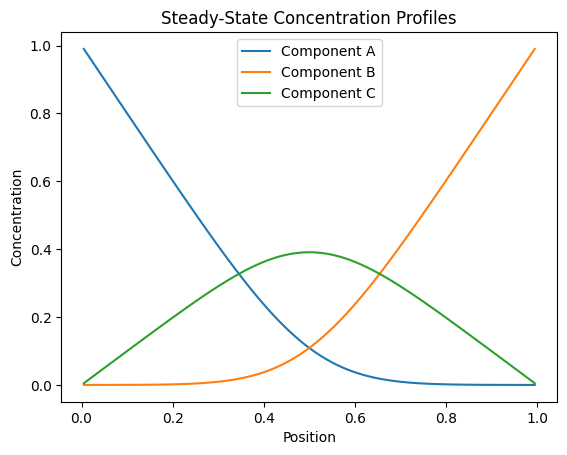
Exercise
Here are some suggestions to extend and experiment with the current implementation:
Vary Diffusion Coefficients: Assign different diffusion coefficients to the components (e.g.,
D = [[1.0, 0.5, 0.1]]). Observe how the steady-state profiles change.Modify Boundary Conditions: Change the boundary conditions for one or more components.
Include a Reverse Reaction: Add a reverse reaction term, such as , with a rate constant
k_rev. Update the reaction function to include this reverse reaction.Explore Convergence: Experiment with different tolerances (
tol) and maximum iterations (maxfev) in thenewtonfunction. Analyze how these parameters affect convergence and computation time.Time-Dependent Solution: Solve the system for a finite time step size (
dt) instead of steady-state. Evolve the concentration profiles over time and visualize the transient behavior.
Feel free to implement these changes and observe how they impact the results!