This notebook demonstrates the implementation of a diffusion-reaction model using a Python class. The class encapsulates the model parameters, initialization, and solution methods, making the code modular, reusable, and easy to extend.
Governing Equation
The diffusion-reaction equation considered in this notebook is:
where:
is a vector of species concentrations.
is a diagonal matrix containing the diffusion coefficients for each species.
represents the reaction kinetics.
is a geometric parameter: for Cartesian, for cylindrical, and for spherical symmetry.
Using divergence and gradient operators, the equation can be rewritten as:
Numerical Solution
The equation is discretized in space and time using backward Euler time integration. This results in a system of nonlinear equations:
g(c) = (jac_accum @ c - c_old/dt) + div_mat @ (- diff_mat @ (grad_mat @ c + grad_bc)) - g_reactwhere:
jac_accumrepresents the accumulation term.div_matandgrad_matare the divergence and gradient operators.diff_matis the diffusion coefficient matrix.g_reactrepresents the reaction kinetics.
The Jacobian of this system is:
jac = jac_accum + div_mat @ (- diff_mat @ grad_mat) - jac_reactThe system is solved iteratively using the Newton-Raphson method.
Typical Use Case
This model is particularly useful for simulating diffusion-reaction systems, such as those in porous particles, where the interplay between reaction kinetics and intra-particle diffusion determines the apparent reaction rate.
# Import necessary libraries
import numpy as np
import matplotlib.pyplot as plt
from pymrm import construct_grad, construct_div, newton, construct_coefficient_matrix, NumJac, non_uniform_grid
Class Definition: DiffusionReaction
The DiffusionReaction class encapsulates the diffusion-reaction model. It includes methods for initializing the model, constructing the Jacobian matrix, and solving the system iteratively.
Key Features
Encapsulation: All model-related parameters and methods are contained within the class.
Reusability: The class can be reused for different configurations of the diffusion-reaction problem.
Modularity: The code is organized into methods for initialization, Jacobian construction, and solving.
Parameters
D: Diffusion coefficients for each component (list or array).nu: Geometric factor for divergence operator (integer).c_b: Boundary conditions for each component (list or array).k: Reaction rate constant (float).dt: Time step size (float).freq_out: Frequency of output during simulation (integer).
class DiffusionReaction:
    """
    A class to model diffusion-reaction systems.

    This class encapsulates the parameters, initialization, and solution methods for a diffusion-reaction model.
    It supports multi-component systems and allows for modular and reusable code.
    """
    def __init__(self, D=[[1.0, 1.0, 1.0]], nu=2, c_b=[[1.0, 1.0, 0.0]], k=1.0, dt=np.inf, freq_out=1):
        """
        Initialize the diffusion-reaction model.

        Parameters:
        - D (list): Diffusion coefficients for each component.
        - nu (int): Geometric factor for divergence operator.
        - c_b (list): Boundary conditions for each component.
        - k (float): Reaction rate constant.
        - dt (float): Time step size.
        - freq_out (int): Frequency of output during simulation.
        """
        # Initialize model parameters
        self.D = np.asarray(D)  # Diffusion coefficients
        self.nu = nu  # Geometric factor for divergence operator
        self.R = 1.0  # Domain length
        self.num_r = 30  # Number of grid points
        self.num_c = 3  # Number of components (e.g., species)
        self.bc = ({'a': 1, 'b': 0, 'd': 0},  # Left boundary conditions
                   {'a': 0, 'b': 1, 'd': c_b})  # Right boundary conditions
        self.k = k  # Reaction rate constant
        self.dt = dt  # Time step size
        self.freq_out = freq_out  # Frequency of output (e.g., every 10 steps)

        # Generate a non-uniform grid for cell-face positions
        dr_large = 0.1 * self.R
        self.r_f = non_uniform_grid(0, self.R, self.num_r + 1, dr_large, 0.75)  # Cell-face positions
        self.r_c = 0.5 * (self.r_f[:-1] + self.r_f[1:])  # Cell-centered grid points

        # Initialize the concentration field and Jacobian matrix
        self.init_field()
        self.init_jac()

    def init_field(self, c0=0.0):
        """
        Initialize the concentration field with a uniform value.

        Parameters:
        - c0 (float or array): Initial concentration value(s).
        """
        c = np.asarray(c0)
        shape = (1,) * (2 - c.ndim) + c.shape  # Ensure c is 2D
        c = c.reshape(shape)  # Reshape c to 2D
        self.c = np.broadcast_to(c, (self.num_r, self.num_c)).copy()  # Broadcast c to the correct shape

    def set_diff_field(self):
        """
        Define a position-dependent diffusion field.

        Returns:
        - diff_field (array): Diffusion field values.
        """
        diff_field = (1.0 + 4.0 * (self.r_f > 0.5 * self.R)).reshape((-1, 1)) * np.asarray(self.D)
        return diff_field

    def init_jac(self):
        """
        Construct the Jacobian matrix and constant terms for the system.
        """
        # Construct gradient and divergence operators
        grad_mat, grad_bc = construct_grad(self.c.shape, self.r_f, self.r_c, self.bc, axis=0)
        div_mat = construct_div(self.c.shape, self.r_f, nu=self.nu, axis=0)

        # Construct diffusion coefficient matrix
        diff_mat = construct_coefficient_matrix(self.D, shape=(self.num_r, self.num_c), axis=0)

        # Compute flux terms
        flux_mat = -diff_mat @ grad_mat
        flux_bc = -diff_mat @ grad_bc

        # Compute Jacobian of diffusion term and boundary forcing term
        jac_diff = div_mat @ flux_mat
        f_diff_bc = div_mat @ flux_bc

        # Accumulation term for time-dependent problems
        jac_accum = construct_coefficient_matrix(1.0 / self.dt, shape=(self.num_r, self.num_c))

        # Precompute constant terms for the residual and Jacobian
        self.g_const = f_diff_bc
        self.jac_const = jac_accum + jac_diff

        # Apparent reaction rate terms
        self.r_apparent_mat = -((self.nu + 1) / self.R) * flux_mat[-self.num_c:, :]
        self.r_apparent_bc = -((self.nu + 1) / self.R) * flux_bc[-self.num_c:, 0].reshape((-1, 1))

        # Numerical Jacobian for reaction terms
        self.numjac = NumJac((self.num_r, self.num_c))

    def set_reaction_rate(self, k):
        """
        Update the reaction rate constant.

        Parameters:
        - k (float): New reaction rate constant.
        """
        self.k = k

    def set_c_b(self, c_b):
        """
        Update the boundary conditions for the system.

        Parameters:
        - c_b (list): New boundary condition values.
        """
        self.bc[1]['d'] = c_b
        self.init_jac()  # Reinitialize the Jacobian matrix with the new boundary condition

    def reaction_kinetics(self, c):
        """
        Compute the reaction kinetics for the given concentration.

        Parameters:
        - c (array): Concentration values.

        Returns:
        - array: Reaction rates for each component.
        """
        r = self.k * c[..., [0]] * c[..., [1]]
        return r * np.array([[-1.0, -1.0, 1.0]])

    def residual(self, c, c_old):
        """
        Compute the residual vector and Jacobian matrix for the current time step.

        Parameters:
        - c (array): Current concentration values.
        - c_old (array): Concentration values from the previous time step.

        Returns:
        - tuple: Residual vector and Jacobian matrix.
        """
        g_react, jac_react = self.numjac(self.reaction_kinetics, c)
        g = self.g_const + self.jac_const @ c.reshape((-1, 1)) - c_old.reshape((-1, 1)) / self.dt - g_react.reshape((-1, 1))
        jac = self.jac_const - jac_react
        return g, jac

    def solve(self, num_timesteps=1, callback=None):
        """
        Solve the system iteratively over a specified number of time steps.

        Parameters:
        - num_timesteps (int): Number of time steps to simulate.
        - callback (function): Optional callback function for custom operations (e.g., plotting).
        """
        for i in range(num_timesteps):
            c_old = self.c.copy()

            # Solve the system using Newton's method
            result = newton(lambda c: self.residual(c, c_old), c_old, maxfev=10)
            self.c[...] = result.x.reshape((self.c.shape))

            # Invoke the callback function if provided
            if i % self.freq_out == 0 and callback is not None:
                callback(i, self)

    def compute_apparent_reaction_rate(self):
        """
        Compute the apparent reaction rate based on the current concentration field.

        Returns:
        - array: Apparent reaction rates for each component.
        """
        r_apparent = -(self.r_apparent_mat @ self.c.reshape((-1, 1)) + self.r_apparent_bc)
        return r_apparent.reshape((self.num_c,))
Solving and Plotting the Diffusion-Reaction Problem
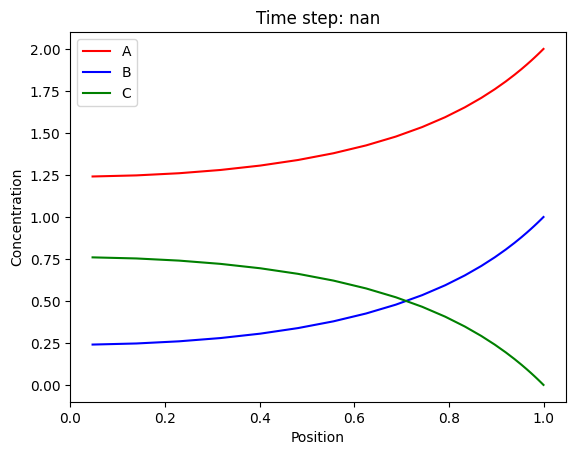
An instance of the DiffusionReaction class is created, and the solve method is called to simulate the system over a specified number of time steps.
The plotting is handled using a callback function for better separation of concerns.
# Create an instance of the diffusion-reaction model
c_b = np.array([2.0, 1.0, 0.0])  # Boundary condition for species B
mrm_model = DiffusionReaction(k=10, c_b=c_b, D=[[1.0, 1.0, 1.0]], nu=3)  # Initialize the model with parameters

# Define a callback function for plotting the concentration profile
def plot_callback(step, model):
    plt.plot(model.r_c, model.c[:, 0], 'r-', label='A')
    plt.plot(model.r_c, model.c[:, 1], 'b-', label='B')
    if model.num_c >= 3:
        plt.plot(model.r_c, model.c[:, 2], 'g-', label='C')
    plt.title(f'Time step: {step * model.dt:.2f}')
    plt.xlabel('Position')
    plt.ylabel('Concentration')
    plt.legend()

# Solve the problem and use the callback function for plotting
mrm_model.solve(callback=plot_callback)

# Compute and print intrinsic and apparent reaction rates
r_intrinsic = mrm_model.reaction_kinetics(c_b).ravel()
print(f"Intrinsic reaction rate at c_A = {c_b[0]:>7.3f} and c_B = {c_b[1]:>7.3f}: r_A = {r_intrinsic[0]:>7.3f}, r_B = {r_intrinsic[1]:>7.3f}, r_C = {r_intrinsic[2]:>7.3f}")
r_apparent = mrm_model.compute_apparent_reaction_rate().ravel()
print(f"Apparent  reaction rate at c_A = {c_b[0]:>7.3f} and c_B = {c_b[1]:>7.3f}: r_A = {r_apparent[0]:>7.3f}, r_B = {r_apparent[1]:>7.3f}, r_C = {r_apparent[2]:>7.3f}")
Intrinsic reaction rate at c_A = 2.000 and c_B = 1.000: r_A = -20.000, r_B = -20.000, r_C = 20.000
Apparent reaction rate at c_A = 2.000 and c_B = 1.000: r_A = -11.310, r_B = -11.310, r_C = 11.310
Exercises
Here are some suggestions to extend and experiment with the current implementation:
Vary Diffusion Coefficients
Assign different diffusion coefficients to the components (e.g.,
D = [[1.0, 0.5, 0.1]]).Implement a position-dependent diffusion coefficient using the
set_diff_fieldmethod and observe its impact on the concentration profiles.Explore the effect of varying diffusion coefficients relative to the reaction rate and analyze the role of intra-particle mass transfer limitations on the apparent reaction rate.
Modify Reaction Kinetics
Change the reaction kinetics to first-order kinetics and compare the results with available analytic solutions.
Investigate the dependency of the effectiveness factor on the Thiele modulus for planar, cylindrical, and spherical geometries by varying the
nuparameter.Implement nonlinear reaction kinetics (e.g., Langmuir-Hinshelwood) and observe the changes in the concentration profiles and reaction rates.
Simulate Counter-Diffusion
Implement a counter-diffusion problem where two species diffuse in opposite directions and react.
Consider a planar and an annular geometry.
Analyze the steady-state and transient behavior of the system.
Investigate Time-Dependent Behavior
Solve the system for a finite time step size (
dt) instead of assuming steady-state.Visualize the transient behavior of the concentration profiles over time.
Extend the Model
Add additional components to the system and define new reaction pathways.
For example, simulate a reaction network with parallel or consecutive reactions.
Feel free to implement these changes and observe how they impact the results!