In a (single tube) membrane fixed bed reactor, a heterogeneously catalyzed chemical equilibrium reaction is carried out. The reaction scheme and associated kinetics are as follows:
The tube wall of the fixed bed consists of a perm-selective membrane through which component selectively permeates. The associated flux expression is given by:
where represents the effective mass transfer coefficient for intra-membrane transport, and is the concentration of component in the sweep gas in the annular zone. The concentration of species in the sweep gas, , can be assumed to be zero, corresponding to a very large sweep gas flow rate.
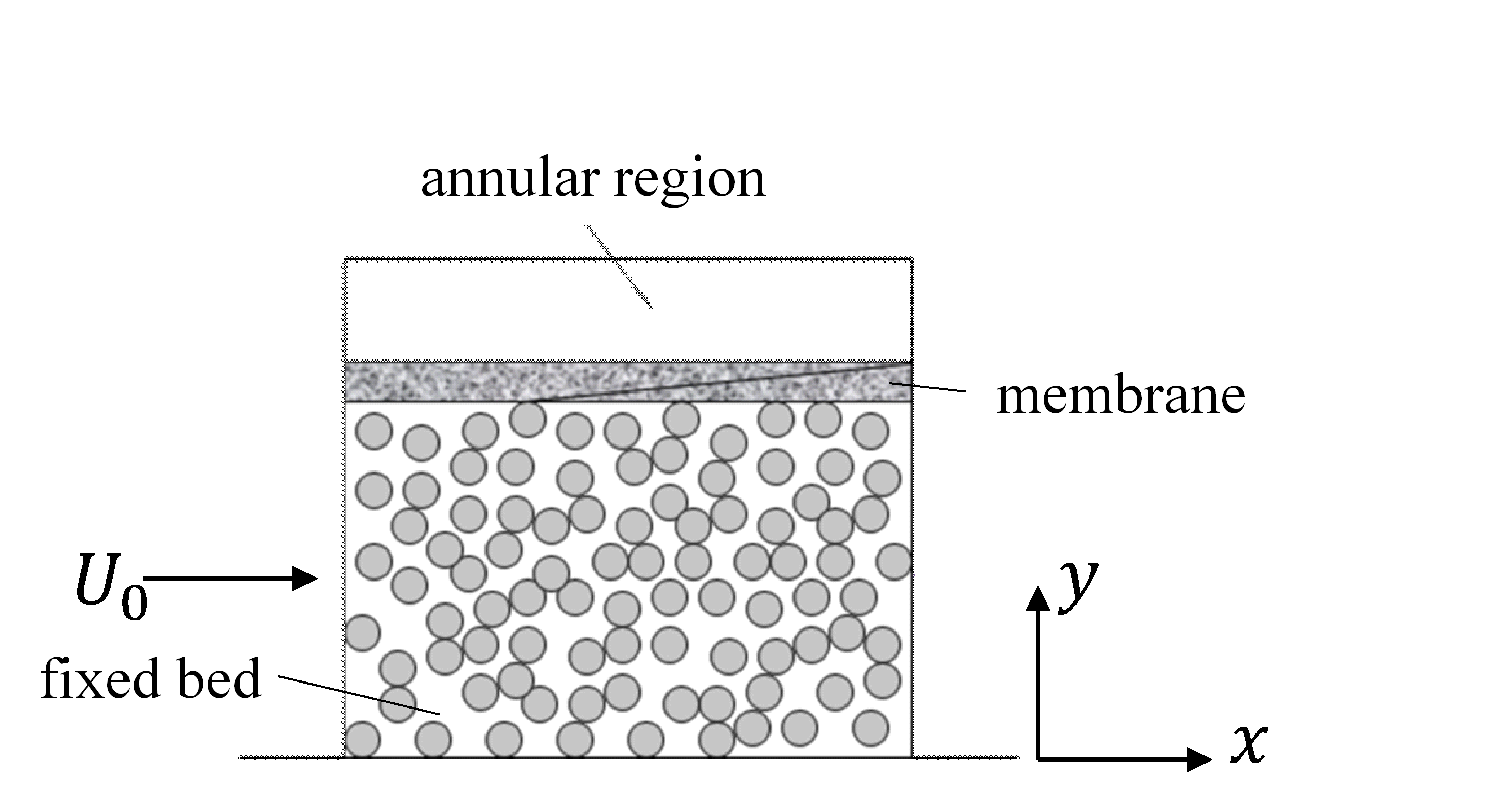
Schematic of the 2D membrane fixed bed reactor model.
The effective radial dispersion coefficient of all species , , , and is . The inlet concentrations of species and are , while the inlet concentrations of species and are . The reactor operates under isothermal conditions.
| Parameter | Value |
|---|---|
| Superficial gas velocity, | |
| Inner radius of fixed bed tube | |
| Length of fixed bed tube | |
| Forward kinetic constant, | |
| Backward kinetic constant, |
Questions:
Calculate the thermodynamic equilibrium conversion.
Formulate the model equations and the associated boundary conditions according to the homogeneous two-dimensional reactor model. Account for the selective permeation of component through the membrane. Neglect axial dispersion effects.
Implement the formulated model equations in Python. It is suggested to use a method-of-lines approach where the spatial discretization is performed in the radial direction, and the axial dependence is solved using
solve_ivp.For the case of no permeation of (), calculate the chemical conversion.
Repeat the calculation for part 4 using values of 0.01, 0.1, 1.0, 10.0, and for the effective mass transfer coefficient. Explain the observed differences with respect to the chemical conversion and the obtained radial concentration profiles. Discuss the validity of the model equations for .
Repeat part 5 using an effective radial dispersion coefficient . Discuss the observed results.
Note: Ensure that all numerical implementations are consistent with the provided equations and parameter values.